
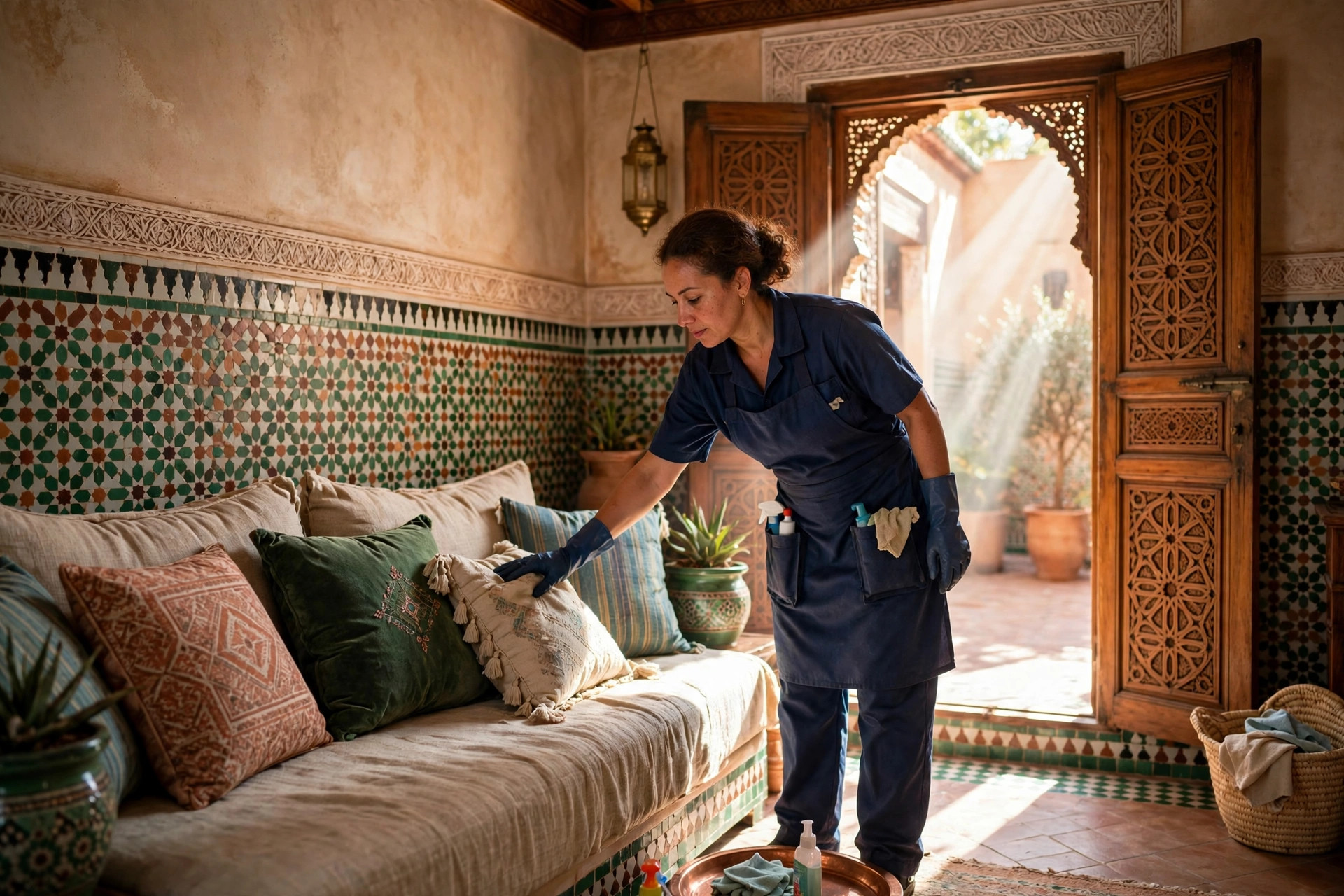
Moving to Morocco changes the maths of daily life. Help that would cost a small fortune in London or Paris is affordable here, and many expat families who never had a cleaner at home find themselves hiring one within weeks of arrival. This guide to household help Morocco newcomers rely on explains what help costs, where to find trustworthy people, and how to hire fairly.
The point is not luxury. A cleaner three mornings a week, a nanny who collects the children from school, or a gardener who keeps a courtyard alive through the summer heat are practical answers to real problems: large houses with tiled floors, long school days, and a climate that fills a home with dust within days. Done well, household help Morocco families arrange is one of the best parts of living here.
Prices in this household help Morocco guide are in Moroccan dirhams (MAD) with US dollar equivalents at about 10 MAD to 1 USD, checked November 2026. Rates vary by city, experience and hours, so treat them as realistic ranges, not quotes.
In this guide
- Why Household Help in Morocco Is So Common
- Types of Household Help in Morocco: Cleaner, Nanny, Cook, Gardener and Driver
- What Does Household Help Cost in Morocco?
- Household Help Costs by City
- Live-In vs Live-Out Help
- Where to Find Trusted Household Help in Morocco
- Hiring Legally: Contracts, CNSS and the Minimum Wage
- Interviewing, Trial Periods and References
- Setting Expectations: Routines, Hours and Days Off
- Language, Culture and Everyday Etiquette
- Problems and Red Flags: What to Watch For
- Frequently Asked Questions
- Conclusion
Why Household Help in Morocco Is So Common
Domestic help is a normal part of Moroccan life, not a sign of wealth. Middle-class Moroccan families commonly employ a cleaner or a nanny, and many homes are built with a small maid's room off the kitchen or courtyard. As an expat you are stepping into an existing culture, not inventing one, and that makes hiring household help Morocco families use simpler than elsewhere.
The economics explain most of it. A full-time cleaner in Morocco costs roughly what a few hours of cleaning costs each week in northern Europe, so families hire help for the hours they actually need. The result is that household help Morocco residents use tends to be part-time: three mornings a week is the most common arrangement.
Moroccan homes also create the demand. Tiled floors and open courtyards look beautiful and collect dust constantly, especially during the dry, windy months. Large houses, rooftop terraces and gardens all need regular attention, and a weekly deep clean by household help Morocco homeowners employ keeps a home pleasant.
Types of Household Help in Morocco: Cleaner, Nanny, Cook, Gardener and Driver
A cleaner, called a femme de ménage, is the most common hire: she cleans, does laundry, irons and often does the daily shopping at the souk, usually working for several families two or three mornings a week.
A nanny, or nounou, looks after children: collecting them from school, helping with homework, cooking lunch and watching them in the afternoon. Many nannies are also experienced cleaners, so young families often hire one person for both jobs. Trust matters more with household help Morocco families invite into their homes than anywhere else.
A cook is a separate hire in larger households, employed for the main meal of the day, and some also manage the kitchen shopping. If you love Moroccan food but cannot cook it, household help Morocco cooks provide is the hire that changes daily life most.
A gardener keeps courtyards, terraces and villa gardens alive through the summer heat, usually working part-time, once or twice a week, and many also do small repairs around the house.
A driver is the least common hire, mostly in Casablanca and Rabat, and at 5,000–8,000 MAD a month it only makes sense if you need one every day.
What Does Household Help Cost in Morocco?
Rates for household help Morocco families pay depend on the city, the hours and the person's experience, but the ranges below reflect what expat families actually pay in 2026. Part-time help is usually paid by the hour or visit, full-time help monthly. Always confirm whether transport, lunch and cleaning products are included.
| Role | Typical arrangement | Monthly cost (MAD) | Approximate USD |
|---|---|---|---|
| Cleaner, part-time | 3 mornings a week, 3–4 hours | 1,200–2,000 | $120–200 |
| Cleaner, full-time live-out | 6 days a week, 8 hours | 3,500–5,500 | $350–550 |
| Live-in maid | Full-time, room and board included | 4,000–6,500 | $400–650 |
| Nanny, full-time | 5–6 days a week, school hours | 3,500–6,000 | $350–600 |
| Cook, part-time | Daily, lunch preparation only | 2,500–4,500 | $250–450 |
| Cook, full-time | 6 days a week, all meals | 4,500–8,000 | $450–800 |
| Gardener, part-time | 1–2 visits a week | 1,500–3,000 | $150–300 |
| Driver, full-time | 6 days a week | 5,000–8,000 | $500–800 |
Hourly rates for a cleaner usually fall between 30 and 50 MAD, higher in Casablanca and Rabat. A nanny with strong French or English, the most sought-after household help Morocco parents look for, can ask 10 to 20 percent above these ranges, and a reliable nanny who stays for years is far cheaper than replacing one every few months.
Household Help Costs by City
Casablanca and Rabat are the most expensive cities for household help morocco employers hire, because wages and living costs are highest there and demand is strong. Marrakech sits in the middle: tourist-season demand pushes rates up, but there is also a large pool of experienced workers.
| City | Full-time cleaner (MAD/month) | Part-time cleaner, 3 mornings (MAD/month) | Nanny, full-time (MAD/month) |
|---|---|---|---|
| Casablanca | 4,500–6,000 | 1,800–2,500 | 4,500–6,500 |
| Rabat | 4,000–5,500 | 1,500–2,200 | 4,000–6,000 |
| Marrakech | 3,500–5,000 | 1,500–2,000 | 3,500–5,500 |
| Tangier | 3,500–5,000 | 1,200–2,000 | 3,500–5,000 |
| Agadir | 3,000–4,500 | 1,200–1,800 | 3,000–4,500 |
| Fes | 3,000–4,500 | 1,000–1,800 | 3,000–4,500 |
Smaller cities and towns are cheaper still for household help Morocco families, but the pool of experienced, French- or English-speaking help is smaller too. Outside the big cities, hire through personal recommendation and train your helper in your own routines.
One practical note: rates rise before Ramadan and during the summer, when demand peaks, so agree the rate early and in writing if you are hiring then.
Live-In vs Live-Out Help
Live-out household help Morocco families choose is the standard choice for most expat families. Your cleaner or nanny has her own home, arrives in the morning and leaves in the afternoon, and you pay a monthly salary plus transport. It is simpler legally and socially.
Live-in help suits large villas and families with very young children. The helper has a room, usually with its own bathroom, eats with the family or separately by agreement, and is available early and late. The salary is higher than a live-out equivalent, but room and board are part of the package.
Whatever you choose, agree the hours of your household help Morocco hire in writing. A live-in helper is not on call twenty-four hours a day, and a live-out helper who regularly stays two hours late is working overtime. Clear hours protect both sides.
Where to Find Trusted Household Help in Morocco
Word of mouth is the best source for household help Morocco newcomers need, and by a wide margin. Ask other expats, your landlord, your neighbours and the parents at your children's school. A cleaner who has worked happily for another family for two years is a far safer hire than a stranger from an online listing.
Facebook groups for expats in your city are the second-best source, with regular posts from families looking for help and from helpers looking for work. Ask for references, and be wary of profiles with no history.
Recruitment agencies in the big cities can help, especially for a nanny or a live-in maid. A good agency checks identity documents, takes references and replaces a placement that does not work out. Expect a fee of roughly one month's salary, and check what it covers before you sign.
Whatever the source for your household help Morocco hire, never hire without meeting the person in your home, seeing their identity card, and speaking to at least one previous employer. Without a reference, start with a short trial rather than a permanent contract.
Hiring Legally: Contracts, CNSS and the Minimum Wage
Moroccan law treats domestic workers as employees with real rights, and hiring properly protects you as well as your helper. The framework is Law 19-12 on domestic work, and the International Labour Organization publishes guidance on domestic workers' rights that explains the principles behind it. The SMIG minimum wage sits around 3,100 MAD a month, so confirm the current rate before you set a salary.
A written contract is the single most useful document when arranging household help Morocco families employ. It should state the job, hours, days off, salary, trial period and notice period. A simple one-page agreement in French, signed by both sides, prevents most misunderstandings. Keep a copy each.
Registering your helper with the CNSS, the social security fund, is the employer's legal duty for regular employment: it gives your helper health cover and a pension record, and gives you a formal, documented employment relationship. Many families ask an accountant or agency to handle the paperwork, which costs little. The general rules of domestic work explain why formal registration matters even inside a private home.
Paid leave is part of the deal: a full-time helper is entitled to paid annual leave, usually eighteen working days after a year of service, plus paid public holidays. Friday is the traditional weekly day off; agree it in the contract.
Ending a household help Morocco arrangement should be done properly too: give the notice period in the contract, pay any outstanding salary and leave owed, and provide a written reference. A good reference costs you nothing.
Interviewing, Trial Periods and References
Interview household help Morocco candidates in your home, not in a café. Show the candidate the house and garden, and watch how they react. Someone who notices the dusty shelves is already thinking about the job.
Ask practical questions: how would you clean a tiled floor, what would you cook for a five-year-old, what if a child falls? The answers reveal experience quickly. If language is a barrier, bring a friend who speaks French or Darija.
Always check references by phone, not just on paper. Ask the previous employer three questions: how long did they work for you, why did they leave, and would you hire them again? The third question matters most, and a hesitant pause tells you more than a polite letter ever will.
Start with a trial period of two to four weeks, paid at the full rate. This is standard in Morocco and fair to both sides. During the trial, be present, explain your routines clearly, and give feedback early. Most problems in the first month are misunderstandings.
Setting Expectations: Routines, Hours and Days Off
Write down the daily routine: what gets cleaned each visit, what time lunch is served, when the children are collected. Put it on the fridge in French or Darija, and update it when the routine changes. Your helper cannot read your mind.
Be specific with your household help Morocco hire about the tasks that matter most to you. If ironing matters, say so; if you would rather the cleaner skipped the guest room and spent the time on the kitchen, say that too. Most frustration comes from unspoken expectations, and a ten-minute conversation prevents months of irritation.
Agree the hours and stick to them. If the cleaner works from 9 a.m. to 1 p.m., do not regularly ask her to stay until 3 p.m. without extra pay. If you need extra hours, agree the price beforehand and pay it the same day.
Language, Culture and Everyday Etiquette
French is the working language of household help morocco employers most often use, and most cleaners and nannies in the big cities speak it. In smaller towns and rural areas, Darija is more common, and a few words of Moroccan Arabic go a very long way. Learning a few household words in Darija is the fastest way to build a warm relationship, and our guide to learning Moroccan Arabic (Darija) covers the phrases you will actually use at home.
Respect the rhythms of Moroccan life: Friday is a special day for many families, and prayer times matter to many helpers. A helper who asks for time to pray is not asking for a favour; build it into the schedule.
Problems and Red Flags: What to Watch For
Most problems are small and fixable, but a few patterns should make you pause: a candidate who will not give any reference, who asks to be paid entirely in advance, or who cannot show an identity card. Together, these are a reason to choose someone else.
Repeated lateness and unexplained absence are the most common complaints about household help Morocco families employ. One late arrival is life; a pattern is a problem. Raise it early, calmly and specifically, and agree what will change. If nothing changes after two conversations, the arrangement is not working.
Finally, trust the relationship, not the paperwork alone. A contract and CNSS registration matter, but the arrangement works because two people respect each other. If respect is missing on either side, no contract will fix it, and the kindest step is a clean ending with notice, final pay and a reference.
Frequently Asked Questions
How much does household help in Morocco cost per month?
A part-time cleaner costs roughly 1,200–2,000 MAD ($120–200) a month, a full-time live-out cleaner 3,500–5,500 MAD ($350–550), a full-time nanny 3,500–6,000 MAD ($350–600), and a part-time gardener 1,500–3,000 MAD ($150–300). Rates are highest in Casablanca and Rabat.
Is it legal to hire household help in Morocco without a contract?
A written contract is strongly recommended, and CNSS registration is the employer's legal duty for regular employment. Informal arrangements leave both sides unprotected: no health cover or pension record for the helper, and no documented agreement for you. A simple one-page contract in French prevents most problems.
Where is the best place to find a nanny in Morocco?
Personal recommendation is the best source for household help Morocco newcomers: ask other expat parents, your children's school, and your neighbours. Expat Facebook groups are second-best, and agencies in the big cities can help for roughly one month's salary. Always meet the candidate in your home and phone a previous employer.
Do I need to register my cleaner with the CNSS?
For regular, ongoing employment, yes: CNSS registration is the employer's responsibility and gives your helper health cover and a pension record; many families ask an accountant or agency to handle the paperwork. For occasional help, families often pay per visit.
What is a fair salary for a live-in maid in Morocco?
A live-in maid typically earns 4,000–6,500 MAD ($400–650) a month plus room and board, higher than a live-out cleaner because the role includes longer availability. The room should be comfortable, with heating in winter and a lock on the door. The SMIG minimum wage sits around 3,100 MAD a month.
Should household help in Morocco get time off during Ramadan?
Yes: many helpers fast during Ramadan, so shorter days and a later start are normal and appreciated. Full-time help is entitled to paid annual leave and public holidays, and a gift at the two Eids is customary for long-serving help.
Conclusion
Hiring household help Morocco families rely on is one of the most practical decisions an expat family makes in Morocco, and one of the most rewarding when it is done well. The costs are modest, the help is widely available, and the arrangement supports local employment directly. The happiest families hired carefully, agreed everything in writing, and paid on time.
Start with a clear idea of what you need: a cleaner three mornings a week, a nanny for the school run, or a gardener for the courtyard. Find your candidate through recommendation, check references by phone, run a paid trial, and put the agreement in writing. That simple sequence is the whole secret of household help Morocco families recommend to each other.
If you are still settling in, read our living in Morocco expat guide for the wider picture, our renting an apartment in Morocco guide before you choose a home, and our cost of living in Morocco guide to budget the rest of your monthly life.