
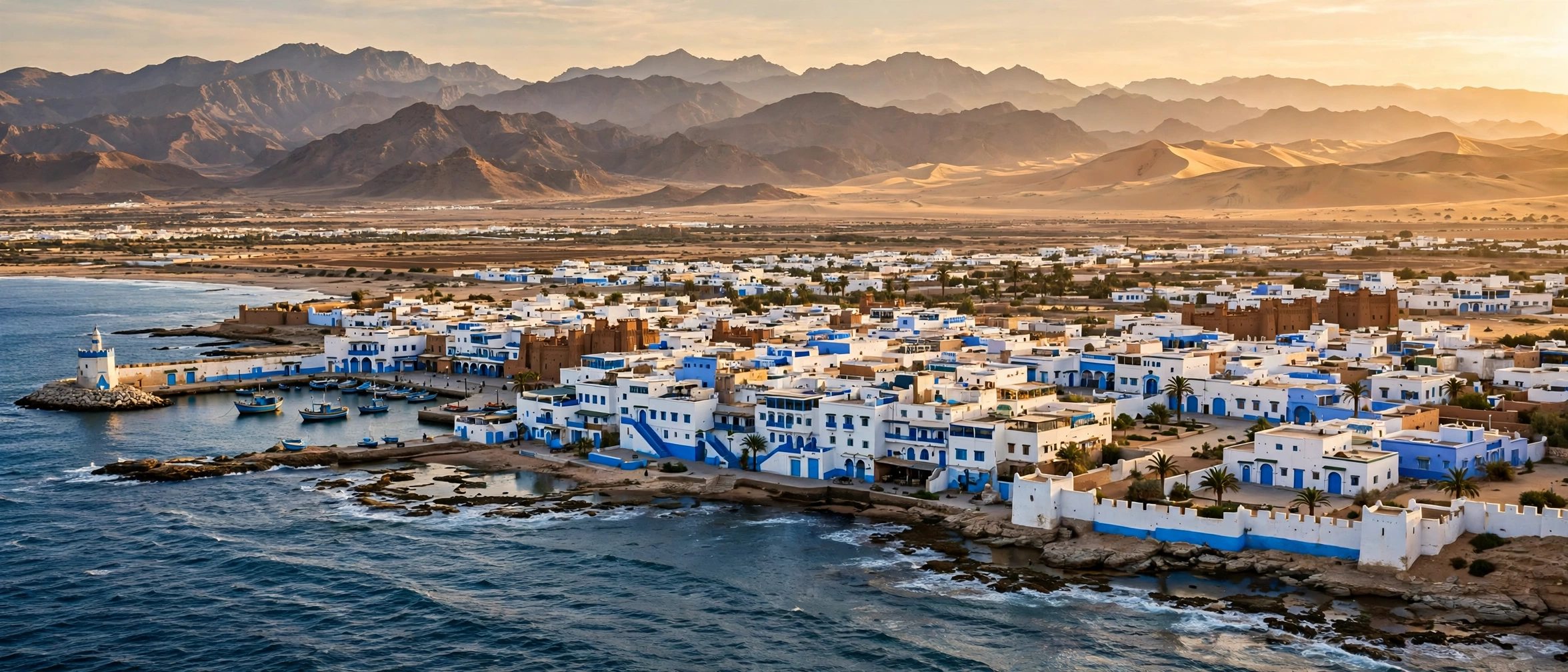
Most two-week trips to Morocco try to see everything and end up seeing it from a bus window. This morocco 14 day itinerary takes the opposite approach: seven bases, two or three nights in each, and rest days built in from the start. You arrive in Tangier, cross the Rif mountains to Chefchaouen, spend slow days in Fes, sleep under the stars in the Sahara, cross the Atlas valleys to Marrakech, and finish on the Atlantic at Essaouira before flying home from Casablanca.
Slow travel is not about doing less for its own sake. It is about giving each place time to open up: a second morning in the same medina, a café you return to, a day with no plan at all. This morocco 14 day itinerary is built around that idea, with trains and comfortable buses doing most of the moving and no day that asks you to change hotels and sightsee at full speed.
In this guide
- Why a Slow Morocco 14 Day Itinerary Works
- The Route at a Glance: 14 Days, 7 Bases
- Days 1–4: Tangier and Chefchaouen
- Days 5–7: Fes, the Imperial City
- Days 8–9: The Sahara at Merzouga
- Days 9–10: Dades, Todra and Aït Ben Haddou
- Days 10–12: Marrakech, Slowly
- Days 13–14: Essaouira, Casablanca and Rabat
- How Much Does a Morocco 14 Day Itinerary Cost?
- Getting Between Bases: Trains, Buses and Shared Taxis
- Practical Tips for Slow Travel in Morocco
- Morocco 14 Day Itinerary FAQ
Why a Slow Morocco 14 Day Itinerary Works
Morocco rewards patience more than most countries. The medinas only make sense on the third visit, the food tastes better when you eat where the neighbourhood eats, and the landscapes — the Rif, the Atlas, the dunes — change completely between morning and evening light. A morocco 14 day itinerary that moves every day trades all of that for mileage.
The maths of slow travel is simple. Fourteen days divided by seven bases means two nights everywhere, and three nights in the places that deserve it: Fes and Marrakech. Two-night stays halve the packing, the checkouts and the lost mornings. They also make a morocco 14 day itinerary cheaper, because longer stays in riads and guesthouses usually earn a better nightly rate, and you spend less on transport between towns.
This route also suits the way Morocco actually moves. The fast Al Boraq train links Tangier, Rabat and Casablanca in hours, CTM and Supratours buses connect Fes with the desert towns, and shared grand taxis fill the gaps in the mountains. You do not need a car for this trip, and for many travellers that is the point: no driving, no parking in the medinas, no rental desks. If you do want to drive part of it, our Morocco road trip guide covers the same ground by car.
The Route at a Glance: 14 Days, 7 Bases
This morocco 14 day itinerary runs in one direction, roughly north to south and then west to the coast, so you never backtrack. You land in Tangier, drop south to blue Chefchaouen, then east to Fes. From Fes you cross the Middle Atlas to Merzouga and the dunes of Erg Chebbi, then follow the Dades and Todra valleys west to Aït Ben Haddou and over the High Atlas to Marrakech. The final days drift to the Atlantic at Essaouira, then north through Casablanca and Rabat. Morocco itself — Atlantic coast, Atlas mountains and Sahara edge in one small country — is introduced well on Wikipedia.
Seven bases, fourteen days, and three built-in rest days: one in Chefchaouen, one in Fes and one in Essaouira. On those days there is nothing scheduled at all. Sleep late, wander, sit in a café. The table below is the whole morocco 14 day itinerary in one view, and the sections after it take each leg day by day. For the big picture, start with our Morocco Travel section, which gathers every guide on this route in one place.
| Day | Base | Nights | What to do |
|---|---|---|---|
| 1 | Tangier | 2 | Arrive, medina, kasbah and the corniche at sunset |
| 2 | Tangier | — | Caves of Hercules, Cap Spartel, Grand Socco |
| 3 | Chefchaouen | 2 | Bus from Tangier, Spanish Mosque at sunset |
| 4 | Chefchaouen | — | Rest day: blue streets, cafés and an early morning walk |
| 5 | Fes | 3 | Bus to Fes, first evening in the medina |
| 6 | Fes | — | Full medina day: tanneries, madrasas and souks |
| 7 | Fes | — | Rest day, or a half-day trip to Volubilis |
| 8 | Merzouga | 1 | Fes to Merzouga, camel ride, night in a desert camp |
| 9 | Dades Valley | 1 | Sunrise in the dunes, drive to the Dades Valley |
| 10 | Marrakech | 3 | Todra Gorge, Aït Ben Haddou, Tizi n'Tichka pass |
| 11 | Marrakech | — | Medina, Jemaa el-Fnaa and the souks |
| 12 | Marrakech | — | Gardens, palaces and a hammam |
| 13 | Essaouira | 1 | Bus to the coast, rest day by the Atlantic |
| 14 | Casablanca | — | Train north, Hassan II Mosque, fly home |
Days 1–4: Tangier and Chefchaouen
Days one and two belong to Tangier. The city sits where the Atlantic meets the Mediterranean, and it has always been a place of arrivals: traders, writers, exiles and travellers stepping off the fast ferry from Spain. Spend the first afternoon in the medina and the kasbah, walk the corniche at sunset, and eat in the small restaurants of the old town. Day two is for the Caves of Hercules and Cap Spartel in the morning, then the Grand Socco and the American Legation museum. A morocco 14 day itinerary should start gently, and Tangier is the gentlest possible start. Our Tangier travel guide has the full detail on where to stay and eat.
On day three, take the morning bus or a shared grand taxi south to Chefchaouen, about two hours through the Rif foothills. Chefchaouen is where the morocco 14 day itinerary first slows down properly: the blue town is small enough to cross on foot in twenty minutes, which is exactly why it works as a rest stop. Check into your riad and climb to the Spanish Mosque for the view at golden hour. Stay two nights here, not one — the town is at its best early in the morning, before the day-trippers arrive.
Days 5–7: Fes, the Imperial City
The bus from Chefchaouen to Fes takes around four hours and drops you at the edge of the largest car-free old city in the world. Fes el Bali is a working medieval medina, not a museum: tanneries, workshops, bakeries and donkeys share the same narrow lanes, and getting lost in it is the point. Three nights in Fes is the minimum this morocco 14 day itinerary allows, and the city repays every one of them. The history here is layered, and the exact founding dates of the city are not settled, with the traditional date of 789 often given alongside 808, so treat any single date with care.
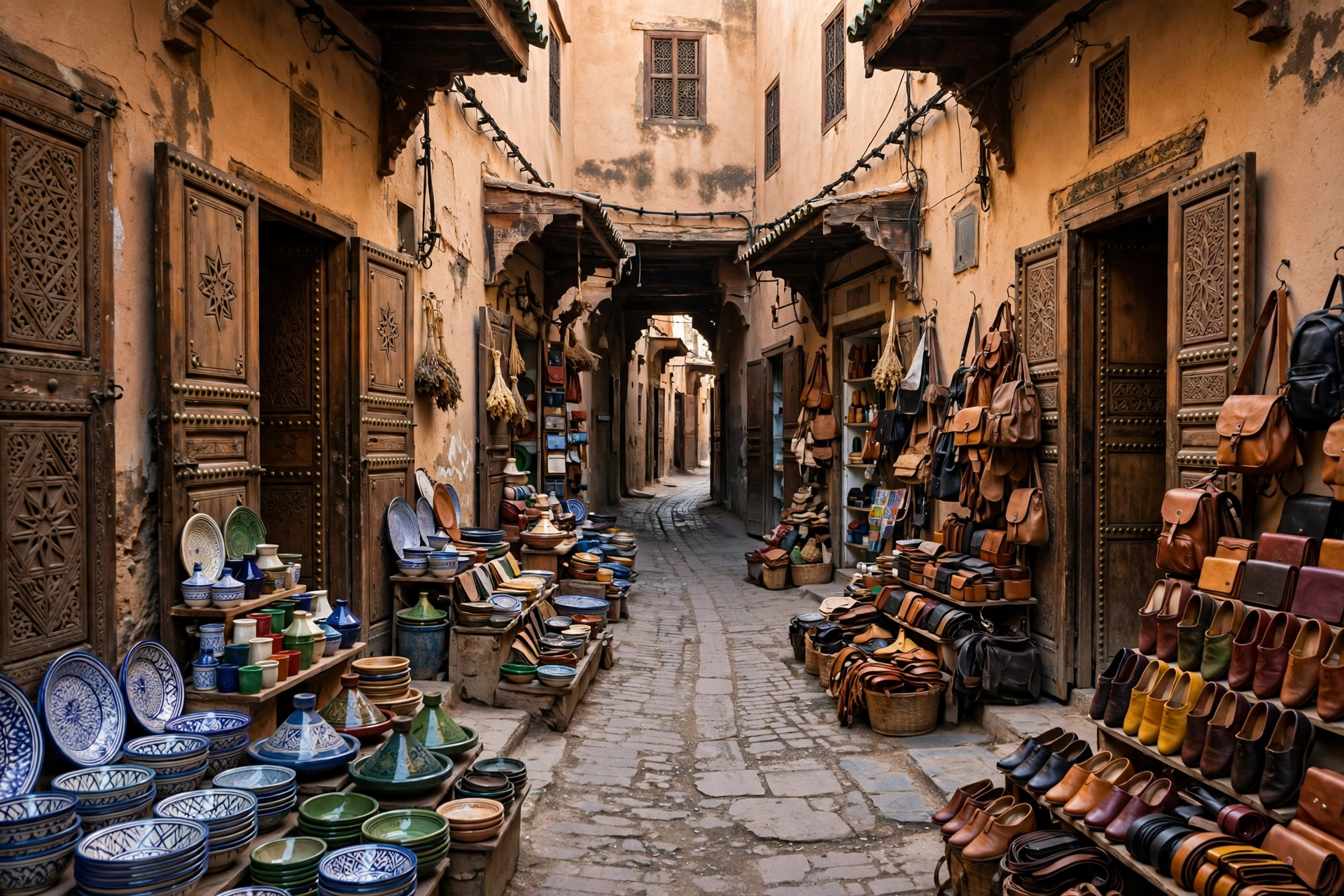
Day six is for the medina itself: the tanneries at Chouara, the Bou Inania madrasa, the dyers' souk and the slow business of wandering. Give the medina a full day, with a guide for the first morning if you want the workshops and madrasas explained. Day seven is the rest day — the morocco 14 day itinerary builds in a pause here on purpose. Sleep in, visit the newer Ville Nouvelle for a change of pace, take a cookery class, or ride out to the Roman ruins of Volubilis, an easy half-day trip. For the onward leg in the other direction, our Fes to Chefchaouen day trip guide covers the road back to the blue town.
Days 8–9: The Sahara at Merzouga
Day eight is the longest travel day of the trip: Fes to Merzouga takes about seven hours by bus or shared taxi, crossing the Middle Atlas cedar forests and the Ziz Valley's palm groves. Break it with stops at Ifrane and Midelt, and arrive in Merzouga in the late afternoon, in time to ride a camel into the dunes of Erg Chebbi as the light turns gold. That evening, sleep in a desert camp under a sky full of stars — the most memorable night of the trip. The desert is the emotional centre of any morocco 14 day itinerary, and the long drive is part of the experience, not a chore to endure.
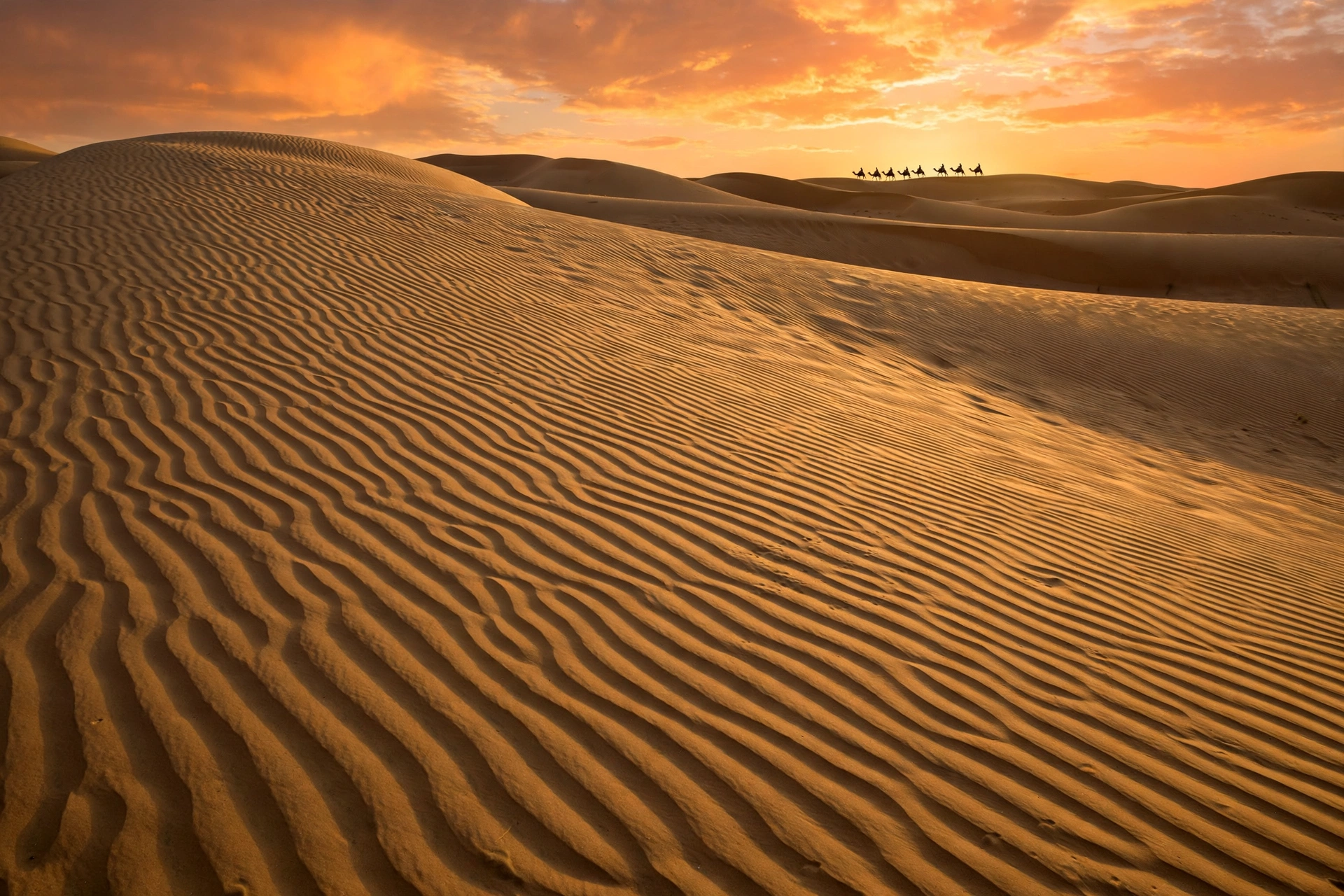
Day nine begins with sunrise over the dunes, then a slow morning walk in the sand after breakfast. Many camps offer sandboarding, tea with a local Amazigh family, or a short drive to Rissani, once a caravan crossroads. Choose one activity and leave the rest of the day empty — that is the point of a morocco 14 day itinerary, and the desert punishes a packed schedule. In the afternoon, drive west to the Dades Valley as the light softens. Our Morocco Sahara camping guide explains how to choose a camp and what the night really costs.
Days 9–10: Dades, Todra and Aït Ben Haddou
Day nine ends in the Dades Valley, where the road winds between red rock walls. Sleep early — the next morning starts at the Todra Gorge, where cliffs rise 300 metres over a river path you can walk in an hour. This middle stretch is where a morocco 14 day itinerary earns its slow label: the valleys are for stopping, not passing through.
Day ten continues west to Aït Ben Haddou, the fortified village of earthen kasbahs that has starred in more films than any other place in Morocco. The exact age of the oldest buildings here is not settled — the site is often described as dating from the 17th century, but parts are older and the record is incomplete — so enjoy it for what it is: a beautiful, still-inhabited ksar at the foot of the Atlas.
Walk up to the granary for the view, cross the river on foot if the water is low, and continue to Marrakech over the Tizi n'Tichka pass in the late afternoon. Aït Ben Haddou is the last stop before Marrakech on this morocco 14 day itinerary, and the pass over the Atlas is a fitting way to arrive.
Days 10–12: Marrakech, Slowly
You arrive in Marrakech on the evening of day ten, over the Tizi n'Tichka pass. Marrakech is the city most travellers rush, and the one that most rewards slowing down. Two full days gives you the medina and Jemaa el-Fnaa on the first evening, when the square fills with food stalls and storytellers, and the gardens and palaces on the second: Jardin Majorelle, the Bahia Palace and the Saadian Tombs. Between them, leave whole afternoons free for a hammam, a rooftop lunch, or sitting in a café watching the square change. On a morocco 14 day itinerary, Marrakech gets two full days and no more — enough to love it, not enough to be exhausted by it.
The practical side matters here. Marrakech is the busiest city on the route, so book your riad early and ask for a room away from the street. The medina is walkable, the taxis are cheap if you agree the price first, and Guéliz is a calmer base if the medina's noise wears you down. A day trip to the Ourika Valley or the Agafay desert is easy, but this trip keeps those as options, not obligations, because the city itself fills two days. That is the rule of this morocco 14 day itinerary: options, not obligations.
Days 13–14: Essaouira, Casablanca and Rabat
Day thirteen is a change of air. The bus from Marrakech to Essaouira takes about three hours, and the Atlantic wind hits you the moment you step off it. Essaouira is where the morocco 14 day itinerary exhales: a whitewashed medina inside old ramparts, a working fishing port, and a long beach for walking. Eat grilled fish at the port, watch the boats come in, and do as little as possible — after thirteen days, you have earned a day with no sights.
The final day runs north by bus or train: Casablanca for the Hassan II Mosque, one of the largest mosques in the world, and Rabat if your flight allows. Rabat is Morocco's calm, green capital, and its old medina and Chellah ruins make a gentle last stop before the airport. If your flight leaves from Casablanca, stay the final night there and take the train to the airport in the morning — it runs every hour and takes about thirty minutes. The last day of a morocco 14 day itinerary should be easy, and the train makes it so. For train times and fares, see our guide to Morocco train ticket prices.
How Much Does a Morocco 14 Day Itinerary Cost?
A slow trip is also a cheaper trip, because you spend less on transport and more on the things that matter. For a mid-range traveller — riads and guesthouses, restaurants rather than street food, buses and trains rather than private drivers — budget around 1,000–1,400 MAD ($100–$140) a day per person, or roughly 14,000–19,000 MAD ($1,400–$1,900) for the two weeks. That daily figure is the honest answer to what this morocco 14 day itinerary costs for one person travelling mid-range. The table below breaks it down, and every price was checked in November 2026 at roughly 10 MAD to the dollar.
Budget travellers can do the same route for 500–700 MAD ($50–$70) a day from hostels, local restaurants and the cheapest buses. At the other end, private drivers and boutique riads push the trip towards 2,500 MAD ($250) a day and beyond. The biggest single saving on this route is the desert camp: book it as part of a two-day package from Fes or Marrakech and the transport, the night in the dunes and the meals are usually cheaper than arranging each piece yourself.
| Item | Per day | 14 days total |
|---|---|---|
| Accommodation (riad or guesthouse) | 450 MAD ($45) | 6,300 MAD ($630) |
| Food and drink | 250 MAD ($25) | 3,500 MAD ($350) |
| Transport (trains, buses, taxis) | 120 MAD ($12) | 1,700 MAD ($170) |
| Desert camp (1 night, all-inclusive) | — | 900 MAD ($90) |
| Activities and entry fees | 100 MAD ($10) | 1,400 MAD ($140) |
| Extras (SIM, laundry, tips) | 80 MAD ($8) | 1,100 MAD ($110) |
| Total | 1,000 MAD ($100) | 14,900 MAD ($1,490) |
Getting Between Bases: Trains, Buses and Shared Taxis
Morocco's transport is built for exactly this kind of trip. The ONCF trains are comfortable and punctual, the Al Boraq high-speed line runs from Tangier through Rabat to Casablanca in under three hours, and CTM and Supratours buses cover the routes the trains do not. Book trains a few days ahead in summer; buses can usually be booked the day before. No leg of this morocco 14 day itinerary needs a private driver, and most need nothing more than a bus ticket bought the day before.
Shared grand taxis fill the gaps, especially in the mountains: Chefchaouen to Fes, Merzouga to the Dades Valley, and the Atlas passes. They leave when full, cost little more than the bus, and are the fastest way to travel short distances. Agree the price before you get in, carry small notes, and expect to share the ride with locals. The table below gives the times and fares for every move in this itinerary, checked in November 2026. For seasonal route ideas, check the official Visit Morocco portal.
| From → To | Mode | Time | Fare per person |
|---|---|---|---|
| Tangier → Chefchaouen | Bus or grand taxi | ~2 hours | 60–100 MAD ($6–$10) |
| Chefchaouen → Fes | Bus | ~4 hours | 90–130 MAD ($9–$13) |
| Fes → Merzouga | Bus or shared taxi | ~7 hours | 180–250 MAD ($18–$25) |
| Merzouga → Dades Valley | Shared taxi or tour transfer | ~4 hours | 150–250 MAD ($15–$25) |
| Dades Valley → Marrakech | Bus or shared taxi | ~5–6 hours | 150–220 MAD ($15–$22) |
| Marrakech → Essaouira | Bus | ~3 hours | 80–120 MAD ($8–$12) |
| Essaouira → Casablanca | Bus | ~5–6 hours | 150–200 MAD ($15–$20) |
| Casablanca → Rabat | Al Boraq train | ~1 hour | 60–100 MAD ($6–$10) |
| Casablanca → Airport | Train | ~30 min | 50 MAD ($5) |
Practical Tips for Slow Travel in Morocco
Pack light: you will carry your own bag through medinas where no car can follow. A small backpack and a day pack beat a wheeled suitcase on every leg of this route. Bring layers: the desert is cold at night even in summer, the Atlas passes are cold in winter, and the coast is windy all year. A scarf helps in the dunes, a hat in the sun, and comfortable shoes everywhere — the medinas are paved with uneven stone. Packing light is the first practical rule of a morocco 14 day itinerary, and it pays off from the first morning in Tangier to the last train in Casablanca.
Finally, leave room for the trip to change. The best days in Morocco are often the unplanned ones: a wedding procession in a mountain village, a fisherman showing you the port, a riad owner drawing you a map of his own city. That is the real promise of travelling slowly — and this morocco 14 day itinerary is built to keep it. Take the route, walk it at your own pace, and let Morocco set the speed.
Last checked: November 2026. Prices are typical ranges gathered from transport operators, riads and desert camps in November 2026; exact fares vary by date, availability and season.
Morocco 14 Day Itinerary FAQ
Is two weeks enough to see Morocco properly?
Yes, for the classic route. Two weeks is the sweet spot: enough for the north, the desert and the coast without moving every day. You will not see everything — the far south and the Rif coast need another trip — but you will see Morocco properly rather than through a bus window.
Do I need a car for this itinerary?
No. Every leg in this plan runs by train, CTM or Supratours bus, or shared grand taxi. A car only makes sense if you want to stop in remote Atlas villages along the way, and even then you can hire a driver for a single day rather than renting for two weeks.
What is the best month for this two-week route?
March to May and September to November are the best months: warm days, cool nights, and a desert that is pleasant rather than punishing. June is workable, July and August are very hot in Marrakech and the desert, and December to February brings cold nights in the Atlas and the dunes, so pack layers if you travel then.
How much should I budget per day?
Mid-range travellers should plan on 1,000–1,400 MAD ($100–$140) per person per day, or roughly 14,900 MAD ($1,490) for the two weeks including the desert camp. Budget travellers can manage on 500–700 MAD ($50–$70) a day, while private drivers and boutique riads push the cost towards 2,500 MAD ($250) a day.
Is the desert camp suitable for children or older travellers?
Yes, with the right camp. Choose a camp with proper beds, a private tent and a 4×4 transfer instead of a camel ride if anyone in your group is unsure about riding. The dunes are a short walk from most camps, the nights are cold, and a good camp provides blankets, a hot dinner and a proper toilet.
Can I shorten this trip to 10 days?
Yes — drop the Dades Valley night and one night in Fes, and take the night bus from Fes to Merzouga instead of the day bus. But the slow pace is the point of this route, and cutting it to 10 days turns it into a different, faster trip, so shorten it only if your dates truly demand it.
1 thought on “Morocco in 14 Days: The Slow Two-Week Itinerary”