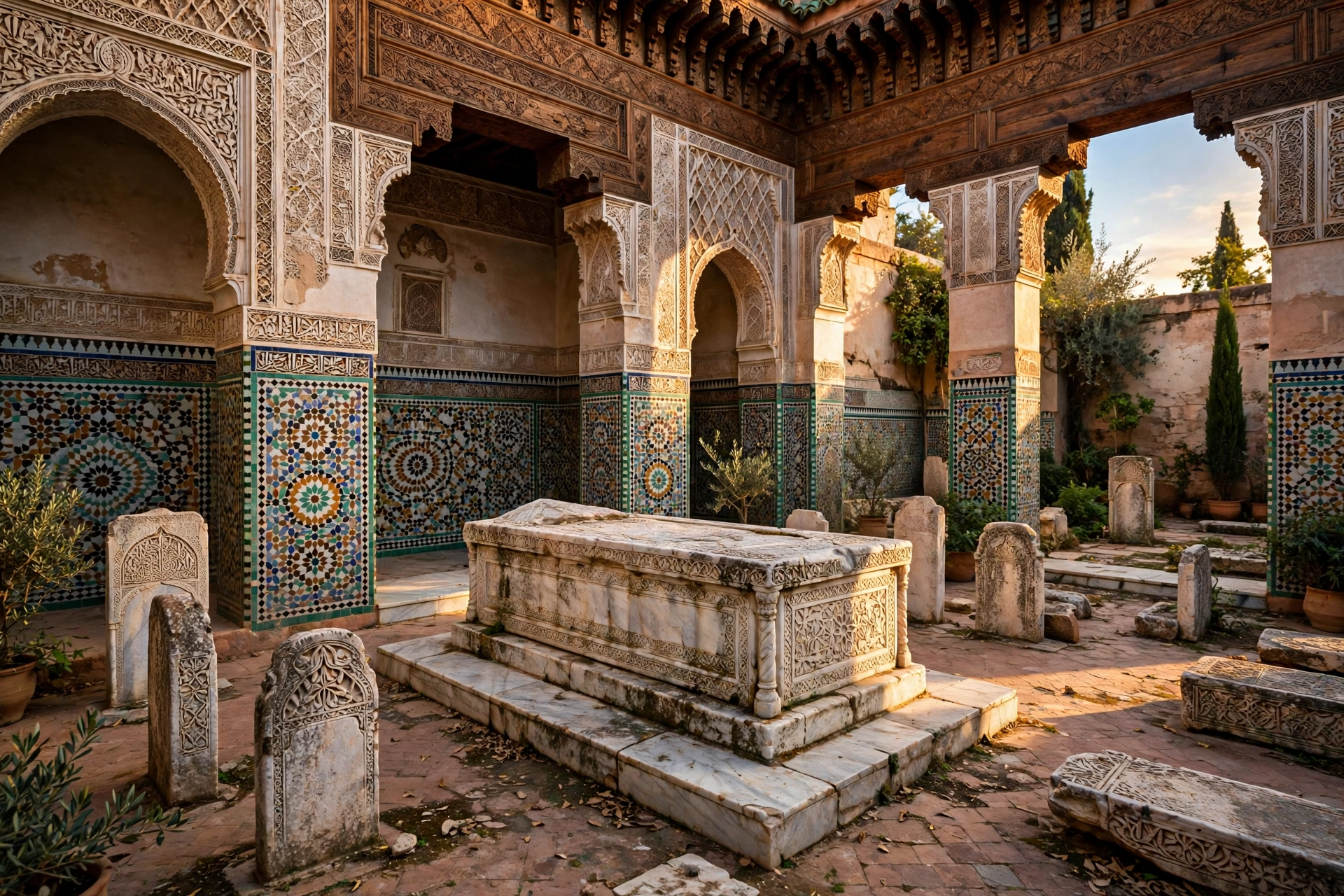
If you walk through Marrakech today, the Saadians are never far away. Their tombs sit behind a mosque in the kasbah, their ruined palace covers a whole city block, and their madrasa work still frames the courtyard of Ben Youssef. Yet most visitors know almost nothing about them, and that is a shame, because the saadian dynasty morocco story is one of the most dramatic in our history: a family from the Sous who took a capital, beat two empires in a single battle, filled their treasury with southern gold and sugar, built the grandest palace Morocco had ever seen, and then tore itself apart in civil war.
The saadian dynasty morocco ruled from 1554 to 1659, a short century between the Marinids and the Alaouites, the dynasty that rules Morocco to this day. It was a century of guns and gold, of trade and treachery, and the saadian dynasty morocco built on a scale that still shapes Marrakech today. This article tells that story in order, explains what survives, and finishes with the practical details you need to visit the sites yourself. See also our Kings of Morocco dynasties guide and the full history of Morocco.
- The Saadian Dynasty Morocco in One Short History
- From the Sous to Marrakech: Mohammed al-Shaykh
- The Battle of the Three Kings: The Turning Point
- Ahmad al-Mansur, “the Golden”
- Gold from the Songhai: The Expedition South
- Sugar: The Crop That Paid for a Palace
- El Badi Palace: Splendour Built to Be Seen
- The Saadian Tombs: Sealed, Forgotten, Found Again
- What to See Today in Marrakech
- Why the Saadian Dynasty Morocco Collapsed
- FAQs
The Saadian Dynasty Morocco in One Short History
The Saadian dynasty began as a sharifian family from the Draa valley and the Sous, in southern Morocco. They claimed descent from the Prophet Muhammad, and that lineage gave them a claim to leadership the Wattasids, the dynasty they replaced, could not match. They were also men of the south: they knew the desert trade, the sugar plains around Marrakech, and the mountain tribes. Religious legitimacy, southern roots, and a talent for war carried them to power, and the saadian dynasty morocco never lost its southern character, even at the height of its wealth.
Their century divides into three acts: the conquest under Mohammed al-Shaykh, who took Marrakech and then Fes; the golden age under his son Ahmad al-Mansur, who turned victory into money and money into buildings; and the collapse, when al-Mansur’s sons fought each other and the country split apart.
From the Sous to Marrakech: Mohammed al-Shaykh
Mohammed al-Shaykh was the founder, and he earned the title. In the early sixteenth century, Morocco was divided and under pressure: the Portuguese held towns on the Atlantic coast, the Wattasids in Fes were weak, and the countryside was ruled by local chiefs and holy men. The saadian dynasty morocco started by organising resistance to the Portuguese in the Sous, and the victories they won there gave them an army, a reputation, and a base.
Then they turned on Marrakech. Here is the first honest warning in this article: the exact year the saadian dynasty morocco captured Marrakech is unsettled. Sources give 1524 or 1525, and historians still disagree, so any guide that states one year as certain is guessing. The capture was the moment the family stopped being a southern resistance movement and became a dynasty. Mohammed al-Shaykh then spent the next three decades fighting his way north, and in 1554 he took Fes itself. He was murdered three years later, in 1557, but by then the work was done: Morocco was united under one family, with a capital in Marrakech and a claim on the whole country.
The Battle of the Three Kings: The Turning Point
On 4 August 1578, at Alcácer Quibir near the Loukkos river, the young Saadian sultan Abd al-Malik faced an invading army led by King Sebastian of Portugal, with the deposed prince Muhammad al-Mutawakkil on the Portuguese side. All three kings died on the field that day, which is why Moroccans still call it the Battle of the Three Kings, and the saadian dynasty morocco kept its throne. The Portuguese army was destroyed, Portugal lost its king and then its independence to Spain, and Morocco was saved from becoming a Portuguese colony.
I am not going to retell the whole battle here, because we already have a full account of it: read The Battle of the Three Kings: How Morocco Defeated Two Empires in 1578 for the fighting, the numbers, and the disputed details.
What matters for the saadian dynasty morocco story is what the battle made possible. Abd al-Malik died of illness during the fighting, and his brother Ahmad al-Mansur took the throne of the saadian dynasty morocco the same day, standing on a battlefield of Portuguese dead and ransom money. The victory gave him legitimacy, security, and cash, and he spent the next twenty-five years turning all three into an empire. Keep that in mind: every stone of El Badi Palace was paid for by this victory.
Ahmad al-Mansur, “the Golden”
Ahmad al-Mansur, who reigned from 1578 to 1603, is the Saadian that most Moroccans remember, and his nickname says why: al-Mansur means “the Victorious”, and the gold that flowed through his court earned him the second name “the Golden”. He was clever, patient, and ruthless, as sixteenth-century rulers had to be. He kept Spain and the Ottoman Empire at arm’s length by playing them against each other, he traded with England and France, and the saadian dynasty morocco court in Marrakech became one that foreign ambassadors wrote home about.
The saadian dynasty morocco reached its peak under al-Mansur, and the peak was real, not just court propaganda. The treasury was full, the army was paid, the building sites were busy, and the sugar refineries were working. But there is a second side that Moroccans do not forget: al-Mansur’s wealth was built on a brutal expedition to the south, and the gold that made him “the Golden” was taken at the point of a gun. A good history tells both halves, and this article will, in the next section.
Gold from the Songhai: The Expedition South
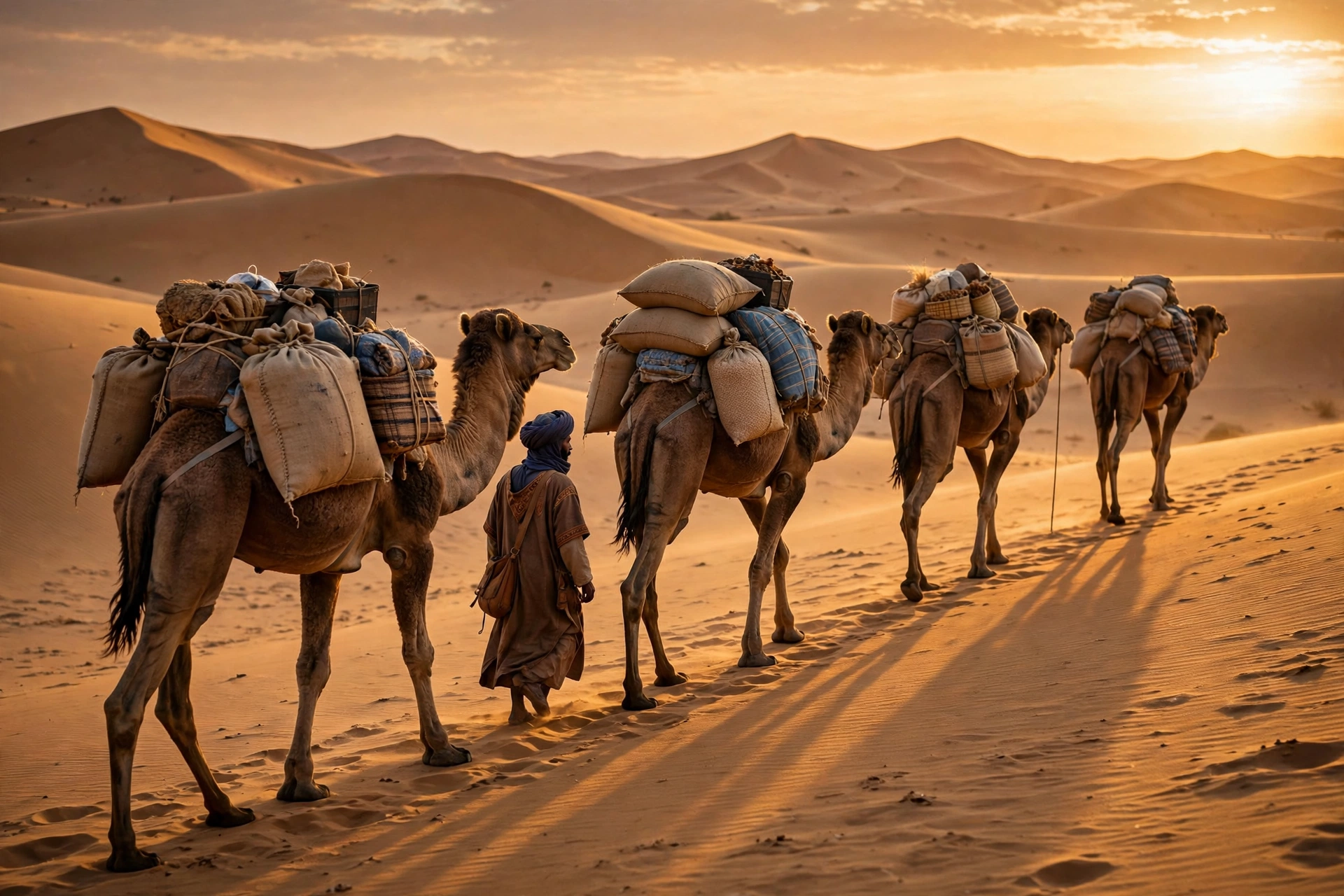
In 1590, al-Mansur sent an army of about 4,000 men across the Sahara to conquer the Songhai Empire, in what is now Mali. The commander, Judar Pasha, was a Spaniard who had risen in the Moroccan court. His men carried muskets and cannon, and at the Battle of Tondibi in 1591, gunpowder beat a much larger army that still fought with spears and arrows. The Songhai Empire collapsed, and its gold mines and trading towns fell under Moroccan control.
The gold mattered enormously, and the saadian dynasty morocco used it well. Caravans brought gold north to Marrakech, where al-Mansur minted coins so pure they were accepted across the Mediterranean, and English merchants dealt with him as an equal. But the conquest did not last. The Sahara is vast, the garrisons were far from home, and within a few decades the saadian dynasty morocco‘s control south of the desert had faded to a claim rather than a reality. The gold rush paid for the palace and the court, but it did not build an empire that could survive its founder.
Sugar: The Crop That Paid for a Palace
If gold was the windfall, sugar was the salary. This is the part of the story that visitors usually miss, and the part a Moroccan will tell you first, because it explains how ordinary work paid for extraordinary buildings. The plains around Marrakech, the Sous, and the Loukkos valley grew sugar cane, and in the sixteenth century sugar was not a cheap kitchen staple. It was a luxury, sold by weight like a spice, and Europe could not get enough of it.
The Saadians ran the sugar trade like a state business. They built refineries and taxed the exports. The saadian dynasty morocco shipped sugar to Europe through Atlantic ports and took payment in cloth, metal, weapons, and gold. Some of that sugar money went straight into El Badi Palace: the marble, the gold leaf, the Italian craftsmen, and the gardens were all paid for, in part, by cane cut in the Moroccan sun. When you stand in the palace ruins today, you are standing inside a sugar fortune — the Saadians were merchants too, and the merchant side of the family paid the bills.
El Badi Palace: Splendour Built to Be Seen
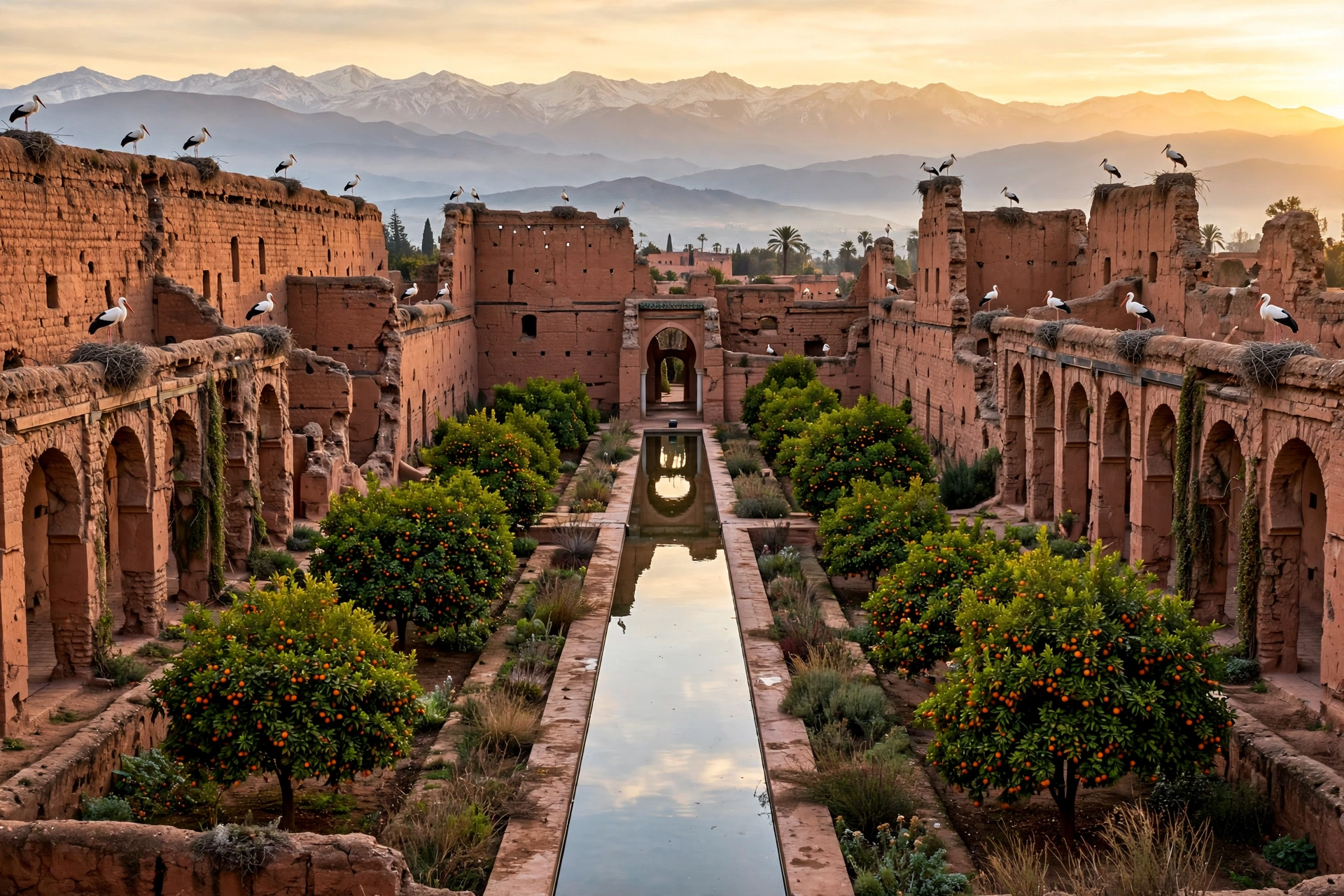
El Badi was the saadian dynasty morocco‘s great statement, built by Ahmad al-Mansur to impress foreign ambassadors as much as to house a court. The palace was a vast complex of courtyards, gardens, pavilions, and a long reflecting pool, decorated with Italian marble, gold leaf, carved cedar, and zellige. It took years to build, and here is the second honest warning in this article: the exact completion date of El Badi Palace is unsettled. Sources differ, and the building went up in stages over many years, so any single year given as “the” completion date is an oversimplification.
What happened to it is not disputed, and this is the insider correction outsiders usually get wrong. El Badi was not destroyed by war or by an earthquake. It was stripped deliberately, about a century after it was built, by the Alaouite sultan Moulay Ismail, who needed its marble, columns, and fittings for his own new capital at Meknes. Workers took the palace apart piece by piece, and what you see today — the great empty walls, the sunken orange garden, the storks nesting on the ruins — is the shell left behind. That emptiness is part of its history, not an accident.
The Saadian Tombs: Sealed, Forgotten, Found Again
The Saadian Tombs are the most visited Saadian site in Marrakech, and the story of how they were found is almost as famous as the tombs themselves. Ahmad al-Mansur built a royal necropolis beside the Kasbah Mosque, with a Chamber of the Twelve Columns — carved marble, gilded cedar, painted stucco — that is still one of the most beautiful rooms in Morocco. More than sixty members of the saadian dynasty morocco were buried there, including al-Mansur himself.
Then the tombs disappeared. Moulay Ismail, the sultan who stripped the saadian dynasty morocco‘s El Badi, sealed the necropolis and blocked its entrance, and for centuries the tombs were hidden behind a wall, known only by rumour.
The common version says they were “lost” until 1917, when the French Protectorate authorities rediscovered them during a survey. That is broadly true, but keep the detail honest: the exact date Moulay Ismail sealed the tombs is unsettled, and the sources do not agree on the year. Photographs from 1917 show a chamber untouched for two centuries. The saadian dynasty morocco had been buried, walled up, and then found again — and that is why the tombs feel less like a museum and more like a secret kept too long.
What to See Today in Marrakech
Start with the Tombs, early in the morning, before the tour groups arrive. The site is small and the Chamber of the Twelve Columns fills quickly, so come at opening time if you can.
Then walk the short distance to El Badi, which is large, open, and best in the late afternoon, when the light turns the red walls gold and the storks come back to their nests.
Finish at the Ben Youssef Madrasa, where the saadian dynasty morocco layer of decoration — the carved cedar, the zellige, the stucco — sits alongside older and newer work, and you can see how one dynasty built on the work of the ones before it. Our guide to the Imperial Cities of Morocco puts Marrakech in its wider context, and our Marinids guide covers the dynasty the Saadians replaced in Fes.
The saadian dynasty morocco sites are all in the Medina of Marrakech (UNESCO World Heritage listing), close together, and easy to combine in half a day. Do not rush the Tombs: the detail in the marble and the cedar repays a slow look. Prices below are approximate, checked in November 2026; they change, so treat them as a guide, not a promise.
| Site | Entry (approx.) | Best time | Allow |
|---|---|---|---|
| Saadian Tombs | ~100 MAD (~$10) | Early morning | 45–60 minutes |
| El Badi Palace | ~70 MAD (~$7) | Late afternoon | 60–90 minutes |
| Ben Youssef Madrasa | ~50 MAD (~$5) | Mid-morning | 45 minutes |
| Kasbah Mosque (outside only) | Free (outside) | Any time | 10 minutes |
Why the Saadian Dynasty Morocco Collapsed
Ahmad al-Mansur died in 1603, probably of plague, and the dynasty died with him in all but name. He had not settled the succession, and his sons — Moulay Zidan, Abu Faris, and Muhammad al-Shaykh al-Ma’mun — spent the next quarter-century fighting each other for the throne. The country split into rival courts, the treasury emptied, the army dissolved into factions, and the regions each went their own way. The saadian dynasty morocco limped on until 1659, when the last Saadian sultan died and the Alaouites, a new sharifian family from the Tafilalt, took over.
The lesson is not that the saadian dynasty morocco was weak. They were strong — strong enough to beat Portugal, to take an empire across the Sahara, and to build a palace that awed Europe. The lesson is that a dynasty built on one man’s talent, and on gold and sugar that depended on trade routes it did not fully control, could not survive a succession fight. When the money ran out and the brothers turned on each other, nothing underneath the splendour held the country together. That is why the Saadian century feels so bright and so short: it burned at full strength for one generation, and then it burned itself out.
FAQs
When did the Saadian dynasty rule Morocco?
The Saadians ruled from 1554, when Mohammed al-Shaykh took Fes and united the country, until 1659, when the last Saadian sultan died and the Alaouites took power. Their golden age was Ahmad al-Mansur’s reign, from 1578 to 1603.
Who was Ahmad al-Mansur?
Ahmad al-Mansur was the sultan of the saadian dynasty morocco who came to the throne on the day of the Battle of the Three Kings in 1578. He was called “the Golden” because of the wealth that flowed through his court, much of it from the Songhai gold expedition and the sugar trade, and he built El Badi Palace and the Saadian Tombs.
What happened at the Battle of the Three Kings?
At Alcácer Quibir on 4 August 1578, the Moroccan army under Abd al-Malik destroyed an invading Portuguese army led by King Sebastian. All three kings on the field died that day. Full account: The Battle of the Three Kings.
Where are the Saadian Tombs and how much do they cost?
The tombs are in the kasbah of Marrakech, beside the Kasbah Mosque, a short walk from Jemaa el-Fna. Entry is about 100 MAD (around $10), checked November 2026. Come early — the Chamber of the Twelve Columns gets crowded.
What happened to El Badi Palace?
El Badi was not destroyed by war. About a century after it was built, Sultan Moulay Ismail had it stripped of its marble, columns, and fittings for his new capital at Meknes. The great walls, the garden, and the reflecting pool survive. Entry is about 70 MAD (around $7), checked November 2026.
Why did the Saadian dynasty fall?
The dynasty collapsed into civil war after Ahmad al-Mansur died in 1603 without settling the succession. His sons fought each other for twenty-five years and the country split apart. The last Saadian sultan died in 1659, and the Alaouites took over.
The saadian dynasty morocco story ends the way it began: with a family from the south, a claim to leadership, and a country that had to be won all over again. The Tombs are still there, the palace shell is still there, and the sugar plains still grow cane. Go early, before the crowds, and you will understand why one short century of gold, sugar, and splendour still shapes the Marrakech you walk through today.