
Moving into your first Moroccan apartment brings a small shock that has nothing to do with the view from the balcony. The first envelope that arrives is a utility bill, printed in French and full of numbers and abbreviations you have never seen. Understanding utility bills in morocco early saves you money and the unpleasant surprise of a cut-off supply.
This guide explains utility bills in morocco the way they actually work in 2026: who supplies your electricity and water, how the tariff tranches push your price up, what fibre internet really costs, and how to pay without queuing for an hour. Prices are in dirhams with dollar equivalents at roughly 10 MAD to $1, checked in November 2026.
Morocco has no single national bill: your supplier, billing rhythm and tariff depend on your city.
In this guide:
- How Billing Works in Morocco
- Electricity: Tariffs, Meters and Your Monthly Cost
- Water, Gas and Shared Building Charges
- Internet and Mobile Data: Fibre, ADSL and Top-Ups
- How to Pay Your Bills (and What Happens If You Don’t)
- Before You Sign a Rental: The Utility Checklist
- Frequently Asked Questions
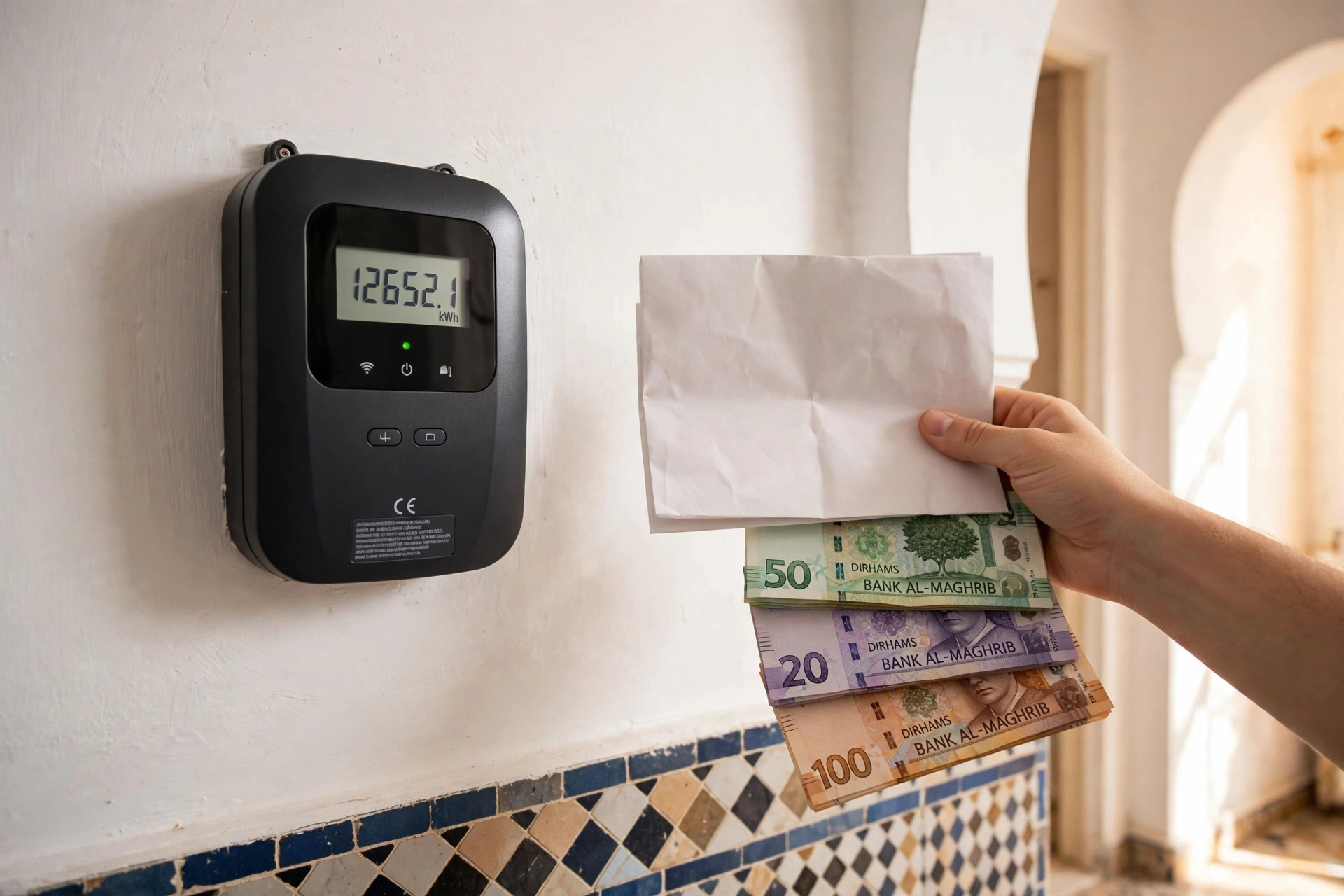
How Utility Bills in Morocco Work
The first thing to understand about utility bills in morocco is who sends them. The national body is ONEE, the Office National de l’Électricité et de l’Eau Potable, which produces and transports electricity and drinking water across the country. In smaller towns ONEE also delivers the service and sends the bill, while big cities use local operators.
Electricity is often billed every two months, which catches many newcomers by surprise. A bill covering two months of use looks large, but it is simply two months in one envelope. Water is billed monthly or every two months, and internet monthly in advance. Check the number of days on your first bill before you panic about the total.
Every bill follows the same logic: a fixed charge covers the meter and the connection, then you pay for what you used, in kilowatt-hours or cubic metres. The more you use, the higher the price per unit climbs, because the tariff is split into tranches. Reading your own meter and understanding utility bills in morocco at this level is the best way to keep costs under control.
Who Supplies Your Home?
Look at the logo and the agency address printed on the first bill you receive. The name on the bill is the company you pay. In Casablanca the distributor is Lydec, in Rabat-Salé it is Redal, and in Tangier and Tetouan it is Amendis. Everywhere else, ONEE usually handles distribution directly. Newcomers who research utility bills in morocco before they move in usually arrive knowing their operator already.
Electricity: Tariffs, Meters and Your Monthly Cost
Electricity is usually the largest of your household bills, and the tranche system decides how large. Anyone budgeting for utility bills in morocco should start with electricity, because it moves the most with the seasons. The first tranche, roughly the first 100 kilowatt-hours, costs around 0.90 MAD per kWh. The next tranche costs more, around 1.07 MAD, and heavy use above 300 kWh climbs towards 1.50 MAD. These approximate rates were checked in November 2026.
A fixed charge is added on top, usually 15–35 MAD per billing period depending on your power level, plus taxes. Air conditioning surprises most expats: one split unit running through a hot Marrakech summer can push a household into the expensive tranches, doubling the bill. That summer jump is the biggest surprise in utility bills in morocco for new arrivals: a household paying 150 MAD in spring can easily pay 400–600 MAD in July and August.
| Tariff tranche | Use per billing period | Approx. rate (checked November 2026) | Typical for |
|---|---|---|---|
| First tranche | 0–100 kWh | ~0.90 MAD/kWh (~$0.09) | Lights and fridge |
| Second tranche | 101–200 kWh | ~1.07 MAD/kWh (~$0.11) | Average flat |
| Third tranche | 201–300 kWh | ~1.25 MAD/kWh (~$0.13) | Air conditioning, water heater |
| Fourth tranche | Over 300 kWh | ~1.50 MAD/kWh (~$0.15) | Several air conditioners |
| Fixed charge | Per billing period | ~15–35 MAD (~$1.50–$3.50) | Meter and connection |
Reading the meter is simple and worth doing once a month. The meter is usually in a hallway cabinet or on the outside wall; the reading is the digits before the decimal point. Photograph it when you move in and out, and compare it with the reading on your bill. Estimated readings are corrected on the next real reading. A monthly photo also builds a record that makes utility bills in morocco easy to dispute if a reading looks wrong.
Water, Gas and Shared Building Charges
Water is the cheapest part of utility bills in morocco, but the tranche system applies here too. The first few cubic metres cost around 2.50–3 MAD each, rising in steps to roughly 6–7 MAD at the top tranche. With the fixed charge and sanitation fee added, a single person typically pays 60–120 MAD a month ($6–$12).
Leaks are the silent budget killer. A dripping tap or running cistern adds cubic metres you never see, and with two-month billing the damage shows up late. Check your meter when no tap is running: if the dial still turns, something is leaking. Report leaks to your landlord in writing, with a photo of the meter. Tenants who understand utility bills in morocco get leaks fixed faster, because they can show the landlord the numbers.
Butane Gas: The Orange Bottle in Every Kitchen
Most Moroccan kitchens cook with a butane gas bottle, the familiar orange 12 kg cylinder. The price is subsidised, but subsidy reform has pushed it up: a 12 kg bottle cost around 40 MAD for years and now sells for roughly 50 MAD. Treat 50–60 MAD as the current approximate range, checked in November 2026. A bottle lasts a small household four to six weeks, and your hanout delivers within the hour.
Syndic: The Shared Building Charge
If you live in an apartment building, expect a monthly syndic charge for cleaning, lighting and the lift. In an ordinary building this runs about 100–300 MAD a month ($10–$30); in a residence with a pool and concierge it can reach 400–800 MAD. It is paid to the building manager, not with your electricity and water bills. Ask who collects it before you sign: it is rarely shown in rental adverts. For many expats it is the most confusing part of utility bills in morocco, simply because no bill arrives for it.
| Household | Electricity | Water | Internet | Gas (share) | Monthly total |
|---|---|---|---|---|---|
| Single person, studio | 80–150 MAD | 40–80 MAD | 99–249 MAD | ~25 MAD | ~250–500 MAD ($25–$50) |
| Couple, one-bedroom flat | 150–300 MAD | 80–150 MAD | 199–249 MAD | ~40 MAD | ~470–740 MAD ($47–$74) |
| Family of four, 2–3 bed flat | 300–600 MAD | 150–250 MAD | 199–299 MAD | ~50 MAD | ~700–1,200 MAD ($70–$120) |
| Family of four, villa | 600–1,200 MAD | 250–500 MAD | 249–399 MAD | ~50 MAD | ~1,150–2,150 MAD ($115–$215) |
Internet and Mobile Data: Fibre, ADSL and Top-Ups
Fibre internet has spread fast across Morocco’s cities, and it is the option most expats should choose. Of all the utility bills in morocco, internet is the easiest to budget, because the price is fixed and printed in the contract. Maroc Telecom, inwi and Orange sell fibre: typically 100 Mbps for 199–249 MAD a month ($20–$25), and 200 Mbps near 299–399 MAD. Installation is usually free during promotions.
Where fibre has not reached, ADSL is the fallback: usually 12–20 Mbps for 99–149 MAD a month. It handles email and video calls but struggles with large uploads. Ask neighbours which operator works best on your street before you commit, because coverage and real-world speed vary by neighbourhood. A chat with a neighbour tells you more about real speeds than any advert, and it is the quickest research you will do on utility bills in morocco.
Mobile Data and Top-Ups
Mobile data in Morocco is cheap and excellent, and many expats use it as a backup when the home connection drops. The three operators sell recharge cards and app top-ups from 10 MAD upwards, and data passes of 5–10 GB cost roughly 20–100 MAD. Our guide to SIM cards, internet and working online in Morocco covers buying a local SIM and the best operator for each city. The telecom regulator, ANRT, publishes coverage maps and price comparisons worth a look before you sign.
Before you sign, check the minimum term: some fibre deals lock you in for 12 or 24 months with a cancellation fee, while others are month to month. Keep the router’s serial number. When utility bills in morocco are compared side by side, internet is the most predictable: the same price every month, no tranches, no meter.
How to Pay Your Bills (and What Happens If You Don’t)
Paying is easier than the paperwork suggests. Most operators accept payment through a Moroccan bank app, by direct debit, in cash at the agency, or at a payment point such as a tobacco shop. Bank apps are simplest: scan the code on the bill or enter the reference number, and keep the digital receipt. Once you have paid your first set of utility bills in morocco, the routine becomes second nature. Direct debit suits travellers: the bill is paid on the due date automatically.
Deadlines matter. Bills usually give you two to three weeks from the issue date, and a late bill can lead to a warning, a late fee, or a cut-off. A missed payment turns routine utility bills in morocco into an afternoon at the agency, so set a reminder for the due date. If your supply is cut, reconnection is not instant: expect a fee of roughly 50–150 MAD and a wait of a day or two. A friend can also pay with the bill in hand, so a neighbour can help.
Paying Without a Moroccan Bank Account
New arrivals without a local account can still pay: cash at the agency works with no account at all, and many payment points accept cash against the bill’s reference number. Opening a local account early makes everything simpler — see our guide to Moroccan money and the dirham. The golden rule of utility bills in morocco is simple: pay on time, keep the receipt, and photograph the bill.
Before You Sign a Rental: The Utility Checklist
Deal with utility bills before you sign the rental contract, not after the first shocking envelope. Ask five questions and get the answers in writing: whose name is on each meter, who pays the fixed charges, whether the syndic is included in the rent, what the last three bills cost, and whether any bill is unpaid. Most arguments about utility bills in morocco start with something that was agreed verbally and forgotten, so write it down. Our guide to renting an apartment in Morocco covers the contract itself.
Insist that the meters are transferred into your name, or at least that the contract states clearly who pays what. If the bills stay in the landlord’s name, a landlord who pays late can get your supply cut off through no fault of yours. Photograph every meter when you move in and out, and note the readings in the handover document (état des lieux). The connection deposit is usually 100–500 MAD, refunded or deducted when the contract ends.
Red Flags to Walk Away From
Walk away from a flat with no individual meter, where the landlord splits one bill between tenants by guesswork; from a building with chronic unpaid syndic debts; and from any arrangement where you pay a year’s bills in advance in cash with no receipts. These are the situations where utility bills in morocco turn from a routine into a dispute. A clean meter, a clear contract and a landlord who shows you the bills are worth more than a nice view.
Frequently Asked Questions
How much should I budget each month for utilities in Morocco?
A single person in a studio typically pays 250–500 MAD ($25–$50) a month for everything combined, while a family in a three-bedroom flat should expect 600–1,200 MAD ($60–$120), more in summer. Budgeting for utility bills in morocco is easiest if you set aside the high summer figure all year, so cheap winter months build a cushion.
Why is my electricity bill every two months?
Most distributors read residential electricity meters every two months, so one bill covers two months of use. The total looks large, but the daily cost is ordinary. Divide the total by two before comparing it with a monthly budget. This two-month rhythm is the detail that confuses newcomers to utility bills in morocco more than any other, so it is worth remembering.
Can I pay my bills online as a foreigner?
Yes. A Moroccan bank app is the easiest route, and most banks let you pay by scanning the bill or entering its reference number. Direct debit works too once your account is open. Without one, pay cash at the agency or an authorised payment point. Keep the receipt either way.
What is the syndic charge, and is it included in my rent?
The syndic is the monthly contribution to your building’s shared costs: cleaning, stairwell lighting, the lift and the gardien. It is usually 100–300 MAD a month, often not included in the rent, so ask before you sign. It goes to the building manager, not the utility company.
How do I get electricity and water connected in my name?
Take your passport, rental contract and a copy of the previous bill to your operator’s local agency, pay the deposit, and the meter is usually transferred within a few days. Photograph the meter reading on transfer day, and bring your carte de séjour if you have one — some agencies ask for it.
Is the gas bottle price fixed?
No. The 12 kg butane bottle is subsidised, and the government adjusts the price as subsidy reform progresses. It cost around 40 MAD for years and now sells for roughly 50–60 MAD, checked in November 2026. Small shops may add a few dirhams for delivery, so buy from a licensed seller and check the seal.
Conclusion
Moroccan utility bills reward a little attention and punish none at all. Read your meters, pay on time, and check the tranches before you blame the company. Most surprises have a boring explanation: a two-month billing period, summer air conditioning, or a leak you never saw. Once you understand the system, utility bills in morocco become one of the most predictable parts of your monthly budget.
If you are still planning your move, read our cost of living in Morocco guide to see how utilities fit into the full monthly picture, and our Moroccan money guide for banking and cash. Then, when the first envelope arrives in French, you will know what it says and what to do next. That turns a foreign admin system into a routine, and utility bills in morocco into a solved problem rather than a monthly worry.
1 thought on “Utility Bills in Morocco: Electricity, Water and Internet Costs for Expats”