
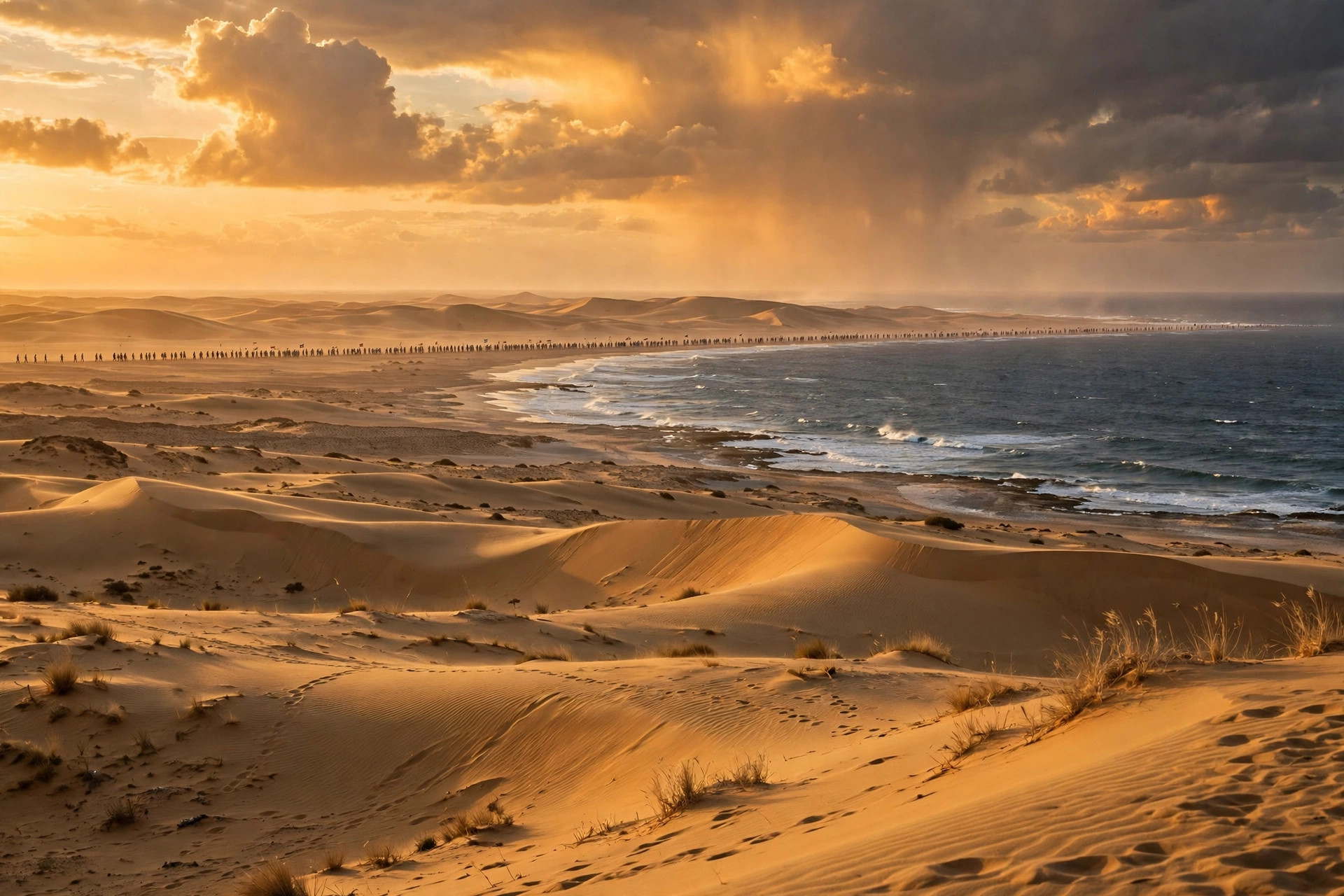
On 6 November 1975, an extraordinary column of unarmed civilians set out from the small Atlantic town of Tarfaya and walked south into the desert, carrying no weapons, only Qurans and Moroccan flags, and led by an idea rather than an army. The green march morocco was King Hassan II’s answer to a colonial question that had lingered for decades: who would govern the Spanish Sahara when Spain finally left? Within days it had changed the course of North African history, and within a week Spain had agreed to withdraw through the Madrid Accords.
Fifty years on, the event still shapes how Moroccans understand their country. Schoolchildren learn its songs and families mark its anniversary every 6 November, and the southern provinces it opened up — Laayoune, Dakhla and Tarfaya — have become fascinating places to visit. This guide explains what happened in November 1975, why it mattered, and how you can see its legacy today.
In this guide:
- What Was the Green March?
- Why 1975? The Road to the March
- 6 November 1975: The Day of the March
- The Madrid Accords and What Followed
- The Green March Morocco Legacy in National Memory
- Where to See the Legacy: Visiting Tarfaya, Laayoune and Dakhla
- Frequently Asked Questions
What Was the Green March?
The green march morocco was a mass civilian march organised by Morocco in November 1975 to press its claim to the Spanish Sahara, the territory Spain had ruled as a colony since the late nineteenth century. On 16 October 1975, King Hassan II announced on national radio and television that 350,000 Moroccan volunteers would walk peacefully into the territory to reclaim it. Green was chosen deliberately — the colour of Islam — and the march was presented as a peaceful, religiously inspired act rather than a military invasion.
The numbers were staggering: roughly 350,000 men and women from every region of Morocco volunteered, about one in fifty Moroccans. They gathered in Tarfaya, a windswept Atlantic town near the border, to wait for the King’s signal, each carrying a Quran and a Moroccan flag. The message was unmistakable: this was a civilian, unarmed movement, and any violence against it would be seen around the world.
The march succeeded in its immediate aim. Spain, weakened by the failing health of General Franco, chose negotiation over confrontation. Spanish troops did not fire on the marchers, and within days Spain, Morocco and Mauritania sat down to settle the territory’s future. For Morocco, the green march morocco became a founding moment of modern national identity, comparable to independence itself.
Understanding the green march morocco matters for any visitor, because it explains so much of what you see in the south: the new cities, the roads, the monuments, and the pride with which people in Laayoune and Dakhla speak about their home. It also explains why the map of Morocco looks the way it does.
Why 1975? The Road to the March
To understand why the green march morocco happened in 1975, go back to the late nineteenth century, when European powers divided Africa among themselves. Spain claimed the Atlantic coast of the Sahara, a vast desert territory south of Morocco, and held it as the colony of Spanish Sahara. Morocco, independent since 1956, always regarded the territory as historically linked to the Moroccan sultanate, pointing to centuries of trade, tribal allegiance and religious ties with the sultans of Fez and Marrakech.
By the early 1970s, pressure was building. The United Nations had called since the 1960s for the decolonisation of the Spanish Sahara, and in 1974 the International Court of Justice was asked for an advisory opinion on the territory. Morocco argued that ties existed between the territory and the throne. The court’s opinion, delivered on 16 October 1975, was nuanced: it found legal ties of allegiance between some Saharan tribes and the Sultan, but not territorial sovereignty — and it settled nothing.
King Hassan II announced the green march morocco on the very same day the court’s opinion was delivered. With Franco dying in Madrid and Spain’s colonial government in disarray, the King saw a narrow window. A military invasion would have invited condemnation and possibly war; a peaceful march of hundreds of thousands of civilians was far harder for Spain to stop without causing a disaster the whole world would witness.
The gamble also reflected the King’s style. Hassan II was a shrewd strategist who understood the power of symbolism and public opinion. The green march morocco combined religion, nationalism and non-violence into one gesture that was difficult for any foreign government to oppose openly, and it united Moroccans at home when the country needed a shared national project.
The International Court of Justice Opinion
The court’s advisory opinion of 16 October 1975 is often misunderstood. The judges found historical evidence of legal ties between the Sultan and some tribes of the territory, and similar ties between Mauritania and others. But they did not find that either country had exercised territorial sovereignty over the Spanish Sahara, and they concluded that the people of the territory had the right to self-determination. The opinion gave something to every side — and settled nothing on its own.
Spain’s Final Months in the Sahara
By the autumn of 1975, Spain was in crisis. General Franco, who had ruled for nearly forty years, was seriously ill and would die on 20 November, two weeks after the march. The Spanish government was divided between holding the Sahara and leaving it. Spanish troops were under orders to avoid bloodshed, and Madrid had quietly begun negotiating its exit. The march arrived when Spain was least able, and least willing, to resist it by force.
6 November 1975: The Day of the March
The green march morocco began in the early hours of 6 November 1975. At dawn, the first columns crossed from Tarfaya into the Spanish Sahara near the border post of Tah, walking in organised groups. They advanced about ten kilometres on the first day, then stopped and waited — a deliberate pause, giving Spain time to negotiate rather than forcing a confrontation with its troops.
Conditions were harsh. The volunteers slept in tents in the desert, in November cold that drops sharply at night, and relied on food and water trucked up from Tarfaya. Yet accounts describe a festive, determined mood — songs, prayers and a sense of history being made. Many marchers were ordinary people: farmers, teachers, shopkeepers and students who had volunteered through local committees across the country.
The international reaction to the green march morocco was immediate and intense. Newspapers and television crews rushed to Tarfaya, and the United Nations Security Council held emergency sessions. Spain protested but did not order its soldiers to fire. On 9 November, after three days inside the territory, King Hassan II ordered the marchers home. He had achieved what he needed: the world was watching, Spain was negotiating, and no blood had been shed.
The green march morocco lasted only a few days on the ground, but its political effect was enormous. Spain agreed to talks, and the marchers went home as heroes. The date of 6 November is now a national holiday in Morocco, celebrated every year across the country and in the southern provinces in particular.
| Date | Event |
|---|---|
| 16 October 1975 | The International Court of Justice delivers its advisory opinion on Western Sahara; King Hassan II announces the Green March the same evening |
| 6 November 1975 | 350,000 unarmed Moroccan volunteers cross from Tarfaya into the Spanish Sahara |
| 9 November 1975 | King Hassan II orders the marchers to return to Tarfaya after advancing about 10 km |
| 14 November 1975 | Spain, Morocco and Mauritania sign the Madrid Accords, agreeing to Spain’s withdrawal |
| 20 November 1975 | General Franco dies in Madrid, ending the era of Spanish rule |
| 26 February 1976 | Spain formally withdraws from the territory |
| 27 February 1976 | The Polisario Front proclaims the Sahrawi Arab Democratic Republic |
The Madrid Accords and What Followed
Five days after the marchers turned back, the Madrid Accords that followed the green march morocco were signed on 14 November 1975. Spain would withdraw by 28 February 1976 and hand administration to a joint Moroccan-Mauritanian administration pending a later settlement. In practice, Morocco took the northern two-thirds, including Laayoune and the phosphate-rich region of Bou Craa, while Mauritania took the southern third, including Dakhla.
The accords were immediately contested. The Polisario Front, a Sahrawi movement founded in 1973, rejected the agreement and proclaimed the Sahrawi Arab Democratic Republic on 27 February 1976, the day after Spain’s formal withdrawal. Algeria, which supported the Polisario, also rejected the accords. What followed the green march morocco was a long war in the desert: Morocco fought the Polisario until a United Nations-brokered ceasefire in 1991, and Mauritania withdrew in 1979, after which Morocco administered the whole territory.
The status of Western Sahara remains internationally contested and unresolved today. The United Nations regards it as a non-self-governing territory, and the UN mission MINURSO has monitored the ceasefire since 1991. Morocco’s autonomy plan and the Polisario’s demand for a referendum remain far apart, and the Security Council renews the mission each year without a final settlement. Travellers should understand this clearly: the green march morocco is a proud national moment in Morocco, but the territory’s final status is still disputed internationally — it is not presented here as a settled question.
For visitors, the practical consequence is simple: the southern provinces are administered by Morocco, are safe and open to travellers, and are reached by domestic flights, buses and roads from the north. The political question stays in the background of daily life, and most travellers experience the region as any other part of Morocco — warm and welcoming.
The Green March Morocco Legacy in National Memory
Few events in modern Moroccan history are remembered as vividly as the green march morocco. Every year on 6 November, Morocco celebrates the anniversary with official ceremonies, school events and television programmes, and the day is a public holiday. The march features in songs, textbooks and monuments, and many families have a relative who took part. For the generation that marched, it remains the defining experience of their lives.
The green march morocco also changed how Morocco saw itself. It gave the country a peaceful national triumph when its young independence still needed symbols, and it cemented the image of Hassan II as a king who could move a nation with a speech. Historians debate the legal and political consequences of 1975 to this day, but inside Morocco there is little debate about its emotional meaning: it is remembered as the moment the country stood together and reclaimed land it saw as its own.
That memory is visible in the landscape of the south. Laayoune has a monument to the march, Tarfaya marks its role as the starting point, and Dakhla’s growth from a fishing town into a city is presented locally as part of the same story. The march is also woven into the wider history of the Alaouite dynasty, which visitors encounter in the imperial cities of the north as well.
Where to See the Legacy: Visiting Tarfaya, Laayoune and Dakhla
The best way to understand the Green March today is to travel the route yourself. The journey south from Agadir follows the Atlantic coast through the desert, past Tarfaya, to Laayoune and on to Dakhla — a road trip of extraordinary landscapes. The green march morocco began in Tarfaya, the natural starting point for any visitor following the story.
Tarfaya is quiet and windswept, a fishing town of low white buildings on a wild Atlantic shore. Its Antoine de Saint-Exupéry museum recalls the French writer-pilot who lived here in the 1920s, when the town was the airstrip of Cape Juby. The beach near the old port is where the green march morocco marchers gathered, and standing there at sunset, with the desert to the south and the ocean to the west, it is easy to imagine the columns forming on the morning of 6 November.
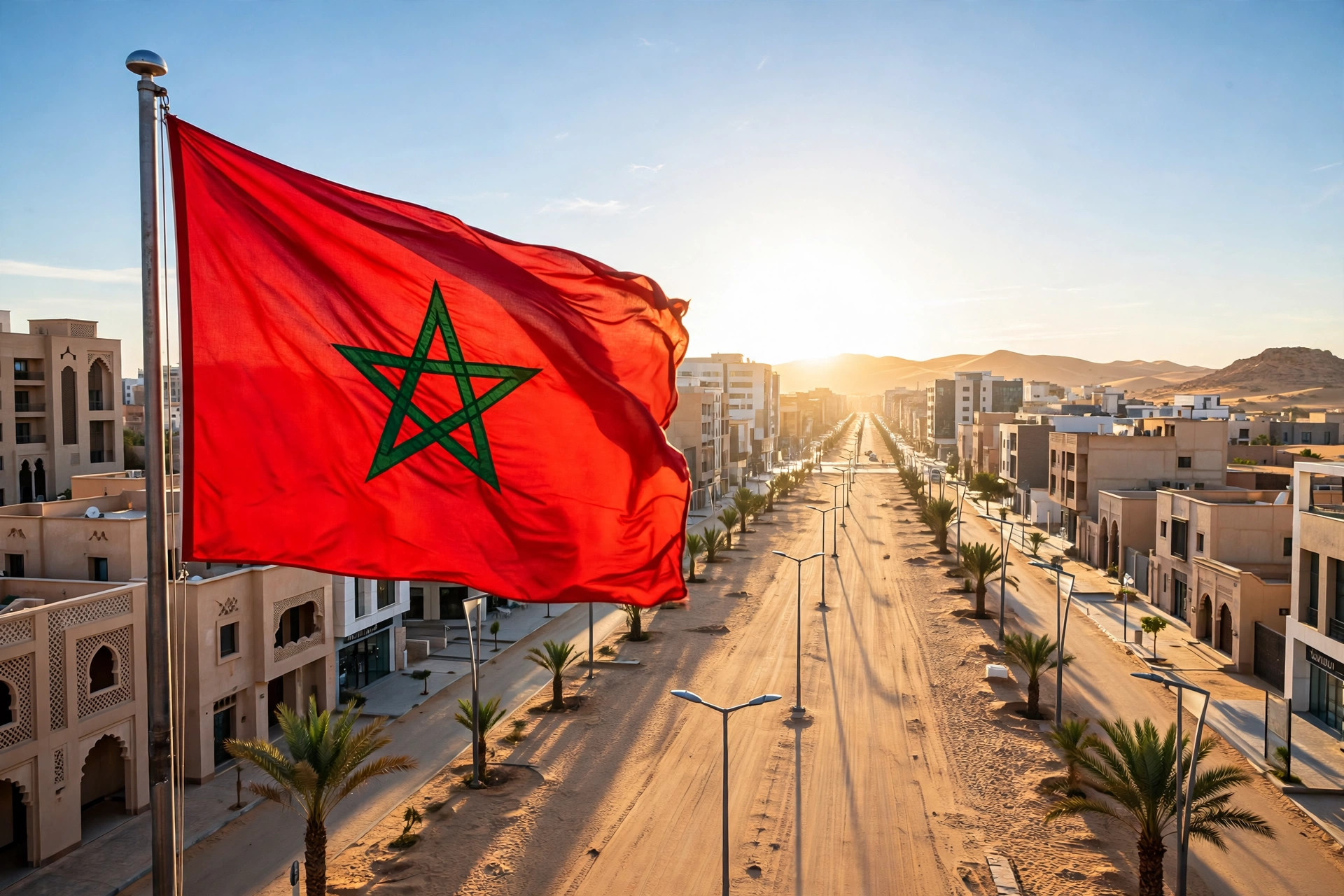
Laayoune, about 270 km south of Tarfaya, is the largest city of the southern provinces and the administrative heart of the region — a modern, planned desert city with wide avenues, gardens and a lively centre that has grown enormously since 1975. Visitors following the green march morocco route come for desert excursions, camel rides on the dunes outside the city, and the remarkable birdlife of the nearby lagoon at Khnifiss.
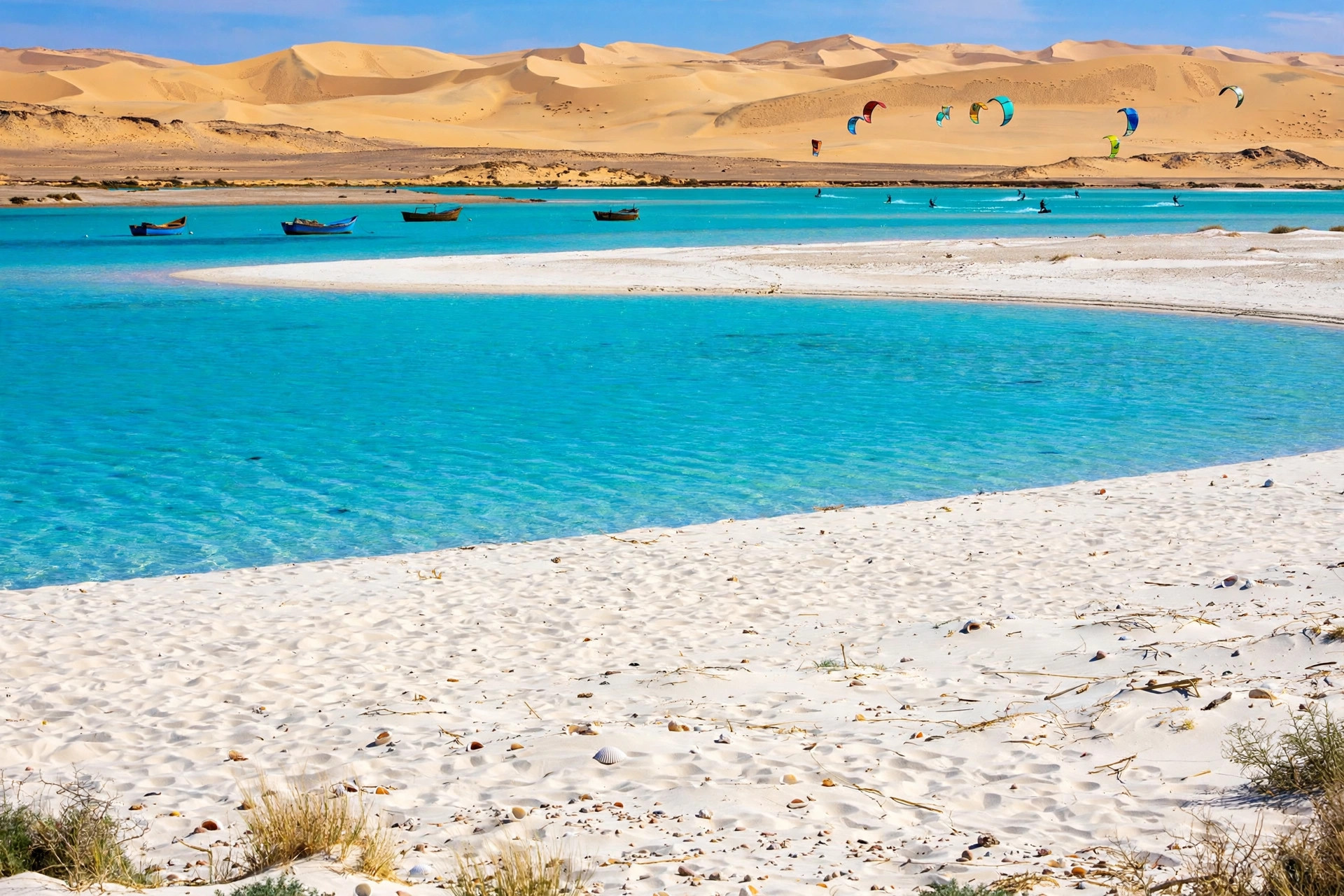
Dakhla, roughly 500 km further south along the green march morocco route, is the most rewarding destination of the three for many travellers. Built on a narrow peninsula between a turquoise lagoon and the Atlantic, Dakhla is now famous for kitesurfing, with world-class conditions and camps and hotels along the water. The White Dune, a vast sand dune rising straight out of the lagoon, is one of the most photographed places in Morocco.
Royal Air Maroc and other airlines fly daily from Casablanca to Laayoune (about 1 hour 40 minutes) and to Dakhla (about 2 hours 20 minutes); CTM and Supratours buses run from Agadir to Laayoune and on to Dakhla. Distances are long and the desert is empty, so plan fuel, water and stops carefully if you drive. Visit between October and April, when desert temperatures are mild.
| Place | What to see | Getting there | Typical cost (Nov 2026) |
|---|---|---|---|
| Tarfaya | March starting point, Saint-Exupéry museum, Atlantic beach | Bus from Agadir (~6 hrs) or drive via Tan-Tan | Museum ~20 MAD (~$2); hotel 200–400 MAD (~$20–$40) |
| Laayoune | March monument, city centre, Khnifiss lagoon, desert dunes | Flight from Casablanca (~1 hr 40 min) or bus from Agadir | Flight 600–1,200 MAD (~$60–$120); hotel 300–600 MAD (~$30–$60) |
| Dakhla | Lagoon, White Dune, kitesurfing, fishing port | Flight from Casablanca (~2 hrs 20 min) or bus from Laayoune | Flight 800–1,500 MAD (~$80–$150); kitesurf lesson ~500 MAD (~$50) |
| Bou Craa area | Phosphate region, desert landscapes (view from road only) | Drive from Laayoune | Day trip with driver 500–800 MAD (~$50–$80) |
Practical tips: book flights early, as the Laayoune and Dakhla routes are popular with Moroccan travellers too; carry cash in dirhams, since card acceptance is patchy outside the main hotels; and bring layers, because desert nights in November can be surprisingly cold. For wider context, read our history of Morocco and our guide to the imperial cities — the Green March is the final chapter of a much longer story that begins with the dynasties of Fez and Marrakech. For a city break on the way south, see our Meknes travel guide and our Rabat travel guide, and check everyday prices in our guide to Morocco grocery prices before you travel.
Frequently Asked Questions
What was the Green March?
The Green March was a peaceful mass march organised by King Hassan II in November 1975, in which around 350,000 unarmed Moroccan volunteers walked from Tarfaya into the Spanish Sahara to press Morocco’s claim. The green march morocco led within days to the Madrid Accords and Spain’s withdrawal.
When did the Green March take place?
The green march morocco began on 6 November 1975, the day after the International Court of Justice delivered its advisory opinion on Western Sahara. The marchers advanced about 10 km, waited three days, and were ordered home on 9 November 1975. The date of 6 November is now a national holiday in Morocco.
Why was it called the Green March?
Green is the colour of Islam, and the march was presented as a peaceful, religious act. The marchers carried Qurans and Moroccan flags rather than weapons, signalling a civilian movement rather than a military invasion.
How many people took part in the Green March?
Around 350,000 Moroccan volunteers took part, from every region of the country. The march remains the largest peaceful civilian mobilisation the country has ever organised.
What were the Madrid Accords?
The Madrid Accords that followed the green march morocco, signed on 14 November 1975 by Spain, Morocco and Mauritania, agreed that Spain would withdraw from the Spanish Sahara by February 1976 and hand administration to Morocco and Mauritania. The Polisario Front rejected them, and the territory’s final status remains internationally contested today.
Can tourists visit the places associated with the Green March?
Yes. Tarfaya, Laayoune and Dakhla are all open to visitors, reached by domestic flights from Casablanca or by bus and road from Agadir. Tarfaya marks the march’s starting point, Laayoune is the main city of the southern provinces, and Dakhla is a lagoon resort famous for kitesurfing. Visit between October and April.
Conclusion
The green march morocco of November 1975 was one of the most remarkable events in modern Moroccan history: a king, a radio speech, and 350,000 ordinary people walking unarmed into the desert — and a colonial power choosing to negotiate rather than to fight. It gave Morocco a peaceful national triumph, reshaped the map, and opened the southern provinces to travellers who now fly to Laayoune and Dakhla every day.
To understand Morocco properly, you need to understand this story, because it explains the pride, the monuments and the modern cities of the south. Visit Tarfaya at golden hour, stand where the marchers gathered, and the green march morocco stops being a chapter in a history book.