
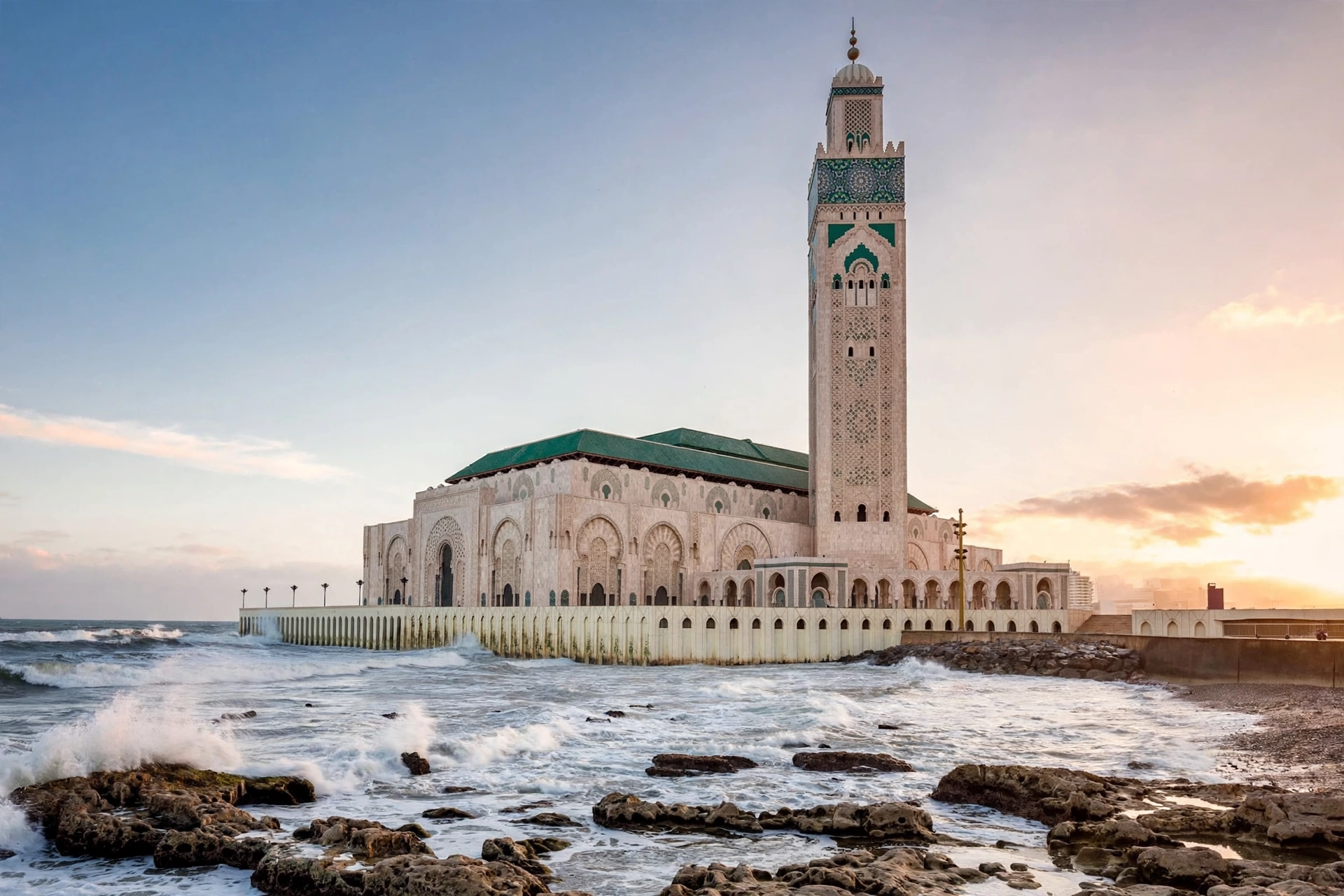
Casablanca is Morocco’s biggest city and economic capital, an Atlantic port city of more than three million people that runs on business, not tourism. The first thing this casablanca travel guide will tell you is the truth: Casablanca is not a pretty old medina city, and if you arrive expecting Chefchaouen’s blue lanes or Marrakech’s red walls, you will be disappointed. What it is, instead, is a working city with a modern skyline, a famous mosque rising out of the sea, and a seafront where the whole city comes to breathe.
This casablanca travel guide is written by a Moroccan explaining his own city, so expect plain talk about the drawbacks as well as the charms. The traffic is heavy, the centre can feel grey in winter, and the old medina is more about scale and commerce than postcard beauty. But Casablanca rewards visitors who look properly: the greatest mosque in the country, a long Corniche of cafés and beaches, and a downtown of 1930s Art Deco that is one of the finest collections anywhere.
Use this casablanca travel guide to plan two or three days here, whether you arrive at Mohammed V airport, on the Al Boraq high-speed train from Tangier, or as a day trip from Rabat. You will find practical prices in dirhams, honest advice about where to stay, and the small details that make the difference between enduring Casablanca and enjoying it.
In this guide:
- Why Visit Casablanca?
- Getting to Casablanca and Getting Around
- The Hassan II Mosque
- The Corniche and Ain Diab
- The Old Medina, the Habous Quarter and the New Medina
- Art Deco Downtown, Place Mohammed V and the Twin Center
- Where to Stay in Casablanca
- Practical Costs, Safety and Tips
- Frequently Asked Questions
Why Visit Casablanca? This Casablanca Travel Guide Starts With an Honest Answer
The reason to come here, as this casablanca travel guide explains, is not a single sight but the feeling of a city at work. Casablanca is Morocco’s engine room: the port, the banks, the headquarters, the airport that connects the country to the world. Its streets are busy, its people are direct, and its skyline mixes colonial facades, glass towers and the great minaret of the Hassan II Mosque rising over the sea.
Most visitors come for two things — the Hassan II Mosque and the Corniche — and both are worth the trip. But the real charm of Casablanca is quieter: the Art Deco facades of the centre, the Twin Center towers catching the evening light, and the day trips that open up in every direction. Pair this guide with our Morocco travel guide for first-time visitors, which covers visas, money, transport and etiquette across the country.
Getting to Casablanca and Getting Around
The best casablanca travel guide advice about arriving is simple: fly into Mohammed V Airport, 30 kilometres south of the city, and take the train. The airport station runs trains to Casa Voyageurs and Casa Port roughly every hour, and the ride takes about 45 minutes. A ticket costs around 50 MAD (about $5). Airport taxis charge a fixed fare of roughly 250 to 300 MAD (about $25 to $30) to the centre, so agree the price first.
As any honest casablanca travel guide should say, the train is also the best way to leave the city. Casa Voyageurs is the main station, on the Al Boraq high-speed line from Tangier through Kenitra and Rabat — about two hours and ten minutes from Tangier, and 50 minutes from Rabat. Check timetables and book on the ONCF website, the national railway operator.
The Tramway: Casablanca’s Easiest Way Across Town
Casablanca’s tramway runs two lines, T1 and T2, from Sidi Moumen to Ain Diab and the faculties district. It is clean and cheap, and this casablanca travel guide recommends it for any trip longer than a short taxi ride. A single ticket costs 8 MAD (about $0.80), and the tram connects Casa Voyageurs, the city centre, the Twin Center and the Corniche.
Petits Taxis, Buses and Walking
Petits taxis, the small red cars, handle short trips in the city. Insist on the meter, which drivers are obliged to use, and expect 10 to 25 MAD (about $1 to $2.50) for most central rides. Some drivers at the airport and the stations quote a flat price to newcomers or claim the meter is broken — walk away and take the next one.
| Transport | Typical price (MAD) | Approx. USD |
|---|---|---|
| Airport train to Casa Voyageurs | 50 MAD | about $5 |
| Al Boraq Casablanca–Rabat | 50–90 MAD | about $5–$9 |
| Al Boraq Casablanca–Tangier | 180–280 MAD | about $18–$28 |
| Tram single ticket | 8 MAD | about $0.80 |
| Petit taxi, central ride | 10–25 MAD | about $1–$2.50 |
| Grand taxi Casablanca–El Jadida | 40–60 MAD | about $4–$6 |
Prices checked November 2026. Fares vary by time of day and ticket type; the ONCF site has the current train prices.
The Hassan II Mosque: Casablanca’s Masterpiece on the Sea
No casablanca travel guide is complete without the Hassan II Mosque, the largest mosque in Morocco and one of the largest in the world. It stands on a platform reclaimed from the Atlantic, so the waves break against its walls and the 210-metre minaret — the tallest in the world — rises out of the sea. Completed in 1993, its prayer hall holds 25,000 worshippers, with room for 80,000 more on the esplanade outside.
Unlike most mosques in Morocco, the Hassan II Mosque opens to non-Muslim visitors on guided tours, and this casablanca travel guide recommends booking one. The tours run several times a day except during prayer times, last about 45 minutes, and cost around 130 MAD (about $13). Inside you will see carved cedar ceilings, marble floors and a glass floor over the sea. Modest dress is required, and you can read the background on Wikipedia’s Hassan II Mosque page.
What to Know Before You Visit the Mosque
Arrive early, especially on Fridays and in summer, when tour groups are large. Photography is allowed during the tour but not during prayer, and women should bring a scarf. The mosque stands at the north end of the Corniche, and this casablanca travel guide recommends pairing the visit with a walk along the seafront afterwards — the view of the minaret from the beach at sunset is one of the great sights of Morocco.
The Corniche and Ain Diab: Where Casablanca Comes to Breathe
This casablanca travel guide puts the Corniche second to the mosque, because it is where the city relaxes. The Corniche is the seafront boulevard running south from the mosque past Ain Diab beach, lined with cafés, restaurants, nightclubs and hotels. In the late afternoon the whole city seems to be here: families strolling, joggers on the promenade, surfers in the water, friends drinking coffee at the terrace tables.
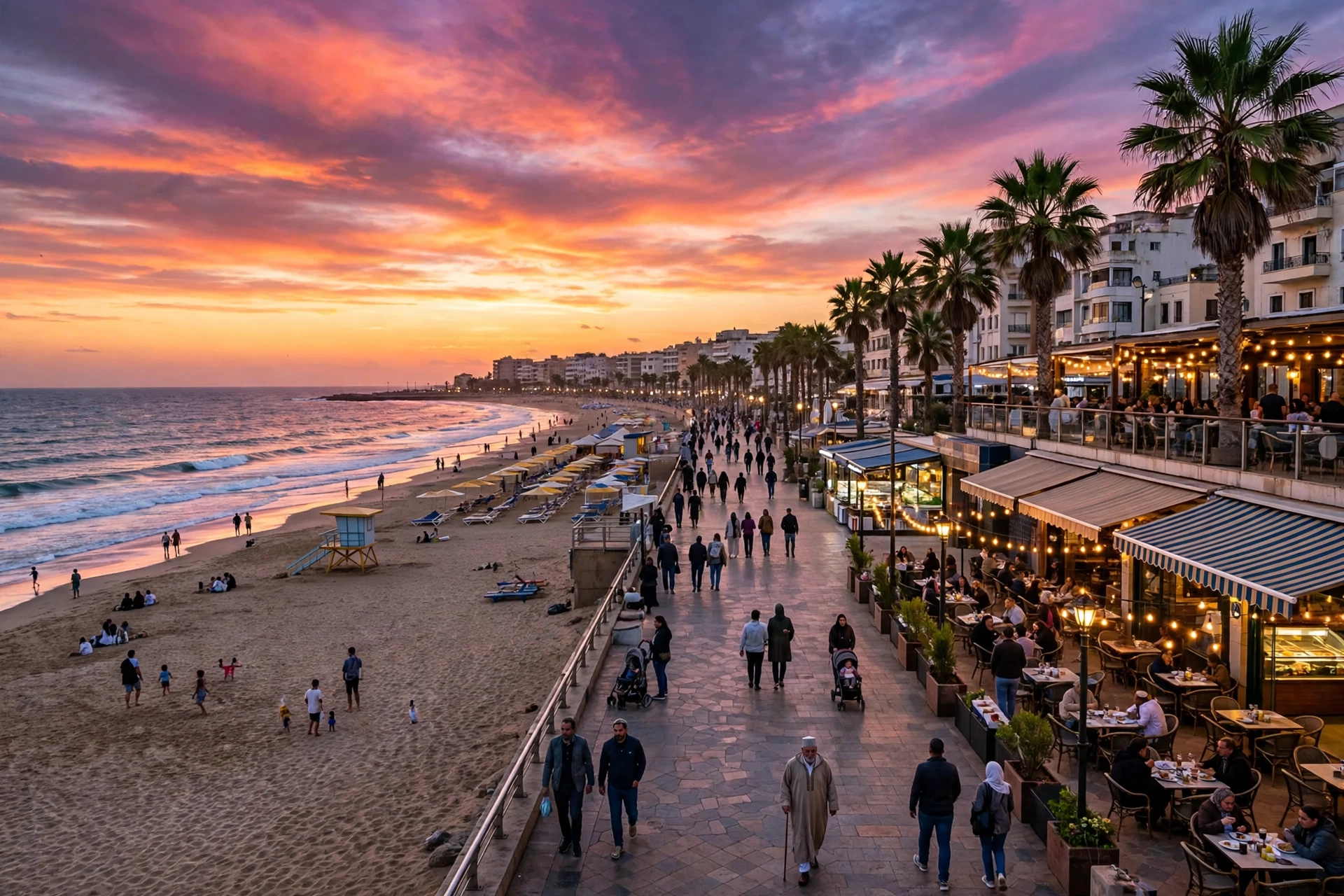
Ain Diab is Casablanca’s city beach, and this casablanca travel guide gives it honest marks. The sand is wide and the atmosphere is lively, especially on summer weekends, but the Atlantic water is cold for much of the year and the current is strong, so most people swim only from June to September. Come for the walk, the sunset and the seafood. For a dedicated beach holiday, compare with our Agadir travel guide, which covers Morocco’s warmest Atlantic bay.
Day Trips from Casablanca: Rabat, El Jadida and Azemmour
Casablanca is the best base in Morocco for day trips, and this casablanca travel guide rates three. Rabat, the calm capital, is 50 minutes north by Al Boraq — see our Rabat travel guide for the Kasbah, Hassan Tower and Chellah. El Jadida, an hour to the south-west, is a relaxed Portuguese-walled port town with a beach and a UNESCO-listed cistern. Azemmour, just beyond it, is a small white town of painted walls and quiet lanes, barely touched by tourism.
The Old Medina, the Habous Quarter and the New Medina
Casablanca’s old medina is not the maze of Fes or the showpiece of Marrakech, and this casablanca travel guide says so plainly. It is a big, working neighbourhood by the port, rebuilt after the 1755 earthquake and again in the twentieth century. The lanes sell clothes, shoes and household goods to locals, and the haggling is gentler than in the tourist souks.
The Habous Quarter: the New Medina
The real gem is the Habous quarter, built by the French in the 1920s and 1930s as a new medina for the Moroccan population. Its whitewashed arcades, arched doorways and quiet squares blend Moroccan and European design, and it is the most photogenic part of the city after the mosque. Walk the main streets, visit the olive souk, and stop for pastries at the pâtisseries that line the square.
Art Deco Downtown, Place Mohammed V and the Twin Center
This casablanca travel guide saves its biggest surprise for downtown. Between the 1920s and the 1950s, Casablanca was rebuilt as a colonial city, and the centre still holds one of the largest collections of Art Deco and modernist architecture in the world — more than 400 listed buildings. Walk the boulevards around Place Mohammed V and you will see curved facades, geometric friezes and wrought-iron balconies.
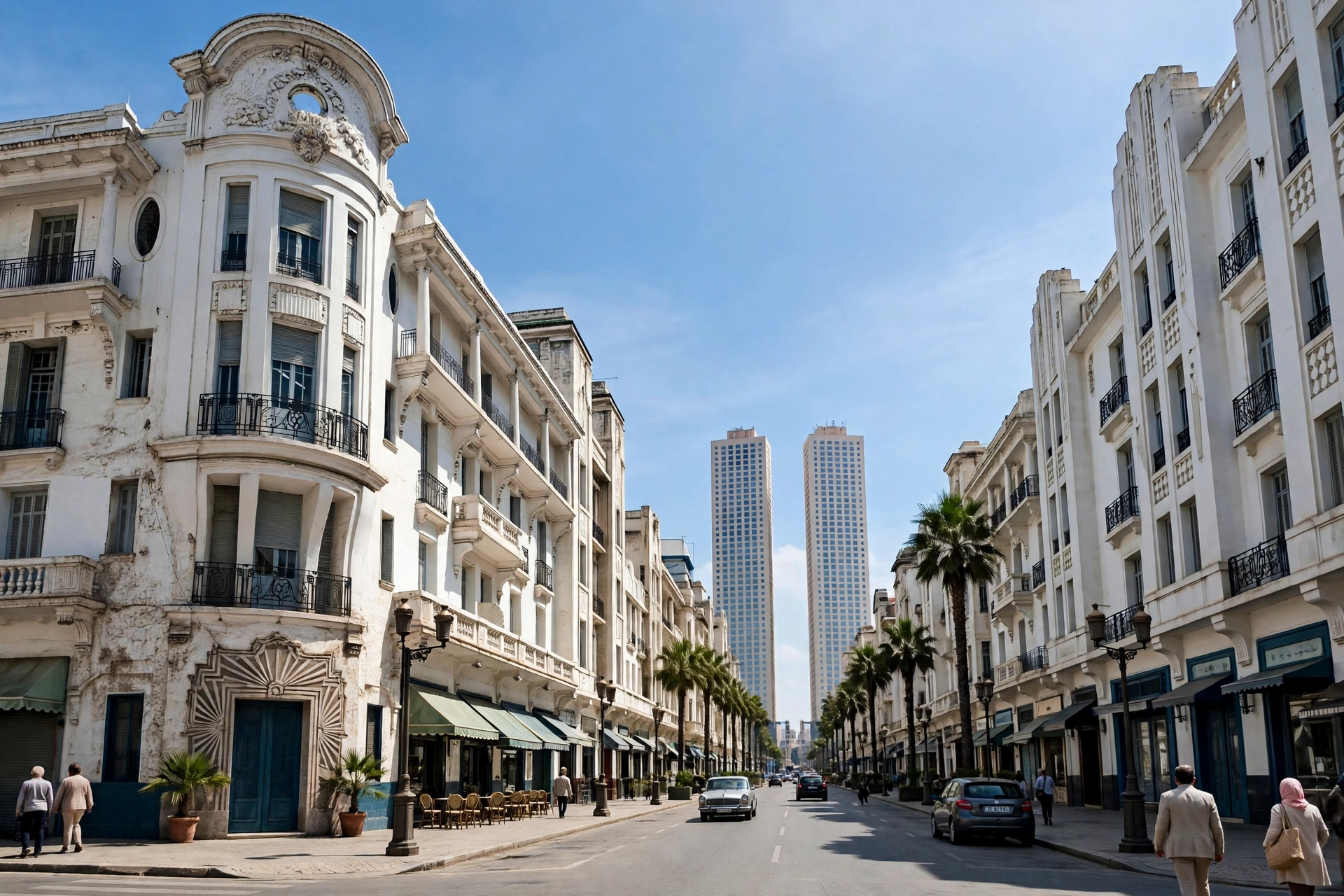
Place Mohammed V is the ceremonial heart of the city, a great square of palm trees and pigeons, flanked by the wilaya, the law courts and the post office — all in the same white stone. From here, walk to the Twin Center, and this casablanca travel guide will tell you the towers are worth the look: two 115-metre towers designed by Ricardo Bofill, completed in 1999, the symbol of modern Casablanca. Go up to the top floor for the panoramic view over the city and the ocean.
Where to Stay in Casablanca
This casablanca travel guide divides the city into three bases, and the right choice depends on your style. The Corniche and Ain Diab suit travellers who want the sea: beachfront hotels and apartment-hotels with sunset views, lively in summer and quieter in winter. Expect roughly 700 to 2,000 MAD (about $70 to $200) a night for a good seafront room.
For business and first-time visitors, this casablanca travel guide suggests the city centre, around Place Mohammed V and the Twin Center. The hotels here are larger and more predictable, the restaurants are plentiful, and the tram runs to the mosque and the Corniche. Mid-range hotels here cost roughly 500 to 1,200 MAD (about $50 to $120) per night.
Book ahead for the big conference seasons and for summer weekends on the Corniche. If you are comparing coastal cities, our Essaouira travel guide covers the windier, more bohemian Atlantic alternative to the south.
Practical Costs, Safety and Tips
This casablanca travel guide prices a comfortable day in the city at roughly 500 to 900 MAD (about $50 to $90) per person, including a mid-range hotel share, meals, tram rides and one paid sight. The mosque tour is the one real expense — almost everything else is cheap or free, which is one reason Casablanca is such good value.
| Sight or cost | Price (MAD) | Approx. USD |
|---|---|---|
| Hassan II Mosque guided tour | 130 MAD | about $13 |
| Corniche and Ain Diab beach | Free | $0 |
| Old medina and Habous quarter | Free | $0 |
| Art Deco walk, self-guided | Free | $0 |
| Mint tea on the Corniche | 15–20 MAD | about $1.50–$2 |
| Lunch in a local restaurant | 50–90 MAD | about $5–$9 |
| Seafood dinner on the Corniche | 150–300 MAD | about $15–$30 |
| Mid-range hotel, per night | 500–1,200 MAD | about $50–$120 |
Prices checked November 2026. Entry fees and menu prices change; ask at the gate or check the menu before you order.
Safety and the Hassle Question
Casablanca is a big city, and this casablanca travel guide is honest about it: violent crime against visitors is rare, but pickpocketing happens in the medina, at the stations and on crowded trams, so keep your bag in front of you. The hassle is lighter than in Marrakech, but expect the odd offer of a tour or a taxi at the main sights. A polite “la, shukran” (no, thank you) ends it.
Money, Language and the Best Time to Visit
French is the everyday language of business and signs, and Darija is what you hear in the markets; English works in hotels and with younger Casablancans. Cash is still king in the medinas, so carry small notes and coins. The best time to visit is spring, March to May, and autumn, September to November, when the days are warm and the evenings are cool.
Frequently Asked Questions
How many days do I need in Casablanca?
Two full days cover the essentials — the Hassan II Mosque and the Corniche on day one, the medinas and the Art Deco centre on day two — and this casablanca travel guide recommends a third day for a day trip to Rabat or El Jadida. Do not try to squeeze it into a single afternoon.
Is Casablanca worth visiting, or should I skip it?
Yes, but come with the right expectations. Casablanca is not a museum city like Fes or a resort like Agadir. Visit it for the mosque, the seafront and the Art Deco downtown, and for the feeling of Morocco’s modern, working capital.
Can non-Muslims visit the Hassan II Mosque?
Yes. It is one of the few mosques in Morocco that welcomes non-Muslim visitors, on guided tours that run several times a day outside prayer times. The tour costs around 130 MAD (about $13) and lasts about 45 minutes; modest dress is required.
Is Casablanca safe for tourists?
Yes, with the usual big-city precautions. As this casablanca travel guide notes, violent crime against visitors is rare, but pickpockets work the medina, the stations and crowded trams. Keep your bag in front of you, and take a petit taxi after dark rather than walking.
Can you swim at Ain Diab beach?
Yes, in summer, but with care. The Atlantic water is cold for much of the year, usually warming up enough to swim from June to September, and the currents can be strong. Swim only where lifeguards are present and never when the red flag is up.
When is the best time to visit Casablanca?
Spring, from March to May, and autumn, from September to November, are the best seasons, with warm days, cool evenings and the Corniche at its liveliest. Summer is hot and busy on the beaches, and winter is mild, though Atlantic wind and rain are possible.
Use this casablanca travel guide as a starting point, not a script. Casablanca rewards the traveller who looks twice, and its best moments are rarely the ones in the photographs: the minaret rising out of the ocean at dawn, the Corniche filling up at sunset, the Art Deco facades glowing in the evening light, the call to prayer rolling over a city that never really stops.
1 thought on “Casablanca Travel Guide: Morocco’s Economic Capital by the Atlantic”