
If you work online and you are moving to Morocco, one question matters more than almost any other: how good is the connection, really? The short answer is that Morocco internet for expats is genuinely workable in 2026, and often surprisingly good, as long as you choose the right connection for your home and habits. Fibre is now common in the big cities, 4G covers most towns and roads, and coworking spaces give remote workers a reliable backup when home Wi-Fi fails.
This guide gives you the honest picture of Morocco internet for expats. It covers real speeds against advertised speeds, fibre availability by building, the three operators and their coverage differences, and what to ask a landlord before you sign. You will also find SIM, eSIM, power-cut, VPN and coworking advice, with prices checked in November 2026. If you are still planning the move, read our guide to moving to Morocco: visas and residency.
One thing to know before you arrive: Morocco internet for expats rewards preparation. A flat with fibre already installed, a local SIM bought on day one, and a mobile data backup will save you more stress than any gadget. The rest of this guide walks you through each step, so your first video call from your new home goes smoothly.
In this guide
- How Good Is Morocco Internet for Expats, Really?
- Fibre at Home: Morocco Internet for Expats on Maroc Telecom, Orange and inwi
- 4G and 5G on the Go: SIM Cards and Mobile Data
- Working from Home: Speeds, Video Calls and Power Cuts
- Coworking Spaces and Cafés with Reliable Wi-Fi
- Setting Up Internet in a Rented Apartment
- Troubleshooting, Fair Use and Staying Connected
How Good Is Morocco Internet for Expats, Really?
Morocco has invested heavily in its networks, and Morocco internet for expats shows the results. Fibre now reaches most new buildings and many older ones in Casablanca, Rabat, Marrakech, Tangier, Agadir and Fes. Typical plans advertise 100 or 200 Mbps, and a wired test in a well-connected building can genuinely show 80 to 190 Mbps.
Outside the big cities, the picture changes. Smaller towns and rural areas often rely on 4G, and sometimes on older ADSL lines that struggle to reach 20 Mbps. A village house with a mountain view may have beautiful light and terrible connectivity, so choose your neighbourhood for connectivity first and charm second. Our guide to the best places to live in Morocco compares the main expat cities.
Real Speeds vs Advertised Speeds
Advertised speeds are maximums, not promises, and that is a key lesson of Morocco internet for expats. A 200 Mbps plan can reach 200 Mbps under ideal conditions, not always at your desk. Wi-Fi is usually the bottleneck: a router in the living room and two thick walls can cut 200 Mbps to 40 Mbps. Test with a cable first.
Evening congestion is real, especially in apartment blocks where many households share the same street cabinet. Speeds often dip between 7 p.m. and 11 p.m., when everyone is streaming. For most remote work this does not matter, because your working hours are daytime. If you work late with a team in another time zone, ask neighbours what their evening speeds look like before you commit to a flat.
Who Regulates the Networks
Morocco’s telecom regulator is the ANRT, the Agence Nationale de Réglementation des Télécommunications. It publishes coverage maps, handles consumer complaints and sets the rules operators must follow. You will rarely need to contact the ANRT directly, but it is useful to know it exists. If a billing dispute goes nowhere, a complaint through the ANRT carries weight, so keep your contract number and every receipt.
Fibre at Home: Morocco Internet for Expats on Maroc Telecom, Orange and inwi
Three operators dominate the market: Maroc Telecom, Orange and inwi. Maroc Telecom is the historic incumbent, with the widest fixed network. Read its background on Maroc Telecom on Wikipedia, and check current offers at iam.ma. Orange leads on city fibre; inwi competes on price and mobile data.
Fibre availability is decided building by building, not city by city, which surprises many newcomers to Morocco internet for expats. One street in Guéliz may have all three operators, while a street two blocks away has none. Check availability by exact address, using each operator’s online checker or a visit to a local agency.
Fibre Plans Compared
Prices below are monthly, checked in November 2026, in Moroccan dirhams with approximate US dollar equivalents at about 10 MAD to $1. Installation fees vary by promotion, so confirm them before signing.
| Operator | Speed (download) | Monthly price (MAD) | Approx. USD | Installation fee | Contract |
|---|---|---|---|---|---|
| Maroc Telecom | 100 Mbps | 249 MAD | $25 | 0–200 MAD | 12 months |
| Maroc Telecom | 200 Mbps | 349 MAD | $35 | 0–200 MAD | 12 months |
| Orange | 100 Mbps | 249 MAD | $25 | Often free on promotion | 12 months |
| Orange | 200 Mbps | 349 MAD | $35 | Often free on promotion | 12 months |
| inwi | 100 Mbps | 249 MAD | $25 | 0–150 MAD | 12 months |
| inwi | 200 Mbps | 399 MAD | $40 | 0–150 MAD | 12 months |
The table shows how close the three operators sit on price: do not choose on price alone. Choose the operator already fibred in your building, with the shortest wait. A 100 Mbps plan installed this week beats a 200 Mbps plan needing a month of work. For 4K streaming or a shared family connection, take 200 Mbps.
What Fibre Does Not Cover
Some landlords advertise “Wi-Fi included” when the flat has an old ADSL line or a shared 4G router. Ask for a speed test in the flat, at your working hour, before signing. Ask which operator supplies the line and what speed the contract promises. A landlord who shows a recent fibre bill has nothing to hide, and that check makes Morocco internet for expats far less stressful.
4G and 5G on the Go: SIM Cards and Mobile Data
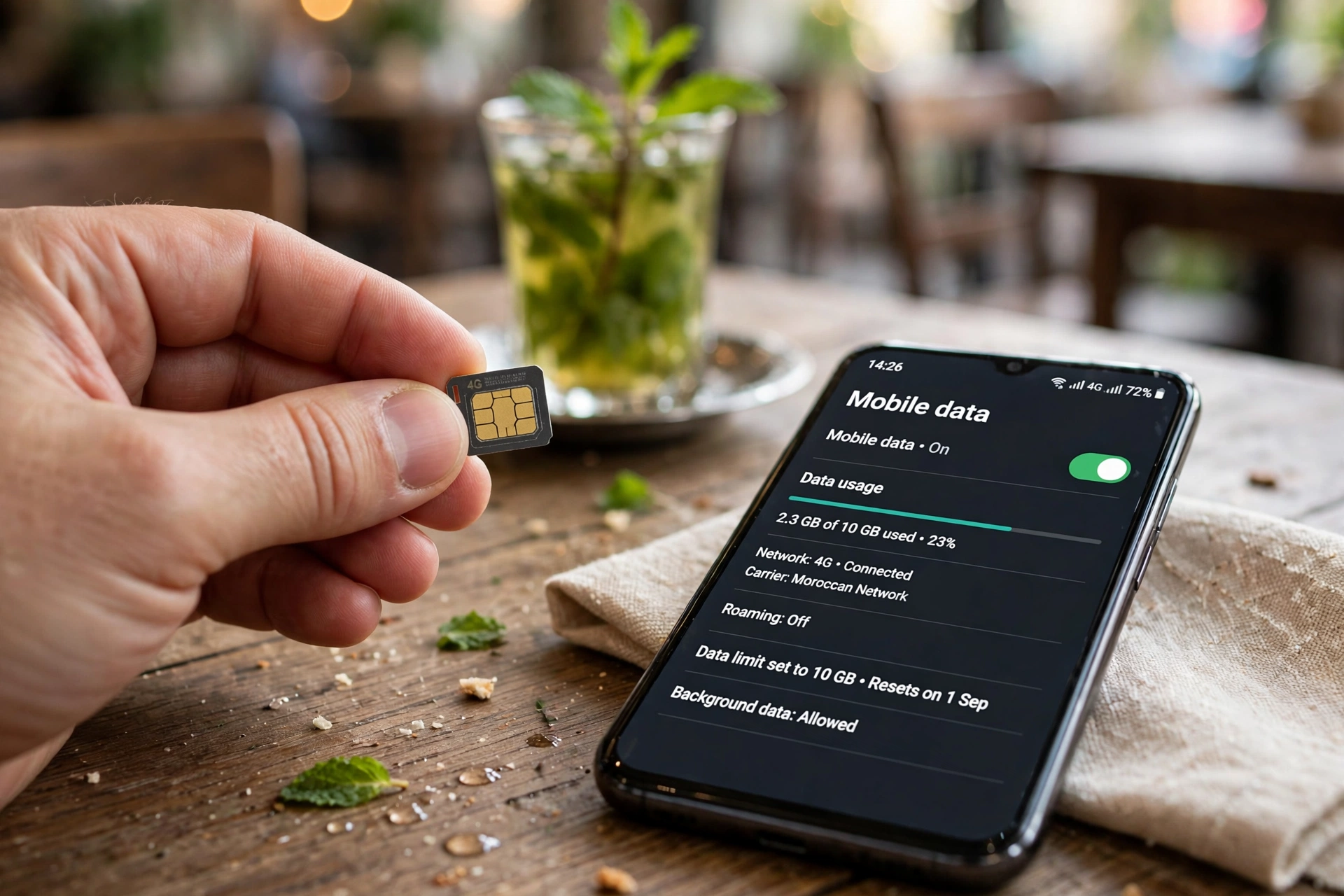
Mobile data is the unsung hero of Morocco internet for expats. The 4G networks cover the main cities, most towns and the motorways, and a prepaid SIM costs very little. For a new arrival, a local SIM is the fastest way online: maps, messages and banking work from the moment the card is active. Keep a generous bundle topped up as backup.
Buying a SIM at the Airport vs in Town
You can buy a SIM at Casablanca Mohammed V, Marrakech Menara, Rabat-Salé and Tangier airports, usually from a kiosk in arrivals. Airport SIMs are convenient and only slightly pricier, but plan choice may be limited. Bring your passport: registration is mandatory, and the card is usually active within minutes.
Buying in town is cheaper and gives you more choice, and it is how most long-stay expats handle Morocco internet for expats. Any agency or phone shop can sell a prepaid SIM and explain bundles in French or English. A basic SIM costs 20 to 30 MAD ($2–3), often with starter data. Top-ups are sold in supermarkets, corner shops and apps.
Mobile Data Plans and eSIM Options
Prepaid data bundles are the norm, and they are good value. Prices below are typical prepaid top-ups, checked in November 2026, in dirhams with approximate US dollar equivalents at about 10 MAD to $1. Allowances change with promotions, so confirm them when you buy.
| Operator | Data allowance | Price (MAD) | Approx. USD | Validity |
|---|---|---|---|---|
| Maroc Telecom | 5 GB | 50 MAD | $5 | 30 days |
| Maroc Telecom | 20 GB | 100 MAD | $10 | 30 days |
| Orange | 10 GB | 50 MAD | $5 | 30 days |
| Orange | 30 GB | 100 MAD | $10 | 30 days |
| inwi | 10 GB | 50 MAD | $5 | 30 days |
| inwi | 50 GB | 150 MAD | $15 | 30 days |
| Any operator | 1–2 GB top-up | 20 MAD | $2 | 7 days |
Monthly bundles of 20 to 50 GB for 100 to 200 MAD ($10–20) are the sweet spot for Morocco internet for expats, and they make tethering practical. Using your phone as a hotspot works on all three networks and is the simplest backup when fibre drops. A day of video calls can burn 2 to 3 GB, so set a data warning.
ESIM options are improving but still patchy. Some operators now offer eSIM for new lines, and international travel eSIMs work on Moroccan networks as data-only roaming, but they cost far more than a local SIM. For a stay of more than a week, a physical local SIM is almost always cheaper and faster. If your phone supports dual SIM, keep your home number on eSIM and put the Moroccan SIM in the physical slot.
5G: Early Days
Morocco began rolling out 5G in the main cities in 2025 and 2026, but coverage is still limited to central districts and business areas. Do not choose a flat or a phone plan because of 5G yet. A good 4G connection at 30 to 60 Mbps is more than enough for video calls, streaming and tethering, and it is available almost everywhere you are likely to live. Check 5G again in a year. For now, treat it as a bonus, not a requirement.
Working from Home: Speeds, Video Calls and Power Cuts
For remote workers, the real test of Morocco internet for expats is not a speed test but a working week. Can you hold a video call without freezing, and upload a large file before a deadline? On 100 Mbps fibre, yes. On good 4G, mostly yes. On old ADSL, maybe — which is why expats check connectivity before signing a lease.
Video calls need far less bandwidth than people assume: about 2 to 4 Mbps down for HD. What matters is stability and latency, not raw speed. A 20 Mbps line with low jitter beats a 200 Mbps line that drops packets. Plug in a cable if you can; if you must use Wi-Fi, sit near the router. See our overview of working in Morocco for the wider jobs picture.
Power Cuts and Backup Power
Power cuts happen in Morocco, though they are usually short in the big cities. A cut of a few minutes is common after a storm; several hours is rare but possible in summer. Fibre needs power, so when electricity goes, the router goes too. A small UPS keeps your router running for 30 to 60 minutes and costs 500 to 900 MAD ($50–90).
Your backup plan should have layers, and this is where Morocco internet for expats gets practical. First, the UPS keeps fibre alive through short cuts. Second, your phone hotspot takes over if fibre fails. Third, know your nearest coworking space, so a long outage becomes a change of scenery. Tell your team in advance.
VPNs and Working Across Borders
Many expats use a VPN for work, to reach a company network or to access services from their home country. VPNs work in Morocco, and the main providers run without blocking. Expect a speed drop of 10 to 30 percent when the VPN is on, because your traffic travels further. Choose a VPN server in Europe, ideally in France or Spain, for the lowest latency from Morocco. Keep the VPN off when you do not need it, so local browsing and calls run at full speed.
Coworking Spaces and Cafés with Reliable Wi-Fi
When home internet is not enough, Morocco internet for expats often means coworking. Casablanca has the largest choice; Rabat has smaller, quieter spaces; Marrakech targets digital nomads; Tangier has modern spaces near the port. A day pass costs 100 to 200 MAD ($10–20), and a monthly hot desk runs 1,500 to 3,000 MAD ($150–300), checked in November 2026.

A good coworking space gives you more than Wi-Fi: a desk, a chair that does not hurt your back, meeting rooms for calls, coffee, and other people who understand remote work. Visit before you buy a monthly pass. Test the Wi-Fi at your usual working hour, sit in the chair for an hour, and ask about the backup connection. The best spaces have a second internet line or a 4G failover, so a fibre cut does not stop work. Ask about opening hours too: some spaces close early on weekends, and that matters if your team works on Saturdays.
Café Wi-Fi Etiquette
Café Wi-Fi is everywhere in Morocco, and it is genuinely usable for light work: email, browsing, a short call with headphones. It is not a substitute for a home connection, because speeds are shared with every other customer and the connection can drop without warning. The etiquette is simple. Order something, and keep ordering if you stay for hours. Do not run long video calls at a small table during the lunch rush. Use headphones, keep your voice down, and tip well if you become a regular.
For longer sessions, choose larger cafés, hotel lobbies or malls, where Wi-Fi is built for crowds. Avoid café Wi-Fi for anything sensitive without a VPN, because public networks are shared. Save banking and confidential work for home or coworking. For many newcomers, this rhythm is what Morocco internet for expats looks like day to day.
Setting Up Internet in a Rented Apartment
Setting up Morocco internet for expats in a rented apartment is the most bureaucratic part of the move, and where newcomers lose time. Check which operators serve the building, choose a plan, gather documents, book installation and be present on the day. Follow that order and you will be online within a week.
Before you sign a lease, ask the landlord five questions. Is fibre installed, and with which operator? Can you take over an existing contract? Who pays the installation fee? Where is the router, and can you move it? Have there been power or internet problems? Our guide to renting an apartment in Morocco covers the lease itself. The cost of living in Morocco guide puts the internet bill in context.
Documents and Installation Wait Times
To open a fixed contract you usually need your passport, residency card or visa copy, proof of address such as the lease, and a Moroccan phone number. A prepaid mobile line may need only a passport, but fibre almost always needs a local address. Still waiting for residency? Ask if a passport and lease suffice, or use a 4G router meanwhile.
Installation wait times vary by city and season. In a building that is already fibred, installation typically takes 3 to 7 working days from signing. If the building needs a new fibre drop, the wait can stretch to 2 to 4 weeks, and in a busy period it can be longer. Book the appointment as soon as you have the keys, and be present for the visit: the technician needs access to the building’s fibre box. Ask for the technician’s number and confirm the time the day before.
Taking Over an Existing Line
The fastest option is often to take over the previous tenant’s line. Ask the landlord whether the contract can transfer to your name. A transfer avoids a new fee and wait, and the line is proven in that flat. Get it in writing, confirm the price, and check no unpaid bills attach to the line — a small part of Morocco internet for expats that saves real trouble.
Troubleshooting, Fair Use and Staying Connected
Even a good connection has bad days, and basic fixes save a lost morning — a practical truth of Morocco internet for expats. Restart the router and fibre box, wait two minutes and test again. Test with a cable to separate Wi-Fi trouble from line trouble. Check one device, then all of them, and check the operator’s app for a known outage.
If the line itself is down, call the operator’s support line or visit the nearest agency. Have your contract number ready, describe what you tested, and ask for a ticket number and an estimated repair time. Keep a record of every outage, with dates and times, because a pattern of failures is your evidence if you ask for a discount or a free month. If support is slow, a polite visit to the agency with your contract in hand usually moves faster than a phone call.
Fair Use and Data Caps
Fibre plans are sold as unlimited, and for normal use they are. Fair use matters only if you run a server or move terabytes monthly; then the operator may slow you at peak hours. Mobile data is different: prepaid bundles have hard caps, and data stops or slows sharply when the allowance ends. Top up before a big call, not during it.
A first-week checklist pulls this guide together. Day one: buy a local SIM and data bundle, and set up your hotspot. Day two: check fibre availability and visit the agency with your documents. Day three: test the flat’s Wi-Fi, ask the landlord the five questions, and order a UPS. By week’s end, know your nearest coworking space and test a video call from your desk. With a home line, mobile backup, UPS and a place to go when both fail, Morocco internet for expats becomes background, the way good infrastructure should be.
Frequently Asked Questions
How fast is fibre internet in Morocco for expats?
Most fibre plans advertise 100 or 200 Mbps, and a wired test in a well-connected building usually shows 80 to 190 Mbps down and 20 to 50 Mbps up. Wi-Fi speeds are lower, and evening speeds can dip when many households are streaming. A 100 Mbps plan is enough for video calls, streaming and cloud work for most households.
Which operator is best for internet in Morocco?
Maroc Telecom has the widest fixed network and the best rural mobile coverage, Orange is strong on fibre in the big cities, and inwi is competitive on price and mobile data. The best operator for you is usually the one already fibred in your building, so check availability by address before choosing on price alone.
Can I buy a SIM card at the airport in Morocco?
Yes. SIM cards are sold at Casablanca, Marrakech, Rabat and Tangier airports, and the card is usually active within minutes. Bring your passport for registration. Buying in town is slightly cheaper and offers more plan choices, so an airport SIM is best as a day-one solution.
How much does home internet cost in Morocco?
Fibre costs about 249 MAD ($25) a month for 100 Mbps and 349 MAD ($35) a month for 200 Mbps, checked in November 2026. Installation is often free on promotion or costs up to 200 MAD ($20). Mobile data bundles of 20 to 50 GB cost 100 to 200 MAD ($10–20) a month.
Do I need a VPN to work from home in Morocco?
You do not need a VPN for general use, and most expats only use one to reach a company network or services from their home country. VPNs work in Morocco, with a speed drop of about 10 to 30 percent. Choose a server in France or Spain for the lowest latency.
What should I do when the internet goes down during a power cut?
Use a UPS to keep your router running through short cuts, then switch to your phone hotspot if the fibre itself fails. For a long outage, move to a coworking space or a café with reliable Wi-Fi. Keep a mobile data top-up ready and save the operator’s support number before you need it.
1 thought on “Morocco Internet for Expats: Fibre, 4G and Working from Home”