
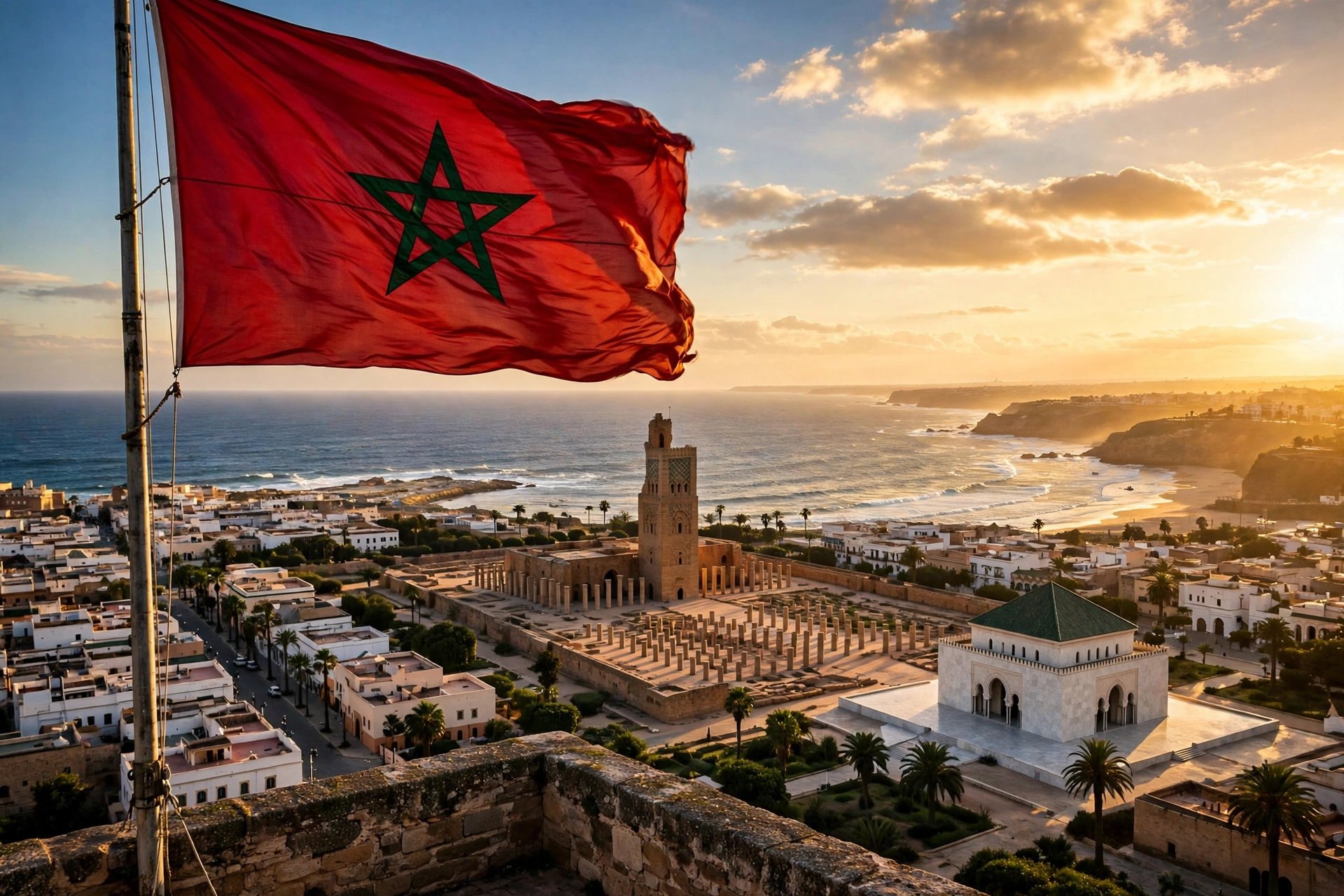
Stand on the Corniche in Casablanca at sunset and you will see the morocco flag history written across the skyline. The flag flies from the Hassan II Mosque, from ferry terminals and football stadiums, from tiny shops in the medina and from the dashboards of grand taxis. It is a plain red rectangle with a single green star in the middle, and it is one of the most recognisable flags in Africa. Yet most visitors who photograph it know nothing about it: not why it is red, not what the star means, and not how recently it took its present form.
The morocco flag history is shorter and stranger than most travellers expect. For centuries Morocco flew a plain red banner with no symbol at all. The green pentagram at the centre — the Seal of Solomon — was added only in 1915, by royal decree, in the middle of the French protectorate. It survived the protectorate, independence in 1956, and the Green March of 1975 to become the symbol every Moroccan carries today. This guide tells that story in full: the red field, the green star, the decree that joined them, and the moments when the flag mattered most.
The first thing outsiders get wrong is calling the green star a “Star of David” or assuming it is a religious symbol borrowed from somewhere else. It is neither. The five-pointed star on the Moroccan flag is the Seal of Solomon, an interlaced pentagram drawn in a single green line, and its meaning in Morocco is its own: a symbol of the link between God and the nation, and — in the reading most Moroccans learn at school — of the five pillars of Islam. That last reading, like several details in the morocco flag history, is debated by historians, and this article says so where the record is not settled. For the wider sweep of the country’s past, start with our pillar guide, A Brief History of Morocco: From the Mauretanian Kings to Today.
In this guide
- The Red Field: Why Morocco’s Flag Is Red
- The Green Pentagram: The Seal of Solomon
- Morocco Flag History Before 1915: Centuries of the Plain Red Banner
- The 1915 Dahir: The Decree That Created the Modern Flag
- The Flag Under the Protectorate, 1912–1956
- Independence and the Flag That Stayed, 1956
- The Green March, 1975: The Flag Becomes a Movement
- The Flag in Moroccan Life Today
- Seeing the Flag Yourself: Etiquette and Souvenirs
- Frequently Asked Questions
- Conclusion: A Flag That Arrived Late and Stayed
The Red Field: Why Morocco’s Flag Is Red
The red of the Moroccan flag is the oldest part of the morocco flag history, and it is also the simplest to explain. Red has been the colour of Moroccan sovereignty for centuries, long before the modern flag existed. It is the colour of the Alaouite dynasty, the royal house that has ruled Morocco since the seventeenth century, and of the Sharifian banner — the banner of a ruler who claims descent from the Prophet Muhammad. When a Moroccan sultan raised his standard, it was red, and everyone in the region understood what that meant.
Red also has a practical history. Before modern dyes, a plain red cloth was visible at sea from a great distance, which mattered for a country whose ports traded with Europe and whose corsair fleets operated out of Salé. The colour was a claim and a warning at once: this ship, this port, this land belongs to the Sultan of Morocco. That seafaring role runs through the whole morocco flag history, from the corsair era to the decree of 1915.
What red exactly? The record does not settle it neatly: today’s shade is often given as #C1272D, but historical banners varied with dye, cloth, and sun, and old engravings show everything from deep crimson to bright scarlet.
The Green Pentagram: The Seal of Solomon
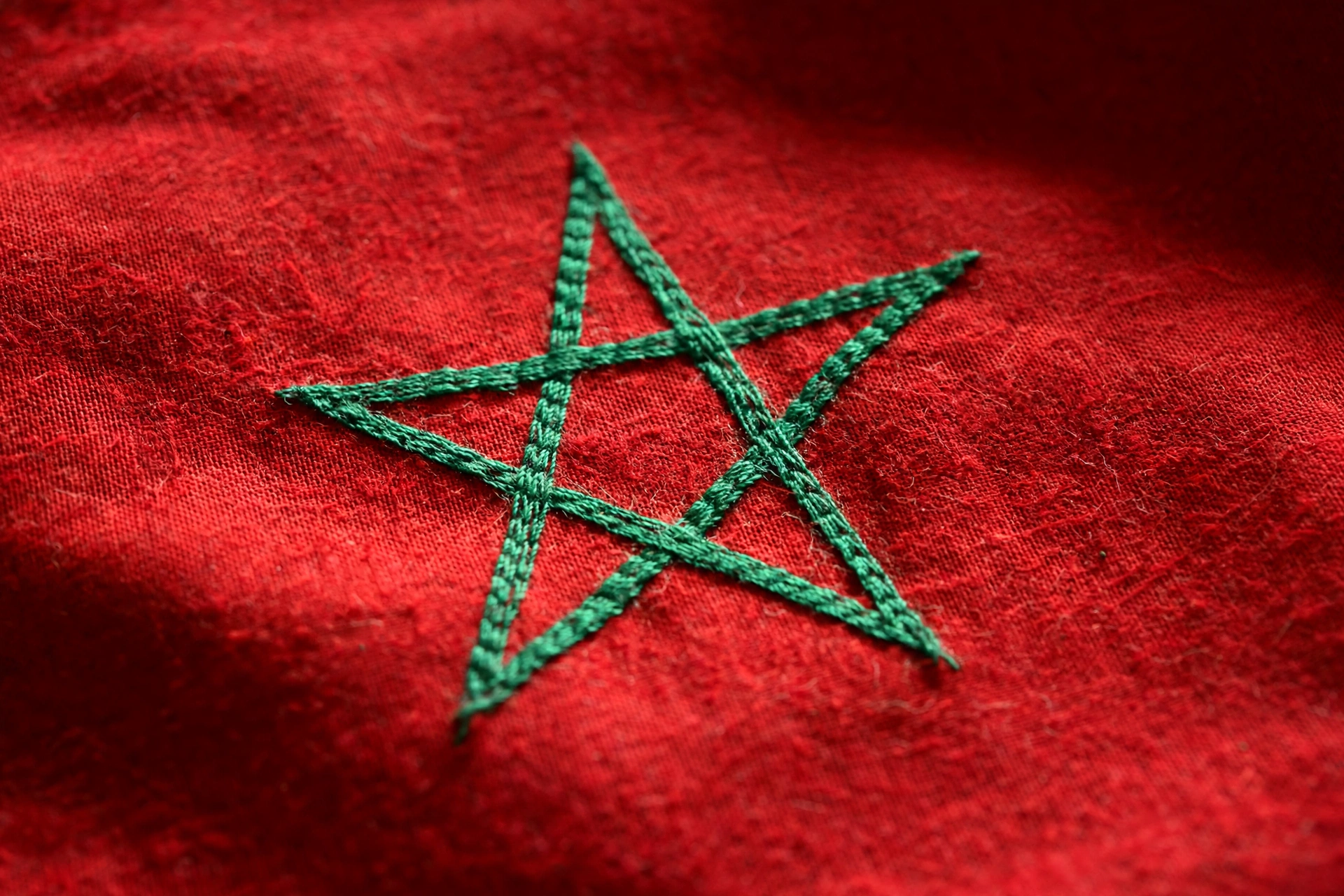
The green five-pointed star in the centre is the part of the morocco flag history that visitors ask about most, and it is the part most often explained badly. The star is a pentagram — a five-pointed star drawn with five straight lines that cross each other, forming a continuous interlaced pattern. In Morocco it is called the Seal of Solomon, after the Prophet Solomon, known in Arabic as Sulayman. You can read the full vexillological summary on the Flag of Morocco on Wikipedia, but the Moroccan understanding of the symbol is what matters here.
In the morocco flag history, the colour matters as much as the shape. Green is the colour of Islam, and it is also the colour of the Alaouite claim to descent from the Prophet. Placing a green star on a red field joins the two colours of Moroccan sovereignty into a single emblem: the red of the dynasty and the green of the faith. The star is drawn in outline only — a thin green line, not a solid shape — which gives the flag its distinctive look and makes it instantly recognisable even at a distance.
The most common explanation in Morocco is that the five points stand for the five pillars of Islam: faith, prayer, almsgiving, fasting, and pilgrimage. It is taught in many schools and repeated in many guides, but historians are careful: the 1915 decree says nothing about the five pillars, and no contemporary document explains the symbolism in those terms. The reading is probably a later interpretation, and this article records it as the popular understanding, not as a documented fact — an honest distinction the morocco flag history demands.
There is also an older reading: the pentagram predates Islam in the Mediterranean, appearing in ancient seals as a sign of protection, and Solomon’s seal was a symbol of legitimate, God-given authority — a quiet statement in 1915 that the throne’s authority came from God, not from Paris.
Morocco Flag History Before 1915: Centuries of the Plain Red Banner
For most of the morocco flag history, there was no star at all. From at least the seventeenth century, and probably earlier, the flag of Morocco was a plain red rectangle. Travellers’ accounts, naval charts, and European engravings from the 1600s onwards show Moroccan ships and fortresses flying solid red banners, sometimes with a small ornament near the hoist, but with no central emblem. The red banner was the flag of the sultan, of the army, and of the state, all in one.
The plain red flag created a practical problem at sea. Other powers also flew red ensigns — most famously, the British Red Ensign — and in the age of sail, a flag announced a ship’s identity before it came within gun range. Diplomatic correspondence of the nineteenth century records Moroccan ships mistaken for others, and vice versa. The need for a distinguishing mark was real, and it was felt first by sailors, not by politicians.
On land, the plain banner was carried into battle, raised over captured towns, and flown from the sultan’s camp when he travelled. In the pre-modern state, where the sultan’s authority was personal and had to be displayed, the red banner was the visible proof that his power had arrived — the flag of a person, not of a nation. The idea of a national flag belonging to the country itself would arrive later, with the 1915 decree.
The 1915 Dahir: The Decree That Created the Modern Flag
The turning point in the morocco flag history came on 17 November 1915, when Sultan Moulay Youssef issued a dahir — a royal decree — that changed the flag of Morocco forever. The decree ordered that the national flag should be red with a green five-pointed star in the centre, the Seal of Solomon, drawn in outline. From that day, the flag Morocco flies today has existed in its present form, with only the proportions and the exact shades standardised later.
Morocco had been under the French protectorate since the Treaty of Fes in 1912, effectively governed by the French Resident-General, Marshal Lyautey. Sultan Moulay Youssef, who had taken the throne in 1912, held limited power but real symbolic authority, and the flag was one of the few instruments of sovereignty still entirely his. Adding the Seal of Solomon marked the Moroccan flag as unmistakably Moroccan and unmistakably Muslim, at a moment when Morocco’s identity was under pressure — and it solved the old naval problem at a stroke: a red flag with a green star could not be confused with any other ensign.
One detail of the 1915 decree deserves a careful note, because it is often misreported. The decree specified a green pentagram, but the exact drawing — how thick the lines should be, how large the star should be relative to the flag — was not fixed with the precision a modern vexillologist would expect. Early versions of the flag show stars of slightly different sizes, and the interlacing of the lines varies in old photographs. The modern standard came later, as the flag was manufactured at scale — a nuance the morocco flag history keeps tripping up.
The Flag Under the Protectorate, 1912–1956
The forty-four years of the protectorate were the strangest chapter in the morocco flag history, because the flag was both everywhere and nowhere. On paper, Morocco remained a sovereign state and the sultan’s flag remained the flag of the country. In practice, French authority flew the tricolour over the administration, the army, and the ports, and the Moroccan flag became a symbol of what Morocco had been and what nationalists hoped it would be again.
That is precisely why the flag mattered so much to the nationalist movement, and why this period looms so large in the morocco flag history. The Istiqlal Party and the wider independence movement adopted the red flag with the green star as their emblem, and it appeared at demonstrations, on pamphlets, and in the windows of houses across the country. Flying it was, at times, an act of defiance, and its meaning shifted with the politics: it was no longer just the sultan’s banner, but the banner of the Moroccan nation itself.
The north had its own complication: Spanish Morocco, around Tetouan, was administered by Spain from 1912, and there the Moroccan flag flew alongside the Spanish one. The Tangier International Zone, which ran on its own strange rules from 1923 to 1956, is part of the same picture: a country divided on paper whose flag stayed whole. Our account of that city, Tangier’s International Zone 1923–1956: Spies, Writers and a City Between Worlds, shows how one Moroccan city lived through those divided decades.
The exile of Sultan Mohammed V in 1953 turned the flag into something more. When the French deposed the sultan and sent him to Madagascar, the red flag with the green star became the symbol of the absent king and of the nation waiting for his return. It flew at protests in Casablanca and Rabat and was carried by the Army of Liberation in the Rif and the Atlas, and when Mohammed V returned in triumph in November 1955, the flag was waiting for him.
Independence and the Flag That Stayed, 1956
Independence came on 2 March 1956, and one of the first acts of the new Moroccan state was, in effect, to do nothing to its flag — a quiet footnote in the morocco flag history that says a great deal. The red field and the green pentagram created by the 1915 dahir were kept exactly as they were, and the flag that had been the sultan’s banner and the nationalists’ emblem became, without a redesign, the flag of independent Morocco. That continuity is unusual: most newly independent states of the era designed a new flag to mark the break with the colonial past, while Morocco kept the flag it already had, because the flag had never belonged to the coloniser.
The years after independence standardised what the 1915 decree had left vague. The proportions were fixed at 2:3, the red is now commonly cited as #C1272D and the green as #006233, and the star’s size was fixed too: it fits inside an imaginary circle whose diameter is one-sixth of the flag’s length.
Moroccan law regulates the flag’s use: it must be flown from public buildings and must not touch the ground, though on holidays and match days the rules bend in practice.
| Period | Flag | What changed |
|---|---|---|
| Before 1915 | Plain red banner | No emblem; the sultan’s red standard, flown at sea and on land |
| 17 November 1915 | Red with green pentagram | Dahir of Moulay Youssef adds the Seal of Solomon |
| 1912–1956 | Same flag, divided country | Flown as nationalist emblem under French and Spanish rule |
| 2 March 1956 | Flag confirmed | Independent Morocco keeps the 1915 design unchanged |
| 1975 | Flag of the Green March | Carried by 350,000 marchers into the Sahara |
| Today | Standardised 2:3 | Official shades red #C1272D, green #006233 |
The Green March, 1975: The Flag Becomes a Movement
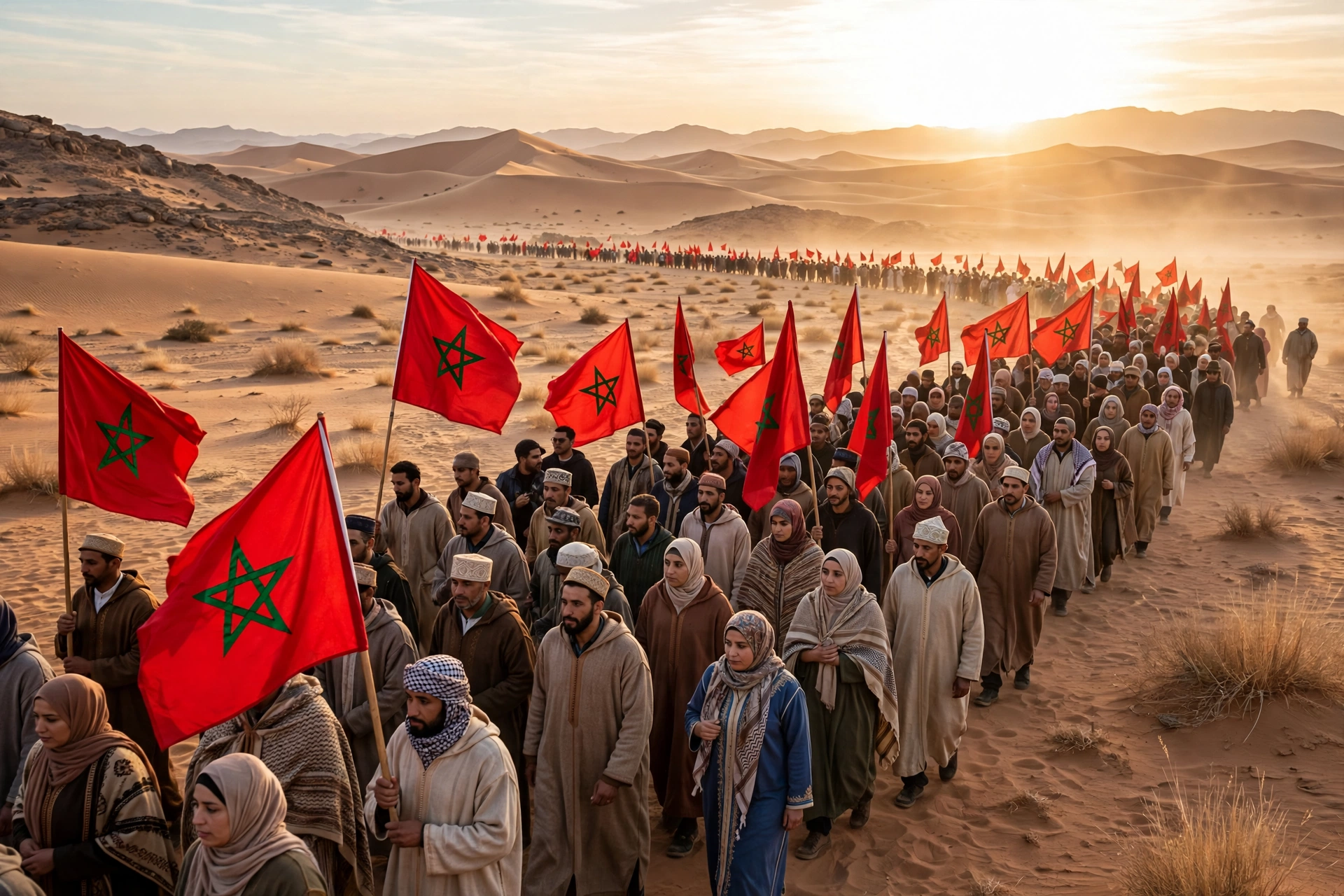
If one image defines the morocco flag history for most Moroccans alive today, it is the Green March of November 1975, when King Hassan II called on 350,000 unarmed civilians to walk south from Tarfaya into the Spanish Sahara carrying Qurans and Moroccan flags. The photographs of that column — a river of red flags stretching to the horizon — became the most famous images in modern Moroccan history.
The choice of the flag for the march was deliberate, and it is a central episode in the morocco flag history. The march was presented as a peaceful, religious act, and the flag was its visual argument: the green star spoke of Islam, the red field spoke of the nation. Within days, Spain agreed to withdraw through the Madrid Accords, and the flag carried into the desert became the flag of the recovered provinces. The march itself is told in full in our article The Green March of 1975: Morocco’s Peaceful March into History.
The Green March also changed how ordinary Moroccans related to their flag: before 1975 it flew mostly from official buildings, but after the march it belonged to everyone, appearing in homes, on cars, and at weddings, and it is commemorated every year on 6 November.
The Flag in Moroccan Life Today
Today the morocco flag history continues in the most ordinary places: the flag flies from the Hassan II Mosque in Casablanca and the Koutoubia in Marrakech, from every school, town hall, and police station in the country. It is printed on the Moroccan passport and stamped on the coins in your pocket — the first thing you see when your plane lands, and the last thing you see when you leave.
The flag has also become a sporting symbol, never more so than during the 2022 World Cup in Qatar, when Morocco became the first African and Arab team to reach the semi-finals. The red flag with the green star filled stadiums from Doha to Casablanca, and the Atlas Lions’ run did for the flag abroad what the Green March had done at home. For more on planning a trip around the places where the flag flies, see the official Visit Morocco site.
Seeing the Flag Yourself: Etiquette and Souvenirs
Visitors will see the flag everywhere, and a little etiquette goes a long way: treat it with respect. Do not let it touch the ground, do not step on it, and do not use it as a tablecloth or a beach towel. Photographing the flag is fine, but showing it torn, dirty, or on the ground is considered disrespectful. Moroccans are generous about tourists who show enthusiasm for the flag; the offence comes from carelessness, not from curiosity.
If you want a flag of your own — a small piece of the morocco flag history to take home — the medinas sell them in every size. A small hand flag costs around 10–20 MAD ($1–2) from a street vendor, a medium flag for a balcony runs 30–60 MAD ($3–6), and a large, well-made flag of about 150 × 90 cm costs 80–150 MAD ($8–15) in a shop. Quality varies: the cheapest flags are printed on thin polyester and fade within a season, while the better ones are sewn with an embroidered star and last for years. Check the star before you buy — on the cheapest flags the pentagram is printed slightly off-centre. Prices checked November 2026.
The best places to see the flag flown properly are the grand flagpoles of the big cities: the vast pole on the Rabat Corniche, the flag over the Hassan II Mosque in Casablanca, and the flags over the kasbahs of the south around Aït Ben Haddou, covered in our guide The Kasbahs of Morocco: Aït Ben Haddou and Beyond. The flag also flies over Moulay Idriss Zerhoun, near Volubilis, where the founder of the first Moroccan dynasty is buried — a place where the red flag and the green star meet the very beginning of the Moroccan state, as told in our article on The Idrisids: Morocco’s First Dynasty and the Founding of Fes.
| Fact | Detail |
|---|---|
| Design | Red field, green pentagram (Seal of Solomon) in outline |
| Proportions | 2:3 (height to length) |
| Red shade | #C1272D (standardised; historical shades varied) |
| Green shade | #006233 (the green of the pentagram) |
| Created | Dahir of 17 November 1915, Sultan Moulay Youssef |
| Confirmed | 2 March 1956, independence — design unchanged |
| Star meaning | Seal of Solomon; popularly read as the five pillars of Islam (unverified in the decree) |
| Small flag | 10–20 MAD ($1–2) from street vendors |
| Large flag (150 × 90 cm) | 80–150 MAD ($8–15) in shops |
Frequently Asked Questions
Why is the Moroccan flag red?
Red is the colour of the Alaouite dynasty and of the Sharifian banner, flown by Moroccan sultans for centuries before the modern flag existed. The red field of the morocco flag history predates the green star by hundreds of years, and it was the flag of the sultan, the army, and the state long before 1915.
What does the green star on the Moroccan flag mean?
The star is the Seal of Solomon, a five-pointed interlaced pentagram. In Morocco it is understood as a symbol of the link between God and the nation, and it is popularly read as representing the five pillars of Islam — although the 1915 decree that created the flag does not say so, and historians treat that reading as a later interpretation rather than a documented fact.
When was the Moroccan flag created?
The flag in its present form dates from a dahir issued by Sultan Moulay Youssef on 17 November 1915, which added the green pentagram to the plain red banner Morocco had flown for centuries. Independent Morocco kept the design unchanged at independence on 2 March 1956.
Is the Moroccan flag the same as the flag of the Green March?
The Green March of November 1975 was carried out under the same flag — the red field with the green star — and the march made the flag a popular symbol for ordinary Moroccans. The marchers carried Qurans and Moroccan flags as they walked south from Tarfaya into the Sahara.
What are the official colours of the Moroccan flag?
The standardised shades are red #C1272D and green #006233, on a flag with proportions of 2:3. Historical banners varied in shade, and cheap modern flags still do — check the star is centred and the green is a deep, clear green before buying.
Can tourists buy a Moroccan flag?
Yes, flags are sold in every medina and souvenir shop in the country. A small hand flag costs 10–20 MAD ($1–2), and a large flag of about 150 × 90 cm costs 80–150 MAD ($8–15). Treat the flag with respect: do not let it touch the ground, and do not use it as clothing or a table covering.
Conclusion: A Flag That Arrived Late and Stayed
The morocco flag history is a story of a symbol that arrived late and then refused to change. For centuries Morocco flew a plain red banner, and the green star that defines the flag today has existed for barely a century — added by decree in 1915, carried through the protectorate as a symbol of resistance, kept unchanged at independence in 1956, and carried into the desert in 1975. It is a young flag by the standards of national symbols, and that youth is part of its strength: every part of it is documented, every part of it is deliberate, and none of it is an accident of the distant past.
The flag works because it is simple. A child can draw it: a red rectangle and a green star. A sailor could recognise it at sea, a marcher could carry it across the desert, and a football fan can paint it on their face — the red of the dynasty and the green of the faith in a single image. The morocco flag history is, in the end, the story of a country that knew exactly what it was long before it had a flag to say so.