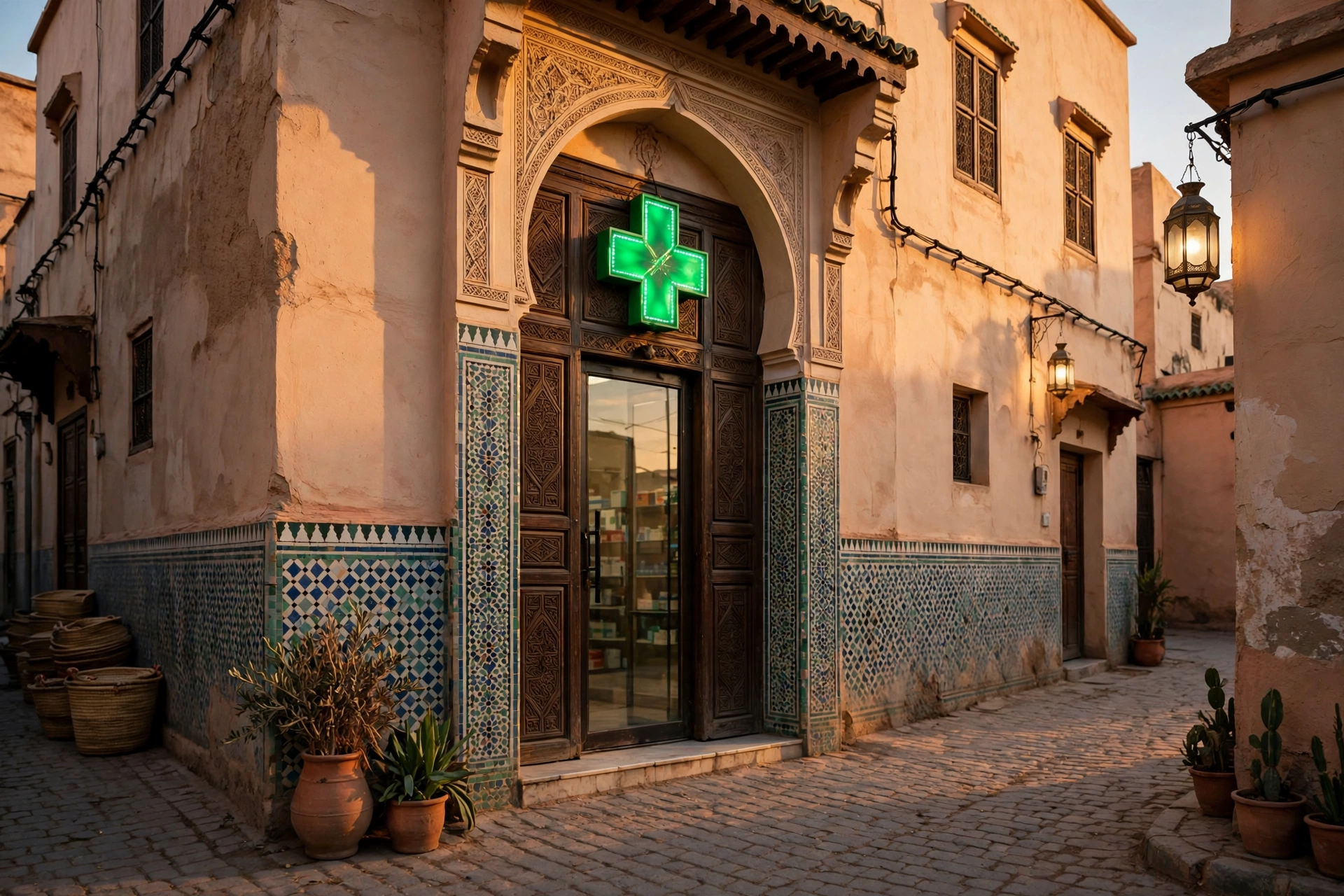
You will spot a Moroccan pharmacy before you need one. The green cross glows above the door on every main street, in every medina, and in villages so small they barely have a second shop. Step inside and the first surprise is the price: a box of paracetamol costs about the same as a mint tea, and most everyday medicines sell for a few dirhams. The morocco pharmacy prices printed on the box are the same in Casablanca and in a mountain town, because the state fixes them — and that makes Morocco one of the cheapest places in the world to fall mildly ill.
This guide explains the morocco pharmacy prices travellers actually pay, in dirhams and dollars, and the system behind them: which medicines need a prescription, how the on-duty pharmacy works at night and on Sundays, what to pack before you fly, and how to get a receipt your travel insurance will accept. Prices were checked in November 2026, and every figure below is a typical shelf price.
One warning before the detail: this is a practical guide, not medical advice. A pharmacist can help with a cold, a stomach upset, or a blister, but chest pain, a high fever that will not break, or a serious injury belongs in a clinic or hospital. For the wider picture of clinics and insurance, read our guide to Healthcare in Morocco for Expats — and for general trip planning, the official Visit Morocco site is the reference most travellers start from.
In this guide
- How Moroccan Pharmacies Work
- Morocco Pharmacy Prices: What Common Medicines Cost in 2026
- Prescriptions in Morocco: What Needs One and What Does Not
- Over-the-Counter Medicines: What You Can Buy Freely
- Why Morocco Pharmacy Prices Are Low and Regulated
- What to Pack Before You Travel
- Pharmacies at Night and on Sundays: The On-Duty System
- Paying and Getting Reimbursed
- Common Traveller Ailments and What to Ask For
- Red Flags: Fake Medicines and What to Avoid
- Frequently Asked Questions
- Conclusion: Cheap, Regulated and Easy to Use
How Moroccan Pharmacies Work
A Moroccan pharmacy — a pharmacie — is a private shop run by a qualified pharmacist, and there are thousands of them. In cities you will find one every few streets; in the medina they sit among the market stalls; in small towns the pharmacy is often the only healthcare on the main road. Look for the green cross, usually lit at night, and the word Pharmacie in French or Arabic script. Most pharmacists speak French, and many speak some English.
Opening hours follow the Moroccan working day. A typical city pharmacy opens around 9 in the morning, closes for lunch between about 1 and 3 in the afternoon, and stays open until 7 or 8 in the evening, Monday to Saturday. In the medina, hours bend to the market, and during Ramadan the whole rhythm shifts to the evening. The morocco pharmacy prices you pay do not change with the hour.
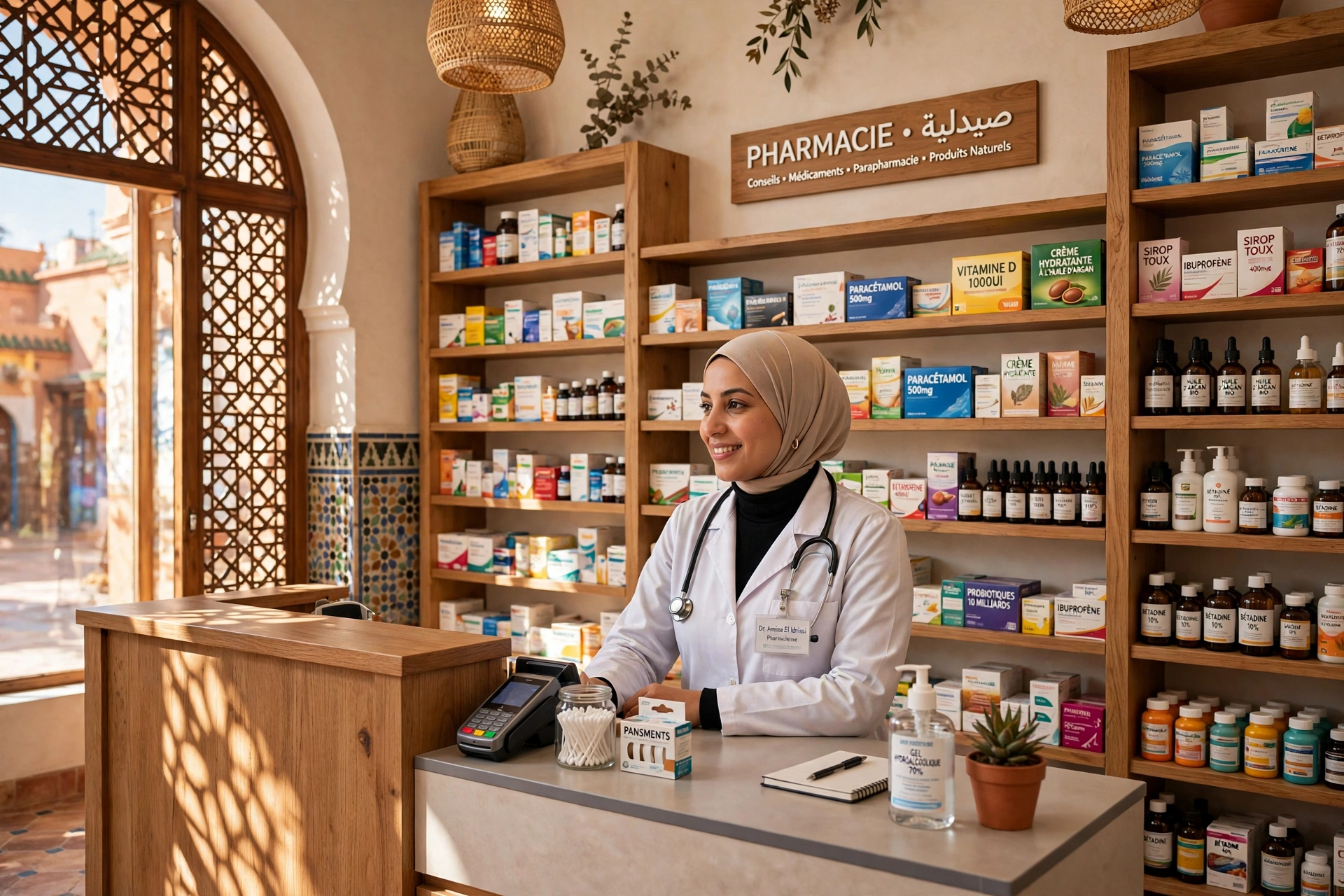
The pharmacist is not just a shopkeeper. Moroccan pharmacists train for years, and they are used to being the first person a sick traveller talks to. Describe your symptoms plainly — a headache, a sore stomach, a blister from walking the medina — and the pharmacist will usually suggest a medicine, explain the dose, and tell you when to see a doctor instead. The advice is free.
Morocco Pharmacy Prices: What Common Medicines Cost in 2026
Here is the heart of this guide: the morocco pharmacy prices for the medicines travellers actually buy. Prices are regulated by the state, so the figures below are typical across the country, with small variations by brand and city. The exchange rate used is about 10 dirhams to the US dollar.
| Medicine | What it is for | Typical price (MAD) | Approx. (USD) |
|---|---|---|---|
| Paracetamol 500 mg (Doliprane), box of 16 | Pain and fever | 13 | $1.30 |
| Ibuprofen 400 mg, box of 20 | Pain and inflammation | 22 | $2.20 |
| Cetirizine 10 mg, box of 14 | Allergies and hay fever | 34 | $3.40 |
| Omeprazole 20 mg, box of 14 | Heartburn and stomach acid | 58 | $5.80 |
| Loperamide (Imodium), box of 20 | Diarrhoea | 28 | $2.80 |
| Oral rehydration salts, one sachet | Rehydration after diarrhoea | 12 | $1.20 |
| Smecta (diosmectite), box of 10 sachets | Upset stomach and diarrhoea | 26 | $2.60 |
| Antiseptic spray and plasters | Cuts and blisters | 24 | $2.40 |
| Sunscreen SPF 50, 150 ml | Sun protection | 120 | $12.00 |
| Insect repellent spray | Mosquitoes and biting insects | 75 | $7.50 |
| Artificial tears eye drops | Dry and dusty eyes | 32 | $3.20 |
| Throat lozenges, one box | Sore throat | 18 | $1.80 |
| Motion sickness tablets, box of 10 | Travel sickness | 22 | $2.20 |
| Salbutamol inhaler (Ventolin) | Asthma relief | 72 | $7.20 |
| Amoxicillin 500 mg, box (prescription) | Bacterial infection | 55 | $5.50 |
Three things stand out from the morocco pharmacy prices in that table. First, the basics are almost free by European or American standards: paracetamol, rehydration salts, and throat lozenges together cost less than a sandwich. Second, imported brands cost more — a French sunscreen at 120 dirhams is the most expensive item on the list, while the Moroccan-made equivalent is often half that. Third, an antibiotic course costs about the same as two coffees. That is the payoff of price regulation, and it is why experienced travellers buy their travel kit in Morocco rather than packing it all from home.
Prescriptions in Morocco: What Needs One and What Does Not
Morocco draws a clear line, at least on paper, between medicines you can buy freely and medicines that need a prescription. Painkillers, antihistamines, antacids, rehydration salts, antiseptics, and most skin creams are sold over the counter with no paperwork at all. Antibiotics, strong painkillers, sleeping tablets, and anything classed as a controlled substance legally require a prescription from a doctor. The morocco pharmacy prices for the two groups are equally low — the prescription is about safety, not money.
In practice the line is softer than the law suggests: many pharmacies will sell antibiotics to a traveller who explains the problem, especially outside the big cities. Do not build your plans on that. If you need a prescription medicine, a short visit to a private clinic — a consultation typically costs 150 to 300 dirhams — will get you the prescription the pharmacy needs.
One rule is absolute: never buy a controlled medicine without a prescription, and never carry someone else’s prescription medicines across a border. Keep your medicines in their original boxes, keep the prescription with them, and keep the pharmacy receipt — the same paperwork that keeps you legal also makes an insurance claim far easier. If you take regular prescription medicine, bring a supply covering your whole trip plus a few extra days, with a copy of the prescription showing the generic name, not just the brand: brand names change between countries, but the generic name is universal, and a Moroccan pharmacist can usually match it to the local equivalent. A rare or very new drug may not be stocked, and a remote town may not have it at all.
Over-the-Counter Medicines: What You Can Buy Freely
Walk into any pharmacy and the shelves behind the counter hold most of what a traveller needs without a prescription. Paracetamol and ibuprofen, antihistamines for dust and pollen, antacids for rich food, rehydration salts, plasters and antiseptic, eye drops for the desert wind, and throat lozenges are all sold freely. So are vitamins, most skin creams, lip balm with sun protection, and the basic first-aid supplies you would expect anywhere — all at the low morocco pharmacy prices this guide lists.
Learn the French names, because they are the names on the boxes. Paracetamol is usually sold as Doliprane, the medicine Moroccans reach for first. Smecta is the standard remedy for an upset stomach. Antihistamines go by Cetirizine or its brand names, and an inhaler is a Ventoline. A few words of French — j’ai mal à la tête for a headache, j’ai mal au ventre for a stomach ache — will get you further than a phrasebook of English.
Children’s medicines deserve a note. Moroccan pharmacies stock paediatric syrups and suppositories, and the pharmacist will ask the child’s age and weight before selling them. Do not guess a dose for a child, and do not give a child an adult tablet cut in half unless the pharmacist tells you to.
Why Morocco Pharmacy Prices Are Low and Regulated
The reason morocco pharmacy prices are so low is not a market accident — it is policy. Morocco regulates the price of medicines through the Ministry of Health, which sets a public price for each drug, known as the prix public Maroc. The price is printed on the box, the pharmacy must sell at that price, and the price is the same in every pharmacy in the country.
The system works because Morocco makes many of its own medicines: local manufacturers produce generic versions of the most common drugs, far cheaper than imported brands. A Moroccan-made paracetamol costs a few dirhams; the imported brand costs more for the same molecule, and pharmacists will usually offer the local version first. For a summary of how the health system behind this works, see Healthcare in Morocco on Wikipedia.
There are limits to what regulation can do. Imported medicines — a specific foreign brand of sunscreen, a new drug still under patent, a specialist treatment — cost more, sometimes much more. And prices do move: the Ministry revises the list and the dirham moves against the euro and the dollar. The figures in this guide are typical shelf prices from November 2026, accurate enough for budgeting. The practical consequence is simple: you do not need to shop around, because the first pharmacy you see charges the same as the fifth.
What to Pack Before You Travel
The cheapest medicine is the one you already own, but the smartest packing is a mix: bring the medicines only you can get at home, and buy the rest in Morocco, where morocco pharmacy prices make a travel kit cost less than a restaurant meal.
| Item | Pack from home or buy in Morocco? | If bought in Morocco |
|---|---|---|
| Regular prescription medicines | Pack — full trip supply plus a few days extra | Bring the prescription with the generic name |
| Paracetamol and ibuprofen | Buy — cheaper in Morocco | About 13–22 MAD a box |
| Oral rehydration salts | Buy | About 12 MAD a sachet |
| Antihistamines | Buy | About 34 MAD a box |
| Sunscreen SPF 50 | Pack if you are loyal to a brand; otherwise buy | About 120 MAD for 150 ml |
| Insect repellent | Buy | About 75 MAD a spray |
| Plasters, antiseptic, bandages | Buy | About 24 MAD for the basics |
| Motion sickness tablets | Buy | About 22 MAD a box |
| Eye drops | Buy | About 32 MAD a bottle |
| Thermometer and small first-aid kit | Buy on arrival | About 30–60 MAD |
| Inhaler or EpiPen | Pack — and carry the prescription | Ask a pharmacist if you run out |
Pack your prescription medicines in your hand luggage, never in a checked bag, and keep them in their original boxes with the labels on. If your luggage is delayed, the medicine you need is the one you cannot buy without a prescription.
Two items deserve special attention. If you use an inhaler, bring a spare — the Moroccan equivalent is easy to find, but the brand may differ. If you carry an EpiPen, bring two and check the expiry date: EpiPens are available in Morocco, but not in every small-town pharmacy.
Pharmacies at Night and on Sundays: The On-Duty System
Pharmacies close on Sundays and at night, but Morocco never leaves you without one. The system is called the pharmacie de garde — the on-duty pharmacy — and it works on a rota. In every town, one pharmacy stays open through the night and all day Sunday, then hands over to the next one. The rota is posted on the door of every pharmacy, and it is also published online.
Finding the on-duty pharmacy is easy in a city and a little harder in a small town. In the city, look for the glowing green cross — the on-duty pharmacy leaves its cross lit — or check the list on the nearest closed pharmacy’s door. Online, search for pharmacie de garde plus the name of your town, or ask your hotel reception. A local SIM card makes this a thirty-second job — see our guide to SIM Cards and Mobile Data for Visitors.
At night, expect a different kind of service: the on-duty pharmacist may serve you through a small window or hatch rather than opening the shop. Have cash ready — card machines work in most pharmacies, but the on-duty window at 2 in the morning is not the place to discover yours does not. The morocco pharmacy prices printed on the box do not change after dark. If the on-duty pharmacy is across town, a petit taxi will get you there for a few dirhams; see our guide to Morocco Taxi Prices so you know the fare before you get in.
If you need a pharmacy on a public holiday, the rota covers that too: the on-duty pharmacy stays open, and hospitals keep their emergency departments running. During Eid, when whole towns shut down for days, check the rota before the holiday starts — your hotel will have the list.
Paying and Getting Reimbursed
Paying in a Moroccan pharmacy is simple: cash or card, with cash the safer bet in small towns and in the medina. Most city pharmacies take cards, but a pharmacy in a village may not, and the on-duty hatch at night may be cash-only. Carry small notes and keep coins for the exact change. At current morocco pharmacy prices, a day’s medicines rarely cost more than a hundred dirhams.
Always ask for a receipt, and check that it lists the medicines you bought. The receipt — a facture — is the document your travel insurance wants if you claim the cost back. Most policies cover medicines bought abroad when they are linked to a medical problem, but the claim needs the receipt, and sometimes a prescription or a doctor’s note. Photograph the receipt as a backup the moment you leave the shop.
Residents play by different rules. Morocco’s mandatory health insurance (AMO) and the older CNSS system reimburse part of the cost of prescribed medicines, but only with a prescription, a receipt, and the right paperwork filed on time. If you live in Morocco, keep every receipt and ask your pharmacist which medicines are reimbursable; if you are a visitor, your travel insurance is the route to a refund.
One more money detail: prices are quoted per box, not per tablet, and the box is the unit the pharmacy sells. A box of paracetamol is 13 dirhams whether you need one tablet or sixteen. The upside is that the box goes home with you. For the wider picture of what daily life costs, see our Cost of Living in Morocco guide and the full set of price guides in our Costs & Practical Life section.
Common Traveller Ailments and What to Ask For
Most travel illness in Morocco is small, predictable, and easy to treat at the pharmacy. A stomach upset from new food, water, or a change of diet is the classic case: the pharmacist will usually suggest rehydration salts first, then Smecta, then loperamide if the diarrhoea persists. Take the salts seriously — dehydration in the Moroccan heat is a bigger risk than the stomach bug itself. If it lasts more than two days, or comes with a high fever or blood, stop self-treating and see a doctor.
Sun and heat are the second classic. Sunscreen is sold everywhere, but the Moroccan sun at midday is stronger than most visitors expect, and a burn on the first day can ruin a week. Buy sunscreen before you need it, reapply after swimming, and wear a hat in the desert and the mountains. Heat exhaustion — headache, dizziness, nausea after a long walk in the sun — is treated with rest in the shade, water, and salts. Resting it off is easier in a comfortable room; our guide to Morocco Hotel Prices shows what a good night’s recovery costs.
Dust, pollen, and the dry wind of the Atlas or the Sahara irritate eyes and noses, and antihistamines and artificial tears handle both. Motion sickness on mountain roads — the Tizi n’Tichka pass is famous for it — is best treated before the journey: take a tablet half an hour before the road climbs, sit in the front seat, and look at the horizon. Blisters from walking the medina are the most Moroccan ailment of all: buy plasters and antiseptic before the walk, and change them daily.
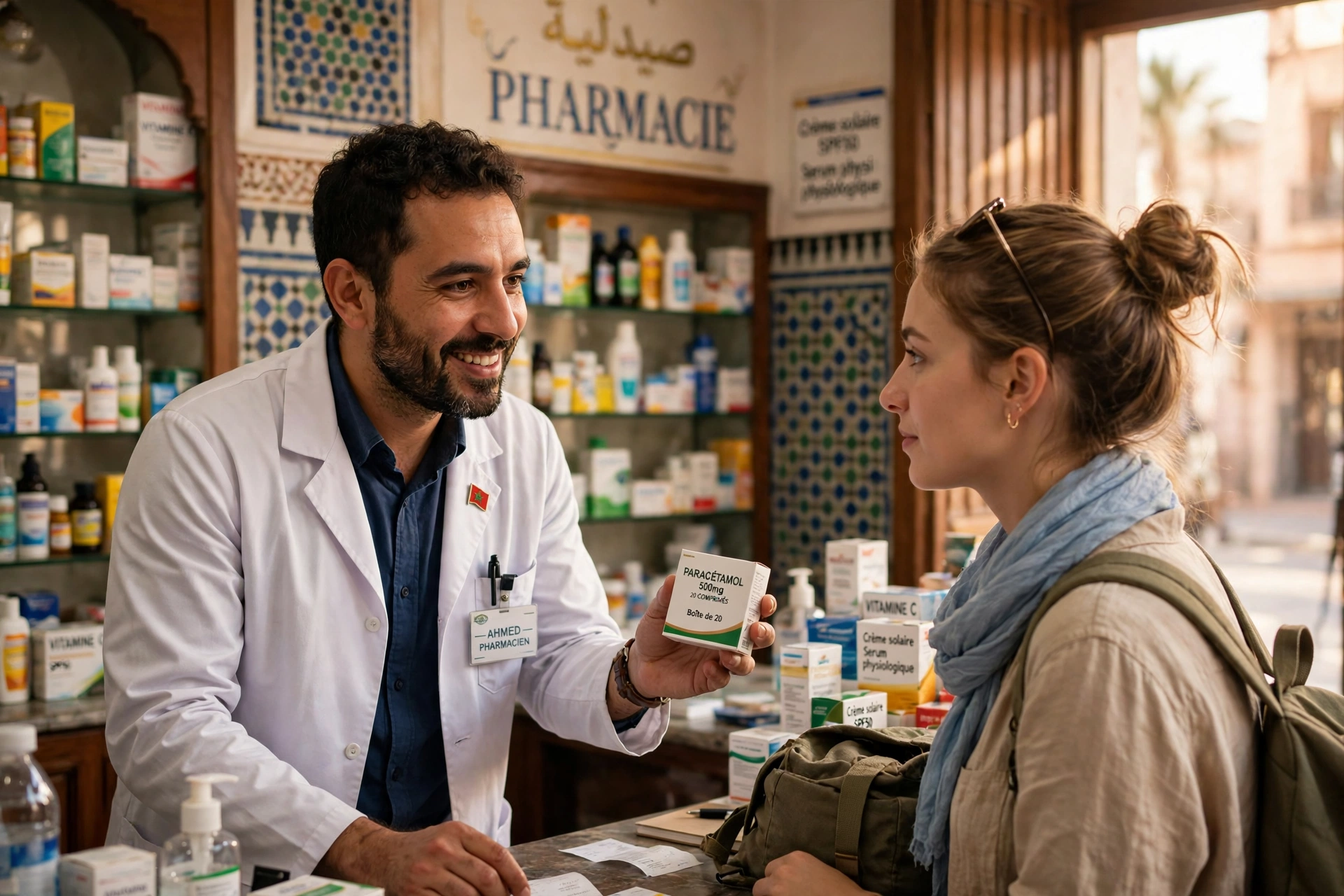
The question to ask the pharmacist is always the same: describe the symptom, say how long it has lasted, and mention any medicines you already take. The pharmacist needs to know about allergies, pregnancy, and regular medication before recommending anything. A traveller who says “I have a headache” gets paracetamol; a traveller who adds blood-pressure tablets and an ibuprofen allergy gets advice worth having — and pays the same low morocco pharmacy prices either way.
Red Flags: Fake Medicines and What to Avoid
Morocco’s regulated pharmacies are safe, and the morocco pharmacy prices printed on the box are your best protection against being overcharged. The risk sits outside the system: in the souk, from a street seller, or from a shop that is not a pharmacy at all. Never buy medicines from a market stall or a street vendor. A box bought in the souk may be expired, stored in the heat, or counterfeit, and the saving is never worth it.
Check the box before you pay. The price should be printed on the packaging, the expiry date should be clear and in the future, and the box should be sealed and undamaged. A box with a torn seal, a faded label, or an unreadable expiry date is a box to refuse. The pharmacist will not be offended — checking the box is normal.
Be careful with medicines you do not recognise. A pharmacist may offer a local brand you have never heard of, which is usually fine — but do not accept a medicine when you cannot read the name on the box or the pharmacist cannot explain what it is for, and never accept an antibiotic from anyone who is not a pharmacist or a doctor. Medicines come from pharmacies, and nowhere else.
One last caution, for the road home. Do not stock up on prescription medicines to take home in bulk. Customs limits apply, and a suitcase full of antibiotics looks like a business, not a holiday.
Frequently Asked Questions
How much do medicines cost in a Moroccan pharmacy?
At current morocco pharmacy prices, most everyday medicines cost between 10 and 60 dirhams — roughly $1 to $6. Paracetamol is about 13 dirhams, rehydration salts about 12, and a course of antibiotics about 55. Sunscreen and imported brands cost more, but the basics are among the cheapest in the world.
Do I need a prescription to buy medicine in Morocco?
No prescription is needed for painkillers, antihistamines, antacids, rehydration salts, and most everyday medicines. Antibiotics, strong painkillers, sleeping tablets, and controlled substances legally require a prescription from a doctor.
Are morocco pharmacy prices the same everywhere in the country?
Yes, for regulated medicines. The state sets a public price for each drug, the price is printed on the box, and every pharmacy must sell at that price, from Casablanca to a mountain village. Imported brands and unregulated items can vary.
What is a pharmacie de garde?
It is the on-duty pharmacy — the one pharmacy in each town that stays open at night, on Sundays, and on public holidays, on a rota. The rota is posted on the door of every pharmacy, and the on-duty pharmacy keeps its green cross lit.
Can I pay by card in a Moroccan pharmacy?
Most city pharmacies accept cards, but small-town pharmacies and the on-duty window at night are often cash-only. Carry small notes and coins, and always ask for a printed receipt.
What should I do if my prescription medicine runs out in Morocco?
Take the empty box and your prescription to a pharmacy — the pharmacist can usually match the generic name to the local equivalent. If the medicine needs a prescription, a private clinic visit (typically 150–300 dirhams) will get you one. Bring a spare supply from home for anything rare or essential.
Conclusion: Cheap, Regulated and Easy to Use
Morocco is an easy country in which to fall mildly ill, and that is a compliment. The green cross is everywhere, the pharmacist will advise you for free, and the morocco pharmacy prices are fixed, printed, and low: a box of paracetamol for the price of a mint tea and a travel kit for less than a restaurant meal. The system rewards the traveller who knows three things — the French names of the common medicines, the on-duty rota, and the habit of asking for a receipt.
Pack the medicines only you can get at home, buy the rest on arrival, and keep the boxes and the paperwork. The pharmacy is one of the few places in Morocco where you never need to bargain or worry about being overcharged — and after a day in the souk, that is a relief in itself. At these morocco pharmacy prices, a well-stocked travel kit is the cheapest insurance on your trip.
Last checked: November 2026. Prices are typical shelf prices in Moroccan pharmacies; the dirham-to-dollar conversion uses about 10 MAD to US$1.