
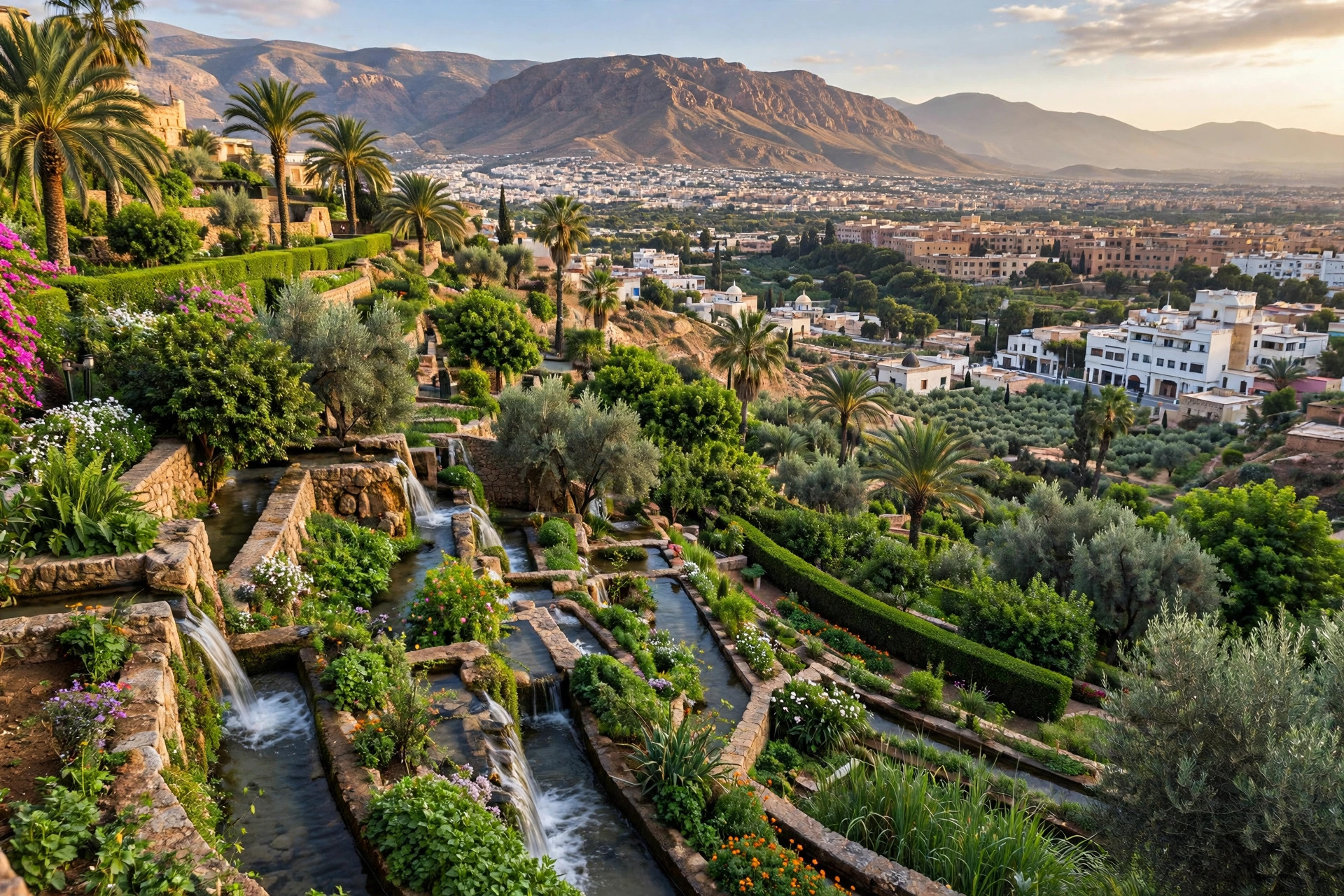
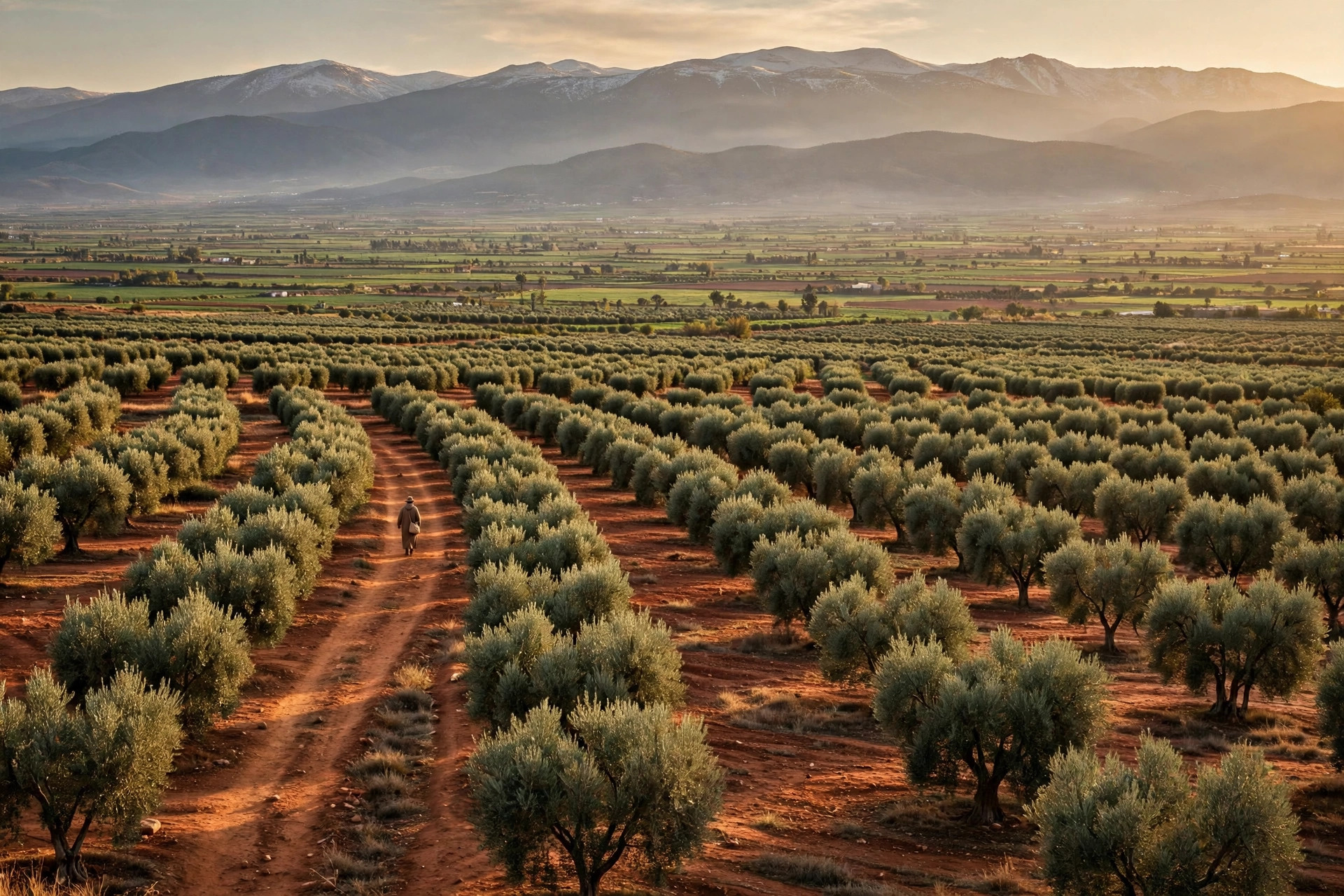
Living in Beni Mellal is Morocco's green-heart choice: a regional capital of 209,594 people (2024 census) at 620 metres in the foothills of the Middle Atlas, where the Ain Asserdoun spring waters the gardens above the city and olive groves cover the Tadla plain below. For expats who want mountain air, low rents and a real working city without a tourist show, living in beni mellal is one of the most honest choices in the country.
This guide covers the neighbourhoods, rents and routines that make a move to Beni Mellal work. It sits in our Living in Morocco section.
Beni Mellal is the capital of the Beni Mellal-Khénifra region, and it grew from 192,676 residents in 2014 to 209,594 in 2024. The Kasbah Ras El Ain above the springs was built in 1688 under Sultan Moulay Ismail to guard the water that made the plain fertile. Today it is a market town, a university town and the gateway to the lakes and waterfalls of the Middle Atlas.
In this guide
- Why Expats Choose Living in Beni Mellal
- Beni Mellal at a Glance
- Best Neighbourhoods for Living in Beni Mellal
- Rents and Housing: What You Pay in 2026
- Monthly Cost of Living in Beni Mellal
- Weather: Hot Summers, Cool Mountain Nights
- Getting Around: Buses, Grand Taxis and No Train Station
- Working and Living in Beni Mellal: Remote Work, Teaching and the University
- Daily Life: Souks, Springs and the Tadla Table
- Healthcare in Beni Mellal
- Schools for Expat Families
- The Downsides of Living in Beni Mellal
- Moving to Beni Mellal: Your First Steps
- Frequently Asked Questions
- Conclusion: Is Beni Mellal Right for You?
Why Expats Choose Living in Beni Mellal
The single biggest reason expats choose living in beni mellal is the price. Expat guide data for November 2026 puts a one-bedroom flat in the centre at around 1,900 MAD a month, about $190, and outside the centre at around 1,250 MAD, about $125. Groceries and transport follow the same pattern, so a foreign pension or remote salary stretches further here than in any coastal city.
The second reason is the setting. Beni Mellal sits where the Middle Atlas meets the Tadla plain, so the city has spring water, green gardens and mountain views. Living in beni mellal means cool evenings under Jbel Tassemit, which rises to 2,247 metres behind the town, and a lake and a waterfall both within a short drive.
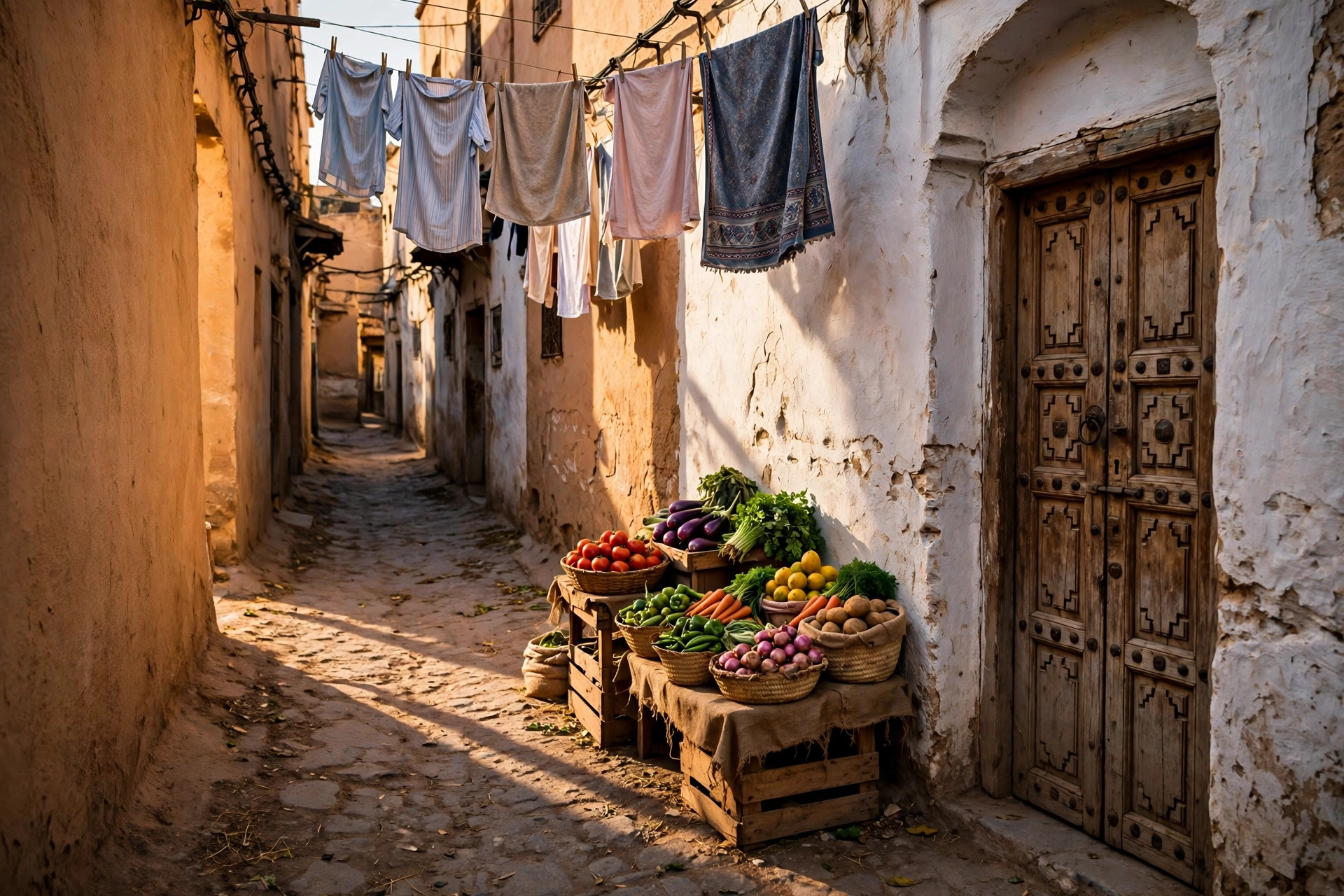
The third reason is the authenticity. Beni Mellal receives almost no international tourists, so the medina is a working market rather than a showpiece and newcomers are treated as neighbours rather than customers. If you want to live inside Moroccan life rather than beside it, living in beni mellal gives you that from the first week.
Beni Mellal at a Glance
| Fact | Detail |
|---|---|
| Population (city, 2024 census) | 209,594 |
| Population (2014 census) | 192,676 |
| Population (region, 2024 census) | 2,525,801 |
| Region | Beni Mellal-Khénifra |
| Kasbah Ras El Ain built | 1688, under Sultan Moulay Ismail |
| Elevation | ~620 m |
| Jbel Tassemit (behind the city) | 2,247 m |
| Distance to Casablanca | ~200 km |
| Distance to Marrakech | ~180 km |
| Distance to Fes | ~240 km |
| Distance to Bin El Ouidane lake | ~35 km |
| Distance to Ouzoud Falls | ~90 km |
| Climate | Hot-summer Mediterranean, July mean ~27.8°C, January mean ~7.8°C |
| Annual rainfall | ~558 mm |
| Best months | March to May and September to November |
| Famous for | Ain Asserdoun springs, olive groves, Tadla plain, Kasbah Ras El Ain |
| Main languages | Arabic, French; Tamazight widely spoken; English limited |
Best Neighbourhoods for Living in Beni Mellal
The centre-ville around Avenue Mohammed V is where most expats land first. Banks, cafes and pharmacies all sit here, and the flats are practical: one- and two-bedroom apartments with balconies, often furnished, from about 1,800 MAD a month.
The Ain Asserdoun area is the greenest place to live in town. The spring gardens and the kasbah sit on the hillside above the centre, and the streets below them are quieter and leafier than downtown.
Hay Al Massira is a modern district with newer apartment blocks, wider streets and parking. The flats are bigger and brighter than in the centre, with two- and three-bedroom family flats around 2,000–3,000 MAD a month.
Hay Riad is a calm, middle-class neighbourhood with small villas, modern apartment buildings and local shops on every corner. Rents match Hay Al Massira.
The university area around Boulevard Ibn Khaldoun is the youngest part of town. Student flats and cheap cafes cluster here, with small one-bedroom flats for 1,000–1,600 MAD a month. For many newcomers, living in beni mellal starts here, in a cheap flat near the campus.
Rents and Housing: What You Pay in 2026
Rents for anyone living in beni mellal are the city's strongest argument. Expat guide data for November 2026 puts a one-bedroom flat in the centre at around 1,900 MAD a month (about $190), and outside the centre at around 1,250 MAD (about $125), while a three-bedroom flat in the centre runs around 2,700 MAD (about $270) and outside the centre around 1,900 MAD (about $190). A listing survey from October 2026 found a lower median of 1,390 MAD for a one-bedroom, so budget for the higher figure.
Search on Avito, Mubawab and local agencies, and always view in person before paying anything. Landlords often ask for two months' rent as a deposit, and an agency fee of about one month's rent is common. Read our guide to renting an apartment in Morocco before you sign, and check whether the price includes syndic charges of 200–500 MAD a month. Winter nights are cold at this altitude, so ask about heating.
| Housing type | Monthly rent (MAD) | Monthly rent (USD) |
|---|---|---|
| 1-bed, outside centre | 1,000–1,500 | $100–$150 |
| 1-bed, centre | 1,800–2,000 | $180–$200 |
| 2-bed flat, Hay Al Massira / Hay Riad | 2,000–2,500 | $200–$250 |
| 3-bed, outside centre | ~1,900 | ~$190 |
| 3-bed, centre | 2,500–3,000 | $250–$300 |
| Villa, Ain Asserdoun / south | 4,000–6,500 | $400–$650 |
| Student flat, university area | 1,000–1,600 | $100–$160 |
| Deposit (typical) | 2 months' rent | — |
| Agency fee (typical) | ~1 month's rent | — |
Last checked: November 2026. Prices are typical ranges from expat guide data and vary by building, floor and furnishing.
Monthly Cost of Living in Beni Mellal
A single expat can live comfortably here on 6,500–9,500 MAD a month, a couple on 10,000–14,000 MAD and a family of three on 13,500–19,000 MAD. Expat guide data for November 2026 puts a single person's total at about $614 a month including rent, roughly 6,140 MAD, with groceries around $185 a month and utilities around 352 MAD. The monthly cost of living in beni mellal sits about 28% below the national average, and well below Marrakech and Rabat.
| Monthly expense | Single (MAD) | Couple (MAD) | Family of three (MAD) |
|---|---|---|---|
| Rent (1–3 bed flat) | 1,250–2,700 | 2,000–3,500 | 2,500–4,500 |
| Groceries and markets | 1,200–1,850 | 2,000–3,200 | 3,000–4,500 |
| Eating out and cafes | 500–1,000 | 800–1,600 | 1,200–2,500 |
| Utilities and internet | 400–800 | 550–1,000 | 700–1,300 |
| Transport (taxis, buses) | 300–700 | 500–1,000 | 700–1,400 |
| Health insurance | 300–800 | 600–1,500 | 1,000–2,500 |
| Leisure and weekends | 300–700 | 500–1,000 | 800–1,500 |
| Total | 6,500–9,500 | 10,000–14,000 | 13,500–19,000 |
| Total (USD) | $650–$950 | $1,000–$1,400 | $1,350–$1,900 |
Last checked: November 2026. Budget ranges are typical for November 2026 and vary by lifestyle.
Weather: Hot Summers, Cool Mountain Nights
Beni Mellal has a hot-summer Mediterranean climate, shaped by its 620-metre elevation and the mountains behind it. The annual mean is about 17.3°C, and about 558 mm of rain falls in a year. July is the hottest month, with a daily mean of 27.8°C and afternoon highs around 35.7°C, while January is the coldest, with a daily mean of 7.8°C and night lows near 1°C.
The best months are March to May and September to November, when the days are mild and the Atlas is green. Summer heat is the price of the low rents: afternoons above 38°C push outdoor life into the early morning and the evening. Winter nights are genuinely cold, and snow sometimes caps Jbel Tassemit above the city.
Houses here have little insulation and no central heating, so most expats heat with butane gas heaters in winter and keep the shutters closed in summer. The upside is the mountain air: summer nights stay cooler than on the Tadla plain below, and the dry air beats the humidity of the coast.
Getting Around: Buses, Grand Taxis and No Train Station
Beni Mellal has no train station of its own. The nearest rail hub is Khouribga, about 100 kilometres west, where ONCF trains run to Casablanca in about two and a half hours for 55–120 MAD. From Khouribga, a bus covers the last stretch in about one hour and forty minutes for 55–85 MAD. Book trains on ONCF Voyages.
In practice, most travel here is by bus. CTM runs to Casablanca in about four hours for 140–200 MAD, and to Marrakech in about three and a half hours for roughly 80–150 MAD. Buses to Fes take around four and a half hours, and to Rabat around five hours. For the lake and the waterfalls, take a grand taxi or hire a car: Bin El Ouidane is about 35 kilometres away, and Ouzoud Falls about 90 kilometres.
Inside the city, petits taxis cost 7–10 MAD for a ride across town, and the centre is small enough to cross on foot. Beni Mellal Airport (BEM) sits about 4 kilometres north, but scheduled flights are extremely limited, so most expats fly through Marrakech Menara, about 175 kilometres away, or Casablanca Mohammed V. Living in beni mellal without a car is perfectly doable, but a car turns the lakes and waterfalls into weekend options.
| Route | Mode | Time | Price (MAD) |
|---|---|---|---|
| Beni Mellal – Marrakech | Bus (CTM) | ~3.5 h | 80–150 |
| Beni Mellal – Casablanca | Bus (CTM) | ~4 h | 140–200 |
| Beni Mellal – Casablanca | Train + bus via Khouribga | ~4.5–5.5 h | 110–205 |
| Beni Mellal – Fes | Bus | ~4.5 h | 120–180* |
| Beni Mellal – Rabat | Bus | ~5 h | 150–220* |
| Beni Mellal – Bin El Ouidane | Grand taxi / car | ~45 min | 40–60 per seat |
| Beni Mellal – Ouzoud Falls | Grand taxi / car | ~1.5 h | 80–120 per seat |
| Airport (BEM) – centre | Taxi | ~15 min | 30–50 |
| Across town | Petit taxi | 5–10 min | 7–10 |
| Across town | On foot | 10–20 min | Free |
Last checked: November 2026. Fares marked * are typical ranges; check CTM at booking. Fares vary by class, date and how far ahead you book.
Working and Living in Beni Mellal: Remote Work, Teaching and the University
The economy here is agriculture, trade, public administration and the university rather than tourism or industry. The Tadla plain grows olives, oranges and sugar beet. Most foreign residents are retirees, remote workers, language teachers and a few academics at Sultan Moulay Slimane University, founded in 2007 and now home to more than 40,000 students.
For remote workers, living in beni mellal is a trade-off worth weighing. Fibre internet is spreading in the newer districts and speeds are generally enough for video calls, but coverage is patchy in older buildings. There is no coworking space in town, so most people work from home or a cafe. Low costs stretch a foreign salary further than almost anywhere else in Morocco.
French is the working language of the university, the administration and most businesses, and English teaching work is thinner here than in Casablanca. A few hours of French a week will change your experience more than any other single investment, and a little Darija opens the souk. If your income depends on meeting clients in person, the four-hour bus to Casablanca is a cost to count.
Daily Life: Souks, Springs and the Tadla Table
Daily life here runs on the souk, the bakery and the cafe. The medina market sells vegetables, olives, spices and bread at prices that make weekly shopping a pleasure, and the Tadla plain puts oranges and olive oil on every table. Evenings belong to the cafes of Avenue Mohammed V and the gardens of Ain Asserdoun.
Food here is plain and generous: tagines, grilled meats, harira and bread from the neighbourhood oven. A restaurant lunch costs 40–70 MAD and a mint tea 6–10 MAD. The kasbah above the springs is free to visit, and the view from its walls across the plain is the best in town.
Weekends are for water. Bin El Ouidane lake sits about 35 kilometres south, a turquoise reservoir in a limestone gorge with boat trips and lakeside lodges, and Ouzoud Falls, about 90 kilometres east, is Morocco's highest waterfall at 110 metres. Both are easy day trips by car and nearly empty on weekdays. Living in beni mellal means a quiet working week in a market town and a mountain lake or a waterfall at the weekend.
Healthcare in Beni Mellal
Beni Mellal has local clinics, private practices and pharmacies for routine care, and a GP consultation runs 150–300 MAD. The city also has a regional hospital for serious cases, so most expats living in beni mellal do not need to travel to Casablanca or Marrakech for hospital care. A new 520-bed university hospital is under construction and should open around 2028.
Register with the CNSS if you are employed locally, and take out private health insurance as well: decent international cover costs roughly 300–800 MAD a month for a single person, and it gets you seen quickly in a private clinic. Pharmacies are plentiful, and most pharmacists speak French. For specialist treatment, some expats still travel to Casablanca, about four hours by bus.
Schools for Expat Families
Families should plan schooling carefully: there is no large international school in Beni Mellal and no French AEFE school in town. Most expat families choose a local private school with French teaching, and younger children pick up French and Arabic fast. Public schools are free but taught in Arabic, and nurseries are plentiful at 1,000–2,500 MAD a month.
For older children who need an international curriculum, Beni Mellal is a harder choice: families either accept a French-language private school, look at boarding options in Casablanca or Rabat, or plan for home schooling. The university offers French-language degrees in town for older teenagers. Living in beni mellal with school-age children works best when the school choice is settled first and the neighbourhood second.
The Downsides of Living in Beni Mellal
Honesty first: Beni Mellal is not for everyone. The expat community is tiny, and winter can feel lonely when the city quiets down and the nights turn cold. If you need a buzzing social life in English, living in beni mellal means making your own fun or taking the bus to Marrakech, three and a half hours away.
Services are limited: no coworking space, no big international supermarket, and no train station, so every trip to Casablanca or Rabat starts with a bus. Summer heat is real, and the city has little shade outside the spring gardens. French or Arabic is not optional here: daily life runs in both, and English alone will leave you dependent on others for simple tasks.
Moving to Beni Mellal: Your First Steps
Start with a scouting trip: spend a week here, walk up to Ain Asserdoun at sunset and view three or four flats. Most expats decide within days whether living in beni mellal suits them, and a week here costs less than a weekend in Casablanca.
On paperwork, the standard path applies: enter on a 90-day tourist stamp, then apply for a carte de séjour at the police prefecture with your rental contract, bank statements and health insurance. Our Morocco carte de séjour renewal guide walks through the documents and the timeline, and our Morocco visa costs guide covers the fees. Open a bank account early and bring certified translations of key documents. Living in beni mellal becomes simple once the residence card is in your pocket.
- Visit for a week and choose your neighbourhood.
- Secure a long-term rental with a written contract.
- Open a bank account and arrange health insurance.
- Apply for your carte de séjour within the first 90 days.
- Learn basic French and Darija before you arrive if you can.
- Join the local expat and university networks once you land.
Frequently Asked Questions
Is Beni Mellal a good place for expats to live?
Yes, for the right expat. Beni Mellal suits remote workers, retirees and families who want low rents, mountain air and a genuine Moroccan city with a lake and a waterfall nearby. It is less suited to anyone who wants a large English-speaking social scene.
How much does it cost to live in Beni Mellal?
A single expat needs roughly 6,500–9,500 MAD a month, a couple 10,000–14,000 MAD, and a family of three 13,500–19,000 MAD, including rent. A one-bedroom flat costs 1,000–2,000 MAD depending on the area.
How do I get to Beni Mellal without a car?
By bus. CTM runs from Casablanca in about four hours for 140–200 MAD and from Marrakech in about three and a half hours for roughly 80–150 MAD. There is no train station: the nearest rail hub is Khouribga, about 100 kilometres west.
What is the weather like in Beni Mellal?
Hot summers and cool winters: July averages 27.8°C, January averages 7.8°C with nights near 1°C, and rain is about 558 mm a year. March to May and September to November are the best months.
Is Beni Mellal safe for foreigners?
Yes. Beni Mellal is a calm, family-oriented city with low street crime by Moroccan standards. Normal precautions apply: watch your bag at the station and the souk, and use registered taxis after dark.
Are there French or international schools in Beni Mellal?
No. There is no French AEFE school and no large international school in the city, so families use local private schools with French teaching or look to Casablanca and Rabat. Nurseries cost 1,000–2,500 MAD a month.
Conclusion: Is Beni Mellal Right for You?
For expats who value price, water and mountain air over comfort and buzz, living in beni mellal is the choice: a regional capital of 209,594 people with a kasbah built in 1688 above its springs, rents from 1,250 MAD, a turquoise lake 35 kilometres south and Morocco's highest waterfall ninety minutes east. It will not entertain you like Marrakech or employ you like Casablanca, but it will give you a comfortable, affordable, genuinely Moroccan life at the lowest cost in central Morocco.
Visit for a week and test living in beni mellal yourself: walk up to Ain Asserdoun at sunset and visit Bin El Ouidane. If the quiet feels like freedom rather than boredom, Beni Mellal is your town — and our Morocco in 25 days route is a good way to see the rest of the country first.
Last checked: November 2026