
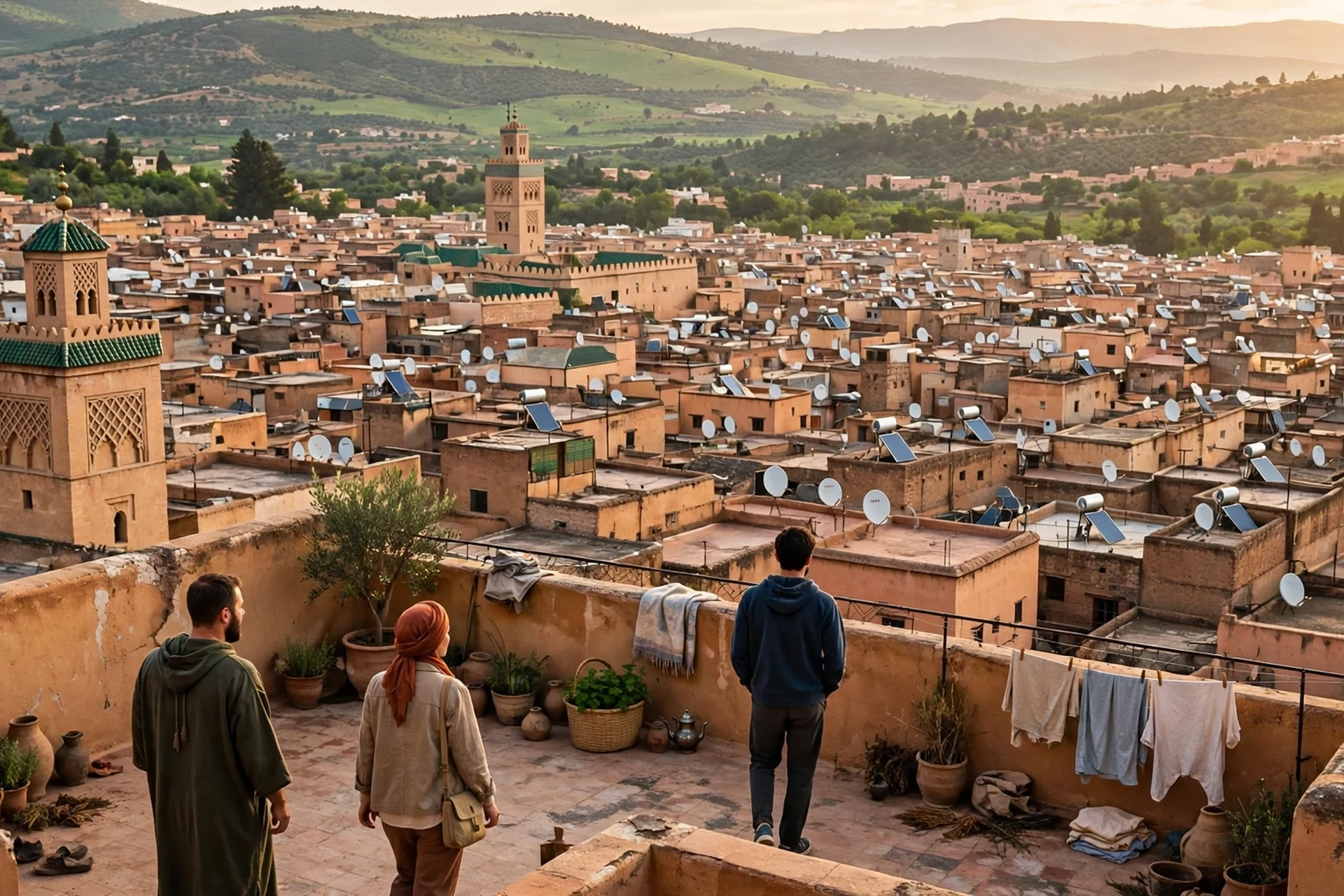
Living in Fes is Morocco at its most complete: a city where the world's oldest university still teaches beside tanneries that have worked leather the same way for a thousand years. If Marrakech is Morocco with the volume turned up, living in Fes is Morocco at full depth — quieter, older and more serious about itself.
Fes rewards patience more than any other Moroccan city. It is not a beach town, and its famous medina can confuse a newcomer for weeks. But the expats who settle here tend to stay: rents are lower than in Marrakech or Casablanca, the food is widely considered the best in the country, and the city sits within reach of the Middle Atlas, the Roman ruins of Volubilis and the blue streets of Chefchaouen. It sits in our Living in Morocco section, alongside our wider Living in Morocco: The Complete Guide for Expats.
In this guide
- Why Expats Choose Living in Fes
- Fes at a Glance
- Best Neighbourhoods for Living in Fes
- Rents and Housing: What You Pay in 2026
- Monthly Cost of Living in Fes
- Weather: Cold Winters, Hot Summers and the Middle Atlas
- Working Remotely While Living in Fes
- Daily Life: Food, Crafts and Getting Around
- Healthcare and Schools
- The Downsides: Who Should Not Move Here
- Practical Steps to Move to Fes
- Frequently Asked Questions
- Conclusion: Is Living in Fes Right for You?
Why Expats Choose Living in Fes
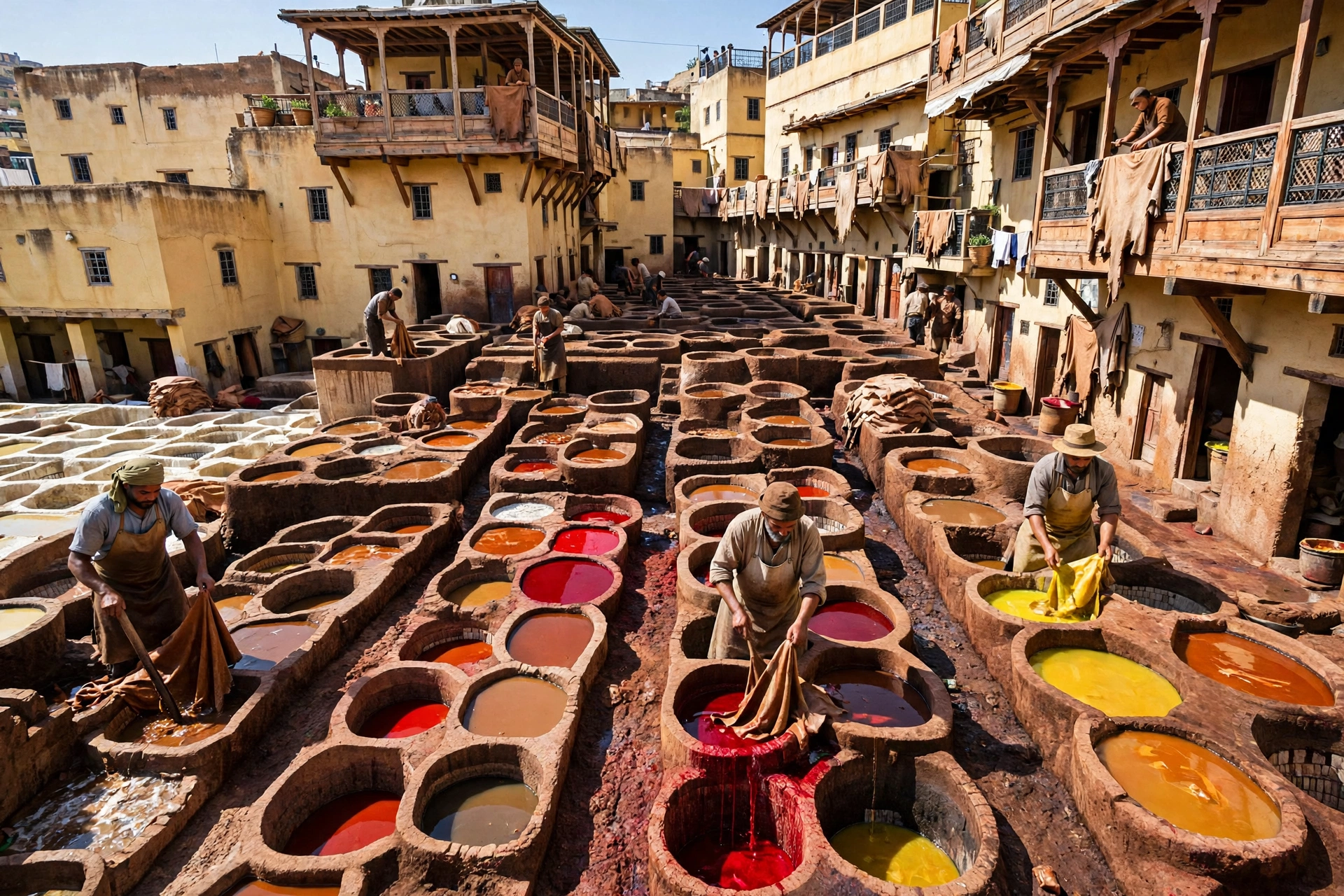
Fes was founded in 789 and has been a centre of learning, craft and trade ever since. The University of al-Qarawiyyin, founded in 859 by Fatima al-Fihri, is recognised as the oldest existing university in the world, and Fes el Bali is one of the largest car-free urban areas on earth. Living in Fes today means sharing a city with potters, brass workers, calligraphers and tanners whose trades have barely changed in centuries — a living museum that is also a working city.
The foreign community is small and easy to join, which is part of the appeal. It mixes French retirees, American and British academics, aid workers, language students and remote workers who traded Marrakech's crowds for something quieter. There is no big expat bubble here: you will know your baker and your neighbours, and living in Fes becomes genuinely Moroccan much faster than in the resort cities.
The trade is honest: Fes gives you history, authenticity and some of the lowest living costs in Morocco, and asks you to accept a conservative, slower city with cold winters and a medina that takes months to learn. For many expats, living in Fes is exactly the point — a city that asks something of you and gives a great deal back.
Fes at a Glance
Living in Fes rewards a little homework: the city is really three cities in one — the medieval medina of Fes el Bali, the 13th-century royal city of Fes el Jdid, and the French-built Ville Nouvelle — and choosing between them shapes everything from your rent to your daily walk.
| Fact | Detail |
|---|---|
| Population | About 1.2 million in the urban area |
| Region | Fes-Meknes, between the Rif and the Middle Atlas |
| Altitude | About 410 metres above sea level |
| Time zone | GMT+1 (Western European Time) |
| Languages | Darija (Moroccan Arabic), French widely spoken, English less common than in Marrakech |
| Nearest airport | Fes-Saiss (FEZ), 15 km south of the city |
| Nearest beach | About 3.5 hours by road to the Atlantic coast |
| Nearest ski slopes | Michlifen, about 1.5 hours by road in the Middle Atlas |
| Best months to arrive | April to June, or September to November |
| Currency | Moroccan dirham (MAD), about 10 MAD to 1 USD |
Best Neighbourhoods for Living in Fes
The first decision in living in Fes is the neighbourhood: the medina or the new city. Fes el Bali offers riads with courtyards and carved plaster, but also narrow lanes and no cars. The Ville Nouvelle offers apartments and wide avenues, but less of the magic that brought you here.
Batha sits between the two worlds and is the favourite of many long-term residents. It has the Dar Batha museum, a calm square, and streets where a bakery and a pharmacy sit within a minute's walk. Rents here are reasonable, the lanes are quieter than the medina's heart, and you can walk into Fes el Bali in ten minutes. Our Best Neighbourhoods to Live in Fes guide compares all the main districts in detail.
Fes el Jdid, built by the Marinids in the 13th century, suits expats who want history with more space: the old Mellah, the Royal Palace gates and the avenue of Moulay Hassan. The Ville Nouvelle, around Avenue Hassan II, is the practical choice — modern apartments, supermarkets and the train station. Agdal, to the south, is the newest residential district, popular with families and university staff. The medina itself is for romantics with patience: a restored riad is the most beautiful home in Morocco, but it comes with damp walls in winter.
Rents and Housing: What You Pay in 2026
Rents in Fes are among the lowest of any major Moroccan city, and living in Fes remains one of the best value propositions in the country. The figures below are typical asking rents in November 2026, gathered from local listings and agents.
| Home | Typical monthly rent |
|---|---|
| Studio in the Ville Nouvelle | 3,000–4,500 MAD ($300–$450) |
| One-bedroom apartment in the Ville Nouvelle | 3,500–6,000 MAD ($350–$600) |
| Two-bedroom apartment in the Ville Nouvelle or Agdal | 5,000–8,000 MAD ($500–$800) |
| Small riad in Fes el Bali | 5,000–10,000 MAD ($500–$1,000) |
| Large restored riad in the medina | 10,000–20,000 MAD ($1,000–$2,000) |
| Villa with garden in Agdal | 12,000–25,000 MAD ($1,200–$2,500) |
| House in a quiet suburb (Route de Sefrou) | 6,000–10,000 MAD ($600–$1,000) |
Expect two months' rent as a deposit plus one month in advance, and 300–700 MAD a month for building charges (syndic). Agents usually charge one month's rent, though many landlords rent directly. Read our Renting an Apartment in Morocco guide before you sign — the inventory (état des lieux) is where disputes are won or lost. Old houses hide damp and roof problems: visit after rain and never rent a riad sight unseen.
Monthly Cost of Living in Fes
The monthly budget for living in Fes depends mostly on your rent and your restaurant habit. A single person who cooks at home and eats out a few times a week can live comfortably on 9,000–14,000 MAD. A couple in a two-bedroom should plan on 15,000–22,000 MAD. The table below is a realistic single-person budget for November 2026.
| Expense | Monthly cost |
|---|---|
| Rent (one-bedroom, Ville Nouvelle) | 3,500–6,000 MAD ($350–$600) |
| Utilities (electricity, water, internet) | 700–1,200 MAD ($70–$120) |
| Groceries and markets | 2,000–3,000 MAD ($200–$300) |
| Eating out (twice a week) | 800–1,500 MAD ($80–$150) |
| Transport (petit taxis, buses) | 300–600 MAD ($30–$60) |
| Gym or sports | 300–600 MAD ($30–$60) |
| Phone (mobile data) | 100–200 MAD ($10–$20) |
| Entertainment and social life | 800–1,500 MAD ($80–$150) |
| Total | 8,500–14,600 MAD ($850–$1,460) |
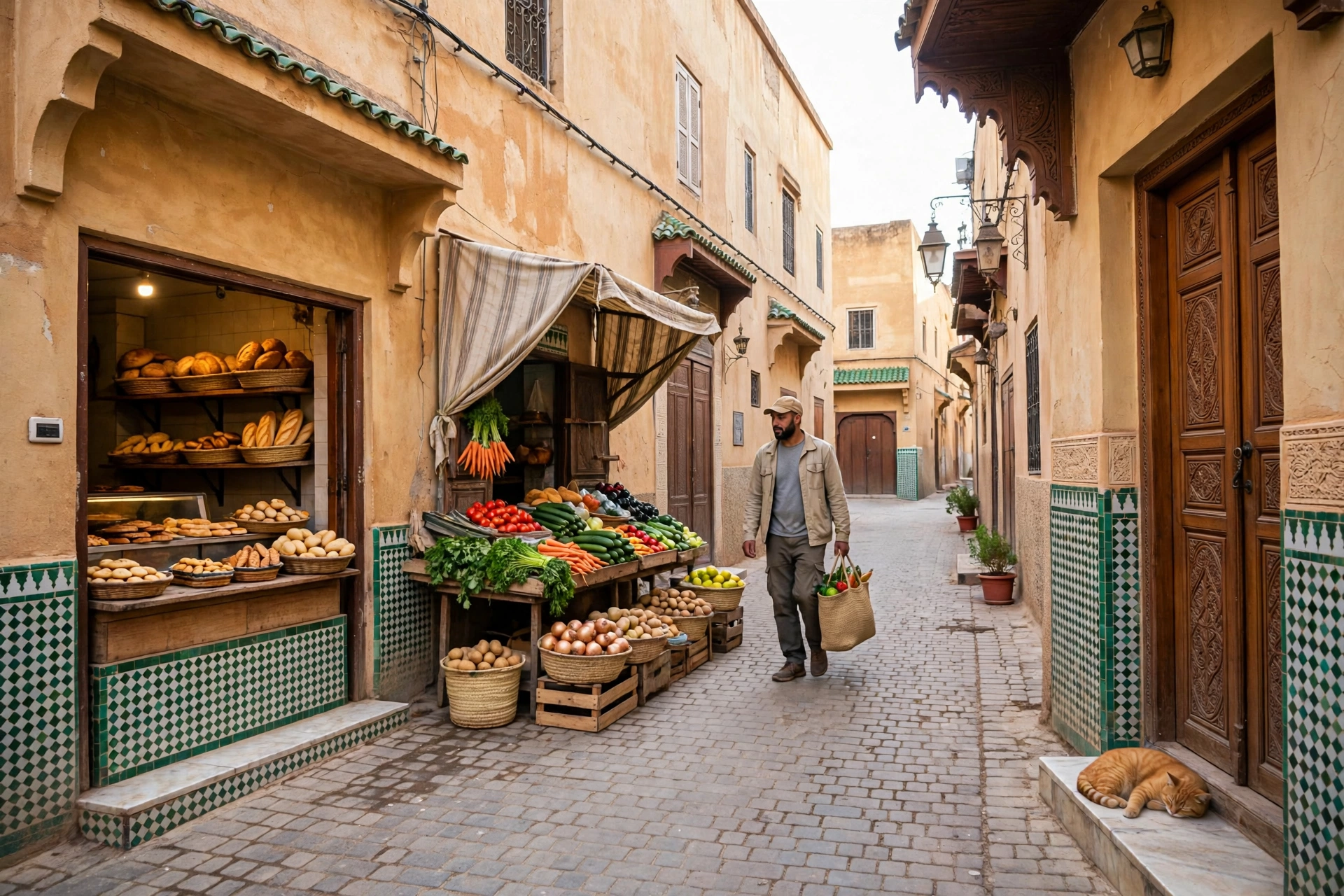
Food is the pleasant surprise: Fes is widely called the culinary capital of Morocco, and a full lunch in a medina restaurant still costs 35–60 MAD. The full national picture is in our Cost of Living in Morocco guide. What costs real money is the expat lifestyle itself — imported wine, school fees and heating in winter.
Weather: Cold Winters, Hot Summers and the Middle Atlas
The climate is the biggest surprise for newcomers, and the main reason some people leave. Living in Fes means a real continental climate: summers that pass 38°C (100°F) in July and August, and winters that can drop close to freezing at night. Old stone houses are built for heat, not insulation, so a cold damp winter inside a beautiful riad is the classic Fes experience.
Winter is the city's honest season: from December to February, days are usually 12–17°C with bright sun, and snow dusts the Middle Atlas peaks. Mornings are cold — pack a warm layer and heat one room. Rain is heavier here than on the coast, and the medina's lanes can flood after a storm.
The shoulder seasons are the sweet spot: April to June brings orange blossom and perfect hiking weather, while September and October offer warm days without the summer's edge. Most expats who can choose their arrival date pick one of these windows, and the nearby mountains offer a weekend escape to Ifrane or Michlifen.
Working Remotely While Living in Fes
Remote work is a smaller scene here than in Marrakech or Tangier, but it works well. Living in Fes puts you in the same time zone as London and one hour behind Paris, with fibre internet in most modern buildings and cafes that welcome laptops. Download speeds of 100–200 Mbps are normal in the Ville Nouvelle and Agdal, and a 20 GB mobile plan costs around 100 MAD a month. Our Morocco Internet for Expats guide explains the providers and the paperwork.
Coworking is still young in Fes: a handful of small spaces and hotel lobbies, with day passes from around 80 MAD. The Morocco Coworking Spaces guide lists the current options. Many remote workers simply work from home in the morning and a cafe in Batha in the afternoon.
Morocco has no dedicated digital nomad visa yet, so most remote workers live here on tourist entries or a carte de séjour, and tax depends on your home country and length of stay. Read our Digital Nomad Guide to Morocco and the Morocco Tax Guide for Expats before you plan a long stay.
Daily Life: Food, Crafts and Getting Around
Daily life is where living in Fes earns its reputation. The morning starts at the market: tomatoes, olives, flatbread from the communal oven, mint by the armful. The medina's souks are a working city, not a museum — tanners, potters and weavers practise trades barely changed in centuries — and learning your way around them is the fastest route to feeling at home. Eating well costs little: a pastilla is 40–70 MAD and a harira 10 MAD.
Getting around while living in Fes is a mix of walking, petit taxis and the occasional bus. The medina is walkable and car-free, and a petit taxi across town rarely costs more than 10–15 MAD if the meter is on. The train station connects Fes to Rabat, Casablanca and Tangier, and our Morocco Train Ticket Prices guide covers the fares. Many long-term expats buy a car for Atlas weekends and the coast, and our Fes Travel Guide covers the day trips that make the city such a good base: Volubilis, Meknes and Chefchaouen.
Social life is smaller and warmer than in the big cities: language exchanges, hiking groups and art openings. The flip side is that Fes can feel quiet, and the city closes earlier than Marrakech. The expats who stay longest build a Moroccan circle too. A few words of Darija transform the experience, and our Learning Moroccan Arabic guide is the place to start.
Healthcare and Schools
Healthcare in Fes is good by Moroccan standards and improving fast. The city has the large CHU Hassan II university hospital and several private clinics with modern equipment and French-speaking doctors. A private GP consultation costs 150–350 MAD, and good international health insurance is essential. Our Healthcare in Morocco for Expats guide compares the options and the insurers most expats use.
Fes has several international and bilingual schools, with fees typically 50,000–120,000 MAD a year. Places at the best schools are limited, so apply early — ideally before you move. Our Schools in Morocco for Expat Families guide covers admissions, fees and waiting lists.
For families considering living in Fes, Agdal and the newer suburbs make more sense: villas with gardens, quiet streets and school buses, while the medina's stairs and damp wear thin with small children. Single expats and couples usually choose Batha or a riad — and living in Fes is at its most romantic when the city is your front garden.
The Downsides: Who Should Not Move Here
Living in Fes is not for everyone, and the city exposes the mismatch quickly. The winter cold is the obvious one — three months of damp and chill inside houses built for summer. If you hate cold houses, Fes will punish you. The second is the medina itself: beautiful and bewildering, but easy to get lost in for months.
Bureaucracy is the third test: residence permits, bank accounts and property purchases all move at Moroccan speed, in French or Arabic. Patience is not optional. The fourth is the quiet: the expat community is small and the nightlife modest. Direct flights are fewer than from Casablanca or Marrakech.
None of this is a reason to stay away — it is a reason to arrive with your eyes open. The expats who thrive at living in Fes are the ones who came for the real city, not the postcard, and who treat the friction as part of the price. If you need warmth all year, a big international scene and predictable administration, look at Rabat or Marrakech instead; our Best Places to Live in Morocco guide compares them honestly.
Practical Steps to Move to Fes
A sensible move takes about three months from decision to arrival, and living in Fes is easiest when the paperwork is done before the plane ticket. Start with a scouting trip of at least a week — stay in both the medina and the Ville Nouvelle, and meet an agent and a lawyer before you commit to anything. The official Visit Morocco site lists current events and seasonal highlights. Most expats rent for the first year and only consider buying once they know the city; our Buying Property in Morocco guide explains the process and the pitfalls.
Visas come next. Most nationalities enter visa-free for 90 days, and the residence permit (carte de séjour) turns a long stay into a legal one. The full process is in our Moving to Morocco: Visas and Residency guide, and renewals are in the Carte de Séjour Renewal Guide. Budget several visits to the police prefecture and bring more copies of everything than you think you need.
Then open a bank account — our Opening a Bank Account in Morocco guide walks through it — arrange health insurance before you arrive, and sort your tax position with an adviser who understands both Morocco and your home country. Retirees should read our Retiring in Morocco guide. Arrive with a month of buffer money and a SIM card: Fes rewards the patient.
Frequently Asked Questions
How much does living in Fes cost per month?
Living in Fes costs a single person roughly 8,500–14,600 MAD ($850–$1,460) a month in 2026, including a one-bedroom in the Ville Nouvelle, groceries, transport and eating out twice a week. A couple should budget 15,000–22,000 MAD. Rents are the biggest variable: a medina riad can cost double a modern apartment.
Is Fes safe for expats?
Fes is one of the safest large cities in North Africa for foreigners, with low violent crime and a strong community feel in the residential districts. The real risks are petty: pickpocketing in the crowded medina lanes and taxi overcharging. Normal precautions — the meter on, bags closed, no valuables on display — cover almost everything.
Can foreigners buy property in Fes?
Yes. Foreigners can buy property in Morocco freely, including riads and apartments in Fes, though agricultural land is restricted. A notary handles the sale, and buyers should budget about 6–7% on top of the price for fees. Always use an independent lawyer and verify the title (titre foncier) before paying anything.
Do I need to speak French or Arabic to live in Fes?
You can survive in English in the tourist areas, but daily life is much easier with French, and warmer with a little Darija. Fes is less English-friendly than Marrakech, so learning French is the most useful investment a new arrival can make.
What is the best neighbourhood for expats in Fes?
Batha is the best all-round choice for newcomers to living in Fes: quiet streets, shops and cafes within walking distance, and the medina ten minutes away on foot. The Ville Nouvelle suits those who want modern apartments and easy parking, Fes el Jdid suits lovers of history with more space, and the medina suits romantics who accept stairs and damp. Our neighbourhood guide compares them.
How cold does Fes get in winter?
Winter is the hardest season of living in Fes: December to February brings daytime temperatures of 12–17°C and nights close to freezing, with damp stone houses that feel colder inside than out. Most expats heat one room well and dress in layers indoors. Summer, by contrast, is hot and dry, with temperatures regularly reaching 38–40°C.
Conclusion: Is Living in Fes Right for You?
Living in Fes is a choice for people who want their daily life to feel like somewhere — not just a cheaper version of home, but a different one. It is a city of rooftop sunsets, market mornings and Atlas weekends. Living in Fes is also cold in winter, quiet at night and bureaucratic, and it will test your patience in ways a softer city would not.
If you want history, authenticity, low costs and a welcoming community, living in Fes will reward you generously. Come for a scouting trip first, rent before you buy, learn some French, and give the city a full year before you decide. Fes does not reveal itself in a week, but for the people it suits, there is nowhere else quite like it.
Last checked: November 2026. Prices and rules change — verify rents, visa requirements and school fees before you commit.
3 thoughts on “Living in Fes: Expat Life in the Medieval Medina”