
Most newcomers stumble into living in Sale by accident: they come for Rabat and notice the rent across the river is far lower. Then they stay. This guide covers living in Sale honestly: the savings, the commute, the schools, and the trade-offs.
In this guide
- Living in Sale at a Glance
- Where Salé Sits — and Why the River Matters
- A Corsair Past You Can Still Walk Through
- Living in Sale: Neighbourhoods Worth Your Rent
- Rents in Salé vs Rabat: What Your Money Buys
- The Daily Budget: What a Couple Spends
- Getting Around: Tram, Train and the Bridges
- Living in Sale with Children: Schools and Family Life
- Healthcare: What Is in Salé and What Is Across the River
- Working from Salé: Internet, Coworking and Technopolis
- The Honest Downsides — and the Everyday Pleasures
- Frequently Asked Questions
- Conclusion: Is Living in Sale Right for You?
Living in Sale at a Glance
At its simplest, living in Sale means capital-city access at provincial prices: a city of nearly a million people, and streets where neighbours know your face within a week.
Salé is often called Rabat's twin city, but it is older and larger: the 2024 census counted 945,101 in the commune and 1,089,554 in the prefecture, making it Morocco's fifth-largest city in the Rabat-Salé-Kénitra region — bigger than Rabat itself (515,619).
| Fact | Detail |
|---|---|
| Population (2024 census) | 945,101 (commune); 1,089,554 (prefecture) |
| Distance to central Rabat | About 2 km; 10 minutes by tram |
| Airport | Rabat–Salé Airport (RBA), 9 km away, 20 minutes by taxi |
| Climate | Mediterranean; about 18°C a year; August highs near 30°C, January near 12°C |
Checked November 2026.
Where Salé Sits — and Why the River Matters
Salé sits on the north bank of the Bou Regreg, directly opposite Rabat, and the river shapes expat life here: the commute, the property prices, and even the social divide.
Crossing is easy: the tram glides over the Hassan II Bridge, rowing boats still ferry passengers between the two medinas, and the train stops at Salé Ville, one stop from Rabat Ville. In practice, residents of each city rarely cross it.
Rents are lower here precisely because the address carries less prestige across the river. If your work, school and social life are all in Rabat, count the crossings before you sign a lease. See our guide to living in Rabat as an expat.
A Corsair Past You Can Still Walk Through
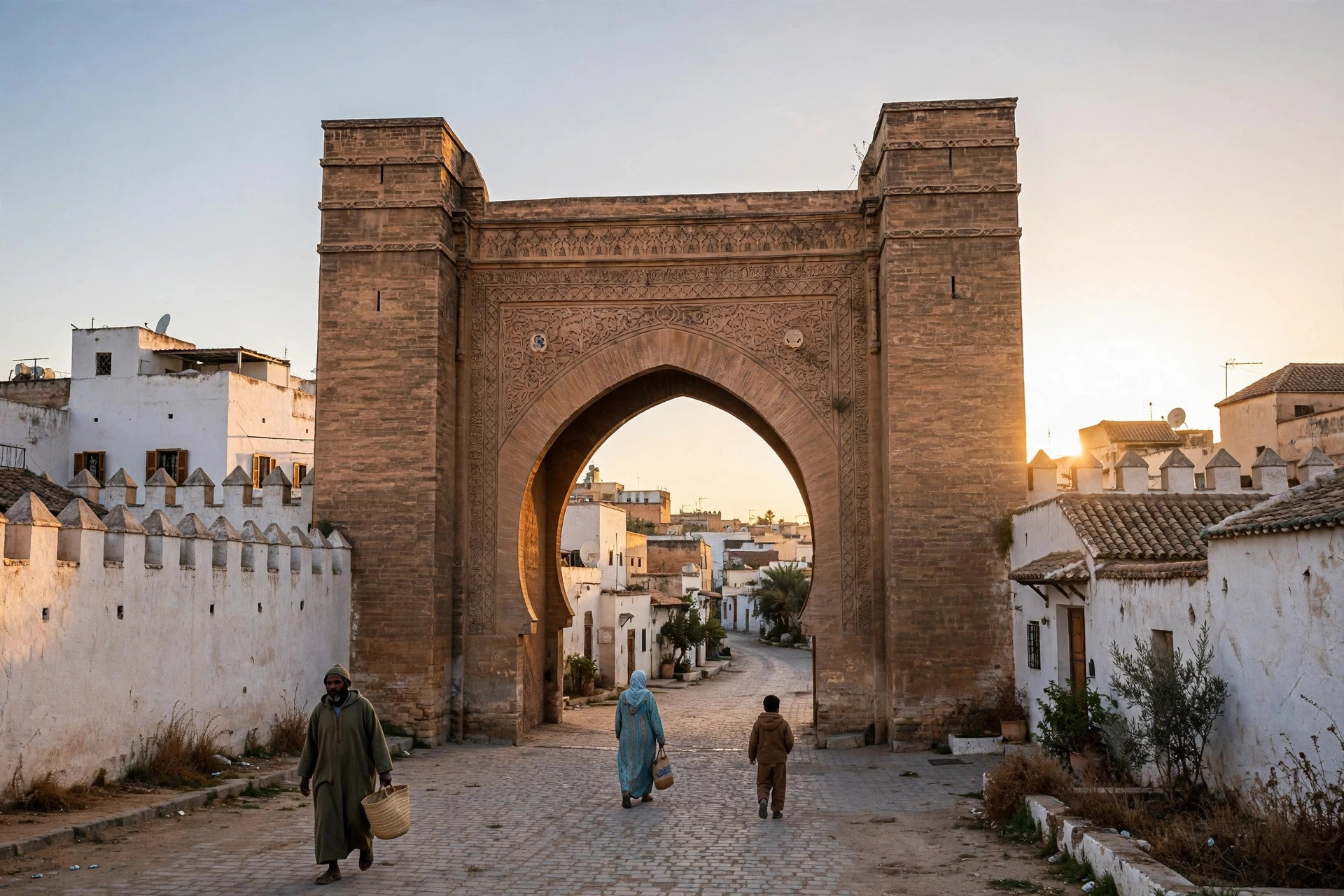
Salé is one of the oldest cities on Morocco's Atlantic coast. The Great Mosque was ordered by the Almohad sultan Yaqub al-Mansur in 1196, though its present form is largely 18th-century. After a Castilian fleet raided the town in 1260, the Marinid sultan Abu Yusuf Yaqub rebuilt the walls and commissioned Bab el-Mrissa, the gate to the city's arsenal.
The gate still stands at the south-west corner of the medina, its tall arch now on dry land. Beside the Great Mosque stands the Madrasa of Abu al-Hasan, completed in 1341.
In the 17th century, Morisco exiles from Spain founded the Republic of Salé, a corsair city-state usually dated 1627–1668 (some sources say 1624, when the Dutchman Jan Janszoon became its admiral). Their fortress, Borj Adoumoue, stands at the river mouth, founded in 1261 and rebuilt in the 18th century. That past is part of what makes living in Sale feel different from Rabat. See the Salé article on Wikipedia.
Living in Sale: Neighbourhoods Worth Your Rent
Choosing where to live is the biggest decision in living in Sale, because the city changes character completely from one district to the next. The medina is the walled core around the Great Mosque: traditional houses, narrow lanes, bread ovens and the souk, all on foot. It suits singles and couples who want atmosphere and low rent. Bab Sebta, at the northern edge, is one of the oldest quarters.
Hay Salam and Hay Ennahda are the solid middle-class districts south and east of the centre, with good tram access and rents that leave room for a car. Hay Tabriquet is the most populous and best connected, with its own train station and tram stops. Bettana mixes older houses with newer apartments; Laayayda is fast-growing, but needs a bus or a car.
Sidi Moussa, near the river mouth, has fishermen, small cafes, and a shoreline locals use all year. The Plage des Nations area, around Sidi Bouknadel, is the prestige coastal strip — villas, a golf course and beach clubs — and the most expensive part of Salé.
Rents in Salé vs Rabat: What Your Money Buys
Rent is the reason most expats choose Salé. Across Rabat-Salé, a one-bedroom averages about 6,000 MAD a month, with most listings between 3,000 and 10,000 MAD. Salé sits at the cheaper end; central Rabat at the top, where a one-bedroom typically runs 6,500–9,000 MAD. That 20–30% gap is the financial case for living in Sale — a two-bedroom in outer Salé can cost less than a one-bedroom in Agdal. The trade-off is finish: Salé flats are more often unfurnished.
| Neighbourhood | 1-bedroom (MAD/month) | 2-bedroom (MAD/month) | 3-bedroom (MAD/month) |
|---|---|---|---|
| Medina / Bab Sebta | 2,500–4,000 ($250–$400) | 3,500–5,500 ($350–$550) | 5,000–7,500 ($500–$750) |
| Hay Tabriquet / Bettana | 3,000–4,500 ($300–$450) | 4,000–6,500 ($400–$650) | 6,000–9,000 ($600–$900) |
| Hay Salam / Hay Ennahda | 3,500–5,500 ($350–$550) | 5,000–7,500 ($500–$750) | 7,000–10,000 ($700–$1,000) |
| Laayayda / Sala El Jadida | 3,000–5,000 ($300–$500) | 4,500–7,000 ($450–$700) | 6,500–10,000 ($650–$1,000) |
| Plage des Nations area | 5,000–8,000 ($500–$800) | 7,000–12,000 ($700–$1,200) | 10,000–16,000 ($1,000–$1,600) |
Indicative asking rents, November 2026. Confirm on arrival.
Deposits are usually one or two months' rent, and agency fees about one month's rent. Get the contract in writing and ask whether rent includes water and electricity — usually it does not. See our guide to renting an apartment in Morocco.
The Daily Budget: What a Couple Spends
For a couple, living in Sale on 11,000–16,000 Moroccan dirhams (MAD) a month (about $1,100–$1,600), including rent, is comfortable.
Groceries are the pleasant surprise: a weekly shop for two at the medina souks rarely passes 700–800 MAD. Electricity and water usually run 400–700 MAD a month, while fibre adds 250–400 MAD and mobile data around 50–100 MAD a month.
| Item | Monthly cost (MAD) | Monthly cost (USD) |
|---|---|---|
| Rent, furnished 2-bedroom in Hay Salam | 5,000–7,000 | $500–$700 |
| Groceries and household | 2,800–3,500 | $280–$350 |
| Utilities (water, electricity) | 500–800 | $50–$80 |
| Internet (fibre) + two mobile plans | 400–600 | $40–$60 |
| Transport (tram passes, occasional taxis) | 400–700 | $40–$70 |
| Eating out and cafes | 1,000–1,500 | $100–$150 |
| Health, pharmacy and insurance share | 800–1,500 | $80–$150 |
| Total | 10,900–15,600 | $1,090–$1,560 |
November 2026 estimates. Confirm on arrival.
Getting Around: Tram, Train and the Bridges
Transport is the part of living in Sale that works best. The Rabat–Salé tramway opened on 18 May 2011 as Morocco's first modern tram network. It now has two lines, 27 km of track and 43 stops. A single ticket costs 7 MAD (about $0.70), valid for one hour including one change between lines. Trams run roughly 6 a.m. to 10 or 11 p.m. See the Rabat–Salé tramway article on Wikipedia.
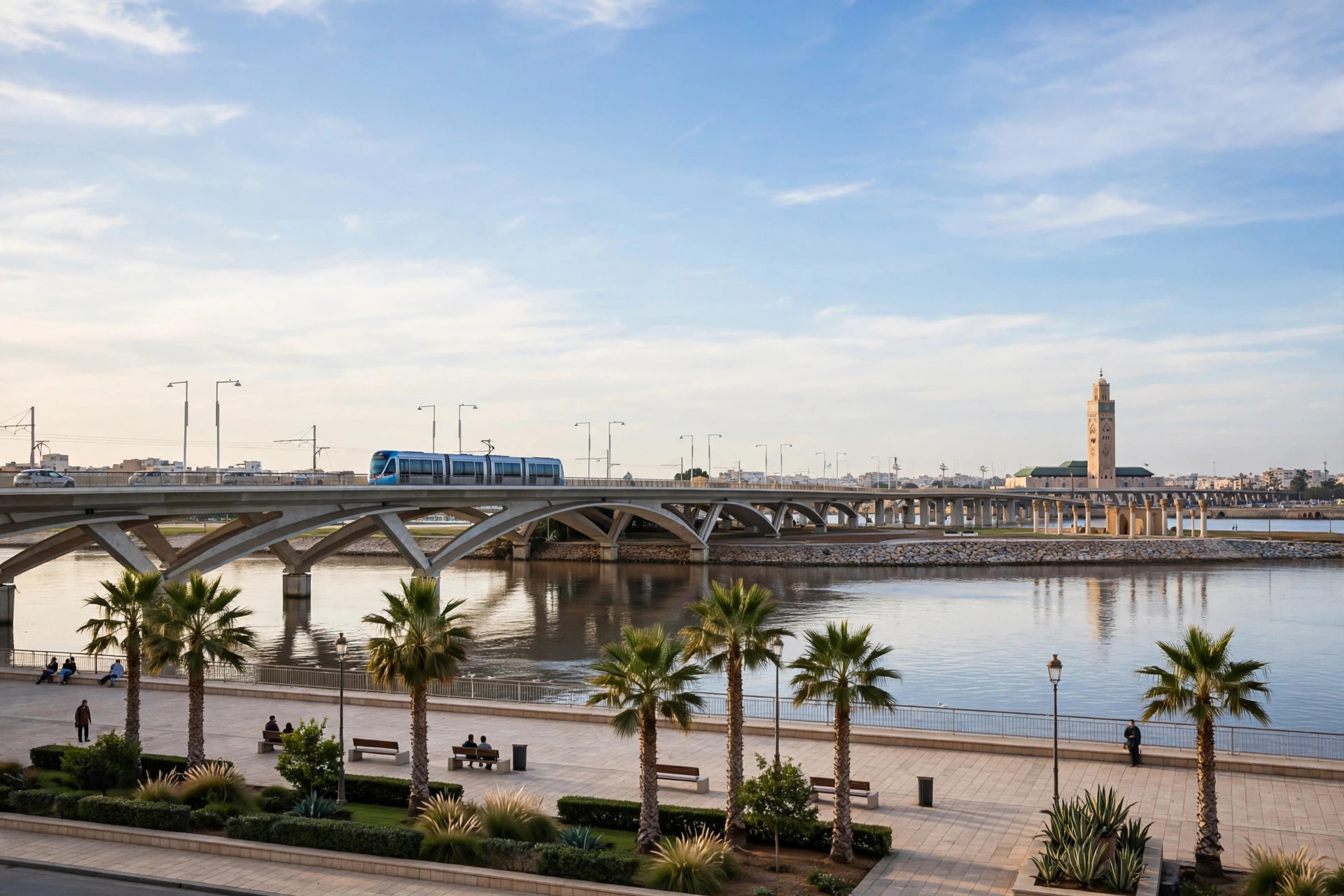
Salé has two stations: Salé Ville, beside the medina, and Salé Tabriquet, in the east. From Rabat Ville, Casablanca is about an hour by train (35–75 MAD); from Salé Tabriquet to Casablanca Port, allow about 1 hour 30 minutes and 40–80 MAD. Rabat–Salé Airport (RBA) is in Salé, about 9 km away and 20 minutes by taxi — small, but hard to beat for European hops.
Petit taxis cost 10–20 MAD for short trips, but at rush hour the bridges jam badly and a 15-minute drive to Rabat can take 45. The tram has no such problem.
Living in Sale with Children: Schools and Family Life
Families considering living in Sale need one honest fact first: there is no major American-curriculum or IB Diploma school inside Salé itself that we could confirm. Inside Salé, Institution El Yakada is a bilingual private school offering the Moroccan national curriculum with an IB Middle Years Programme. Across the river, the main options are Rabat American School (American programme with the IB Diploma), Dar Essalam American School in Hay Riad, Khalil Gibran School in Souissi, and the French schools Lycée Descartes and Lycée Français Sophie Germain.
Fees in Rabat are substantial: Khalil Gibran's 2026–27 fees run from about 39,339 MAD a year to 76,174 MAD in the final years on the Cambridge route. Before enrolment, sort out residence paperwork: children need their own file. Our guide to moving to Morocco, visas and the carte de séjour walks through the process.
Day to day, Salé is an easy place to raise children: safe streets, beaches close by, and family-sized flats. The trade-off is that organised children's activities in English are thin on the ground; most run in French or Arabic.
Healthcare: What Is in Salé and What Is Across the River
Healthcare is one area where living in Sale surprises newcomers. The main public hospital is the Prince Moulay Abdallah Prefectural Hospital in Hssaine, inaugurated in 2018 with about 250 beds, an emergency department, surgery, maternity and dialysis units. There is also the El Ayachi hospital and a community medical centre in Tabriquet.
For anything complex, the major hospitals are across the river: the CHU Ibn Sina university hospital in Rabat, and the private clinics of Agdal and Hay Riad. English-speaking doctors are easier to find in Rabat, so many expats register with a GP there. For the full overview, see our guide to healthcare in Morocco for expats.
Working from Salé: Internet, Coworking and Technopolis
For remote workers, living in Sale is practical as long as the flat has fibre. Fibre is available in newer buildings and across much of the city, from around 249 MAD a month. Commercial 5G launched in November 2025. Test the connection with a real video call before signing.
No well-known coworking space inside Salé itself could be confirmed. Most remote workers here work from home or cross to Rabat (Formatim charges around 200 MAD a day). The exception is Technopolis, the 300-hectare technology park in Salé, hosting the International University of Rabat, Mohammed VI Polytechnic University, and companies including AWS and Capgemini. If you work in tech or higher education, Technopolis is the reason to live in Salé.
The Honest Downsides — and the Everyday Pleasures
The downsides of living in Sale are real but manageable. Salé has far fewer expat venues than Rabat: fewer international restaurants, no real nightlife, and a smaller foreign community. French or Arabic is not optional; English alone goes only so far. August afternoons push toward 30°C, and the bridges jam at rush hour.
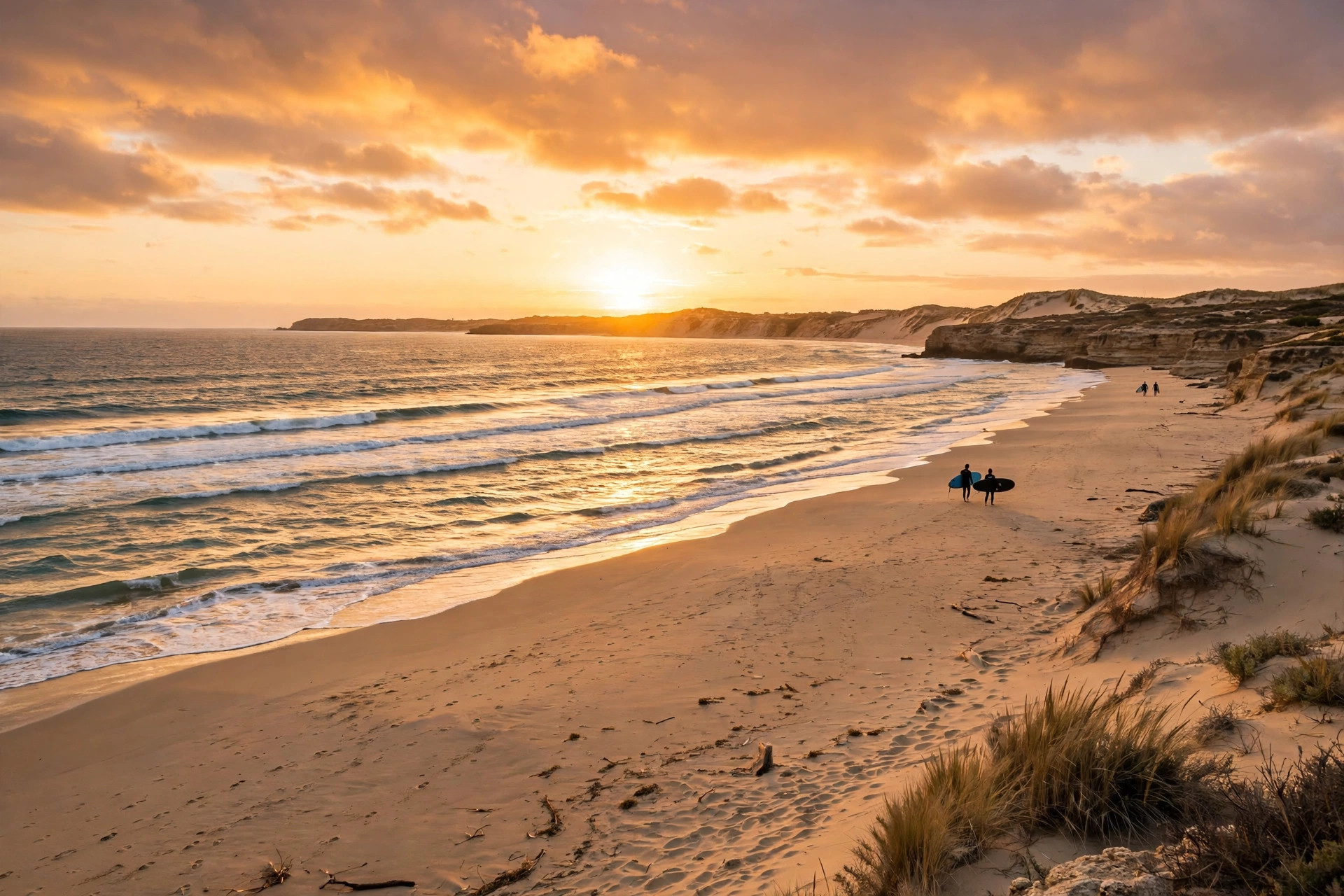
Set against that, the pleasures are everyday ones: morning bread from a wood oven, the call to prayer over the medina, a surf session before work, and an evening walk. Plage des Nations, about 17 km north of Rabat, is a wide beach break best for intermediate surfers — but respect the strong rip currents.
Frequently Asked Questions
Is living in Sale cheaper than living in Rabat?
Yes, by roughly 20–30% on rent. A one-bedroom in central Rabat typically costs 6,500–9,000 MAD a month, while a similar flat in Hay Salam or Hay Tabriquet runs 3,000–5,500 MAD. The saving is mostly in housing — and living in Sale keeps that saving every month.
Is Salé safe for expats?
Salé is generally safe, and most expats feel comfortable walking around in the daytime. Watch for pickpockets in crowded souks and on the tram, avoid poorly lit lanes late at night, and keep valuables out of sight.
Do I need a car in Salé?
No, not at first. The tram covers the main axis between Salé and Rabat, the train serves Casablanca, and petit taxis are cheap for short trips. A car helps in Laayayda, the Plage des Nations area or Sala El Jadida, or if your children attend school in Rabat.
Can I send my children to an international school from Salé?
Yes, but the school will almost certainly be in Rabat. No major American-curriculum or IB Diploma school inside Salé itself could be confirmed; the main options are all across the river. Allow 30–60 minutes for the crossing at peak times.
How long is the commute to Rabat?
By tram, about 10–20 minutes to central Rabat, plus walking time. By car, 15 minutes off-peak and 30–45 minutes at rush hour. By train, Salé Ville is one stop from Rabat Ville.
What is the best area of Salé for expats?
For most newcomers, Hay Salam or Hay Ennahda. Couples who want atmosphere should look at the medina. Families with a car and a bigger budget should consider the Plage des Nations area or Sala El Jadida. Budget first-timers usually start in Hay Tabriquet or Bettana.
Conclusion: Is Living in Sale Right for You?
Living in Sale suits a particular kind of expat: someone who wants Morocco at a Moroccan price, does not mind crossing a river for work or school, and would rather spend the rent saving on travel than on an address. If you need an international school nearby, a buzzing expat scene, and English everywhere, Rabat will serve you better — and our guide to the best places to live in Morocco can help you compare.
But if you can live in French or Arabic, work from home or near the tram, and enjoy a city older, cheaper and less polished than its famous neighbour, living in Sale is one of the best-value moves in Morocco. Come for a week first, and price a flat in Hay Salam.