
The cost of studying in Morocco is one of the lowest in the Mediterranean for a recognised degree — and one of the hardest to price, because the answer changes completely with your route. A Moroccan student at a public university pays little more than a small annual registration charge; an international student at a private English-taught university can pay over 100,000 MAD a year in tuition alone. This guide gives you the real cost of studying in Morocco in 2026: tuition, housing, budgets, health cover, visas and scholarships.
In this guide
- Cost of Studying in Morocco at a Glance
- Public Universities and the Cost of Studying in Morocco
- Private Universities: Tuition in 2026
- Student Housing: Residences, Shared Flats and Studios
- The Monthly Cost of Studying in Morocco: A Student Budget
- Food, Transport and Books: The Daily Costs
- Health Cover: AMO for Students
- Student Visa and Residence Permit: The Paperwork Costs
- Scholarships and Financial Aid: AMCI and Merit Grants
- Can International Students Work Part-Time?
- Application Timelines: When to Apply
- Frequently Asked Questions
- Conclusion: Is the Cost of Studying in Morocco Worth It?
Cost of Studying in Morocco at a Glance
The cost of studying in Morocco runs from almost nothing to over 150,000 MAD ($15,000) a year, and the route matters more than the city. A public-university student pays a few hundred dirhams a year in fees plus living costs; a private-university student pays European-level tuition. Monthly living costs run roughly 3,500–7,000 MAD ($350–$700). Our cost of living in Morocco guide compares these figures with a working adult’s budget.
| Route | Tuition per year (MAD) | Tuition per year (USD) | Who it suits |
|---|---|---|---|
| Public university, daytime licence (Moroccan or AMCI scholarship student) | Near-free; small registration charge only | Near-free | Moroccan students; scholarship students from partner countries |
| Public university, flexible evening/weekend track (from 2026/27) | 5,000–20,000 by level | $500–$2,000 | Working students; contested fees, see below |
| Private university, undergraduate | 62,000–110,000 | $6,200–$11,000 | Self-funded students; English-taught programmes |
| Private university, master’s | 62,000–80,000 | $6,200–$8,000 | Graduates; business and engineering |
| Monthly living costs (student, shared housing) | 3,500–7,000 per month | $350–$700 per month | Most students in Rabat, Casablanca, Fes or Marrakech |
Checked November 2026. Verify on arrival — tuition changes every academic year.
Public Universities and the Cost of Studying in Morocco
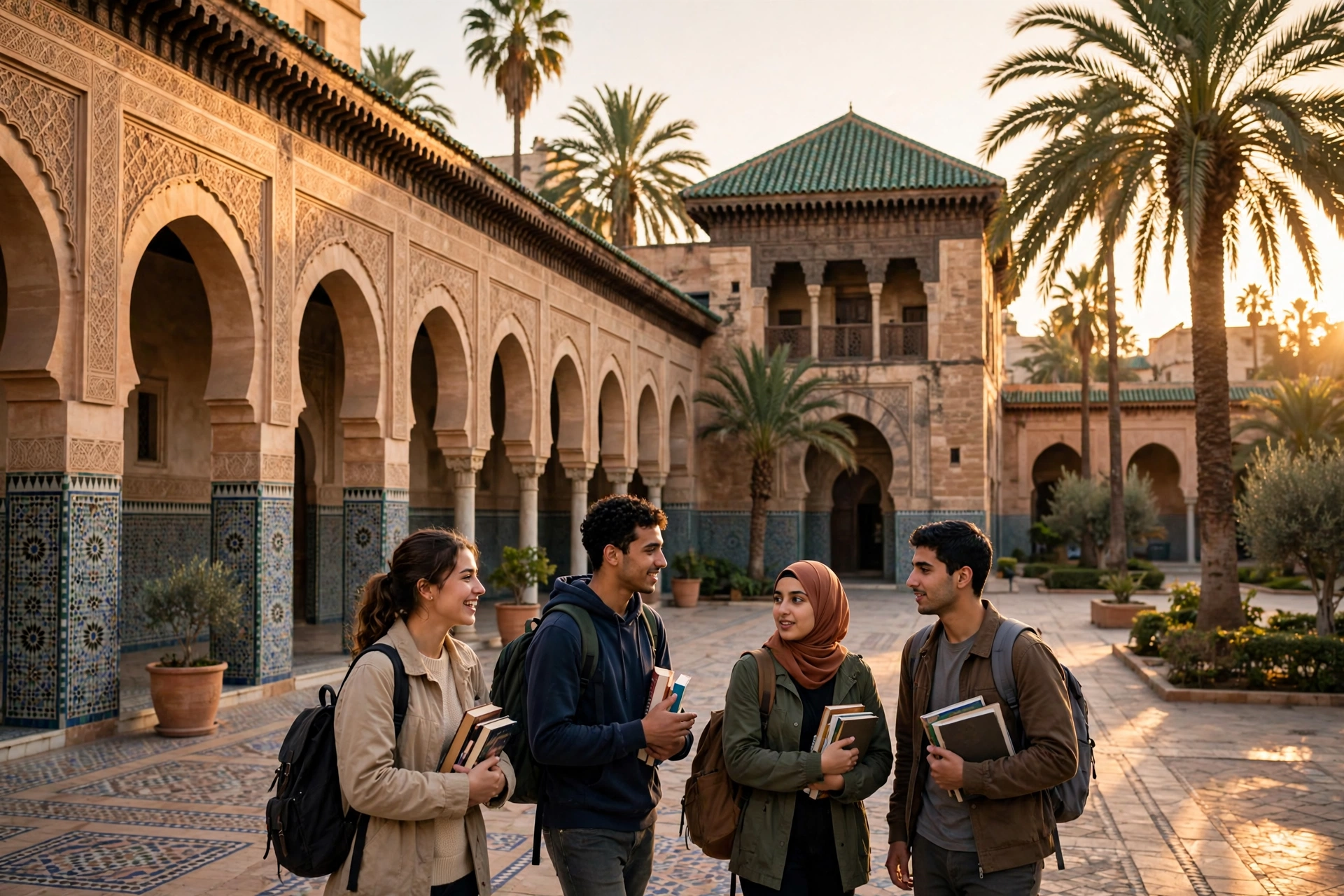
Morocco has 13 public universities, and daytime study at them is effectively free for Moroccan students. There is no published national tuition table for standard daytime programmes: students pay a small annual registration charge set by each faculty, plus books, transport, food and housing. Confirm the charge with the faculty — no official figure could be verified.
That picture is changing at the edges. From 2026/27, public universities are introducing harmonised fees for flexible evening and weekend programmes: 5,000 MAD a year for a licence, 18,000 MAD for a professional bachelor’s, 15,000 MAD for a master’s, and 20,000 MAD for a doctorate. Reported by Hespress and contested, they apply only to flexible programmes.
International students usually arrive through cooperation agreements managed by the Moroccan Agency for International Cooperation (AMCI): your home country submits your file for ministry authorisation. A 2026–27 AMCI notice states that public-university training is free of charge for scholarship holders. For self-funded students outside AMCI, the cost of studying in Morocco is unconfirmed — guidebooks quote roughly €2,000–€8,000 a year, but no official fee table exists. See the list of universities in Morocco on Wikipedia.
Private Universities: Tuition in 2026
Private universities set their own fees, and the range is wide. Figures below come from official fee pages where stated, and from aggregators otherwise — confirm every figure with the university, because the cost of studying in Morocco at a private university moves fastest.
Al Akhawayn University (AUI) publishes a full fee schedule. For autumn 2026, undergraduate tuition is 2,226 MAD per credit for Moroccan students and 3,392 MAD for international students; graduate tuition is 2,809 MAD and 4,240 MAD. A full-time international undergraduate taking 16 credits pays 54,272 MAD a semester plus 5,100 MAD registration — roughly 108,500 MAD a year before housing.
University Mohammed VI Polytechnic (UM6P) publishes 75,000 MAD a year plus a 5,000 MAD registration fee for bachelor’s programmes, with some master’s at 78,750 MAD. UIR, ESCA and Mundiapolis figures below are unverified aggregator estimates, while HEM publishes 76,000–79,000 MAD a year. Add 5,000–10,000 MAD a year for fees and deposits.
| Institution | Annual tuition (MAD) | Annual tuition (USD) | Source and status |
|---|---|---|---|
| Al Akhawayn University, undergraduate (international) | ~108,500 | ~$10,850 | Official Fall 2026 fee schedule, per-credit |
| Al Akhawayn University, undergraduate (Moroccan) | ~71,200 | ~$7,120 | Official Fall 2026 fee schedule, per-credit |
| UM6P, bachelor’s | 75,000 + 5,000 registration | ~$8,000 | Official programme page |
| UIR, bachelor’s / master’s | 62,000–75,000 | $6,200–$7,500 | Aggregator listings; indicative only, check on arrival |
| ESCA, bachelor’s | ~87,800 | ~$8,780 | Aggregator estimate; unverified, check on arrival |
| Mundiapolis, bachelor’s | ~83,700 | ~$8,370 | Aggregator estimate; unverified, check on arrival |
| HEM, graduate management | 76,000–79,000 | $7,600–$7,900 | Official HEM fee page |
Checked November 2026. Private fees change annually — confirm with the university.
Student Housing: Residences, Shared Flats and Studios
Housing is the biggest variable in the cost of studying in Morocco after tuition. Public universities run student residences, and AMCI houses its students at the International University City in Rabat. Places are limited. No published price for a public residence bed could be verified. At AUI, a shared double room costs 5,880 MAD a semester.
Most students rent privately, and the market rewards sharing. In Rabat, a room near the Mohammed V University campuses in Agdal runs roughly 1,800–3,500 MAD a month, and a studio 3,500–6,000 MAD. In Casablanca, budget studios start around 1,500–2,500 MAD, furnished studios in Maarif run 3,500–5,000 MAD, and a shared room costs roughly 2,500–4,500 MAD. In Fes a room runs 1,200–2,500 MAD — check on arrival, as no survey covers student rents there.
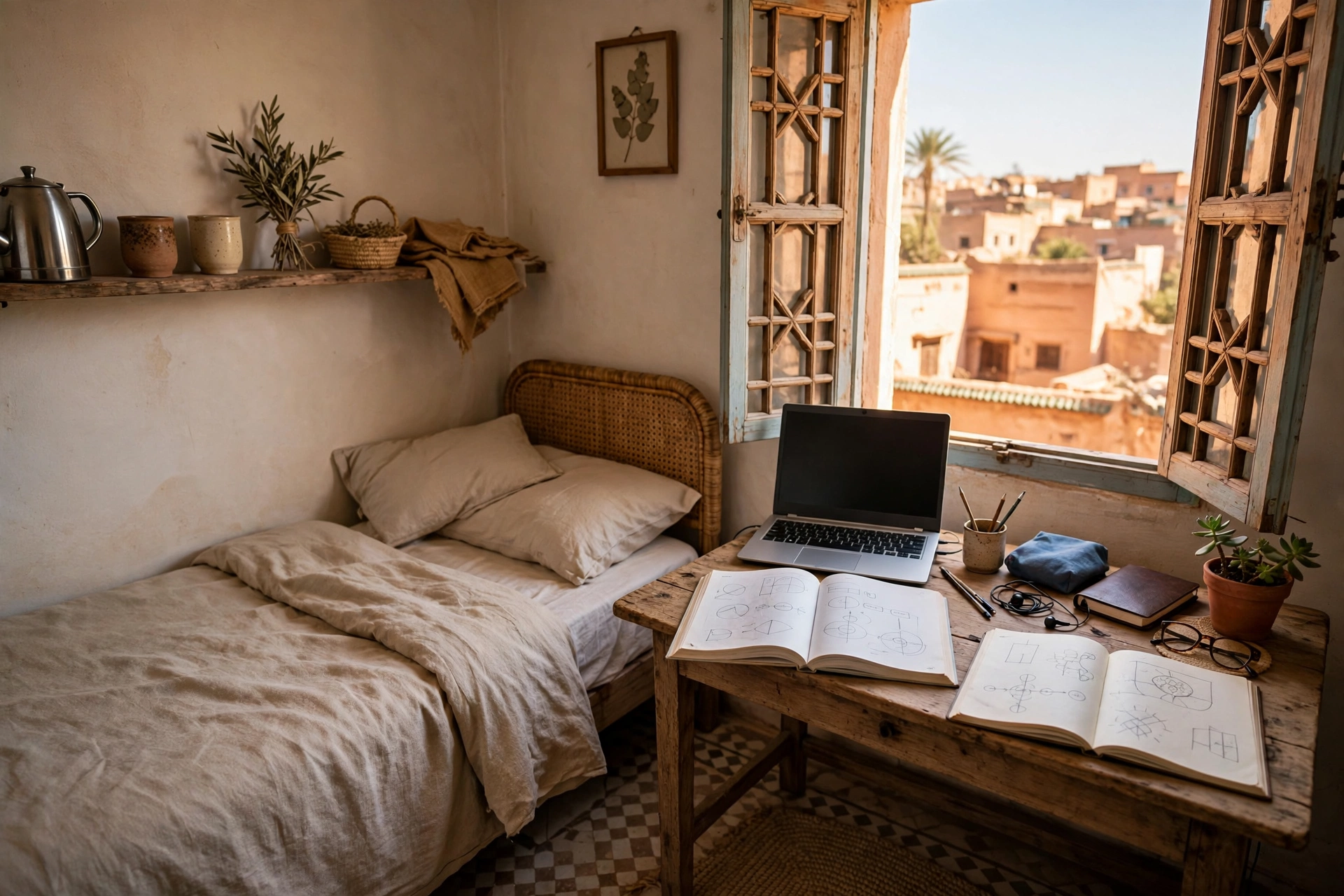
Three rules protect your deposit. Under rental law (Law 67-12), the deposit is capped at two months’ rent, agency fees run about one month’s rent, and every lease must be in writing. Never pay before you have stood inside the flat and hold a signed contract — see our guide to renting an apartment in Morocco. Budget for the first payment: deposit plus advance rent plus the agency fee can mean 10,000–25,000 MAD before your first night.
The city you choose moves the cost of studying in Morocco more than any decision after tuition. Rabat has the highest student rents, Casablanca the strongest job market, Fes rents roughly a third lower — visit before committing. Still deciding whether Morocco fits? See how much a trip to Morocco costs for a scouting visit.
The Monthly Cost of Studying in Morocco: A Student Budget
The table below is for one student in a shared flat in Rabat or Casablanca, cooking at home and using public transport. A student in Fes or at AUI in Ifrane can land near the bottom of the range.
| Item | Monthly cost (MAD) | Monthly cost (USD) |
|---|---|---|
| Room in a shared flat (your share) | 1,800–3,500 | $180–$350 |
| Utilities and internet (your share) | 300–600 | $30–$60 |
| Groceries and cooking at home | 1,200–2,000 | $120–$200 |
| Eating out and cafes | 300–700 | $30–$70 |
| Transport (tram/bus pass, taxis) | 150–400 | $15–$40 |
| Phone and mobile data | 50–150 | $5–$15 |
| Books, printing and study materials | 100–300 | $10–$30 |
| Health cover (averaged monthly) | 0–35 | $0–$3.50 |
| Leisure and personal | 300–800 | $30–$80 |
| Total | 4,200–8,500 | $420–$850 |
November 2026 planning ranges. Verify on arrival.
A realistic student year — nine months plus a summer — runs roughly 40,000–75,000 MAD in living costs at a public university, before tuition. Add tuition, and the total cost of studying in Morocco for a self-funded international student at a private university lands roughly at 110,000–190,000 MAD a year.
Food, Transport and Books: The Daily Costs
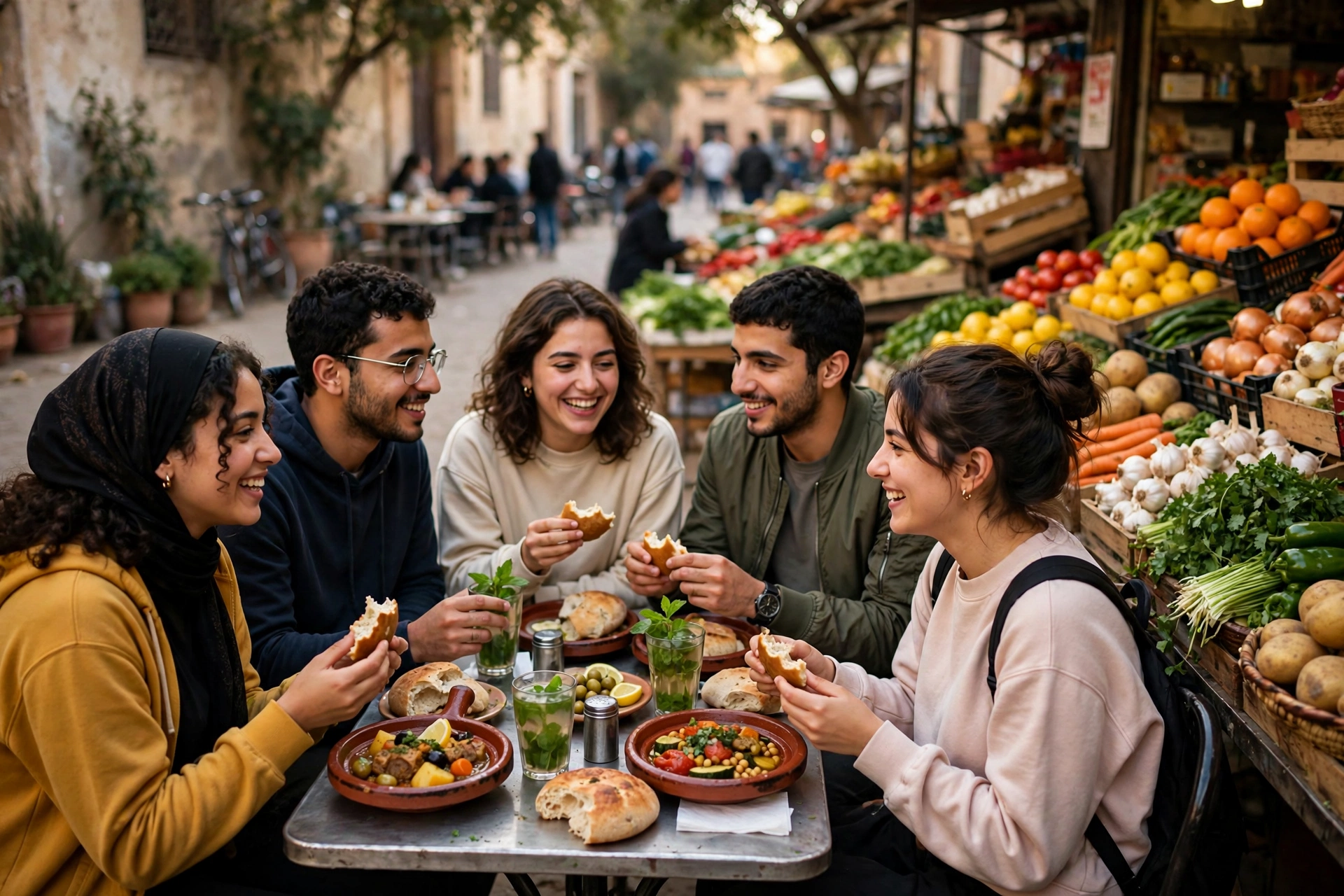
Food is where student budgets in Morocco are genuinely kind. A filling lunch — tagine, bread, salad and mint tea — at a neighbourhood restaurant costs 40–80 MAD ($4–$8), a bowl of harira or bissara from a market stall 10–20 MAD, and a coffee 8–20 MAD. Cooking at home is cheaper: khobz about 1.20 MAD, vegetables 4–8 MAD a kilo, chicken 35–45 MAD a kilo, eggs about 1.50 MAD each.
Transport is cheap if you buy the student pass. In Rabat, the student tram pass costs 160 MAD a month for unlimited travel under 26, against 270 MAD for the public pass. In Casablanca, 150 MAD a month. A single ride costs 6–8 MAD, a petit taxi across town 10–25 MAD on the meter. Between cities, second-class fares on two-to-three-hour train journeys typically cost 100–200 MAD. Cash tips: our Morocco money and dirham guide.
Books and materials are the line students most often forget when pricing the cost of studying in Morocco. AUI’s own estimate puts books at 1,000 MAD a semester: budget 2,000–3,000 MAD a year, plus printing. Science programmes add lab charges — ask the faculty. A laptop is effectively compulsory.
Health Cover: AMO for Students
Health cover is one of the cheapest parts of the cost of studying in Morocco, and it is compulsory. The scheme is AMO Étudiant, run through CNOPS for public-sector students, covering consultations, medicines, tests, hospital stays and dental care, reimbursing roughly 80% for consultations and 90–100% for hospital stays.
The price depends on your programme. Students in tuition-free programmes at public universities are exempt — the state pays. Students in fee-paying programmes or at private institutions pay 400 MAD ($40) a year, per Cadi Ayyad University’s AMO page. You must be enrolled, aged 30 or under, and not covered by any other insurance.
Two caveats. First, AMCI scholarship holders receive insurance with their package, so check whether you are already covered. Second, the system is mid-reform: a draft law (54.23) proposes moving AMO management from CNOPS to the CNSS. Confirm the registration route each year.
Student Visa and Residence Permit: The Paperwork Costs
The paperwork is cheap; the timing is what costs students their semester. Apply for a long-stay student visa at a Moroccan consulate — the online e-visa covers tourism and business only, not study. You will need an acceptance letter or AMCI certificate, proof of funds, a medical certificate and police clearance; processing takes two to four weeks.
The fee is the most uncertain part of the cost of studying in Morocco. One guide quotes a single-entry visa at about 220 MAD ($23); another puts the fee at roughly 200–500 MAD; a third quotes around $145. No official tariff is published, so budget 200–1,500 MAD and confirm the figure with your consulate. See our guide to Morocco visa costs — but its 770 MAD e-visa figure does not apply to student visas.
Once you arrive, apply for the residence permit, the carte de séjour, at the foreigners’ office of the local police prefecture within 90 days of entry, with your passport and entry stamp, enrolment certificate, proof of accommodation and proof of funds. The permit costs 100 MAD a year in fiscal stamps, is valid for one year and renewable annually; it takes one to three months to issue, and you receive a receipt (récépissé) meanwhile. Start the file in your first month.
Scholarships and Financial Aid: AMCI and Merit Grants
For most international students, the scholarship is the whole ballgame, because it is what makes the cost of studying in Morocco genuinely low. The Kingdom of Morocco scholarships, awarded through AMCI to students from partner countries, cover tuition at public universities, plus a stipend of 1,750 MAD a month, flights and insurance. The stipend does not cover enrolment fees, housing or transport.
About 14,500 foreign students studied at Moroccan public institutions in 2019–20, including 12,500 from 47 African countries, and more than 12,000 held AMCI scholarships. Apply through your own country’s authorities, not directly to AMCI.
Private universities run their own aid, and the cost of studying in Morocco at a private university can fall sharply with it. AUI states that its undergraduate scholarships are reserved for Moroccan students; UIR advertises excellence scholarships up to 50% of tuition, plus Erasmus+ grants. UM6P offers master’s scholarships, some fully funded. Apply for aid with admission.
Can International Students Work Part-Time?
Honestly, no — not on a student visa alone. A student visa and residence permit grant no right to work, and the cost of studying in Morocco should never be budgeted on a part-time job. Paid work needs a separate work permit from your employer — so you need a job offer first. Working without authorisation risks a fine, cancellation of your permit and deportation.
That does not mean students have no income options. Paid internships that form part of your degree are a different category from outside employment — ask your faculty whether your programme includes one. On-campus work such as tutoring is sometimes available, and private tutoring in English or French is a common informal income — discuss it with your international office first.
Application Timelines: When to Apply
Moroccan universities run on a September start, so begin nine to twelve months ahead. For public universities through AMCI, your home country’s authorities set the deadline, usually in the first half of the year; authorisation then takes about 60 days, so a late file can cost you the year. Cadi Ayyad ran pre-registration from 1 to 31 August 2026.
Private universities set their own calendars. AUI’s deadlines are 31 May for an August start and 31 October for a January start, with TOEFL iBT 71 (undergraduate) or 79 (graduate) for non-native English speakers. UM6P, UIR, ESCA and Mundiapolis open applications in winter and spring for September entry, with exams or interviews in spring. Documents need translating into French or Arabic, and diplomas need certifying — both take weeks.
Frequently Asked Questions
How much does it cost to study in Morocco for international students?
It depends on the route. At a public university through an AMCI scholarship, tuition is free and living costs run roughly 3,500–7,000 MAD a month. At a private university, add 62,000–110,000 MAD a year, so the total cost of studying in Morocco for a self-funded international student lands roughly at 110,000–190,000 MAD a year.
Is university free in Morocco for foreign students?
Daytime study at public universities is free for AMCI scholarship holders, and effectively free for Moroccan students beyond a small registration charge. Self-funded students outside AMCI face an unconfirmed picture: no official fee table exists, so ask the university directly.
Which Moroccan universities teach in English?
Al Akhawayn University in Ifrane teaches entirely in English on the American model, and University Mohammed VI Polytechnic teaches in English and French. Most other institutions teach mainly in French, so French is the safer bet.
How much is student housing in Morocco?
Housing is the second-biggest part of the cost of studying in Morocco after tuition. A room in a shared flat costs roughly 1,800–3,500 MAD a month in Rabat, 2,500–4,500 MAD in Casablanca, and 1,200–2,500 MAD in Fes. A shared double room on campus at AUI costs 5,880 MAD a semester.
Can I work while studying in Morocco?
Not on a student visa alone — so do not budget the cost of studying in Morocco around part-time work. Student status grants no automatic work rights; paid work needs a separate permit applied for by your employer. Degree internships are different — ask your international office first.
What is the AMCI scholarship and how do I apply?
AMCI is the Moroccan Agency for International Cooperation, which awards Kingdom of Morocco scholarships to students from partner countries. It covers public-university tuition and pays a stipend of 1,750 MAD a month plus flights and insurance. Apply through your own country’s authorities.
Conclusion: Is the Cost of Studying in Morocco Worth It?
The cost of studying in Morocco is genuinely low by international standards — but only if you choose the right route and budget honestly. A public-university place through AMCI is one of the cheapest recognised degrees in the world, while a private English-taught degree costs far less than the same years in Britain, America or Canada. The traps are the small ones — a deposit paid before seeing a flat, a visa applied for too late.
So price the route before you fall in love with the university. Confirm the tuition and visa fee, apply for housing and scholarships with admission, and arrive with your funding settled. Do that, and the cost of studying in Morocco buys something rare: a recognised degree, a second language, and three or four years in one of the most rewarding countries to live in.