The history of Moroccan hammams begins long before the first steam rose in Fez. It begins in the Roman thermae of Volubilis, passes through the bathhouses of Damascus and Córdoba, and arrives in the medinas of Morocco as something distinct: a weekly ritual of steam, black soap and gossip that has survived for more than a thousand years.
All prices are in Moroccan dirhams (MAD), checked in November 2026, with dollar equivalents at roughly 10 MAD to $1. They are planning ranges, not promises. This guide follows the history of Moroccan hammams from their Roman roots to the working bathhouses you can still visit today.
The short version of the history of Moroccan hammams fits in one line: Rome built the rooms, Islam gave them their purpose, and Morocco kept them working for over a thousand years.
Period
What happened
Roman Morocco, 1st–3rd centuries
Public thermae at Volubilis make bathing a civic habit
Idrisid period, late 8th–9th centuries
Bathhouses appear in Morocco; early hammams at Volubilis
Almohad period, 12th–13th centuries
Fez counts 93 hammams, according to the chronicle Rawd al-Qirtas
Marinid period, 14th century
Hammam Saffarin is built for the coppersmiths of Fez
Saadian period, 16th century
The Mouassine hammam is built beside its mosque in Marrakech
Today
Around 120 hammams still work in Fez; spas carry the ritual worldwide
From Roman Thermae to the Moroccan Hammam
The Roman thermae were the social centres of every provincial city, and Volubilis had them. When Arab Muslim rule reached Morocco in the 7th and 8th centuries, the new societies did not abandon the bathhouse — they adapted it. The earliest known Islamic hammams were built under the Umayyads in Syria and Jordan, at Qusayr Amra and similar desert palaces, and archaeology shows hammams appearing as far west as Volubilis during the Idrisid period, in the late 8th to early 9th centuries. That Volubilis link is the oldest thread in the history of Moroccan hammams.
What changed on the way was the reason for going. Islam asks for ghusl, the full washing of the body, and for taharah, ritual purity before prayer. Custom in Morocco wanted water poured over the skin, never a shared still pool. So the cold plunge pool of the Roman bath disappeared, and the Moroccan hammam kept buckets, taps and a floor that drains. The sequence of rooms survived — undressing room, cold room, warm room, hot room — because the Roman thermae had already solved the problem of moving a body through rising heat. That single change, pouring water instead of sharing a pool, is the pivot of the history of Moroccan hammams.
That is why the hammam stands next to the mosque: in every old Moroccan city the bathhouse was part of the neighbourhood’s basic kit, as ordinary as the bakery and the fountain. Read the wider story in our history of Morocco to see how the hammam fits into each dynasty that ruled the country.
The History of Moroccan Hammams in the Golden Age of Fez
Fez is where the history of Moroccan hammams is best documented, and also where its earliest dates are the least certain. The first hammams of the city date to the Idrisid dynasty, in the 8th to 10th centuries, but no Idrisid bathhouse survives intact and the dating rests on archaeology and later chronicles rather than on a foundation stone.
By the Almohad period, in the 12th and 13th centuries, the 14th-century chronicle Rawd al-Qirtas claims Fez had 93 hammams. Treat that number as the chronicler’s, not a census — medieval writers rounded generously, and no list of 93 names survives. Even halved, it tells the same story: the bathhouse was already a mass institution, not a luxury.
Many hammams were habous, charitable endowments whose rent kept a mosque lit and its imam paid. Hammam al-Mokhfiya, south of Place R’cif in Fez, dates to the reign of the Marinid sultan Abu Inan in the 1350s and belonged to the endowment of the Qarawiyyin. A bathhouse that pays for a mosque is a different kind of business from a spa, and that difference still shapes the history of Moroccan hammams today.
Hammam Saffarin: Seven Centuries of Steam
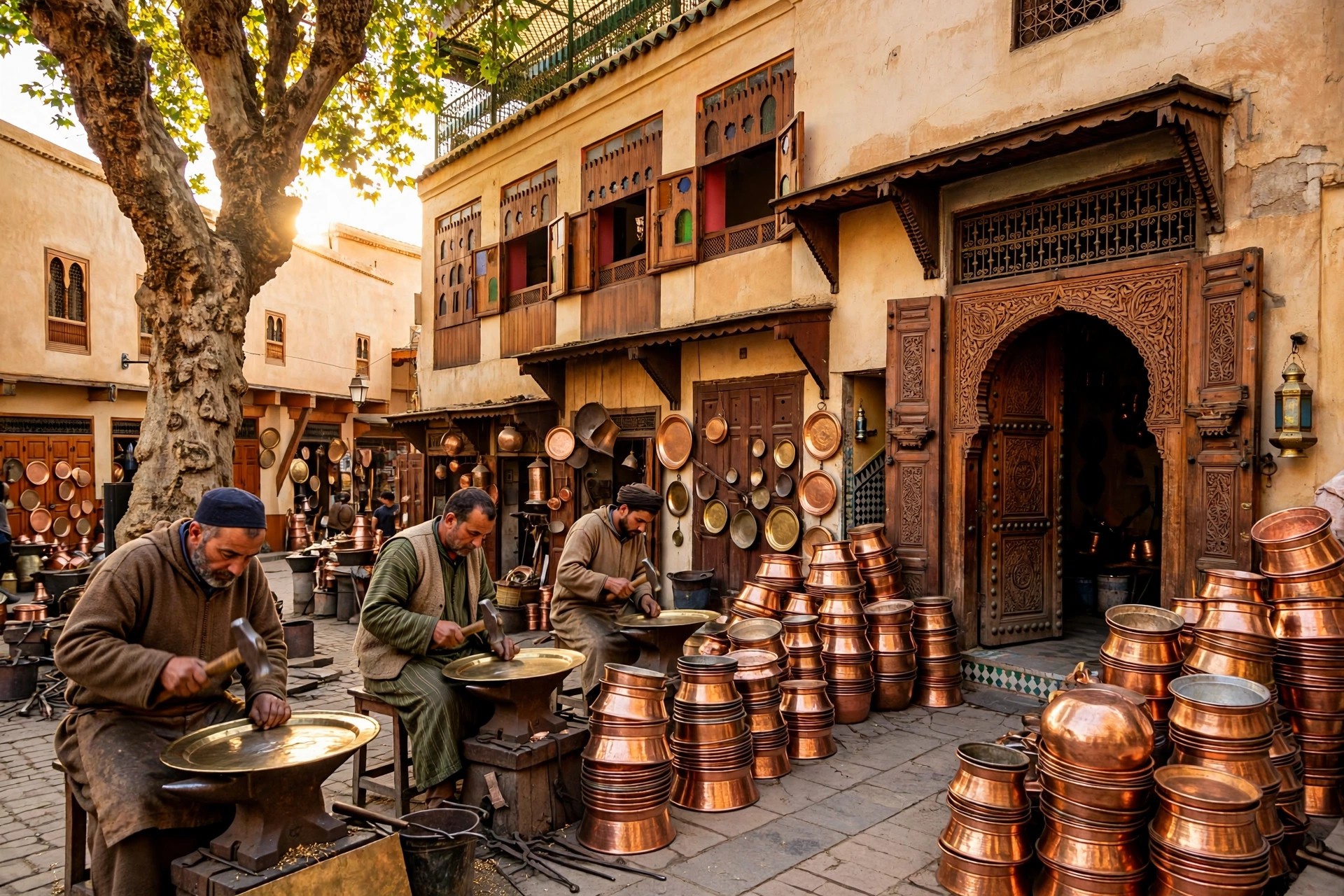
If one building could tell the whole history of Moroccan hammams, it would be Hammam Saffarin in Fez: a 14th-century Marinid bath, probably built for the coppersmiths who worked around Place Seffarine — and they are still hammering trays outside its door.
Behind the hot room, a level below the bathers, two fires burn — one for the women’s side, one for the men’s — lit in that spot since the fourteenth century. The heat runs under the floor through a hypocaust, the same Roman underfloor system, and two great brass cauldrons sit above the flames. Saffarin is one of the few Moroccan hammams with separate facilities for men and women, so it can stay open to both sexes all day instead of splitting the day into men’s hours and women’s hours.
Local people link the hammam to two Sufi saints, Sidi Tallouk and Sidi Ahmad Skalli, though no tombs are visible and the link is not clearly established. Restored under the architect Rachid Halaoui as part of an Austrian-led project to save historic bathhouses around the Mediterranean, it still works as a neighbourhood bath, not a museum. The poorer quarters of Fez still use it for the same reason they always did: it costs little, it is hot, and it is theirs. Read the full account on Hammam Saffarin for the architectural detail.
Inside the Hammam: Rooms of Rising Heat
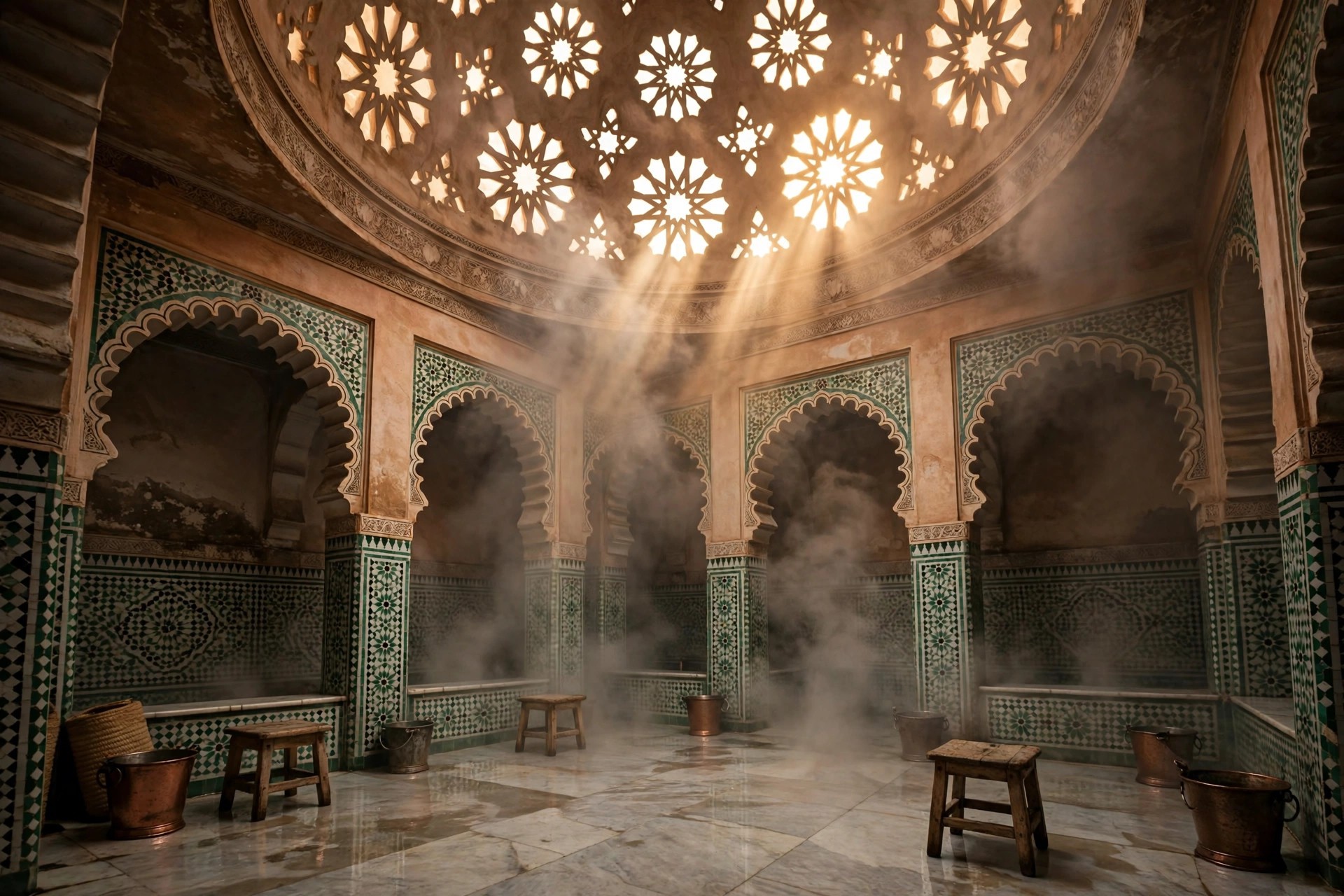
The plan of a Moroccan hammam has barely changed in a thousand years. You enter from the street into the undressing room, the mashlah — the goulsa, in Fez — the largest room, often domed and, in the grander hammams, the most decorated space in the building. From there you move through three bathing rooms in order — the order that has defined the history of Moroccan hammams for a thousand years: el-barrani, the cold room; el-wasti, the warm room; and ad-dakhli, the hot room nearest the fire.
The ceilings are pierced with small star-shaped openings that let in shafts of light and let out steam. There is no pool anywhere. A bather sits on a low stool with a bucket, and an attendant — or the bather — pours water over the body. That single rule, water poured and never shared still, is the clearest line between the Roman bath and the Moroccan hammam. The furnace at the back warms floor and water; old hammams burn wood, modern ones often use gas.
The Ritual: Black Soap, Kessa and Ghassoul
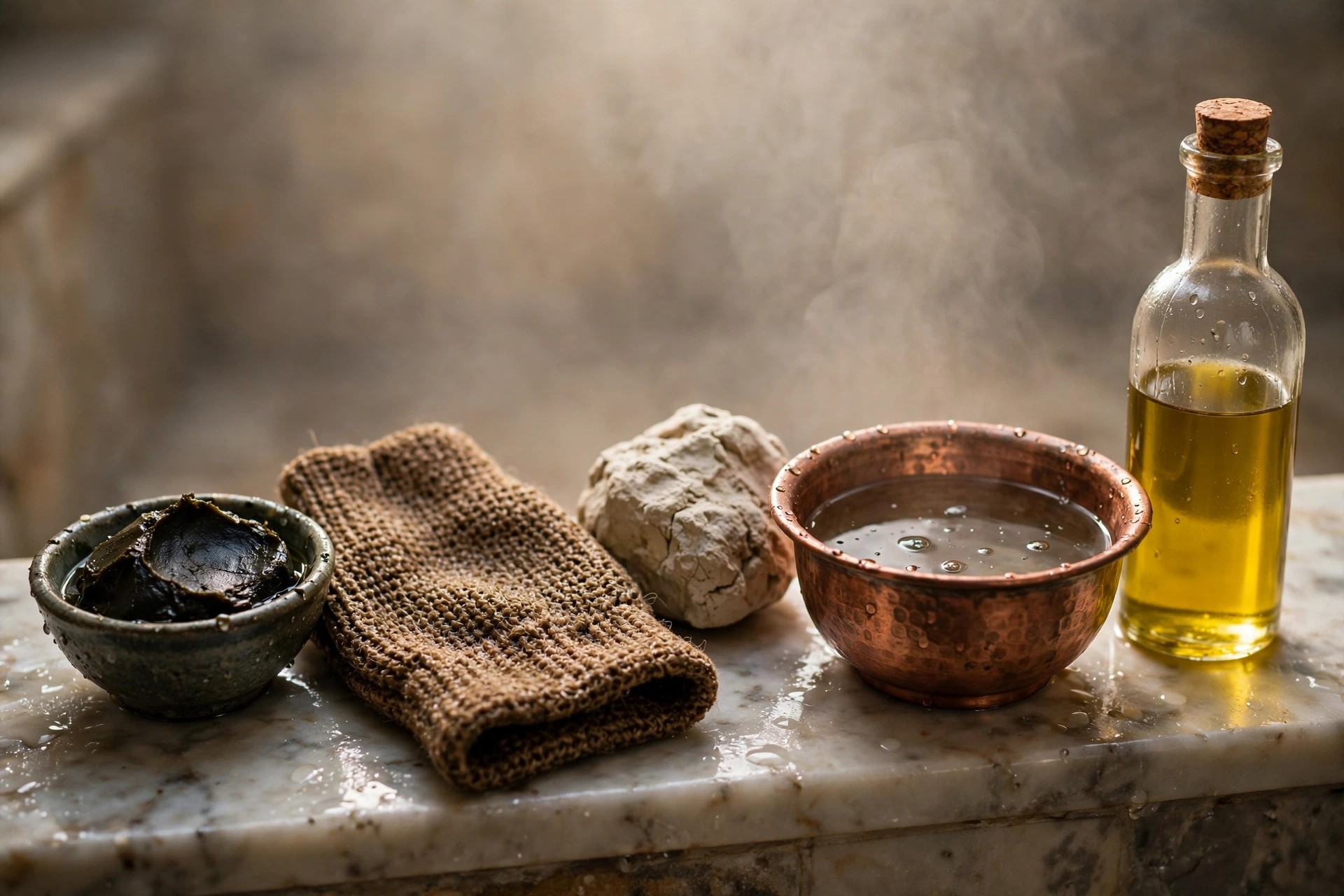
The ritual at the centre of the history of Moroccan hammams is the same in a 10-dirham neighbourhood bath and a 500-dirham riad spa. First comes the steam: ten or fifteen minutes in the warm room, then the hot room, until the skin is soft and sweating. Then the attendant — or you — spreads savon beldi, black soap, over the whole body: a soft, dark olive-based paste that sits for five to ten minutes to loosen the outermost layer of skin. It does not lather.
Then comes the kessa, the rough woven glove, worked over the body in long, firm strokes. Dead skin rolls off in grey strips — startling the first time, deeply satisfying after that. The scrub is the heart of the hammam, and why regulars return weekly. After the rinse comes ghassoul, the mineral clay of the Moulouya basin in the Middle Atlas, mixed with water or rose water and applied as a mask to body and hair. A final rinse, a little argan oil, and the ritual ends in the cool room with a glass of mint tea.
Product
What it is
Typical price (MAD)
Savon beldi (black soap)
Soft olive-oil paste that softens the skin
20–40 ($2–$4)
Kessa glove
Coarse woven mitt for the exfoliating scrub
15–30 ($1.50–$3)
Ghassoul clay
Mineral clay from the Middle Atlas, for body and hair
20–50 ($2–$5)
Argan oil
Oil from the southwest, for skin after the rinse
100–300 ($10–$30)
Rose water
Dades Valley rose water, for the final rinse
20–40 ($2–$4)
The Hammam as the Neighbourhood’s Living Room
For centuries the hammam was where Moroccan women could gather freely, away from the more public spaces of the medina, to talk, laugh and be at ease. Mothers brought daughters, grandmothers caught up with neighbours, and mothers visited weekly to scout potential brides for their sons. Before a wedding, the bride’s female family and friends gathered at the hammam for a ritual cleansing celebration — the tiyab al-arussa — still one of the most cherished traditions in the history of Moroccan hammams. After the birth of a child, the new mother returned to the hammam as part of her recovery.
Men had their own hours and their own talk: business, neighbourhood news, the week’s football. The hammam was, and still is, the social heart of the neighbourhood — where news travelled, marriages were arranged, and the body was cared for with the same seriousness as a meal.
The institution was built into the city itself. In Marrakech, the Saadian sultan Abdallah al-Ghalib built the Mouassine quarter a mosque between 1562 and 1573, and set around it everything a neighbourhood needed: a public fountain, a Quranic school, a library, an ablutions house, and a hammam to the east for ghusl. Walk the quarter today with our Marrakech travel guide and the logic is still visible in the street plan.
What a Visit Costs in 2026
The Moroccan hammam is still one of the cheapest pleasures in the country, and price is the most practical footnote to the history of Moroccan hammams. Prices below are planning ranges checked in November 2026 — always confirm at the door, because neighbourhood hammams rarely publish a price list.
Item
Neighbourhood hammam (MAD)
Riad or hotel spa (MAD)
Entry
10–20 ($1–$2)
Included in the package
Attendant scrub
50–150 ($5–$15)
150–400 ($15–$40)
Full ritual with massage
Not usually offered
300–800 ($30–$80)
Luxury spa session
Not offered
600–1,500 ($60–$150)
Soap, kessa and clay kit
20–60 ($2–$6)
Included
Mint tea afterwards
5–10 ($0.50–$1)
Included
A weekly neighbourhood visit, entry plus scrub, costs about 60 to 170 dirhams — $6 to $17. A spa session costs five to ten times as much for the same ritual in a prettier room: the soap, the steam and the scrub are the same, and what the spa sells is privacy, quiet and time.
Visiting a Hammam as a Traveller
Travellers can use either kind of hammam; the choice is about comfort, not authenticity. A public hammam is the real thing — welcoming, but communal, steamy and confusing on a first visit. A riad spa gives you the same ritual in a private room with an attendant who speaks your language. Both are legitimate ways into the history of Moroccan hammams: one is the living tradition, the other its translation.
A few rules are absolute. Gender separation is total — separate sections or split hours — and if you are unsure which door is yours, pause, watch, or ask. In a public hammam you keep your underwear on. Bring flip-flops, a towel, soap and a kessa; all are usually sold at the door. Keep your voice low in the hot rooms, and never take photographs inside. Rabat’s old medina has working neighbourhood hammams a short walk from the Kasbah of the Udayas, if you want a quieter city than Fez or Marrakech.
Afterwards, do what every Moroccan does: sit down somewhere calm with a glass of mint tea. Our Moroccan food guide explains why that glass tastes better after steam than before it.
The Hammam Today: Survival and Revival
The hammam has survived plumbing, showers, gyms and spas without changing its core. Fez still has more than 120 functioning hammams, about 30 of them historic and inside the medina. The count has fallen from the chroniclers’ 93 only because the city has grown far beyond its medieval walls; the old quarters are as well served as ever. That continuity is the point of the history of Moroccan hammams: the institution outlasted every dynasty that built it.
Restoration has helped: Saffarin’s Austrian-led project showed a working hammam can be repaired without becoming a museum, and other historic baths have followed. Meanwhile the ritual has gone global — riads and spas from Marrakech to London sell a “Moroccan hammam” that is the black-soap-and-kessa sequence in a private room, which keeps the soap, the glove and the clay in production and in demand.
The neighbourhood hammam, though, is the thing itself. It still opens before dawn, still heats its water over a fire, and still costs less than a sandwich. As long as Moroccans go weekly, the history of Moroccan hammams is not history at all. It is Tuesday. More stories from the same centuries live in our History & Heritage section.
Frequently Asked Questions
How old is the Moroccan hammam tradition?
More than a thousand years. Bathhouses appear in Morocco in the Idrisid period, in the late 8th to early 9th centuries, and Fez had its first hammams under the Idrisids in the 8th to 10th centuries. The tradition descends from the Roman thermae through the early Islamic bathhouses of the Umayyad period. That unbroken line is why the history of Moroccan hammams is usually dated from the Idrisids rather than from Rome.
What is the difference between a hammam and a sauna?
A sauna is dry heat for sweating; a hammam is steam plus a washing ritual — black soap, a hard scrub with a kessa glove, and usually a ghassoul clay mask. A hammam also has no plunge pool: water is poured over the body, never shared still.
Do men and women use the same hammam?
Never at the same time in the same rooms. Most hammams split the day into men’s hours and women’s hours. Hammam Saffarin in Fez is a rare exception, with separate facilities for men and women, so it can serve both all day.
What should I bring to a public hammam?
Flip-flops, a towel, soap, a kessa glove and a small bag for your clothes. Buckets and stools are provided inside; anything you forget is usually sold at the door for a few dirhams.
How much does a hammam cost in Morocco?
A neighbourhood hammam costs 10 to 20 dirhams for entry, about $1 to $2, plus 50 to 150 dirhams if an attendant does the scrub. A riad spa session runs 300 to 800 dirhams, and a luxury hotel spa 600 to 1,500. Prices are planning ranges checked in November 2026.
Can tourists visit a traditional hammam?
Yes. Public hammams welcome visitors, and riad spas offer the same ritual in a private setting, including for couples. Go to a spa for your first time if you want guidance, and try a neighbourhood hammam once you know the sequence — that is where the history of Moroccan hammams is still being lived.
Conclusion
From the thermae of Volubilis to the fires still burning under Hammam Saffarin, the history of Moroccan hammams is the story of a Roman room that Islam made necessary and Morocco made its own. The architecture barely changed, the ritual barely changed, and the social role — neighbourhood living room, women’s gathering place, bride’s preparation — barely changed either.
That is the real surprise of the history of Moroccan hammams: most medieval institutions survive as ruins or museums, while this one survives as a weekly appointment, kept by millions who do not think of it as history at all. Go on a Tuesday afternoon, sit in the steam, and you are not visiting the past. You are joining it.