
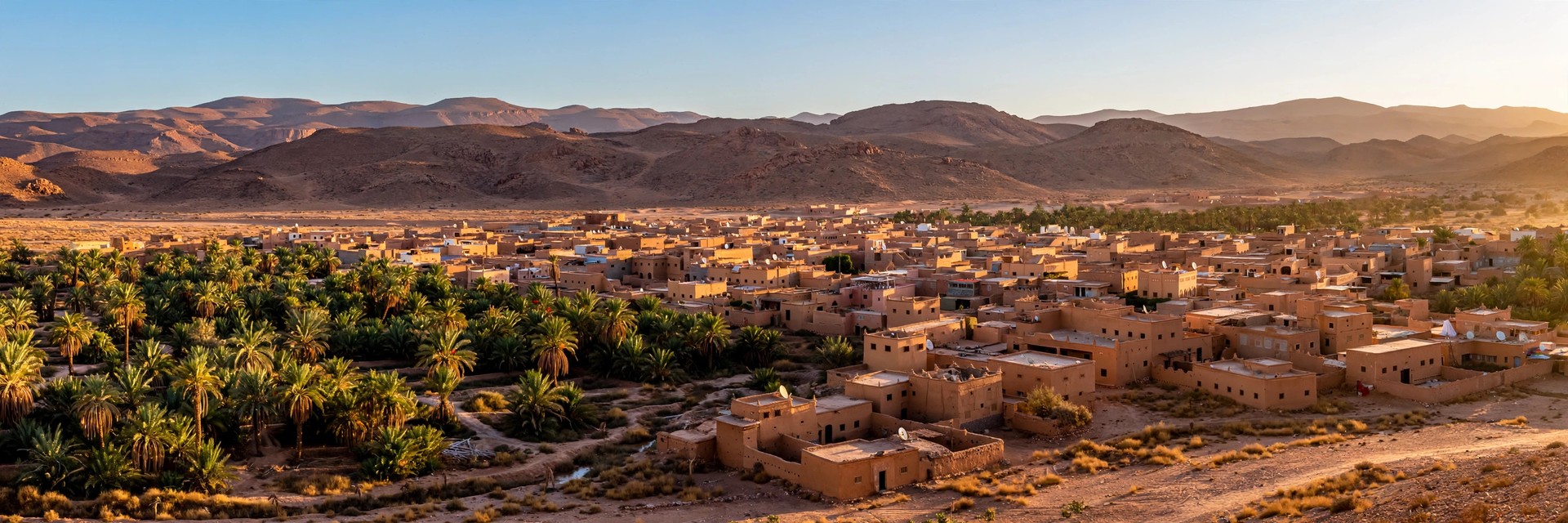
Living in Guelmim is Morocco at its most Saharan: a city of about 127,000 people at the edge of the desert, where the Anti-Atlas mountains run out of rock and the road south turns to sand. Guelmim is the capital of the Guelmim-Oued Noun region and the town Moroccans call the Gateway to the Desert — a caravan crossroads where the N1 and N12 highways meet, and where traders in blue robes still gather every Saturday for one of the largest camel markets in the country.
This is not a polished expat hub. There is no international school, no marina, no old medina full of riads. What living in Guelmim offers instead is space, sun, very low costs and a front-row seat to Saharan culture — the oasis, the market, the tea ritual and the desert itself, all within a short drive. This guide to living in Guelmim covers costs, housing, healthcare, internet and the honest downsides. All prices are in Moroccan dirhams (MAD), checked in November 2026, at roughly 10 MAD to $1.
In this guide
- Guelmim at a Glance
- Why Expats Choose Living in Guelmim
- Where to Live in Guelmim: Neighbourhoods
- Housing and Rents in Guelmim
- Monthly Budget for Living in Guelmim
- Food and Daily Life
- Getting Around Guelmim
- Healthcare in Guelmim
- Schools and Family Life
- Internet and Working Remotely from Guelmim
- Climate and Seasons in Guelmim
- Weekend Trips from Guelmim
- Practical Tips: What to Know Before Moving to Guelmim
- Frequently Asked Questions
- Conclusion
Guelmim at a Glance
| Fact | Detail |
|---|---|
| Location | Southern Morocco, Guelmim-Oued Noun region, where the Anti-Atlas meets the Sahara |
| Population | 126,729 (2024 census) |
| Character | Caravan town and regional capital, the Gateway to the Desert |
| Elevation | About 230 metres |
| Nearest airport | Guelmim Airport (GLN), domestic flights to Casablanca |
| Budget, single person | 5,500–9,000 MAD ($550–$900) a month |
| Budget, couple | 8,500–13,000 MAD ($850–$1,300) a month |
Guelmim sits where the N1 from Agadir meets the N12 from the east, about 200 km south of Agadir and 125 km north of Tan-Tan. The oasis of Asrir, once an important trade-route town, lies just north of the city, and the palm grove of Tighmert is a short drive to the south. Read more on Wikipedia.
Why Expats Choose Living in Guelmim
The first reason people choose living in Guelmim is the desert itself. The Sahara begins here in spirit long before the sand does: the light is hard and golden, the horizon is wide, and the culture of the caravans — the camels, the blue robes, the three glasses of tea — is everyday life, not a tour. For writers, photographers and anyone who works online and wants Morocco without the crowds, that is the draw.
The second reason is cost. Living in Guelmim is among the cheapest ways to live in Morocco: rents run well below Agadir or Marrakech, food comes from the souk at farm prices, and a coffee still costs a few dirhams. The trade is real — fewer services, real summer heat and a small foreign community — and the rest of this guide makes it with your eyes open.
Where to Live in Guelmim: Neighbourhoods
Most of daily life for people living in Guelmim happens within a few kilometres, and a petit taxi covers almost any trip in town for a few dirhams.
The town centre, around the main avenues and the covered market, is where most newcomers start: banks, pharmacies, cafes and the souk streets within a short walk. Flats here are simple, often above shops, and the streets are busiest on market days.
The newer residential districts at the edges of town are the comfortable choice for a longer stay: wider streets, newer buildings, more space and better odds of a balcony, a parking spot and a flat with proper sun protection.
The districts towards the palm grove, on the road to Tighmert, are quieter and greener, with date palms at the end of the street — the best choice if you came for the oasis and the open sky.
Housing and Rents in Guelmim
Renting while living in Guelmim works the way it works in most small Moroccan cities: the best flats move by word of mouth, not listing sites. The local semsar, the neighbourhood broker, knows what is free; so do cafe owners and hotel receptionists.
Expect a simple contract in French or Arabic, a deposit of one to two months' rent (the legal maximum is two months under Law 67-12), and a flat that is usually unfurnished. As a planning range for November 2026: one-bedroom in the centre 1,500–2,500 MAD ($150–$250), outside the centre 1,200–2,000 MAD ($120–$200); three-bedroom in the centre 2,500–4,000 MAD ($250–$400). Our renting an apartment in Morocco guide explains the contract rules.
Never pay a full year upfront for a flat seen only in photos — rent month to month until you know the building. Check water pressure, hot water and cooling before you sign: summer days pass 40°C and many flats have no air conditioning, so a shaded flat with thick walls matters more here than a view.
Monthly Budget for Living in Guelmim
A realistic monthly budget for living in Guelmim in a modest flat, cooking mostly at home and eating out a few times a week — planning ranges, checked in November 2026.
| Expense | Single person (MAD) | Couple (MAD) |
|---|---|---|
| Rent, one-bedroom centre | 1,500–2,500 | — |
| Rent, two-bedroom centre | — | 2,200–3,500 |
| Utilities (electricity, water) | 250–500 | 400–800 |
| Internet and mobile | 200–350 | 300–500 |
| Groceries and market | 1,500–2,500 | 2,500–4,000 |
| Eating out and cafes | 300–700 | 500–1,100 |
| Local transport | 150–300 | 250–500 |
| Healthcare and pharmacy | 200–500 | 300–700 |
| Leisure and trips | 300–700 | 500–1,000 |
| Total | 5,500–9,000 | 8,500–13,000 |
The biggest saving against the big cities is rent, and the second is food: the daily market and the Saturday souk sell what the oasis and the surrounding farms grow — dates, vegetables, olives and honey. Cooling is the cost newcomers forget: fans and air conditioning can add 200–400 MAD a month to the electricity bill from June to September.
Food and Daily Life
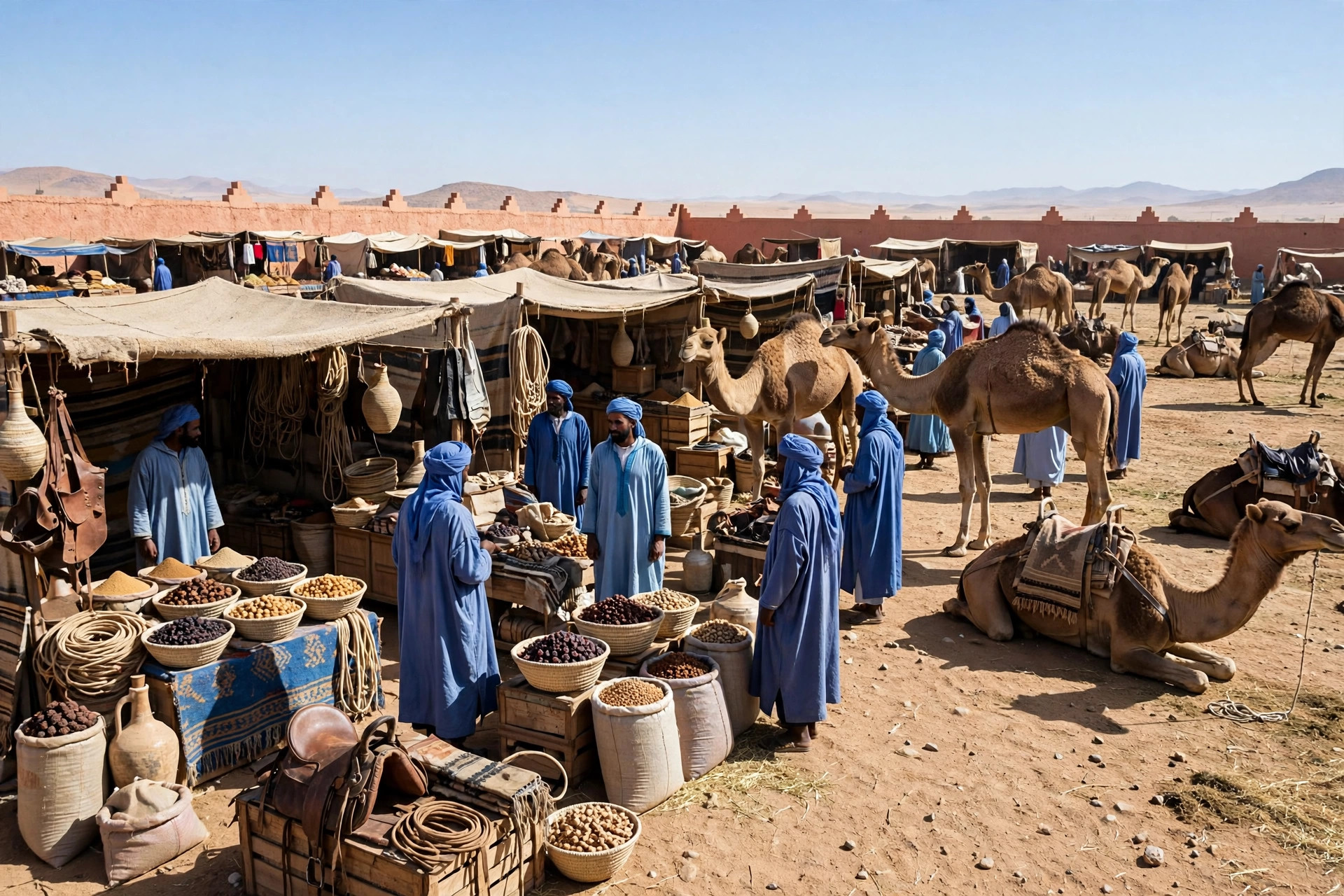
Daily life for people living in Guelmim runs on the market: the covered market and the street stalls sell lamb, chicken, dates and the produce of the oasis, and bread comes from the neighbourhood bakery, still warm, for a dirham or two. The Saturday camel market, the Souk Amhayrich, is the event of the week — camels, sheep and goats traded at the edge of town from early morning, with traders in blue robes and stalls selling ropes, saddles, spices and dates.
Eating out while living in Guelmim is simple and cheap: a tagine or grilled meat lunch runs 25–50 MAD ($2.50–$5), a harira and bread breakfast less than 15 MAD, and mint tea in a cafe 5–10 MAD. Camel meat appears on menus here more than anywhere else in Morocco, and Saharan tea — poured high in three glasses, the last the sweetest — is a ritual, not a drink. Our cost of a week in Morocco guide puts these prices in a national context.
Getting Around Guelmim
Getting around while living in Guelmim is easy: the town is compact enough to walk across in half an hour. Petit taxis run everywhere for a few dirhams a ride, and grand taxis connect the town to Tiznit, Tan-Tan, Assa and Sidi Ifni. There is no train station — this is a bus and taxi town.
For longer trips, CTM and local buses run daily to Agadir (about 3 hours), Tan-Tan (about 1.5 hours), Laayoune (about 4.5 hours) and Casablanca (about 9 hours). Guelmim Airport has domestic flights to Casablanca a few times a week — check the current schedule before planning around them. Driving is the real freedom for people living in Guelmim: the N1 runs north to Agadir and south to Tan-Tan and the desert, and the N12 runs east towards Assa and Zagora. Our Morocco driving costs guide covers petrol and tolls.
Budget for desert driving: carry water, check the fuel gauge before the long empty stretches south, and expect sand on the road after a wind.
Healthcare in Guelmim
People living in Guelmim have a regional hospital for general care and emergencies, plus private clinics and pharmacies in the centre. For routine care — a doctor's visit, a prescription, a minor injury — the town is well served, and a private GP consultation typically costs 150–250 MAD ($15–$25).
For anything serious, the plan is Agadir: the nearest large hospitals with specialists are about 200 km north, roughly 3 hours by road. That is the honest trade of desert living, and it matters most for families with young children and for anyone who needs regular specialist care. Our healthcare in Morocco guide explains public and private cover for expats.
Schools and Family Life
There is no international school in Guelmim, and no French mission school — the plain fact families need first. Children go to Moroccan public or local private schools, where teaching is in Arabic and French, and a child who arrives speaking neither will need a year of patience and language support. The nearest international schools are in Agadir, about 200 km away, so most expat families who choose Guelmim either home-school or accept the local system.
What living in Guelmim gives families in return is space, safety and a childhood shaped by the desert: children play in the streets, the air is dry and clean, and the camel market, the oasis and the dunes give children a Moroccan childhood rather than an international-school bubble. The town also hosts a school of technology linked to Ibn Zohr University, so older students have a local route into higher education.
Internet and Working Remotely from Guelmim
Remote workers living in Guelmim will find the basics in place: fibre internet is available in much of the town through Maroc Telecom, Orange and inwi, and 4G coverage is good across the city. A home fibre line typically costs 200–350 MAD ($20–$35) a month, and a mobile data top-up is cheap enough to keep as a backup.
The honest caveats: speeds are lower than in Casablanca or Rabat, and a sandstorm can slow a connection for an afternoon. Our SIM cards and mobile data guide explains the local operators. Cafes with wifi exist, but there is no coworking space — most remote workers here work from home, with a terrace and a view of the palms.
Climate and Seasons in Guelmim
Living in Guelmim means living with the desert climate: very dry air, huge temperature swings between day and night, and a summer that is genuinely hot. Daytime highs pass 40°C from June to August, and the chergui — the hot, dry wind from the Sahara — can push temperatures higher still for days at a time.
Winter is the reward: daytime temperatures around 20°C, cool nights that can drop towards 5°C, and clear skies for months. Spring and autumn are the sweet spots, warm days and mild evenings, and the best months to arrive, settle in and explore. Rain is rare all year, so plan for sun, dust and shade rather than umbrellas.
Weekend Trips from Guelmim
Weekends are where living in Guelmim pays off: the desert, the coast and the mountains are all within a few hours.
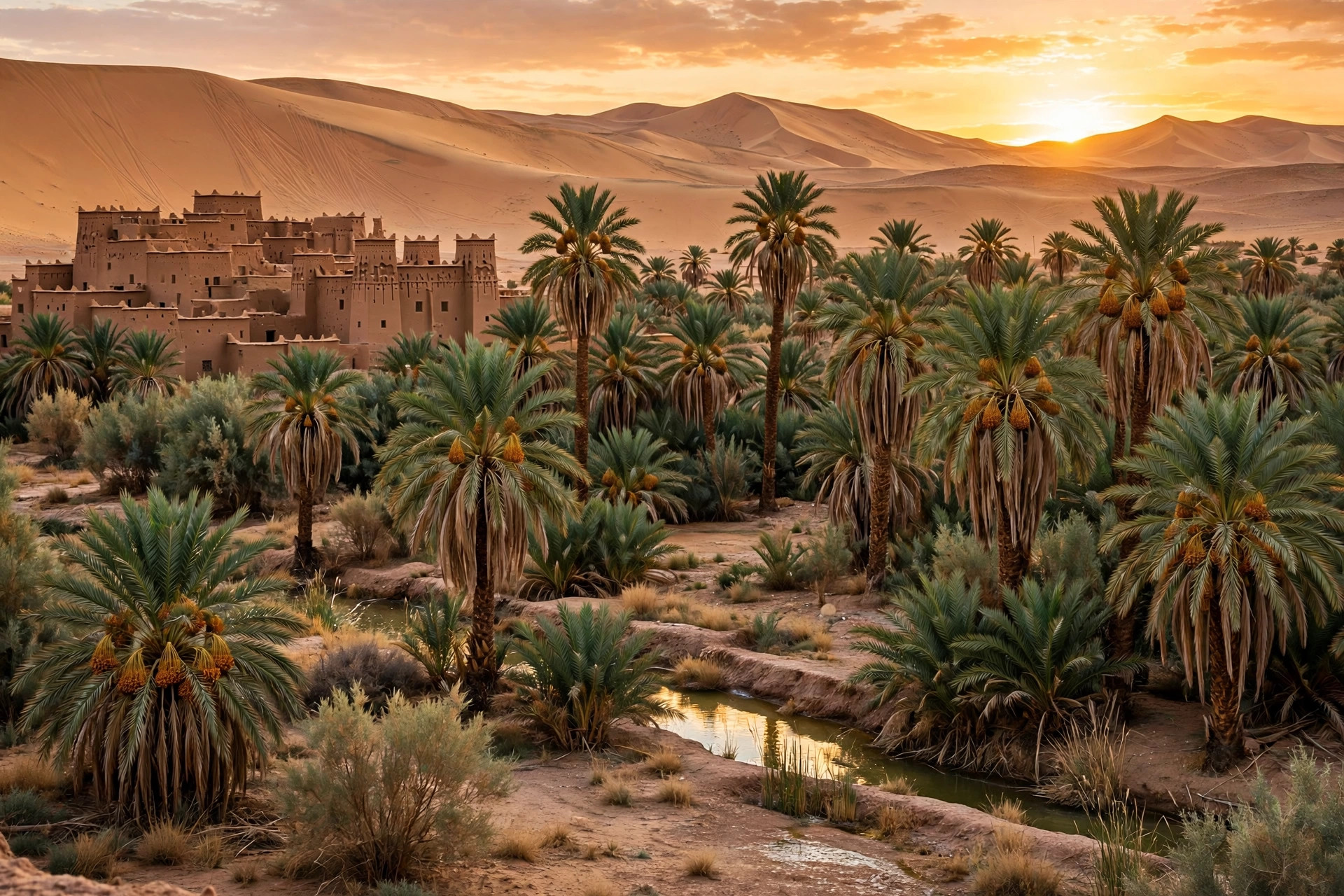
Tighmert oasis, about 15 km south, is the closest escape — a green palm grove with a small ksar, guesthouses and camel rides, and the easiest taste of oasis life without leaving the region.
The hot springs of Abaynou, about 20 km away, are a local favourite for a soak and a picnic, especially in the cooler months.
Sidi Ifni and Legzira beach, about 150 km west, give you the Atlantic: a quiet former Spanish town, fresh fish and the famous stone arch at Legzira. Our Sidi Ifni travel guide covers the coast in detail.
Tiznit, about 120 km north, is the silver city of the Anti-Atlas, with pink ramparts and a famous jewellery souk — an easy day trip up the N1. Our Tiznit travel guide covers it in detail.
Amtoudi and the Anti-Atlas granaries, about 110 km away, are for the adventurous: ancient collective granaries perched on cliffs, reached on foot through a mountain valley.
Practical Tips: What to Know Before Moving to Guelmim
Learn some French first, then Darija. French runs the administration, the banks and the clinics; Darija runs the souk and the street. Tamazight (Tachelhit) and Hassaniya Arabic are also heard every day, and a greeting in either opens doors.
Bring cash for the souk. Cards work in supermarkets and larger shops, but the market, the taxis and the small cafes run on cash — keep small notes and coins.
Rent before you buy, and visit in summer first. A flat that feels perfect in February can be an oven in July. Spend a few days in the hottest month before committing to a year.
Drink bottled water at first. Most long-term residents settle into local water, but newcomers should start with bottled water and keep a filter or a stock of bottles at home.
Respect the market. The camel market is a working market, not a show: ask before photographing people, dress modestly, and go early — the trading is mostly done by mid-morning.
Frequently Asked Questions
Is Guelmim safe for expats?
Yes. Guelmim is a quiet, conservative regional town with low street crime, and foreigners who respect local customs are welcomed. The usual advice applies: keep valuables out of sight in crowds and avoid walking alone late at night in unfamiliar districts.
How hot does Guelmim get in summer?
Daytime highs regularly pass 40°C from June to August, and the chergui wind can push temperatures higher for several days. Air conditioning or at least a shaded, thick-walled flat is essential, and outdoor activity is best before 10 in the morning or after 5 in the afternoon.
When is the camel market in Guelmim?
The famous camel market, the Souk Amhayrich, is held every Saturday morning at the edge of town. Arrive around 7 or 8 in the morning to see the trading at its busiest, before the heat builds.
Can I live in Guelmim without speaking Arabic?
You can manage with French in banks, clinics and administration, but daily life in the souk and with neighbours runs on Darija, Tachelhit and Hassaniya. A few months of French and basic Darija will change the experience completely.
How far is Guelmim from Agadir?
About 200 km north on the N1, roughly 3 hours by bus or car. Agadir is the nearest big city for specialist hospitals, international schools, flights and shopping.
Is Guelmim a good base for exploring the Sahara?
Yes — that is its main strength. From Guelmim the road south runs through Tan-Tan towards Laayoune and the desert, while the Anti-Atlas, the coast at Sidi Ifni and the oasis towns are all day trips. Living in Guelmim puts the Sahara at your doorstep.
Conclusion
Living in Guelmim is a deliberate choice: the cheapest rents in southern Morocco, a real Saharan culture that has not been packaged for tourists, and a desert, an oasis and the Atlantic all within a few hours. The price is honest too — summer heat, a small foreign community and a three-hour drive to the nearest big-city hospital. If you want Morocco at its most open and least crowded, and you can handle the heat, living in Guelmim rewards you with space, sun and a Saturday market you will never forget.