
Introduction
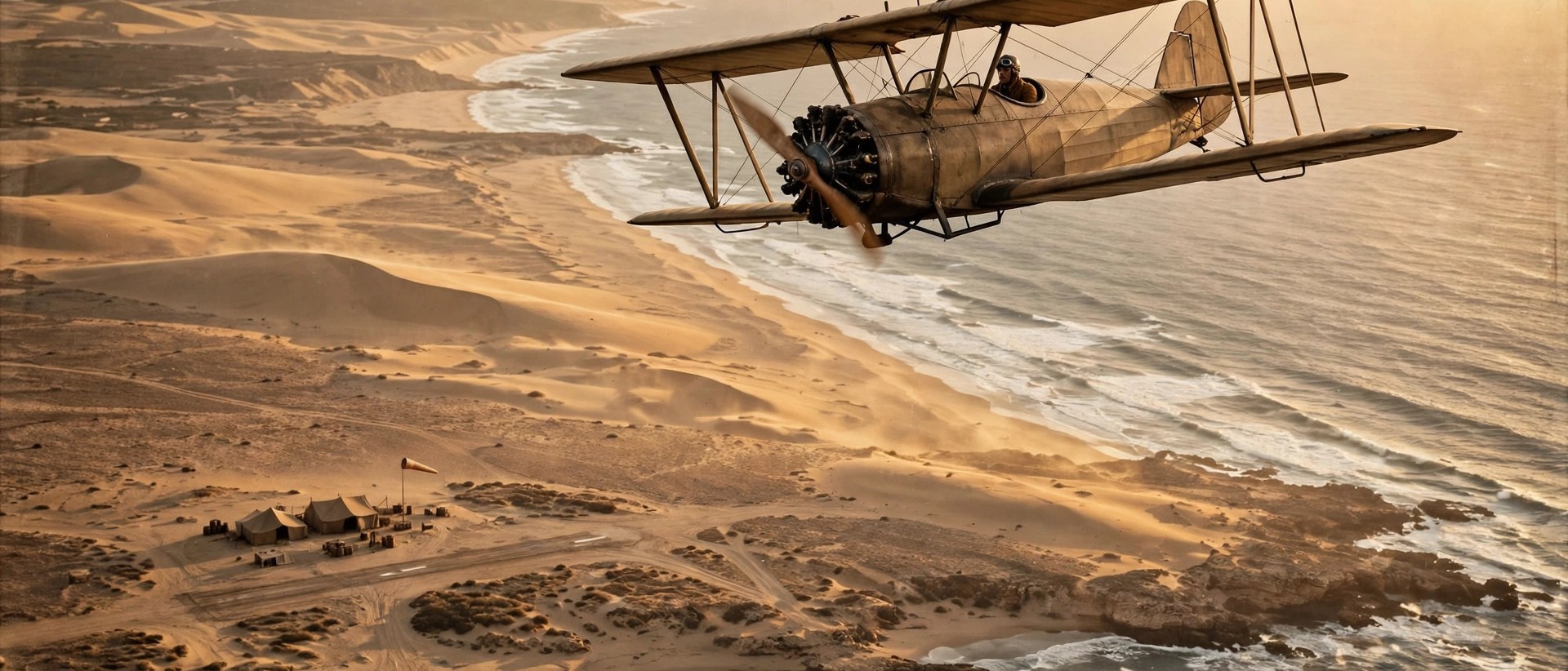
The history of Moroccan aviation begins with letters, not passengers. In 1919, open-cockpit biplanes carried mail from Toulouse to Rabat, flying from Toulouse to Rabat. Within a single generation, that fragile airmail line grew into a national airline, and the history of Moroccan aviation became one of the great adventure stories of the twentieth century — desert landings, a future novelist at a lonely Saharan station, and a flag carrier that now flies to four continents.
This guide follows the history of Moroccan aviation from the first airmail flights to the low-cost revolution and the plans for the 2030 World Cup. Where sources disagree about a date, this guide says so plainly. Our History & Heritage section covers the wider story. LahbabiGuide is written by travellers who live in Morocco — read more about us. For the trains that once competed with the planes, see our history of Moroccan railways.
In this guide
- Moroccan Aviation at a Glance
- The History of Moroccan Aviation Begins With the Mail
- Latécoère's Line: Toulouse to Rabat
- Casablanca to Dakar: The Desert Airmail
- Saint-Exupéry at Cap Juby
- Casablanca–Anfa: Morocco's First Airport
- War, Torch and the Birth of Berrechid Airfield
- Air Atlas and Air Maroc: Two Airlines, One Merger
- Royal Air Maroc: The Name, the Caravelle and the First Jets
- Mohammed V International Airport: From Nouasseur to the Hub
- ONDA and Morocco's Airport Network
- Open Skies: The Low-Cost Revolution of 2006
- Royal Air Maroc Today: Oneworld and the 2030 Plan
- Timeline: Key Dates in the History of Moroccan Aviation
- Flying in Morocco Today: Domestic Routes and Fares
- What the Records Do Not Tell Us
- Frequently Asked Questions
- Conclusion
Moroccan Aviation at a Glance
| Fact | Detail |
|---|---|
| First airmail flight | Toulouse–Rabat, September 1919 (see the disputed dates section) |
| First airport | Casablanca–Anfa, built in the 1920s |
| National airline formed | July 1953, by merger; renamed Royal Air Maroc on 28 June 1957 |
| Main hub | Mohammed V International Airport, Casablanca (CMN) |
| Airport operator | ONDA (Office National des Aéroports), created in 1990 |
| Open Skies | EU–Morocco aviation agreement, applied from December 2006 |
| Alliance | Oneworld member since 1 April 2020 |
| Fleet today | Around 60–70 aircraft, with a plan for 200 by 2037 |
The History of Moroccan Aviation Begins With the Mail
Morocco's first aeroplanes were not built for passengers or for war. They were built for the post. After the First World War, the French industrialist Pierre-Georges Latécoère had a bold idea: carry the mail by air from France to its colonies in Africa. Morocco was the first stop, and the history of Moroccan aviation starts the day his pilots landed at Rabat with sacks of letters.
The early flights were brave to the point of recklessness. Pilots navigated by sight, with no sealed cockpit and no radio worth the name. When an engine failed, a pilot landed wherever he could and waited — sometimes for rescue, sometimes for ransom.
Latécoère's Line: Toulouse to Rabat
On Christmas Day 1918, Latécoère launched the world's first airmail service, flying from Toulouse to Barcelona with the pilot René Cornemont at the controls and Latécoère himself riding behind him. Three months later, in March 1919, Latécoère flew on to Rabat, landing with a day-old newspaper and a bouquet of fresh violets from Toulouse.
Regular service followed in September 1919, when Bréguet 14 biplanes began flying the Toulouse–Rabat route under a contract with the French state. Eight flights a month were promised. The first pilots were lost within a year, in an October 1920 crash. But the line held, and the history of Moroccan aviation moved south with it when the route was extended to Casablanca. By late 1923 the company operated around 100 aircraft and had carried three million letters and more than 1,300 passengers.
Casablanca to Dakar: The Desert Airmail
From Casablanca, the line pushed south along the Atlantic edge of the Sahara, to Saint-Louis and Dakar in Senegal. This was the most dangerous stretch in the history of Moroccan aviation. South of Agadir there was nothing but desert, and a forced landing could mean days on foot — or capture.
In 1926 the company assigned Jean Mermoz to the Casablanca–Dakar link. An engine failure left him a hostage, freed only after a ransom was paid. In 1927 Latécoère sold the operation to the businessman Marcel Bouilloux-Lafont, who renamed it the Compagnie Générale Aéropostale. In May 1930 Mermoz flew the first commercial crossing of the South Atlantic, from Saint-Louis in Senegal to Natal in Brazil, in a Latécoère 28 seaplane
Saint-Exupéry at Cap Juby
The most famous name in Moroccan aviation never set out to be famous. Antoine de Saint-Exupéry joined Latécoère's company in 1926. In 1927 he was made station chief at Cap Juby — today Tarfaya, on Morocco's far southern coast — where his job was to keep the airstrip open, service the planes, and recover any pilot who went down between Agadir and Villa Cisneros.
He negotiated with desert tribes for the release of captured airmen, and wrote his first novel, Southern Mail, from what he saw there. The desert he knew at Cap Juby later became the setting of The Little Prince. Today Tarfaya keeps a small museum to Saint-Exupéry on the coast he flew.
Casablanca–Anfa: Morocco's First Airport
The airmail pilots needed somewhere to land, and Casablanca gave them Anfa. Built in the 1920s about six kilometres southwest of the city centre, Anfa Airport was Casablanca's primary airport for more than three decades — the first airfield in the history of Moroccan aviation.
During the Second World War, Anfa was taken over by the Vichy French government and used as an air base. It was one of the primary Allied objectives during Operation Torch, the invasion of North Africa in November 1942, and was seized in the first landings around Casablanca. It served as a pilot training airfield until it ceased all operations in 2007. Its runways have since been demolished, though Royal Air Maroc still lists its registered office on the old grounds.
War, Torch and the Birth of Berrechid Airfield
The war changed the history of Moroccan aviation twice over. First, Operation Torch turned Casablanca's airfields into Allied assets. Then, in early 1943, American forces built a new airfield at Berrechid, southeast of the city, as an auxiliary field for Anfa.
When the war ended in 1945, Berrechid was handed to the civil government. In the early 1950s the field reopened as Nouasseur Air Base, a staging area for B-47 bombers. After independence in 1956, the government of Mohammed V insisted the American bases leave. The United States agreed to withdraw in December 1959, and was fully out by 1963.
Air Atlas and Air Maroc: Two Airlines, One Merger
After the war, two small airlines were born in Morocco, then still a protectorate. Air Atlas was founded in 1946, flying Junkers Ju 52s on routes that included Algeria and Tunisia. Air Maroc, a private company founded in 1947, began scheduled operations in 1949 and focused at first on aircraft maintenance.
In July 1953 the two companies merged as Royal Air Maroc — Compagnie Nationale de Transports Aériens. The new airline's fleet was a museum of piston aviation: six Sud-Ouest Bretagnes, four Curtiss C-46 Commandos, five Douglas DC-3s and two SNCASE Languedocs. They flew the old routes, and added Frankfurt, Geneva and Paris. The merger was the real birth of the national carrier in the history of Moroccan aviation — even though the famous name came four years later.
Royal Air Maroc: The Name, the Caravelle and the First Jets
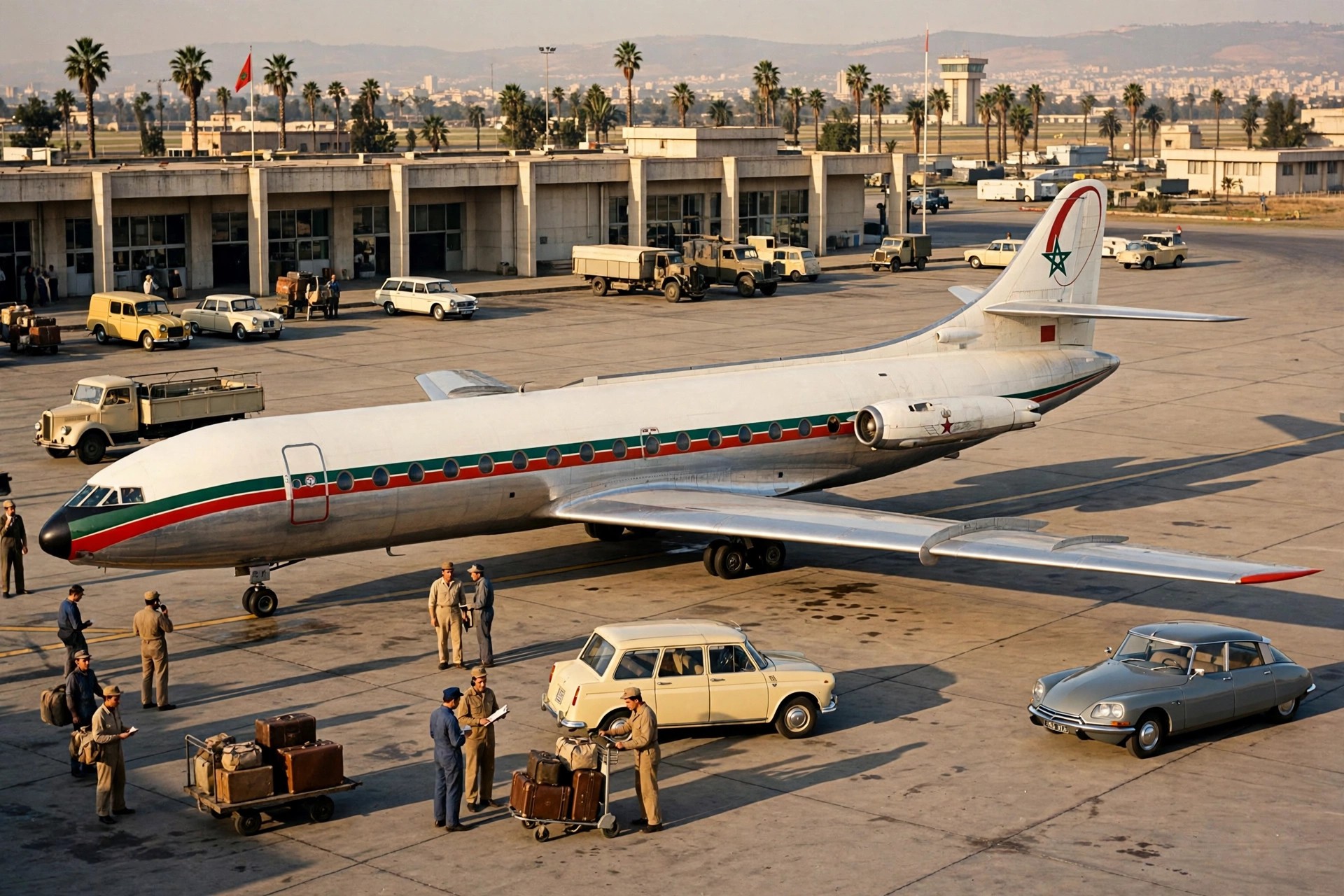
The name Royal Air Maroc was adopted on 28 June 1957, a year after independence, with the Moroccan government holding a 67.73% stake. By April 1958 the fleet numbered 16 aircraft, and in May the airline ordered its first two Caravelles. The first Caravelle arrived in 1960, when the airline carried 164,706 passengers.
The history of Moroccan aviation accelerated through the jet age. Royal Air Maroc took delivery of its first Boeing 727-200 in May 1970 and handed domestic routes to a subsidiary, Royal Air Inter, the same year. In 1975 it became the first Arab airline to serve New York. In 1986 it became the first African airline to operate the Boeing 757.
Mohammed V International Airport: From Nouasseur to the Hub
The old Nouasseur air base became Mohammed V International Airport, and the history of Moroccan aviation gained its great hub. Construction of the first passenger terminal began in 1970; it opened in 1980. Terminal 2 followed, begun in 2004 and inaugurated in 2007, and a rebuilt Terminal 1 opened in 2019. The airport sits at Nouaceur, about 30 kilometres southeast of central Casablanca, and is run by ONDA — see the official ONDA page for Casablanca Mohammed V Airport.
It is the busiest airport in the country and the hub of Royal Air Maroc. In 2022 it was ranked the fourth busiest airport in Africa, with about 7.6 million passengers, against a peak of 10 million in 2019. On 1 April 1970 a Royal Air Maroc Caravelle crashed on approach, killing 61 of the 82 people on board. In May 2025 Morocco launched a tender for a new H-shaped terminal, at an estimated cost of US$1.6 billion, to raise capacity from about 15 million to 35 million passengers a year in time for the 2030 World Cup.
ONDA and Morocco's Airport Network
Morocco's airports were run directly by the Ministry of Transport until 1990, when the Office National des Aéroports (ONDA) was created to manage them as a single national system. A year later ONDA inaugurated Al Massira Airport in Agadir.
Today ONDA runs the country's international airports, from Tangier's Ibn Battouta Airport — named after the great traveller from that city, whose story we tell in our Ibn Battuta guide — to Marrakech Menara, Agadir Al Massira and Rabat-Salé. In 2022 Marrakech Menara handled about 4.9 million passengers, Agadir 1.8 million, Tangier 1.4 million and Rabat-Salé 873,000.
Open Skies: The Low-Cost Revolution of 2006
For fifty years, the history of Moroccan aviation was the story of one airline and a handful of European flag carriers, at prices to match. That changed with liberalisation. Morocco reformed its aviation market in 2004 and signed an aviation agreement with the EU in 2005 — the first such agreement between the EU and a non-European country — applied from December 2006.
The first European low-cost carriers, easyJet and Ryanair, both launched services to Morocco in 2006. Ryanair signed a five-year deal with the government in May 2006, promising up to 20 routes. Passenger traffic between Morocco and Europe grew by about 18% a year between 2006 and 2009, adding roughly €1 billion to GDP and 24,000 jobs, while fares fell about 7%. Air Arabia Maroc, Morocco's own low-cost carrier, launched in 2009. In 2024 Royal Air Maroc's chief executive called the agreement unfair: European airlines enjoy free access to Morocco while Moroccan carriers struggle for slots in Europe.
Royal Air Maroc Today: Oneworld and the 2030 Plan
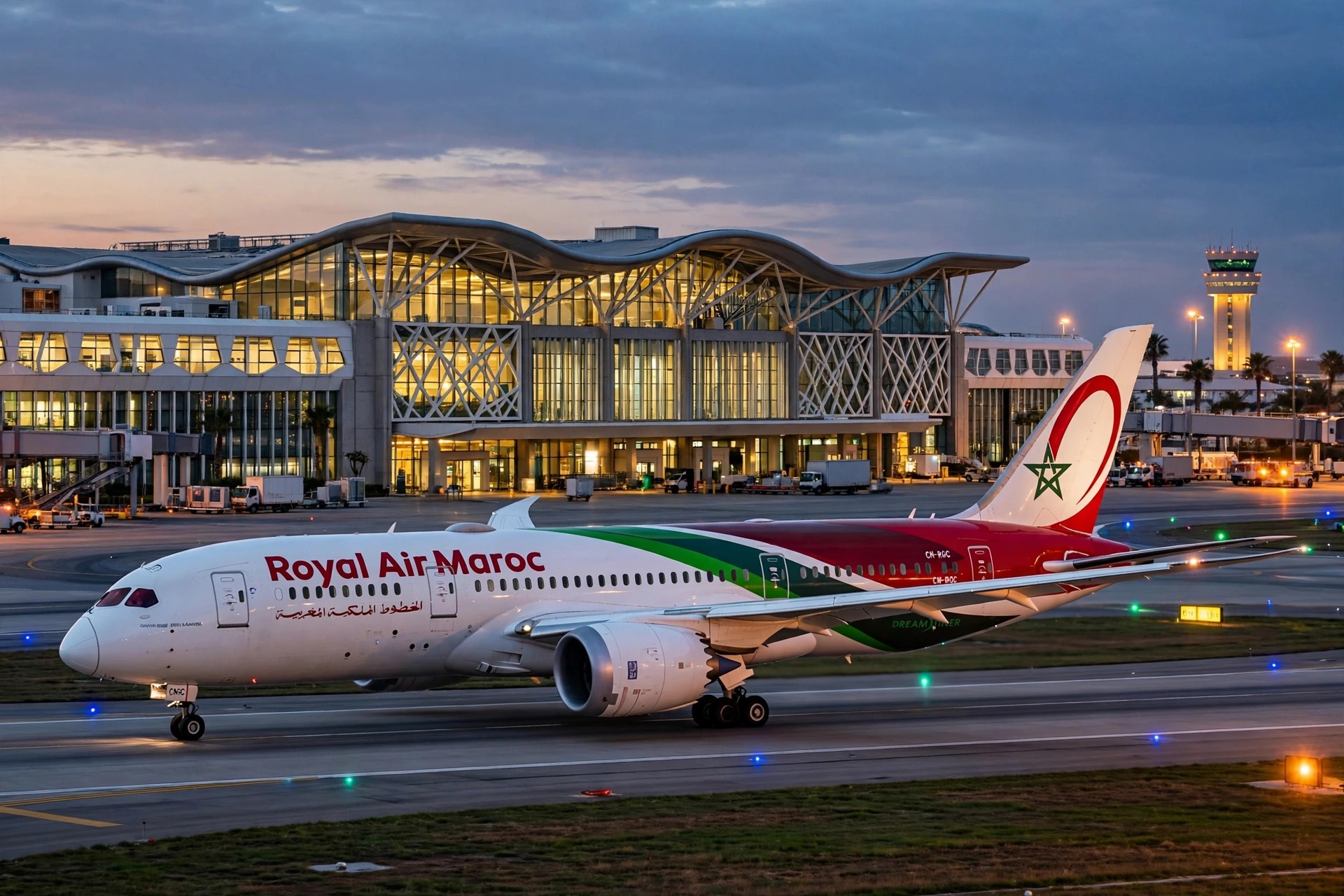
Royal Air Maroc survived the low-cost invasion — the next chapter in the history of Moroccan aviation — and reinvented itself as a hub airline, connecting Europe with Africa through Casablanca. Its low-cost subsidiary Atlas Blue, created in 2004, was folded back into the parent in 2009, the fleets merging in 2011. On 1 April 2020 Royal Air Maroc became the 14th member of the Oneworld alliance.
The airline today serves around 45 countries on about 134 routes, with around 60–70 aircraft, mostly Boeing 737s and 787 Dreamliners. In June 2023 it announced a plan to double its fleet, and under a 2023–2037 programme contract with the state it aims for 200 aircraft. For the full story of the airline, see the Royal Air Maroc article on Wikipedia.
Timeline: Key Dates in the History of Moroccan Aviation
| Year | Event |
|---|---|
| 1918 | Latécoère launches the Toulouse–Barcelona airmail service on Christmas Day |
| 1919 | First flights to Rabat; regular Toulouse–Rabat airmail begins in September |
| 1926 | Jean Mermoz assigned to the Casablanca–Dakar airmail link |
| 1927 | Saint-Exupéry becomes station chief at Cap Juby; Latécoère sells the line, which becomes Aéropostale |
| 1930 | Mermoz flies the first commercial South Atlantic crossing, Saint-Louis to Natal |
| 1942–43 | Operation Torch; Anfa seized; Berrechid Airfield built by the United States |
| 1946 | Air Atlas founded |
| 1947 | Air Maroc founded; scheduled operations begin in 1949 |
| 1953 | Air Atlas and Air Maroc merge in July |
| 1957 | The name Royal Air Maroc is adopted on 28 June, after independence |
| 1960 | First Caravelle delivered; 164,706 passengers carried |
| 1970 | First Boeing 727-200 delivered; Royal Air Inter takes over domestic routes |
| 1975 | Royal Air Maroc becomes the first Arab airline to serve New York |
| 1986 | First African airline to operate the Boeing 757 |
| 1990 | ONDA created to run Morocco's airports |
| 2004 | Atlas Blue, the low-cost subsidiary, is created |
| 2006 | EU–Morocco Open Skies agreement applied; easyJet and Ryanair arrive |
| 2009 | Air Arabia Maroc launches |
| 2020 | Royal Air Maroc joins Oneworld on 1 April |
| 2023 | Fleet expansion plan announced; target of 200 aircraft by 2037 |
| 2025 | Tender launched for a new terminal at Mohammed V Airport |
The timeline shows how the history of Moroccan aviation moved from mail planes to a global hub in a single century.
Flying in Morocco Today: Domestic Routes and Fares
Flying inside Morocco is the practical, everyday side of the history of Moroccan aviation. Royal Air Maroc and Air Arabia Maroc fly the domestic network from Casablanca. The table below shows typical one-way fares seen in November 2026. Fares change with the season and with how early you book, so check on arrival and compare before you buy.
| Route | Flight time | Typical one-way fare | In USD |
|---|---|---|---|
| Casablanca – Agadir | About 1h 05m | MAD 350–700 | About $35–70 |
| Casablanca – Marrakech | About 50m | MAD 300–600 | About $30–60 |
| Casablanca – Tangier | About 1h | MAD 350–750 | About $35–75 |
| Casablanca – Fez | About 1h | MAD 350–700 | About $35–70 |
| Casablanca – Dakhla | About 2h 15m | MAD 700–1,400 | About $70–140 |
| Casablanca – Oujda | About 1h 15m | MAD 400–800 | About $40–80 |
USD figures use about MAD 10 to $1. Casablanca is the hub: most domestic flights route through Mohammed V Airport, so direct flights between smaller cities are rare. For the ports that the mail planes once flew over, see our history of Moroccan ports.
What the Records Do Not Tell Us
Three dates in the history of Moroccan aviation are genuinely unsettled, and this guide does not pretend otherwise. First, the date of the first flight to Morocco. Some sources describe Latécoère's March 1919 flight to Rabat as the first, others date the first official flight to 1 September 1919 and give Casablanca, not Rabat, as the destination after an 18-hour journey of 1,850 km.
Second, the founding date of Royal Air Maroc. The airline is often said to have been founded in 1957, but the company was formed by merger in July 1953 and only took the name Royal Air Maroc on 28 June 1957.
Third, the opening of Mohammed V Airport. Some sources give 1959, the year the Americans left Nouasseur. But the site was a military airfield from 1943, and the first civilian passenger terminal did not open until 1980. "Opened in 1959" is a convenient shorthand, not a precise fact. Anfa Airport is dated to the 1920s by most sources but to the 1910s by a plaque on the old runway. For wider context, see our guides to Morocco's independence in 1956 and the history of Morocco.
Frequently Asked Questions
When did aviation start in Morocco?
The history of Moroccan aviation started with the airmail. Latécoère flew to Rabat in March 1919, and regular Toulouse–Rabat airmail service began in September 1919. The exact "first flight" date is disputed, because sources disagree on whether the March flight or the September service counts.
Who was Saint-Exupéry in Morocco?
Antoine de Saint-Exupéry was a pilot for Latécoère's airmail company and, from 1927, station chief at Cap Juby (now Tarfaya) on the Casablanca–Dakar route. He rescued downed pilots and wrote his first novel, Southern Mail, from the experience. The desert he knew there later shaped The Little Prince.
When was Royal Air Maroc founded?
The company was formed in July 1953 by the merger of Air Atlas and Air Maroc, and it adopted the name Royal Air Maroc on 28 June 1957. 1957 is the year most often quoted, but 1953 is the merger that created the airline.
What is Morocco's main airport?
Mohammed V International Airport in Casablanca (CMN) is Morocco's busiest airport and the hub of Royal Air Maroc. It began as a wartime airfield built in 1943 and became a US base, Nouasseur, before turning civilian after 1959.
Can I fly cheaply inside Morocco?
Yes. Domestic flights from Casablanca to Agadir, Marrakech, Tangier and Fez typically cost MAD 300–750 one way (about $30–75) when booked in advance, based on fares seen in November 2026. Book early; fares vary by season, so check on arrival.
Is Tangier's airport named after Ibn Battuta?
Yes. Tangier Ibn Battouta Airport (TNG) is named after the great fourteenth-century traveller born in Tangier, whose journeys we cover in our Ibn Battuta guide. It is the closest Moroccan airport to Europe. For Tangier's unusual past as an international city, see our Tangier International Zone history.
Conclusion
The history of Moroccan aviation is a story of distance conquered in stages: first the mail, then the passengers, then the jets, and finally low-cost flights within reach of almost everyone. From a biplane landing at Rabat with a bouquet of violets to Dreamliners lifting off from a terminal built for the 2030 World Cup, Morocco's century in the air has been improbable, dangerous and, in the end, triumphant. The next time your plane banks over the Atlantic coast into Casablanca, you will know what flew there before you.