
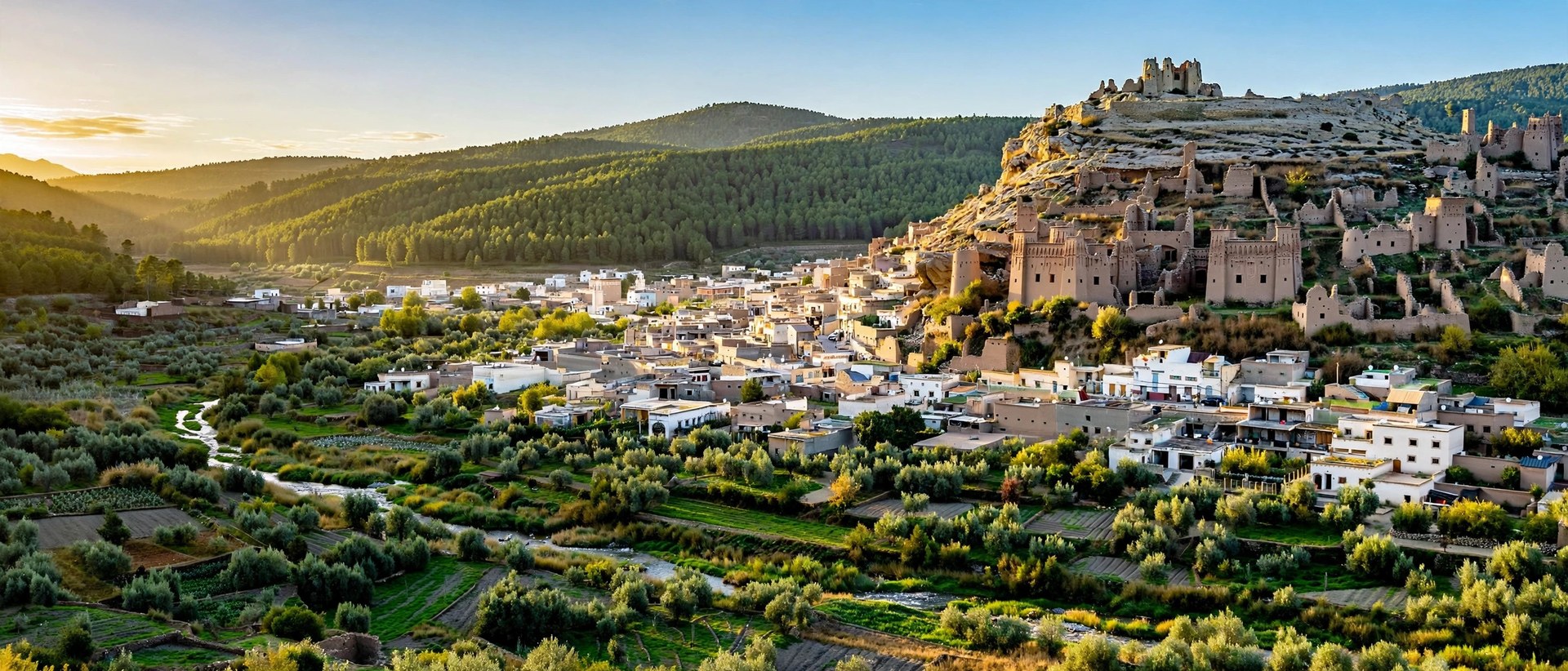
Living in Debdou is Morocco at its quietest: a mountain town of 4,447 people (2024 census) in the hills of the Oriental region, about 50 kilometres south of Taourirt, with one main street, a ruined Marinid kasbah above the roofs, and a past far larger than its size.
This is not an expat destination. There is no published rental market, no international school, no hospital in town, and — as far as any published source shows — no expat community at all. What living in Debdou offers instead is silence, space, heritage, and some of the lowest living costs in Morocco. This guide, part of our Living in Morocco series, covers housing, costs, healthcare, internet, and the honest downsides, in dirhams (MAD) at roughly 10 MAD to $1, checked in November 2026.
In this guide
- Debdou at a Glance
- Who Living in Debdou Suits — and Who It Does Not
- Where to Live in Debdou
- Housing and Rents
- Monthly Budget for Living in Debdou
- Food and the Wednesday Souk
- Healthcare
- Schools and Family Life
- Internet and Working Remotely
- Transport and Getting Around
- Residency and Paperwork
- Community and Daily Life
- Climate and Seasons
- Practical Tips
- Frequently Asked Questions
- Conclusion
Debdou at a Glance
| Fact | Detail |
|---|---|
| Location | Taourirt Province, Oriental region, ~950 m altitude |
| Population | 4,447 (2024 census) |
| Character | Mountain market town; Marinid kasbah, Kiadid quarter, old mellah |
| Nearest city | Taourirt, ~50–53 km, 45 minutes to 1 hour by road |
| Nearest airport / train | Oujda Angad, ~150–160 km; nearest station Taourirt |
| Budget, single person | 3,850–7,700 MAD ($385–$770)/month (planning estimates) |
| Budget, couple | 5,800–10,650 MAD ($580–$1,065)/month (planning estimates) |
Debdou sits at around 950 metres in a valley below a long rocky escarpment, fed by the spring of Aïn Tafrant. For six centuries it was one of Morocco's great centres of Jewish learning, the City of Priests, and from about 1430 to 1563 it was the capital of its own small mountain principality — the reason the World Monuments Fund put its Jewish heritage on the 2025 World Monuments Watch. More background is on Wikipedia.
Who Living in Debdou Suits — and Who It Does Not
Living in Debdou suits a very specific person: self-reliant, comfortable with solitude, and happy to build a life in French and Darija. Writers, researchers, retirees, and remote workers who need quiet more than speed will find a whole town to themselves here.
It does not suit most people. There is no expat community to join, no international school, no hospital in town, and no rental market to browse. Winters are cold at 950 metres, summers can pass 40°C, and a simple errand — a specialist doctor, a spare part, a proper supermarket — means a trip to Taourirt or Oujda. If you need fast fibre, a social life in English, or a school for your children, read our guide to living in Oujda instead. Debdou is a deliberate choice, not a default.
Where to Live in Debdou
Most daily life for people living in Debdou happens on foot, along one main street and in the old quarters around it. The town is small enough that everywhere is walking distance, and the choice is really between old stone lanes and newer concrete houses.
Kiadid is the old district and the most atmospheric place to live: narrow lanes, whitewashed and ochre walls, and the studded wooden doors Debdou is known for. A house here means thick walls, shade in summer, and neighbours who know your name within a week — plus stairs and patchy paving.
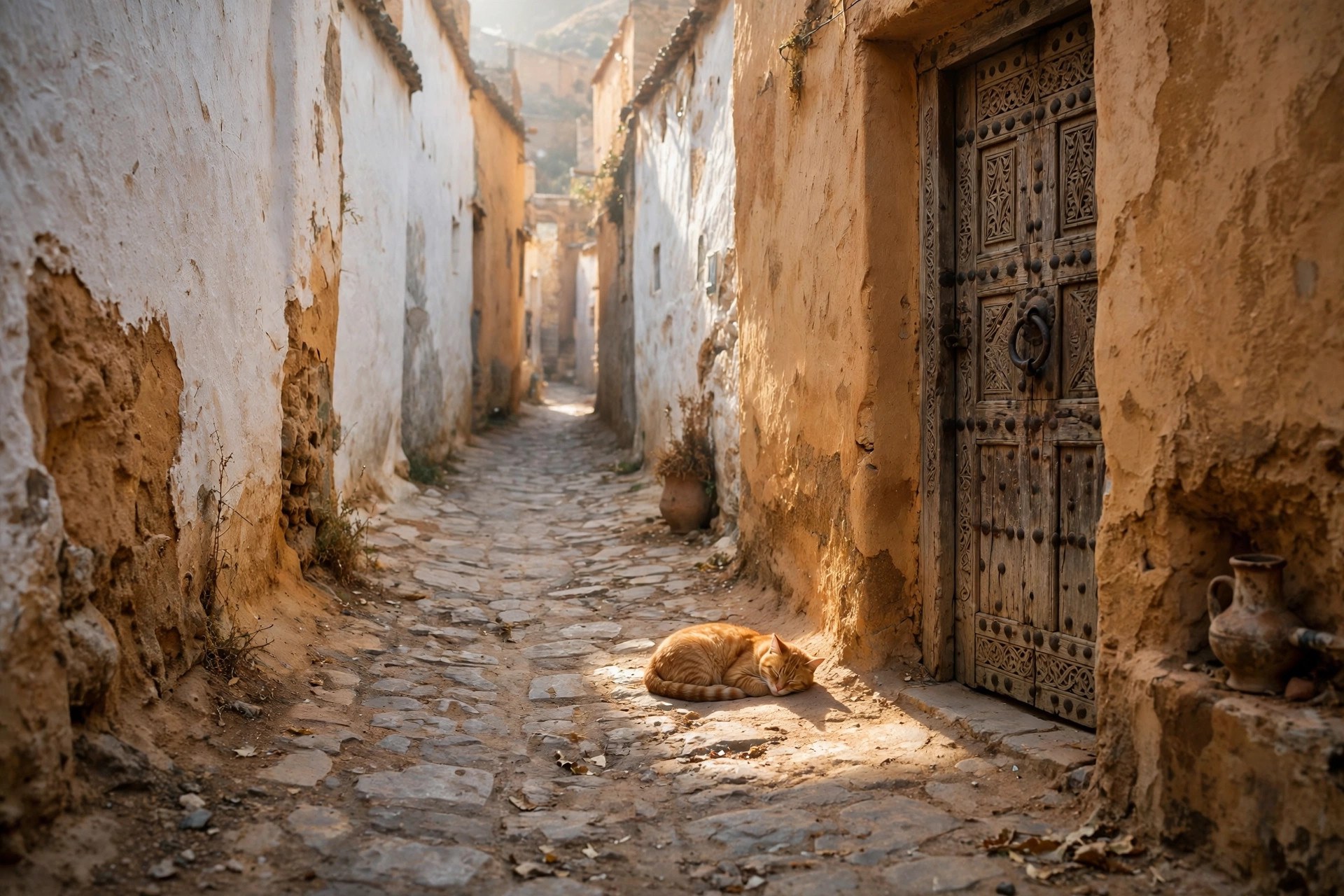
The old mellah is still legible in the street pattern, and the newer streets near the main road have simpler concrete houses with easier parking. For a first stay, choose the newer streets — easier to heat and closer to the shops — and move to Kiadid once you know the town and its winters.
Housing and Rents
Renting while living in Debdou works nothing like renting in a Moroccan city: no listing site, no estate agent, no published rental data. We searched for Debdou rents and found no listings, no rental index, and no advertised prices. Houses change hands by word of mouth, through cafe owners, shopkeepers, and neighbours.
The realistic route is to arrive, stay a few nights in Taourirt, and ask around in person. Many houses belong to families living elsewhere, and finding the owner can take weeks. Expect a simple contract in French or Arabic and a deposit of one to two months' rent — the legal maximum under Law 67-12. Our renting an apartment in Morocco guide explains the contract rules.
As a planning estimate for November 2026 — not a market rate, because no market data exists — budget 1,500–3,000 MAD ($150–$300) a month for a simple house, based on small-town Moroccan rents, and confirm the figure in person. A larger house may cost more, one needing work less. Never pay a full year upfront for a house seen only in photos. Before you sign, check water pressure, hot water, and heating: many older houses have none, and January nights fall to around 6°C.
Monthly Budget for Living in Debdou
A monthly budget for living in Debdou, cooking mostly at home and travelling to Taourirt weekly — planning ranges, checked in November 2026.
| Expense | Single person (MAD) | Couple (MAD) |
|---|---|---|
| Rent (est.) | 1,500–3,000 | 2,000–3,500 |
| Utilities | 200–400 | 300–600 |
| Internet and mobile | 150–300 | 250–450 |
| Groceries | 1,200–2,000 | 2,000–3,200 |
| Eating out | 150–400 | 300–700 |
| Transport | 300–700 | 400–900 |
| Healthcare | 150–400 | 250–600 |
| Leisure and misc. | 200–500 | 300–700 |
| Total | 3,850–7,700 | 5,800–10,650 |
In dollars, that is roughly $385–$770 a month for one person and $580–$1,065 for a couple. The biggest savings are rent and food, and there is little to spend money on. Heating is the cost newcomers forget — a cold January can add 200–400 MAD a month — and transport to Taourirt and Oujda is the other hidden cost.
Food and the Wednesday Souk
Food shopping while living in Debdou runs on the weekly market. The souk falls on Wednesday, drawing farmers and traders from the surrounding countryside for vegetables, household goods, and livestock — the liveliest day in town and the cheapest day to fill the kitchen.
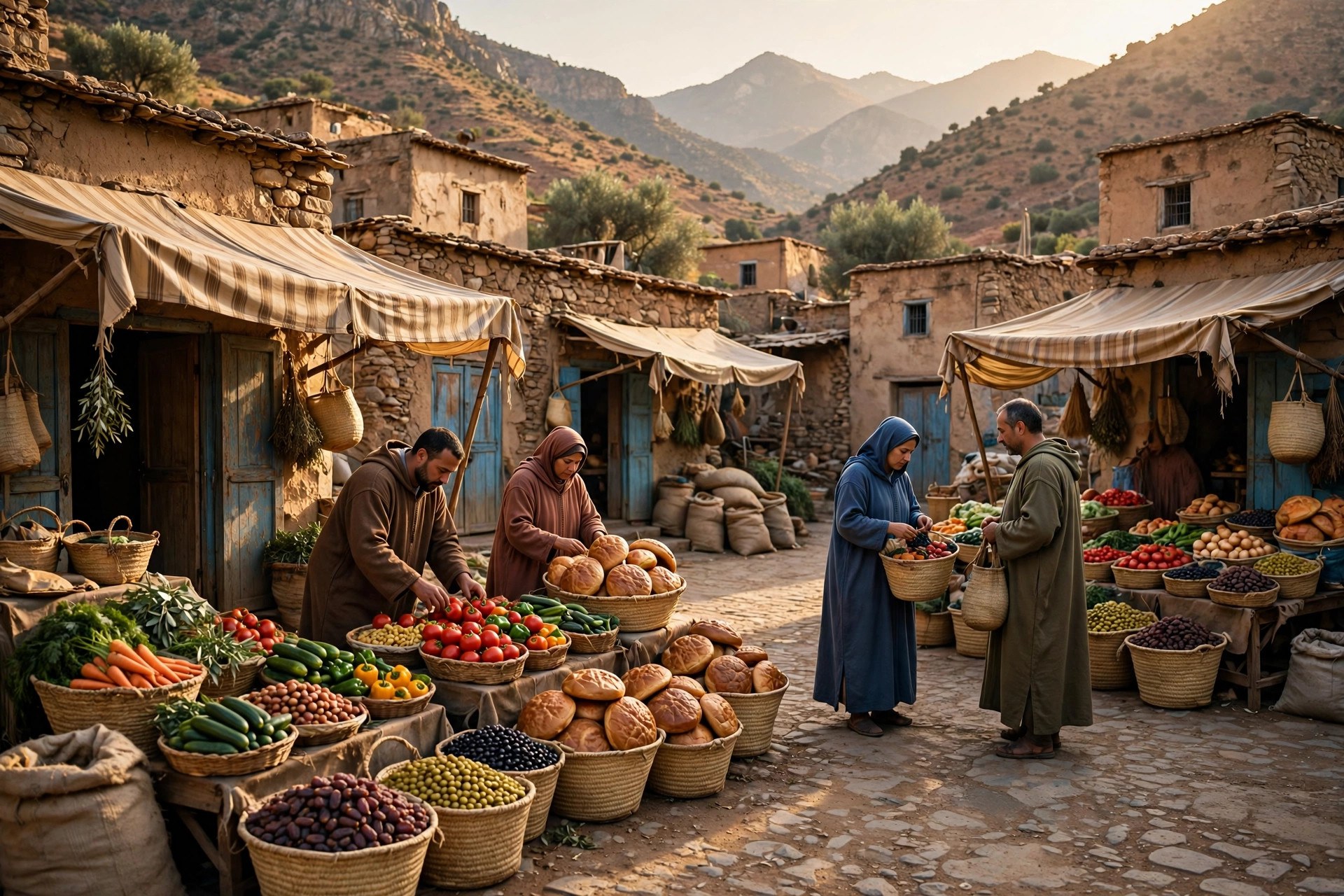
Between souks, small shops sell bread, tea, sugar, and basics, and expect to cook most meals yourself. Eating out is simple and cheap: a tagine at a roadside grill runs about 30–60 MAD ($3–$6), bread from a neighbourhood oven 1–2 MAD, and mint tea 5–10 MAD. There is no supermarket in town for people living in Debdou — for a big shop, go to Taourirt — and no reliable choice of restaurants, so treat eating out as a treat, not a routine.
Healthcare
People living in Debdou have limited healthcare in town, and this is the section to read twice. We could not verify a named health centre in Debdou itself — no official listing, opening hours, or services could be confirmed — so do not plan as if one exists. Towns of this size normally have a basic public health centre, but its presence, staffing, and hours here are unconfirmed: check on arrival and ask neighbours what actually operates.
For anything beyond basic care, the plan is the provincial hospital in Taourirt, about 50 km north, roughly an hour by road. For anything serious, the plan is Oujda, about 150 km away, with the region's large hospitals. That distance is the honest trade of living this far out: keep a car fuelled, keep prescriptions stocked, and know the road to Taourirt by heart. A private GP visit typically costs 150–250 MAD ($15–$25). Our healthcare in Morocco guide explains cover for expats.
Schools and Family Life
There is no international school in Debdou, and no French mission school — the plain fact families need first. For children living in Debdou, school means Moroccan public schools, taught in Arabic and French, and a child who arrives speaking neither will need a year of patience. The nearest international schooling is in Oujda, about 150 km away: one international school is listed for the city, but we could not confirm its name, curriculum, or fees from a live source — verify the options there first. Our schools in Morocco guide explains the options.
What Debdou gives families in return is space, safety, and a childhood shaped by a small town: children play in the lanes, the air is clean, and the kasbah and the souk give them a Moroccan childhood rather than an international-school bubble. For most expat families, though, the honest advice is to base the family in Oujda and visit Debdou.
Internet and Working Remotely
Remote workers living in Debdou will find the basics, but not city infrastructure. Mobile 4G reaches the town, and Maroc Telecom is the usual choice: it is widely reported to have the strongest rural coverage in Morocco. Do not assume fixed fibre is available — no reliable source confirms fibre in Debdou, so treat 4G as the working connection and check the address with the operator before signing a lease. Our internet and mobile data guide explains the operators and packages.
The honest caveats: speeds are lower than in Casablanca or Rabat, signal fades outside the town and in thick-walled old houses, and 5G, launched in November 2025, is concentrated in the big cities, not here. There is no coworking space, so most remote workers here work from home. Download offline maps, keep a second SIM as a backup, and test video calls from the actual house before you commit to it.
Transport and Getting Around
Getting around while living in Debdou is mostly on foot: the town is compact, and the main street, the souk, and the old quarters are all within walking distance. There is no public transport inside the town, no train station, and no confirmed direct CTM bus — buses serve Taourirt and Oujda, and the last 50 km is by shared grand taxi or hired car.
A shared grand taxi from Taourirt costs roughly 30–50 MAD (about $3–$5) per seat — an estimate, so agree the fare first. A car with a driver for the day costs roughly 500–800 MAD (about $50–$80), also an estimate. Diesel costs about 16.30–16.90 MAD per litre (about $1.63–$1.69) as of November 2026. The nearest airport is Oujda Angad, about 160 km away, and the nearest railway station is Taourirt, on the Fes–Oujda line. A car is close to essential for anyone settling here. For a gentler introduction to the region, our guide to living in Figuig covers another remote eastern town with the same trade-offs.
Residency and Paperwork
Morocco allows many nationalities 90 days visa-free. For anyone living in Debdou beyond 90 days, a longer stay means a residence permit — the carte de séjour — applied for through the local police authorities. Bring a rental contract, proof of income or funds, your passport, a medical certificate, and a criminal record from your home country. The filing fee is 100 MAD per year, and a first card is usually valid for one year.
Debdou's small size cuts both ways: short queues, but anything unusual may need a trip to Taourirt — we could not confirm that residence applications can be filed in Debdou itself, so ask at the local police post on arrival and expect to file in Taourirt. Sort the paperwork early, keep copies, and confirm requirements in person: rules and local practice change.
Community and Daily Life
Daily life for people living in Debdou runs on greetings, tea, and the souk. This is a small, traditional town where visitors are a novelty and newcomers are noticed — in a good way, if they make the effort. Greet people, accept the tea, ask before photographing residents, and dress modestly. The mellah and the kasbah are living heritage, not a museum.
Daily life runs on three languages: Darija, Moroccan Arabic, in the market and the street; French in the administration, the banks, and the clinics; and Tamazight, the Amazigh language, in the surrounding countryside. English is rare. French first, then Darija, is the practical order. Our learning Darija guide is a start.
There is no expat bar, no club, and no organised community to join — your social life will be your neighbours, the cafe on the main street, and the Wednesday souk. That is either the point of moving here or the reason not to. Bring books, bring a hobby, and bring patience: the town rewards the people who stay, not the people who pass through.
Climate and Seasons
Living in Debdou means living with a hot-summer Mediterranean climate at about 950 metres: hot, dry summers, cold clear winters, and roughly 200–300 mm of rain a year. July averages about 39°C by day and 22°C at night, January about 15°C by day and 6°C at night, and summer heatwaves have pushed local readings past 40°C.
| Season | Daytime | Nights | Best for |
|---|---|---|---|
| Winter (Dec–Feb) | 15–17°C | 6–7°C | Clear, cold days |
| Spring (Mar–May) | 20–29°C | 9–15°C | Moving in |
| Summer (Jun–Aug) | 33–39°C | 19–23°C | Early mornings only |
| Autumn (Sep–Nov) | 20–32°C | 11–19°C | Souk and harvest |
Spring and autumn are the windows to arrive: warm days, cool nights, and the town at its most alive. Summer is genuinely punishing — do outdoor things before 11am — and winter demands heating and a house that holds the cold.
Practical Tips
Visit first, in the hard season: July or January, not only the gentle weeks of April.
Rent before you buy, and month to month. Never pay a full year upfront for a house seen only in photos.
Bring cash, medicines, and spares. Withdraw what you need in Taourirt or Oujda — do not expect to pay by card anywhere in Debdou.
Learn French first, Darija second. French opens the official doors, Darija the neighbours' doors.
Respect the old quarters. Kiadid and the mellah are living neighbourhoods: greet people and ask before photographing residents.
Frequently Asked Questions
Is Debdou a good place for expats to live?
Living in Debdou suits a very specific expat: self-reliant, comfortable with solitude, and happy to build a life in French and Darija. If you need an international school, fast internet, or a hospital nearby, look elsewhere — Oujda, 150 km away, is the practical base.
How much does living in Debdou cost?
A single person can live on roughly 3,850–7,700 MAD ($385–$770) a month, and a couple on 5,800–10,650 MAD ($580–$1,065), in a rented house. These are planning estimates — there is no published rental market in Debdou, so confirm every figure on arrival.
Can I live in Debdou without speaking Arabic?
You can manage with French in banks, clinics, and administration, but daily life runs on Darija, with Tamazight in the surrounding countryside. A few months of French and basic Darija will change everything.
Is there an international school in Debdou?
No. Children attend Moroccan public schools in Arabic and French. The nearest international schooling is in Oujda, about 150 km away — verify the options there first.
Can I work remotely while living in Debdou?
Yes, on 4G — but test it first. No reliable source confirms fixed fibre in Debdou, so plan on Maroc Telecom 4G. Test the signal in the actual house before signing a lease, and keep a second SIM as a backup.
How do I get to Debdou from Oujda?
Take the train or road to Taourirt, then a shared grand taxi for the last 50 km — about 30–50 MAD per seat, an estimate. The whole trip from Oujda takes about 2 to 2.5 hours by road. Arrange your return transport before you leave Taourirt.
Conclusion
Living in Debdou is a deliberate choice: some of the lowest living costs in Morocco, a mountain town with a Marinid kasbah above the roofs and six centuries of history in its lanes, and a Wednesday souk. The price is honest — no expat community, no hospital in town, no published rental market, and very quiet nights. If you want Morocco at its quietest, it rewards you with space, silence, and a market morning you will never forget. See our About page for how these guides are researched.