
Introduction: The Capital Before Marrakech
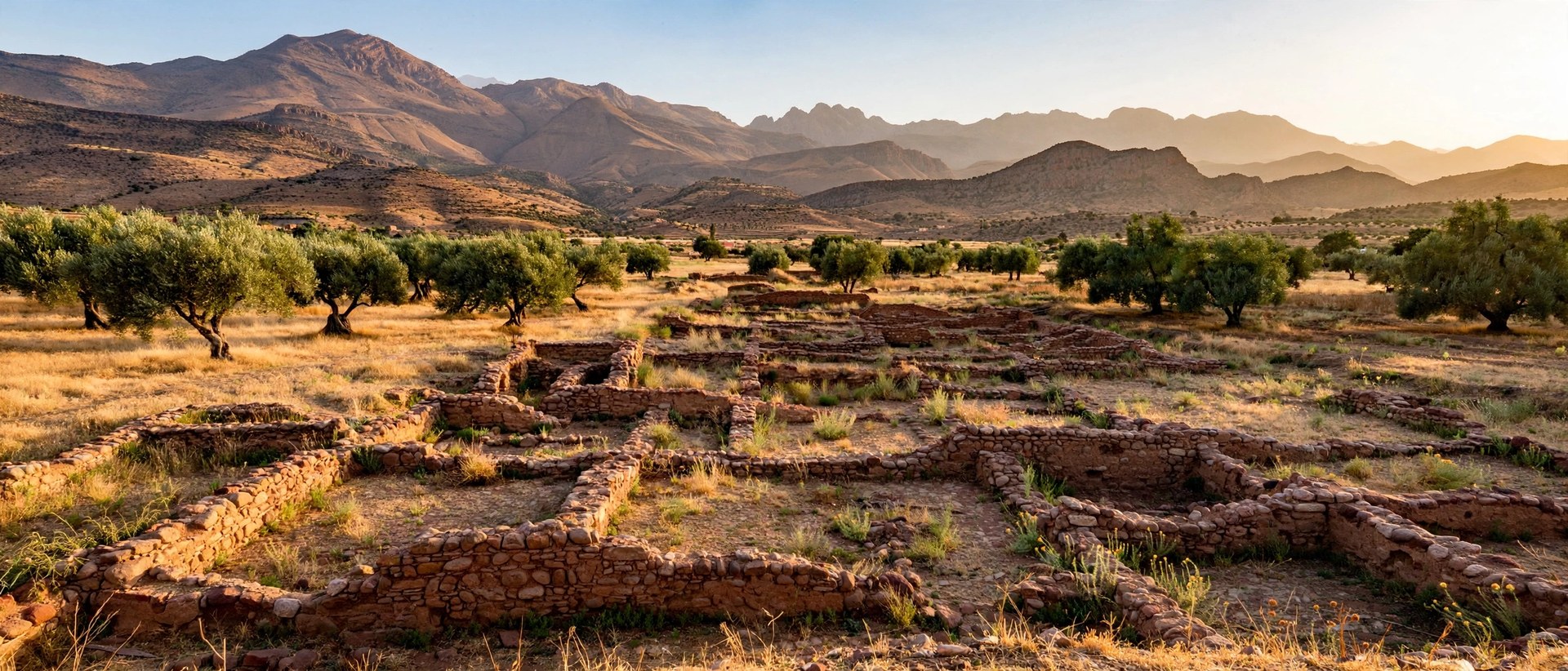
This Aghmat travel guide starts with a surprise: Marrakech was not the first capital of southern Morocco. About 30 kilometres southeast of the Red City, on the road towards the Ourika Valley, lies a quiet farming village called Ghmat — and beneath its fields, the remains of Aghmat, the city that ruled the region before Marrakech existed.
Aghmat was the first capital of the Almoravids, the dynasty that went on to found Marrakech in 1070 and build an empire stretching from the Sahara to Spain. It was also the place of exile of Al-Mutamid, the poet-king of Seville, whose tomb is still a place of pilgrimage today. Archaeologists have been digging here since 2005, uncovering a great hammam, a mosque, a palace and stretches of city wall.
This Aghmat travel guide covers the history, what to see, how to get there, what it costs, and how to combine it with the Ourika Valley in a half day. For the wider story of the dynasty that started here, see our history of the Almoravids.
In this guide
- Where Is Aghmat?
- Aghmat at a Glance
- A Short History of Aghmat
- Zaynab al-Nafzawiyya: The Woman Behind the Empire
- Al-Mutamid: The Poet-King in Exile
- What to See at the Archaeological Site
- The Mausoleum of Al-Mutamid
- The Friday Souk and Modern Ghmat
- How to Get to Aghmat from Marrakech
- Aghmat and the Ourika Valley: A Half-Day Plan
- Where to Stay Near Aghmat
- Best Time to Visit Aghmat
- Practical Tips for Visiting Aghmat
- What to Budget: Aghmat Day Trip Costs
- Frequently Asked Questions
- Conclusion: Why Aghmat Deserves a Morning
Where Is Aghmat?
Aghmat sits about 30 kilometres southeast of Marrakech, on the Ourika road at the northern foot of the High Atlas. The modern village beside the ruins is called Ghmat, in the commune of Jemaa Aghmat, and the drive from Jemaa el-Fna takes roughly 35 to 45 minutes. It stands where the Ourika Valley opens onto the Haouz plain — the position that made the medieval town rich.
There is no train station and no bus that drops you at the gate. You come by taxi, by rental car, or as part of a guided trip. Ask in the village for the site archéologique or the tomb of Al-Mutamid. The practical details — transport, costs and timing — are covered in the rest of this Aghmat travel guide.
The setting is part of the appeal. Unlike the crowded monuments of Marrakech, Aghmat is quiet — an active dig in open countryside, with the Atlas foothills behind it. Our Marrakech travel guide covers the city you will be coming from, including Bab Aghmat, one of the old gates of the medina, named after the road to Aghmat.
Aghmat at a Glance
The Aghmat travel guide at a glance: the facts you need before you go.
| Fact | Detail |
|---|---|
| Location | 30 km southeast of Marrakech, on the Ourika road |
| Modern village | Ghmat (commune of Jemaa Aghmat), Al Haouz province |
| Founded | Before the 7th century, according to medieval texts |
| Almoravid capital | 1058–1070, until Marrakech was founded |
| Famous exile | Al-Mutamid ibn Abbad, poet-king of Seville, died around 1095 |
| Main remains | Great hammam, grand mosque, palace, city walls, qanats |
| Excavations | Mission Archéologique d’Aghmat, running since June 2005 |
| Best visit | Half day from Marrakech, combined with the Ourika Valley |
| Entry | No fixed ticket office confirmed; ask locally for the site guardian |
| Coordinates | 31.4225° N, 7.8011° W |
A Short History of Aghmat
Aghmat is older than the Morocco most travellers know — and this Aghmat travel guide begins with that depth. Medieval texts suggest the town existed before the arrival of Islam in the seventh century, and it later became the capital of the Souss region under the Idrisids. It grew rich on the caravan routes that carried gold and salt from sub-Saharan Africa through Sijilmassa to the north.
The decisive moment came in 1058. The Almoravids, a movement of Amazigh tribes from the Sahara, entered Aghmat on 27 June 1058 after defeating its ruler Laqut of the Maghrawa. The town became their first capital in the north — the base from which they built their empire. The Almoravid dynasty on Wikipedia gives the wider imperial context.
Then, in 1070, the Almoravid leader Abu Bakr ibn Umar founded a new capital on the plain to the northwest: Marrakech. Aghmat declined as its rival grew, and took on a new role — a backwater where the dynasty sent its deposed rulers into exile. The city was largely abandoned by the end of the fourteenth century, its stones sinking under farmland and olive groves, preserved like a time capsule.
Aghmat reappears in modern history on 18 November 1950, when Istiqlal nationalists demonstrated at the tomb of Al-Mutamid during the French protectorate — and were brutally suppressed by police under the local caïd. Read more in our history of Morocco.
Zaynab al-Nafzawiyya: The Woman Behind the Empire
No Aghmat travel guide is complete without Zaynab al-Nafzawiyya, the most remarkable figure in the town’s story. She was the widow of Aghmat’s ruler, and one of the richest people in the region: her fortune from the caravan trade was said to have helped the Almoravid leaders consolidate their rule.
After the Almoravids took the town, Zaynab married their leader Abu Bakr ibn Umar, and after him his cousin Yusuf ibn Tashfin, the future sultan. Her story is one of the reasons this Aghmat travel guide lingers on the town’s golden decade: Aghmat’s importance was not only military — it was a city of merchants, and its money moved dynasties.
Al-Mutamid: The Poet-King in Exile
The most famous name attached to Aghmat is Al-Mutamid ibn Abbad, ruler of Seville and Córdoba in Muslim Spain and one of the finest Arabic poets of his age. When Christian kingdoms pressed south, he called on the Almoravids for help. Yusuf ibn Tashfin crossed the strait and won — then removed Al-Mutamid from power and sent him into exile, here, to Aghmat.
The poet-king spent his final years in this town, far from the palaces and gardens of Seville, living in poverty and captivity with his wife Itimad. He died around 1095, and his poems of loss — about his chains, about his daughters spinning wool for money — are still read across the Arabic-speaking world. Abdallah ibn Buluggin, the former king of Granada, was exiled here too, and wrote his memoirs.
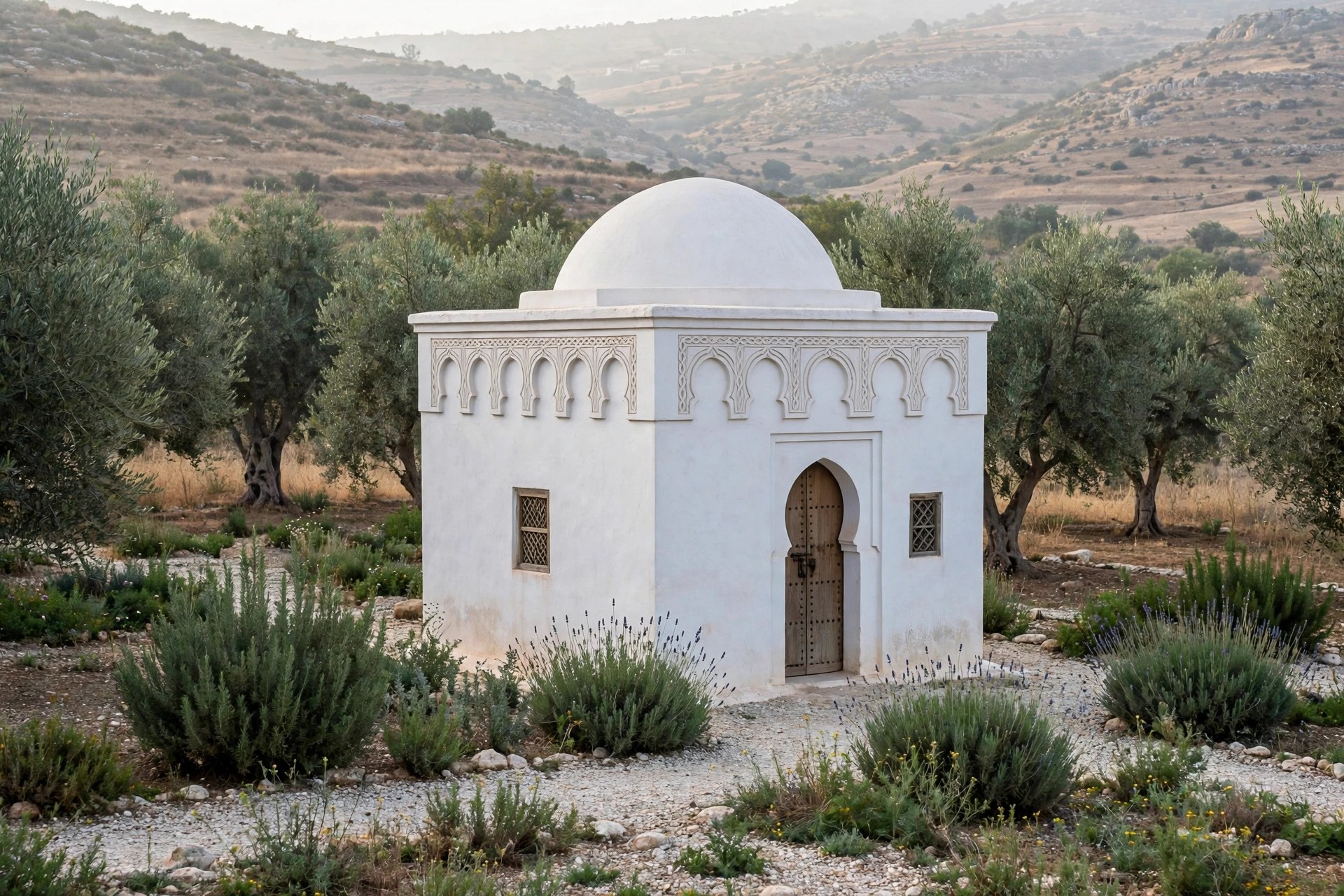
Today Al-Mutamid’s tomb is the most visited spot in Aghmat — and the emotional heart of this Aghmat travel guide. The mausoleum is a modern building, erected in 1970 with a cupola in the Almoravid style: white walls, a garden and a domed chamber, with the poet-king’s grave beside his wife’s. Lines of his poetry are displayed on the walls.
What to See at the Archaeological Site
The ruins of Aghmat are an active excavation, not a polished museum — and that is exactly what makes them worth visiting, as this Aghmat travel guide argues. The Mission Archéologique d’Aghmat, a Moroccan-American team led by Professors Abdallah Fili and Ron Messier, has been digging here since June 2005. See the Aghmat entry on Wikipedia for the site’s background and coordinates.
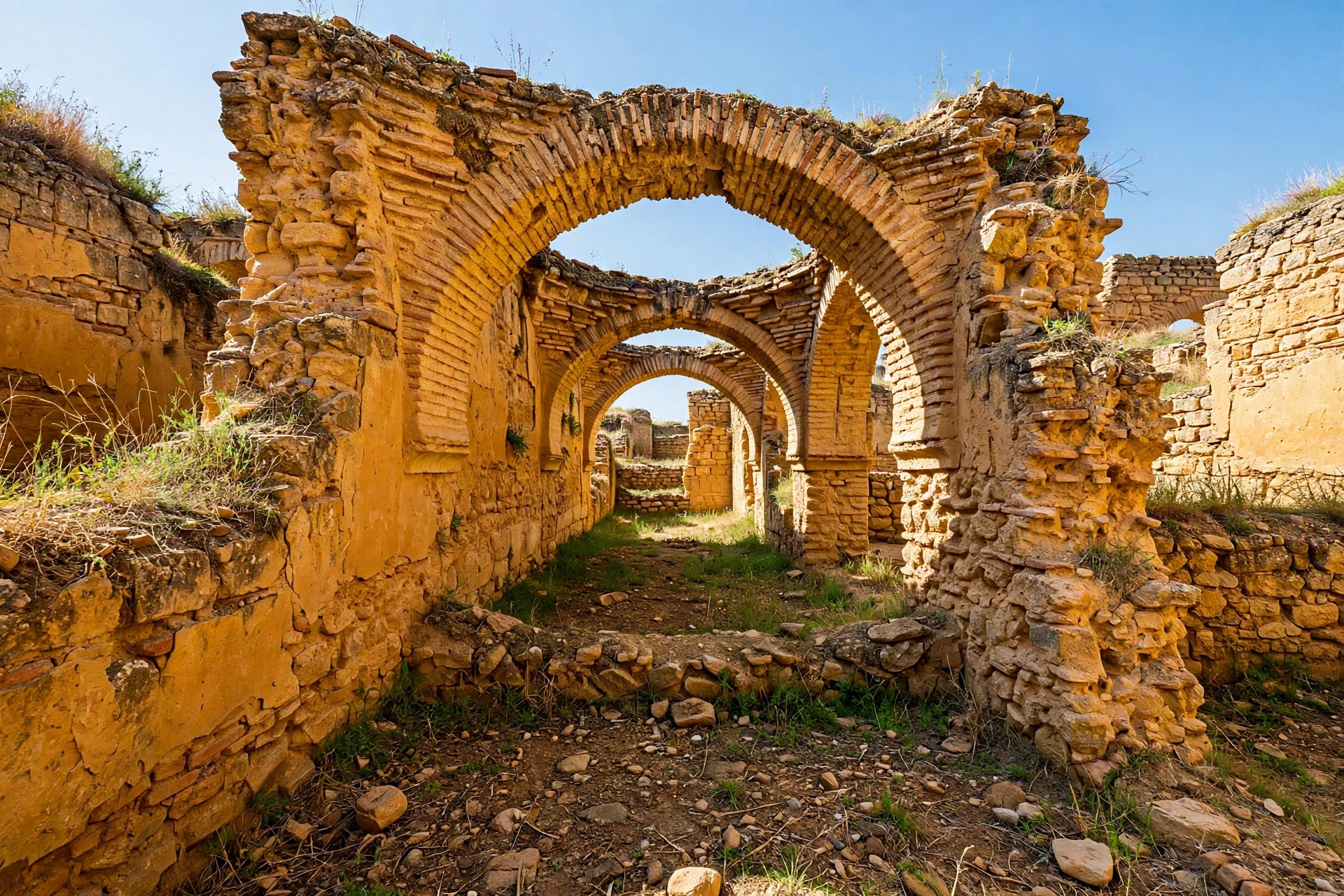
The centrepiece is the great hammam, a bathhouse dating from the tenth to fourteenth centuries and one of the largest and best-preserved medieval hammams in the region. Its vaulted rooms still stand, and walking through them brings the town’s social life vividly to mind. After the city declined, the hammam had a second life as a pottery workshop — excavators even found a potter’s wheel inside it.
The excavations have also revealed a grand mosque, confirmed in 2011 and said to have been founded by Wattas ibn Kardus in 859, and a palace in the Andalusian style of the fourteenth century, with older ninth- to twelfth-century levels beneath it. Around them are parts of the city walls, house foundations, and qanats — the underground canals that watered the city.
Aghmat was in fact two towns: Aghmat Ourika, the main town, and Aghmat Haylana, a second settlement a few miles east inhabited by the town’s Jewish community, who were not permitted to live inside the main walls. That community was large and old, and its history is part of the same story.
The Mausoleum of Al-Mutamid
The mausoleum stands a short walk from the excavated walls and bathhouse, and it is the easiest part of Aghmat to visit. Built in 1970, it is a calm, simple building: white walls, a garden, and a domed chamber in the Almoravid style where Al-Mutamid lies beside his wife Itimad.
Come here first if you arrive without a plan — this Aghmat travel guide’s first practical tip. The guardian can usually point you towards the archaeological site, and the mausoleum repays a slow visit: the verses on the walls are among the most moving in Arabic poetry, written by a king who lost everything and kept writing. Dress modestly and keep your voice low inside the chamber.
The Friday Souk and Modern Ghmat
Modern Ghmat is a small farming village, and its weekly market is the best time to see it alive. The Friday souk at Jemaa Aghmat draws farmers and traders from the surrounding valleys, with stalls of vegetables, olives, dates and bread — an ordinary country market, not a tourist show.
Time your visit for a Friday morning if you can — this Aghmat travel guide recommends Friday above all. The souk is also the practical place to ask for directions: the guardian’s contact, the state of the track, and whether a team is digging that day are all best settled over a glass of tea.
How to Get to Aghmat from Marrakech
Getting to Aghmat is straightforward, but it takes planning — the transport section of this Aghmat travel guide is the one to read twice. There is no public transport to the site itself. The road is the P2017 towards the Ourika Valley, and the drive takes 35 to 45 minutes from Jemaa el-Fna.
| Option | Cost (one way unless stated) | Notes |
|---|---|---|
| Private taxi, hired for the trip | Around 300 MAD (about $30) | Agree the price and the waiting time before leaving Marrakech; travellers report about 300 MAD each way |
| Rental car | 250–400 MAD per day (about $25–$40) | Best for combining Aghmat with the Ourika Valley; the last kilometres are a rough track |
| Grand taxi to Ourika, then local taxi | 30–50 MAD per seat (about $3–$5) to the valley road | Cheapest option, but you still need a local taxi for the last stretch |
| Guided day trip from Marrakech | From around 350 MAD (about $35) per person | Usually combined with the Ourika Valley; check Aghmat is on the itinerary |
| Driver for the day | 500–800 MAD (about $50–$80) | Good value for a group; agree the full route and waiting time in advance |
Prices are estimates checked in November 2026 — confirm them on arrival, as taxi fares are negotiated rather than metered outside the city. If you hire a taxi, arrange the return as well: no cruising taxis wait at the site. Our best time to visit Morocco guide helps you pick the season.
Aghmat and the Ourika Valley: A Half-Day Plan
The best way to visit Aghmat, and the plan this Aghmat travel guide recommends, is as the first stop on an Ourika Valley morning. The waterfalls at Setti Fatma are the classic Marrakech escape, and Aghmat sits on the same road — adding the ruins costs about an hour and turns a pretty valley drive into a journey through a thousand years of history.
A workable plan: leave Marrakech by 8 a.m., reach Aghmat by 9, spend an hour at the mausoleum and the site, then continue up the valley for lunch and the Setti Fatma waterfalls. Aghmat alone makes a satisfying half-day trip of three to four hours including the drive. Either way, start early: the site has almost no shade, and the midday sun is fierce for much of the year. Bring water, a hat and sunscreen, and wear shoes you can walk in — the ground is uneven.
Where to Stay Near Aghmat
Most visitors sleep in Marrakech and visit Aghmat as a day trip — the approach this Aghmat travel guide recommends. The city has rooms at every price, and the drive is short. But a night in the countryside suits travellers who want the Atlas air.
Aghmat Lodge, a guesthouse near Ghmat, charges from around £72 a night depending on the season, with a garden, a pool and views towards the mountains. Smaller riads in the Ourika Valley, such as Riad Cle de Sol near Aghmat, offer a similar escape 35 to 40 minutes from the city centre. Plan every outing by car or taxi: nothing is within walking distance, and the last kilometres of track are in poor condition.
If you stay in Marrakech instead, our Morocco itinerary for 7 days shows how a day trip like this fits into a first week.
Best Time to Visit Aghmat
Aghmat is an open-air site with almost no shelter, so the season matters more here than in Marrakech itself — a warning this Aghmat travel guide repeats for a reason. Spring, from March to May, is the best time: the plain is green, the Atlas still holds snow, and daytime temperatures suit walking the ruins. Autumn, from late September to early November, is nearly as good.
Summer is hot — the Haouz plain regularly passes 40°C in July and August — and the excavation offers no shade, so visit at dawn. Winter days are mild and bright, though rain can turn the track to mud. The Friday souk runs all year.
Practical Tips for Visiting Aghmat
The practical notes this Aghmat travel guide would give a friend:
- Ask for the guardian. The site has no fixed ticket office that we could confirm, so ask in the village or at the Friday souk for the guardian’s contact.
- Bring cash. There is no card payment at the site or in the village shops; carry small dirham notes for taxis, tea and the souk.
- Dress for the sun, and for the mausoleum. A hat and sunscreen for the ruins; modest dress and a quiet voice inside the tomb chamber.
- Wear proper shoes. The excavation ground is uneven, with low walls and loose stones.
- Do not climb on the walls. The hammam and the ramparts are fragile — admire them from the paths.
- Photography is fine outdoors. Ask before photographing people, and be discreet inside the mausoleum.
- Combine, don’t rush. Aghmat pairs naturally with the Ourika Valley; allow at least an hour at the site itself.
What to Budget: Aghmat Day Trip Costs
Aghmat is one of the cheapest historical sites near Marrakech — the budget section of this Aghmat travel guide is short for a reason: the main cost is the transport, not the entry. No admission fee could be confirmed, and the village costs nothing to wander.
| Item | Cost | Notes |
|---|---|---|
| Transport from Marrakech | 300–800 MAD (about $30–$80) | Taxi each way or a driver for the day |
| Entry to the site | No fixed fee confirmed | A tip for the guardian is customary |
| Lunch in the Ourika Valley | 60–120 MAD (about $6–$12) | Tagine and tea at a riverside café |
| Souvenirs at the Friday souk | 20–100 MAD (about $2–$10) | Olives, dates and bread |
| Half-day total for two | 400–1,000 MAD (about $40–$100) | Excluding accommodation |
Prices are estimates checked in November 2026, using roughly 10 MAD to $1. For another imperial city, see our Fez travel guide, and for the coast, our Essaouira travel guide.
Frequently Asked Questions
The questions this Aghmat travel guide hears most often.
Is Aghmat worth visiting?
Yes, if you care about history — this Aghmat travel guide’s short answer. Aghmat is the lost capital that came before Marrakech, with the tomb of the poet-king Al-Mutamid and an active excavation of a medieval hammam, mosque and palace. It is quiet, uncrowded and genuinely old — an easy half day away.
How far is Aghmat from Marrakech?
About 30 kilometres southeast of Marrakech on the Ourika road. The drive takes 35 to 45 minutes from Jemaa el-Fna, depending on traffic.
Can I visit Aghmat by public transport?
Not directly. There is no bus to the site. Shared grand taxis run from Marrakech towards the Ourika Valley, but you will still need a local taxi for the last stretch. A private taxi, a rental car or a guided trip is the practical way there.
Who was Al-Mutamid?
Al-Mutamid ibn Abbad was the ruler of Seville and Córdoba in Muslim Spain and a celebrated Arabic poet. After calling on the Almoravids for help, he was deposed by Yusuf ibn Tashfin and exiled to Aghmat, where he died around 1095. His tomb, under a white-domed mausoleum built in 1970, is the most visited spot in Aghmat.
Is there an entrance fee for Aghmat?
No fixed ticket price could be confirmed, and there is no ticket office. Ask locally for the site guardian; a tip is customary.
Can I combine Aghmat with the Ourika Valley?
Yes — the best way to do it. Aghmat lies on the Ourika road, so a morning at the ruins followed by lunch and the Setti Fatma waterfalls makes a full and rewarding day trip from Marrakech.
Conclusion: Why Aghmat Deserves a Morning
Aghmat is the Morocco that most visitors never see: a capital that lost its crown to the city it founded, a poet-king’s grave in a quiet garden, and a medieval city rising out of the fields under the archaeologists’ trowels. No ticket queues, no gift shops, no crowds — just the stones, the stories and the Atlas on the horizon.
That is exactly why this Aghmat travel guide recommends it. Give it a morning on your way to the Ourika Valley, stand in the vaulted rooms of the old hammam, and read a verse or two at the tomb of Al-Mutamid. Marrakech will still be there when you get back — and you will understand it better for having seen the city that came first. Read more about the country on our about page.