
Introduction: A Thousand-Year-Old Stage
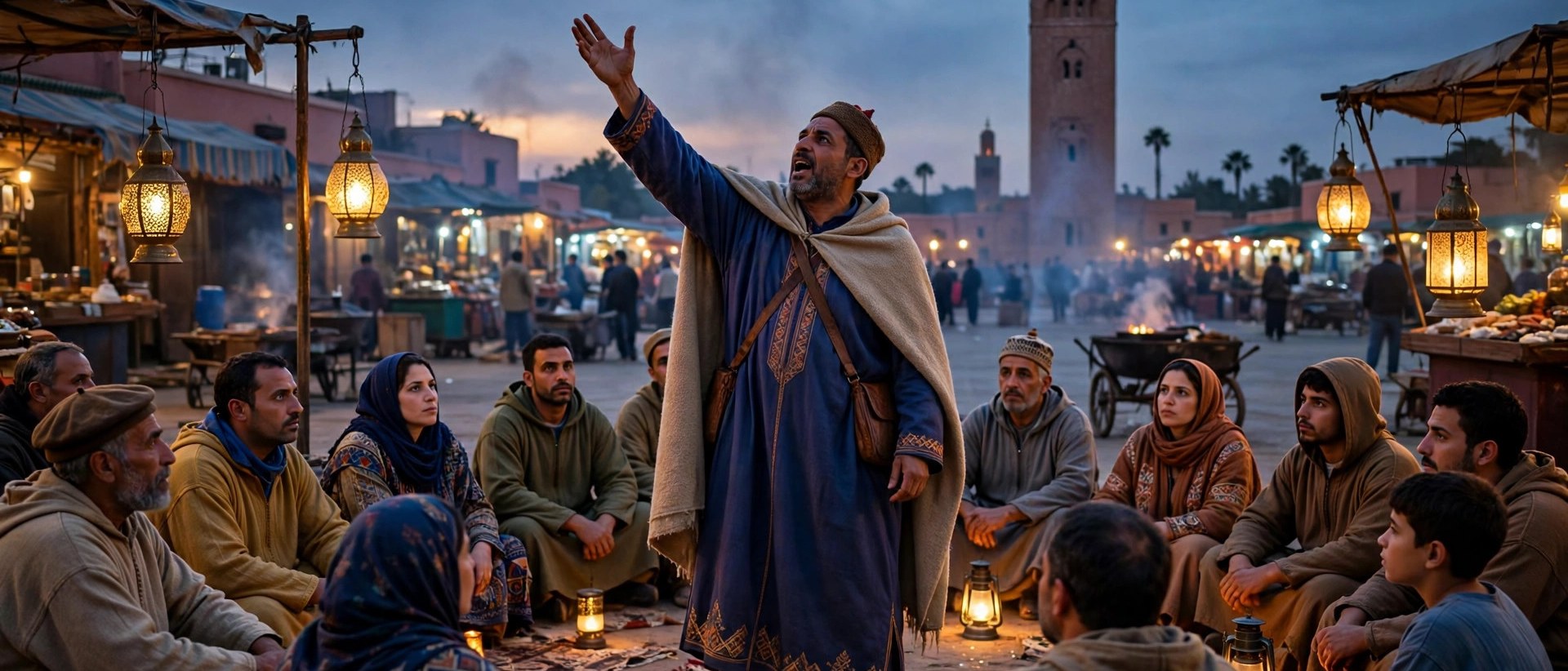
The history of Moroccan theatre begins not in a theatre at all, but in a circle. Every evening in Jemaa el-Fna, Marrakech's great square, storytellers draw a ring of listeners around themselves and hold them with a voice, a gesture and a tale: the halqa, the oldest stage in Morocco, still performing today.
This guide follows the whole arc of the history of Moroccan theatre: the halqa and the ritual forms before the proscenium, the European theatres of the protectorate, the amateur troupes of the 1920s, resistance theatre, the state stages of the 1960s, and Tayeb Saddiki. It ends in the present, with festivals, Amazigh-language stages and a new royal theatre in Rabat — flagging the dates in the history of Moroccan theatre that historians still argue about. For the wider backdrop, start with our history of Morocco.
In this guide
- The Halqa: Morocco's First Stage
- Before the Proscenium: Ritual, Story and Satire
- 1913: The Cervantes Brings the European Stage to Tangier
- 1923–1926: The First Arab Troupes and Moroccan Amateurs
- Theatre Under the Protectorate: Resistance and Censorship
- 1954: The Mamora Workshops and the First Professional Troupe
- 1956–1962: Independence and the National Theatre Mohammed V
- Tayeb Saddiki: The Man Who Reinvented Moroccan Theatre
- The History of Moroccan Theatre at a Glance
- Amazigh Theatre: A Language Takes the Stage
- Regional Stages: Casablanca, Tetouan, Fez and Beyond
- Festivals: Where Moroccan Theatre Gathers
- Key Figures and Plays of Moroccan Theatre
- Theatre Today: The Contemporary Scene
- Where to See a Show: A Visitor's Guide
- Frequently Asked Questions
- Conclusion: Why the History of Moroccan Theatre Still Matters
The Halqa: Morocco's First Stage
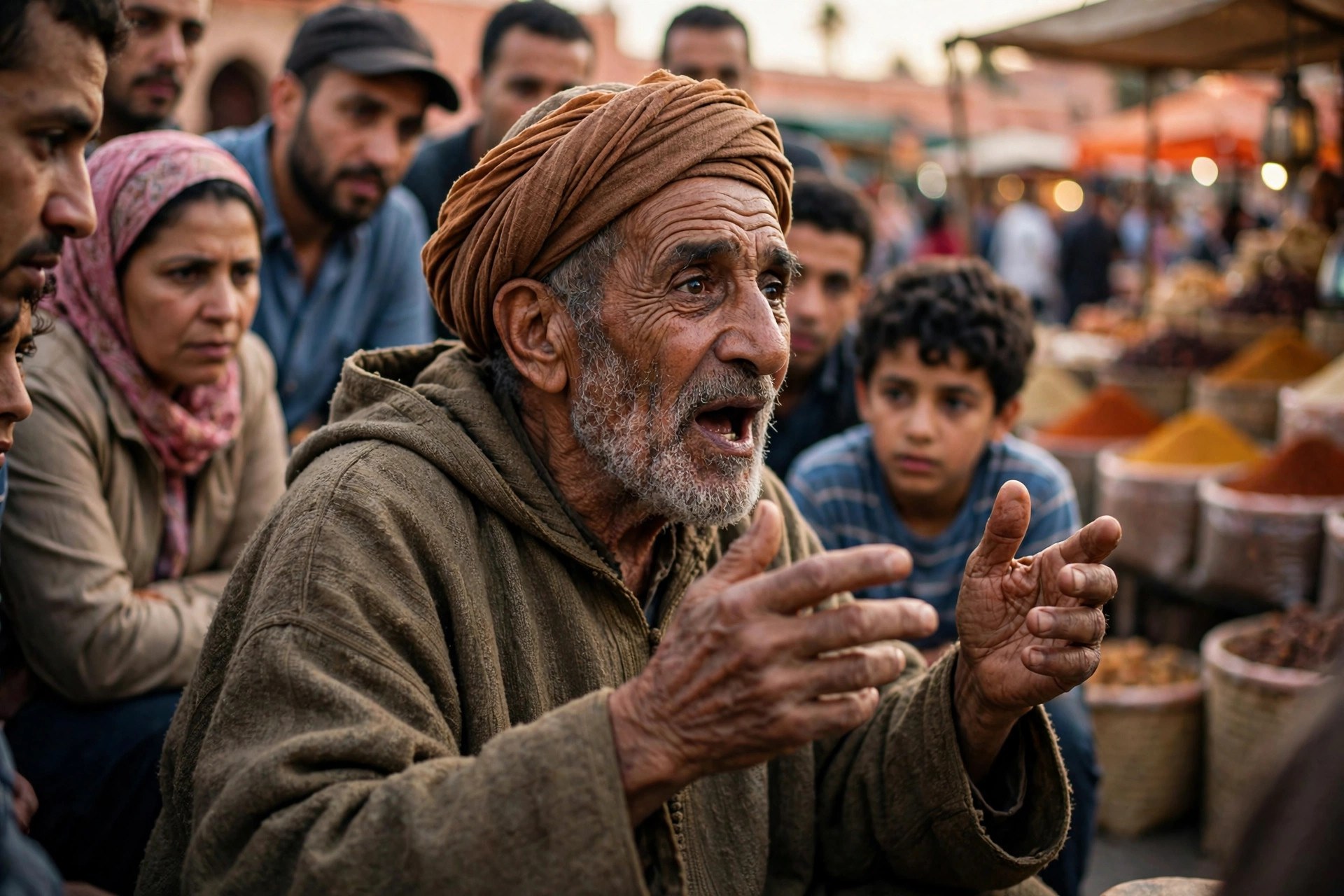
In the history of Moroccan theatre, the halqa is the beginning. The word means "circle": a ring of listeners that forms around a performer in a public square. The storyteller — the hlayqi — stands in the middle with no set and no fourth wall. The audience can drift in, laugh and answer back — and the performer must win them back with the next sentence.
Its repertoire is vast: the Thousand and One Nights, the epic of the Banu Hilal, tales from the Quran and the Prophet's life, and stories of love, trickery and morality — a theatre of improvisation, memory and nerve that trained generations of Moroccan performers.
The world has recognised it: UNESCO proclaimed the cultural space of Jemaa el-Fna a Masterpiece of the Oral and Intangible Heritage of Humanity in 2001, and inscribed it on the Representative List in 2008. See the UNESCO listing and our Marrakech travel guide for how to find the storytellers' circles.
Before the Proscenium: Ritual, Story and Satire
Long before European-style theatre reached Morocco, the country had a rich performance culture of its own: the halqa, the l'bsat, Sultan al-Talba, the maddahun, the singers of the Mawlid, and Boujeloud, the masked carnival figure of the Atlas foothills. The l'bsat — literally "the rug" — began in the eighteenth century as palace entertainment and grew into sharp satire of power, whose humour and direct address became hallmarks of modern Moroccan theatre.
These forms were not "theatre" in the European sense, and historians disagree about whether to call them theatre at all — but they are the oldest roots of the history of Moroccan theatre, and modern playwrights kept returning to them: Tayeb Saddiki went back to the halqa and the l'bsat, not to Paris. The storytelling tradition Ibn Battuta carried out of Morocco in the fourteenth century was an export of the same oral culture.
1913: The Cervantes Brings the European Stage to Tangier
The European theatre arrived in Morocco as a building before it arrived as an idea. In Tangier, the Gran Teatro Cervantes opened in 1913, built by Esperanza Orellana, Manuel Peña and Antonio Gallego, to a design by Diego Jiménez Armstrong. With some 1,400 seats — a few sources say 919 — it was the largest theatre in North Africa until the mid-twentieth century.
Its stage hosted the great names of the age — Enrico Caruso, Adelina Patti, Lola Flores, Imperio Argentina and the Egyptian actor Youssef Wahbi — and in 1929 the local Moroccan troupe Al Hilal performed Shakespeare's Othello there. Yet for most of its life the Cervantes served Tangier's European community — see our guide to the Tangier International Zone.
The Cervantes outlived its golden age and then faded: its last performances came in the 1980s, and the building fell into ruin. Spain donated it to Morocco in 2019, on condition the restoration respect its architecture and keep its name, and work resumed in October 2021.
1923–1926: The First Arab Troupes and Moroccan Amateurs
The turning point in the history of Moroccan theatre came not from a building but from a visit: in 1923, the first Arab theatre company toured Morocco, bringing Arabic-language drama, largely Egyptian in style, to Moroccan audiences for the first time. Within three years, Moroccan amateur companies were performing in Fez, Tetouan, Tangier and Casablanca.
These early troupes were small and self-taught, but they put Moroccans on stage speaking Arabic, mixing imported Egyptian scripts with local material. School troupes and youth clubs soon took plays to smaller towns, and the founders of the first professional company in the 1950s had almost all passed through them.
Theatre Under the Protectorate: Resistance and Censorship
Under the French and Spanish protectorates, theatre was political whether it wanted to be or not: Moroccan plays of the 1920s and 1930s spoke of resistance, and the authorities answered with suspicion, censorship and closures. The history of Moroccan theatre in this period is therefore a story of two forces: a nationalist movement that saw the stage as a weapon and a colonial administration that saw it as a threat.
The crackdown sharpened after 1950, when the French administration decided Moroccan theatre had become too political and brought in French professionals to steer it towards a safer, more decorative direction. Among them was André Voisin, who with Charles Nugue — some sources spell it Nugues — ran workshops at the Mamora Centre near Rabat. The Mamora workshops trained a generation who would soon take the stage for independence, and censorship taught Moroccan theatre to speak in metaphor and satire — a habit it has never lost.
1954: The Mamora Workshops and the First Professional Troupe
The Mamora workshops were the decisive school in the history of Moroccan theatre. Under Voisin and Nugue, assisted by Abdessamad Kenfaoui and Tahar Ouaziz, young performers learned voice, movement and stagecraft in the forest centre outside Rabat.
From these workshops came the first professional Moroccan theatre company, founded under the Ministry of Youth and Sport around Tayeb Saddiki, Ahmed Tayeb Laalej, Fatima Regragui, Abdessamad Dinia, Driss Tadili and Mohamed Afifi. Some accounts date the troupe to 1954, when Voisin established the Troupe al-Maamoura; others place it at independence — the same moment seen from different angles.
1956–1962: Independence and the National Theatre Mohammed V
Independence remade the history of Moroccan theatre in six years: in 1956, the new state created the National Theatre Mohammed V in Rabat, with a theatre research centre under government auspices — theatre as a national institution at last.
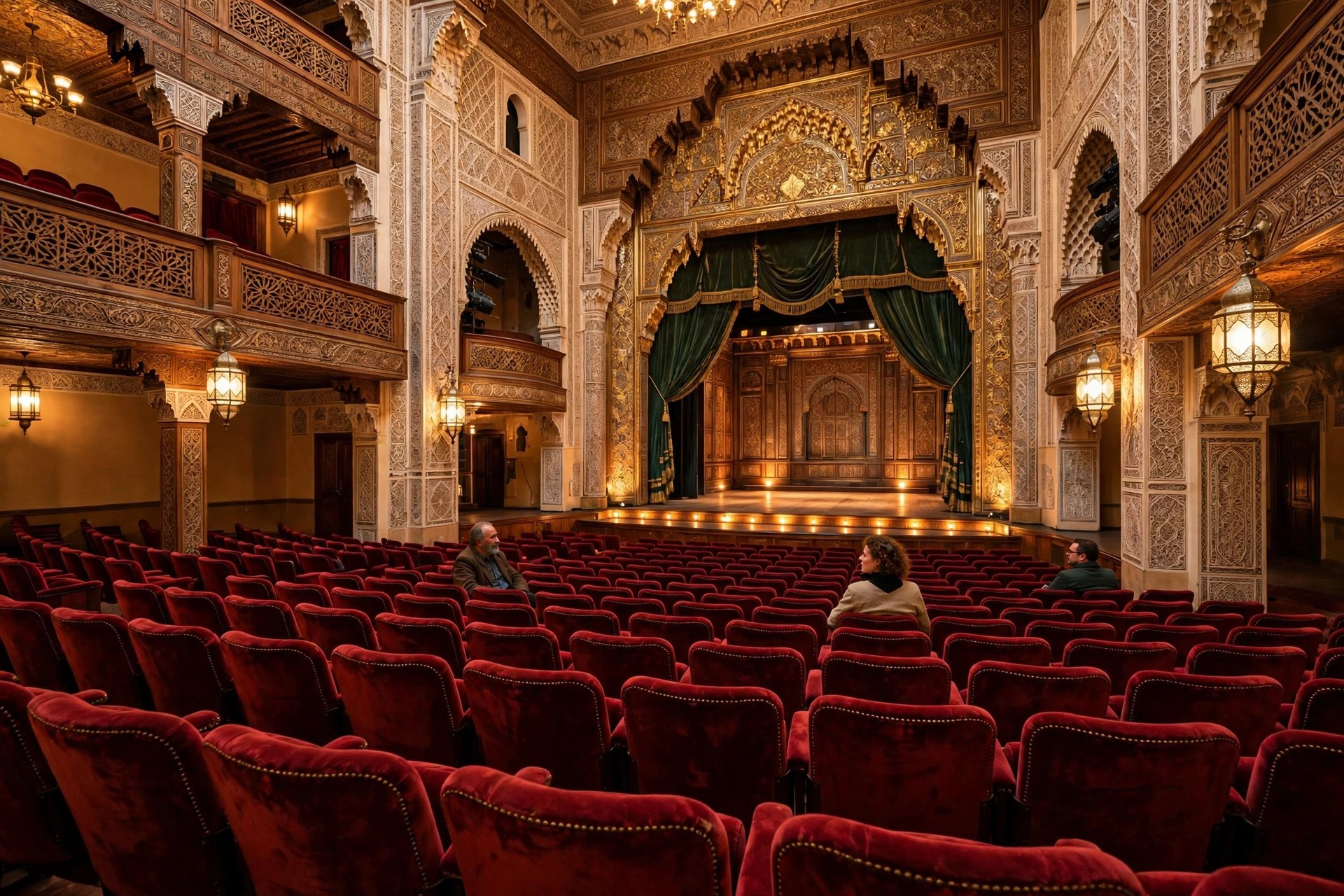
The theatre needed a home, and it got one of the finest: the Mohammed V National Theatre, built in 1961 and inaugurated on 14 March 1962 by King Hassan II — although a few sources give 1961. In 1973 it became a public establishment under the Ministry of Culture.
The new institution gave Moroccan theatre a stage and a salary: its first artistic director was Tayeb Saddiki, appointed in 1964, and its programme mixed Moroccan plays, European classics and touring productions. Read more in our account of Moroccan independence in 1956.
Tayeb Saddiki: The Man Who Reinvented Moroccan Theatre
No one dominates the history of Moroccan theatre like Tayeb Saddiki (1938–2016). Born in Essaouira and trained at Mamora in 1954, he studied in Rennes and Paris, then returned home in 1958 and founded the Workers' Theatre under the trade union movement. He became artistic director of the National Theatre Mohammed V in 1964 and director of Casablanca's Municipal Theatre until 1977, and founded the Travelling Theatre and Masrah al-Nas.
Saddiki's genius was fusion: he took the halqa and the l'bsat — the circle and the rug — and transplanted them into the theatre building, turning their improvisation and satire into a modern stage language. His landmark production, Diwan Sidi Abderrahman al-Majdub, drew on the sixteenth-century folk poet of the same name (sources date it to 1966 or 1967).
He said he was trained in Jemaa el-Fna itself, calling the square "a real theatre school". In 1976, King Hassan II awarded him the Wissam al-Massira, the medal of the Green March. His theatre was popular without being simple, Moroccan without being closed to the world — and it remains the standard.
The History of Moroccan Theatre at a Glance
The whole story fits on one page: the turning points of Moroccan theatre history, from the storyteller's circle to the royal stage.
| Year | Milestone | Why it matters |
|---|---|---|
| 18th century | The l'bsat emerges as palace entertainment | Satire and direct address enter Moroccan performance |
| 1913 | Gran Teatro Cervantes opens in Tangier | The European proscenium theatre arrives in Morocco |
| 1923 | First Arab theatre company visits Morocco | Arabic-language drama reaches Moroccan audiences |
| 1926 | Moroccan amateur companies begin performing | Theatre spreads to Fez, Tetouan, Tangier and Casablanca |
| 1950 | French administration cracks down on theatre | Censorship pushes theatre towards satire and metaphor |
| 1954 | Mamora workshops; Troupe al-Maamoura founded | The first professional training and company take shape |
| 1956 | Independence; National Theatre Mohammed V created | Theatre becomes a national institution |
| 1962 | National Theatre Mohammed V inaugurated in Rabat | Morocco gains its first great national stage |
| 1964 | Saddiki leads the National Theatre and Casablanca Municipal Theatre | The modern era begins |
| 1966/1967 | Diwan Sidi Abderrahman al-Majdub staged | The halqa is reinvented for the modern stage |
| 1976 | Saddiki receives the Wissam al-Massira | State recognition of theatre's national role |
| 1980s | Modern Amazigh theatre emerges in the Souss | Tamazight takes the stage in print and performance |
| 2001 | Jemaa el-Fna proclaimed a UNESCO Masterpiece | The halqa gains world recognition |
| 2008 | Jemaa el-Fna inscribed on the Representative List | The recognition becomes permanent |
| 2011 | Tamazight recognised as an official language | Amazigh theatre gains constitutional backing |
| 2024 | Royal Theatre of Rabat inaugurated | A new national stage for the twenty-first century |
| 2026 | Royal Theatre opens to the public in April | Regular performances begin in the new venue |
Amazigh Theatre: A Language Takes the Stage
Amazigh theatre is a late chapter in the history of Moroccan theatre, and one of its most determined. Hall theatre arrived with European influence and was performed in Arabic or French for most of the twentieth century; Tamazight, long a language of oral poetry and song, had to fight for its place on the stage.
The turning point came in the 1980s, when the plays of Moumen Al Safi were published — widely regarded as the beginning of modern Amazigh theatre in the Souss — and school troupes and cultural associations carried the work forward in the Rif, the Atlas and the Souss.
The movement found its institutions in the 2000s: Tamazight became an official language in the 2011 constitution, and the Casablanca Amazigh Theatre Festival — its eighth edition ran from 30 September to 4 October 2026 — now brings troupes from across Morocco and the Arab world together each year. For Amazigh audiences, hearing their own language on stage is what the halqa always was: recognition.
Regional Stages: Casablanca, Tetouan, Fez and Beyond
The history of Moroccan theatre was written in more than one city. Casablanca's Municipal Theatre, which Saddiki directed from 1964 to 1977, was for a generation the busiest stage in the country, and the city remains its commercial heart.
Tetouan claims a special place: home to some of the earliest amateur troupes of the 1920s, it now hosts the National Theatre Festival, the country's most important annual gathering. Fez, where amateurs were performing by 1926, keeps a quieter but steady theatrical life through its cultural centres and university troupes. In El Jadida, the Théâtre Mohamed Afifi — a dance hall from 1920, a theatre from 1930 — still anchors the city's cultural life.
Festivals: Where Moroccan Theatre Gathers
Festivals now carry the history of Moroccan theatre forward, and they are the easiest way for a visitor to see the country's stage at its best — the main events spread across the year and the map.
| Festival | Where | When | What to expect |
|---|---|---|---|
| National Theatre Festival | Tetouan (and Tangier) | October | Morocco's flagship theatre festival; the 26th edition ran 16–23 October 2026 with ten competition productions, workshops and tributes |
| Casablanca Amazigh Theatre Festival | Casablanca-Settat region | September–October | Amazigh-language productions, training and the National Amazigh Culture Prize for theatre |
| International Theatre and Cultures Festival | Casablanca-Settat region | April | International companies alongside Moroccan troupes; the 19th edition ran 15–25 April 2026 |
| FIESAD | Rabat | October–November | International festival of drama schools; the 12th edition ran 30 October–2 November 2026 |
Key Figures and Plays of Moroccan Theatre
The people who shaped the history of Moroccan theatre — directors, actors, playwrights and their troupes.
| Figure or play | Dates | Why it matters |
|---|---|---|
| Tayeb Saddiki | 1938–2016 | Founder of modern Moroccan theatre; fused halqa and l'bsat with the European stage |
| Diwan Sidi Abderrahman al-Majdub | 1966/1967 | Saddiki's landmark production, built on a sixteenth-century folk poet |
| Ahmed Tayeb Laalej | 1927–2008 | Playwright and actor; a founder of the first professional company |
| Fatima Regragui | 1941–2021 | Leading actress of the Mamora generation; a face of Moroccan stage and screen |
| André Voisin | 1914–2008 | French director whose Mamora workshops trained the first professionals |
| Mohamed Saïd Afifi | 20th century | Director who gave El Jadida's municipal theatre its golden age |
| Moumen Al Safi | 20th–21st century | Playwright whose published plays founded modern Amazigh theatre in the Souss |
| The Inspector General (Saddiki's adaptation) | 1960s | Gogol in Moroccan Arabic: proof that world classics could speak Moroccan |
Theatre Today: The Contemporary Scene
The history of Moroccan theatre is still being written, and the current chapter is crowded: professional troupes, university companies and collectives share stages with stand-up comedy in Darija and one-person shows — the old argument, halqa or Paris, dissolved into a scene that uses both.
The newest stage is the grandest: the Royal Theatre of Rabat, designed by Zaha Hadid, was inaugurated on 29 October 2024 and opened to the public on 22 April 2026, its 1,800-seat auditorium standing on the Bouregreg beside the Hassan Tower.
Theatre also lives beyond the stage: the same stories travel into film and television — see our history of Moroccan cinema and our history of Moroccan radio and television.
Where to See a Show: A Visitor's Guide
The living end of the history of Moroccan theatre is easy to reach. In Marrakech, go to Jemaa el-Fna in the late afternoon, when the storytellers' circles form and the square fills with lantern light; the halqa is free and in Darija, so you will follow the gestures even if you miss the words. See Djemaa el-Fna on Wikipedia for the square's background.
In Rabat, check the National Theatre Mohammed V and the new Royal Theatre, and look for FIESAD in autumn. In Casablanca, the Municipal Theatre and the Anfa and Maarif complexes host regular productions. In Tetouan, time your visit for the National Theatre Festival in October. Most plays are in Arabic or French, and some in Tamazight, so check the language before booking; performances typically start between 7 and 8 p.m. Arrive early, sit close, and let the circle do its work.
Frequently Asked Questions
When did theatre begin in Morocco?
The history of Moroccan theatre has no single starting date: the halqa and other popular forms such as the l'bsat go back centuries; the first European-style theatre opened in Tangier in 1913, and the first Moroccan professional company dates to the mid-1950s. Most historians treat the halqa as the true beginning and 1923 as the start of the modern era.
Who is Tayeb Saddiki?
Tayeb Saddiki (1938–2016) was Morocco's most important theatre figure: actor, director and playwright, trained at Mamora, artistic director of the National Theatre Mohammed V and director of Casablanca's Municipal Theatre. He fused the halqa and the l'bsat with European stagecraft, and his Diwan Sidi Abderrahman al-Majdub defined modern Moroccan theatre.
What is a halqa?
A halqa is a circle of listeners that forms around a performer in a public square. The storyteller, or hlayqi, performs with no set or stage, and the audience can join, leave or answer back. Jemaa el-Fna is the most famous halqa site, recognised by UNESCO in 2008.
Can I see a play in English in Morocco?
Rarely. Almost all Moroccan theatre is performed in Arabic, French or Tamazight. International festivals sometimes include English-language or surtitled productions, and the halqa in Jemaa el-Fna is visual enough to enjoy without understanding every word.
What is the National Theatre Festival?
Morocco's flagship annual theatre festival, held in Tetouan (with performances in Tangier) by the Ministry of Youth, Culture and Communication. The 26th edition ran 16–23 October 2026, with ten competition productions, workshops and tributes to theatre pioneers.
Where is the best place to see Moroccan theatre today?
Rabat and Casablanca have the most regular programming, Tetouan has the best festival, and Marrakech has the halqa — the oldest performance in the country. If you see only one thing, see the storytellers at dusk.
Conclusion: Why the History of Moroccan Theatre Still Matters
The history of Moroccan theatre is the story of a circle that refused to become a box. It began in the squares, where anyone could join the ring and anyone could leave it, and it passed through colonial theatres, censorship and resistance, the Mamora workshops and the national stage, arriving at a country performing in Arabic, Tamazight and French.
Three threads run through it. First, orality: the spoken word, the story and the joke have always mattered more than the written script. Second, hybridity: Moroccan theatre has always taken foreign forms and made them Moroccan. Third, the audience: from the halqa to the National Theatre Festival, it has always been a public art, performed before people who could answer back.
If you visit Morocco, go and stand in a circle: the storyteller in Jemaa el-Fna, the troupe in Tetouan, the audience in Rabat are all part of the same long performance. Read about the people behind it on our about page.