
Introduction: A Century of Moroccan Airwaves
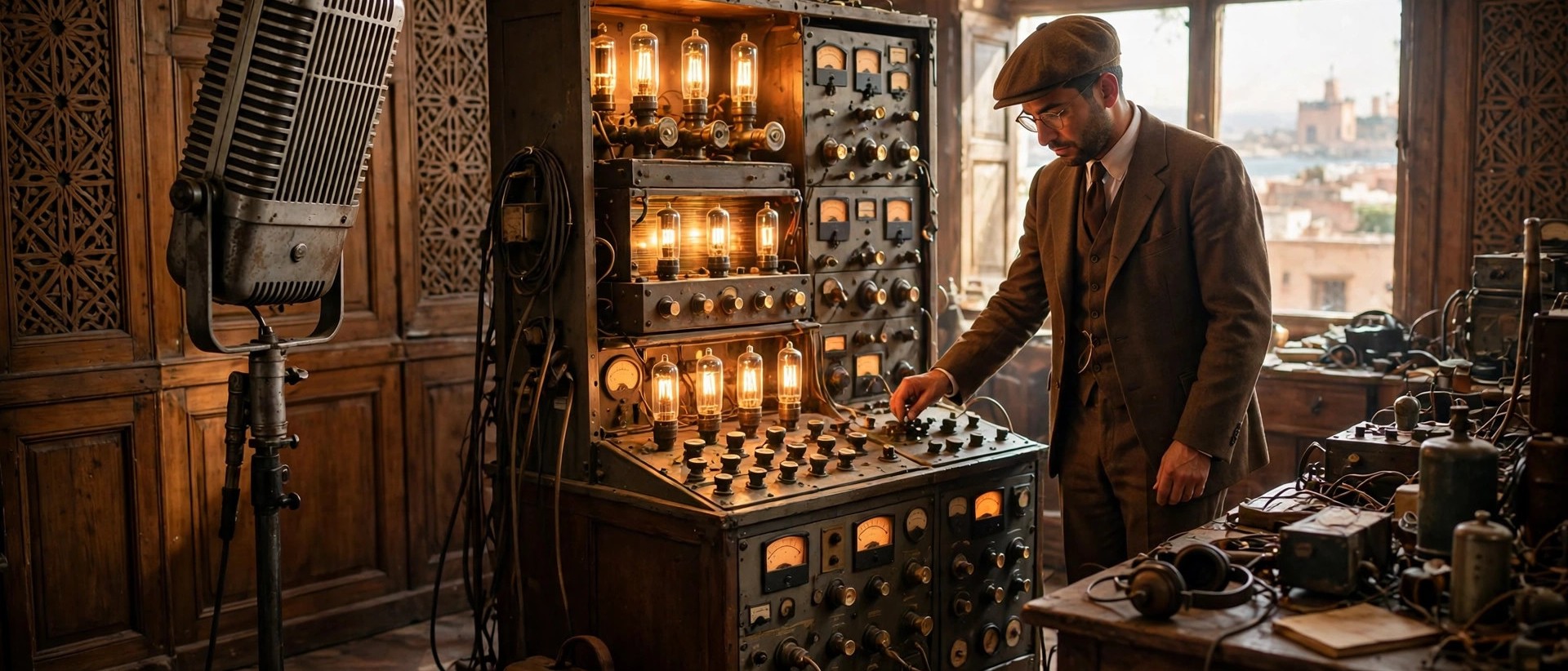
The history of Moroccan radio and television begins almost a century ago, in a small Rabat studio in February 1928, when a two-kilowatt transmitter sent the country's first regular broadcasts across the airwaves. From that modest start, Moroccan broadcasting grew into one of the Arab world's oldest.
This guide follows the whole arc of the history of Moroccan radio and television: Radio Maroc under the French protectorate, the TELMA experiment, the launch of TVM in 1962, the arrival of colour, the shock of 2M in 1989, and the great opening of the 2000s — the SNRT channels, private radio and digital terrestrial television.
Along the way, we flag the dates historians still argue about, because the history of Moroccan radio and television has a few of them. For the wider backdrop, start with our history of Morocco.
In this guide
- 1928: Radio Maroc Goes on Air
- Radio Under the Protectorate: Control and Resistance
- Tangier, Tetouan and the Airwaves of the International Zone
- 1954–1955: TELMA, Morocco's First Television Experiment
- 1962: TVM and the Birth of Moroccan Television
- The RTM Years: One Channel, One Voice
- Colour Arrives: Television in the 1970s
- Medi 1: Radio Across the Strait
- 1989: 2M and the End of the Monopoly
- The History of Moroccan Radio and Television at a Glance
- The 2000s: SNRT, HACA and the Great Opening
- Tamazight on Air: A Language Finds Its Channel
- From Analogue to Digital: TNT and the Streaming Age
- Frequently Asked Questions
- Conclusion: Why This History Still Matters
1928: Radio Maroc Goes on Air
In the history of Moroccan radio and television, radio came to Morocco under French rule, as a state project. In February 1928, Radio Maroc began broadcasting from Rabat with a two-kilowatt medium-wave transmitter, run by the Sherifian Office of Posts and Telegraphs, its first director appointed by the Résident Général.
The legal groundwork was already old: as early as 1907, Sultan Moulay Hassan had declared wired and wireless telegraphy a state monopoly, and a dahir of July 1929 extended it to every means of transmitting signals, audio or visual.
Early broadcasts were mainly in French, aimed at the European settler community, and reception reached little beyond Rabat and Casablanca, with Fez and Meknes following. Yet the medium was magnetic: cafés bought sets, neighbours gathered to listen, and a shared national audience was born.
Radio Under the Protectorate: Control and Resistance
The protectorate treated the airwaves as an instrument of rule, and Moroccan nationalists learned to treat them as an instrument of resistance. With Radio Maroc under official control, nationalist leaders broadcast from stations in Spain and Italy, turning radio into a key channel of the independence struggle.
Inside Morocco, listening itself became a quiet act of defiance, and the authorities answered with jamming and surveillance. The history of Moroccan radio and television in this period is therefore not only a technical story about transmitters. It is a political story about who gets to speak to a nation, and in which language.
Tangier, Tetouan and the Airwaves of the International Zone
Tangier was the exception to every rule in the history of Moroccan radio and television. As an international zone, the city hosted stations serving British, Spanish, French and American interests — including Radio Tanger, founded in 1946, and relays of the Voice of America — each power with its own frequency and its own message.
In the Spanish zone, Radio Dersa broadcast from Tetouan. A listener in the north could cross dial positions the way a traveller crossed borders — our guide to the Tangier International Zone explains the strange legal world that made this possible. After independence in 1956, the new state folded the Tangier and Tetouan studios into the national system, ending the era of competing foreign stations.
1954–1955: TELMA, Morocco's First Television Experiment
In the history of Moroccan radio and television, Morocco was a pioneer of television in the Arab world — and its first channel lasted barely fifteen months. TELMA, a French company, was authorised to broadcast in 1951 and began transmitting from Casablanca in February 1954, with transmitters also in Rabat, Fez and Meknes.
The channel broadcast mostly in French for the European community, using the French 819-line standard from studios in Casablanca's Ain Chock district, with twenty to thirty hours a week. But most Moroccans saw TELMA as a protectorate propaganda tool, and nationalists rejected it outright.
TELMA's end came with the return of Mohammed V: the station covered his homecoming on 16 November 1955, then closed soon after. Some sources date its suspension to 20 May 1955, which cannot be squared with the November coverage — one of several small contradictions in the early record. Morocco then went without television for more than six years, even after independence. Read more in the Television in Morocco overview on Wikipedia.
1962: TVM and the Birth of Moroccan Television
Television returned as a Moroccan, state-owned project — the next chapter in the history of Moroccan radio and television. On 3 March 1962, the first anniversary of King Hassan II's reign, TVM, Télévision Marocaine, went on air. The inaugural broadcast was the king's speech, and television was tied to the monarchy's rhythms and the national calendar from then on.
At first, TVM reached only Casablanca and Rabat, using the old TELMA transmitters, broadcasting in black and white on the European 625-line standard. In the mid-1960s, the daily schedule ran from about 7:30 in the evening to midnight: French until nine, then Arabic until closedown.
The launch came six years after Moroccan independence in 1956, and the new channel had a nation-building job: carrying Arabic-language culture and education to a country where most people could not read a newspaper. Radio, which reached far more homes, remained the senior medium for another generation.
The RTM Years: One Channel, One Voice
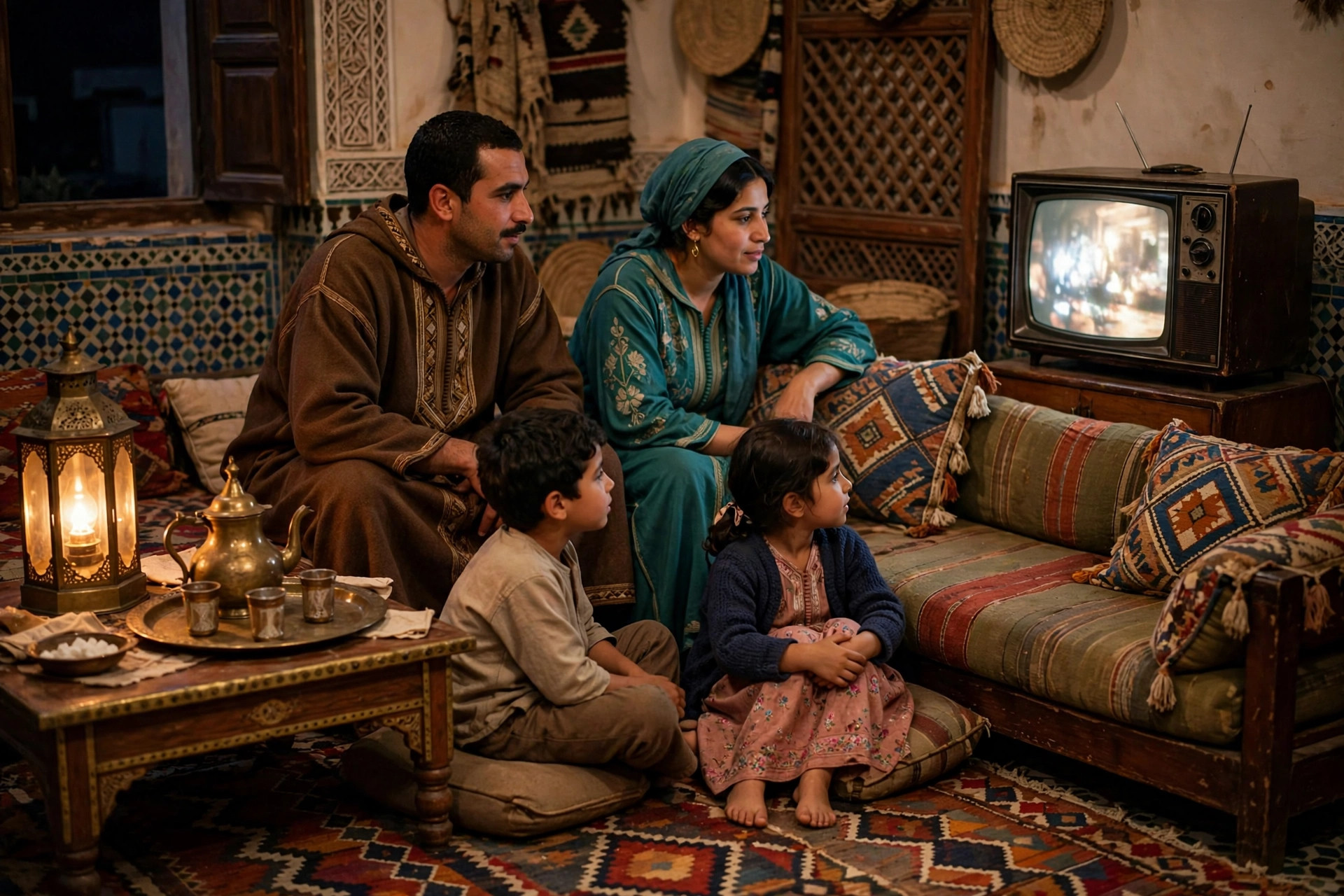
In March 1962, radio and television were reorganised under one body, Radiodiffusion-Télévision Marocaine (RTM) — a landmark in the history of Moroccan radio and television. It became a financially autonomous public establishment in 1966, and in 1978 it passed under the Ministry of the Interior. For more than a quarter of a century, RTM was the only broadcaster in the country.
Regional radio grew steadily. From 1978, stations opened in Tangier, Oujda, Fez, Casablanca, Laayoune and Marrakech, bringing local voices to a network that had begun in Rabat alone. The railways had already connected these cities physically; now radio connected them in sound — see our history of Moroccan railways.
RTM's great national moments were collective ones. Millions followed the Green March of 1975 on radio and the single television channel, and the evening news became a shared ritual in cafés and living rooms.
Colour Arrives: Television in the 1970s
Colour came to Moroccan television in 1972, when TVM introduced SECAM broadcasts — though the exact moment is disputed. Some accounts say the first colour transmission was the Throne Day speech of 1973, with royal occasions in colour first and ordinary programmes following gradually.
Whichever date is right, the change was symbolic as much as technical: in the history of Moroccan radio and television, a black-and-white Morocco gave way, programme by programme, to a colour one. More transmitters went up, more towns came within range, and television sets became normal in middle-class homes. Yet the monopoly held firm for another decade.
Medi 1: Radio Across the Strait
The first crack in the monopoly in the history of Moroccan radio and television came from Tangier, not Rabat. Medi 1 — Radio Méditerranée Internationale — was a Moroccan-French joint venture that began broadcasting from Tangier around 1980, a legal anomaly when the law still banned private stations outright. French and Moroccan banks and companies held the capital, and the station broadcast across the Strait of Gibraltar to both countries.
Medi 1 proved that a Moroccan station could sound different: faster, more musical, more commercial, aimed at young listeners. It also proved the state monopoly could be bent without being formally broken. Its founding year is unsettled in the sources — 1979, 1980 and 1981 are all given. For listeners, it was the first Moroccan radio that felt like a choice rather than an announcement.
1989: 2M and the End of the Monopoly
On 4 March 1989, 2M went on air from Casablanca — Morocco's first private commercial television channel, and the first of its kind in Africa and the Arab world. Created by SOREAD, a company of the ONA group, and modelled on France's Canal+, it broadcast as an encrypted pay channel with two unscrambled slots each day.
The excitement was real, and so were the problems. Piracy undercut subscriptions, and the channel drifted from its international, film-led concept towards a general local channel. In June 1996, ONA withdrew, and the state — which had signed the concession — took back control of around 68 percent of the capital.
On 10 January 1997, 2M began broadcasting unencrypted, and the Moroccan audiovisual landscape changed overnight: a second free channel, full of films, dubbed series and entertainment, suddenly reached every home with an aerial. The history of Moroccan radio and television turns on this date — the single-channel era was over. 2M went to 24-hour broadcasting in October 2000, reached satellite in January 2001, and launched Radio 2M in 2002. See our history of Moroccan cinema for the films themselves.
The History of Moroccan Radio and Television at a Glance
The whole story fits on one page: the turning points of the history of Moroccan radio and television, from the telegraph monopoly to the streaming age.
| Year | Milestone | Why it matters |
|---|---|---|
| 1907 | Sultan declares telegraphy a state monopoly | The state claims the airwaves before radio exists |
| 1928 | Radio Maroc begins in Rabat | Morocco's first regular radio broadcasts |
| 1929 | Dahir extends the monopoly to all signals | Radio and future television come under state control |
| 1946 | Radio Tanger founded | Tangier's international airwaves take shape |
| 1954 | TELMA begins transmitting | Morocco's first, short-lived television channel |
| 1962 | TVM launches on 3 March | Regular Moroccan television begins |
| 1972 | Colour television (SECAM) introduced | TVM moves from black and white to colour |
| 1978 | Regional radio stations open | Radio reaches beyond Rabat and Casablanca |
| 1980 | Medi 1 radio begins in Tangier | The first crack in the state monopoly |
| 1989 | 2M launches on 4 March | Morocco's first private TV channel |
| 1997 | 2M goes free-to-air on 10 January | The single-channel era ends |
| 2002 | HACA regulator created | The state monopoly formally ends |
| 2005 | SNRT replaces RTM | The public broadcaster becomes a state company |
| 2006 | Private radio licensed; Medi 1 TV launches | The dial opens up |
| 2010 | Tamazight TV launches | Amazigh-language television begins |
| 2015 | Analogue switch-off on 17 June | Morocco moves to digital terrestrial TV |
| 2025 | SNRT takes full control of 2M | The public holding is completed |
The 2000s: SNRT, HACA and the Great Opening
The decisive decade in the history of Moroccan radio and television began with a regulator. In 2002, the High Authority for Audiovisual Communication (HACA) was created by royal decree to oversee the sector and end the state monopoly. In 2005, a new audiovisual law was published, and RTM became the Société Nationale de Radiodiffusion et de Télévision (SNRT), a state-owned company.
Then the dial opened. In 2006, the state monopoly on radio ended: six new private stations and two groups of local stations received frequencies in the first wave, with a second wave in 2009. Hit Radio, Radio 2M, Med Radio, Chada FM and MFM joined Medi 1 and the SNRT stations, and Moroccan radio became a crowded, commercial, music-led medium overnight.
Television moved more slowly. Private licences were granted in 2006 and 2008, but the new channels were satellite-only with limited hours. Medi 1 TV, launched on 1 December 2006 as Medi 1 Sat, became the main private challenger, while the SNRT built thematic channels around Al Aoula, the former TVM, rebranded in 2007.
| Channel | Launched | What it shows |
|---|---|---|
| Al Aoula | 1962 | General programming, news and drama |
| Laayoune TV | 2004 | Programmes for the southern regions |
| Al Maghribia | 2004 | General programming for Moroccans abroad |
| Assadissa | 2005 | Religious programming |
| Arryadia | 2006 | Sport, including the Botola league |
| Athaqafia | 2006 | Culture and education |
| Tamazight TV | 2010 | Programming in the Amazigh language |
| Aflam TV | 2016 | Moroccan and international films |
Today the SNRT runs six national radio stations and eleven regional ones, alongside its television family — see the SNRT overview on Wikipedia. By the end of the decade, the old world of one channel and one voice had been replaced by something unrecognisably busier, and the storyteller's tradition Ibn Battuta embodied had found a dozen new stages.
Tamazight on Air: A Language Finds Its Channel
For most of the twentieth century, Morocco's airwaves spoke mainly Arabic and French. Amazigh-language programming existed on radio, but it was limited, and television offered almost nothing. That changed in the 2000s, as the Amazigh language gained recognition.
Tamazight TV — Channel 8 of the SNRT — launched in 2010, giving Amazigh speakers a dedicated national television channel for the first time in the history of Moroccan radio and television. Its schedule mixes news, drama, music and children's programmes in Tamazight, with coverage of Amazigh culture across the Atlas, the Rif and the Souss.
The channel matters beyond audience figures. For Amazigh communities, hearing their own language on national television was a recognition radio alone had never delivered. It completed the picture of Moroccan broadcasting as a multilingual medium: Arabic, Tamazight, French and Spanish share the airwaves today, sometimes on the same dial.
From Analogue to Digital: TNT and the Streaming Age
On 17 June 2015, Morocco switched off its analogue television signals and moved to TNT, digital terrestrial television. The SNRT's channels — Al Aoula, Arryadia, Athaqafia, Al Maghribia, Assadissa, Aflam TV, Tamazight TV and Laayoune TV — became available free-to-air in digital quality, with 2M and Medi 1 TV.
Satellite had already changed the picture. 2M Monde reaches Moroccans abroad through Nilesat and Arabsat, Al Maghribia was built for the diaspora, and beIN Sports became the most popular pay-TV package. Surveys still put Al Aoula and 2M far ahead, each taking about a quarter of total viewing.
The newest shift is streaming. The SNRT and 2M both run apps and websites with live streams and catch-up, and online news portals and social media now compete with broadcasters for younger Moroccans. Radio has survived every change: around 15 million Moroccans still listen each week, for nearly three hours on average. The history of Moroccan radio and television is still being written, one stream at a time.
| Platform | What you get | Cost |
|---|---|---|
| TNT (digital terrestrial) | Al Aoula, 2M, Medi 1 TV and all SNRT channels | Free |
| Satellite (Nilesat, Arabsat) | 2M Monde, Al Aoula and Medi 1 TV abroad | Free with a dish |
| SNRT and 2M apps and websites | Live streams and catch-up | Free |
| IPTV via Maroc Telecom | Moroccan channels plus pay-TV bouquets | Subscription, price varies |
Frequently Asked Questions
When did radio start in Morocco?
Radio began in February 1928, when Radio Maroc started broadcasting from Rabat with a two-kilowatt medium-wave transmitter. A state-run station under the French protectorate, it remained the country's main broadcaster through independence in 1956.
When did television start in Morocco?
Television first appeared with TELMA, a French company that transmitted from Casablanca between February 1954 and 1955. Regular Moroccan television began on 3 March 1962, when TVM — now Al Aoula — launched with a speech by King Hassan II.
What is the difference between RTM and SNRT?
RTM, Radiodiffusion-Télévision Marocaine, was the state broadcaster from 1962 to 2005. SNRT, the Société Nationale de Radiodiffusion et de Télévision, replaced it in 2005 under the new audiovisual law.
Is 2M a private channel?
Not any more. 2M launched in 1989 as the first private, commercial pay-TV channel in the history of Moroccan radio and television, owned by the ONA group. The state took control in 1996, the channel went free-to-air in 1997, and in January 2025 the SNRT acquired full ownership of its parent company SOREAD.
Can I watch Moroccan TV outside Morocco?
Yes. 2M Monde and Al Maghribia are broadcast by satellite for viewers abroad, and the SNRT and 2M apps and websites stream their channels live. A dish aimed at Nilesat or Arabsat is the simplest option.
What is Tamazight TV?
Tamazight TV is the SNRT's Amazigh-language channel, launched in 2010 as Channel 8. It broadcasts news, drama, music and children's programmes in Tamazight, and was the first national channel dedicated to the Amazigh language and culture.
Conclusion: Why This History Still Matters
The history of Moroccan radio and television is the story of Morocco learning to talk to itself. It began with a colonial transmitter in Rabat, passed through a single state channel that gathered the whole country around one evening bulletin, and arrived at a crowded landscape of public channels, private radio, satellite and streaming.
Three threads run through the history of Moroccan radio and television. First, control: whoever held the airwaves held a powerful tool, and every regime has tried to shape them. Second, language: from French-only broadcasts to Arabic, Tamazight, French and Spanish on the same dial, the airwaves track who counts as Moroccan. Third, resilience: radio survived television, television survived satellite, and both survive the internet.
If you visit Morocco today, listen: the café television, the taxi radio, the call to prayer on Assadissa and the match commentary on Arryadia are all part of the same long broadcast. Explore more in our History & Heritage section, and read about the people behind it on our about page.