
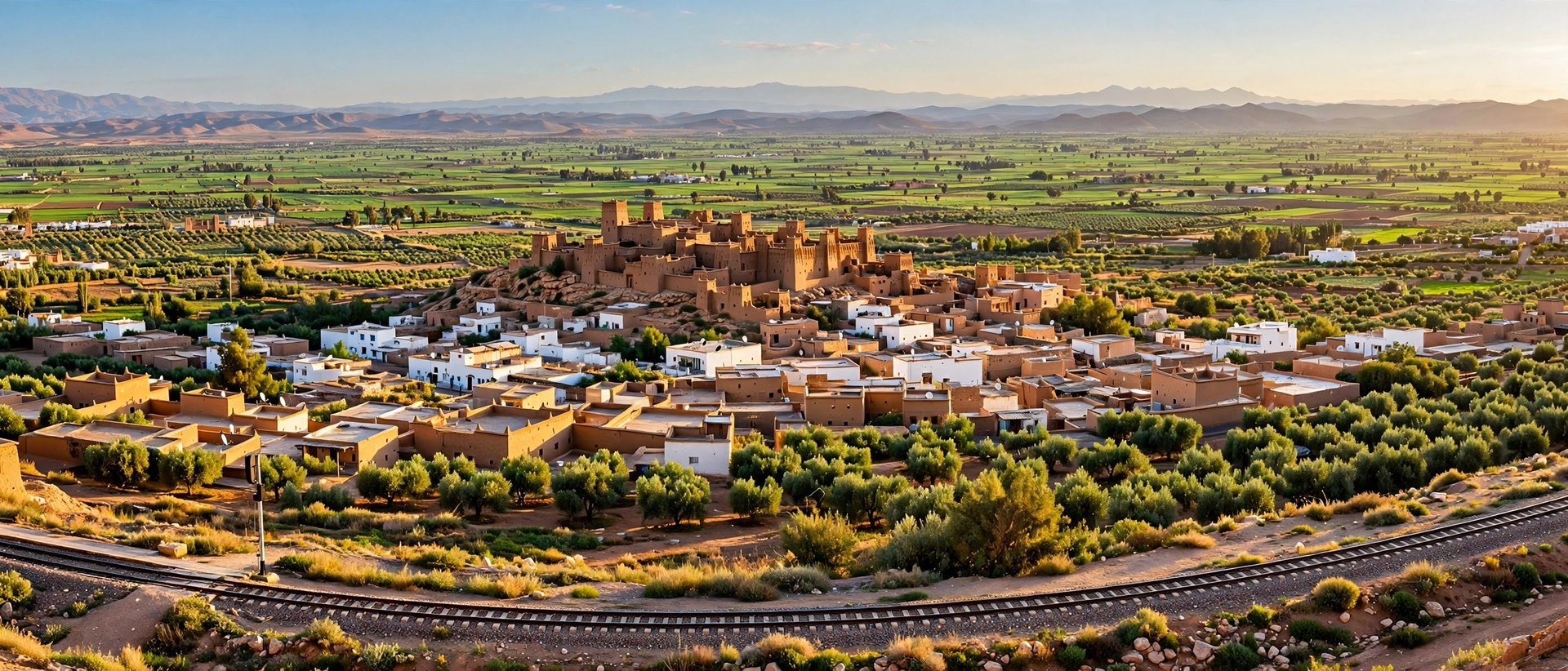
Living in Taourirt is Morocco at its most practical: a town of 100,402 people (2024 census) in the Oriental region, about 100 kilometres west of Oujda, where the main railway from Fes meets the branch line to Nador.
This is not a tourist town or an expat destination: no international school, no coworking space, and — as far as any published source shows — no expat community at all. What living in Taourirt offers instead is a real town with real services at some of the lowest costs in Morocco: a provincial hospital, a railway station, and rents a single pension covers comfortably. This guide, part of our Living in Morocco series, covers housing, costs, healthcare, internet, and the honest downsides, in dirhams at roughly 10 MAD to $1.
In this guide
- Taourirt at a Glance
- Who Living in Taourirt Suits — and Who It Does Not
- Where to Live in Taourirt
- Housing and Rents
- Monthly Budget for Living in Taourirt
- Food and the Weekly Souk
- Healthcare
- Schools and Family Life
- Internet and Working Remotely
- Transport and Getting Around
- Residency and Paperwork
- Community and Daily Life
- Climate and Seasons
- Day Trips from Taourirt
- Practical Tips
- Frequently Asked Questions
- Conclusion
Taourirt at a Glance
| Fact | Detail |
|---|---|
| Location | Taourirt Province, Oriental region, on the Oued Za, ~394 m altitude |
| Population | 100,402 (2024 census); province 220,157 |
| Character | Railway junction and olive-oil town; Marinid kasbah on its hill |
| Nearest city | Oujda, ~100 km east; Guercif, ~80 km west |
| Nearest airport / train | Oujda Angad, ~120 km; Taourirt station on the Fes–Oujda line, branch to Nador |
| Budget, single person | 5,200–8,500 MAD ($520–$850)/month (planning estimates) |
| Budget, couple | 7,500–12,000 MAD ($750–$1,200)/month (planning estimates) |
Taourirt takes its name from the Tamazight word for hill — Thawrart — and the hill is still there, crowned by the kasbah. The old settlement below it was once called Saa, after the river later called Wadi Za. The Marinid sultan Abu Yaqub Yusuf laid the fort out on the frontier with Tlemcen; Ibn Khaldun records the wall finished in Ramadan 694 AH (1295 CE), though Ibn Abi Zar puts it a year later. Abu Said Uthman rebuilt it in 721 AH (1321), and Moulay Ismail renewed it, settling a hundred horsemen inside the walls. About 273 metres of that wall still stand, its square and rectangular towers rising around 10 metres. More background is on Wikipedia.
Who Living in Taourirt Suits — and Who It Does Not
Living in Taourirt suits a very specific person: self-reliant, comfortable without an expat bubble, and happy to build a life in French and Darija. Remote workers on a tight budget, retirees who want a real town rather than a resort, and anyone who values a railway station over nightlife will find it works surprisingly well.
Living in Taourirt does not suit most people: no international school, no private hospital of note, no coworking space, and no English-speaking social life to join. Winters are cold, summers hot and dry, and anything specialist — a dentist, a spare part, a proper supermarket — means a trip to Oujda or Fes. If you need fast fibre, a school for your children, or a ready-made community, read our guide to living in Oujda instead.
Where to Live in Taourirt
Most daily life for people living in Taourirt happens on foot, along the main N6 road and in the quarters around it. The choice is really between the old town below the kasbah and the newer streets around the station.
The old quarter grew up around the barracks Lyautey raised below Jbel Azrou once Oujda was secured, and a covered market from those years still trades. It is the most atmospheric place to live: old streets, low houses, and the kasbah hill above the roofs. A house here means thick walls and neighbours who know your name within a week.
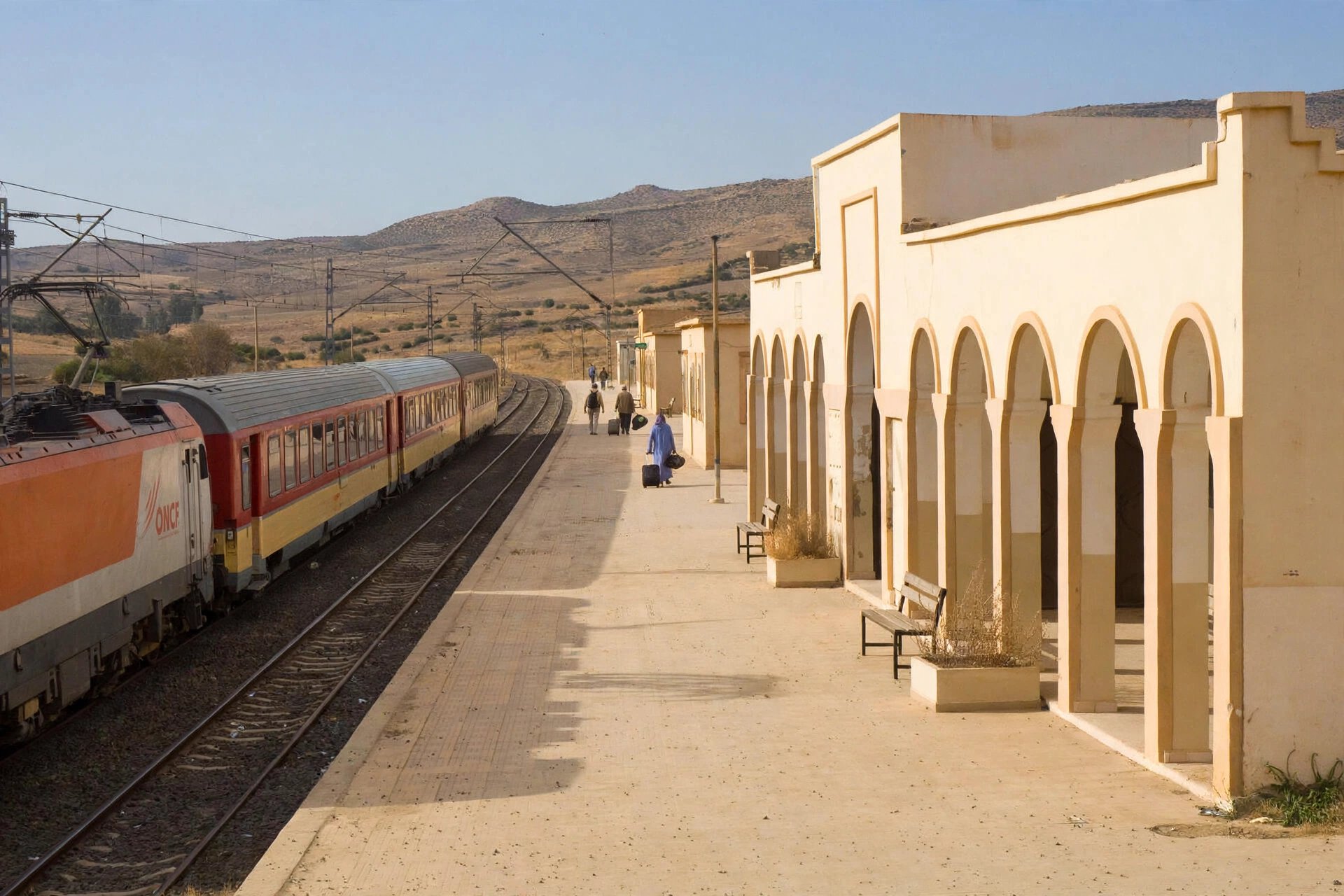
The station side suits anyone living in Taourirt without a car. Trains on the Casablanca to Oujda line call here, and the branch that opened in 2009 turns north to Nador, so the station side puts Fes, Oujda, and the coast within a single ticket. The newer districts along the N6 hold most of the modern apartments, with wider streets and parking.
Housing and Rents
There is no published rental market for people living in Taourirt in the way Marrakech or Rabat have one. Flats are found through word of mouth, a caretaker, or the handwritten signs in shop windows — and prices reflect that. Third-party cost surveys published in November 2026 disagree widely, so treat every figure here as a planning estimate to confirm on the ground, not a quoted price.
| Home | Monthly rent (planning estimate) |
|---|---|
| 1-bedroom flat, town centre | 1,800–2,700 MAD ($180–$270) |
| 1-bedroom flat, outside the centre | 1,200–1,700 MAD ($120–$170) |
| 3-bedroom flat, town centre | 4,900–6,000 MAD ($490–$600) |
| 3-bedroom flat, outside the centre | 2,500–3,700 MAD ($250–$370) |
| Small house with courtyard, old quarter | 2,000–3,500 MAD ($200–$350) |
| Utilities (electricity, water, gas, rubbish) | 350–600 MAD ($35–$60) |
Expect to pay in cash, to negotiate, and to pay several months in advance without local references. A one-bedroom in the centre is the realistic starting point for a single person; a couple should budget for a two- or three-bedroom flat, where the best value sits. Read our guide to renting an apartment in Morocco before you sign, and never pay a deposit for a flat you have not walked through in daylight.
Monthly Budget for Living in Taourirt
A single person can live in Taourirt on roughly 5,200–8,500 MAD a month, and a couple on roughly 7,500–12,000 MAD. The ranges reflect real choices: a centre flat and restaurant meals at the top, a flat outside the centre and market cooking at the bottom. One third-party survey puts a single person at about $694 a month including rent.
| Monthly cost | Single person | Couple |
|---|---|---|
| Rent (1–2 bedrooms) | 1,500–2,700 MAD | 2,500–4,500 MAD |
| Groceries and market | 1,500–2,000 MAD | 2,200–3,000 MAD |
| Utilities and internet | 500–800 MAD | 600–1,000 MAD |
| Transport (local + trains) | 300–600 MAD | 500–900 MAD |
| Eating out and cafés | 400–800 MAD | 700–1,200 MAD |
| Household and miscellaneous | 500–900 MAD | 800–1,400 MAD |
| Total | 5,200–8,500 MAD ($520–$850) | 7,500–12,000 MAD ($750–$1,200) |
The figures are planning estimates, checked November 2026. They assume you cook most meals, use the train rather than a car, and skip alcohol — sold only in a handful of licensed outlets. A car changes the maths: diesel runs about 16.30–16.90 MAD a litre in November 2026, and a small rental costs roughly 250–400 MAD a day. For the national picture, see our cost of living in Morocco guide.
Food and the Weekly Souk
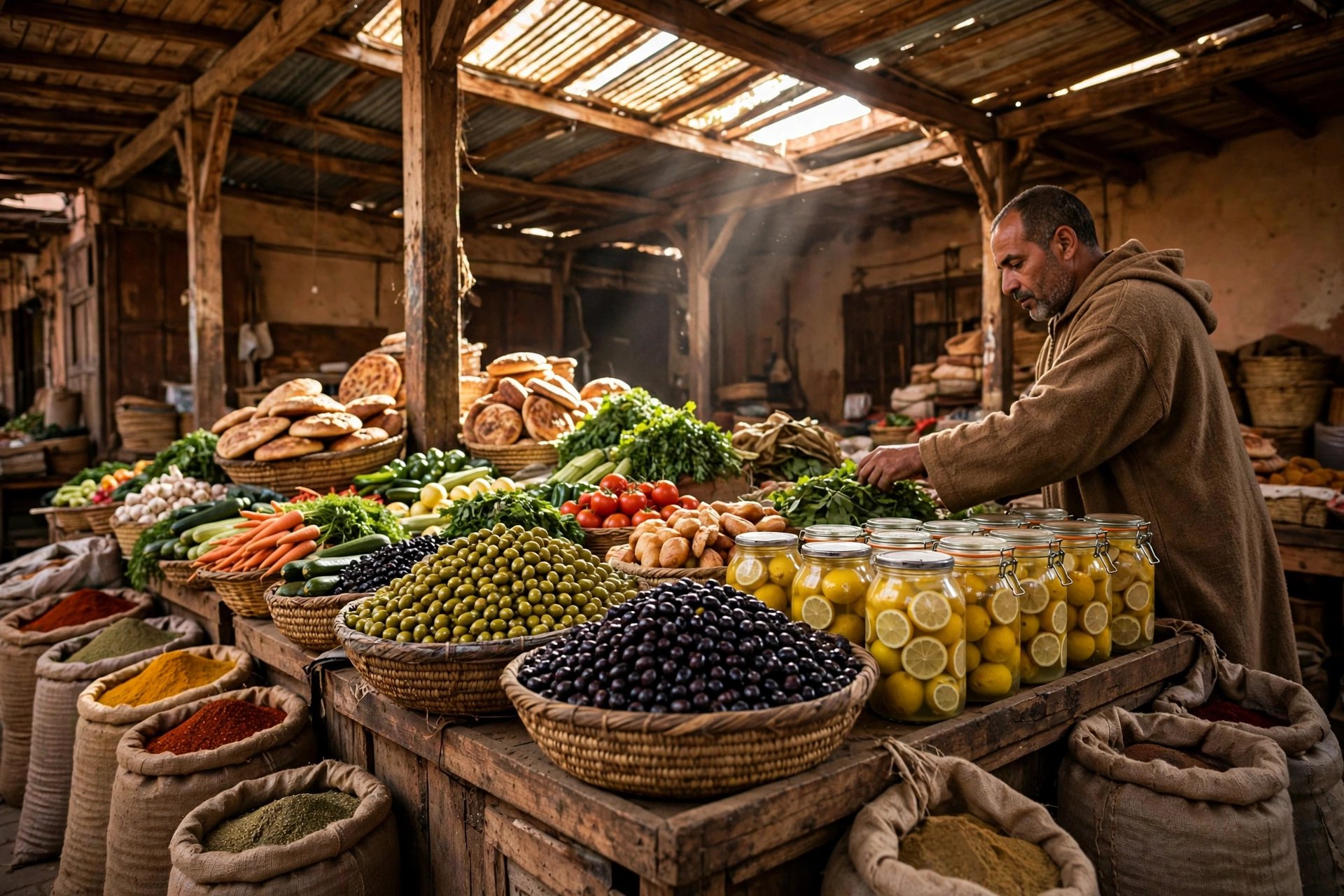
Taourirt is Morocco's olive capital, and the food follows from that. The town is often described as the largest olive-producing city in the country, with around 176 olive-oil factories in and around it. Olive oil here is bought by the litre from the press, and the covered market sells it with olives, preserved lemons, bread, and vegetables from the plain.
Daily shopping is a market errand, not a supermarket run. The covered market in the old quarter trades every day, the weekly souk brings in livestock, produce, and traders from the surrounding villages, and the small shops along the N6 stock everything else. A weekly shop for one person runs about 350–450 MAD if you cook from the market: bread at a few dirhams a loaf, vegetables for a tagine for 20–30 MAD, chicken at roughly 25–30 MAD a kilo, coffee for 8–12 MAD. Eating out means grill restaurants and sandwich shops — a full lunch for 30–60 MAD.
Healthcare
For anyone living in Taourirt, the town's public provincial hospital covers everyday care, emergencies, and childbirth for the town and the surrounding province. For anything beyond that — a specialist, an MRI, a planned operation — residents travel to Oujda, about 100 kilometres east, where the university hospital and private clinics sit. Private clinics in town are limited, and English-speaking doctors are rare: French is the working language of medicine here.
Keep private health insurance that covers evacuation to Oujda or Casablanca, keep a small pharmacy kit at home, and register with a local GP as soon as you arrive — a doctor who knows you will see you faster than a walk-in. Pharmacies stock the common medicines, and an on-duty rota covers nights. Our guide to healthcare in Morocco for expats explains insurance and the public system.
Schools and Family Life
Taourirt has public primary and secondary schools and private Moroccan schools, but no international school. Families who need an English-language curriculum send their children to Oujda, about an hour and a half away, or choose a French-language private school in town. There is no international school in Taourirt to price — if a listing claims otherwise, check it before you believe it.
That makes living in Taourirt a poor fit for most families with school-age children, and an honest one for families whose children are grown or who are happy with the Moroccan system. The town is safe for children in the old-fashioned sense: quiet streets and neighbours who watch out for each other's children. Our guide to schools in Morocco for expat families covers curricula, fees, and Oujda options.
Internet and Working Remotely
Internet is the weakest link in living in Taourirt. There is no coworking space in town, fibre is patchy, and third-party estimates put the average fixed speed around 10 Mbps — enough for email and calls, tight for heavy video work. Mobile 4G from Maroc Telecom is the reliable fallback, and most remote workers run a 4G router as their main connection, with a fixed line as backup.
Budget about 200–300 MAD a month for a mobile data plan and 300–500 MAD for a fixed line where available. Test the actual speed in the flat before you sign a lease, not after: speeds vary street by street, and a landlord's promise is not a measurement. Our guide to internet in Morocco for expats covers fibre, 4G, and the providers to try first.
Transport and Getting Around
The railway is the reason living in Taourirt works as a base. The station sits on the main line from Casablanca, Rabat, and Fes to Oujda, and the branch to Nador, opened in 2009, runs north through the mountains to the coast. Timetables and fares are published by ONCF, and trains are the comfortable way to leave town.
| Route from Taourirt | Mode | Time |
|---|---|---|
| Oujda | Train | ~2 hours |
| Fes | Train | ~3 hours |
| Nador | Train (branch line) | ~2 hours |
| Debdou | Grand taxi | ~1 hour |
| Oujda Angad airport | Taxi + bus, or car | ~1.5–2 hours |
| Casablanca | Train | ~7–8 hours |
Inside the town, everything is walkable, and petit taxis cover the rest for 10–20 MAD. Grand taxis run the regional routes: Taourirt to Debdou costs roughly 30–50 MAD a seat, and the same logic covers Guercif to the west and El Aioun to the east. Buses connect the town to Nador province and beyond, and the N6 runs straight through town. Check train times on ONCF before you travel — the branch-line timetable is thinner than the main line.
Residency and Paperwork
For anyone living in Taourirt, residency works as anywhere else in Morocco: a long-stay visa first, then a residence card (carte de séjour) from the local police, with proof of income, housing, and health insurance. The paperwork is in French and Arabic, the queues are real, and a local fixer or a French-speaking friend saves more time than any preparation online.
Two practical notes. First, the town is small enough that the administration knows its foreigners — officials are generally helpful once they know you. Second, keep copies of everything — passport, lease, bank statements, insurance — in a folder you can carry to an appointment. No published source confirms that every residency step can be completed inside Taourirt itself, so expect at least one trip to Oujda. Budget for it rather than discovering it.
Community and Daily Life
There is no expat community in Taourirt to join, and that is the honest starting point. Daily life is Moroccan life: greetings in the street, coffee in the café, the covered market in the morning, and the weekly souk as the social event. The town is overwhelmingly local, French is widely spoken, and Darija is the language of the market.
That means the social work is yours to do. Learn Darija — our guide to learning Moroccan Arabic is the place to start — join the café regulars, shop at the same stalls, and accept invitations. Foreigners who settle here are remembered and looked after; foreigners who stay behind their shutters are simply forgotten. The olive harvest in autumn is the best moment to arrive: the presses run and the town smells of fresh oil.
Climate and Seasons
The climate shapes living in Taourirt more than the guidebooks suggest: semi-arid and continental, with hot, dry summers, cool winters, and big swings between day and night. Average temperatures run from about 13°C in January to about 26–27°C in July and August, with July days at 34°C and January nights at 6°C. Rain is scarce — around 192 mm a year — and November is the wettest month.
| Season | What to expect |
|---|---|
| Winter (Dec–Feb) | Days 16–19°C, nights 6–9°C; cold houses, heating needed |
| Spring (Mar–May) | Days 24–27°C, nights 11–14°C; the best season to arrive |
| Summer (Jun–Aug) | Days 32–34°C, nights 19–21°C; dry heat, siesta hours |
| Autumn (Sep–Nov) | Days 24–30°C cooling to 23°C; first rains in November |
The practical consequence is a house, not a wardrobe, problem: most flats have thin walls and no central heating, so winter mornings indoors feel colder than outside. Budget for a gas heater and warm bedding, and check the flat has sun in winter — a south-facing room is worth more than an extra bedroom. Summer is the reverse: thick walls, shutters, and a siesta are the local technology.
Day Trips from Taourirt
Living in Taourirt puts the whole Oriental region within a day trip. Debdou, about 50 kilometres south in its own hills, is the essential one: a quiet mountain town with a Marinid kasbah, an old Jewish quarter, and a Wednesday souk — see our guide to living in Debdou. Guercif, about 80 kilometres west on the N6, is the next market town. Oujda, 100 kilometres east, is the regional capital for shopping and specialists. Nador, two hours by train through the mountains, is the Mediterranean coast — a comfortable day out rather than a drive.
Further afield, the Moulouya valley runs west towards the Middle Atlas, and the road south from Debdou climbs to the high plateaus. None of these trips needs a car: the train and the grand taxis cover them all, one more reason the town suits people who would rather not own a vehicle.
Practical Tips
- Arrive in spring. March to May is the kindest season, and you can judge a flat in daylight.
- Test the internet before you sign. Run a speed test on 4G and on the fixed line in the flat, at the hour you work.
- Learn the greetings first. A correct salam and a few words of Darija open more doors in Taourirt than fluent French ever will.
- Keep cash. Cards work in the bigger shops and at the station, but the market, taxis, and most landlords run on cash.
- Buy olive oil from the press. A litre of fresh oil from a local press costs a fraction of a supermarket bottle.
- Plan Oujda trips monthly. One day a month in the regional capital covers the dentist, the specialist, the big shop, and the paperwork Taourirt cannot.
- Heat in winter, shade in summer. A gas heater and a south-facing room matter more than air conditioning.
Frequently Asked Questions
Is living in Taourirt cheap?
Yes. A single person can live in Taourirt on roughly 5,200–8,500 MAD ($520–$850) a month, and a couple on 7,500–12,000 MAD, with rents from 1,200 MAD outside the centre. It is one of the cheapest towns in Morocco with a railway station and a hospital.
Is Taourirt safe for foreigners?
The town scores around 50/100 on third-party safety indexes: petty theft and lost belongings are the common problems, not violent crime. Normal precautions — watch your bag in the souk, lock the flat — cover almost everything.
Can I work remotely from Taourirt?
Yes, with care. Fibre is patchy and average fixed speeds are estimated around 10 Mbps, so most people living in Taourirt rely on 4G from Maroc Telecom. Test the speed before signing a lease, and keep a mobile backup.
How do I get to Taourirt?
By train from Fes (about 3 hours) or Oujda (about 2 hours), or by car on the N6. The nearest airport is Oujda Angad, about 120 kilometres east.
Is there an international school in Taourirt?
No. Families needing an English-language curriculum use schools in Oujda, about 100 kilometres away, or a French-language private school in town.
What is Taourirt famous for?
Olives and the railway. It is often described as Morocco's largest olive-producing city, with around 176 olive-oil factories nearby, and it sits on the main Fes–Oujda railway with a branch to Nador. The Marinid kasbah dates to 1295.
Conclusion
Living in Taourirt is a trade, and the terms are clear. You give up the expat scene, the international school, the fast fibre, and the easy social life — and you get a real Moroccan town with a railway station, a hospital, a covered market, and rents that leave money in your pocket. For a remote worker on a tight budget, a retiree who wants the town rather than the resort, or anyone who would rather learn Darija than join a club, it is one of the most honest bargains in Morocco. Come in spring, test the internet before you sign, buy your olive oil from the press. Taourirt rewards patience more than money — and that is exactly why living in Taourirt suits the people it suits.