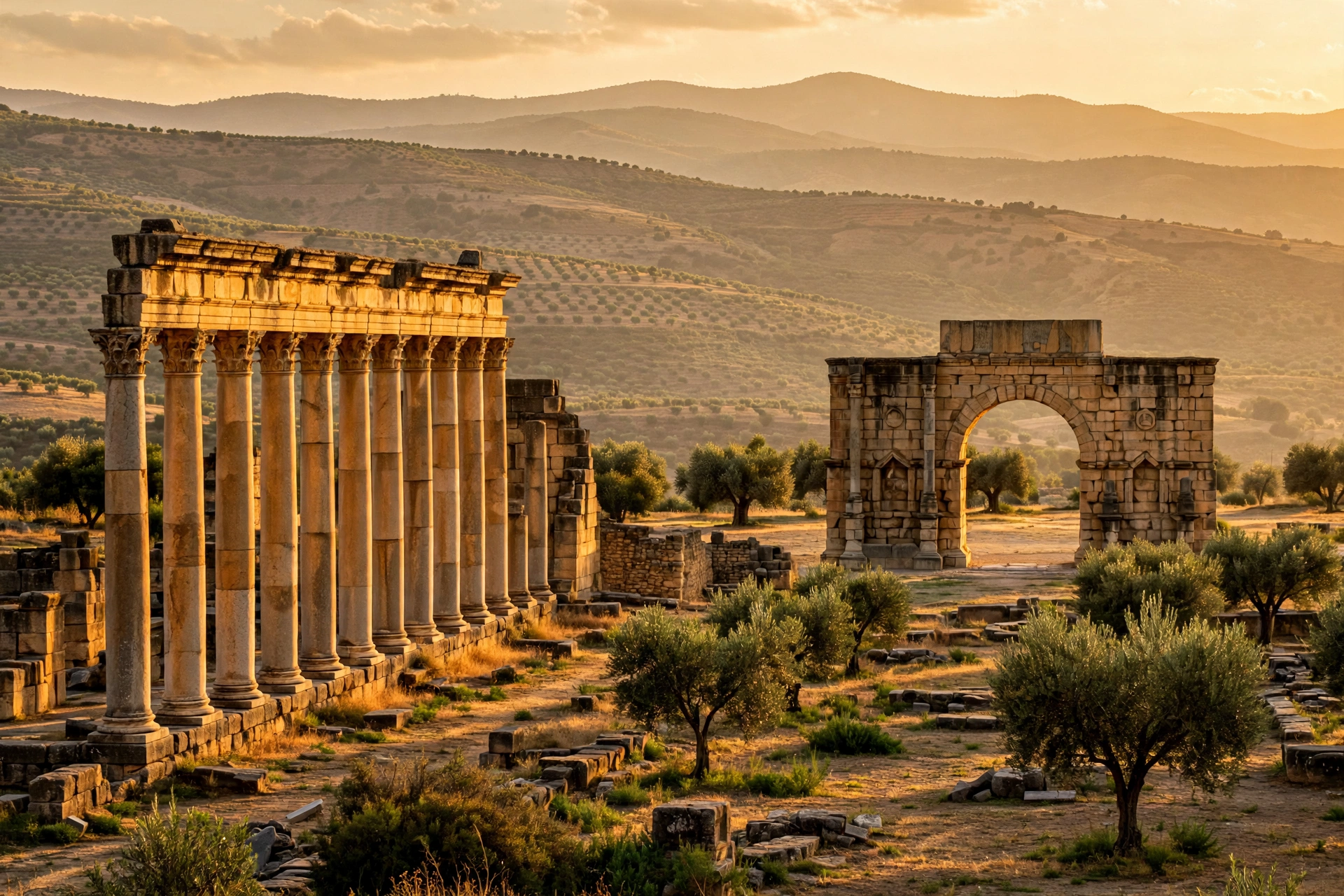
If you are planning a visit to Morocco’s greatest Roman site, this volubilis roman morocco guide is the place to start. Volubilis is not a tidy museum reconstruction. It is a ruined city spread across a green hillside in northern Morocco, where columns stand against the sky, mosaic floors still lie where Roman families walked on them, and the hills around you have been farmed for two thousand years.
Most visitors arrive expecting a smaller Pompeii and leave surprised. Volubilis was never a Roman colony built from nothing. It was already an old and wealthy city before Rome arrived, and its story belongs as much to Berber and Mauretanian kings as to Roman emperors. This guide explains what Volubilis really was, what each ruin actually is, and how to plan a half-day visit from Fes or Meknes.
Table of Contents
Volubilis Before Rome: A Berber-Mauretanian City
The first thing this volubilis roman morocco guide wants you to unlearn is the idea that Rome founded the city. Settlement traces go back centuries before annexation, and by the first century BC Volubilis was already the capital of a powerful local kingdom.
Volubilis sat at the edge of the fertile Gharb plain, close to the Zerhoun hills and the trade routes of northern Morocco. Olive oil, grain and trade made it rich. Its rulers spoke Punic and Latin, traded with Carthage and Rome, and built temples, houses and public buildings long before any Roman legion marched in. That explains the character of the ruins: a local city that became Roman gradually, keeping its own streets, gods and elite families while adopting Roman baths, forums and mosaics.
King Juba II and the Missing First Chapter
The missing first chapter of Volubilis belongs to King Juba II, who ruled Mauretania in the late first century BC and early first century AD. He was one of the ancient Mediterranean’s most remarkable rulers: the son of a defeated Numidian king, raised in Rome, married to Cleopatra Selene — daughter of Cleopatra VII and Mark Antony — and a scholar who wrote books on history, geography and art.
Under Juba II and his son Ptolemy, Volubilis flourished as a royal city of Mauretania — a client kingdom of Rome, independent in name and closely tied to Rome in practice, where Greek, Latin, Punic and Berber influences mixed in art and architecture.
One caution: the exact chronology of the Mauretanian kingdom under Juba II is not fully settled. Scholars debate the dates of his accession, the extent of his building programme at Volubilis, and how much of the early city should be credited to him rather than his predecessors. What is clear is that Volubilis was a royal Mauretanian centre before it was a Roman one.
How Rome Annexed Volubilis
Rome’s takeover was not a single dramatic conquest. After the emperor Caligula had King Ptolemy of Mauretania killed in AD 40, the kingdom revolted, and the emperor Claudius annexed Mauretania in the AD 40s, dividing it into two provinces. Volubilis became part of Mauretania Tingitana, the western province, governed from Tingis (modern Tangier).
Annexation changed the city but did not erase it. Local families took Roman names, served as magistrates and priests of the imperial cult, and rebuilt their houses in Roman style. Latin inscriptions record their careers in detail — a city proud of both its local roots and its Roman citizenship. By the second century AD Volubilis had a forum, a basilica, baths, a triumphal arch and a defensive wall, with a population usually estimated at around 20,000 people.
Life in Roman Volubilis
To walk Volubilis today is to walk a working city, not a monument. The ruins are the bones of everyday life: houses, shops, workshops, baths and temples along streets that still follow their ancient lines.
The Forum and the Basilica
The forum was the civic heart of the city, a paved open square surrounded by public buildings. The basilica stood at one end — a great hall where courts sat and business was done. What you see today is its skeleton: rows of tall columns and the outline of the nave.
The basilica is one of the most photographed spots in Volubilis. Its columns catch the late-afternoon light, and the view across the forum to the triumphal arch is the classic image of the site — and the best place to grasp how Roman public life worked, with law, trade and politics all happening in one square.
The Triumphal Arch of Caracalla
At the far end of the main street, the Decumanus Maximus, stands the triumphal arch built in honour of the emperor Caracalla (AD 211–217). Raised in AD 217, according to its inscription, it celebrated Caracalla’s grant of Roman citizenship to the city’s inhabitants — and, more broadly, his famous edict extending citizenship across the empire.
Reconstructed in the twentieth century from fallen blocks, the arch is the most complete large monument at Volubilis. It marks the formal entrance to the forum area and the end of the main street.
Houses, Mosaics and the People Who Lived Here
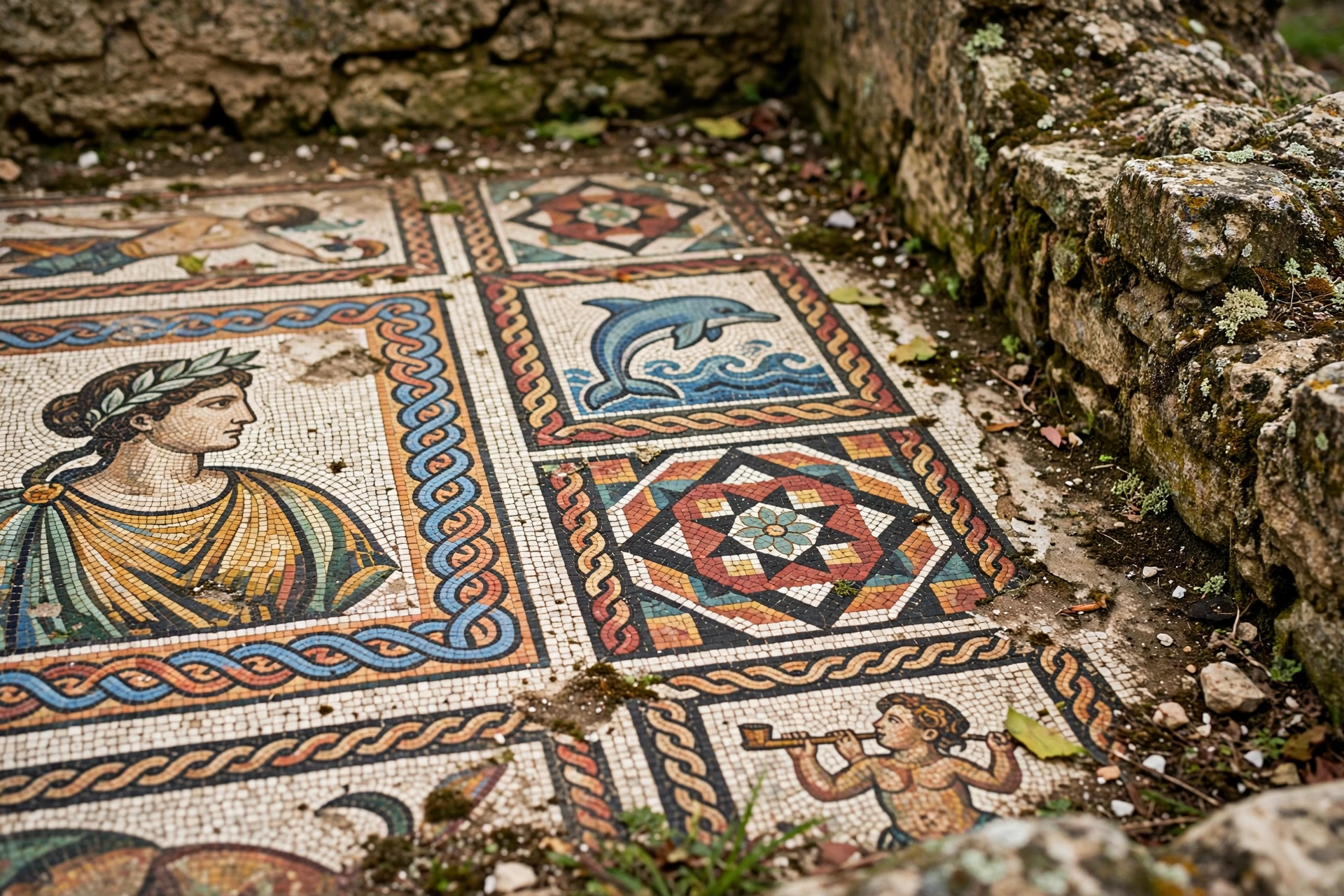
The real treasure of Volubilis is its houses — and this volubilis roman morocco guide insists you give them time. Wealthy families built large courtyard homes with peristyle gardens, dining rooms and reception halls, and floored those rooms with mosaics: vivid panels of geometric patterns, gods, heroes and hunting scenes, laid out where people walked eighteen centuries ago.
The most famous are the House of Orpheus, with its mosaic of the musician charming the animals; the House of the Labours of Hercules; the House of Venus, with its mosaic of the goddess in her bath; and the House of the Four Seasons. Each one reveals its owners’ education, taste and pride in classical culture.
The mosaics stayed in place — in situ — because the site’s later history accidentally protected them. When the city was abandoned, the floors were buried under rubble and earth. And so little marble and fine stone survives above ground because much of it was carted off centuries later to build the imperial city of Meknes under the Alaouite sultan Moulay Ismail. The builders took the columns and carved stone but left the floors. What was worth stealing is gone; what was buried survived.
The Olive Presses and the Economy
Volubilis was an olive-oil town. You can still see the stone presses in houses and workshops across the site — heavy circular basins where olives were crushed. Oil was the city’s great export, shipped across the Roman world in amphorae, and it paid for the mosaics, the baths and the public buildings.
Look for the presses as you walk. They are easy to miss beside the mosaics, but they are the city’s honest economic engine, and they explain why this inland site mattered to an empire that ran on olive oil, grain and trade.
The End of Roman Volubilis — and What Came Next
Roman rule at Volubilis ended in the late third century AD, when the empire withdrew its administration from southern Mauretania Tingitana. The exact date Volubilis was abandoned is not settled. Some scholars place the Roman withdrawal around AD 280–285, but the city was not emptied overnight: people continued to live there, the Latin-speaking Christian community persisted for a time, and the site was still inhabited when the first Muslim armies arrived. What is debated is the sequence and speed of the decline — when the walls stopped being maintained, when the forum ceased to function, and when the last inhabitants left. The honest answer is that Volubilis faded over generations, not in a single year.
The city was never rebuilt after its final abandonment, and that is why it survives so well. Later, Volubilis became a quarry — its stone reused for new buildings, including the imperial constructions of Meknes. The ruins you walk through today are the parts nobody found worth carrying away.
For the wider story of Morocco before and after Rome, read the History & Heritage pillar, History of Morocco, and for the deep past that came long before any of this, see Jebel Irhoud and the Oldest Homo Sapiens.
Volubilis Roman Morocco Guide: Planning Your Visit
This is the practical heart of this volubilis roman morocco guide. Volubilis is an easy half-day trip from Fes or Meknes, and it pairs naturally with Moulay Idriss Zerhoun, the white hill town five minutes away.
Getting There from Fes and Meknes
From Meknes, Volubilis is about 30 kilometres north — roughly a 40-minute drive. From Fes, it is about 75–80 kilometres, roughly 1 hour 15 minutes by road. There is no direct public bus to the site entrance, so most visitors come by grand taxi, private driver or organised day tour.
The simplest option is a grand taxi from Meknes, or a private driver hired for the half day. Day tours from Fes usually combine Volubilis with Moulay Idriss Zerhoun and sometimes Meknes, and they are good value if you want transport and a guide in one package. If you drive yourself, the roads are good and the site is well signposted. Allow at least two hours on site — three if you linger over the mosaics. The ground is uneven, so wear proper walking shoes and bring water; there is little shade at midday.
Entry Fees, Hours and Practical Details
Prices below are given in Moroccan dirhams (MAD) with US dollar equivalents, checked November 2026. Note that sources differ on the current foreign-adult entry fee, which is reported in a range of roughly 70–100 MAD (about $7–10 USD). Treat the range honestly: confirm the exact price at the gate on the day of your visit.
| Item | Detail |
| Entry fee (foreign adult) | ~70–100 MAD (~$7–10 USD) — check at the gate; sources differ |
| Entry fee (Moroccan adult) | Lower local rate applies; typically ~20–30 MAD (~$2–3 USD) |
| Opening hours | Daily, roughly 08:30–17:30 (summer hours may extend to 18:00–18:30) |
| Time needed | 2–3 hours on site |
| Getting there from Meknes | ~30 km, ~40 minutes by grand taxi or private driver |
| Getting there from Fes | ~75–80 km, ~1 hour 15 minutes by car or day tour |
| Best time of day | Early morning or late afternoon for light and cooler temperatures |
| Facilities | Small visitor centre, toilets, a café near the entrance, local guides available for hire |
| Official listing | UNESCO World Heritage Site since 1997 — see the UNESCO Volubilis listing |
A local guide at the entrance is worth the money if you want the stories behind the houses. Agree the price before you start — a guided walk of one to two hours typically costs around 150–250 MAD (about $15–25 USD), though rates vary by season. For background reading, the Volubilis article on Wikipedia gives a solid overview of the site’s history and layout.
For first-time visitors to Morocco, this trip sits naturally inside a wider itinerary — see the Morocco Travel Guide for First-Time Visitors for how to fit Volubilis, Fes and Meknes into a northern Morocco route.
Best Time of Day and Best Time of Year
Come early or late. Midday in summer is hot and exposed, and the mosaics are hard to see under direct overhead sun. In the first hour after opening, the light is soft and the site is quiet. Late afternoon is the photographer’s hour — the basilica columns and the triumphal arch turn gold. Spring (March to May) and autumn (September to November) are the best seasons: green hills, wildflowers in spring, comfortable temperatures. Winter is quiet, though rain can make the paths muddy. Summer works if you arrive early.
Moulay Idriss Zerhoun: The Neighbour on the Hill
No volubilis roman morocco guide is complete without Moulay Idriss Zerhoun, the whitewashed hill town visible from the ruins. It is one of Morocco’s holiest towns, built around the tomb of Moulay Idriss I, founder of the Idrisid dynasty and a descendant of the Prophet Muhammad, who established his capital nearby in the late eighth century.
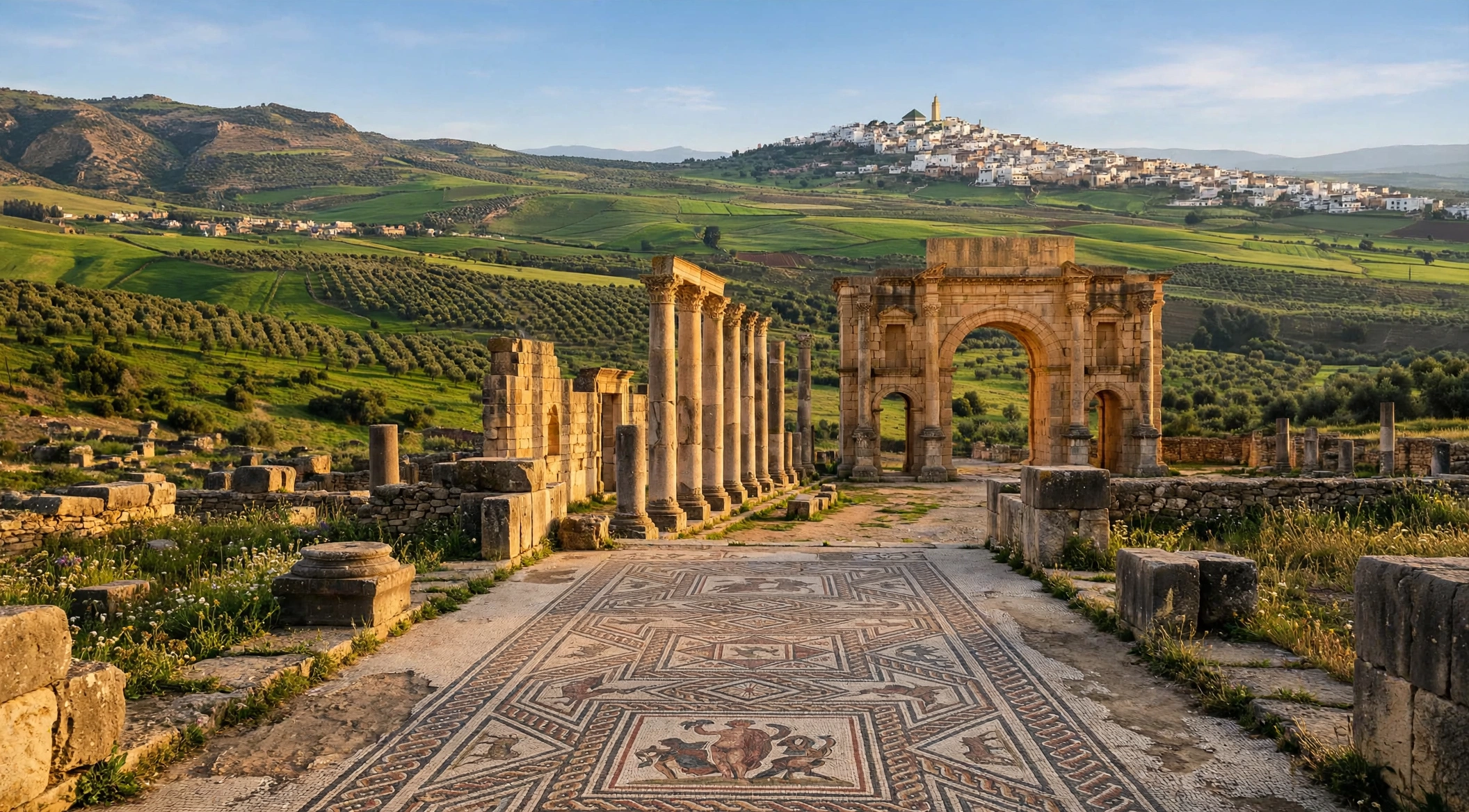
The town’s white houses tumble down two hills, and its green-tiled mausoleum dominates the skyline. Non-Muslim visitors cannot enter the mausoleum, but the town is open to walk through, and the views back across the valley to Volubilis are superb. Small cafés make it the natural place for lunch after the ruins. The pairing is poetic: the Roman city on one hill, the holy town on the next, and between them more than a thousand years of Moroccan history. If you have a full day, add Meknes — the imperial city whose walls and gates were built, in part, with stone taken from Volubilis. The story of the Imperial Cities of Morocco continues that thread, from Roman ruins to the great capitals of Fes, Meknes, Marrakech and Rabat.
Frequently Asked Questions
How long do I need at Volubilis?
Plan two to three hours. Two covers the forum, basilica, triumphal arch and the main mosaic houses at a comfortable pace. Three lets you linger, hire a guide, and walk the full site including the western quarters and the views.
Can I visit Volubilis as a day trip from Fes?
Yes — it is one of the best day trips from Fes. The drive is about 1 hour 15 minutes each way, and most tours combine Volubilis with Moulay Idriss Zerhoun and Meknes for a full, rewarding day. A private driver gives you the most flexibility over timing.
Are the mosaics original, and are they really still in place?
Yes. The famous mosaics are original Roman floors, still in situ in the houses where they were laid. They survived because they were buried under rubble after the city declined, while the marble and carved stone above ground was later removed — much of it to build Meknes. Some smaller finds are in museums, but the great floors remain where they were made.
What is the entry fee for Volubilis?
Sources differ, and the honest range for foreign adults is roughly 70–100 MAD (about $7–10 USD), checked November 2026. Moroccan residents pay a lower local rate. Confirm the exact price at the gate, and bring cash in dirhams — card payment is not always available.
Is Volubilis worth visiting if I have already seen Roman ruins elsewhere?
Yes — precisely because it is different. Volubilis is not a grand imperial showpiece like Rome or Baalbek. It is a provincial city with a Berber-Mauretanian past, extraordinary mosaics still in their original houses, and a landscape setting — green hills, olive groves, a holy town on the next ridge — that no other Roman site in North Africa can match.
Conclusion
Volubilis rewards the visitor who arrives knowing what it really was: a Berber-Mauretanian royal city before it was Roman, a wealthy olive-oil town under Juba II and his successors, then a flourishing provincial capital where local families became Roman citizens and did business in a basilica that still stands open to the sky.
Its end was slow and unrecorded in any single date, and the honest history says so. The city faded, its marble was carried off to Meknes, and its floors slept under the earth until archaeologists uncovered them. What survives is more intimate than a monument: a city you can walk through, house by house, and imagine as a living place. That is why this volubilis roman morocco guide ends with simple advice. Go early, go slowly, look down at the mosaics and up at the hills, and then walk over to Moulay Idriss Zerhoun for lunch. You will have spent a morning in two thousand years of Moroccan history — and you will understand, better than any textbook, how Morocco’s story began long before Rome and continued long after it left.