Introduction
If you are wondering about tipping in Morocco, the short answer is this: yes, small tips are expected almost everywhere, but the amounts are modest and the rules are relaxed. A few dirhams on a cafe table, a 10-dirham note for a porter, or rounding up a taxi fare covers most situations you will meet. Nobody expects the 15 to 20 percent that is standard in the United States, and nobody will chase you down the street for tipping too little.
This guide explains tipping in Morocco in plain terms: who to tip, how much to give in dirhams, and when to keep your wallet closed. All prices are in Moroccan dirhams (MAD) with US dollar equivalents, checked and verified in November 2026 at roughly 10 MAD to $1. The amounts below reflect real tipping in Morocco in 2026, not the inflated figures some guidebooks still quote from a decade ago.
Before you travel, it helps to understand the money itself. Read our Morocco money and dirham guide so you know which notes and coins to carry, because tipping in Morocco runs on small change. A 200-dirham note is useless for a 5-dirham tip. Carry 5, 10 and 20-dirham notes and a pocket of coins, and tipping becomes effortless.
Why Tipping in Morocco Works Differently
Tipping in Morocco is a social habit rather than a formal rule. There is no service charge added to most bills, and no law that requires you to tip. What exists instead is a widespread expectation that a satisfied customer leaves something small for the person who served them. Wages in cafes, restaurants and hotels are often low, and tips form a real part of many workers’ income — a 10-dirham tip means far more here than in London or New York.
Tipping in Morocco is also how a large informal economy works. The man who watches your car, the boy who points you toward the right alley, the attendant who hands you a towel — many earn most of their income from tips rather than a salary. That does not mean you must pay everyone who approaches you — carry small notes, decide in advance what a service is worth, and tip calmly.
Context matters too. In a smart restaurant in Casablanca, a 10 percent tip is normal. In a neighbourhood cafe in Fes where mint tea costs 8 dirhams, 2 dirhams is generous. The amounts in this guide are calibrated to the setting. Our cost of living in Morocco guide puts these sums in context.
Restaurants and Cafes
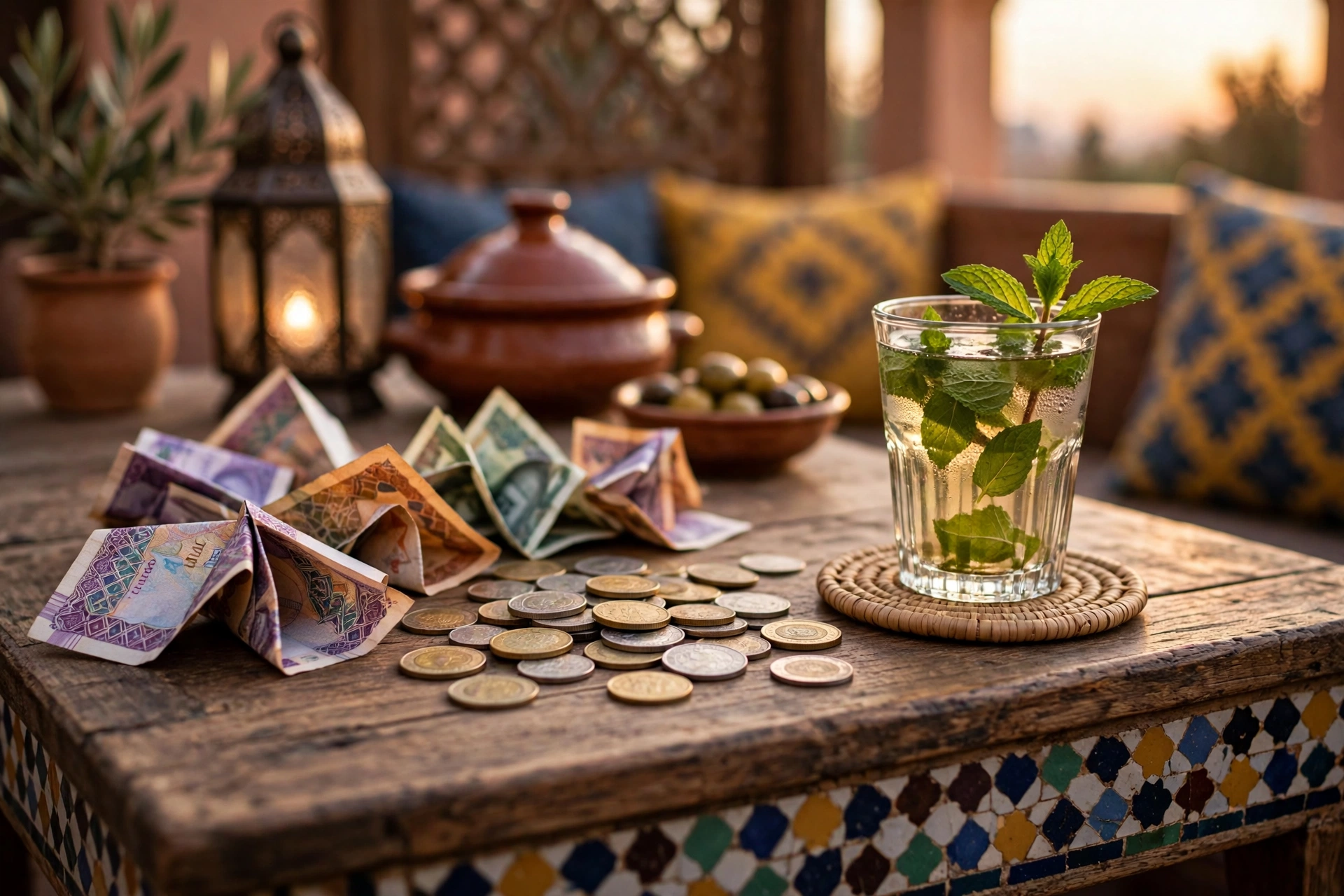
Restaurants are where most visitors tip first, and the rule is simple. When tipping in Morocco restaurants, leave 5 to 10 percent of the bill, or 10 to 20 MAD ($1–$2) on a typical meal for two. With a bill of 300 MAD or more, 10 percent — around 30 MAD ($3) — is right. Rounding up to a convenient note is how Moroccans do it.
Check the bill before you tip. Some upmarket and hotel restaurants print a service charge of 5 to 10 percent on the bill. If one is already there, add only a few dirhams for good service. Most small restaurants, cafes and street food stalls add nothing, so the tip is entirely up to you.
Cafes are even simpler. For a coffee or mint tea costing 8 to 15 MAD, round up to the next 5 or 10 dirhams, or leave 2 to 5 MAD ($0.20–$0.50) on the table. Nobody expects a percentage on a 10-dirham tea.
Regulars often leave the coins from their change, and cafe staff are happy with that.
At a street food stall or a market eatery, tipping is optional. If someone brings food to your table or finds you a seat in a crowded square, 5 MAD is a friendly thank you. If you order at a counter and carry your own plate, no tip is expected at all. See our Moroccan food guide for real dish prices across the country.
Hotels
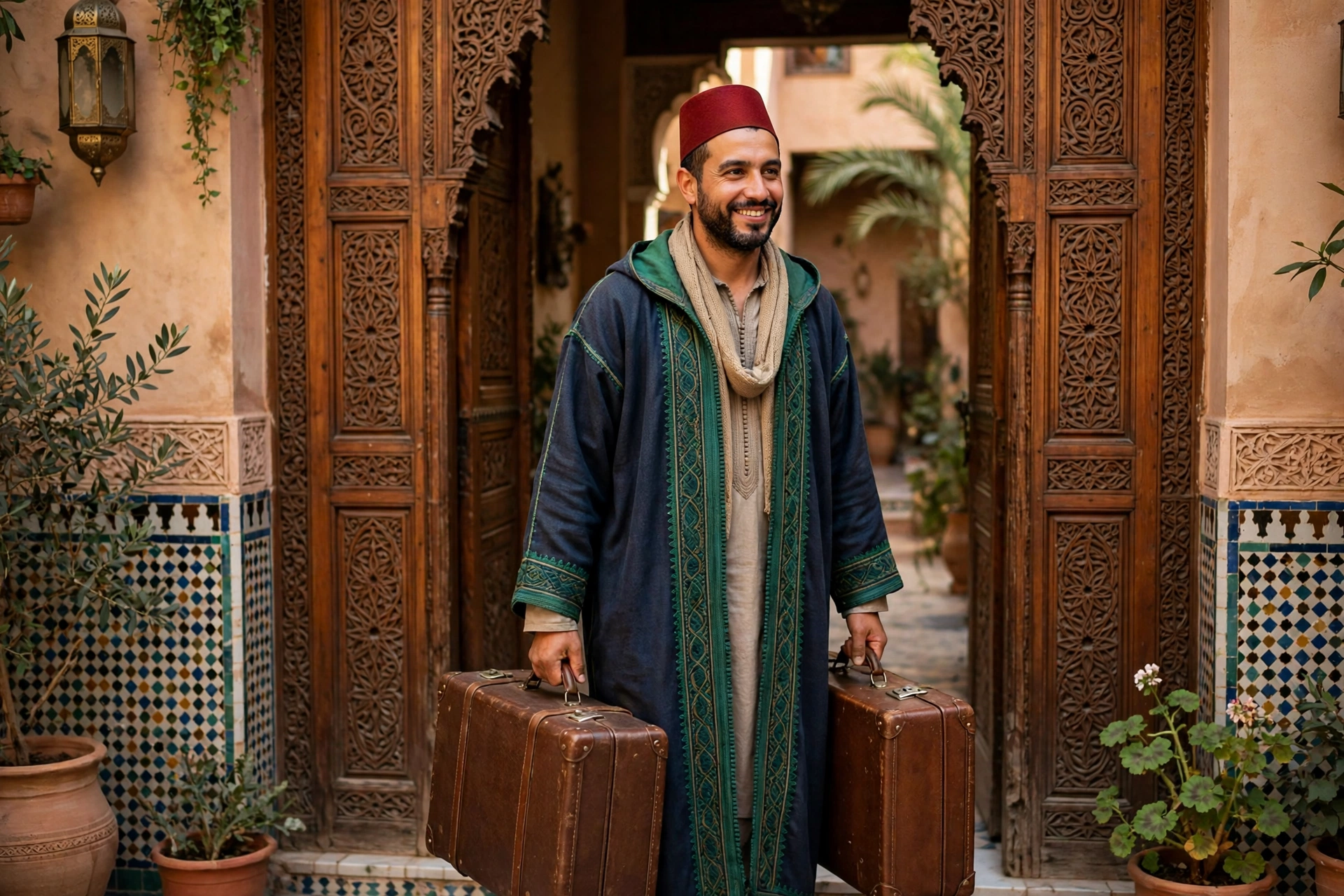
Tipping in Morocco hotels follows a clear pattern, and the amounts are small. Give the porter 10 to 20 MAD ($1–$2) per bag when your luggage is carried to your room. If you have two heavy bags, 20 MAD total is fine — you do not need to tip per bag twice over. Hand the money directly to the porter with a smile and a thank you.
Housekeeping deserves 10 to 20 MAD ($1–$2) per night, left on the bed or the bedside table each morning rather than in one lump at the end of your stay. Tip daily, because different staff may clean your room on different days.
At reception, no tip is expected for checking in. The concierge is different: if they book a table, arrange a driver, or solve a real problem, 20 to 50 MAD ($2–$5) is appropriate. If you are staying somewhere upmarket, our guide to how much a trip to Morocco costs includes hotel price ranges alongside these small daily extras.
Taxis and Private Drivers
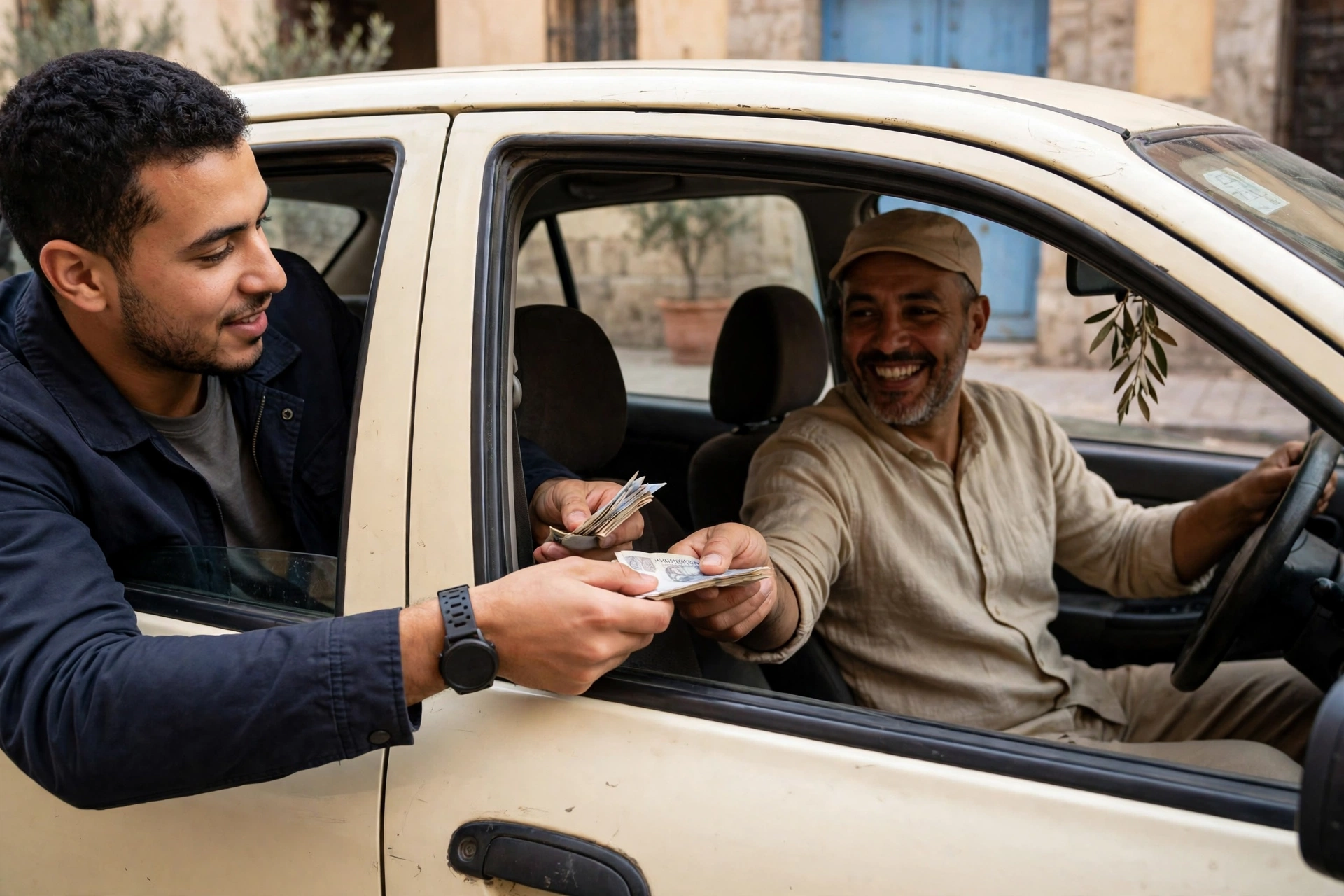
Taxis are the most common tipping situation in Morocco, and the rule is the easiest of all: round up. Tipping in Morocco taxis means a ride that meters at 13 MAD becomes 15 MAD, and a 22-dirham ride becomes 25. That rounding up of 2 to 5 MAD is the tip, and drivers expect it. If the driver helps with heavy bags, add 5 to 10 MAD ($0.50–$1).
Grand taxis between towns work the same way. Agree the fare before you set off, or confirm the meter is running, and then round up at the end. For a longer ride of 100 MAD or more, rounding up to the next 10 dirhams is enough. Have small notes ready, because a driver who must break a 200-dirham note at the start of the day will not be pleased.
A private driver hired for a full day is a different case. For a day of driving between cities, through the Atlas Mountains or out to the desert, tip 100 to 200 MAD ($10–$20) for the day, depending on its length and how helpful the driver was. A driver who doubles as an informal guide has earned the upper end. Give the tip at the end of the day, directly and with a thank you.
Guides and Day Tours
When tipping in Morocco guides on a day tour, 100 to 200 MAD ($10–$20) per person is standard for a full day, with the higher amount for a private guide who shaped the whole day around you. On a half-day walking tour of a medina, 50 to 100 MAD ($5–$10) per person is right. Tour companies rarely include a tip, so assume it is not.
Group tours are simpler. If ten people share a guide for a day, each person tipping 50 to 100 MAD adds up to a generous total without anyone overspending. Guiding is seasonal work, and a good tip at the end of a long hot day is genuinely appreciated.
Two warnings matter here. First, only tip a guide you actually hired. In the medinas of Fes and Marrakech, unofficial “guides” will attach themselves to you and then demand payment. Politely decline before they start. Second, tip at the end, not the beginning — a tip given upfront pays for a service you have not yet received.
Hammams, Porters and Everyday Services
Tipping in Morocco hammams is one of the most confusing situations for first-time visitors, so here is the clear version. At a public hammam, the attendant who scrubs you — the kessala — should be tipped 20 to 50 MAD ($2–$5) on top of the entry and scrub price: 20 MAD at a simple neighbourhood hammam, 50 MAD at a fancier one.
The person who hands you towels gets 5 to 10 MAD. At a hotel spa hammam, the same 20 to 50 MAD applies, or 20 MAD if a service charge is already on the bill.
Porters at train stations and bus stations expect 10 to 20 MAD ($1–$2) per bag, the same as hotel porters. Agree the amount before they pick up your bags, not after. A firm, friendly “10 dirhams, OK?” before you hand over the bag prevents all argument.
Everyday services follow the same small-change logic. A petrol station attendant who fills your tank gets 5 to 10 MAD. A parking attendant — the famous gardien de voitures in his yellow vest — gets 2 to 5 MAD when you return to your car. A shoe shiner gets 5 to 10 MAD. In each case the amounts are tiny, but they are the person’s livelihood.
When NOT to Tip
The rules for tipping in Morocco include clear cases where you should not tip at all. Do not tip anyone who demands money for a service you did not ask for. The classic example is the self-appointed guide in the medina, or someone who points at a parking space you were already driving into and then holds out a hand. A polite “no, thank you” and walking on is the correct response. Paying once teaches them the approach works.
Do not tip for bad service. A rude waiter, a taxi driver who refuses the meter and triples the price, or a guide who rushes you through a site in twenty minutes has not earned a tip. A tip is a thank you for good service, not a tax on being a tourist.
Do not tip in shops. Shopkeepers do not expect tips, and offering one can be awkward. If you enjoy haggling, read our haggling in Morocco guide first, then agree a fair price and pay it happily.
Do not tip government officials, police officers, or anyone in an official uniform either. That is not tipping — it is a bribe, and it is both illegal and insulting. Finally, do not tip at a mosque, a museum ticket desk, or a train station ticket window — fixed-price, official services where no tip is wanted.
Tipping Etiquette and Practical Rules
The etiquette around tipping in Morocco is simple once you know it. Always tip in cash, in dirhams, and hand the money directly to the person with your right hand or both hands. The left hand is traditionally considered impolite for giving money in Morocco, so use the right one — it costs nothing and is noticed. A short “shukran” — thank you — alongside the tip matters as much as the money.
Keep your tipping money separate from your spending money. A small pocket or a section of your wallet with 5, 10 and 20-dirham notes and coins means you never have to unfold a 200-dirham note in front of a porter.
Get small change early: break large notes at a hotel reception, a supermarket, or a bank. ATMs dispense large notes, so make breaking them a habit on your first day. Small notes and coins are the currency of tipping in Morocco, so treat them as essential packing, not an afterthought.
Tipping is a private act, not a performance. Do not make a show of generosity or tip more than this guide suggests — over-tipping can raise prices for the next traveller. If you are unsure, ask your hotel receptionist what is normal. Moroccans are proud of their hospitality and will tell you honestly.
The table below is the quick reference for tipping in Morocco. Remember the pattern: 5 to 10 dirhams for small services, 10 to 20 for hotel staff and porters, 100 to 200 for a full day of guiding or driving.
| Situation | Who you tip | Typical tip (MAD) | USD equivalent |
|---|---|---|---|
| Restaurant meal | Waiter | 5–10% of the bill, or 10–20 MAD | $1–$2 |
| Cafe coffee or mint tea | Server | Round up, or 2–5 MAD | $0.20–$0.50 |
| Hotel porter | Porter | 10–20 MAD per bag | $1–$2 |
| Housekeeping | Room attendant | 10–20 MAD per night | $1–$2 |
| Petit taxi ride | Driver | Round up, or 5–10 MAD | $0.50–$1 |
| Private driver, full day | Driver | 100–200 MAD per day | $10–$20 |
| Tour guide, full day | Guide | 100–200 MAD per day | $10–$20 |
| Hammam scrub | Attendant (kessala) | 20–50 MAD | $2–$5 |
| Petrol station | Attendant | 5–10 MAD | $0.50–$1 |
| Parking attendant | Gardien de voitures | 2–5 MAD | $0.20–$0.50 |
All amounts were verified in November 2026 at roughly 10 MAD to $1. See the Moroccan National Tourist Office and the UK government’s travel advice for Morocco for official guidance.
FAQ
Is tipping in Morocco expected everywhere?
Almost everywhere, but not in every situation. Tipping in Morocco is expected in restaurants, cafes, hotels, taxis and for guides. Not in shops, ticket windows, or for officials. The rule of thumb is simple: if someone served you personally, tip a little; if you bought something at a fixed price from a counter, do not.
Do I tip in dirhams or can I tip in euros or dollars?
Always tip in dirhams. Foreign coins are useless in Morocco — banks do not exchange them — and foreign notes force the recipient to find an exchange office. If you arrive without dirhams, withdraw cash at the airport ATM and break a large note at your hotel before you go out.
How much should I tip at a restaurant in Morocco?
At a mid-range restaurant, 5 to 10 percent, or 10 to 20 MAD ($1–$2). At a smart restaurant, 10 percent. At a cafe, round up or leave 2 to 5 MAD. If a service charge is already on the bill, add only a few dirhams.
Should I tip my tour guide and driver separately?
Yes, tip them separately. The guide and the driver are usually different people with different employers, and a tip given to one does not reach the other. On a day tour, 100 to 200 MAD ($10–$20) each is standard, given directly to each person at the end of the day.
What if someone demands a tip I did not agree to?
Stay calm and polite, but do not pay for a service you never asked for. Say “no, thank you” and walk on. This happens most often with unofficial guides in the medinas. Paying once encourages the same demand tomorrow.
Is it rude not to tip in Morocco?
Not tipping at all in a restaurant or hotel would be noticed, because tips are part of how staff are paid. But nobody expects large tips, and a small, consistent tip beats an occasional large one. If service was genuinely bad, withholding a tip is acceptable.
Conclusion
Tipping in Morocco is easy once you learn the pattern: small amounts, given in cash, directly to the person who helped you. Five dirhams at a cafe, ten for a porter, a hundred for a guide who gave you a full day — these are the numbers that will carry you through the country without fuss and without overspending. Carrying small notes and coins makes a tip a quick, relaxed gesture rather than a search through your wallet.
Travel well, tip fairly, and remember that tipping in Morocco is a thank you, not a transaction. A smile and a “shukran” alongside a few dirhams will be remembered far longer than the money itself.