
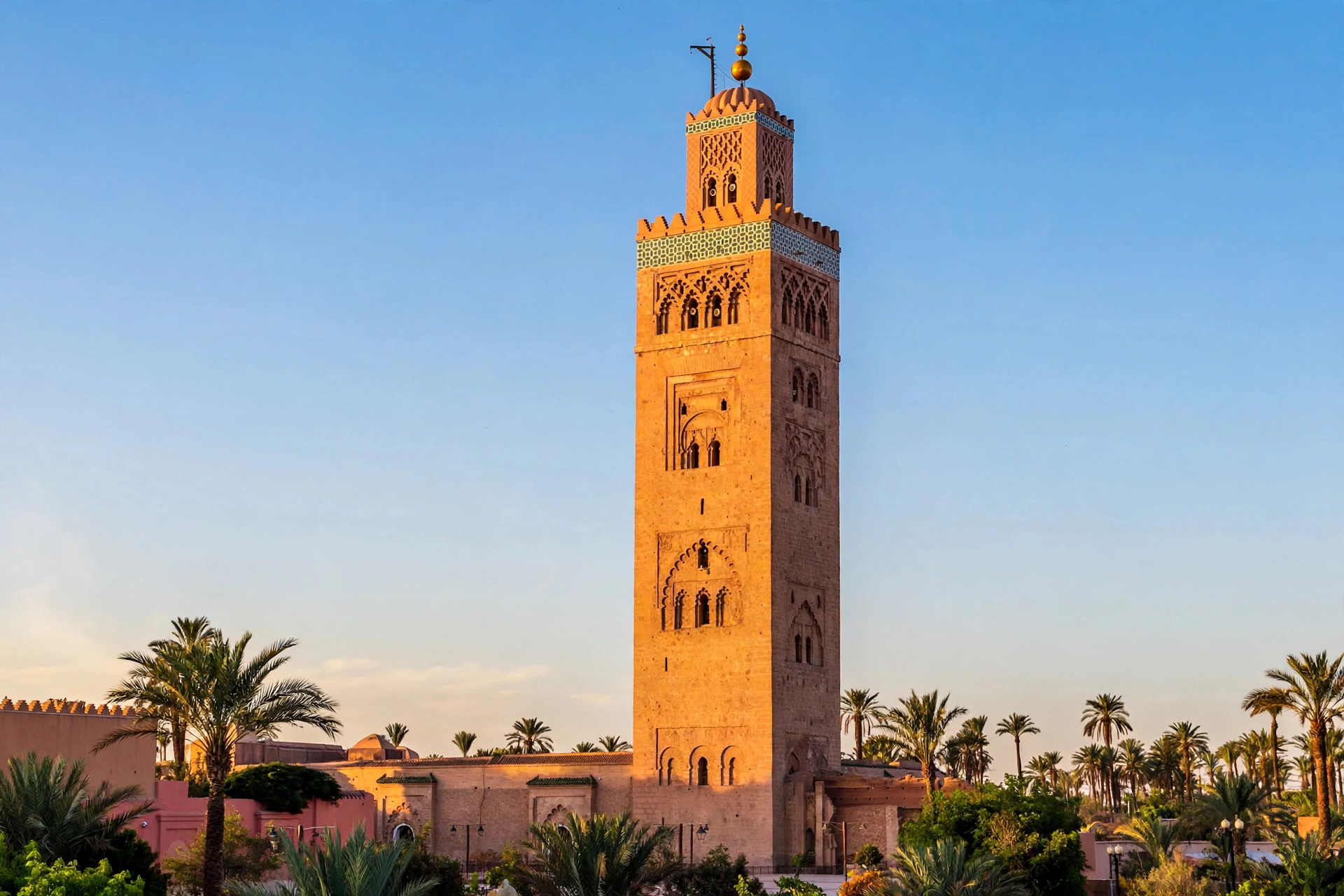
Stand in Jemaa el-Fnaa at dusk and look up at the Koutoubia minaret, and you are looking at the signature of the almohad dynasty morocco, a dynasty that ruled from the Atlantic to Tripoli and from the Atlas to Seville, yet remains the most misunderstood chapter of Moroccan history. This guide tells the story properly: a mountain preacher, a brilliant general, a golden age of learning and building, a famous victory in Spain, and a slow fall that still shapes the Morocco you visit today.
For Moroccans, the Almohads are not a distant chapter in a textbook. Their minarets still mark our skylines, and their story is the bridge between the desert warriors who founded Marrakech and the scholars of Fes who followed them. Episode 17 of our Kings of Morocco YouTube channel tells the life of Yaqub al-Mansur, their greatest sultan, and this article is its written companion: the full story, the places you can still visit, and the dates historians still argue about. The almohad dynasty morocco built an empire on faith, discipline and stone, and understanding it changes how you see every old city in the country.
In this guide:
- Who Were the Almohads? Reformers from the Atlas
- Ibn Tumart: The Preacher from the Mountains
- Abd al-Mu’min: The General Who Built an Empire
- The Almohad Dynasty Morocco Built Across Two Continents
- The Battle of Alarcos (1195): Triumph and Turning Point
- Almohad Architecture: The Koutoubia, the Giralda and the Tower That Was Never Finished
- Decline After Las Navas de Tolosa (1212)
- Where to See the Almohads Today: Sites, Prices and Practical Tips
- Why the Almohads Still Matter
- Frequently Asked Questions
Who Were the Almohads? Reformers from the Atlas
The Almohads began in the High Atlas mountains, among the Masmuda Berber tribes, and their very name tells you what they stood for. In Arabic they were al-Muwahhidun, “those who profess the unity of God”, and their movement was a call to return to a strict, pure faith. The Almohads were mountain people, not desert nomads, and they believed the Almoravid rulers of Marrakech had grown soft and corrupt. The almohad dynasty morocco remembers today was therefore born as a religious reform before it became a political empire.
The timing matters. By the early 1100s the Almoravid empire was already fraying. Its rulers had grown rich on Saharan gold and Andalusi taxes, its armies were stretched across two continents, and its austere desert faith had softened into court life. A young scholar returning from years of study in the east looked at this and saw decay, not glory, and the almohad dynasty morocco was its direct answer: a mountain revolt against an empire that had forgotten its own beginnings.
They built a hierarchy of councils, a system of ranks, a shared doctrine taught to every follower, and a capital in the mountains at Tinmel, far from the cities they meant to conquer. The almohad dynasty morocco built from that mountain base lasted more than a century, and its imprint outlived its fall by centuries. Read our brief history of Morocco for the wider sweep.
Ibn Tumart: The Preacher from the Mountains
Muhammad ibn Tumart was born in the Sous valley, in the village of Igli in the Anti-Atlas, and he spent his youth travelling to the great centres of learning in the east before returning to Morocco around 1117. He preached with a bluntness that made enemies everywhere he went. In the markets and mosques he denounced what he saw as corruption, luxury and loose practice, and he gathered followers among the Masmuda tribes of the High Atlas.
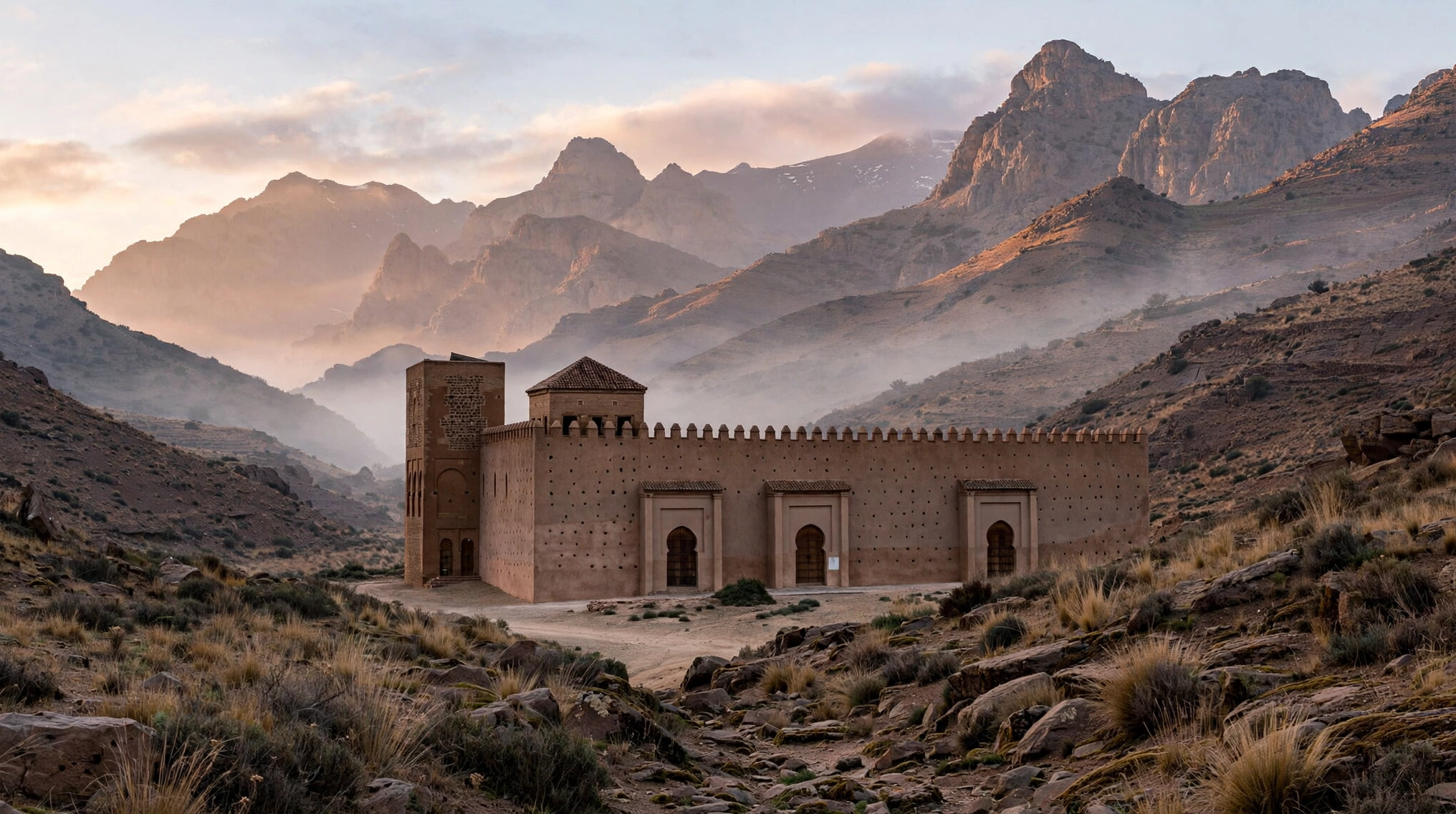
At Tinmel, in a remote valley south of Marrakech, Ibn Tumart built the movement’s headquarters: a mosque, a school and a fortified community where his followers lived under strict discipline. Around 1121 he took the extraordinary step of proclaiming himself the Mahdi, the guided one awaited at the end of time, and from that moment his followers owed him absolute obedience. It bound the tribes together and turned a reform movement into a holy cause. His disciples, who would build the almohad dynasty morocco, organised into councils of ten and fifty and spread his doctrine through the Atlas villages.
Ibn Tumart died in 1130, leading the siege of Marrakech, and here honesty matters: the year of his death is debated, and historians have not settled the question. What is certain is that his death could have ended the movement, and instead it made it. His closest disciple kept the death secret for three years while the movement regrouped, and the almohad dynasty morocco inherited from Ibn Tumart was carried forward by a man of a very different kind: not a preacher, but a soldier and statesman.
Abd al-Mu’min: The General Who Built an Empire
Abd al-Mu’min ibn Ali was a Zanata Berber from Tlemcen, in what is now Algeria, and he had joined Ibn Tumart as a young student before becoming his most trusted commander. He was patient, pragmatic, and a brilliant organiser of armies and administrations. After the Mahdi’s death he took command, consolidated the mountain tribes, and spent seventeen years grinding down the Almoravid state, city by city. The almohad dynasty morocco became a real empire under his hand, because he turned a holy revolt into a state that could tax, build and govern.
His birth year is uncertain, usually given as around 1094, but the exact year remains unsettled. What the records do agree on is the scale of his achievement. In 1147, after a long siege, his armies took Marrakech, the Almoravid capital, and made it their own. The date is generally given as 1147, though the exact sequence of the siege remains a matter of scholarly discussion. From Marrakech he moved east and west at once, taking Fes, then Tlemcen, then Algiers, Tunis and Tripoli, until the Almohads ruled all of North Africa from the Atlantic to Libya.
Abd al-Mu’min ruled as caliph, the first Moroccan ruler to claim that title, and he built the machinery of empire to match: a standing army, a civil service, a coinage, and a capital rebuilt in his own image. He began the Koutoubia mosque in Marrakech and laid out the Kasbah of the Udayas in Rabat. When he died in 1163, the almohad dynasty morocco had passed from a mountain sect to the greatest power in the western Mediterranean, and his son Abu Yaqub Yusuf inherited an empire, not a revolt.
The Almohad Dynasty Morocco Built Across Two Continents
At its height, under Abd al-Mu’min and his successors, the almohad dynasty morocco stretched from the Atlantic coast of Morocco to Tripoli in Libya, and across the Strait of Gibraltar deep into Spain, covering the whole of al-Andalus south of Toledo.
The empire’s wealth came from trade, and its cities show it. Seville became the Almohad capital in Spain, a great port and centre of learning. Fes, taken early and held firmly, remained the city of scholars of the almohad dynasty morocco.
For ordinary people, life under the almohad dynasty morocco meant something simpler: security on the roads, a single coinage, and a state strong enough to keep the peace across an enormous territory. Trade paid for the minarets and mosques that still stand. Our guide to the imperial cities of Morocco explains how each great city still carries the stamp of the dynasty that made it, and for Marrakech and Rabat that stamp is Almohad.
The Battle of Alarcos (1195): Triumph and Turning Point
Yaqub al-Mansur was the greatest of the Almohad sultans, and his name, “the victorious”, was earned on a single day. On 19 July 1195, at Alarcos in central Spain, his army met the forces of Alfonso VIII of Castile, and the result was a crushing Almohad victory. Alfonso’s army was destroyed and the Christian advance into Muslim Spain was halted for a generation. The date is firm: 19 July 1195 is one of the best-attested dates in the whole period, and the almohad dynasty morocco reached its peak of power and prestige on that battlefield.
Al-Mansur was not only a soldier. After Alarcos he returned to Morocco and built with the same energy he had shown in war. He completed the Koutoubia minaret, founded the great Hassan Mosque in Rabat, and built up the Kasbah of the Udayas. He also patronised scholars, and the court of the almohad dynasty morocco under al-Mansur was one of the most learned in the Mediterranean. Our Kings of Morocco channel devotes Episode 17 to him.
Yet Alarcos also marks the beginning of the end, and that is the honest paradox of the story. The victory bred complacency, and the Christian kingdoms spent seventeen years preparing their answer. The almohad dynasty morocco would never again field an army like the one al-Mansur led at Alarcos. When al-Mansur died in 1199, he left his son Muhammad al-Nasir an empire at its widest extent and a coalition of enemies determined to destroy it.
Almohad Architecture: The Koutoubia, the Giralda and the Tower That Was Never Finished
Here is the correction every visitor to Marrakech needs to hear, because almost everyone gets it wrong: the Koutoubia minaret is not Almoravid. It is Almohad. The Almoravids founded the city, but the tower that defines its skyline was begun by Abd al-Mu’min and completed under Yaqub al-Mansur, and it became the model for Moroccan minarets ever since. The almohad dynasty morocco invented a style, square minarets with restrained geometry, that you can recognise at a glance once you know what to look for.
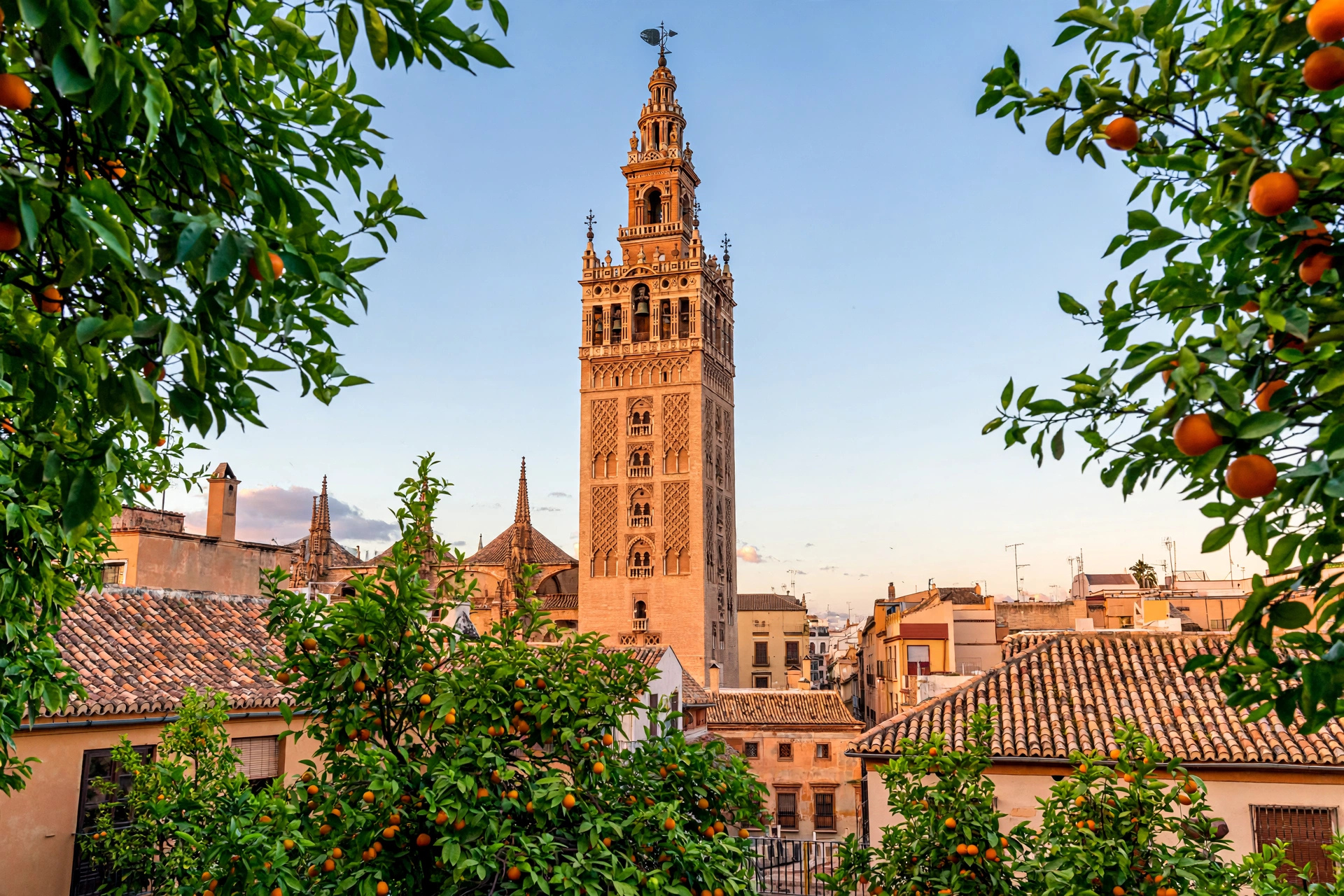
The style of the almohad dynasty morocco crossed into Spain, and its most famous survivor stands in Seville. The Giralda, the great bell tower of Seville cathedral, began life as the minaret of the Almohad great mosque, built under Yaqub al-Mansur at the end of the twelfth century. After the Christian conquest of Seville in 1248 the tower was kept, a Renaissance belfry added on top, but its brickwork and ramped interior, wide enough for a rider on horseback, are Almohad through and through. The Koutoubia and the Giralda are sister towers, and the UNESCO-listed Medina of Marrakech is best understood with that connection in mind.
The third great Almohad tower was never finished, and its ruin is the most moving of all. In Rabat, Yaqub al-Mansur began a mosque with a minaret meant to be the tallest in the world, but he died in 1199 and the work stopped. The Hassan Tower stands today at 44 metres, half its intended height. The exact year the Koutoubia minaret was completed is also disputed, with some sources giving 1195 and others a few years later. The almohad dynasty morocco left its ambitions written in stone, finished and unfinished alike.
Decline After Las Navas de Tolosa (1212)
The answer to Alarcos came on 16 July 1212, at Las Navas de Tolosa in the hills of southern Spain, where a united Christian army under Alfonso VIII destroyed the Almohad host of Muhammad al-Nasir. The sultan fled, his army scattered, and within a generation the Almohads had lost almost all of Spain. The almohad dynasty morocco never recovered its confidence or its armies, and the empire began to break apart: rival princes, restless tribes, and governors declaring independence.
The fall in Morocco was slower but just as certain. The Marinids, a Zanata Berber confederation from the eastern plains, rose in the north and took Fes in 1244, then Meknes, and finally Marrakech itself in 1269, ending the almohad dynasty morocco. Our guide to the Marinids and their madrasas in Fes picks up the story where the Almohads leave it: the Marinids built schools, the Almohads built minarets. The last Almohad rulers held on around Tinmel for a few more years, but the empire was over.
Where to See the Almohads Today: Sites, Prices and Practical Tips
The best way to understand the Almohads is to stand where they stood, and their greatest monuments are also the most visited places in Morocco. Start in Marrakech at the Koutoubia, which you can admire from the gardens and the square at any hour, then walk to Bab Agnaou, the Almohad gate that once guarded the kasbah, with its carved stonework still sharp after eight centuries. The almohad dynasty morocco rewards the patient visitor: the details are in the geometry of the stonework and the light on the towers at dusk.
Rabat is the second stop, where the Almohads are most visible as city-builders. The Hassan Tower and the Kasbah of the Udayas were both their work, and the old medina walls follow their plan. Tinmel is the third stop, the hardest to reach on mountain roads, but the most rewarding: a remote mosque in a mountain valley, where the movement began. Our guide to the Idrisids and the founding of Fes shows where the story of Moroccan dynasties began.
| Almohad site | Where | What to see | Entry fee |
|---|---|---|---|
| Koutoubia Mosque and minaret | Marrakech | Exterior, gardens and square; mosque closed to non-Muslims | Free |
| Bab Agnaou | Marrakech | Carved Almohad ceremonial gate of the kasbah | Free (street view) |
| Tinmel Mosque | High Atlas, near Ijoukak | Birthplace mosque of the movement, mountain setting | Free (donations welcome) |
| Hassan Tower | Rabat | Unfinished Almohad minaret and mosque columns | Free |
| Kasbah of the Udayas | Rabat | Almohad fortress, gardens and sea views | Free; Andalusian Gardens 10 MAD (about $1) |
| The Giralda | Seville, Spain | Almohad minaret, now the cathedral bell tower | About €12 (about 130 MAD / $13) |
Prices checked November 2026. Moroccan prices are in dirhams (MAD); about 10 MAD is roughly $1.
Why the Almohads Still Matter
The Almohads matter because they made Morocco a single idea. Before them the country was a patchwork of tribes and cities; after them it was an empire with a capital, a coinage and a skyline. Their story, from a mountain preacher to an empire and back to the mountains, is the most dramatic in our history. The almohad dynasty morocco is not a footnote between the Almoravids and the Marinids: it is the chapter that turned Morocco into an empire, and once you have seen its towers, you will never look at this country the same way.
Frequently Asked Questions
Who were the Almohads?
The Almohads were a Berber religious and political movement from the High Atlas mountains who founded a dynasty and an empire in the twelfth and thirteenth centuries. They began as reformers under Ibn Tumart, conquered North Africa under Abd al-Mu’min, and at their height ruled from the Atlantic to Libya and into Spain.
What is the difference between the Almoravids and the Almohads?
The Almoravids came first: desert nomads from the Sahara who founded Marrakech around 1070 and ruled until 1147. The Almohads were mountain Berbers from the High Atlas who overthrew them, took Marrakech in 1147, and ruled until 1269. The two are often confused because their names sound similar, but they were rivals, not relatives, and the Koutoubia minaret, so often credited to the Almoravids, is Almohad.
When was the Battle of Alarcos?
The Battle of Alarcos was fought on 19 July 1195, near Alarcos in central Spain. The Almohad sultan Yaqub al-Mansur defeated the army of Alfonso VIII of Castile so completely that the king barely escaped, and the victory earned al-Mansur his title, “the victorious”. It was the high point of Almohad power, and halted the Christian advance into Muslim Spain for a generation.
Can you visit Tinmel Mosque today?
Yes. Tinmel Mosque stands in a remote valley of the High Atlas, about two hours south of Marrakech, and it is free to visit, though donations are welcome. The mountain road is best done with a local driver. The almohad dynasty morocco began here, in this quiet valley, and the mosque’s plain stone walls and mountain setting make it one of the most atmospheric historic sites in the country.
Is the Giralda in Seville really Almohad?
Yes. The Giralda began as the minaret of the Almohad great mosque of Seville, built under Yaqub al-Mansur at the end of the twelfth century. After the Christian conquest of Seville in 1248 it was kept and adapted, with a Renaissance belfry added on top, but its brickwork, arched windows and horse-ramp interior are Almohad. It is the sister tower of the Koutoubia in Marrakech.
What is the connection to the Kings of Morocco YouTube channel?
The Almohads are a central chapter of the Kings of Morocco series, and Episode 17 is devoted to Yaqub al-Mansur, their greatest sultan. This article is the written companion to that episode, with the full story and the sites you can visit. The almohad dynasty morocco is the bridge in the series between the Almoravids and the Marinids.