
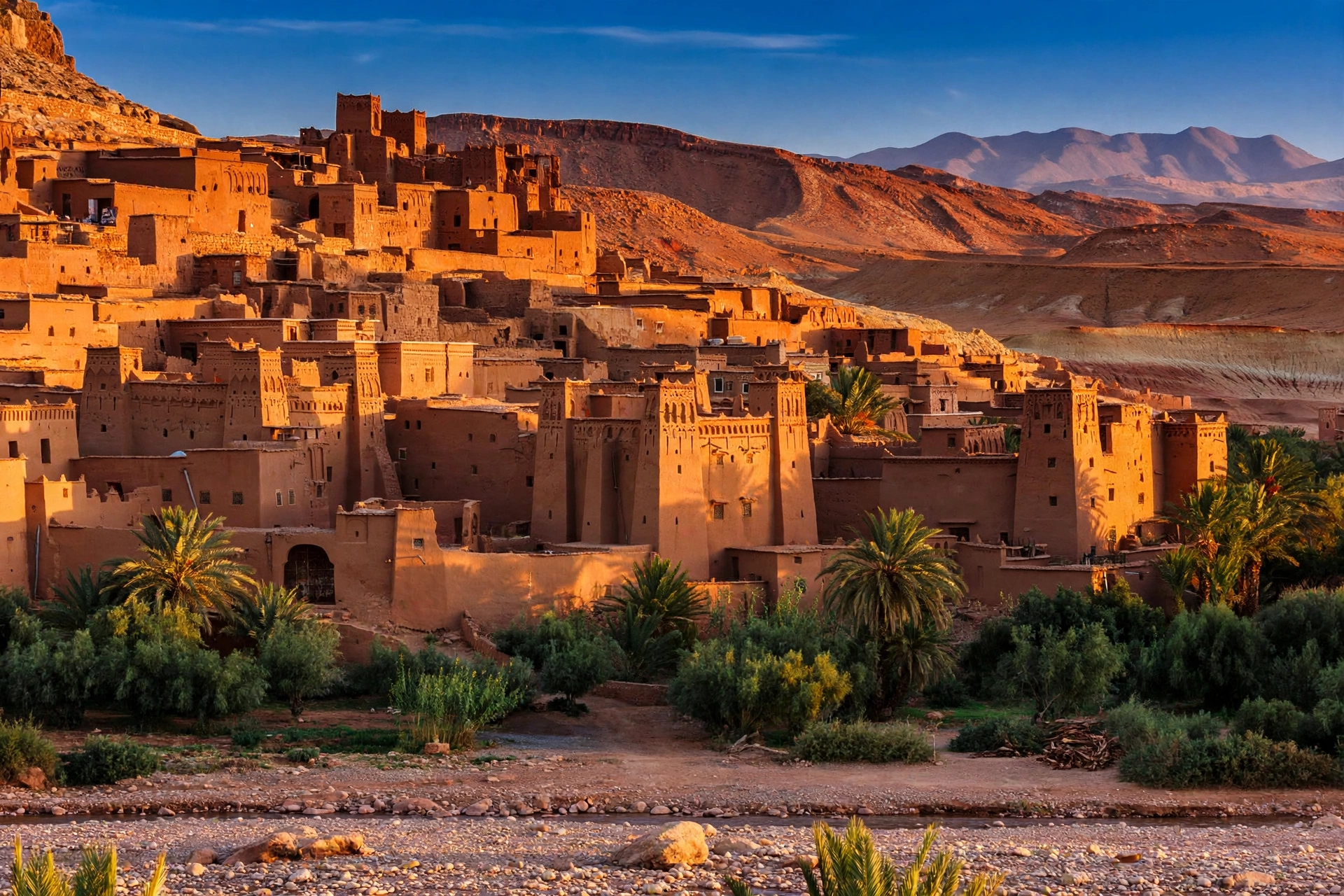
Stand on the far bank of the Ounila River at sunset, and the hill of Aït Ben Haddou glows red-gold against the sky. Towers, crenellated walls and narrow lanes climb the slope in a single mass of mud brick. This is the starting point of the morocco kasbahs ait ben haddou journey, a route through the fortified towns and palaces of southern Morocco that once guarded the caravan roads between Marrakech and the Sahara.
The kasbahs of the south are the architecture of the caravan dynasties: fortresses, granaries and family palaces built of earth, straw and palm wood, raised by the Amazigh communities of the Atlas valleys and the great caid families who controlled the trade in salt, gold and dates. Some are still lived in, others stand in ruins, and the morocco kasbahs ait ben haddou route links all five in a few days' drive. For the wider story, see our history of Morocco, browse the History & Heritage section, and read our Ouarzazate travel guide.
In this guide
- Morocco Kasbahs Ait Ben Haddou: Why These Fortresses Still Matter
- What Is a Kasbah? Earth, Straw and the Architecture of Defence
- Aït Ben Haddou: The Ksar That Became a Film Star
- Taourirt Kasbah: The Glaoui Palace of Ouarzazate
- Telouet: The Ruined Palace on the Road to Marrakech
- Tamnougalt and the Draa Valley: Kasbahs Along the River of Palms
- Amridil and Skoura: The Oasis Kasbah
- Morocco Kasbahs Ait Ben Haddou: Comparing the Great Kasbahs
- Morocco Kasbahs Ait Ben Haddou: A Three-Day Route from Marrakech
- Visiting Tips: Guides, Tickets and the Best Light
- Morocco Kasbahs Ait Ben Haddou FAQ
Morocco Kasbahs Ait Ben Haddou: Why These Fortresses Still Matter
For centuries, Morocco's wealth travelled by caravan. Gold and salt crossed the Sahara, dates and grain moved up the Draa Valley, and every load passed through the High Atlas to Marrakech. Whoever controlled the passes controlled the trade, and the families who did built kasbahs: fortified homes that were at once houses, granaries, watchtowers and statements of power.
That is why the morocco kasbahs ait ben haddou route matters beyond its beauty. These buildings are not decoration. They are the physical record of how southern Morocco was governed for hundreds of years, by local caids and Amazigh confederations as much as by the sultans. The Almoravids, the Almohads, the Saadians and the Alaouites all depended on the caravan roads, and the kasbahs were the architecture that made those roads work.
The route also matters because it is disappearing: mud brick melts in the rain, and a kasbah without a family to maintain it can crumble within a generation. UNESCO's inscription of Aït Ben Haddou in 1987, on the UNESCO page for the Ksar of Ait-Ben-Haddou, helped save one ksar. Many others survive only because travellers keep coming, and the money they bring gives families a reason to keep repairing the walls. Visiting the morocco kasbahs ait ben haddou route is, in a small way, part of keeping it alive.
What Is a Kasbah? Earth, Straw and the Architecture of Defence
The word kasbah is used loosely in Morocco. A kasbah is a fortified building, usually of rammed earth and mud brick, with high blank walls, corner towers and a single guarded entrance. A ksar is a whole fortified village of such buildings, like Aït Ben Haddou itself. A kasbah could be the home of one powerful family, the seat of a local caid, or a communal granary, and the largest combined all three.
The material is the message: builders mixed earth with straw and water, packed it into wooden frames, and let the sun bake it hard. The walls are thick at the base and taper as they rise, keeping interiors cool in summer and warm in winter, and decoration came from the same earth. Nothing was imported; everything came from the valley where the kasbah stood.
Aït Ben Haddou: The Ksar That Became a Film Star
Aït Ben Haddou is the most famous kasbah in Morocco. It stands about 30 kilometres north-west of Ouarzazate, on the old caravan road between Marrakech and the Sahara: not a single building but a fortified village, a cluster of kasbahs gathered inside a defensive wall on a hillside above the Ounila River. UNESCO inscribed it on the World Heritage List in 1987, and it remains the finest surviving southern Moroccan ksar.
Honesty requires a note about its age. The ksar is commonly said to date from the 17th century, and you will find that date in almost every guidebook. But the exact founding date of Aït Ben Haddou is not precisely documented: the buildings have been rebuilt and repaired so many times that no single foundation date can be fixed with confidence. What is certain is that the site guarded the caravan route for centuries, and its families grew rich on the passing trade.
From Caravan Stop to Film Set
The ksar's second life began with the cinema. Directors discovered that Aït Ben Haddou looked like the ancient world: Lawrence of Arabia was filmed here in 1962, followed by The Man Who Would Be King, Gladiator, Kingdom of Heaven, and, most recently, the slave city of Yunkai in Game of Thrones. Today the hilltop is still partly inhabited, though many families have moved to the newer village across the river, and several old houses inside the walls now serve as small museums or guest rooms.
Visiting Aït Ben Haddou
Cross the river by the stepping stones or the small footbridge, and climb slowly through the lanes to the granary at the top, where the view runs across the whole Ounila Valley. The ksar itself is free to wander. A local guide costs about 100 to 150 MAD (about $10 to $15) and is worth it: the guides know which houses are open, which towers to climb, and where the best views are. A few houses charge about 10 to 20 MAD (about $1 to $2) to enter. Go at golden hour, when the mud brick turns the colour of honey, and come back the next morning for the empty lanes — the morocco kasbahs ait ben haddou experience at its quietest. The Aït Benhaddou article on Wikipedia has more on the ksar's film history.
Taourirt Kasbah: The Glaoui Palace of Ouarzazate
If Aït Ben Haddou is a village, Taourirt is a palace. It stands at the edge of Ouarzazate, the desert town that grew up around the French garrison in the 1920s, and it was the seat of the Glaoui, the most powerful caid family of the south. The kasbah was built and greatly expanded in the 19th and early 20th centuries, when Thami el-Glaoui, the Pasha of Marrakech, controlled the southern caravan routes and collected their tolls.
Taourirt is the largest kasbah in Morocco, a maze of more than 300 rooms around courtyards, with painted ceilings, carved plaster and reception halls that show how the Glaoui wanted to be seen. Some of the finest rooms have been restored, and walking through them gives the clearest picture anywhere of how a great southern caid lived: ornate private apartments above, storerooms and kitchens below, and roof terraces looking across the town to the Atlas foothills.
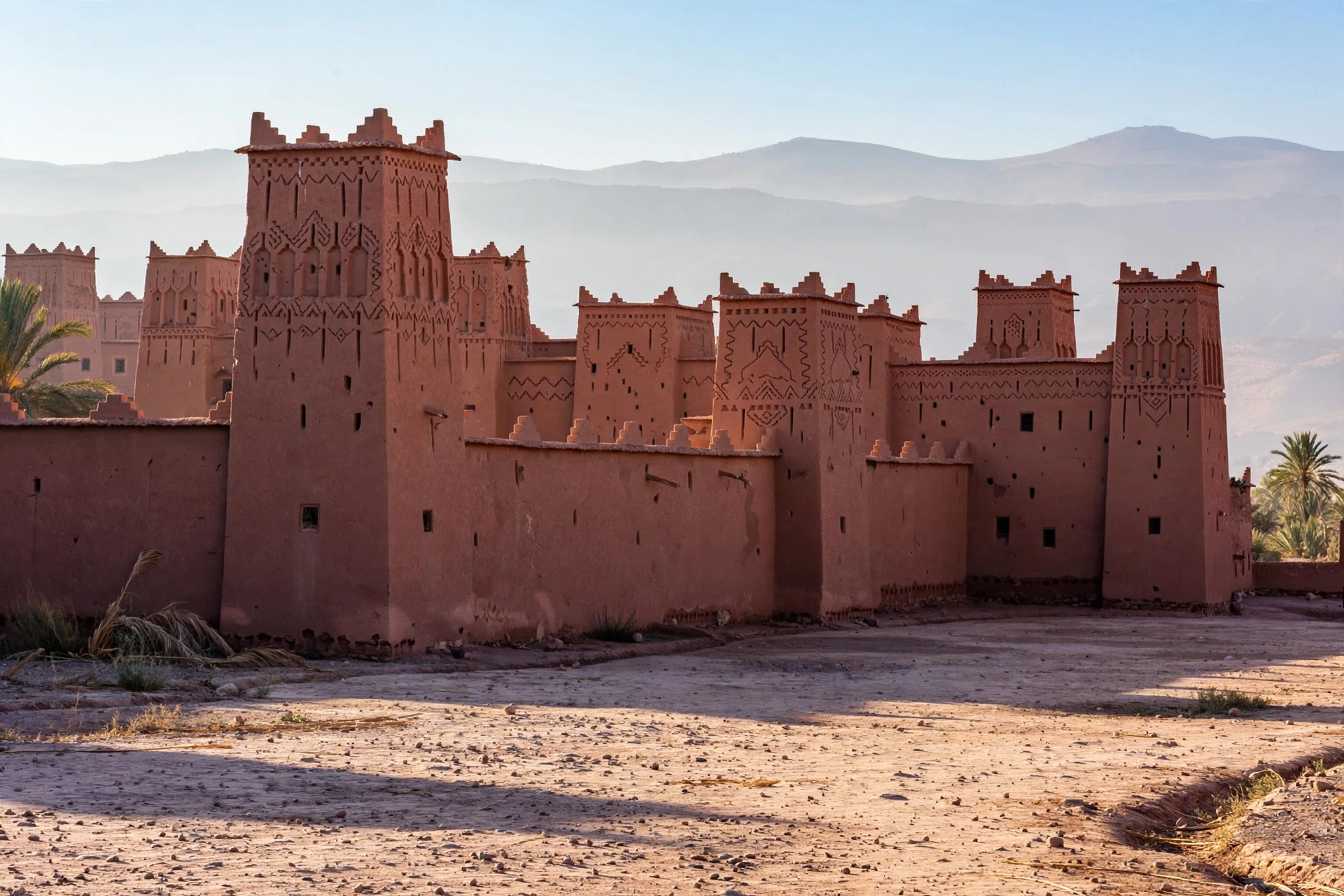
The kasbah is also the easiest on the morocco kasbahs ait ben haddou route to visit. It sits inside Ouarzazate, a short walk from the town centre, and entry costs about 20 MAD (about $2). Allow an hour, then take the small road to the Atlas Studios if film history interests you: Ouarzazate's studios are among the largest film lots in the world, and the town's nickname, the Hollywood of Morocco, was earned on the back of Aït Ben Haddou. For the town around it, see our Ouarzazate travel guide.
Telouet: The Ruined Palace on the Road to Marrakech
Telouet is the haunted one. It stands high in the Atlas foothills on the old road between Marrakech and Aït Ben Haddou, and it was the mountain palace of Thami el-Glaoui, the same pasha who held Taourirt. Built in the late 19th and early 20th centuries, it was once one of the most luxurious palaces in Morocco, with painted ceilings, zellige tilework and reception rooms decorated by craftsmen from Fez and Marrakech.
Today it is a ruin, and that is its power. The Glaoui fell from power in 1955, a year before independence, and the palace was abandoned to the weather. Its outer walls still stand, but the roofs have gone and the decorated rooms are open to the sky. Restoration has begun on parts of the palace, and the morocco kasbahs ait ben haddou traveller who stops here gets something the other kasbahs cannot offer: a great house in the middle of falling apart, beautiful precisely because time left it unfinished.
Getting there is part of the morocco kasbahs ait ben haddou experience. Telouet sits off the main Tizi n'Tichka road, about 60 kilometres from Aït Ben Haddou through the Ounila Valley, and the drive is one of the most beautiful in Morocco. Entry costs about 20 MAD (about $2), and a local caretaker will usually show you the painted rooms. Combine it with Aït Ben Haddou on the same day if you are driving from Marrakech.
Tamnougalt and the Draa Valley: Kasbahs Along the River of Palms
South-east of Ouarzazate, the road drops into the Draa Valley. The Draa is Morocco's longest river, and for more than 200 kilometres it runs through date palms, green fields and mud-brick villages, with the desert pressing in on both sides. The morocco kasbahs ait ben haddou route continues here in its most peaceful form.
Tamnougalt is the valley's great kasbah. It stands near Agdz, about 65 kilometres south-east of Ouarzazate, and it was the seat of the caid who controlled the northern Draa. Its origins are commonly traced to the 16th century, though, like Aït Ben Haddou, its exact founding date is not precisely documented: the kasbah was rebuilt and extended over generations. What survives is a fortified complex with a Jewish quarter, the mellah, at its foot, — a reminder that the caravan trade was shared business between Muslim and Jewish merchants.
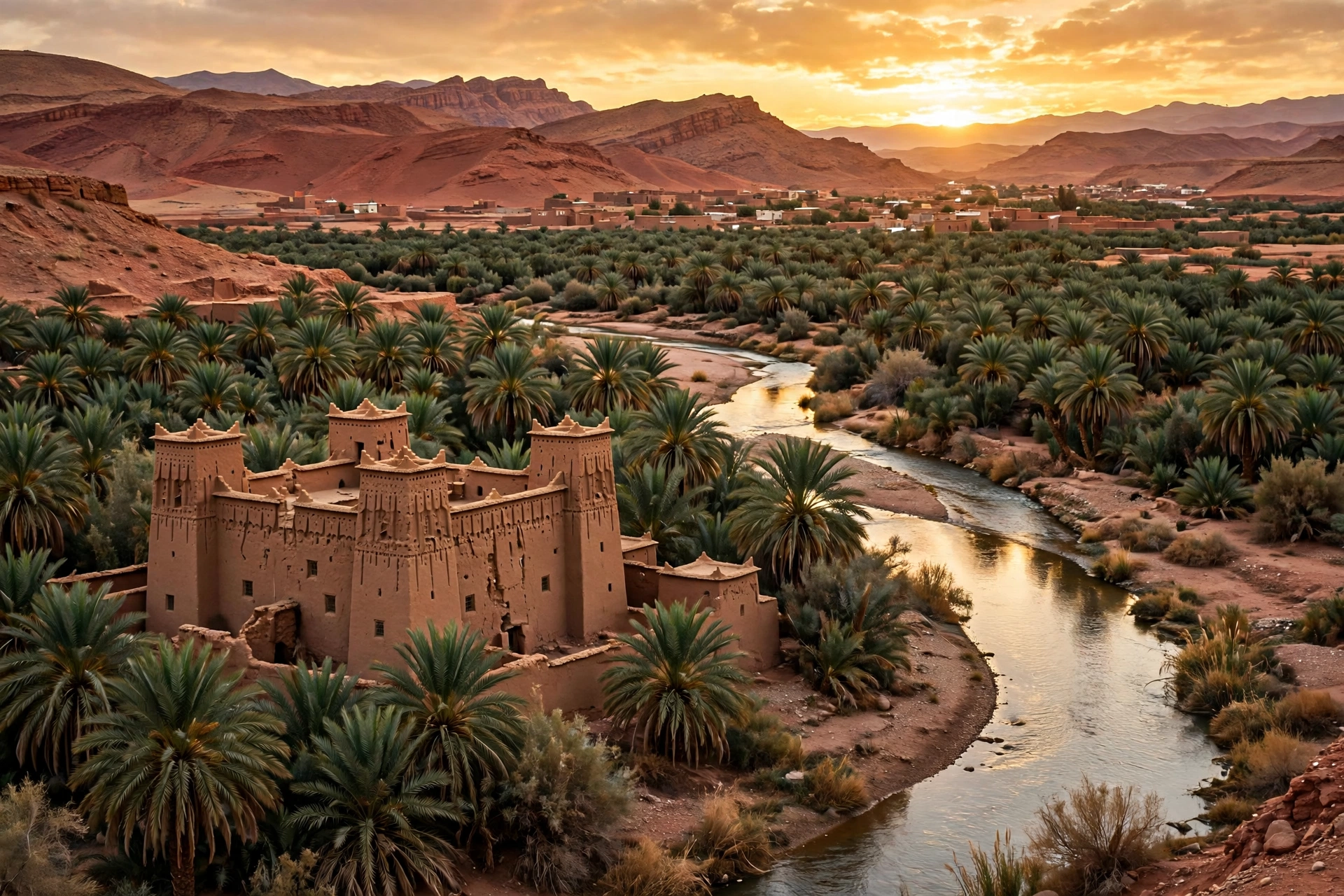
The Draa is best seen slowly. Drive south from Agdz through the palm grove to Zagora, about 90 kilometres further, stopping at the villages along the way: Tinzouline, with its rock carvings, and the small kasbahs at every bend in the river. Entry to Tamnougalt costs about 10 to 20 MAD (about $1 to $2), and a walk through the palm grove below it is free and takes an hour. This is also the road to the desert: from Zagora, the dunes of the deep Sahara are a day's drive further south, and our Morocco Sahara camping guide covers that journey.
Amridil and Skoura: The Oasis Kasbah
The last of the five great kasbahs on the morocco kasbahs ait ben haddou route is also the most lived-in. Amridil stands in the Skoura oasis, about 40 kilometres east of Ouarzazate on the road to the Dades Valley, in the middle of one of Morocco's largest palm groves. Commonly dated to the 17th century, it is still a family home: the descendants of the family that built it live there today, and they open its doors to visitors.
Amridil is the best-preserved kasbah in the south, and the most rewarding to visit with a guide from the family itself. The tour takes you through the old olive press, storerooms, kitchens and upper rooms, and the family explains how the kasbah worked as a small world: grain on the top floor, animals below, and the family in between. From the roof terrace, the view runs for kilometres over the oasis to the desert beyond.
Entry costs about 20 MAD (about $2), and the visit takes an hour. The Skoura oasis itself is worth half a day: rent a bicycle, ride the tracks between the palm groves, and look for the other small kasbahs hidden among the trees. Skoura is quieter than Ouarzazate, and its guesthouses, from about 300 MAD (about $30) a night, are good value. Prices checked: November 2026.
Morocco Kasbahs Ait Ben Haddou: Comparing the Great Kasbahs
The five kasbahs differ in character, and the table below puts them side by side. The morocco kasbahs ait ben haddou route takes three days, but with only one day, go to Aït Ben Haddou first, then Taourirt. With two, add Telouet and Skoura. The Draa Valley deserves a day of its own.
| Kasbah | Where | What it is | Entry (Nov 2026) | Time needed |
|---|---|---|---|---|
| Aït Ben Haddou | 30 km NW of Ouarzazate | Fortified ksar village, UNESCO 1987 | Free to wander; houses 10–20 MAD (about $1–$2) | 2–3 hours |
| Taourirt | Ouarzazate town centre | Glaoui palace, 19th–early 20th century | About 20 MAD (about $2) | 1 hour |
| Telouet | Ounila Valley, Atlas foothills | Ruined Glaoui mountain palace | About 20 MAD (about $2) | 1 hour |
| Tamnougalt | Near Agdz, Draa Valley | Caid's kasbah, 16th-century origins | About 10–20 MAD (about $1–$2) | 1–2 hours |
| Amridil | Skoura oasis, 40 km E of Ouarzazate | Lived-in family kasbah, 17th century | About 20 MAD (about $2) | 1 hour |
Morocco Kasbahs Ait Ben Haddou: A Three-Day Route from Marrakech
The practical way to do the morocco kasbahs ait ben haddou route is by car. The roads are good and the distances short, and a rental car costs about 300 to 500 MAD (about $30 to $50) a day in Marrakech. Buses also work: CTM and Supratours run Marrakech to Ouarzazate in about four to five hours for about 100 to 130 MAD (about $10 to $13), and a grand taxi for the day costs about 400 to 600 MAD (about $40 to $60). Prices checked: November 2026.
| Day | Route | Highlights | Driving |
|---|---|---|---|
| Day 1 | Marrakech to Aït Ben Haddou via Tizi n'Tichka (2,260 m) | Atlas pass views, Telouet palace, sunset at Aït Ben Haddou | About 200 km, 4–5 hours |
| Day 2 | Aït Ben Haddou to Ouarzazate | Morning in the ksar, Taourirt kasbah, Atlas Studios | About 30 km, under 1 hour |
| Day 3 | Ouarzazate to Skoura and the Draa Valley | Amridil kasbah, Skoura palm grove, Tamnougalt near Agdz | About 100 km, 2 hours |
Visiting Tips: Guides, Tickets and the Best Light
A few practical rules make the kasbahs far more rewarding. First, on the morocco kasbahs ait ben haddou route, go early or late: the mud-brick walls turn to gold in the first and last hours of light, and the lanes of Aït Ben Haddou are empty before 9 a.m. Second, hire local guides at Aït Ben Haddou and Amridil, where the guides are the families themselves, but skip the touts at the car parks: official guides wait at the kasbah entrances and charge about 100 to 150 MAD (about $10 to $15) for an hour.
Third, carry cash in small notes: entry fees are small, usually 10 to 20 MAD (about $1 to $2), and few kasbahs take cards. Fourth, dress for the sun and the dust — a hat, water and closed shoes — because the lanes are steep and uneven. And finally, remember that several kasbahs are still people's homes: ask before photographing residents, keep your voice down inside, and treat the buildings as living places rather than film sets. The morocco kasbahs ait ben haddou route is at its best when it is visited with respect, and the families who keep these walls standing will notice the difference.
Morocco Kasbahs Ait Ben Haddou FAQ
Where is Aït Ben Haddou?
Aït Ben Haddou stands in southern Morocco, about 30 kilometres north-west of Ouarzazate, on the Ounila River. It lies on the old caravan road between Marrakech and the Sahara, about 200 kilometres from Marrakech over the Tizi n'Tichka pass, a drive of four to five hours.
How old is Aït Ben Haddou?
This is genuinely unsettled. The ksar is commonly said to date from the 17th century, but its exact founding date is not precisely documented, because the buildings have been rebuilt and repaired many times over the centuries. UNESCO inscribed the Ksar of Ait-Ben-Haddou on the World Heritage List in 1987, which is the one date that is certain.
How much does it cost to visit the kasbahs?
Very little. Aït Ben Haddou itself is free to wander, with some houses charging 10 to 20 MAD (about $1 to $2) to enter. Taourirt, Telouet, Tamnougalt and Amridil each charge about 10 to 20 MAD (about $1 to $2). A local guide at Aït Ben Haddou costs about 100 to 150 MAD (about $10 to $15). Prices checked: November 2026.
Which kasbah should I visit if I only have one day?
Go to Aït Ben Haddou. It is the most complete, the most beautiful and the most famous, and its hilltop view is the single best sight in southern Morocco. If you have time left, add Taourirt in Ouarzazate on the same day: the two together show both sides of the kasbah story, the village and the palace.
Can you stay overnight at a kasbah?
Yes, in a sense. Several kasbahs have guesthouses inside or beside them, and Aït Ben Haddou has small hotels in the newer village across the river, from about 250 MAD (about $25) a night. Amridil is still a family home and is not a hotel, but Skoura has guesthouses in the palm grove from about 300 MAD (about $30) a night.
What is the best time of year to visit the kasbahs?
Spring (March to May) and autumn (September to November) are best, with warm days and cool nights. Summer in the south is very hot, often above 40°C, and winter nights in the Atlas foothills can be cold. The light for photography is best in the early morning and the last hour before sunset, when the mud brick glows.
Conclusion
The kasbahs of southern Morocco are not ruins to be ticked off a list. They are the architecture of the caravan dynasties, built of the earth they stand on, and they still carry the story of the roads that made Morocco: the gold and salt of the Sahara, the dates of the Draa, the power of the caids and the patience of the Amazigh builders. Aït Ben Haddou may be the most famous, but the morocco kasbahs ait ben haddou route is best taken whole, from the Atlas passes to the palm groves of the Draa.
Go and see them before the mud brick melts further. Climb the hill at Aït Ben Haddou at sunset, walk the painted rooms of Taourirt, stand in the roofless halls of Telouet and drink tea in the courtyard of Amridil. The morocco kasbahs ait ben haddou journey is a walk through the Morocco the caravans built, still standing and waiting to be visited.
Last checked: November 2026
4 thoughts on “The Kasbahs of Morocco: Aït Ben Haddou and Beyond”