
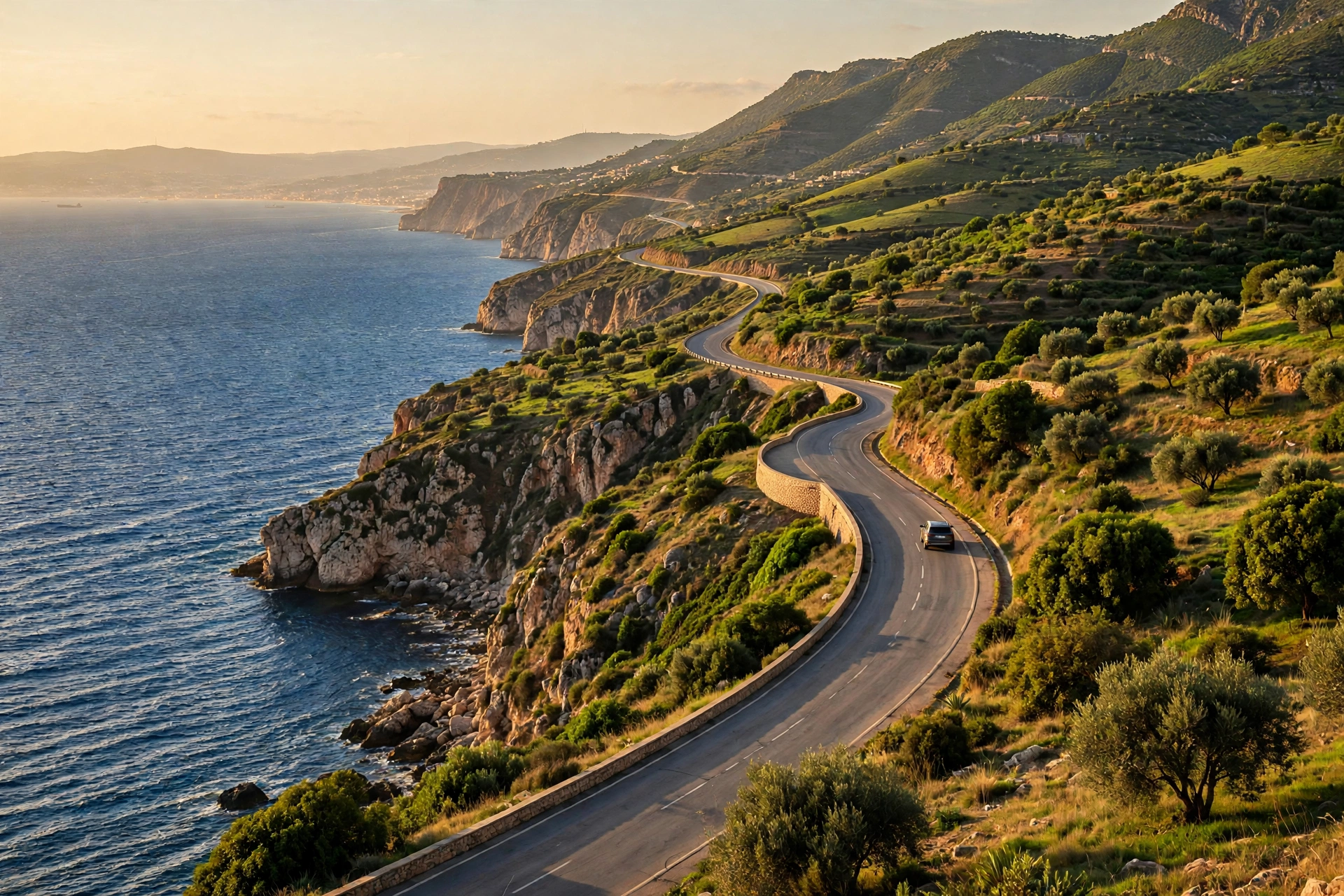
There is a particular moment, about an hour south of Tangier, when the motorway gives way to the Rif foothills and the whole idea of a morocco road trip suddenly makes sense. The road narrows, the hills turn green, and every bend seems to hide a village, a view, or a reason to stop. Morocco is a country built for driving: the distances are honest, the roads are mostly good, and the landscape changes completely every two hours — coast, mountains, cedar forest, palm valley, desert.
This guide plans the classic route end to end, from the Strait of Gibraltar to the dunes of Erg Chebbi and back to the Atlantic at Essaouira. It is the morocco road trip most first-time drivers should take: ten days, about 1,600 kilometres of driving between stops, and no day longer than seven hours behind the wheel. Every price is in Moroccan dirhams (MAD) with a dollar equivalent, checked in November 2026 at roughly 10 MAD to the dollar. For official travel advice alongside this guide, the Visit Morocco portal is the reference to check before you set off on a morocco road trip. For a version of this journey without a car, see our Morocco in 10 Days itinerary and the Morocco Travel section.
In this guide
- The Route at a Glance
- How Long Does a Morocco Road Trip Take?
- Car Hire: What It Costs and What to Book
- Morocco Road Trip Costs: Fuel, Tolls and the Real Budget
- Driving in Morocco: The Rules That Actually Matter
- The Route Day by Day
- The Atlas Crossing: Tizi n’Tichka
- Reaching the Sahara: Merzouga and Erg Chebbi
- Common Mistakes First-Timers Make
- Morocco Road Trip FAQ
The Route at a Glance
The route runs in a great arc: north to south, then west to the coast. You start in Tangier, cross the Rif to Chefchaouen, drop to Fes, climb through the Middle Atlas to the desert at Merzouga, then return west through the gorges and kasbah country to Marrakech, finishing at the Atlantic in Essaouira. It is the spine of the country, and a morocco road trip along it touches every landscape Morocco has except the far south.
| Leg | Distance | Driving time | Why stop |
|---|---|---|---|
| Tangier → Chefchaouen | 115 km | 2 h 15 min | The blue city and the Rif foothills |
| Chefchaouen → Fes | 200 km | 3 h 30 min | Olive country and the road via Ouazzane |
| Fes → Merzouga | 465 km | 7 h | Middle Atlas, cedar forests, Ziz Valley |
| Merzouga → Todra Gorge | 250 km | 3 h 30 min | Rissani market and the road to Tinghir |
| Todra Gorge → Aït Ben Haddou | 230 km | 3 h 45 min | Dades Valley, Ouarzazate, film studios |
| Aït Ben Haddou → Marrakech | 190 km | 3 h 30 min | The Tizi n’Tichka pass |
| Marrakech → Essaouira | 175 km | 2 h 45 min | Argan country and the Atlantic coast |
Two things make this order work. First, the hardest driving day — Fes to Merzouga — comes after two gentle days, when you are used to the car and the roads. Second, the desert comes near the end of the outward journey, so the long drive back west feels like a different trip: gorges and kasbahs instead of motorway. The whole morocco road trip adds up to roughly 1,600 kilometres between stops, or about 1,800 with detours and city driving.
How Long Does a Morocco Road Trip Take?
Seven days is the honest minimum for this route, and it means driving on six of them. You get one night in each stop, the desert night included, and almost no slack for a flat tyre, a closed road, or a town you fall in love with. It can be done, and many people do it, but it is a driving holiday rather than a travelling one.
Ten days is the sweet spot for a first morocco road trip. It gives you two nights in Fes and two in Marrakech, a full day in the desert rather than a rushed overnight, and one spare day to spend wherever the trip surprises you. With ten days, no driving day exceeds seven hours, and four of them are under four hours — short enough to arrive by lunch and actually see the place you drove to.
Fourteen days turns the same route into a slow journey. Add a night in the Dades Valley, a night in Essaouira instead of a day trip, a detour to Volubilis from Fes, and a second desert night. The extra days cost little — a room and meals run 400–600 MAD ($40–$60) a day for two — and they are what turn a route into a memory. Whatever length you choose, do not plan to drive after dark on mountain roads; Moroccan driving after sunset is a different, harder game.
Car Hire: What It Costs and What to Book
Hire the car at Tangier airport if you fly in, or in the city centre if you arrive by ferry from Spain; both have the same international brands and several good local firms. Book at least two weeks ahead for spring and autumn, when demand is highest and the price of a small car can double. A morocco road trip is one of the few trips where the cheapest car is often the right car: a small hatchback handles every road on this route except the last sandy track to a desert camp, where the camp’s own 4×4 takes over.
| Car type | Daily hire price | Best for |
|---|---|---|
| Economy hatchback | 250–400 MAD ($25–$40) | Couples, light luggage, paved roads |
| Compact SUV | 450–650 MAD ($45–$65) | Four people, rough shoulders, comfort |
| 4×4 / large SUV | 800–1,200 MAD ($80–$120) | Desert tracks, heavy luggage, winter |
| Minivan (7 seats) | 700–1,000 MAD ($70–$100) | Families and groups |
Take the full insurance if it is offered at a fair price, usually 100–150 MAD ($10–$15) a day, and photograph every scratch on the car before you leave the lot — including the wheels and the windscreen. Most hirers block a deposit of 3,000–5,000 MAD ($300–$500) on a credit card, not a debit card, so bring a real credit card even if you pay for everything else in cash.
Diesel is the sensible fuel choice: it is cheaper per litre than petrol, and a diesel car will do this route on roughly 130 litres. Automatic cars cost about 30% more to hire and are scarcer outside the big cities, so book one early if you need it. One-way hire — collecting in Tangier and returning in Marrakech — usually adds a fee of 500–1,000 MAD ($50–$100); our route returns you to the north only if you loop back, so most drivers return the car in Marrakech and fly or train onward.
Morocco Road Trip Costs: Fuel, Tolls and the Real Budget
Fuel is the most predictable cost of a morocco road trip. Petrol and diesel both sell for roughly 13–15 MAD a litre (about $1.30–$1.50), and the whole route needs around 130–150 litres depending on the car. That puts fuel for the full ten days at 1,800–2,400 MAD ($180–$240). Petrol stations are frequent on main roads and in every town, but fill up before the desert stretch: between Errachidia and Merzouga the gaps get long.
Tolls apply on the motorways only — Tangier to Rabat, Rabat to Casablanca, Casablanca to Marrakech — and the total for the motorway sections of this route is 300–500 MAD ($30–$50). Pay cash at the booths; cards work at most, but cash is faster and never fails. The mountain and desert roads on this route have no tolls at all.
| Budget item (10 days, two people) | Cost in MAD | Cost in USD |
|---|---|---|
| Car hire, economy, 10 days | 3,000–4,000 | $300–$400 |
| Fuel, ~1,600 km | 1,800–2,400 | $180–$240 |
| Motorway tolls | 300–500 | $30–$50 |
| Parking, guarded lots | 150–250 | $15–$25 |
| Accommodation, 9 nights | 3,500–5,500 | $350–$550 |
| Food and drink | 2,000–3,000 | $200–$300 |
| Desert camp night (1 night) | 600–1,200 | $60–$120 |
| Total for two people | 11,350–16,850 | $1,135–$1,685 |
The wide range is mostly the hotels: a 300 MAD guesthouse night and a 900 MAD riad night are both easy to find in the same town. As a rule of thumb, budget 600–850 MAD ($60–$85) per person per day all-in for a comfortable trip, and 400 MAD ($40) per person per day if you sleep in guesthouses and eat where locals eat.
Driving in Morocco: The Rules That Actually Matter
Morocco drives on the right, and the rules on paper will look familiar to any European or North American driver: 60 km/h in towns, 100 km/h on open roads, 120 km/h on motorways. What matters is how they are enforced. Fixed speed cameras are everywhere on main roads, and mobile police checks with radar are common at the entrance to towns — the fine for speeding is usually 300–700 MAD ($30–$70), payable on the spot with a receipt. The single best habit on a morocco road trip is to slow down before every town sign, not after it.
Roundabouts are the second thing to learn. Traffic already in the roundabout has priority, and in busy city roundabouts the flow can look chaotic — go slowly, commit to your exit early, and do not stop inside the circle. Overtaking on two-lane mountain roads is normal, but only overtake where you can see at least 200 metres ahead; trucks and buses do it constantly, and the oncoming lane is not a suggestion. The country’s road network has grown fast in the last two decades — Wikipedia’s overview of transport in Morocco is a useful primer on the motorways, ports and railways that shape the drive.
Night driving deserves its own warning. Outside the cities, roads are poorly lit, animals cross without warning, and unlit carts, mopeds and parked trucks appear where you least expect them. Plan to arrive everywhere before sunset — in winter that means 5:30 pm — and treat a night drive as an emergency, not a plan. Keep your driving licence, passport and hire papers in the car at all times; police checks ask for them often, and a friendly attitude plus documents in order ends the stop in two minutes.
The Route Day by Day
Day one is Tangier to Chefchaouen, a gentle introduction: the coast road out of Tangier, then the climb into the Rif. Day two, Chefchaouen to Fes, is a half day of driving through olive groves, which leaves the afternoon for the Fes medina. Day three is a full day in Fes on foot — no driving at all, which your legs will appreciate. Our Fes to Chefchaouen Day Trip guide covers the blue city in detail if you want to linger there longer.
- Day 1 — Tangier → Chefchaouen: collect the car, drive the Rif road, sunset in the blue medina.
- Day 2 — Chefchaouen → Fes: morning in Chefchaouen, afternoon arrival in Fes.
- Day 3 — Fes: a full day on foot in the medina and the tanneries.
- Day 4 — Fes → Merzouga: the long day — Ifrane, Midelt, the Ziz Valley, arrive by sunset.
- Day 5 — Merzouga: dunes at sunrise, a lazy afternoon, camel ride and camp night.
- Day 6 — Merzouga → Todra Gorge: Rissani market, then the gorge road to Tinghir.
- Day 7 — Todra Gorge → Aït Ben Haddou: Dades Valley, Ouarzazate, overnight at the kasbah.
- Day 8 — Aït Ben Haddou → Marrakech: the Tizi n’Tichka pass, arrive by afternoon.
- Day 9 — Marrakech: a full day in the medina, Jemaa el-Fnaa and the gardens.
- Day 10 — Marrakech → Essaouira: argan country, the coast, and the Atlantic sunset.
Short on time? Cut Essaouira and fly home from Marrakech, or cut the Fes rest day and drive straight through. The one thing not to cut is the desert night: it is the reason most people take this route, and a single night in Erg Chebbi is the part of the trip everyone talks about afterwards. If trains appeal more than driving for part of the journey, our Morocco Train Ticket Prices guide shows where the railway can replace the road.
The Atlas Crossing: Tizi n’Tichka
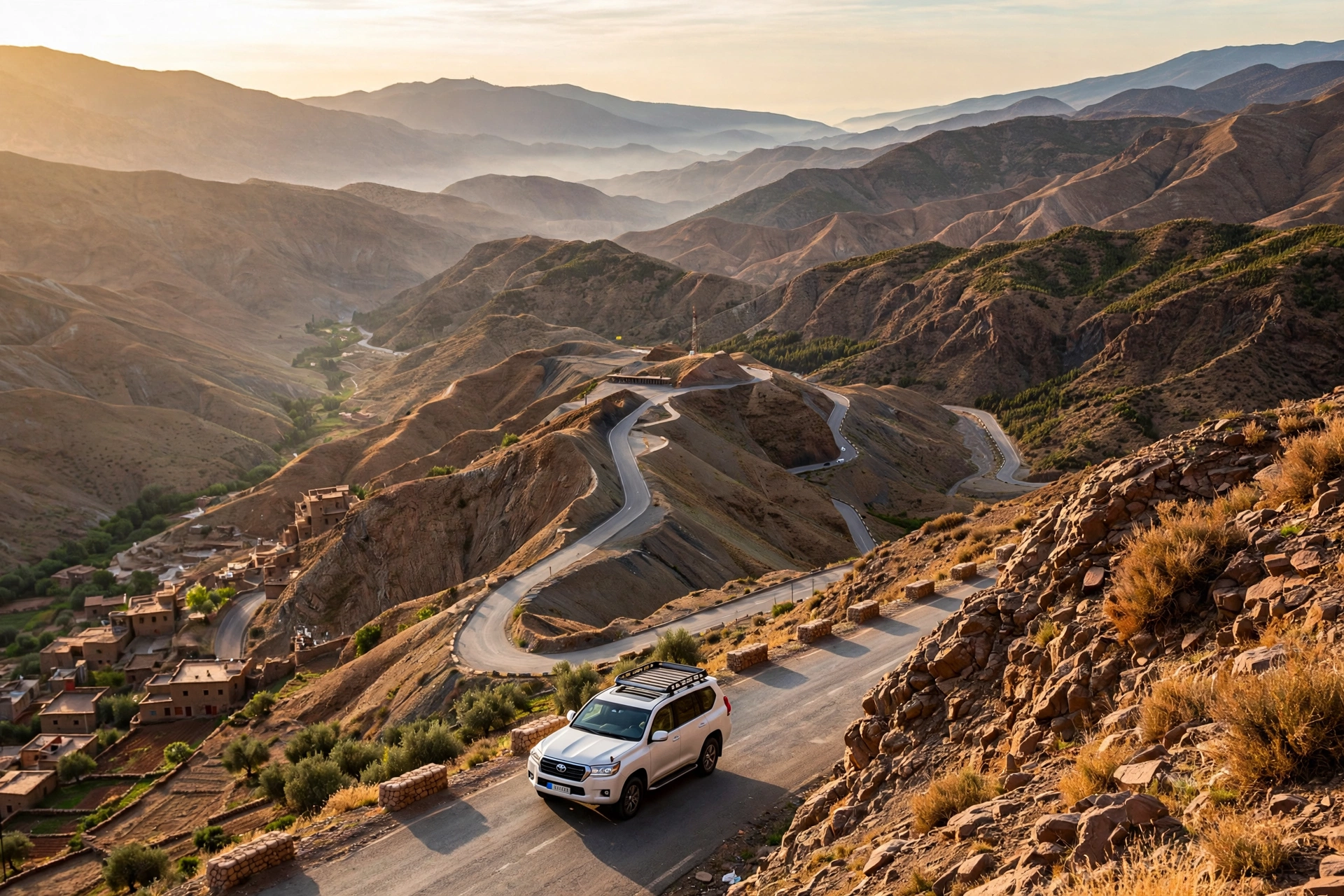
The Tizi n’Tichka is the highest major road pass in North Africa at 2,260 metres, and the three hours between Ouarzazate and Marrakech are the most dramatic driving on the whole route. The road climbs in tight switchbacks past Amazigh villages clinging to the slopes, then drops through pine forest towards the plains. Allow four hours for the crossing rather than three: you will want to stop, and the viewpoints near the summit are the best photographs of the trip.
The pass is open all year, but winter changes the rules. Between December and February, snow can close it for hours at a time, and ice forms on the shaded bends before 10 am. Check conditions in Ouarzazate before you set off, carry water and snacks in case of a wait, and descend in a low gear rather than riding the brakes — the long downhill is where hire-car brakes overheat. In summer, the opposite problem applies: the climb is hot, so keep the air conditioning modest and watch the temperature gauge on the steepest sections.
Halfway up, the village of Telouet is worth a thirty-minute detour for its ruined kasbah, once the seat of the Glaoui family; it is quieter and stranger than the famous kasbahs further south, and the road to it is paved all the way. Our guide to the kasbahs of Morocco covers Aït Ben Haddou and its neighbours in detail for the night before the crossing.
Reaching the Sahara: Merzouga and Erg Chebbi
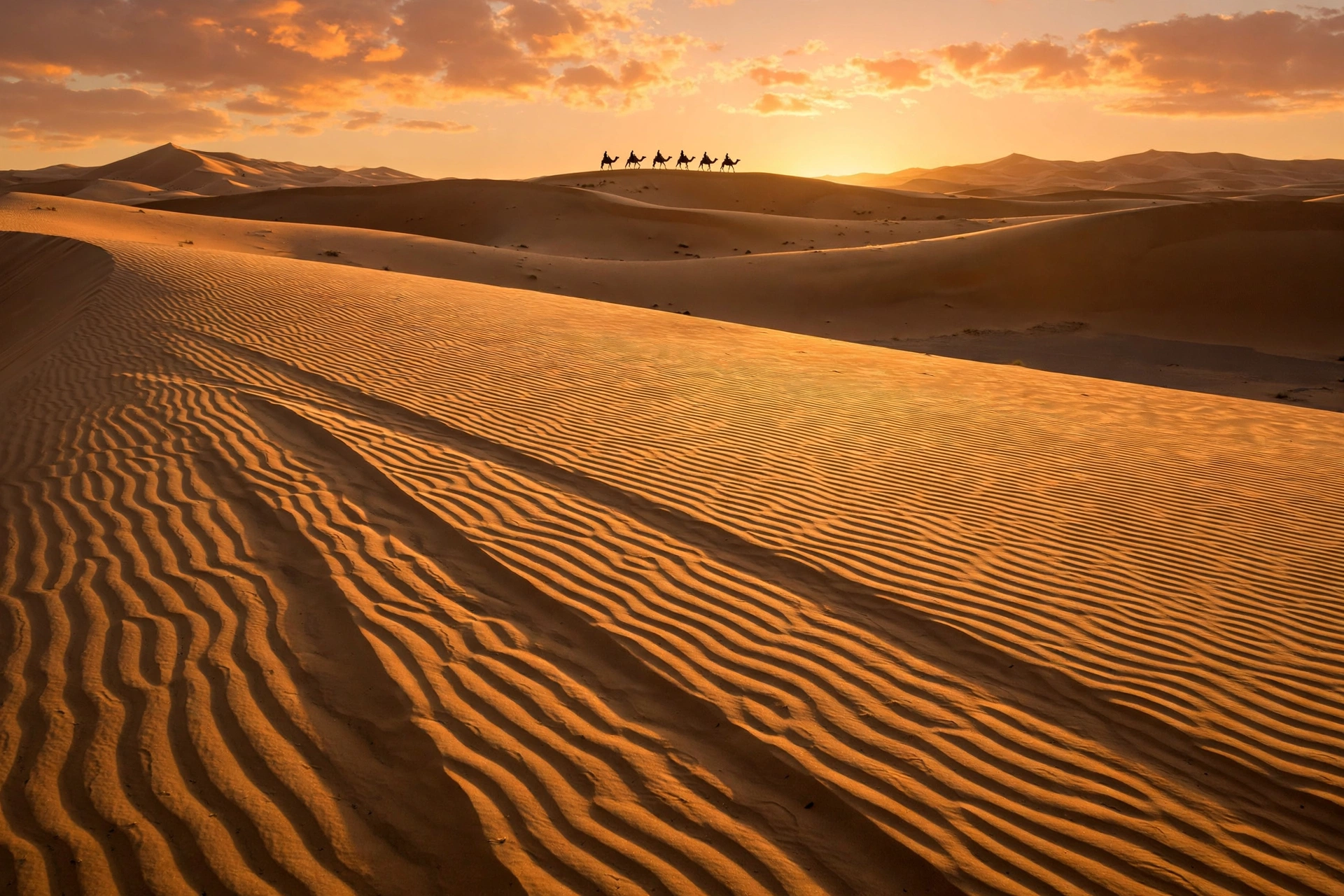
The last hour into Merzouga is the moment the trip earns its name: the road flattens, the palm groves thin out, and then the dunes of Erg Chebbi rise out of the plain like a wall of gold. Do not drive onto the sand. Park in Merzouga village — every hotel and camp has guarded parking for 10–20 MAD ($1–$2) a night — and let the camp collect you by camel or 4×4. Cars buried to their axles in soft sand are the classic first-timer mistake, and recovery costs far more than the transfer.
A camp night usually costs 600–1,200 MAD ($60–$120) per person and includes dinner, breakfast, the camel ride and the night in the dunes. Read what that price covers before you book: the cheapest camps sell a mattress in a shared tent with dinner and the camel ride charged separately. One night is enough for most people; a second night buys you a full day among the dunes, a sandboarding session, and a sunrise without the pressure of the drive out. Our Morocco Sahara Camping guide compares the camp types and prices in full.
Pack the desert night separately from the rest of your luggage: a small bag with warm layers, a headlamp, sunscreen and water, so you are not dragging suitcases onto a camel. Nights in the desert are cold even in summer — temperatures can drop 20 degrees after sunset — and the stars are the best show in Morocco, so bring a jacket and stay up for them.
Common Mistakes First-Timers Make
The first mistake is trusting the map time. Moroccan roads add a third to whatever your navigation app promises: roadworks, slow trucks, a herd of goats, a police check and a viewpoint you cannot resist all eat the margin. Add 30% to every estimate, and never plan two long driving days back to back. The second mistake is the opposite — filling the car with fuel anxiety. Stations are everywhere except the desert approach, so the rule is simple: fill up whenever the tank passes half.
The third mistake is driving into the old medinas. The medinas of Fes, Marrakech and Chefchaouen are pedestrian mazes; your hotel’s parking is outside the walls, and the walk in is part of the experience. Follow the hotel’s directions, not the satnav, and accept that the last 200 metres are on foot. Fourth, do not pay for anything in the desert in advance without reading the small print, and fifth, keep small notes — 10 and 20 MAD — for parking attendants, tips and roadside oranges, because nobody has change for a 200 MAD note at a mountain viewpoint.
A morocco road trip rewards the driver who slows down. The best moments of this route are not on the itinerary: the mint tea pressed on you by a petrol station attendant, the shepherd who waves you through his flock, the viewpoint where everyone stops at once. Leave room in the day for those, and the road will give you more than the plan ever promised.
Morocco Road Trip FAQ
How many days do I need for a Morocco road trip?
Ten days is the ideal length for the Tangier to Sahara route: two nights each in Fes and Marrakech, a desert night, and no driving day over seven hours. Seven days works if you drive every day and skip the rest days, while fourteen days lets you add the Dades Valley, Volubilis and a second desert night.
Is it safe to drive in Morocco as a tourist?
Yes, with normal care. The main roads are in good condition, and the biggest risks are speed cameras, slow trucks on mountain passes and animals on rural roads. Avoid night driving outside cities, slow down before every town, and keep your licence and hire papers in the car.
Do I need an international driving permit in Morocco?
Visitors can drive on a valid licence from their home country for up to one year, and an international driving permit is recommended but not legally required for most licences. Carry your passport with the licence, as police checks often ask for both documents together.
What is the best month for a Morocco road trip?
March to May and September to November are the best months: warm days, cool nights and green mountains in spring, or golden light and harvest season in autumn. Summer is very hot in the desert and in Marrakech, and winter can close the Tizi n’Tichka pass with snow.
How much does a 10-day Morocco road trip cost?
For two people sharing an economy car and mid-range rooms, expect 11,350–16,850 MAD ($1,135–$1,685) all-in for ten days, or roughly 600–850 MAD ($60–$85) per person per day. Budget travellers in guesthouses can do it for about 400 MAD ($40) per person per day.
Can I do this Morocco road trip in a normal car?
Yes. Every road on this route is paved, and an economy hatchback is enough for the whole journey. The only unpaved section is the last track into a desert camp, and the camp collects you by camel or 4×4, so you never need to drive on sand yourself.
Last checked: November 2026.
3 thoughts on “Morocco Road Trip: The Ultimate Driving Route from Tangier to the Sahara”