
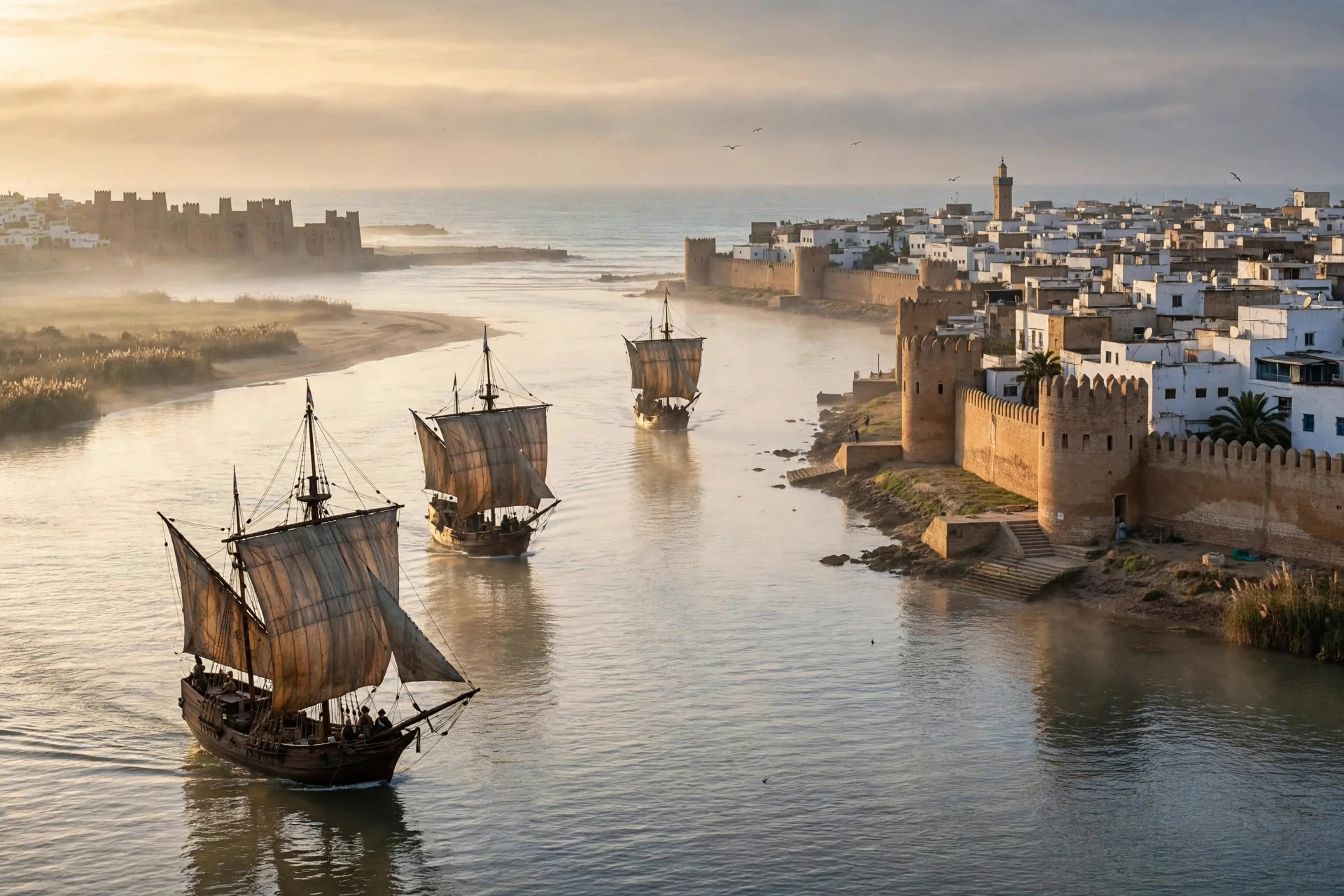
On a summer morning in 1627, the corsair captains of Salé did something no other pirate port in the Mediterranean had dared: they declared themselves a republic. For the next forty-one years, the Republic of Sale was a state in its own right, with a council, a fleet, a flag and treaties with European kings — and a business built on capturing ships and ransoming their crews.
This guide tells the full story of the Republic of Sale: the Morisco refugees who founded it, Jan Janszoon, the raids that reached Iceland and Ireland, the wars with Spain and England, and the sultan who ended it in 1668. It also flags where historians still disagree, and ends with a guide to visiting the Republic of Sale sites in Salé today.
In this guide
- The Republic of Sale: Why 1627 Still Matters
- The Moriscos and the Hornacheros
- Why Salé? The Bou Regreg and the Atlantic
- The Corsairs of the Republic of Sale: How the Pirate Economy Worked
- Jan Janszoon: The Dutch Renegade Who Became Murad Reis
- The Republic of Sale at War: Spain, England and the Bombardment of 1637
- Daily Life Inside the Pirate Republic
- The Republic of Sale and the Sultan: Al-Ayashi and the End of Independence
- 1668: How the Republic of Sale Fell
- The Legacy of the Republic of Sale
- Visiting Salé Today: The Pirate Republic’s Footprints
- Frequently Asked Questions
- Conclusion: The Legacy of the Republic of Sale
The Republic of Sale: Why 1627 Still Matters
The Republic of Sale matters because it was not a pirate gang. It was a republic in the full sense: a self-governing city-state run by an elected council, with its own laws, admiral, diplomacy and flag. For forty-one years, at the mouth of the Bou Regreg on Morocco's Atlantic coast, refugees and renegades ran one of the most feared naval powers in Europe — and the European kings treated it as a state, signing treaties with it and sending ambassadors.
The Republic of Sale also matters because it shows a different Morocco from the one in the history books. The same century that produced the Saadian sultans and the rise of the Alaouites — the dynasty that still rules Morocco today — also produced this small, improbable state, built by people Spain had thrown out: a revenge, in a sense, as the men Spain expelled came back across the strait and built a fleet that haunted Spanish shipping for a generation.
The Moriscos and the Hornacheros
The founders of the republic were the Moriscos: Muslims of Spain forced to convert after the fall of Granada in 1492, then expelled altogether by King Philip III between 1609 and 1614. Around 300,000 people were driven out, and many crossed the Strait of Gibraltar to Morocco, arriving with nothing but the memory of their lost homes — and a deep hatred of Spain.
Among them were the Hornacheros, Moriscos from Hornachos in Extremadura. Unlike most Moriscos, who were farmers and craftsmen, the Hornacheros had been soldiers and men of standing, and they arrived in Morocco in 1610 with their weapons, money and organisation intact. The Saadian sultan let them settle at Salé, on the north bank of the Bou Regreg opposite Rabat, and within a few years the Hornacheros had turned the sleepy port into the corsair base that would become the Republic of Sale — and they, not the sultan's officials, ruled it.
Why Salé? The Bou Regreg and the Atlantic
Salé was the perfect pirate port. The Bou Regreg offered a sheltered harbour, and its sandbar was a natural defence: only pilots who knew the shifting channel could bring a ship in or out, so no enemy fleet could simply sail in. The corsairs' light ships slipped over the bar on a rising tide; heavy Spanish warships could not follow.
The position was just as valuable. Salé sat at the edge of the Atlantic shipping lanes, where merchant ships of England, France, the Netherlands and Spain passed between the Mediterranean, the Canaries and the Americas. A corsair leaving the Bou Regreg at dawn could be among the shipping by noon, and the port was barely a day's sail from Spain, so a captured prize could be brought home before any rescue was organised. The town's other advantage was political: in the early 1600s the Saadian sultanate was collapsing, and no central authority could stop the corsairs from governing themselves.
The Corsairs of the Republic of Sale: How the Pirate Economy Worked
The economy of the Republic of Sale was piracy, organised as a business. A corsair captain received a licence from the council of the Republic of Sale — a formal commission much like the privateering licences European kings issued — and fitted out a ship with investors from the town. The investors took the largest share of any prize, the captain and crew took the rest, and the republic took a tenth, the khums, which funded the council, the harbour and the town's defences.
The prizes were of two kinds: the ship and its cargo — cloth, wine, sugar, silver, spices — and the crew. Captured sailors were held for ransom, and ransoming was a whole industry: the Trinitarian and Mercedarian orders travelled from Europe to Salé to negotiate releases, and families raised money at home to buy their relatives' freedom. A skilled prisoner — a master, a gunner, a surgeon — was worth more than an ordinary sailor, and some captives waited years while their price was argued over.
| Feature | Salé | Algiers | Tunis | Tripoli |
|---|---|---|---|---|
| Ruled by | Elected council of captains | Ottoman governor (Dey) | Ottoman governor (Bey) | Ottoman governor |
| Founded as corsair base | 1610–1627 | 1516 | 1534 | 1551 |
| Peak period | 1627–1641 | 1600s | 1600s | 1600s |
| Main targets | Atlantic shipping | Mediterranean shipping | Mediterranean shipping | Mediterranean shipping |
| Famous raiders | Jan Janszoon, the Hornacheros | Barbarossa, Dragut | Various | Various |
| End of corsair era | 1668 | 1830 (French conquest) | 1881 (French protectorate) | 1835 |
Jan Janszoon: The Dutch Renegade Who Became Murad Reis
The most famous corsair of the Republic of Sale was not a Morisco at all. Jan Janszoon, a Dutch pirate from Haarlem, had been captured by Algerian corsairs in 1618 and converted to Islam as Murad Reis. He reached Salé in the early 1620s and rose fast: by 1627 he was the republic's Grand Admiral, commander of its fleet and its most feared captain.
Janszoon's raids were spectacular. In 1627, the year the republic was proclaimed, his ships attacked Iceland, landing at Grindavík and the Westman Islands and carrying off several hundred Icelanders — an event Icelanders still call the Tyrkjaránið, the Turkish Abductions. Four years later, in 1631, he led the famous sack of Baltimore in Ireland, seizing the whole village in a single night and taking more than a hundred people. The raid became a ballad in Ireland, and Janszoon's name was known in every port in Europe.
What happened to Janszoon in his later years is not fully settled, and this guide says so plainly. Most sources place him in Algiers after he left Salé in the mid-1630s, serving as an admiral there, and give his death as 1641 — but where exactly he died and what he was doing are obscure, and accounts differ. What is certain is his legacy: the Dutchman who became a Muslim admiral remains the most vivid symbol of the Republic of Sale, a man who crossed every border of his century — religion, nationality and law — and made his name on the Atlantic.
The Republic of Sale at War: Spain, England and the Bombardment of 1637
The Republic of Sale was at war with Spain from the day it was founded, and Spain tried more than once to destroy the Republic of Sale. Spanish fleets blockaded the Bou Regreg and bombarded the town, and Spanish agents plotted with the republic's enemies. But the sandbar protected the harbour, the corsairs were too fast to catch, and Spain — fighting wars in the Netherlands, Germany and Italy — could never spare the army a full invasion would have needed.
England took a different approach. In 1637, an English fleet under Captain William Rainsborough arrived off Salé to free the English captives held there. Rainsborough bombarded the town for two weeks, and when the council refused to surrender, his men landed and stormed the defences. The republic handed over some 300 English prisoners, and England and Salé signed a treaty — an agreement between a king and a pirate republic.
The treaty did not end the raiding: the corsairs repaired their defences and went back to sea, and Europe learned to live with the republic as it lived with Algiers and Tunis.
Daily Life Inside the Pirate Republic
Daily life in the Republic of Sale was a strange mix of piety and piracy. The town was governed by a council of fourteen, drawn from the corsair captains and leading merchants, which elected a governor — often the Grand Admiral himself — for a fixed term. The council made the laws, settled disputes, divided the prizes and negotiated with foreign powers, all in the name of a republic with no king and no sultan.
The population was as mixed as the Mediterranean itself: Moriscos from Spain, Amazigh families from the interior, Arab merchants, European renegades like Janszoon, and captives, some of whom converted and stayed. The Republic of Sale's markets sold the goods of a dozen nations, and its shipyards repaired captured ships with timber and cannon bought from the same merchants whose vessels the corsairs were taking.
The Republic of Sale and the Sultan: Al-Ayashi and the End of Independence
The republic's independence always depended on the weakness of the sultan in Marrakech, and that weakness did not last. In the 1630s, a new power rose in the north: Sidi Mohammed al-Ayashi, a holy man and warrior of the Beni Zerwal tribe who had fought the Spanish at La Mamora, near the mouth of the Sebou. Al-Ayashi saw the republic as both a prize and a problem — a rich port that answered to no one, and a base he needed for his own war against Spain.
In 1636, al-Ayashi seized Salé and made himself its ruler, pushing the republic's council aside. The corsairs kept sailing — al-Ayashi needed their ships and money — but the Republic of Sale as a self-governing state was over in all but name. Al-Ayashi ruled until 1641, when he was assassinated. Who ordered the killing is disputed: some accounts blame rival corsair captains, others the Dila brotherhood, the powerful religious order of the Middle Atlas. The truth is not settled, and the sources do not agree.
1668: How the Republic of Sale Fell
After al-Ayashi's death, Salé passed to the Dila brotherhood, which ruled the port for two decades as part of its wider state in central Morocco. The corsairs still sailed, but the town was no longer a republic: it was a province of someone else's empire — first the Dila'ites, then the rising Alaouites.
The end came in 1668, when Moulay Rashid, founder of the Alaouite dynasty, took Salé and brought northern Morocco under his rule. The captains entered the sultan's service, the council was abolished, and the republic's flag came down for the last time. The year 1668 is the conventional end date of the Republic of Sale, though some historians argue it effectively ended in 1641, with al-Ayashi's takeover. Either way, the forty-one years were over, and Salé became what it has been ever since: a Moroccan city, not a state of its own.
| Date | Event |
|---|---|
| 1609–1614 | Moriscos expelled from Spain; the Hornacheros reach Salé in 1610 |
| 1627 | The Republic of Sale is proclaimed; Jan Janszoon becomes Grand Admiral |
| 1627 | Raid on Iceland — the Turkish Abductions |
| 1631 | Sack of Baltimore, Ireland, led by Janszoon |
| 1636 | Al-Ayashi seizes Salé; the council loses power |
| 1637 | English fleet under Rainsborough bombards Salé; treaty signed |
| 1641 | Al-Ayashi assassinated; the Dila brotherhood takes Salé |
| 1659–1668 | The Dila state collapses; the Alaouites rise in the east |
| 1668 | Moulay Rashid takes Salé — the end of the republic |
The Legacy of the Republic of Sale
The legacy of the Republic of Sale is written across the Atlantic world. In Iceland, the Turkish Abductions of 1627 are still remembered, and some Icelanders trace their family stories to captives who never came home. In Ireland, the sack of Baltimore is a ballad and a local legend. In Morocco, the Republic of Sale left a different legacy: the Morisco families who founded it became part of Salé and Rabat, and their descendants — with Spanish surnames like Bargach, Benjelloun and Torres — are still among the leading families of the two cities.
The republic also left a mark on how Morocco is understood: the country's history is not only dynasties and sultans — the Almoravids who founded Marrakech, the Alaouites who rule today — but also cities that governed themselves, refugees who built fleets, and renegades who crossed from one world to another. The kings of Morocco are one half of the story; the Republic of Sale is the other half, the part that sailed.
Visiting Salé Today: The Pirate Republic’s Footprints
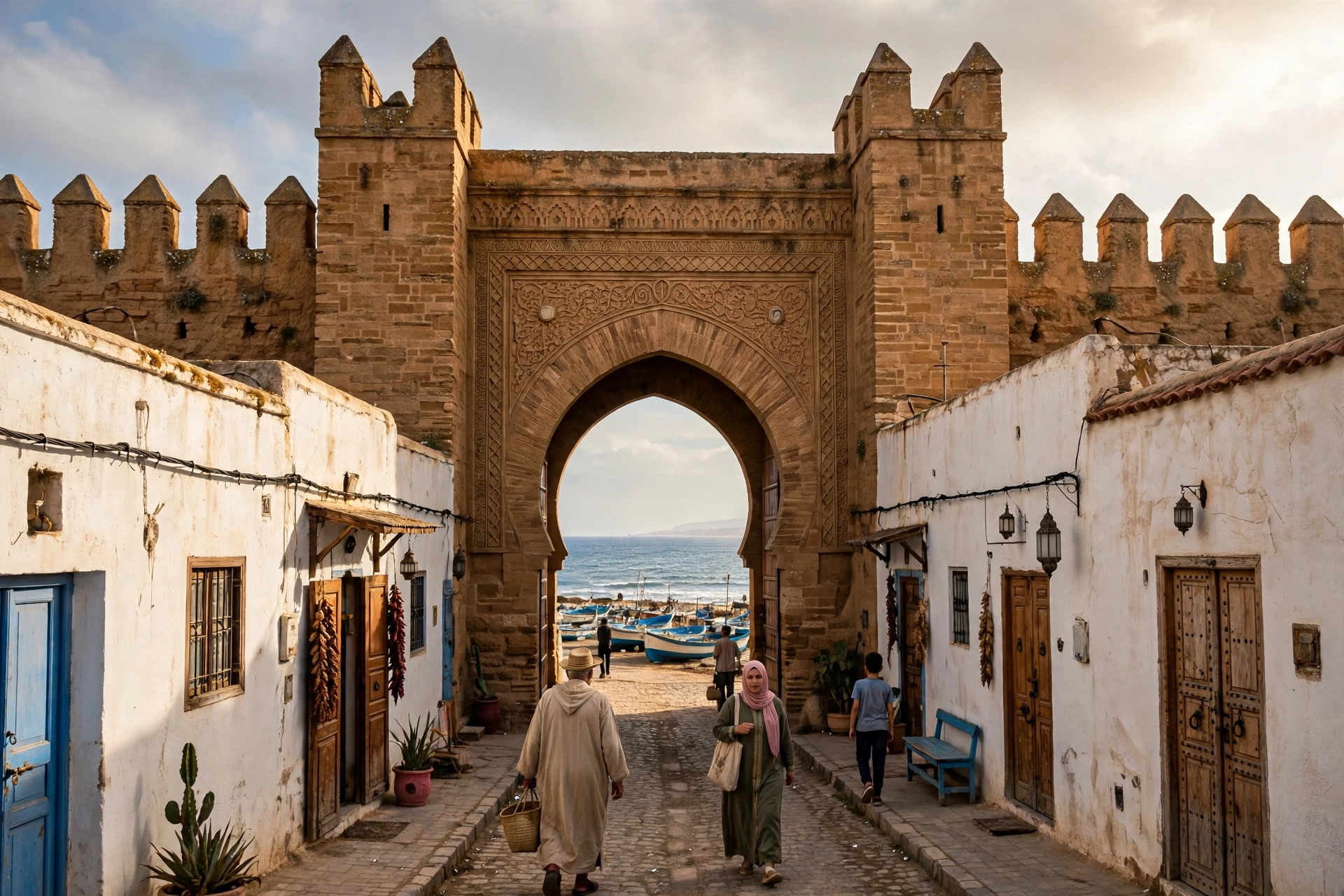
Modern Salé is a quiet city of about a million people, and most visitors never see it — they cross the Bou Regreg to Rabat and never look back. That is a mistake: the pirate republic's footprints are still there, and a morning in Salé is one of the best history walks in Morocco. Start at Bab Mrisa, the great sea gate built by the Marinids, where corsair ships loaded and captives came ashore, then walk through the medina to the Great Mosque and the Madrasa of Abu al-Hasan, built in 1341, with its carved cedar and zellige tilework.
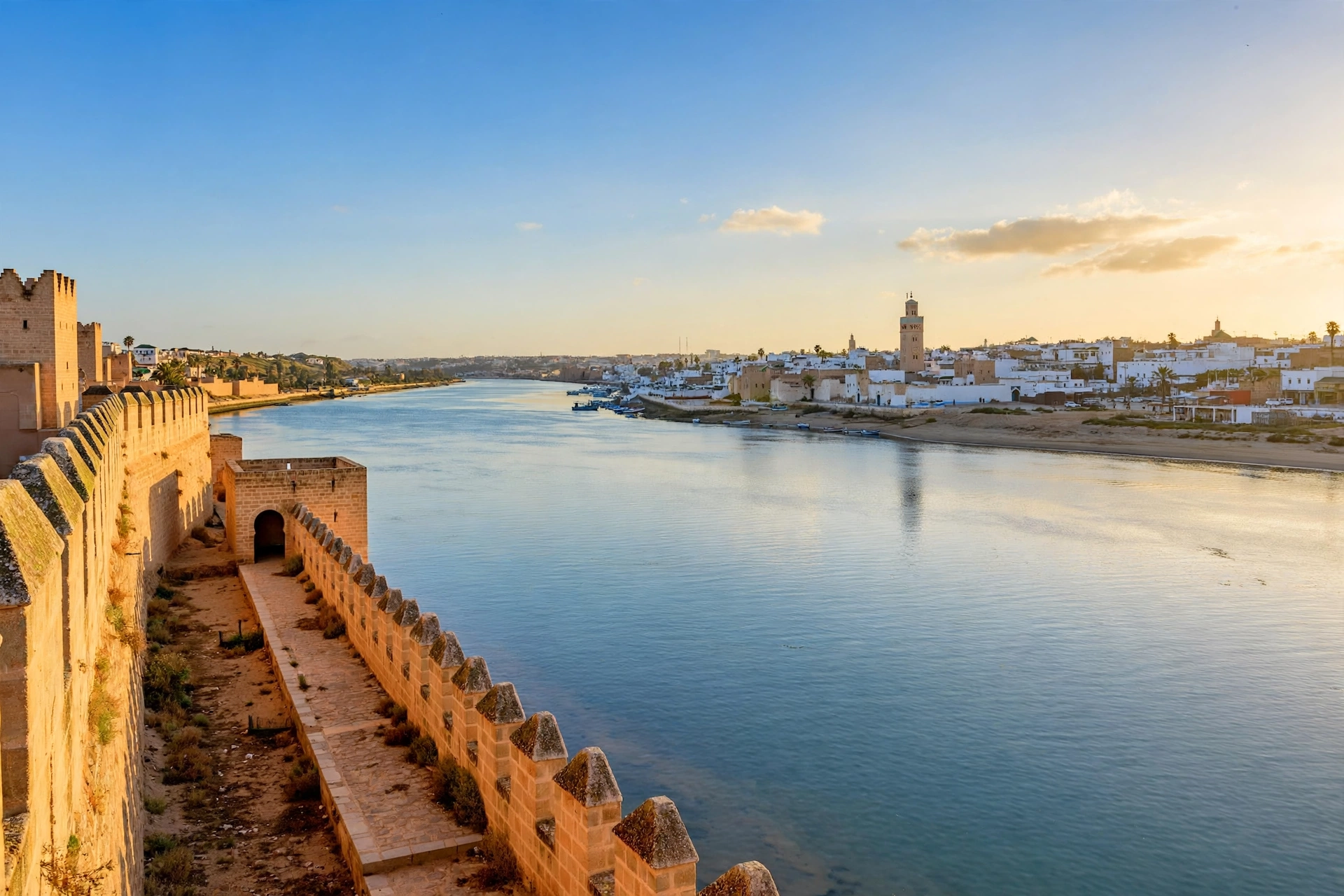
From the medina, cross the river to Rabat and climb to the Kasbah of the Udayas, the fortress that guarded the mouth of the Bou Regreg. Its museum and Andalusian garden are the best place to imagine the Republic of Sale at its height: the ships at anchor below, the town across the river, and the Atlantic beyond. Finish in the kasbah café, looking out over the water where the corsairs sailed.
| Item | Typical cost (November 2026) |
|---|---|
| Tram Rabat Ville to Salé (one way) | 6 MAD ($0.60) |
| Train Rabat Ville to Salé Tabriquet (one way) | 10–20 MAD ($1–2) |
| Petit taxi within Salé | 10–20 MAD ($1–2) |
| Madrasa of Abu al-Hasan entry | 20 MAD ($2) |
| Guided walking tour of Salé medina (2 hours) | 300–500 MAD ($30–50) |
| Lunch in the medina | 80–150 MAD ($8–15) |
| Kasbah of the Udayas entry (Rabat) | 70 MAD ($7) |
Last checked: November 2026. Prices are ranges for independent travellers; confirm fares at the station before travelling.
Frequently Asked Questions
What was the Republic of Sale?
The Republic of Sale was a corsair city-state at the mouth of the Bou Regreg in Morocco, independent from 1627 to 1668. It was founded by Morisco refugees expelled from Spain and governed by an elected council of corsair captains, with its own fleet, laws and treaties with European kings.
When did the Republic of Sale exist?
The republic was proclaimed in 1627 and ended in 1668, when the Alaouite sultan Moulay Rashid took Salé. Some historians argue it effectively ended earlier, in 1641, when the warlord al-Ayashi seized the town and pushed the council aside — the end date is still disputed.
Who was Jan Janszoon?
Jan Janszoon was a Dutch pirate from Haarlem who was captured by Algerian corsairs in 1618, converted to Islam as Murad Reis, and became the Grand Admiral of the Republic of Sale. He led the 1627 raid on Iceland and the 1631 sack of Baltimore in Ireland, and he is the republic's most famous corsair.
Why were the corsairs of Salé called pirates?
Because their business was capturing ships and ransoming crews, which European governments called piracy. The corsairs saw it as lawful war: they held licences from their council, paid a tenth of every prize to the republic, and treated captured sailors as prisoners to be ransomed, not murdered.
Can I visit the Republic of Sale sites today?
Yes. Salé is a short tram ride from Rabat, and the old medina, Bab Mrisa sea gate, Great Mosque and Madrasa of Abu al-Hasan are all walkable in a morning. Cross the river to the Kasbah of the Udayas in Rabat for the best view over the Bou Regreg and the corsairs’ harbour.
Is Salé the same as Rabat?
No. Salé and Rabat are twin cities on opposite banks of the Bou Regreg — Salé on the north bank, Rabat on the south. In the 1600s the two banks were rivals: the Hornacheros settled in Salé, while the Moriscos across the river built the Kasbah of Rabat. Today they are connected by tram, bridge and train.
Conclusion: The Legacy of the Republic of Sale
The Republic of Sale lasted only forty-one years, but it deserves its place among the great stories of Moroccan history. Refugees thrown out of Spain with nothing built a fleet that terrified Europe, a republic that negotiated with kings, and a city that still bears their names. The republic fell in 1668, but its story did not end: it lives on in the ballads of Baltimore, in the family histories of Iceland, and in the streets of Salé, where the sea gate still opens onto the river the corsairs sailed.
If you visit Rabat, take the tram across the river and walk the medina of Salé. Stand at Bab Mrisa, look out over the Bou Regreg, and imagine the morning in 1627 when the captains declared their republic. Read the history of Morocco for the wider picture, and the story of Moulay Ismail for what came next.