
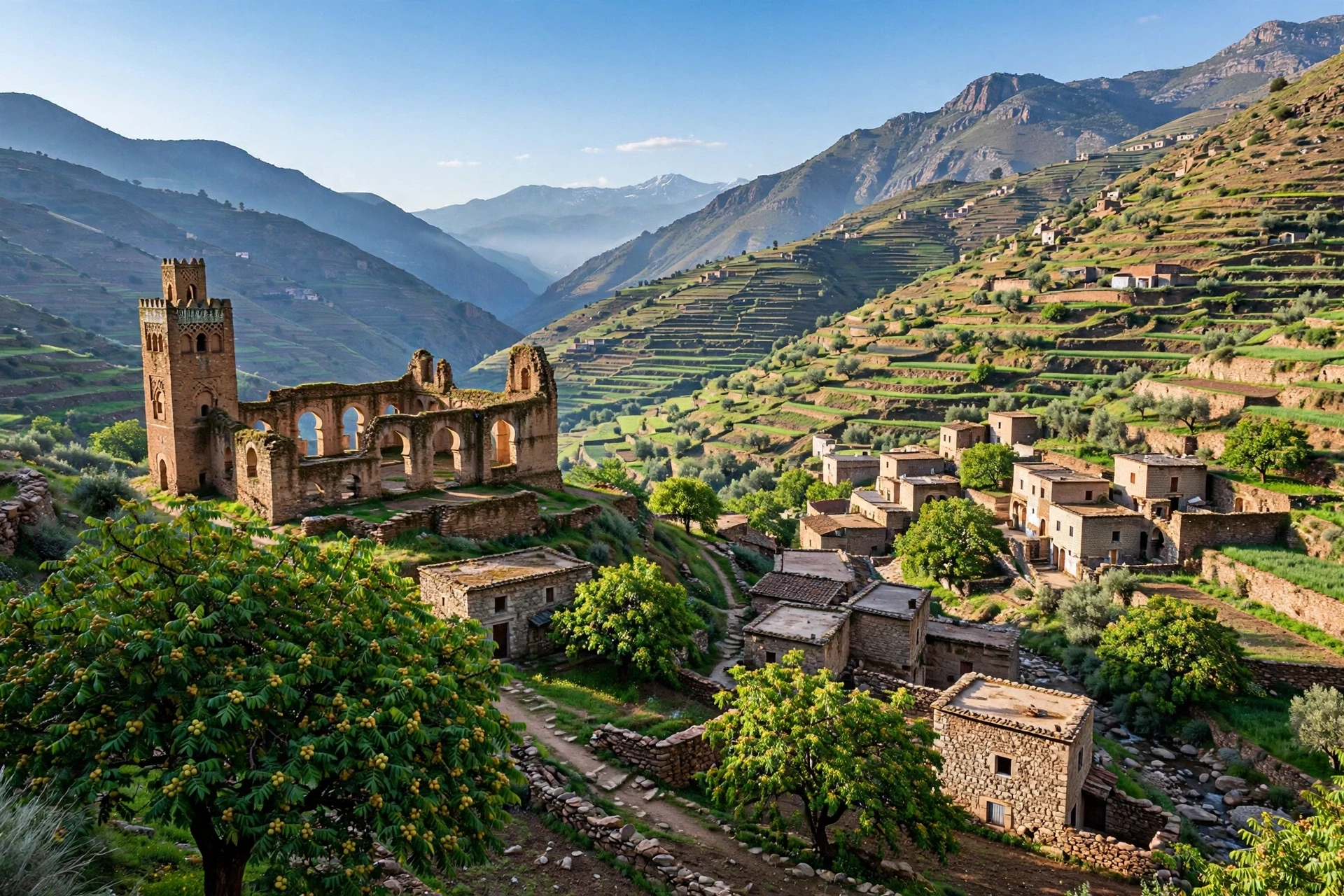
Tinmel Morocco is the most important historic site most visitors never reach. High in the Atlas Mountains, about 100 kilometres south of Marrakech, a ruined twelfth-century mosque stands in a small mountain village — where one of the great empires of the medieval Mediterranean began. Tinmel Morocco was the first capital of the Almohads, the dynasty that would rule from the Atlantic to Libya and deep into Spain.
This guide explains what Tinmel Morocco is, who built it, what you can see there today, and how to visit it on a day trip from Marrakech. It sits in our History & Heritage section, beside our Almohad dynasty guide and our wider History of Morocco — read those first if you want the full dynastic picture, then come back for the place itself.
In this guide
- The Story of Tinmel Morocco: From Mountain Village to Imperial Capital
- Ibn Tumart and the Almohad Idea
- The Tinmel Mosque: What You See Today
- The Road to Tinmel Morocco: Tizi n’Test and the High Atlas
- Visiting Tinmel Morocco: Tickets, Hours and What to Bring
- Tinmel and Marrakech: Two Halves of One Empire
- What Else to See Nearby
- Tinmel Morocco in One Day: A Practical Itinerary
- Frequently Asked Questions
- The Bottom Line on Tinmel Morocco
The Story of Tinmel Morocco: From Mountain Village to Imperial Capital
The story of Tinmel Morocco begins in the 1120s, in a small Amazigh village of the High Atlas. The Masmuda tribes who lived in these valleys were mountain farmers and herders, far from the courts of Marrakech — and it was here, not in a palace, that a religious reformer named Ibn Tumart built the movement that would conquer an empire. He chose Tinmel as his base around 1124, and the village became the spiritual and political headquarters of the Almohads.
What made Tinmel Morocco the capital was not wealth or size. It was loyalty. The tribes of the surrounding valleys rallied to Ibn Tumart's call for reform, and their mountain stronghold could not be taken by the Almoravid armies sent against it. For more than two decades, while the Almohads fought their way out of the mountains, Tinmel remained their capital, their treasury and the burial place of their first leaders.
The turning point came in 1147, when the Almohad armies finally took Marrakech. The court moved to the great plain city, and Tinmel Morocco faded from politics into memory. But it never lost its sacred status: the Almohad caliphs kept coming back, and the mosque Ibn Tumart's successors built here remained the dynasty's spiritual heart until the empire itself fell in the thirteenth century.
Ibn Tumart and the Almohad Idea
Ibn Tumart was born around 1080 — the exact year is not settled, and sources disagree — in the village of Igiliz in the Anti-Atlas. He studied in the east, in Baghdad and Mecca, and returned to Morocco convinced that the ruling Almoravids had drifted from true Islam. His message was strict and simple: one God, no compromise with luxury or corruption, and a community ruled by the law as he understood it.
In 1121 he declared himself the Mahdi, the awaited guided one, and the tribes of the Atlas accepted him. That claim is the hinge of the whole story: it turned a reformer into a ruler, and his followers into an army. The Almohad movement was a religious revolution first and a conquest second, and Tinmel Morocco was where the revolution was organised, preached and defended.
Ibn Tumart died in 1130, before Marrakech fell, and was buried at Tinmel Morocco. His successor Abd al-Mu'min — a brilliant general from the plains, not a mountain tribesman — turned the movement into an empire. Abd al-Mu'min ordered the great mosque of Tinmel built, around 1153 or 1154, on the site associated with Ibn Tumart. The exact year of the mosque's foundation is not settled either; what is certain is that it was raised within a generation of the Mahdi's death, as a monument to the man and the movement.
The Tinmel Mosque: What You See Today
The Tinmel Mosque is a ruin with a roof — and that is exactly what makes it extraordinary. Its walls, arches and mihrab survive almost complete, so you can walk through a twelfth-century Almohad mosque and read its architecture like a book. Historians consider it the prototype of Almohad mosque design: the great Koutoubia Mosque in Marrakech and the Giralda in Seville both descend from the plan first worked out here.
Step inside: the first thing you notice is the light. The prayer hall is a forest of horseshoe arches on plain pillars, with a carved stucco dome above the mihrab — the oldest surviving example of its kind in Morocco. There is no tilework, no gold, no painted cedar: the Almohads built in stone and plaster, and the decoration is geometry and calligraphy. It is austere by design, a building that preaches the same reform Ibn Tumart preached.
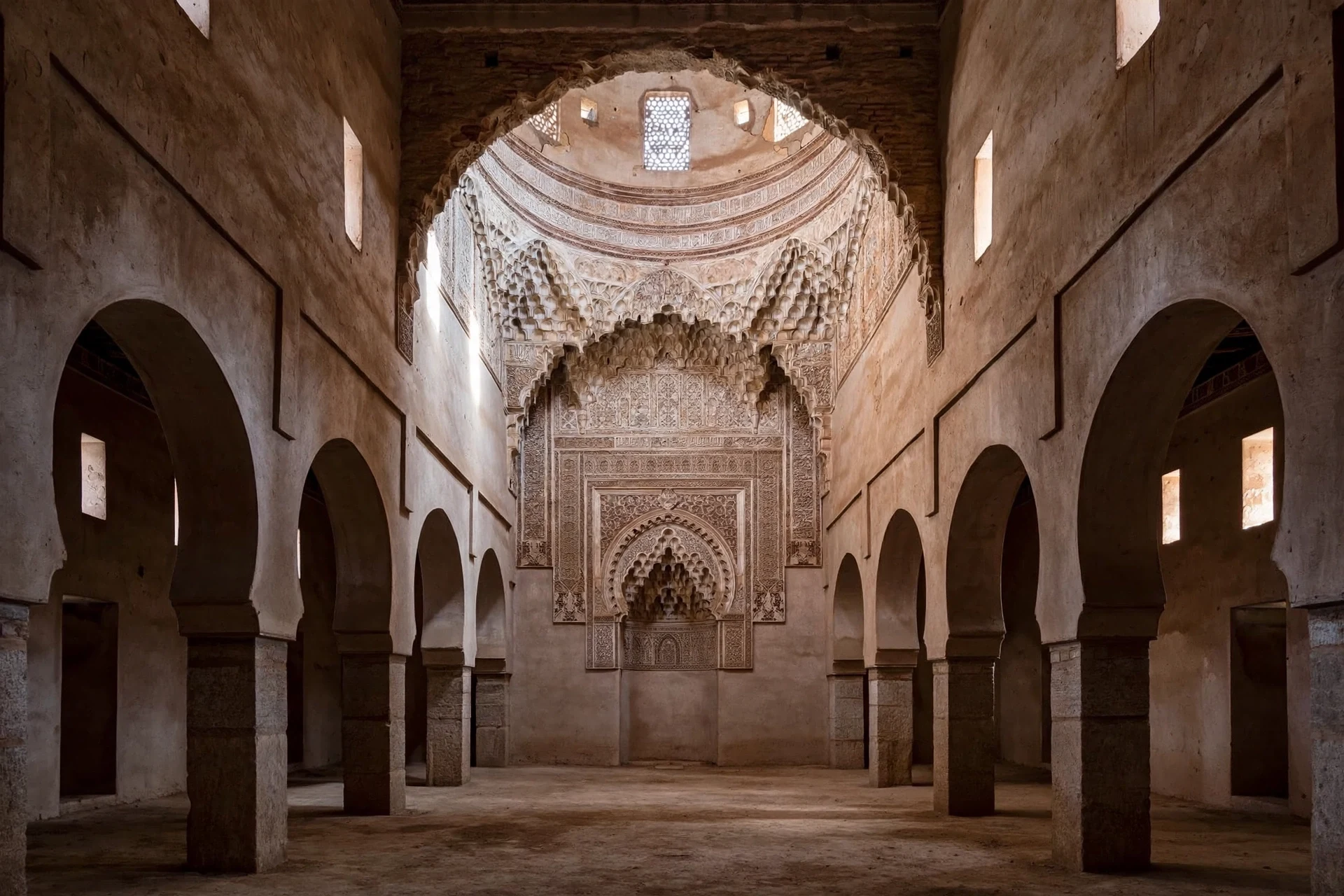
The mosque was badly damaged by the earthquake of September 2023, which struck the Al Haouz region and cracked walls across the Atlas. Restoration work was under way through 2025 and 2026, and access to the interior depends on the state of the works when you visit — the exterior and the village are always open, but the prayer hall may be partly scaffolded. Check the Wikipedia page on Tinmel and local news before you travel, and ask your driver or guide for the latest position.
The tombs of Ibn Tumart and the first Almohad caliphs lie beside the mosque, in a small cemetery that was once the dynasty's royal necropolis. It is a quiet, unmarked place by the standards of royal tombs — no marble, no guards, just low walls and mountain light — and that modesty is part of the story. The men who built an empire from this valley were buried where they began.
| Date | What happened at Tinmel |
|---|---|
| c. 1080 | Ibn Tumart is born in Igiliz in the Anti-Atlas (exact year not settled) |
| c. 1124 | Ibn Tumart makes Tinmel his base; the Almohad movement takes shape |
| 1130 | Ibn Tumart dies and is buried at Tinmel |
| 1147 | The Almohads take Marrakech; the court leaves Tinmel |
| c. 1153–1154 | Abd al-Mu'min builds the great mosque of Tinmel (exact year not settled) |
| 1269 | The Marinids take Marrakech; the Almohad empire ends |
| 20th century | The mosque is restored and protected as a historic monument |
| September 2023 | The Al Haouz earthquake damages the mosque; restoration begins |
| November 2026 | Restoration continues; check access before visiting |
The Road to Tinmel Morocco: Tizi n'Test and the High Atlas
Half the reason to visit Tinmel Morocco is the road. From Marrakech you drive south through the Ourika valley, then climb the Tizi n'Test pass at 2,092 metres — one of the great mountain roads of North Africa, a ribbon of tarmac cut into cliffs above a deep valley, with views that stop first-time drivers in their tracks. Tinmel sits on the far side of the pass, on the road down toward Taroudant.
The drive to Tinmel Morocco takes about two and a half to three hours from Marrakech, and the pass is the slow part: narrow, winding, and not a road for nervous drivers or large vehicles. In winter it can close after snow; in summer the afternoon heat makes the climb hard on an old car. A local driver who knows the road is worth every dirham — a private car with driver from Marrakech costs roughly 800–1,200 MAD (about $80–$120) for the day, and our Morocco Taxi Prices guide explains how to agree the price before you leave.
There is no train and no regular bus to Tinmel Morocco. Shared grand taxis run from Marrakech toward Ijoukak and the Tizi n'Test villages, but they are irregular, slow and hard to arrange without Arabic or French. For most visitors the practical choice is a private driver, or a day trip booked through a Marrakech agency that includes the pass, the mosque and a stop in the Ourika valley.
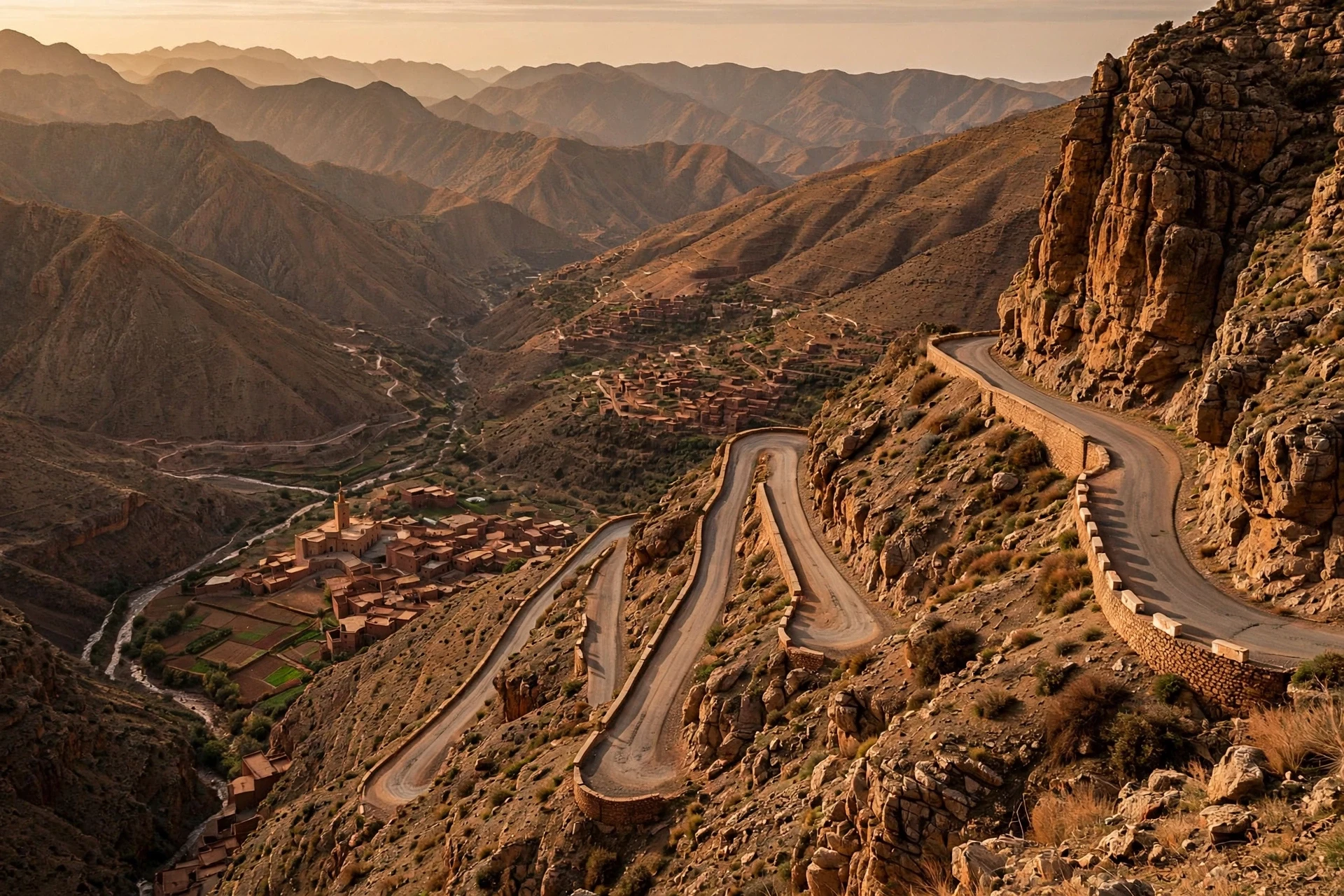
The reward for the climb is the silence. Tinmel Morocco is not a tourist town: there are no souvenir stalls, no tour buses, no queues. The village is a cluster of stone and earth houses in a valley of walnut trees and terraced fields, and the mosque rises from it without a fence or a ticket hall. Come on a weekday morning and you may have the twelfth century to yourself.
Visiting Tinmel Morocco: Tickets, Hours and What to Bring
Entry to the mosque at Tinmel Morocco has traditionally been free, with a small tip expected for the local guardian who opens the door and shows visitors around. That may change as restoration completes and formal visiting arrangements return, so carry cash — 50–100 MAD (about $5–$10) covers a tip and a drink in the village. A local guide at the site costs around 100–150 MAD (about $10–$15) and is worth it: without one, the arches are beautiful and meaningless; with one, the stones start to tell the story.
There are no fixed opening hours published for Tinmel Morocco. The mosque is generally open during daylight hours when the guardian is present, and closed on the rare days he is away. Arrive before noon for the best light inside the prayer hall and the best chance of finding the guardian. Friday is the weekly prayer day, so the mosque is busiest then and least available for sightseeing — visit on another day if you can.
Bring water, sun protection and walking shoes: the village paths are uneven, the altitude is around 1,200 metres, and there is little shade. A small shop or two in the village sells water and snacks, but there is no restaurant — eat in Marrakech before you leave, or plan lunch in the Ourika valley on the way back. Dress respectfully: this is a working mosque and a place of burial, so cover shoulders and knees, and ask before taking photographs inside.
| Practical detail | What to expect |
|---|---|
| Entry to the mosque | Traditionally free; tip the guardian 20–50 MAD |
| Local guide at the site | Around 100–150 MAD (~$10–$15) |
| Private car with driver from Marrakech | Around 800–1,200 MAD (~$80–$120) for the day |
| Drive from Marrakech | 2.5–3 hours each way via Tizi n'Test |
| Best time to arrive | Before noon, on a weekday |
| What to bring | Water, sun protection, walking shoes, cash |
| Facilities | Small village shops; no restaurant at the site |
Tinmel and Marrakech: Two Halves of One Empire
You cannot understand Tinmel Morocco without Marrakech, and you cannot understand Marrakech without Tinmel. The Almohads took the great plain city in 1147 and rebuilt it as their imperial capital — the Koutoubia Mosque, the Kasbah, the ramparts — but the dynasty's soul stayed in the mountains. Every Almohad caliph traced his legitimacy back to Ibn Tumart's preaching at Tinmel, and the mosque there was the empire's founding shrine.
Visit both in one trip and the contrast explains the dynasty. Our Marrakech Travel Guide covers the imperial city at its grandest: the Koutoubia's minaret is the direct descendant of Tinmel's modest tower, and the Kutubiyya's plan copies the mountain mosque's layout at ten times the scale. Tinmel is the sketch; Marrakech is the finished painting.
The link runs forward through Moroccan history too. The dynasties that followed the Almohads — the Marinids, the Saadians, the Alaouites — all ruled from the plain cities, but all of them kept returning to the Atlas for legitimacy, troops and refuge. Our Kings of Morocco: The Dynasties guide traces that pattern, and our Imperial Cities guide explains how the capital moved between Fes, Marrakech, Meknes and Rabat while the mountains watched.
What Else to See Nearby
Tinmel Morocco rewards a slow day, and the road over the Tizi n'Test is lined with stops that make the drive an itinerary in itself. The Ourika valley, on the Marrakech side of the pass, has waterfalls, Amazigh villages and riverside restaurants — go early, before the day-trip crowds. On the far side of the pass, the road drops toward Taroudant, the walled market town the Saadians used as a capital, and the Anti-Atlas beyond.
The classic pairing is Tinmel with the Kasbahs of the south. From the Tizi n'Test road you can continue to Ouarzazate, the gateway to the Sahara, and to Aït Ben Haddou, the famous fortified village on the old caravan road. Our Kasbahs of Morocco guide covers Aït Ben Haddou in detail, and our Ouarzazate Travel Guide explains how to build a two-day loop from Marrakech through Tinmel and the south.
If you have a second day, keep going: the Anti-Atlas town of Tafraoute, the painted rocks and the palm valleys, is a full day further south, and the Draa valley's kasbahs run east toward the Sahara. Tinmel Morocco is the starting point of that whole southern world, not just a stop on the way to it.
| Nearby stop | From Tinmel | Why go |
|---|---|---|
| Tizi n'Test pass (2,092 m) | On the road, 30 minutes | The great Atlas viewpoint |
| Ourika valley | 1.5 hours toward Marrakech | Waterfalls and riverside lunch |
| Taroudant | About 2 hours south | Walled Saadian market town |
| Aït Ben Haddou | About 3 hours via Tizi n'Tichka | The famous caravan kasbah |
| Ouarzazate | About 3 hours | Gateway to the Sahara |
Tinmel Morocco in One Day: A Practical Itinerary
A day trip to Tinmel Morocco works best as an early start and a slow return. Leave Marrakech by 8 a.m., drive the Ourika valley and climb the Tizi n'Test pass, and reach Tinmel by late morning — in time for the best light in the mosque and a guided visit of an hour or so. Walk the village, eat the packed lunch or the snacks you brought, and take the same road back, stopping at an Ourika riverside cafe for a late lunch.
Budget around 1,000–1,500 MAD (about $100–$150) for two people sharing a private car with driver, including the guide's tip and lunch — our How Much Does a Trip to Morocco Cost? guide puts that in context. If you want a fuller day, ask the driver to add the Ourika waterfalls on the way out and a sunset stop at the pass on the way back. The road is the attraction as much as the mosque, and rushing it wastes the trip.
Do not try to combine Tinmel Morocco with the Sahara or the coast in one day. The mountain roads are slow, the pass deserves an hour of stops, and the mosque deserves an unhurried visit. If you are short on time, choose Tinmel or the desert — not both. Our Morocco in 5 Days itinerary shows how to fit the Atlas, the desert and the imperial cities into a single trip without driving yourself to exhaustion.
Last checked: November 2026. Prices are given in Moroccan dirhams (MAD) with approximate US dollar equivalents at 10 MAD = $1. Entry, hours and restoration access at Tinmel change without notice; confirm with your driver or guide on the day, especially while earthquake restoration work continues.
Frequently Asked Questions
Where is Tinmel Morocco?
Tinmel Morocco is a small village in the High Atlas Mountains, about 100 kilometres south of Marrakech, on the road over the Tizi n'Test pass toward Taroudant. The ruined Almohad mosque stands in the village itself, beside the tombs of Ibn Tumart and the first Almohad caliphs.
Can you visit the Tinmel Mosque?
Yes, Tinmel Morocco is open to visitors, and non-Muslims can enter the mosque — it is a historic monument as well as a place of prayer. Access to the interior depends on the earthquake restoration work under way since 2023, so check the current position before you travel and arrive before noon, when the guardian is most likely to be present.
How long does a day trip to Tinmel Morocco take?
Allow a full day: about 2.5–3 hours each way from Marrakech, plus an hour at the mosque and stops on the Tizi n'Test pass. Leave by 8 a.m. and expect to be back in Marrakech by early evening.
How much does it cost to visit Tinmel Morocco?
Entry to the mosque has traditionally been free, with a tip of 20–50 MAD for the guardian. A local guide costs around 100–150 MAD, and a private car with driver from Marrakech costs roughly 800–1,200 MAD for the day. Budget 1,000–1,500 MAD for two people sharing a car, including lunch.
Is the Tizi n'Test road safe?
The Tizi n'Test is narrow and winding, with steep drops and few barriers, and it can close after snow in winter. It is safe with a local driver who knows it, but it is not a road for nervous drivers or for driving at night. Go in daylight, and never attempt it in bad weather.
What is the connection between Tinmel Morocco and the Koutoubia Mosque?
The Koutoubia Mosque in Marrakech was built by the Almohads on the plan first worked out at Tinmel Morocco — the same layout, arches and austere decoration, at ten times the scale. Tinmel is the prototype; the Koutoubia and the Giralda in Seville are its famous descendants. Check the official Visit Morocco site for opening hours and travel information.
The Bottom Line on Tinmel Morocco
Tinmel Morocco is the quietest great site in the country: no queues, no ticket hall, no crowds — just a twelfth-century mosque in a mountain village where an empire began. Go for the history, and stay for the road: the Tizi n'Test pass is one of the finest drives in North Africa, and the village itself is a reminder that Morocco's greatest dynasties started in the Atlas, not in the palaces. Visit Tinmel Morocco on a weekday morning, hire the local guide, and give the mosque the unhurried hour it deserves — it is the founding place of the Almohad empire, and it still feels like one.