
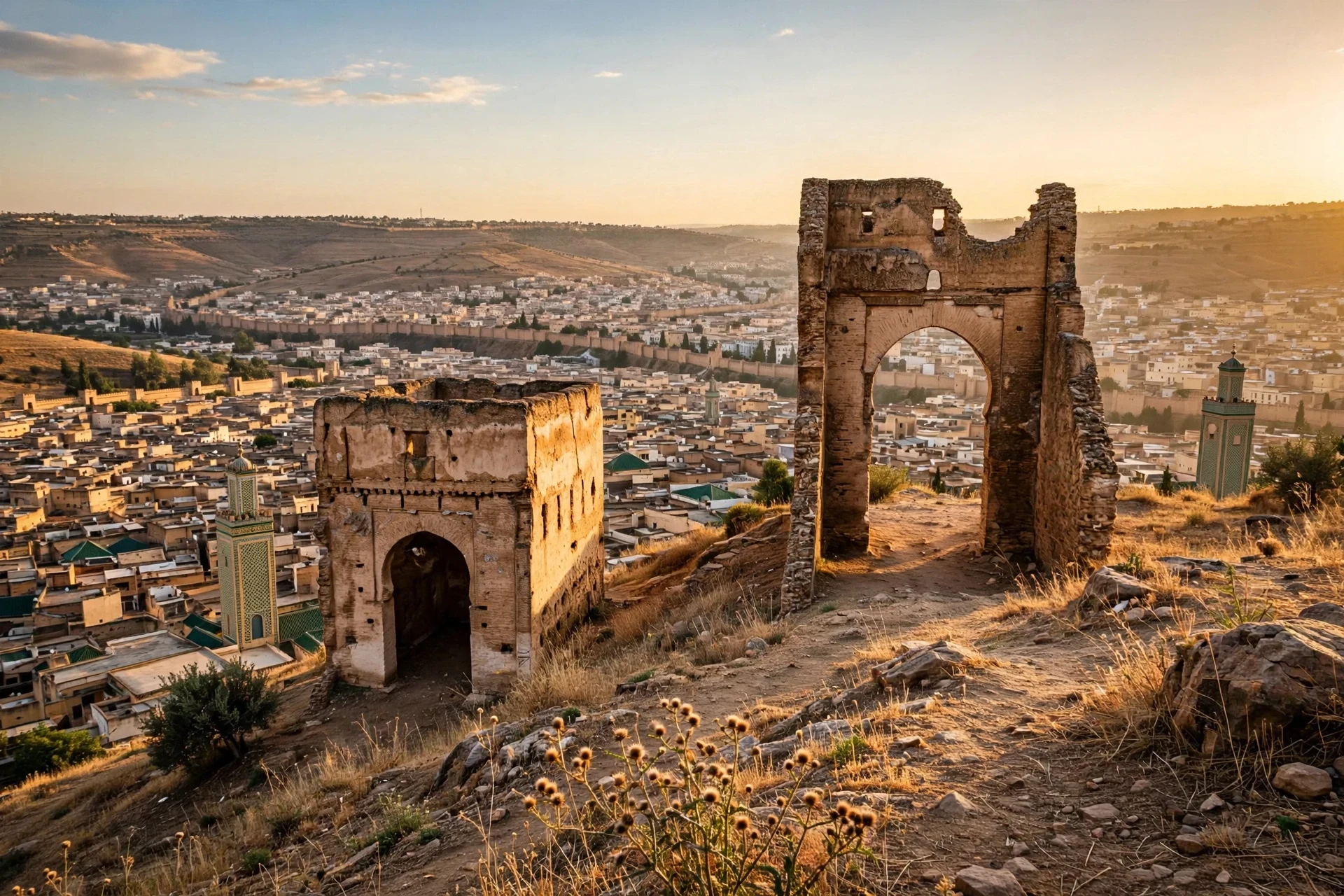
The Marinid Tombs Fes are the most atmospheric ruin in Morocco’s oldest city. On a bare hill north of the medina, two ruined 14th-century mausoleums stand open to the sky, their horseshoe arches framing the greatest view in Fes. The Marinid Tombs Fes hold the remains of the sultans who made the city a capital of learning, and they cost nothing to visit — no ticket, no queue, no guide.
This guide explains what the Marinid Tombs Fes are, who is buried there, what you can see today, and how to reach the hilltop safely. It sits in our History & Heritage section, beside our guide to the Marinid dynasty and our Fes Travel Guide — read those first for the wider story.
In this guide
- What Are the Marinid Tombs Fes?
- The Marinids: The Dynasty That Built Fes
- Who Is Buried at the Marinid Tombs Fes?
- What You See Today: Ruins, Arches and Silence
- The View from the Marinid Tombs Fes
- Visiting the Marinid Tombs Fes: Tickets, Hours and Getting There
- The Walk Up: From Bab Bou Jeloud to the Hilltop
- The Tombs and the Madrasas of Fes
- What Else to See Nearby
- The Marinid Tombs Fes in Half a Day
- Frequently Asked Questions
- The Bottom Line on the Marinid Tombs Fes
What Are the Marinid Tombs Fes?
The Marinid Tombs Fes are a ruined royal necropolis on a hill just north of Fes el Bali, the old medina. In the 14th century the Marinid sultans built a funerary complex here — a mosque, a madrasa and a row of mausoleums — on high ground where the tombs could watch over the city they ruled. Today the complex is a ruin: two mausoleums survive with their arches and domed roofs partly intact, the mosque is a shell of walls, and the rest is foundations and scattered stone.
What makes the Marinid Tombs Fes worth the climb is not what survives but where it stands. The hill is the natural viewpoint of the medina: from the tombs you look down across the whole of Fes el Bali — flat roofs, green-tiled minarets, the smoke of the tanneries — with the hills of the Middle Atlas behind it. At sunset the light turns the whole city gold, and the ruined arches frame it like a picture.
The Marinids: The Dynasty That Built Fes
The Marinids were an Amazigh dynasty of the Zenata tribal confederation who rose in the 13th century as the Almohad empire collapsed. They took Fes in 1244 and made it their capital, ruling Morocco from the city for the next two centuries. Under the Marinids, Fes became the great centre of learning in the western Islamic world, and the sultans founded the new royal city of Fes el Jdid in 1276.
The golden age came under Sultan Abu al-Hasan Ali ibn Othman (1331–1348), remembered as the Black Sultan, who took Tlemcen in 1337 and Tunis in 1347 and briefly ruled from the Atlantic to Libya. His reign also built the dynasty’s finest monuments: the great madrasas of Fes and the mosque and mausoleums of the Marinid Tombs Fes.
The fall was as fast as the rise. Abu al-Hasan was defeated at Kairouan in 1348, deposed by his son Abu Inan, and died in exile in 1351. Abu Inan built the Bou Inania Madrasa and was assassinated by his vizier in 1358. After him came a century of weak sultans, and in 1465 the last Marinid sultan was killed in a revolt in Fes. Our guide to the Marinid dynasty tells the full story.
| Date | What happened |
|---|---|
| 1244 | The Marinids take Fes and make it their capital |
| 1276 | Sultan Abu Yusuf founds Fes el Jdid, the new royal city |
| 1331–1348 | Reign of Abu al-Hasan, the dynasty’s greatest expansion |
| 1337 | Abu al-Hasan takes Tlemcen; 1347 he takes Tunis |
| 1348 | Defeat at Kairouan; Abu al-Hasan is deposed by his son Abu Inan |
| 1350–1355 | Abu Inan builds the Bou Inania Madrasa in Fes |
| 1351 | Abu al-Hasan dies in exile in the High Atlas |
| 1358 | Abu Inan is assassinated; the dynasty begins its long decline |
| 1465 | The last Marinid sultan is killed in a revolt in Fes |
| 1981 | Fes el Bali is listed as a UNESCO World Heritage Site |
Who Is Buried at the Marinid Tombs Fes?
The honest answer is that nobody knows for certain. The two surviving mausoleums are generally attributed to Sultan Abu al-Hasan and his son Abu Inan, the two great 14th-century rulers — but the attribution is a tradition, not a proven fact. No inscriptions survive, and the sources disagree: some accounts place Abu al-Hasan’s burial here, others say he was buried elsewhere after his death in exile. The exact identities of the dead are not settled — see the Wikipedia page on the Marinid Tombs — and any guide who tells you otherwise is guessing.
What is certain is that the Marinid Tombs Fes were a royal necropolis of the Marinid dynasty, built in the 14th century on the hill above the capital. The sultans chose the site deliberately: high ground, visible from the city, beside the road to the north. A royal tomb in medieval Morocco was a political statement as much as a burial. The Marinids built theirs on this hill, and then the dynasty was moved anyway.
The uncertainty is part of the visit. Stand between the two ruined mausoleums and you are standing among the most powerful men of 14th-century Morocco — or among their relatives, or among later sultans whose names are lost. The stones do not say.
What You See Today: Ruins, Arches and Silence
Arrive at the Marinid Tombs Fes and the first thing you notice is how little is left — and how much that little says. Two mausoleums stand on the hilltop, their walls of stone and rammed earth still carrying the great horseshoe arches of Marinid architecture. One keeps part of its domed roof; the other is open to the sky. Around them are the low foundations of the mosque and the madrasa, and fragments of carved plaster and tile the weather has not yet taken.
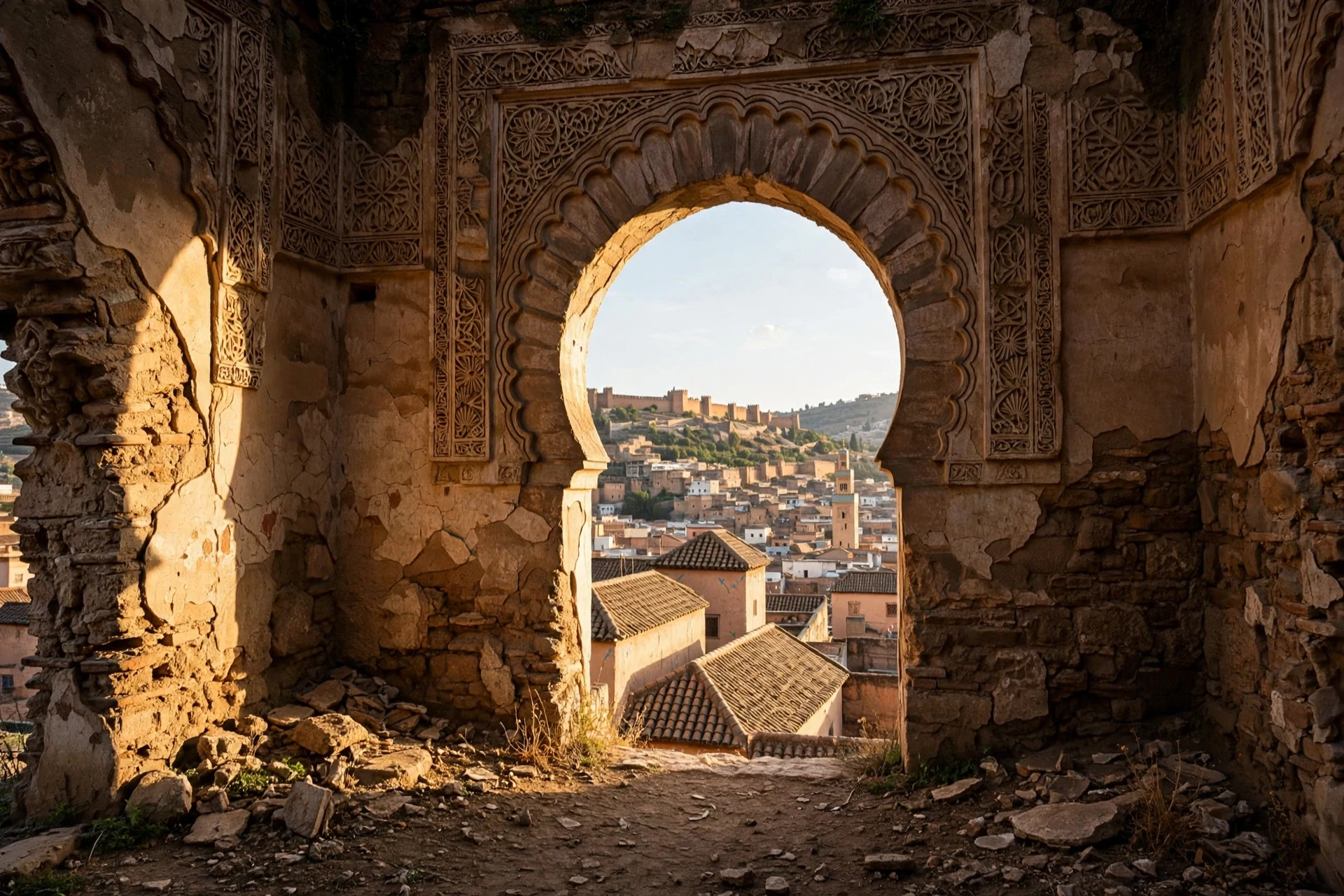
The arches are the highlight. Marinid builders worked in the style the Almohads had perfected — the horseshoe arch, carved plaster, geometry — and at the tombs you can see it without the crowds that fill the madrasas below. Walk through one mausoleum and look back: the arch frames the medina like a window.
There is no restoration here and no museum: the site is conserved as a ruin, the stones stabilised but nothing rebuilt. That honesty is rare among Morocco’s historic sites. At the Marinid Tombs Fes you see the 14th century as time left it — broken, weathered, and entirely itself. Bring a camera, but also bring patience: the place rewards a slow half hour, not a five-minute photo stop.
The View from the Marinid Tombs Fes
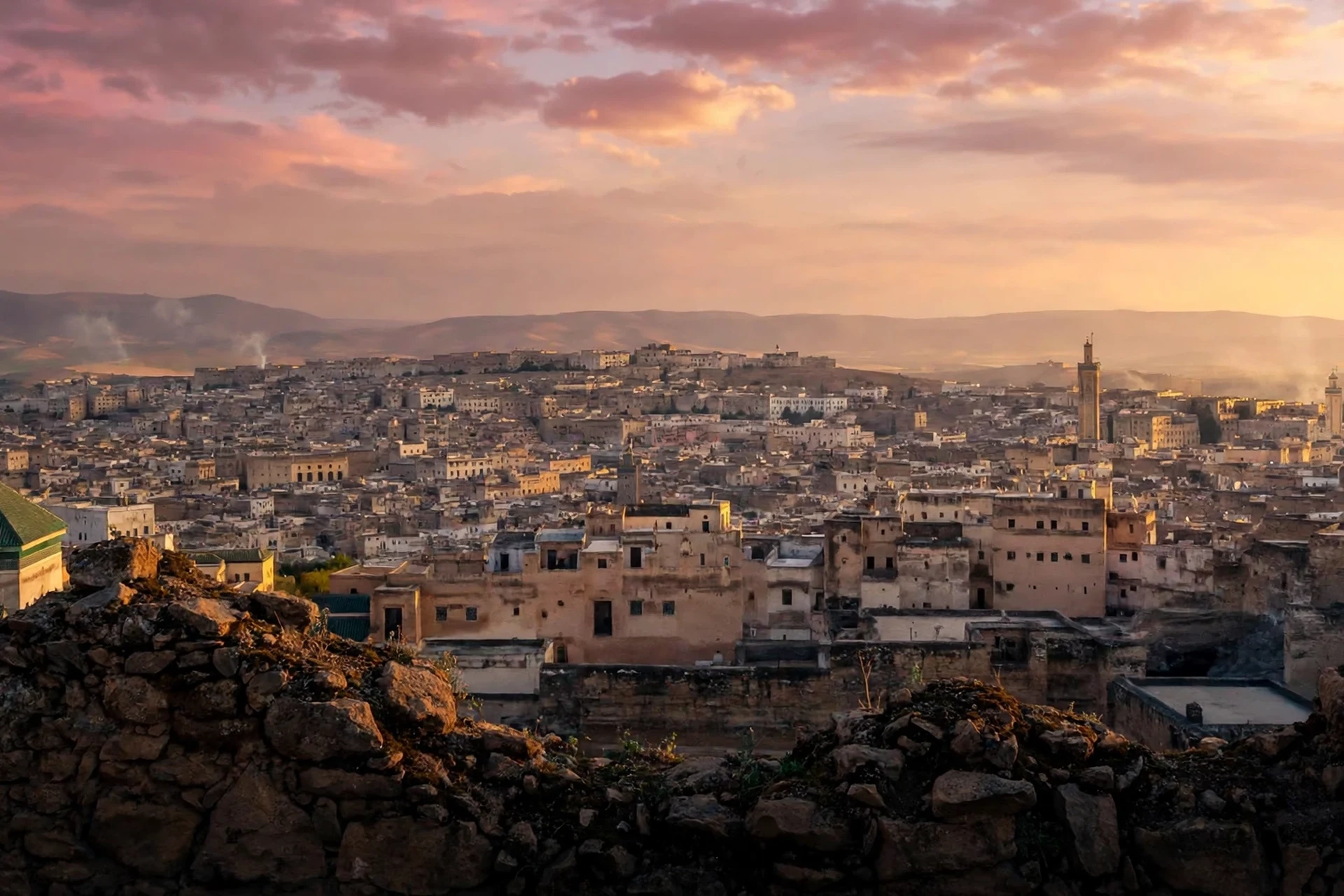
The view is why most people climb the hill. From the Marinid Tombs Fes you see the whole of Fes el Bali below you: the dense roofs, the green tiles of the Bou Inania and Attarine minarets, the dome of the Qarawiyyin, and the smoke of the Chouara tannery. Beyond the medina, Fes el Jdid and the modern city stretch to the hills.
Sunset is the best time. The light comes low across the medina, the roofs turn gold and then rose, and the call to prayer rises from a dozen minarets at once. Come to the Marinid Tombs Fes an hour before sunset, claim a spot by the northern mausoleum, and leave as the last light fades — the walk down in the dark is the one thing to avoid.
Sunrise is the quieter choice: the tombs are empty at dawn, the light is soft, and the hill is cool — which matters, because the hilltop has no shade at all and by noon in July the stone is too hot to sit on. In winter the afternoon is kindest, with warm sun and the best long-distance visibility. Whatever the season, bring water and a hat: there is nowhere to buy anything.
Visiting the Marinid Tombs Fes: Tickets, Hours and Getting There
Entry to the Marinid Tombs Fes is free. There is no ticket office, no gate and no published opening hours — the hilltop is an open site, and you can walk up at any time in daylight. That freedom is the attraction and the catch: there are also no facilities, no toilets, no cafe, no shade and no official guide. Come prepared, and treat the site like a walk in the hills.
The only money you are likely to spend is on transport. A petit taxi from the edge of the medina to the road below the tombs costs around 20–30 MAD (about $2–$3) on the meter — agree the price first if the meter is off, as our Morocco Taxi Prices guide explains. From the road it is a short climb on foot to the Marinid Tombs Fes. There is no bus to the site.
Unofficial guides sometimes wait near the tombs and offer a tour. A short explanation is worth 50–100 MAD (about $5–$10) if you want one, but agree the price first and be ready to say no politely — the history in this guide covers everything a guide will tell you, and the view needs no explanation.
| Practical detail | What to expect |
|---|---|
| Entry to the Marinid Tombs Fes | Free — open site, no ticket or gate |
| Opening hours | No fixed hours; visit in daylight only |
| Walk from Bab Bou Jeloud | 20–30 minutes, steep in places |
| Petit taxi from the medina edge | Around 20–30 MAD (~$2–$3) on the meter |
| Unofficial guide at the site | 50–100 MAD (~$5–$10) if you accept one |
| Best time | One hour before sunset, or early morning |
| What to bring | Water, sun protection, good shoes, cash |
| Facilities | None — no toilets, cafe, shade or shop |
The Walk Up: From Bab Bou Jeloud to the Hilltop
The classic approach is on foot from Bab Bou Jeloud, the great blue gate of the medina. From the gate, walk north through Bab Guissa and follow the road as it climbs out of the medina and up the hill. The walk takes 20–30 minutes and gets steep in the last stretch. Wear proper shoes: the path is a mix of tarmac, stone steps and loose earth.
The walk is part of the experience. Leaving the medina through Bab Guissa, you pass from the dense lanes of Fes el Bali into a quieter world of houses and gardens, and the city falls away below you with every step. Look back often: the view builds as you climb.
Go to the Marinid Tombs Fes in daylight and come down before dark. The hilltop is isolated after sunset, the path is uneven, and there is no lighting. Groups gather for sunset and walk down together as the light fades — join them rather than lingering alone. Women travelling solo should go in the morning or with the sunset crowd, not alone at dusk.
The Tombs and the Madrasas of Fes
You cannot understand the Marinid Tombs Fes without the madrasas below them. The same sultans who built their tombs on the hill built the great schools of Fes el Bali — the Bou Inania, the Attarine, the Sahrij — and the two projects were one idea: the dynasty would be remembered for learning as well as for conquest.
Visit both on the same day and the contrast teaches the dynasty. The Bou Inania Madrasa, built by Abu Inan between 1350 and 1355, is a jewel of carved cedar, zellige tile and plaster — the finest Marinid building in Morocco. Entry costs around 20 MAD (about $2); our Morocco Attraction Ticket Prices guide lists the current fees for the monuments of Fes.
The link between the hill and the schools is the man himself: Abu Inan built the Bou Inania while his father’s tomb — probably — stood at the Marinid Tombs Fes above. Seven centuries later, the schools are still used and the tombs are still standing.
What Else to See Nearby
The Marinid Tombs Fes sit at the northern edge of the medina, so the best of old Fes is a short walk downhill. Start with Bab Guissa itself, the 13th-century northern gate of Fes el Bali, and the Borj Nord just outside it — a 16th-century Saadian fortress that now holds the Museum of Arms, with a terrace view of its own. Entry costs around 20 MAD (about $2).
Downhill from the tombs, the medina offers a full day on its own: the Bou Inania and Attarine madrasas, the Chouara tannery with its pits of dye, and the Qarawiyyin mosque and university, founded in 859. Our Fes Travel Guide maps all of them, and our guide to the Saadians explains the dynasty that built the Borj Nord and the tombs of Marrakech.
If you have a second day, cross to Fes el Jdid, the Marinid royal city founded in 1276, with its Mellah and the gates of the Royal Palace, the most photographed doors in Morocco. The Marinids built two cities side by side — one for the people, one for the court — and both are still standing. Our Imperial Cities guide explains how Fes fits beside Marrakech, Meknes and Rabat.
| Nearby stop | From the tombs | Why go |
|---|---|---|
| Bab Guissa | 10 minutes downhill | The 13th-century northern gate of Fes el Bali |
| Borj Nord and the Museum of Arms | 15 minutes downhill | Saadian fortress, arms collection, terrace view |
| Bou Inania Madrasa | 20 minutes in the medina | The finest Marinid building in Morocco |
| Attarine Madrasa | 25 minutes in the medina | Quiet courtyard of tile and carved wood |
| Chouara Tannery | 25 minutes in the medina | The famous dye pits, best seen from a terrace |
| Fes el Jdid and the Mellah | 30 minutes by taxi | Marinid royal city and the old Jewish quarter |
The Marinid Tombs Fes in Half a Day
The tombs fit neatly into a half day in Fes, as the end of a medina morning. Spend the morning in Fes el Bali — the Bou Inania Madrasa, the Attarine, the tanneries, lunch in a medina restaurant — and walk up in the late afternoon, arriving an hour before sunset. An hour on the hilltop is enough: walk the ruins, watch the light change, and walk down with the sunset crowd.
Budget around 100–150 MAD (about $10–$15) for the half day beyond lunch: the madrasa entries, a petit taxi if you skip the walk up, and a tip if you take a guide. Our How Much Does a Trip to Morocco Cost? guide puts that in the context of a full Fes budget. The tombs themselves cost nothing, and they are the best free view in the city.
Do not try to combine the tombs with a long drive the same afternoon. The hill deserves an unhurried hour. If you are short on time, choose the tombs at sunset or the medina in the morning — not both in a hurry. Fes rewards slowness, and the Marinid Tombs Fes most of all: they have waited seven centuries.
Last checked: November 2026. Prices are given in Moroccan dirhams (MAD) with approximate US dollar equivalents at 10 MAD = $1. The Marinid Tombs are an open, unstaffed site; access and conditions can change without notice, so confirm the walking route with your hotel or guide on the day.
Frequently Asked Questions
Where are the Marinid Tombs Fes?
The Marinid Tombs Fes are on a hill just north of Fes el Bali, above the Bab Guissa gate. The ruined 14th-century mausoleums stand on the hilltop, overlooking the whole medina, about a 20–30 minute walk uphill from Bab Bou Jeloud.
Is there an entry fee for the Marinid Tombs Fes?
No. Entry to the Marinid Tombs Fes is free — the hilltop is an open site with no ticket office or gate. The only costs are transport (a petit taxi costs around 20–30 MAD) and an optional tip of 50–100 MAD if you accept an unofficial guide.
Who is buried in the Marinid Tombs Fes?
The two surviving mausoleums are generally attributed to Sultan Abu al-Hasan (ruled 1331–1348) and his son Abu Inan (ruled 1348–1358), but the attribution is not certain — no inscriptions survive, and the sources disagree. The exact identities of the dead at the Marinid Tombs Fes are not settled.
When is the best time to visit the Marinid Tombs Fes?
One hour before sunset, for the golden light over Fes el Bali and the call to prayer from the minarets below. Early morning is the quieter alternative, with soft light and no crowds. Avoid midday in summer — the hilltop has no shade — and leave before dark.
How long does it take to walk to the Marinid Tombs Fes?
Allow 20–30 minutes on foot from Bab Bou Jeloud, through Bab Guissa and up the hill — steep in the last stretch. A petit taxi from the edge of the medina costs around 20–30 MAD and leaves only a short climb. Check the official Visit Morocco site before you go.
Are the Marinid Tombs Fes safe to visit?
Yes, in daylight. The Marinid Tombs Fes are a popular viewpoint and are busy at sunset. Go in the morning or with the sunset crowd, stay on the main path, and walk down before dark — the hilltop is isolated and unlit at night.
The Bottom Line on the Marinid Tombs Fes
The Marinid Tombs Fes are the quietest great site in Morocco’s oldest city: no ticket, no queue, no restoration — just two ruined mausoleums on a hill above the medina, holding the remains of the sultans who built Fes into a capital of learning. Go for the history, and stay for the view: at sunset the whole of Fes el Bali turns gold below the arches. Visit the Marinid Tombs Fes on a clear afternoon, walk up from Bab Bou Jeloud, give the hilltop an unhurried hour, and walk down with the light — the best free view in Fes, and the most honest monument the Marinids left behind.