
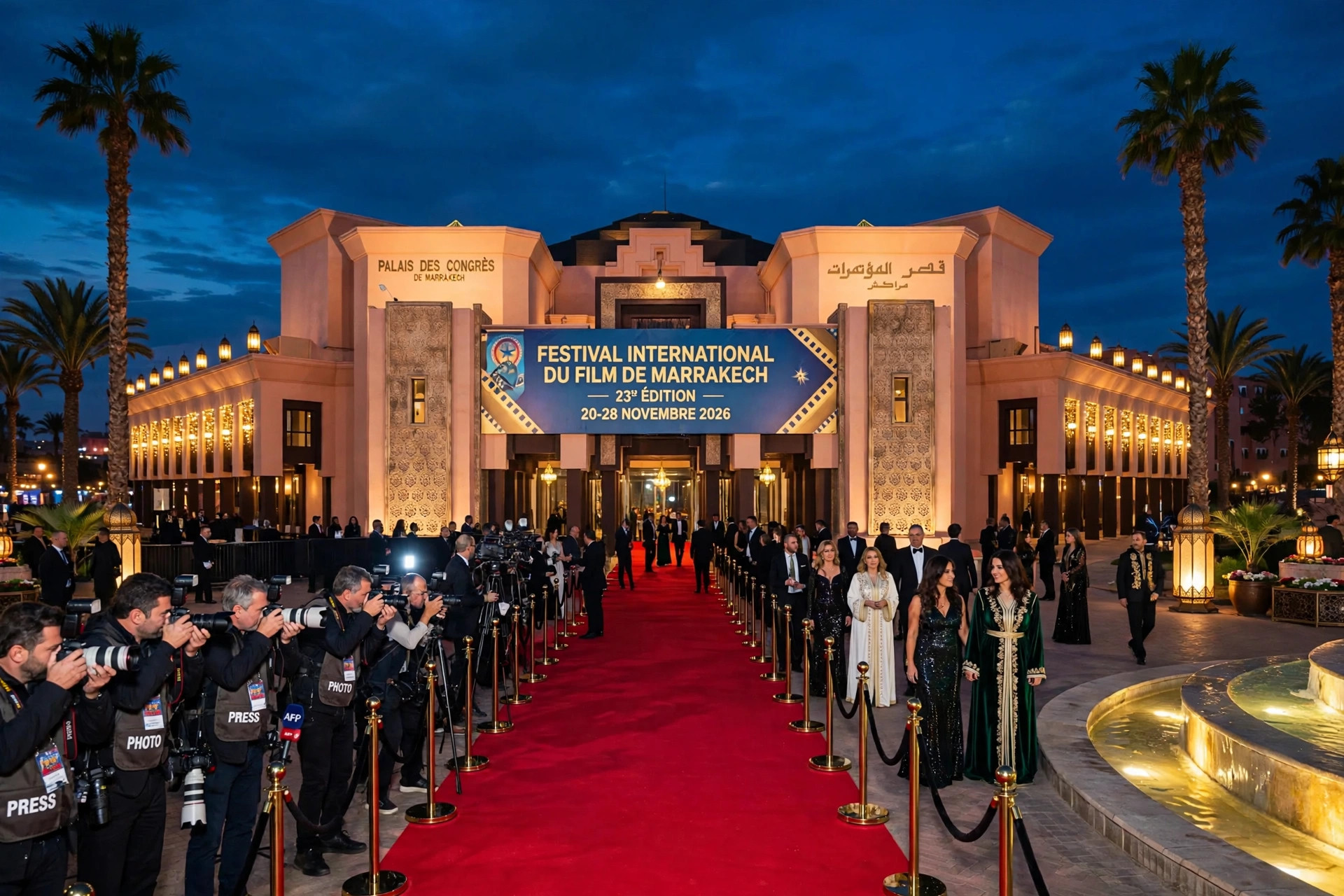
The history of Moroccan cinema begins with a camera pointed at a goatherd in 1897, and it is still being written today on a red carpet in Marrakech. In between lies an unusual film story: a country that spent its first sixty years as a backdrop for other people's films, then built its own cinema from almost nothing — and now wins prizes at Cannes.
This guide follows the history of Moroccan cinema era by era, from the first Lumière reel to the studios of Ouarzazate and the open-air screenings on Jemaa el-Fna — pioneers, desert blockbusters, festivals and the new generation, and where to watch Moroccan films and walk through the sets yourself.
In this guide
- The Short Answer: The History of Moroccan Cinema in One Page
- The History of Moroccan Cinema at a Glance
- 1897: The Camera Arrives — Lumière, Veyre and a Sultan Behind the Lens
- The Colonial Screen: Foreign Films and the First Moroccan Audiences
- 1944: The CCM and the Institutions of Moroccan Cinema
- Independence and the First Moroccan Feature: Ousfour’s Le fils maudit
- Wechma (1970) and the New Wave That Followed
- Ouarzazate: How the Desert Became Hollywood’s Backlot
- The Blockbusters: From Lawrence of Arabia to Gladiator
- The Festivals: Tangier 1982 and the Birth of Marrakech
- The Marrakech International Film Festival Today
- The New Generation: Ayouch, Touzani, El Moudir and Cannes
- Amazigh Cinema and the Languages of the Screen
- The Industry Today: Funding, Screens and Audiences
- Watching Moroccan Cinema as a Visitor
- Frequently Asked Questions
- Conclusion: Why the History of Moroccan Cinema Still Matters
The Short Answer: The History of Moroccan Cinema in One Page
The history of Moroccan cinema is the story of a country that learned to film itself late, then caught up fast. A Lumière operator shot the first footage in Morocco in 1897, and for sixty years the cameras belonged to foreigners: French colonial films, then Hollywood epics around Ouarzazate.
Independence in 1956 changed the question. Mohamed Ousfour made the first Moroccan feature, Le fils maudit, in 1958, and Hamid Bennani's Wechma (1970) gave the young cinema its first cult classic. The state built the Centre Cinématographique Marocain (CCM) in 1944 and a production fund in 1980; Atlas Studios, founded in Ouarzazate in 1983, turned the desert into a great backlot. Think of the history of Moroccan cinema as two stories braided together — the foreign blockbusters that made Morocco famous, and the Moroccan directors who finally told their own stories — meeting every November at the Marrakech festival, founded in 2001. More in our History & Heritage section.
The History of Moroccan Cinema at a Glance
| Era | Dates | Defining moment |
|---|---|---|
| First images | 1897–1912 | Lumière operator films Le chèvrier Marocain in 1897 |
| Colonial screen | 1912–1956 | French features use Morocco as a set; CCM founded 1944 |
| Independence pioneers | 1956–1970 | Ousfour's Le fils maudit (1958), the first Moroccan feature |
| New wave | 1970–1983 | Bennani's Wechma (1970); state production fund from 1980 |
| Ouarzawood | 1983–2001 | Atlas Studios opens (1983); Gladiator shoots in 2000 |
| Festival era | 2001–today | Marrakech festival founded 2001; Cannes prizes in 2022–2023 |
| Boom years | 2023–2025 | Record 26 features completed in 2025; 87 screens nationwide |
1897: The Camera Arrives — Lumière, Veyre and a Sultan Behind the Lens
The history of Moroccan cinema starts almost as early as cinema itself. In 1897, barely two years after the Lumières' first public screening in Paris, one of their operators filmed Le chèvrier Marocain — "The Moroccan Goatherd" — on Moroccan soil: a short actuality film of the kind the Lumière company shot all over the world, and proof that Morocco faced a movie camera from the very first years of the medium.
The Colonial Screen: Foreign Films and the First Moroccan Audiences
For the first half of the twentieth century, the history of Moroccan cinema was mostly written by visitors. French directors found in Morocco an Orient close to home: Jacques Feyder shot L'Atlantide (1921) and Julien Duvivier filmed La Bandera (1935) with Moroccan landscapes and extras, and Jean Benoît-Lévy's Itto (1934), shot in the Atlas with Moroccan actors, was one of the first sound films to give local faces a real part.
Egyptian musicals were hugely popular too, and their songs shaped Moroccan taste for a generation — an influence you can still hear in Moroccan popular music, as our guide to the history of Moroccan music explains.
1944: The CCM and the Institutions of Moroccan Cinema
The history of Moroccan cinema changed course in 1944, twelve years before independence, with the creation of the Centre Cinématographique Marocain (CCM). Founded under the Protectorate, it survived independence and became the central institution of Moroccan film, regulating the sector, running the support fund and keeping the national archive.
The CCM's real power came later. In 1980 it set up the Support Fund for film production, the avance sur recettes — advances on box-office receipts, modelled on the French system — and from 2009 the state committed about 60 million dirhams (around $6 million) a year to production. Today the CCM supports national film with nearly 110 million dirhams (about $11 million) a year, and that steady funding is the main reason Morocco now produces more than twenty features a year.
Independence and the First Moroccan Feature: Ousfour's Le fils maudit
Independence in 1956 posed a new question. The history of Moroccan cinema is usually dated from the answer: Mohamed Ousfour's Le fils maudit ("The Damned Son"), released in 1958 and widely cited as the first Moroccan feature. Ousfour, a projectionist who had taught himself the craft in Casablanca's cinemas, made a melodrama in the popular Egyptian style — a son, a curse, a family torn apart.
The "first feature" label deserves a small caution: Ousfour had already made shorts in 1956 and 1957, and some scholars trace Moroccan narrative film to those rather than to the 1958 feature. What nobody disputes is that Ousfour was the pioneer: he showed that a Moroccan could write, direct and produce a film in his own country, and he went on making popular films for decades, while the CCM's film caravans carried Moroccan films to rural areas.
Wechma (1970) and the New Wave That Followed
If Ousfour opened the door, Hamid Bennani kicked it open. His Wechma (1970) is the film most critics agree marks the real beginning of modern Moroccan cinema. A bleak, beautiful portrait of a young man drifting through Casablanca, shot in black and white.
Wechma became a cult film, acclaimed abroad and studied at home ever since, and it set the pattern for the generation that followed. In the 1970s and early 1980s, Mustapha Derkaoui (About Some Meaningless Events, 1974), Ahmed Maanouni (Alyam, Alyam, 1978) and Ahmed Bouanani (Mirage, 1980) made personal, political, formally daring films — the Casablanca of the poor, the villages of the Atlas, the silences of the Years of Lead — often with little hope of a commercial release. It set the tradition that still defines Moroccan film: modest budgets, strong local stories, directors who write what they know. The same generation built the critical culture around it — magazines, ciné-clubs and the National Film Festival, founded in Tangier in 1982.
Ouarzazate: How the Desert Became Hollywood's Backlot
The history of Moroccan cinema took a second, very different turn in the desert. Filmmakers had been drawn to Ouarzazate since David Lean shot Lawrence of Arabia there in the early 1960s, but there was no permanent facility until 1983, when the entrepreneur Mohamed Belghmi founded Atlas Studios about five kilometres west of town.
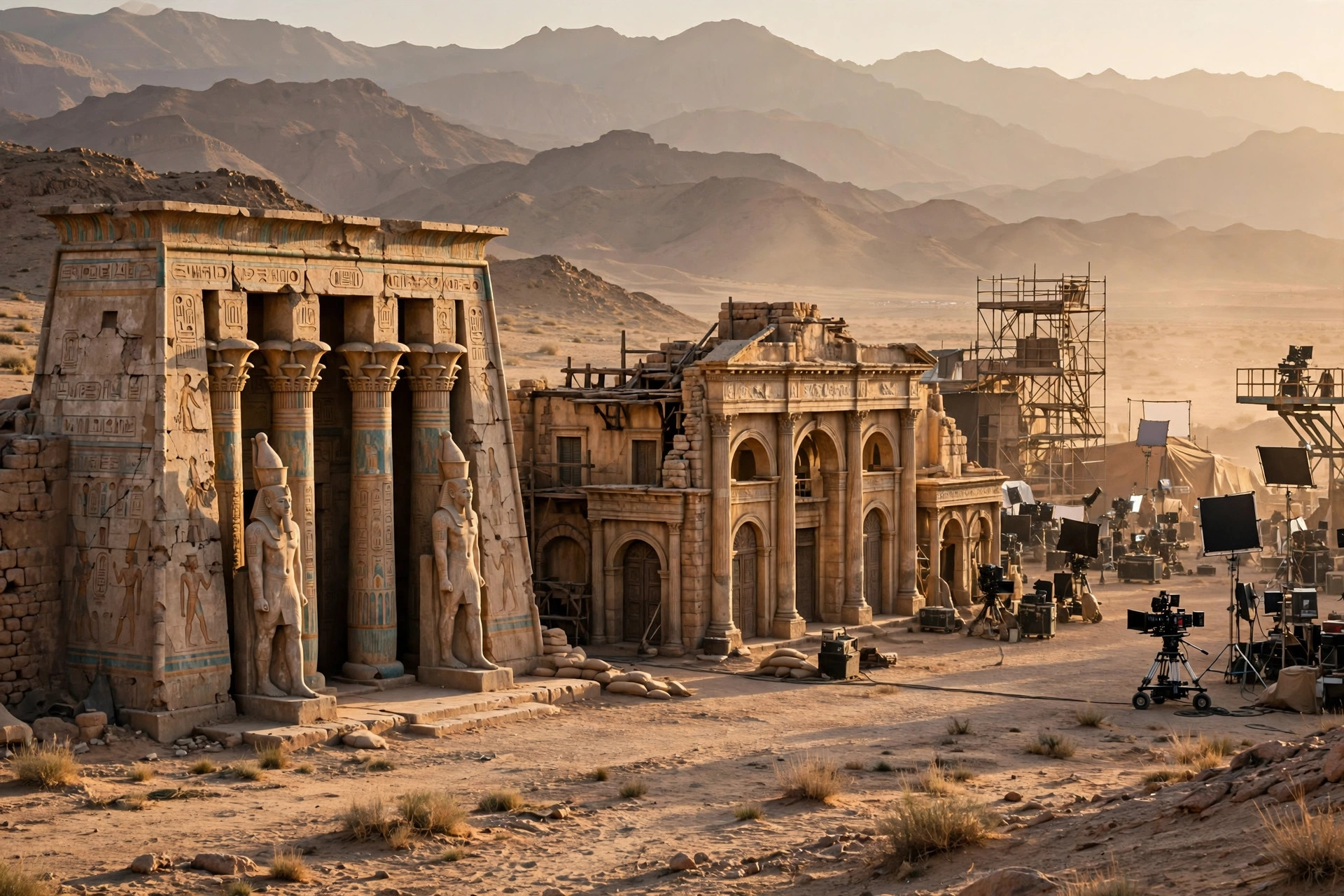
Atlas Studios — also called Atlas Corporation Studios — grew into one of the largest film studios in the world by land area, a huge open-air backlot where full-scale sets are built and left standing: a Tibetan monastery for Scorsese's Kundun (1997), a Roman town for Gladiator (2000), an Egyptian temple for The Mummy (1999). The town earned the nickname "Ouarzawood", and a second studio, CLA Studios, opened nearby.
The economics matter as much as the glamour. Foreign productions injected about 1.21 billion dirhams (around $121 million) into the Moroccan economy in 2025 alone, and in June 2026 Morocco broke ground on an International Cinema City at the entrance to Ouarzazate, a 240-million-dirham (about $25 million) complex. See our guide to Ait Benhaddou and the kasbahs and our Marrakech travel guide for the full story.
The Blockbusters: From Lawrence of Arabia to Gladiator
In the history of Moroccan cinema, the desert has played more parts than any actor, standing in for ancient Rome, Tibet, Egypt, Jerusalem and the fantasy continents of television — the table below picks the landmarks.
| Film or series | Year | What Morocco played |
|---|---|---|
| Lawrence of Arabia | 1962 | The Arabian desert; David Lean's epic put Ouarzazate on the map |
| The Man Who Knew Too Much | 1956 | Marrakech, in Hitchcock's opening scenes |
| The Jewel of the Nile | 1985 | One of the first big productions at Atlas Studios |
| Kundun | 1997 | Tibet, built in the desert by Martin Scorsese |
| The Mummy | 1999 | Ancient Egypt, shot around Ouarzazate and Erfoud |
| Gladiator | 2000 | A Roman provincial town; the slavery and gladiator-school scenes |
| Kingdom of Heaven | 2005 | Jerusalem and the Crusades, on the Ouarzazate backlot |
| Babel | 2006 | A Moroccan village, in Alejandro Iñárritu's multi-story drama |
| Game of Thrones | 2013 | Yunkai, the slave city, played by Ait Benhaddou |
| Gladiator II | 2024 | Early sequences shot in Ouarzazate before the move to Malta |
The relationship cuts both ways. Foreign shoots employ hundreds of Moroccan technicians, drivers, builders and extras, and train local crews for Moroccan films — but they also fix an image of Morocco as deserts and ruins, one reason Moroccan directors work so hard to film the country's cities and interiors instead.
The Festivals: Tangier 1982 and the Birth of Marrakech
The festival that changed everything in the history of Moroccan cinema was born in Marrakech. The Marrakech International Film Festival (FIFM) was created in 2001 on the initiative of King Mohammed VI, with the French producer Daniel Toscan du Plantier as its first organiser. Its first edition opened on 28 September 2001, barely two weeks after the 11 September attacks; the Étoile d'Or went to Yamina Benguigui's Inch'Allah Dimanche. From 2002 the festival has been run by a foundation chaired by Prince Moulay Rachid, with a competition for first and second features, gala screenings and free open-air screenings on Jemaa el-Fna — bringing world cinema to Moroccans, not just stars to Marrakech.
The Marrakech International Film Festival Today
The Marrakech festival is a leading film event in Africa and the Arab world, and the history of Moroccan cinema is written there every year. The 23rd edition runs from 20 to 28 November 2026, with Marion Cotillard as jury president — see the official festival site, marrakech-festival.com, for the programme. Past jury presidents include Martin Scorsese, Francis Ford Coppola, Jessica Chastain, Luca Guadagnino and Bong Joon-ho.
The competition is for first and second features. Around it, the festival runs tributes, a Moroccan panorama and masterclasses, and open-air screenings on Jemaa el-Fna, where thousands watch for free under the stars. In 2018 the festival launched the Atlas Workshops for emerging Moroccan, Arab and African filmmakers. The festival was not held in 2017, 2020 or 2021, so edition numbers lag the calendar years.
The New Generation: Ayouch, Touzani, El Moudir and Cannes
The newest chapter in the history of Moroccan cinema is the one the world watches now. Nabil Ayouch, the most internationally recognised Moroccan director of his generation, broke through with Ali Zaoua (2000), about Casablanca street children, then made Horses of God (2012), about the 2003 Casablanca bombings, and the controversial Much Loved (2015), banned in Morocco.
Faouzi Bensaïdi (A Thousand Months, 2003) and Hicham Lasri kept the auteur tradition alive through the 2000s. Then came the breakthrough years. Maryam Touzani's Adam (2019), about a pregnant stranger taken in by a Casablanca baker, reached Cannes; her next film, The Blue Caftan (2022) — a quiet love story in a tailor's shop in Salé — won the FIPRESCI Prize in Un Certain Regard at Cannes and was shortlisted for the Academy Award for Best International Feature.
2023 was even bigger. At Cannes, Asmae El Moudir won Best Director in Un Certain Regard for The Mother of All Lies, a documentary about her family's silences during the Years of Lead, built around a miniature model of her childhood street in Casablanca. In the same section, Kamal Lazraq's Hounds won the Jury Prize. Months later, The Mother of All Lies became the first Moroccan film to win the Étoile d'Or at Marrakech, and it too reached the Oscar shortlist — three Moroccan prizes at one Cannes.
Amazigh Cinema and the Languages of the Screen
The history of Moroccan cinema in Tamazight — the Amazigh language — is younger than the Arabic and French story, but it is one of the liveliest parts of the industry. For decades, Amazigh stories reached the screen only through music and folklore, until the CCM began supporting Amazigh-language films in the mid-2000s. The films deal with village life, migration, women's lives and tradition against change, often with non-professional actors. The Amazigh film world has its own stars, its own festival in Agadir, and an audience built on video, television and streaming. Moroccan screen stories are told in Arabic, Tamazight and French — a multilingual cinema for a multilingual country.
The Industry Today: Funding, Screens and Audiences
The history of Moroccan cinema entered a boom phase in the 2020s, and the CCM's annual review for 2025 reads like a record year. Moroccan filmmakers completed 26 features in 2025, and more than half — 54% — were produced without public funding, a sign that private production is growing alongside the state fund. Moroccan films took about 1.03 million admissions in 2025, earning 56.34 million dirhams (around $5.6 million).
Exhibition is recovering too. Screens fell from 71 in 2010 to 57 in 2015, as old cinemas closed, before climbing back to 87 across 24 cinemas in 2025. Total attendance reached 2.19 million in 2025, worth 129.78 million dirhams (around $13 million) — a recovery from a low base: Morocco had 247 cinemas in 1987 and only around two dozen in 2025, so most towns still have no cinema at all. The total filmography stands at around five hundred features. The biggest cinemas are the multiplexes: Pathé Californie in Casablanca led the 2025 ranking, followed by Mégarama Casablanca and Mégarama Rabat.
Watching Moroccan Cinema as a Visitor
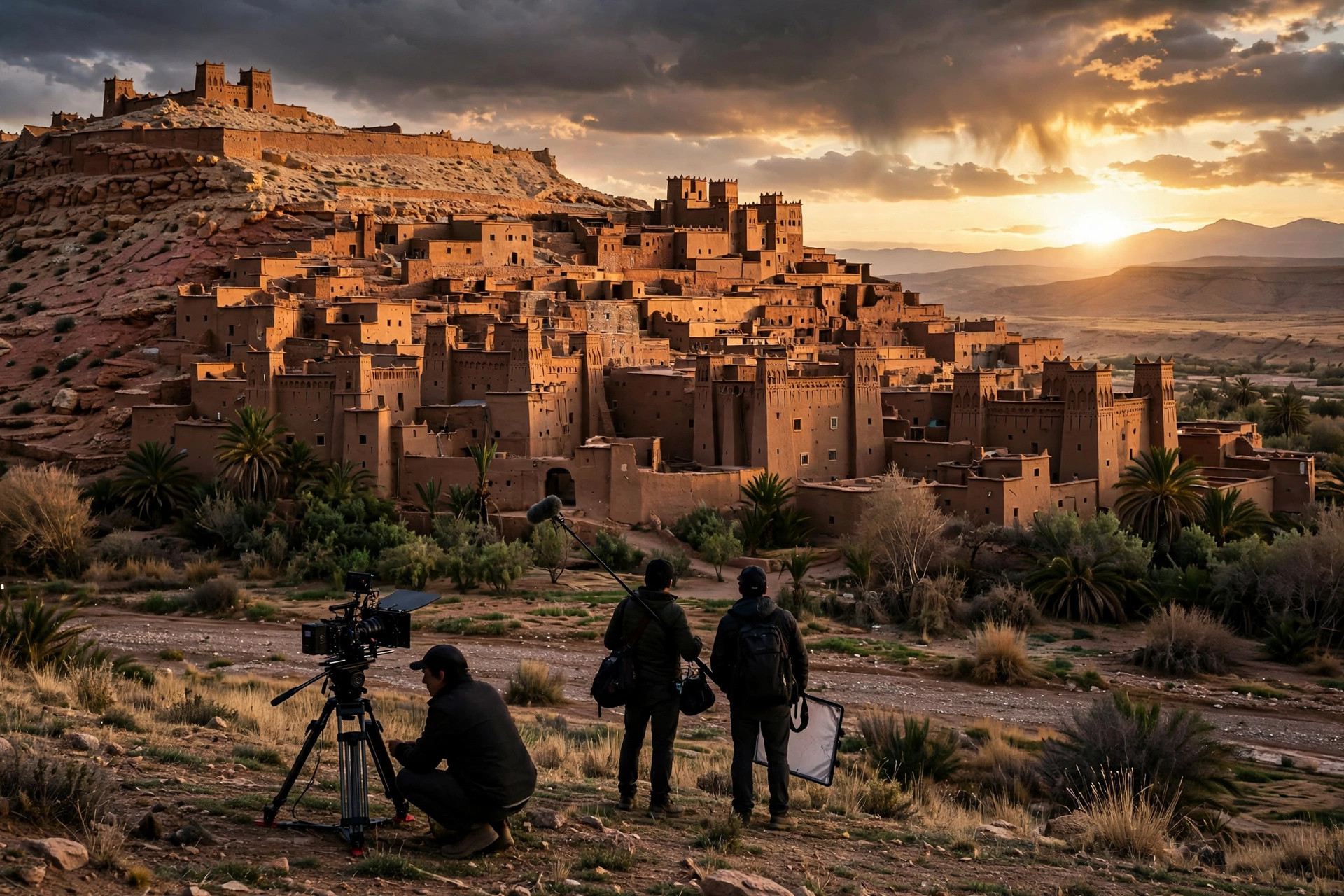
The history of Moroccan cinema comes alive when you go and see it. Start in Ouarzazate, where Atlas Studios opens its sets to visitors — then Ait Benhaddou, thirty minutes away, where the ksar itself is the set.
| Experience | Where | Approximate cost | Notes |
|---|---|---|---|
| Atlas Studios guided visit | Ouarzazate, 5 km west of town | ~80 MAD (~$8) per person | Open daily 08:30 to sunset; extra ~40 MAD (~$4) for the Kingdom of Heaven set |
| Ait Benhaddou ksar | 30 minutes from Ouarzazate | Free to walk the village; guides ~50–100 MAD (~$5–$10) | UNESCO site; best at golden hour |
| Mégarama or Pathé cinema ticket | Casablanca, Rabat, Marrakech, Tangier, Fes | ~60–100 MAD (~$6–$10) | Moroccan films share screens with blockbusters; check listings |
| Marrakech festival open-air screenings | Jemaa el-Fna, Marrakech | Free | Late November; arrive early for a seat |
| National Film Festival | Tangier, usually winter | Screenings often free or low-cost | The home showcase of Moroccan cinema |
Time your trip for late November and you can attend the Marrakech festival itself: the open-air screenings on Jemaa el-Fna are free, and the city fills with posters and film talk. The rest of the year, the multiplexes in Casablanca, Rabat and Marrakech regularly screen new Moroccan releases — look for them in the listings. Before Ouarzazate, read our history of Morocco and our guide to the imperial cities.
Last checked: Prices and festival dates checked November 2026; confirm Atlas Studios hours and festival screenings on arrival.
Frequently Asked Questions
When did the history of Moroccan cinema begin?
The history of Moroccan cinema begins in 1897, when a Lumière operator filmed Le chèvrier Marocain in Morocco. The first Moroccan feature came much later: Mohamed Ousfour's Le fils maudit (1958). Most critics date modern Moroccan cinema from Hamid Bennani's Wechma (1970).
What was the first Moroccan film?
The first Moroccan feature is widely cited as Le fils maudit ("The Damned Son"), directed by Mohamed Ousfour in 1958. Ousfour had made shorts in 1956 and 1957, so some scholars trace Moroccan narrative film to those shorts, but Ousfour is universally recognised as the pioneer.
Where is Atlas Studios and can I visit it?
Atlas Studios is about five kilometres west of Ouarzazate. Founded in 1983, it is one of the largest film studios in the world by land area, and it is open to visitors when nothing is filming, with guided tours of the standing sets for about 80 dirhams (around $8) per person.
When is the Marrakech International Film Festival?
The Marrakech International Film Festival is held every year in late November or early December; the 23rd edition runs from 20 to 28 November 2026. The competition is reserved for first and second features, and the open-air screenings on Jemaa el-Fna square are free.
Which Moroccan films have won prizes at Cannes?
In the history of Moroccan cinema, the biggest Cannes moment came in 2023, when Asmae El Moudir won Best Director in Un Certain Regard for The Mother of All Lies and Kamal Lazraq's Hounds won the Jury Prize. The year before, Maryam Touzani's The Blue Caftan won the FIPRESCI Prize in the same section. Orson Welles' Othello, partly shot in Morocco, won the Palme d'Or in 1952 under the Moroccan flag.
How many films does Morocco produce each year?
Morocco completed 26 features in 2025, according to the CCM — a record year — and typically produces more than twenty a year, supported by about 60 million dirhams (around $6 million) of annual state production funding. The country has 87 screens across 24 cinemas, and foreign productions invested about 1.21 billion dirhams (around $121 million) in 2025.
Conclusion: Why the History of Moroccan Cinema Still Matters
The history of Moroccan cinema is a story of catching up — and then of leading. A country that entered the twentieth century as a location for other people's cameras now makes more than twenty films a year, wins prizes at Cannes, runs one of the Arab world's great festivals and hosts the biggest studio backlot on earth. The arc from a Lumière reel of a goatherd in 1897 to a Moroccan director holding a Cannes prize in 2023 took 126 years.
What matters is not the prizes but the perspective. Moroccan directors film the country from the inside: the Casablanca of the poor, the tailor's shop in Salé. The foreign blockbusters gave Morocco its famous landscapes; Moroccan cinema gave it its own voice. If you visit, watch one Moroccan film first — Wechma for the history, The Blue Caftan for the present — then stand on Jemaa el-Fna during the festival and watch the history of Moroccan cinema unfold under the stars.
1 thought on “The History of Moroccan Cinema: From the First Films to the Marrakech Festival”