The cost of learning Arabic in Morocco can be as little as nothing at all, or as much as a full university semester. A private tutor charges roughly 100 to 300 dirhams an hour, a group evening course costs about 3,000 dirhams for thirty hours, and an intensive programme at a Rabat language school runs 1,750 dirhams a week. At the other end of the scale, a sixteen-week semester reaches 26,665 dirhams. The range is wide because "learning Arabic" in Morocco means several different things: the Moroccan dialect Darija for daily life, Modern Standard Arabic for reading and formal use, or both together.
This guide breaks down the cost of learning Arabic in Morocco option by option, with real published prices from schools in Rabat and Fes, tutor marketplaces, and online platforms, all checked in November 2026. It sits in our Costs & Practical Life section. Whether you are moving here for a year or spending a winter in Marrakech, you will find a route that fits your wallet. For the wider trip planning around your course, see our Morocco travel guide for first-time visitors.
Moroccans speak Darija at home, in the market, and with friends — about 91% of the population speaks it — while Modern Standard Arabic is the language of newspapers, television news, and official documents. Most schools teach both at the same hourly rate. Before you pay for anything, decide which one you need, because the cost of learning Arabic in Morocco is only good value when you are learning the variety you will actually use.
In this guide
- The Cost of Learning Arabic in Morocco at a Glance
- Darija or Modern Standard Arabic: Two Languages, One Cost
- Group Courses: Schools and Weekly Prices
- Private Tutors and the Cost of Learning Arabic in Morocco
- Online Lessons vs In-Person Classes
- University and Semester Programmes
- Language Schools by City: Rabat, Fes, Marrakech and Beyond
- Free and Cheap Ways to Learn Darija
- Books, Apps and Materials
- Monthly Budget: What the Cost of Learning Arabic in Morocco Adds Up To
- Hidden Costs to Watch For
- How to Choose a School or Tutor
- Frequently Asked Questions
- Conclusion: Is the Cost of Learning Arabic in Morocco Worth It?
The Cost of Learning Arabic in Morocco at a Glance
At the low end, the cost of learning Arabic in Morocco can be close to zero: free language exchanges, free apps, and daily conversation in the souk cost nothing but time. Private tuition sits in the middle of the cost of learning Arabic in Morocco, and it is the fastest route to speaking confidence.
The table below summarises the main options. All prices were checked in November 2026.
| Option | Typical cost | Best for |
|---|---|---|
| Private tutor (1-to-1, in person) | 100–300 MAD/hour ($10–30) | Fast progress, speaking confidence |
| Private tutor (online) | 60–370 MAD/hour ($6–37) | Flexible hours, lower prices |
| Group evening course | 3,000 MAD per 30 hours ($300) | Workers and long-stay expats |
| Semi-intensive group course | 1,450 MAD/week ($145) | Steady progress, 10 hours a week |
| Intensive group course | 1,750 MAD/week ($175) | Full immersion, 20 hours a week |
| Semester programme (16 weeks) | 22,265–26,665 MAD ($2,227–2,667) | Students and long stays |
| Language apps | 0–150 MAD/month ($0–15) | Vocabulary and daily habit |
| Language exchange | Free | Real conversation, friendships |
Darija or Modern Standard Arabic: Two Languages, One Cost
Moroccan Arabic, universally called Darija, is the everyday spoken language of Morocco. It differs sharply from textbook Arabic: it drops many short vowels, borrows words from French, Spanish, and Tamazight, and uses its own verb forms. A learner who studies only Modern Standard Arabic will be able to read a newspaper but will struggle to understand a taxi driver.
Most language schools in Morocco teach both varieties, and the cost of learning Arabic in Morocco rarely changes between them: an hour of Darija costs the same as an hour of Modern Standard Arabic at the same school. The difference is in what you get. Darija courses focus on speaking and listening from the first lesson, with role plays for the market, the cafe, and the landlord. Standard Arabic courses spend more time on reading, writing, and grammar.
If you are moving to Morocco, start with Darija: three months of lessons will transform your daily life, and you can add reading and writing later. Either way, ask the school before you enrol which variety a course actually teaches: some courses advertised simply as "Arabic" are heavily weighted toward the standard variety. If you are also considering French, which many Moroccans speak alongside Arabic, our cost of learning French in Morocco guide breaks down those prices too.
Group Courses: Schools and Weekly Prices
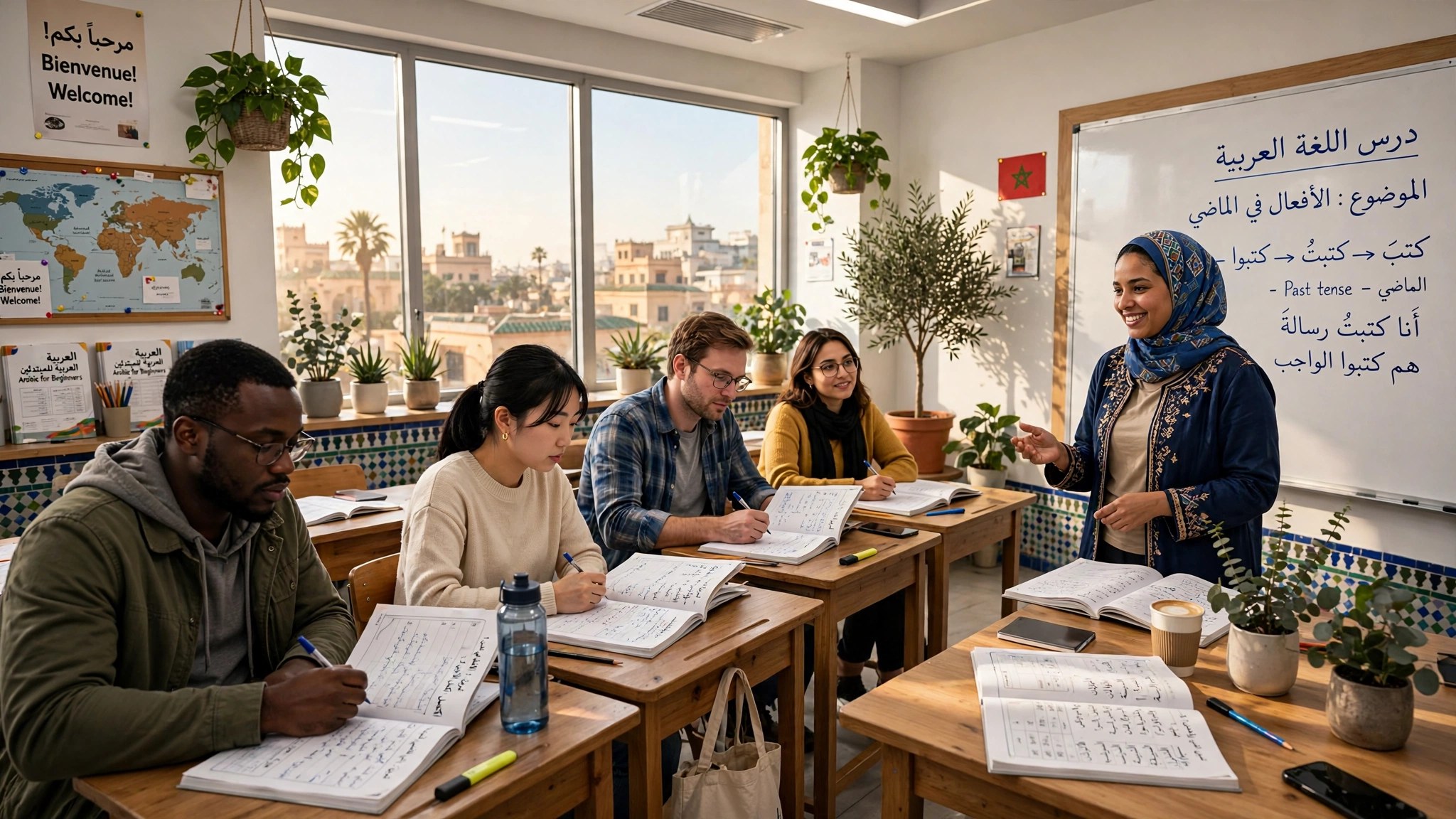
Group courses are the most popular way to study, and the cost of learning Arabic in Morocco in a classroom is easy to compare because the big schools publish their fees. Roots Academy in Rabat charges 1,450 dirhams a week for its semi-intensive programme (ten hours a week) and 1,750 dirhams a week for its intensive programme (twenty hours a week). Its evening course costs 3,000 dirhams for thirty hours over ten weeks.
In Fes, Crossroads Cultural Exchange prices its ninety-minute sessions by group size: 240 dirhams for an individual lesson, 180 dirhams per student for two students, and 130 dirhams per student for three or more, with materials included and a one-time registration charge of 350 dirhams.
Summer intensive programmes cost more per hour because they bundle cultural activities and excursions. The Jacques-Berque Centre in Rabat lists its July 2026 intensive session at 459 to 919 euros for one hundred hours over four weeks, and its spring session at 836 to 1,672 euros for 228 hours over twelve weeks, depending on enrolment status.
Private Tutors and the Cost of Learning Arabic in Morocco
A private tutor is the most flexible option, and also the one with the widest price range. On TeacherOn, a marketplace listing 211 Moroccan Arabic tutors across the country, most advertise between 100 and 300 dirhams an hour, with experienced teachers in Casablanca and Rabat at the top of that range and student tutors in smaller cities from 35 to 45 dirhams an hour. Roots Academy charges 250 dirhams an hour for one-to-one lessons, with 5% off twenty-hour monthly packages and 10% off forty-hour ones.
Online platforms stretch the range further: Apprentus lists Darija tutors at 20 to 37 dollars an hour, roughly 200 to 370 dirhams. At the budget end, the Fes Arabic Institute charges 8 euros for a fifty-minute one-to-one lesson online, about 80 dirhams, and 5 euros per person for small group lessons. The cheapest hourly rate is not always the best value in the cost of learning Arabic in Morocco: a tutor charging 80 dirhams who cancels often costs more in wasted weeks than a reliable tutor at 250 dirhams.
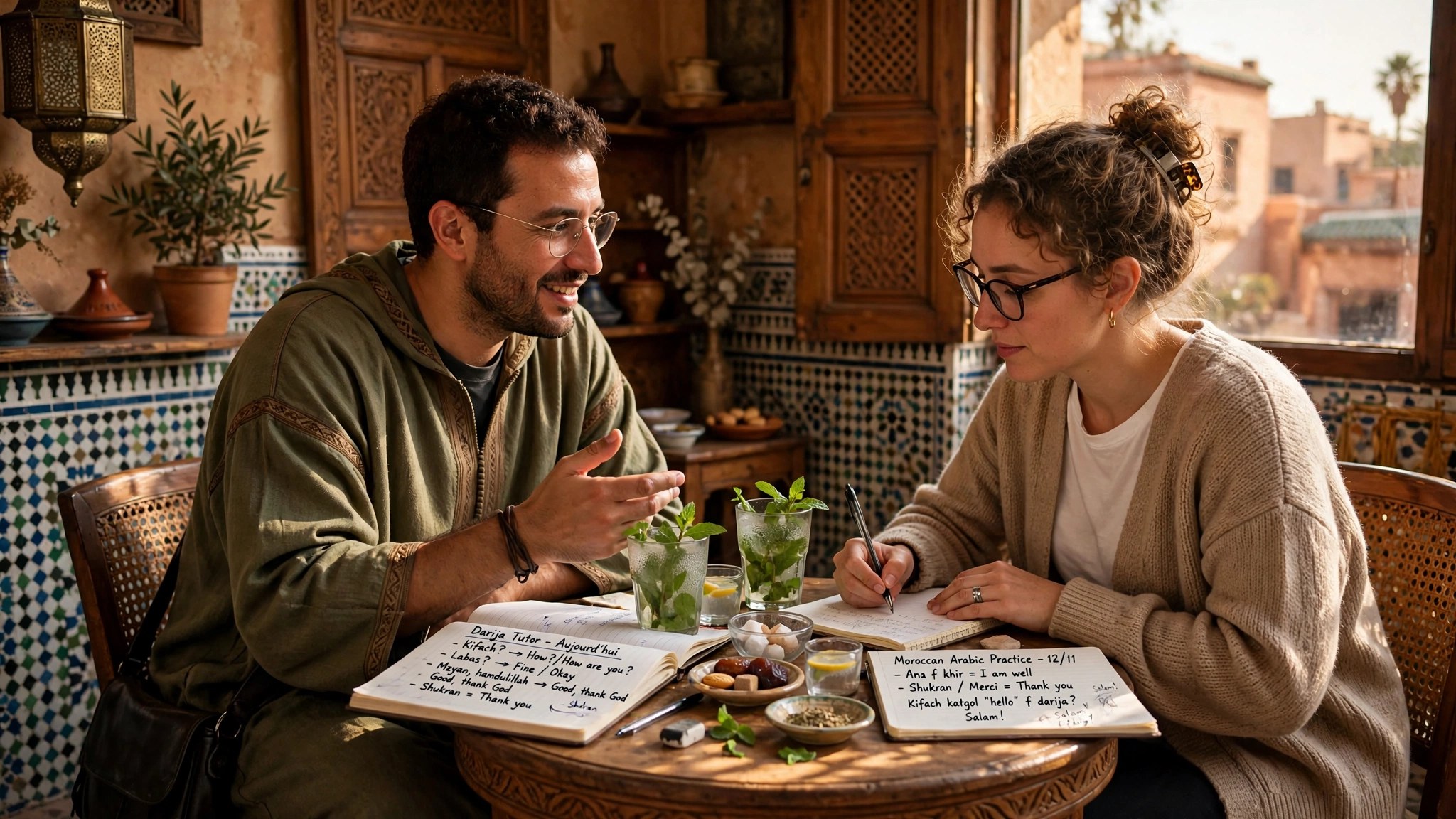
Always take a trial lesson first: a good tutor will test your level and bring a plan to the second lesson. Agree the price, the cancellation rule, and the location before you start: some tutors charge extra for travelling to your home. Pay week by week for the first month rather than buying a large package upfront, until you are sure the tutor is reliable. Our guide to learning Moroccan Arabic Darija lists the phrases a tutor should teach you first.
Online Lessons vs In-Person Classes
Online lessons are usually the cheapest part of the cost of learning Arabic in Morocco, and they make sense if you are still at home planning a move: a fifty-minute online lesson from a Fes-based teacher costs around 80 dirhams, less than half the price of the same lesson in person in Rabat. You can also study at hours that suit your time zone, and switch tutors easily if the first one does not fit. The drawback is the missing immersion: you cannot practise ordering lunch or asking directions through a screen.
A student in Fes practises Darija with shopkeepers between lessons and learns the local accent rather than a generic one. The premium is real: the same twenty hours a week costs 1,750 dirhams in a Rabat classroom and can be found online for half that. Many learners split the difference, studying online for three months before arrival and switching to in-person classes once they are in Morocco, which keeps the total cost of learning Arabic in Morocco lower than a full year of classroom tuition.
University and Semester Programmes
For a stay of a full semester, a structured programme usually gives you a lower cost of learning Arabic in Morocco per hour than paying week by week. Roots Academy charges 22,265 dirhams for its semi-intensive semester, 160 hours over sixteen weeks, and 26,665 dirhams for the intensive semester at 320 hours. That works out to roughly 139 dirhams an hour semi-intensive and about 83 intensive.
Academic programmes such as the Jacques-Berque Centre in Rabat add a certificate of completion, with fees from 459 euros for a four-week summer session. If you are a registered university student, ask about reduced fees: the centre's published prices vary by enrolment status. A semester of study is also the only route that can support a longer stay, so read our Morocco visa costs guide before you commit.
Language Schools by City: Rabat, Fes, Marrakech and Beyond
It hosts Roots Academy and the Jacques-Berque Centre, both with published fees and structured levels, and its large expat community means tutors are easy to find and group classes actually fill up. The tram, the libraries, and the cafes of Agdal give you somewhere to study between lessons — see our living in Rabat guide for neighbourhoods near the schools.
Fes is the traditional choice, and the city where the cost of learning Arabic in Morocco often goes furthest. Crossroads Cultural Exchange and the Fes Arabic Institute both operate there, the medina forces you to use Darija every day, and the city's scholarly history, centred on the ancient University of al-Qarawiyyin, gives the study a depth no other city matches. Group classes in Fes are typically 20 to 30% cheaper than in Rabat or Casablanca. Read our living in Fes guide before choosing a neighbourhood near your school.
Marrakech has the most schools but also the most variable quality, because tourism creates demand from short-stay visitors who never check results. Expect to pay Rabat prices or slightly more, and be wary of schools that cannot show a syllabus or a placement test. Casablanca suits learners who need Arabic for business, but the city runs on French in offices, so daily Darija practice is harder to find. Tangier is a good northern option with a Spanish flavour in its Darija.
Free and Cheap Ways to Learn Darija
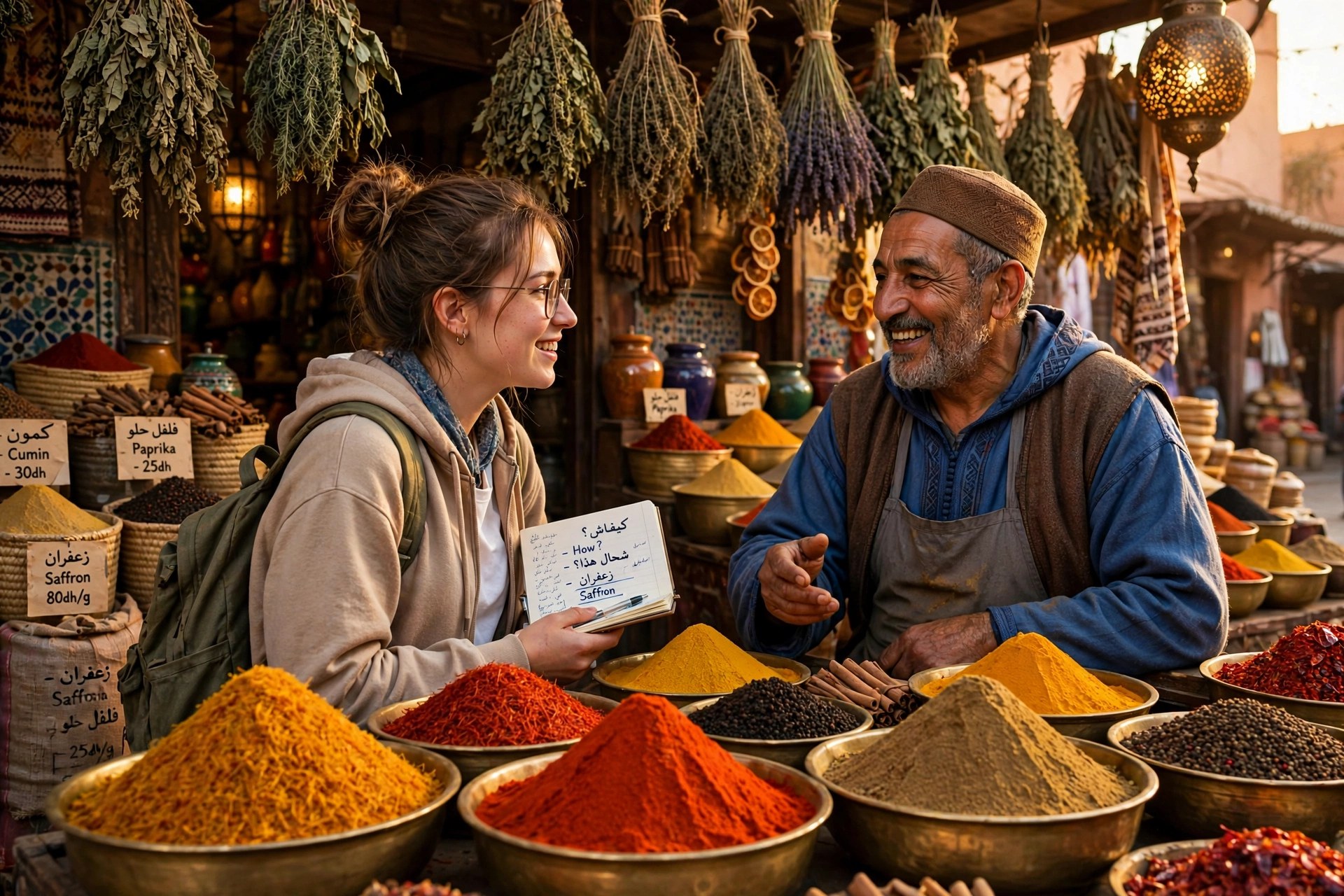
Not every dirham of the cost of learning Arabic in Morocco has to be bought. Language exchanges are free and widely available: universities, cultural centres, and expat groups in the big cities run weekly tandem sessions where you teach an hour of English in exchange for an hour of Darija.
Free apps cover the basics, though most teach Modern Standard Arabic rather than Darija. Our learning Moroccan Arabic Darija guide gives you twenty phrases covering greetings, prices, and directions — the fastest free start available. YouTube channels by Moroccan teachers, local radio, and the daily habit of buying your own bread and vegetables in Darija — and haggling for them — will take you further than any app once you know those first phrases. Volunteering with a local association is another free classroom: you will learn the vocabulary of real work.
Books, Apps and Materials
Budget 150 to 400 dirhams for your first textbook, and expect to buy one per level. The standard classroom series, "Al-Arabiyyah Bayna Yadayk" (Arabic Between Your Hands), costs roughly 200 to 300 dirhams per volume in Moroccan bookshops.
Note that most apps teach Modern Standard Arabic, not Darija, so treat them as a supplement for reading and vocabulary rather than as your main speaking practice. Some schools include all materials in the tuition fee — Crossroads Cultural Exchange in Fes, for example, bundles textbooks, audio files, and flashcards in its course price — so check this before you buy books separately. A notebook and a pocket dictionary cost under 100 dirhams, and they matter more than any app — small change next to the cost of learning Arabic in Morocco.
Monthly Budget: What the Cost of Learning Arabic in Morocco Adds Up To
Tuition is only part of the cost of learning Arabic in Morocco. The table below shows three realistic monthly budgets for a learner already living in Morocco, using the prices in this guide and our cost of living in Morocco figures for housing and food.
| Budget | Tuition | Housing and food | Transport and extras | Monthly total |
|---|---|---|---|---|
| Light self-study | 500–1,450 MAD ($50–145) | 6,000–9,000 MAD ($600–900) | 500–1,000 MAD ($50–100) | 7,000–11,450 MAD ($700–1,145) |
| Part-time classes | 1,900 MAD ($190) | 7,000–10,000 MAD ($700–1,000) | 800–1,500 MAD ($80–150) | 9,700–13,400 MAD ($970–1,340) |
| Full immersion | 7,000 MAD ($700) | 6,000–10,000 MAD ($600–1,000) | 1,000–2,000 MAD ($100–200) | 14,000–19,000 MAD ($1,400–1,900) |
The light budget assumes four hours of private tuition a month plus free apps and language exchange; the part-time budget, an evening course plus four hours of tutoring; the full immersion budget, an intensive twenty-hour-a-week course, which alone costs about 7,000 dirhams a month. Before signing a lease near your school, check our rent prices in Morocco guide, because housing is the largest single cost in every budget here.
Hidden Costs to Watch For
The headline course price is rarely the full cost of learning Arabic in Morocco. Registration fees are the most common extra: Crossroads charges a one-time 350 dirhams, and other schools charge similar amounts.
Transport to and from school adds up faster than learners expect: a daily fare of 10 to 20 dirhams becomes 300 to 600 dirhams a month. If your course runs past ninety days, remember the visa question: a tourist entry allows ninety days, and extending it has its own costs, covered in our Morocco visa costs guide.
How to Choose a School or Tutor
Start with a trial lesson, and treat it as an interview in both directions. A good school will give you a placement test before quoting a price, show you the syllabus for your level, and tell you the maximum class size. If a school cannot answer those three questions, walk away: the cost of learning Arabic in Morocco is wasted fastest in a class of fifteen students with no plan and no placement.
For a private tutor, check three things before paying for a package: that the tutor teaches Darija, that they have a plan beyond chatting, and that they turn up on time. Ask for two references from past students, and pay week by week for the first month. For a school, visit the building if you can: a real classroom, a library corner, and students you can talk to are worth more than a polished website. If you are comparing two schools at similar prices, choose the one whose timetable fits your life.
Frequently Asked Questions
How much does it cost to learn Arabic in Morocco?
The cost of learning Arabic in Morocco starts at nothing for language exchanges and free apps, runs 100 to 300 dirhams an hour for a private tutor, and reaches 1,750 dirhams a week for an intensive group course or 22,265 to 26,665 dirhams for a sixteen-week semester.
Is Darija or Modern Standard Arabic better to learn first?
Learn Darija first if you are moving to Morocco, because it is the language of daily life and about 91% of Moroccans speak it. Learn Modern Standard Arabic first if you are studying or working in a formal setting. Most learners end up studying both, at the same rate for either.
How long does it take to learn Darija?
A motivated learner with ten hours of lessons a week plus daily practice can handle everyday conversations in about three to six months.
Can I learn Arabic in Morocco for free?
You can learn a surprising amount for free: language exchanges, free apps, YouTube lessons, and daily conversation in the market all cost nothing.
Do I need a student visa to study Arabic in Morocco?
Most nationalities can enter Morocco visa-free for up to ninety days, which covers a short course or a summer programme. A sixteen-week semester runs past ninety days, so check the rules for your nationality and plan an extension before you enrol.
Which city is cheapest for learning Arabic in Morocco?
Fes is usually the cheapest of the big study cities: group classes there run 20 to 30% below Rabat and Casablanca prices, and rents are lower too. Smaller cities are cheaper still, but they have fewer schools.
Conclusion: Is the Cost of Learning Arabic in Morocco Worth It?
The cost of learning Arabic in Morocco is low by international standards, and the value is high. A few hundred dirhams a week buys you a teacher, a classroom, and a city that corrects your Arabic every time you buy bread. The cheapest route — free exchanges plus a handful of tutoring hours — works if you are patient, while an intensive semester is the fastest way to real fluency.
Start with Darija, take a trial lesson before you pay, and budget for the hidden costs as well as the headline price. Do that, and the money you spend on Arabic will pay you back every day you live in Morocco.
Last checked: November 2026. Prices are typical ranges from published school fees and tutor marketplaces; smaller cities are often 20–30% cheaper than Rabat and Casablanca. USD equivalents use roughly 10 MAD to $1.