
The cost of sending money to Morocco depends on two things: the fee you can see and the exchange rate you cannot. A "zero fee" transfer can still be the most expensive option if it converts your dollars at a poor rate, while a provider charging a few dollars upfront can deliver far more dirhams.
Every month, Moroccans abroad send money home to family, and travellers send money to themselves for rent and daily life. The cost of sending money to Morocco matters most to those people, because a 3 percent worse rate on a regular $500 transfer quietly costs about $180 a year. Prices are in dirhams (MAD), checked in November 2026 at about 10 MAD to $1.
In this guide
- How Sending Money to Morocco Works
- What Determines the Cost of Sending Money to Morocco
- Provider Comparison: Wise, Remitly, WorldRemit, MoneyGram, Western Union, XE and Banks
- Example: What 500 Dollars, Euros and Pounds Actually Deliver
- Cash Pickup in Morocco: Wafacash, Cash Plus and Bank Counters
- Bank Deposit: Sending Straight to a Moroccan Bank Account
- Speed, Limits and ID: What to Expect
- Sending Money Out of Morocco: The Rules Going the Other Way
- Hidden Costs to Watch For
- Staying Safe: Scams and Mistakes to Avoid
- The Best Option for Every Situation
- Frequently Asked Questions
- Conclusion
How Sending Money to Morocco Works
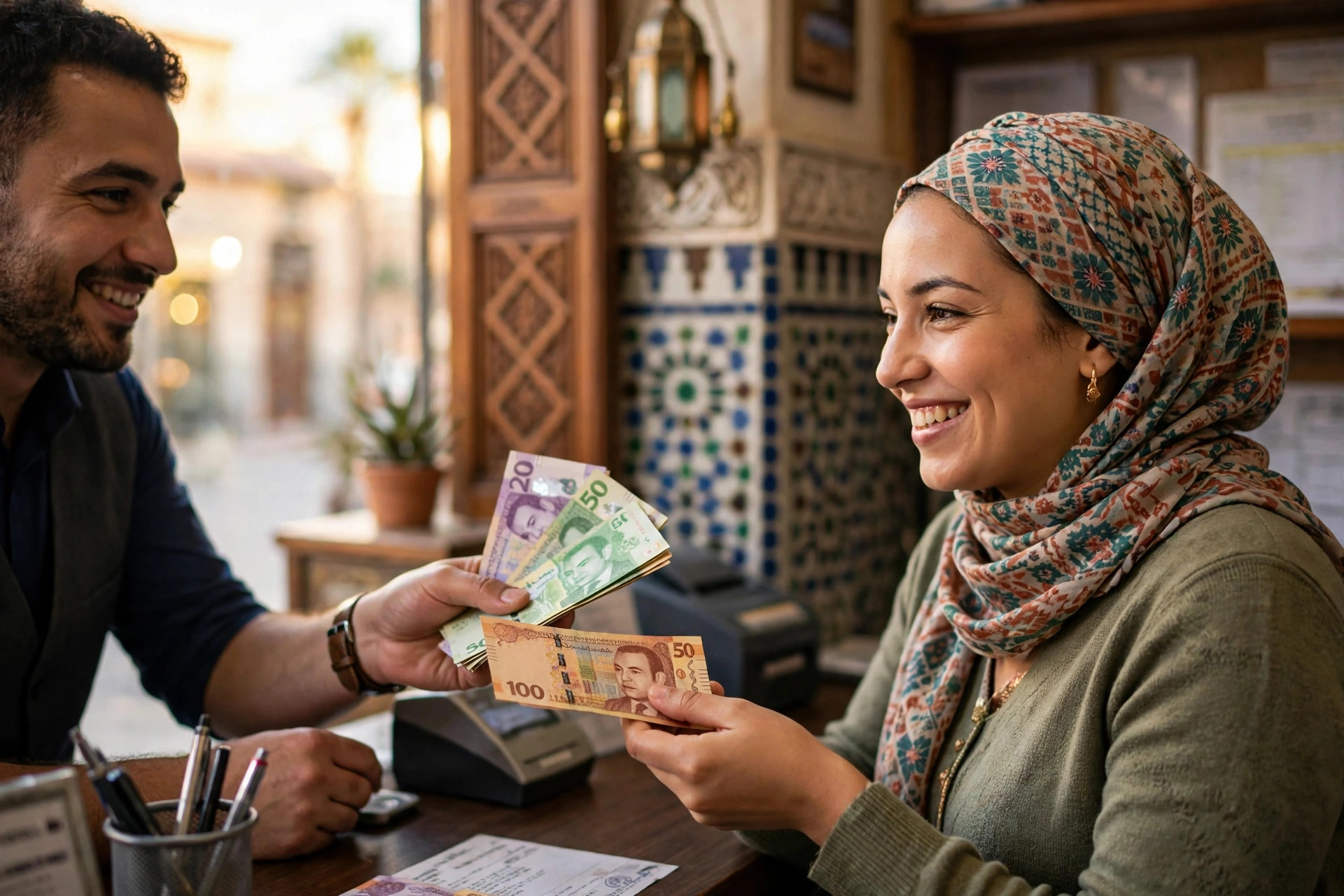
The Moroccan dirham (MAD) is a closed currency: it cannot legally be bought, sold or held outside Morocco, so you cannot send dirhams from abroad, and no ordinary Moroccan account can hold dollars or euros. You send dollars, euros or pounds, the provider converts them, and your recipient receives dirhams. That is why the exchange rate mostly decides the cost of sending money to Morocco: two providers charging the same $5 fee can deliver amounts 200 MAD ($20) apart on the same $500.
There are three ways the money arrives. Cash pickup is the most popular: your recipient collects dirhams from an agent such as Wafacash, Cash Plus or a bank branch. Bank deposit sends it straight into a Moroccan bank account, and mobile wallet delivery credits a phone wallet such as CIH's. Each method changes the cost of sending money to Morocco, and the cheapest option for one is rarely the cheapest for another.
What Determines the Cost of Sending Money to Morocco
The cost of sending money to Morocco is the fee plus the exchange-rate margin, usually the larger of the two. The margin is the gap between the mid-market rate and the rate your provider gives you. At 9.70 MAD per dollar against a mid-market rate of 10.00, a provider keeps 3 percent of your money: 150 MAD ($15) on a $500 transfer.
Three things move the cost of sending money to Morocco up or down. Flat fees hurt small transfers most; rate margins hurt large ones most. Paying by card usually costs more than paying by bank transfer. And the delivery method matters, because cash pickup often carries a worse rate than bank deposit.
Provider Comparison: Wise, Remitly, WorldRemit, MoneyGram, Western Union, XE and Banks
Wise is the benchmark for bank deposits: a fee usually under 1 percent and a rate very close to mid-market, delivered to bank accounts only, so it suits regular support payments to family with an account. The cost of sending money to Morocco through Wise is usually the lowest on a $500 bank transfer. Remitly is the strongest all-rounder for cash pickup, with Express delivery in minutes and cheaper Economy delivery in three to five days; WorldRemit is similar and often cheapest for smaller amounts.
Western Union and MoneyGram have the biggest agent networks in Morocco, with pickup points in almost every town. Their online prices are far better than their in-person agent prices, so always book online: in-person prices raise the cost of sending money to Morocco sharply. XE suits larger amounts, with no fee above a threshold, but it only does bank deposits. Bank wires are the most expensive route for ordinary amounts and only make sense for very large, one-off transfers.
| Provider | Best for | Typical fee on $500 | Delivery | Speed |
|---|---|---|---|---|
| Wise | Bank deposits, best rate | About $5–$8 (0.5–1%) | Bank account only | Minutes to 1 day |
| Remitly | Cash pickup, regular support | $0–$5 | Cash, bank, mobile | Minutes (Express) or 3–5 days (Economy) |
| WorldRemit | Small amounts, cash pickup | About $4 | Cash, bank, mobile | Minutes to 1 day |
| Western Union | Widest agent network | $0–$10 online, more in person | Cash, bank | Minutes |
| MoneyGram | Cash pickup in small towns | $5–$10 | Cash, bank | Minutes |
| XE | Larger amounts | $0 above threshold | Bank account only | 1–3 days |
| Bank SWIFT wire | Very large one-off transfers | $25–$45 plus $15–$45 intermediary fees | Bank account only | 2–5 business days |
Example: What 500 Dollars, Euros and Pounds Actually Deliver
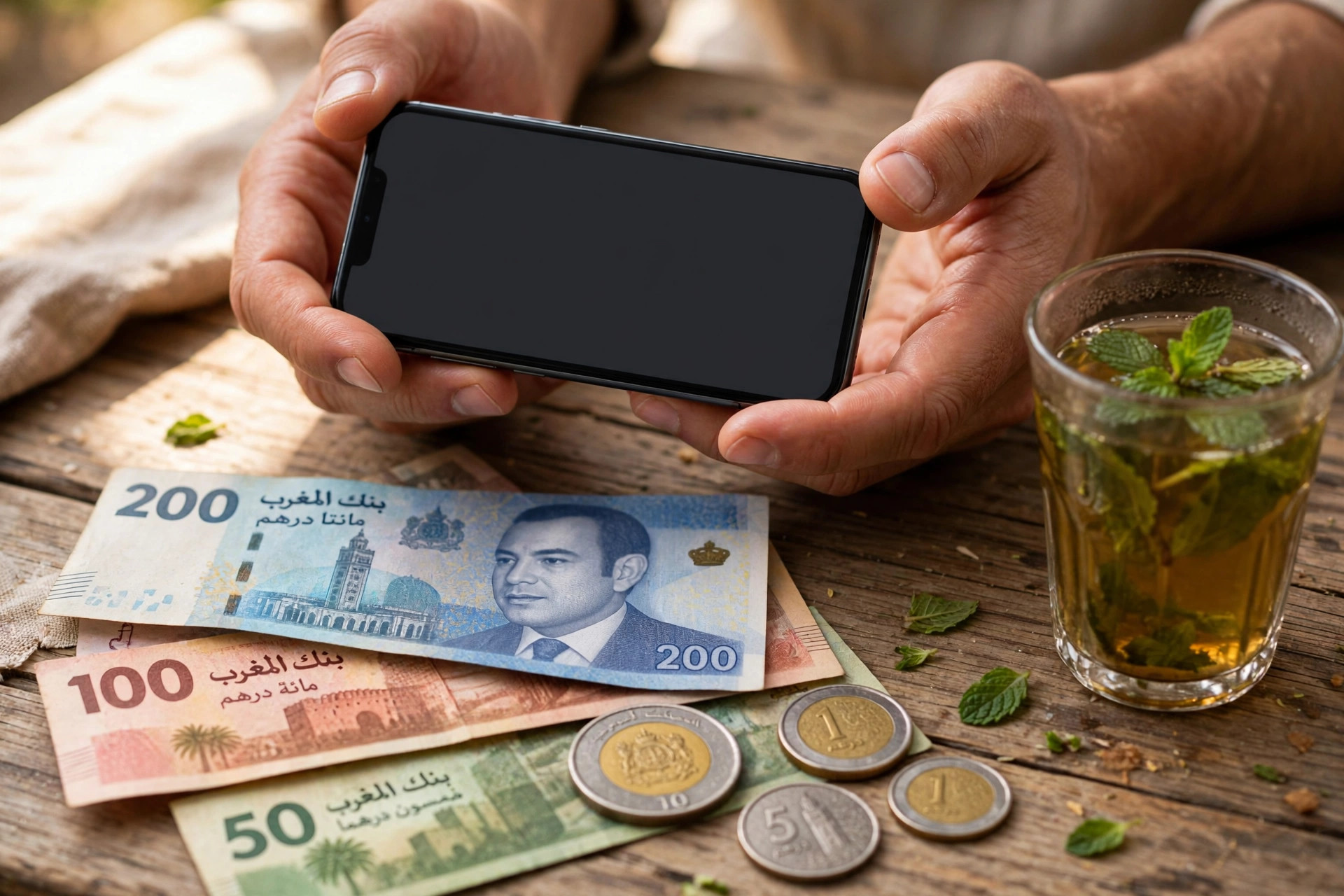
The table below compares a $500 transfer at illustrative November 2026 rates, with a mid-market rate of 10.00 MAD per dollar. The "total cost" column is the real cost of sending money to Morocco: what your $500 is worth at the mid-market rate minus what your recipient receives. Check the live quote before you send.
| Provider | Fee | Rate (MAD per $1) | Recipient gets | Total cost |
|---|---|---|---|---|
| Wise | $6.50 | 9.95 | 4,910 MAD ($491) | 90 MAD (about $9) |
| WorldRemit | $3.99 | 9.75 | 4,836 MAD ($484) | 164 MAD (about $16) |
| Remitly Express | $3.99 | 9.70 | 4,811 MAD ($481) | 189 MAD (about $19) |
| MoneyGram online | $4.99 | 9.60 | 4,752 MAD ($475) | 248 MAD (about $25) |
| Western Union online | $4.99 | 9.55 | 4,727 MAD ($473) | 273 MAD (about $27) |
| Bank SWIFT wire | $60.00 | 9.60 | 4,224 MAD ($422) | 776 MAD (about $78) |
The cheapest-looking fee is not the cheapest transfer. Western Union charges less upfront than Wise here but delivers 183 MAD ($18) less. The same rule holds in euros and pounds: at about 10.80 MAD per euro and 13.00 MAD per pound, a €500 transfer via a low-margin provider delivers roughly 5,350 MAD ($535) and a £500 transfer roughly 6,450 MAD ($645). So the cost of sending money to Morocco follows the same rule in any currency: compare the final dirham figure.
Cash Pickup in Morocco: Wafacash, Cash Plus and Bank Counters
Cash pickup is how most money sent to Morocco is collected, because many recipients have no bank account or prefer cash, and the cost of sending money to Morocco by cash pickup is set mostly by the rate, not the fee. The two big networks are Wafacash, owned by Attijariwafa Bank, and Cash Plus, with thousands of small agencies across the country. Western Union and MoneyGram transfers can also be collected at branches of Attijariwafa Bank, CIH Bank and BMCE Bank of Africa.
Your recipient needs two things: a valid ID and the transfer reference number. Moroccan nationals show their CIN, the national identity card; foreigners show a passport, sometimes with a residence card. The reference number is the MTCN for Western Union, or the equivalent code for other providers, and the name on the transfer must match the ID exactly. Pickup is usually free for the recipient, since the sender pays the whole cost of sending money to Morocco. Count the money at the counter. Agencies generally open Monday to Saturday, roughly 8:30 to 18:30, so check the provider's agent map before you send if your recipient lives far from any agency.
Bank Deposit: Sending Straight to a Moroccan Bank Account
Bank deposit is usually the cheapest way to get money into Morocco, with the best exchange rates and the lowest fees. Wise, Remitly Economy, WorldRemit and XE all offer it, and the money lands directly in a Moroccan current account in dirhams. If your recipient has an account, this is almost always the best option, and the cost of sending money to Morocco by bank deposit is usually the lowest.
You need the recipient's full name as it appears on the account, the bank name, and the RIB, the Moroccan account number. A RIB is 24 digits, and a single wrong digit can send the money to the wrong account or bounce it back, so copy it from a bank statement rather than from memory. Receiving banks sometimes charge a small incoming fee, typically 50–200 MAD ($5–$20). Once the money is in the account, our ATM fees guide explains what it costs to withdraw dirhams from it.
Mobile money is still small in Morocco compared with cash pickup, but it is growing. CIH Bank has pushed furthest: its mobile app and wallet let recipients receive money on their phone, pay in shops and transfer to other CIH users. WorldRemit and Remitly both offer mobile wallet delivery, arriving within minutes. It suits people who already use the wallet; it is no help to a recipient in a village who needs physical dirhams for the market. Your recipient needs a local SIM first: our SIM card guide covers the operators and prices.
Speed, Limits and ID: What to Expect
Speed matters most in emergencies. Cash pickup through Western Union, MoneyGram, Remitly Express or WorldRemit is usually ready within minutes, and bank deposits with Wise or Remitly typically arrive within minutes to a few hours. But the clock depends on when you pay: a transfer started late on a Friday can sit until Monday, because Moroccan banks do not process weekend deposits, and some providers add a weekend markup that raises the cost of sending money to Morocco by 1–2 percent. Bank wires take two to five business days.
Every provider sets limits: generous for ordinary family support, but real for large amounts. Online specialists commonly allow $5,000–$10,000 per transfer and $10,000–$50,000 per month, with higher limits after extra identity checks. Cash pickup limits are usually lower, often around $5,000, so a very large transfer may need to be split or sent by bank deposit. Expect to verify your identity with a passport or driving licence and proof of address, especially on your first transfer or above roughly $1,000.

Sending Money Out of Morocco: The Rules Going the Other Way
Sending money out of Morocco is a different world: the dirham's closed status works in both directions. The Office des Changes, Morocco's exchange control authority, limits how much residents can send abroad, and the rules are paperwork-heavy. If you live in Morocco and need to pay for something overseas, expect a bank visit, forms and supporting documents.
Residents have annual allowances for travel, study, medical treatment and immigration, each with its own cap and documents. The travel allowance is the one most people meet: a set yearly amount for trips abroad. The exact caps change, so treat any figure online as approximate and ask your bank; the Bank Al-Maghrib website publishes the official framework. Foreigners face narrower rules: moving savings earned in Morocco abroad usually needs proof of income and tax clearance, so keep your payslips, contract and bank statements from day one.
Hidden Costs to Watch For
The cost of sending money to Morocco hides in places the headline fee never mentions, and the biggest is the exchange-rate margin itself. A provider advertising "zero fees" is almost always making its money on the rate instead: a zero-fee transfer at 9.50 MAD per dollar costs $25 more on $500 than a $7 fee at 9.95. Weekend markups are the second trap: some providers widen their margin from Friday evening to Monday morning. Intermediary bank fees are the third: a SWIFT wire can pass through one or two correspondent banks, each taking $15–$45, and you only discover this when less money arrives than expected.
Two more costs catch people out: double conversion, where dollars become euros and then dirhams, with each conversion taking a cut. The second is dynamic currency conversion, where a terminal offers to charge you in your home currency: always choose dirhams. Finally, some "guaranteed rates" last only a few hours. Each of these lifts the cost of sending money to Morocco without ever appearing in any fee.
Staying Safe: Scams and Mistakes to Avoid
The cost of sending money to Morocco through a licensed provider is low and the transfer is safe: the risks come from who you send to, not how you send. Never send money to someone you have only met online: romance scams, fake rental deposits and "stranded traveller" emergencies are the classic frauds, and a cash pickup transfer cannot be reversed once it is collected. Never share your transfer reference number publicly, and never send a photo of your ID to a stranger who asks for it "to verify" the transfer.
Real providers never ask for your password or full card number by email or message. If a deal involves an overpayment — someone sends you too much and asks you to forward the difference — stop: it is almost certainly fraud using a stolen card. Check the recipient's name against their ID, check the RIB digit by digit, and send a small test transfer the first time you use a new provider or recipient. A $50 test is far cheaper than a $500 transfer stuck for a week, and it keeps the cost of sending money to Morocco low.
The Best Option for Every Situation
There is no single cheapest way: the best option depends on the amount, the urgency and how your recipient wants to receive it. For regular monthly support to family with a bank account, Wise bank deposit usually wins on the cost of sending money to Morocco, with Remitly Economy as the main alternative. For urgent cash, use Remitly Express, WorldRemit or Western Union online. For large one-off amounts, compare XE and Wise. And for every transfer, compare two or three providers on the final dirham figure first: five minutes of comparison is how you keep the cost of sending money to Morocco down every time.
Frequently Asked Questions
How much does it cost to send $500 to Morocco?
At illustrative November 2026 rates, the total cost of sending money to Morocco on $500 is about $9 with Wise, $16–$19 with WorldRemit or Remitly Express, $25–$27 with MoneyGram or Western Union online, and about $78 with a bank wire.
What is the cheapest way to send money to Morocco?
For bank deposits, Wise is usually cheapest on a $500 transfer, with a rate close to mid-market and a fee under 1 percent. For cash pickup, Remitly Express and WorldRemit are usually cheapest. Compare the final dirham amount across two or three providers each time.
Can I send money to Morocco without a bank account?
Yes. You can pay online by card or bank transfer, and your recipient can collect cash in dirhams from Wafacash, Cash Plus or a bank agent with their CIN or passport and the reference number. No bank account is needed by the recipient.
How long does a transfer to Morocco take?
Cash pickup through Western Union, MoneyGram, Remitly Express or WorldRemit is usually ready within minutes. Bank deposits with Wise or Remitly typically arrive within minutes to a day, and bank wires take two to five business days. First transfers can take a day longer, so send on a weekday morning when the money is urgent.
Can I send Moroccan dirhams from abroad?
No. The dirham is a closed currency that cannot legally be bought, sold or held outside Morocco. You send dollars, euros or pounds, and your recipient receives dirhams after conversion — see the Moroccan dirham page for the background.
Is it safe to send money to Morocco?
Yes, with a licensed provider such as Wise, Remitly, WorldRemit, Western Union or MoneyGram. The danger is fraud, not the transfer itself: never send money to a stranger, never share your reference number publicly, and never forward an "overpayment" to someone you do not know.
Conclusion
The cost of sending money to Morocco is not the fee on the screen: it is the fee plus the exchange-rate margin, measured by the dirhams your recipient receives. On a $500 transfer that total runs from about $9 with a low-margin online specialist to about $78 with a traditional bank wire, and the difference is decided almost entirely by the rate.
So compare the final dirham figure across two or three providers before every transfer, send on a weekday when you can, and match the delivery method to your recipient: bank deposit for the best rate, cash pickup for speed. Do that, and the cost of sending money to Morocco becomes a small, predictable part of supporting the people you care about, instead of a quiet leak in every transfer. Read our Moroccan dirham guide and browse the Costs & Practical Life section, and verify every rate live before you send.