
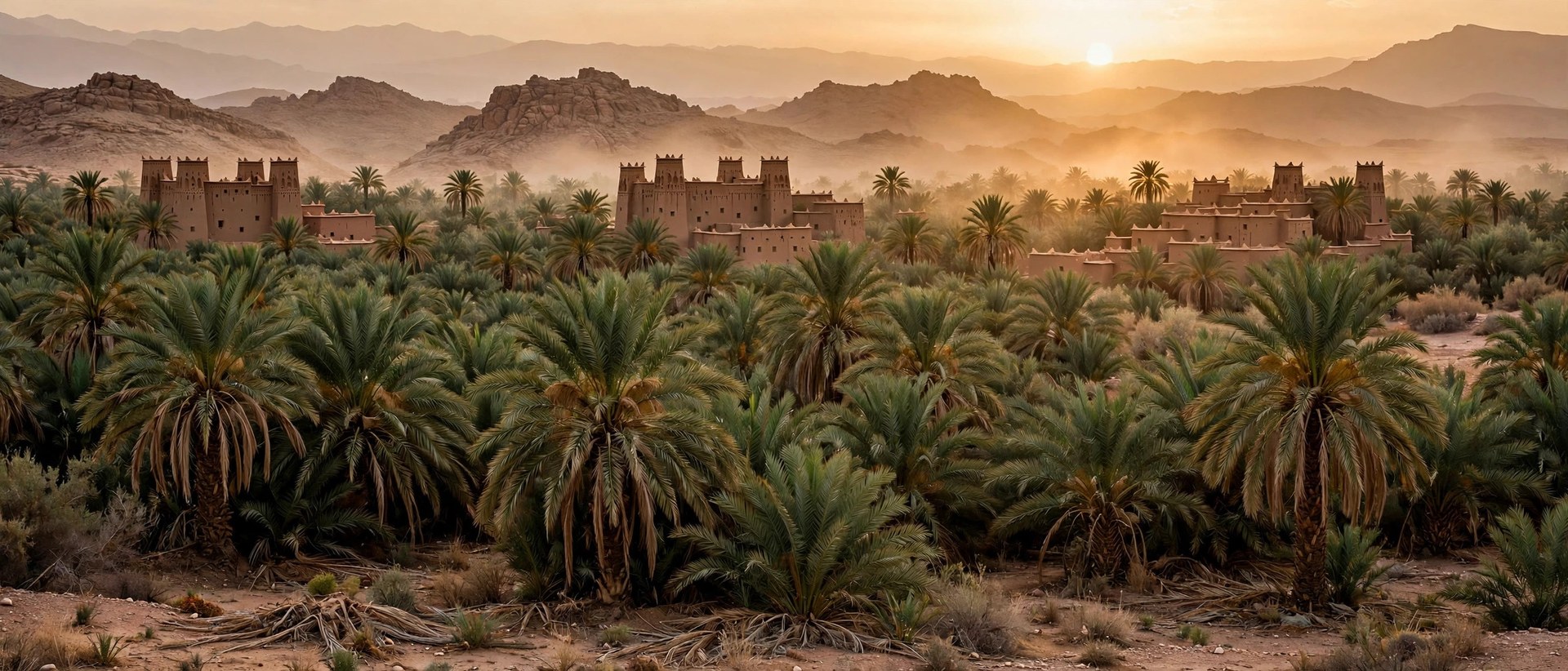
Living in Figuig is Morocco at its most remote: an oasis town of about 10,449 people (2024 census) on the Algerian border, some 370 kilometres south of Oujda, where seven mud-brick ksour stand around roughly 200,000 date palms.
This is not an expat hub: the same census counted just three foreign residents in the whole town, there is no international school, and the nearest big-city hospital is two hours away. What living in Figuig offers instead is silence, space, heritage and some of the lowest living costs in Morocco. This guide, part of our Living in Morocco series, covers housing, costs, healthcare, internet and the honest downsides. Prices are in Moroccan dirhams (MAD), checked in November 2026, at roughly 10 MAD to $1.
In this guide
- Figuig at a Glance
- Why Anyone Chooses Living in Figuig
- Where to Live in Figuig
- Housing and Rents
- Monthly Budget for Living in Figuig
- Food and Daily Life
- Getting Around
- Healthcare
- Schools and Family Life
- Internet and Working Remotely
- Climate and Seasons
- Language and Fitting In
- Residency and Paperwork
- Safety and the Border
- Practical Tips
- Frequently Asked Questions
- Conclusion
Figuig at a Glance
| Fact | Detail |
|---|---|
| Location | Oriental region, ~900 m altitude, ~5 km from Algeria |
| Population | 10,449 (2024 census); peak 14,571 in 1982 |
| Character | Seven ksour around ~200,000 date palms |
| Nearest airport / train | Oujda Angad, ~370 km; no train |
| Budget, single person | 5,300–9,600 MAD ($530–$960)/month |
| Budget, couple | 7,800–13,450 MAD ($780–$1,345)/month |
The population has fallen from a peak of 14,571 in 1982 to 10,449 in 2024, and many houses stand empty — which matters for anyone hoping to rent one. More on Wikipedia.
Why Anyone Chooses Living in Figuig
The first reason people choose living in Figuig is the place itself: seven fortified ksour of mud brick and stone, a palm grove of some 200,000 trees, and water channels older than most countries. The oasis joined Morocco's Tentative List for UNESCO World Heritage status in 2011 — see the World Monuments Fund page on Figuig.
The second reason is cost. It is among the cheapest ways to live in Morocco: no formal rental market, food from the grove and the market, and a quiet life for a fraction of a Casablanca flat. For a larger southern town with the same low costs plus an airport and a hospital, see our guide to living in Laayoune.
Where to Live in Figuig
Most daily life for people living in Figuig happens on foot, inside one of the seven ksour or in the newer part of town. Zenaga is the largest and best preserved ksar, a maze of covered passages near the main springs; Loudaghir sits nearest the border, El Maïz against the escarpment, and the two Hammam ksour take their names from the warm springs.
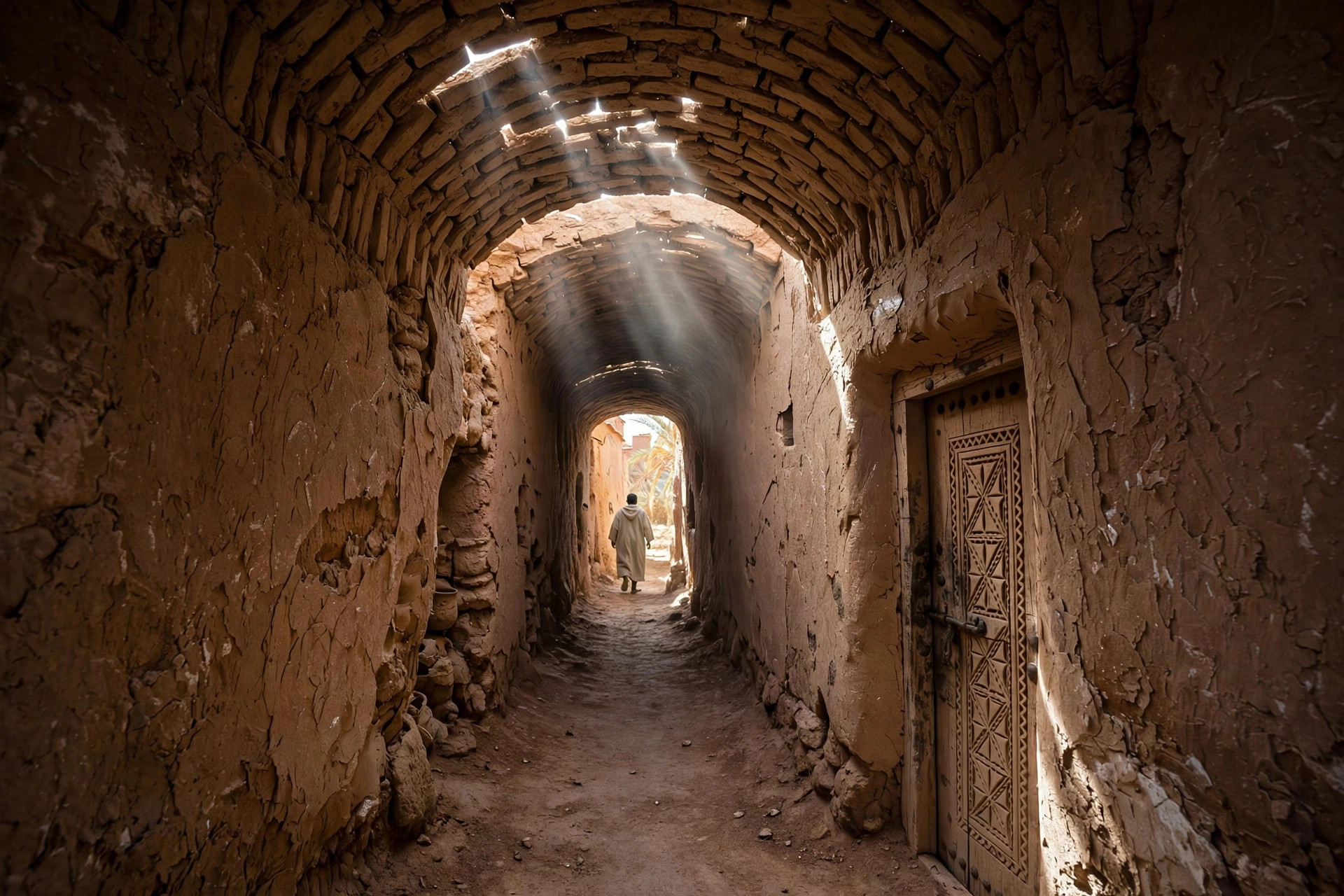
A ksar house means thick earthen walls, a shaded lane outside the door, and neighbours who know your business — plus stairs, low doorways, patchy signal, and maintenance that is your problem. The new town has simpler concrete houses and easier parking, but far less character.
Housing and Rents
Renting while living in Figuig works nothing like renting in a Moroccan city: no listing site, no estate agent, no published rental data. Houses change hands by word of mouth, through guesthouse hosts, cafe owners and neighbours.
The realistic route for a newcomer is a long stay in a family guesthouse. Nightly rates run roughly 150–280 MAD ($15–28), often with dinner included, and a monthly rate usually costs less than thirty nights at the tourist price. As a planning estimate for November 2026 — not a market rate, because no market data exists — budget 3,000–5,000 MAD ($300–$500) a month, and confirm the figure in person.
A house of your own is possible but slow: many houses belong to families living abroad, and finding the owner can take weeks of asking around. Expect a simple contract in French or Arabic and a deposit of one to two months' rent — the legal maximum under Law 67-12. Our renting an apartment in Morocco guide explains the contract rules.
Before you sign, check water pressure, hot water and heating — many older houses have none, and January nights fall to around 4°C.
Monthly Budget for Living in Figuig
A monthly budget for living in Figuig in a negotiated guesthouse stay, cooking mostly at home — planning ranges, checked in November 2026, to confirm on arrival.
| Expense | Single person (MAD) | Couple (MAD) |
|---|---|---|
| Rent / guesthouse (est.) | 3,000–5,000 | 4,000–6,500 |
| Utilities | 200–400 | 300–600 |
| Internet | 150–300 | 250–450 |
| Groceries | 1,200–2,000 | 2,000–3,200 |
| Eating out | 200–500 | 400–800 |
| Transport | 200–500 | 300–600 |
| Healthcare | 150–400 | 250–600 |
| Leisure | 200–500 | 300–700 |
| Total | 5,300–9,600 | 7,800–13,450 |
The biggest savings are rent and food: the market sells what the grove and the region's farms provide. Heating is the cost newcomers forget — a cold January can add 200–400 MAD a month to the electricity bill.
Food and Daily Life
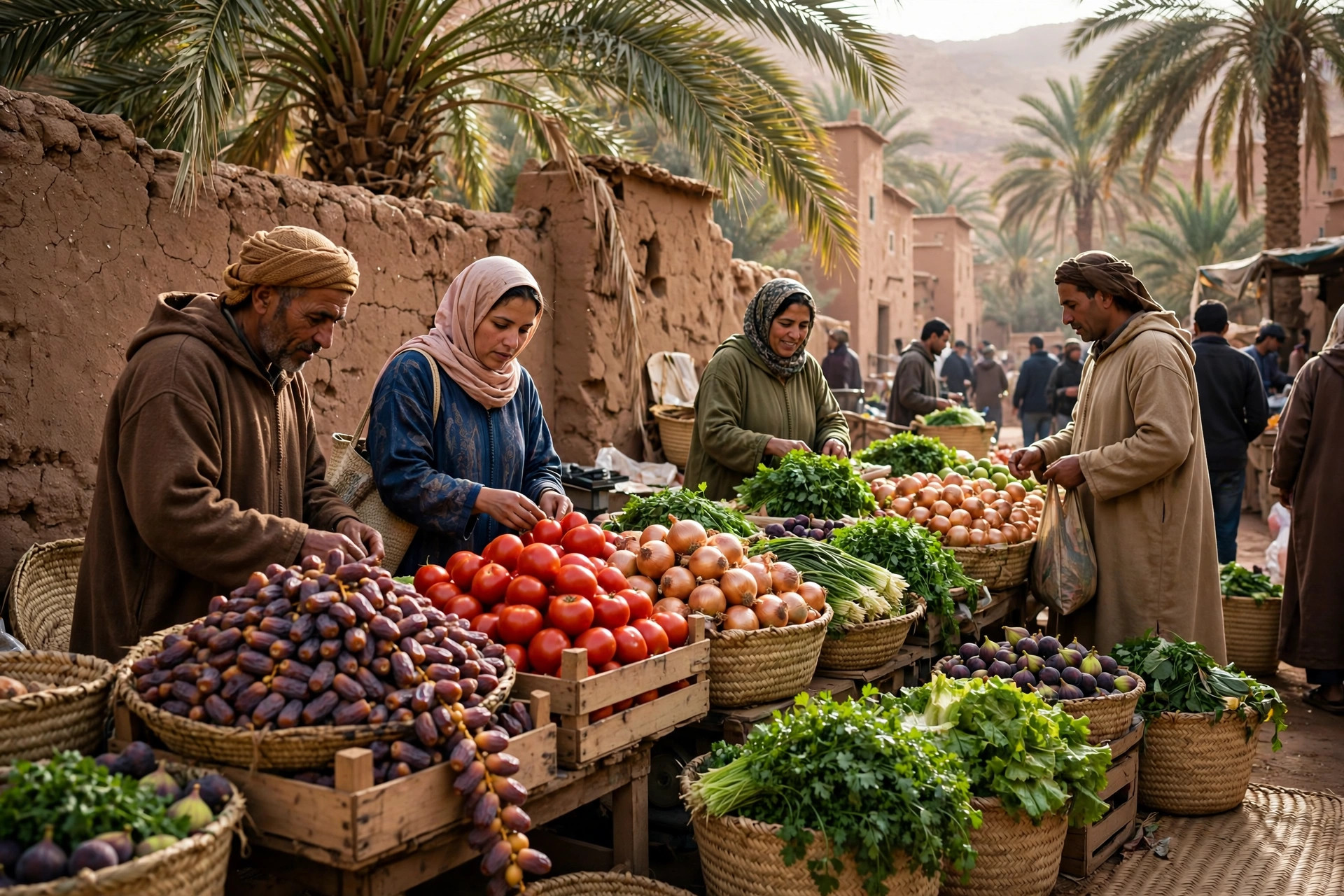
Daily life for people living in Figuig runs on the market: the local market held in Zenaga twice a week, plus small shops for bread, tea, sugar and basics. Dates bought direct from growers cost around 30–50 MAD per kilo (about $3–5, November 2026).
Eating out is simple and cheap: a home-cooked dinner at a guesthouse runs roughly 60–90 MAD ($6–9), a cafe lunch around 25–60 MAD, mint tea 5–10 MAD. Expect date tagine, harira, couscous on Fridays, and bakery bread.
Getting Around
Getting around while living in Figuig is mostly on foot: the ksour and the new town are compact, and the palm grove is a walk, not a drive. No train, no city bus.
For the road out, CTM runs to Oujda in about six hours for roughly 150–200 MAD ($15–20), and shared taxis and buses connect Figuig to Bouarfa, about 117 km north. Our Figuig travel guide has the routes in detail.
A car is close to essential for anyone settling here — the difference between a weekly trip to Bouarfa for supplies and a day lost to bus timetables. Fill the tank in Bouarfa, carry water, and expect signal to fade on the open road. The nearest airport is Oujda Angad, 370 km away.
Healthcare
People living in Figuig have a local health centre for routine care, and a new health centre for the Figuig-Bouarfa area opened in October 2025. For anything beyond basic care, the plan is the provincial hospital in Bouarfa — the Hassan II Hospital Center, about 108–117 km north, roughly an hour and a half by road.
For anything serious, the plan is Oujda or Errachidia: the nearest large hospitals are a long drive away, and that is the honest trade of living this far out. In November 2026 two fully equipped ambulances were assigned to the hospitals of Bouarfa and Figuig — helpful, but it does not close the distance. Our healthcare in Morocco guide explains cover for expats.
Bring every prescription medicine in sufficient quantity, plus rehydration salts and sun protection. A private GP visit typically costs 150–250 MAD ($15–25). Scorpion stings are a documented risk in the province — shake out shoes and bedding in summer.
Schools and Family Life
There is no international school in Figuig, and no French mission school — the plain fact families need first. Children go to Moroccan public or local private schools, taught in Arabic and French, and a child who arrives speaking neither will need a year of patience. The nearest international schooling is in Oujda, about 370 km away — verify the options there first. Our schools in Morocco guide explains the options.
What living in Figuig gives families in return is space, safety and a childhood shaped by the oasis: children play in the lanes, the air is clean, and the palm grove and the harvest give them a Moroccan childhood rather than an international-school bubble.
Internet and Working Remotely
Remote workers living in Figuig will find the basics, but not city infrastructure. Mobile 4G reaches the town, and Maroc Telecom is the usual choice: it is widely reported to have the strongest rural coverage in Morocco. Do not assume fixed fibre is available — no reliable source confirms it in Figuig, so treat 4G as the working connection. Our internet and mobile data guide explains the operators and packages.
The honest caveats: speeds are lower than in Casablanca or Rabat, signal fades outside the town, and thick earthen walls weaken reception indoors. There is no coworking space — most remote workers here work from home. Download offline maps and keep a second SIM as a backup.
Climate and Seasons
Living in Figuig means living with a hot desert climate at about 900 m altitude: scorching summers, cold clear winters, and around 125 mm of rain a year. July averages about 39°C by day and 27°C at night, January about 15°C by day and 4°C at night.
| Season | Daytime | Nights | Best for |
|---|---|---|---|
| Winter (Dec–Feb) | 15–17°C | 4–6°C | Clear, cold |
| Spring (Mar–May) | 21–29°C | 9–18°C | Moving |
| Summer (Jun–Aug) | 36–39°C | 23–27°C | Grove mornings |
| Autumn (Sep–Nov) | 19–33°C | 9–21°C | Date harvest |
Spring and autumn are the windows to arrive: warm days, cool nights, and the town at its most alive. October brings the date harvest. Summer is genuinely punishing — plan around the heat — and winter demands heating and a house that holds the cold.
Language and Fitting In
Daily life for people living in Figuig runs on three languages: Figuig Tamazight, the home language, spoken daily but rarely written; Darija, Moroccan Arabic, in the market and the street; and French in the administration, the banks and the clinics.
English is rare, and a newcomer who speaks only English will struggle with everything from the market to the municipality. French first, then Darija, is the practical order: French opens the official doors, Darija the neighbours' doors. Our learning Darija guide is a start.
Fitting in is slower than in the tourist towns and more rewarding: greet people, accept the tea, and remember the ksour are neighbourhoods, not museums.
Residency and Paperwork
Morocco allows many nationalities 90 days visa-free, and a longer stay means a residence permit — the carte de séjour — applied for through the local police authorities. Bring a rental contract or proof of address, proof of income or funds, and your passport.
Figuig's remoteness cuts both ways: small offices and short queues, but anything unusual may need a trip to Bouarfa or Oujda. Sort the paperwork early, keep copies, and confirm requirements on arrival — rules change.
Safety and the Border
Figuig is a quiet, conservative small town, and visitors report a warm welcome. Street crime is low, and the main risks are practical: the desert heat, the distance from help, and the road north. Carry ID — there are routine checkpoints on the road from Oujda.
The border itself deserves respect. It has been closed since 1994, Beni Ounif is only a few kilometres away but unreachable by road, and there is no crossing for foreign travellers. Do not approach the border fence or photograph checkpoints. No reliable source confirms that visitors need a special permit to visit Figuig.
Practical Tips
Visit first, in the hard season: July or January, not only the gentle weeks of October. A town that feels perfect at harvest can feel very different at 39°C or 4°C.
Rent before you buy, and month to month. Never pay a full year upfront for a house seen only in photos — rent until you know the building and the winter.
Bring cash, medicines and spares. ATMs are unreliable, pharmacies stock the basics, and anything specific is a 370 km round trip to Oujda.
Respect the ksour. They are living neighbourhoods: greet people, ask before photographing residents, and keep your voice down in the covered lanes.
Frequently Asked Questions
Is Figuig a good place for expats to live?
Living in Figuig suits a very specific expat: self-reliant, comfortable with solitude, and happy to build a life in French, Darija or Tamazight. If you need an international school, fast internet or a hospital nearby, look elsewhere.
How much does it cost to live in Figuig?
A single person can live on roughly 5,300–9,600 MAD ($530–$960) a month, and a couple on 7,800–13,450 MAD ($780–$1,345), in a negotiated guesthouse stay. These are planning estimates — there is no published rental market in Figuig, so confirm on arrival.
Can I live in Figuig without speaking Arabic?
You can manage with French in banks, clinics and administration, but daily life runs on Darija and Figuig Tamazight. A few months of French and basic Darija will change the experience completely.
Is there an international school in Figuig?
No. Children attend Moroccan public or local private schools in Arabic and French. The nearest international schooling is in Oujda, about 370 km away — verify the options there first.
How do I get to Figuig from Oujda?
Drive the N17 south through Aïn Beni Mathar, Tendrara and Bouarfa: about 370–385 kilometres, five to six hours. CTM and local buses take about six hours, roughly 150–200 MAD ($15–20).
Is Figuig safe for foreigners?
Yes. Figuig is a quiet, conservative town with low street crime, and foreigners who respect local customs are welcomed. The main cautions are practical: the remote location, the desert heat, the closed border and the limited services.
Conclusion
Living in Figuig is a deliberate choice: the cheapest living costs in Morocco, an oasis culture untouched by mass tourism, and seven ksour and 200,000 date palms outside your door. The price is honest — three foreign residents on paper, a long way from the nearest big-city hospital, and very quiet nights. If you want Morocco at its most remote, it rewards you with space, silence and a market morning you will never forget. See our About page for how these guides are researched.