
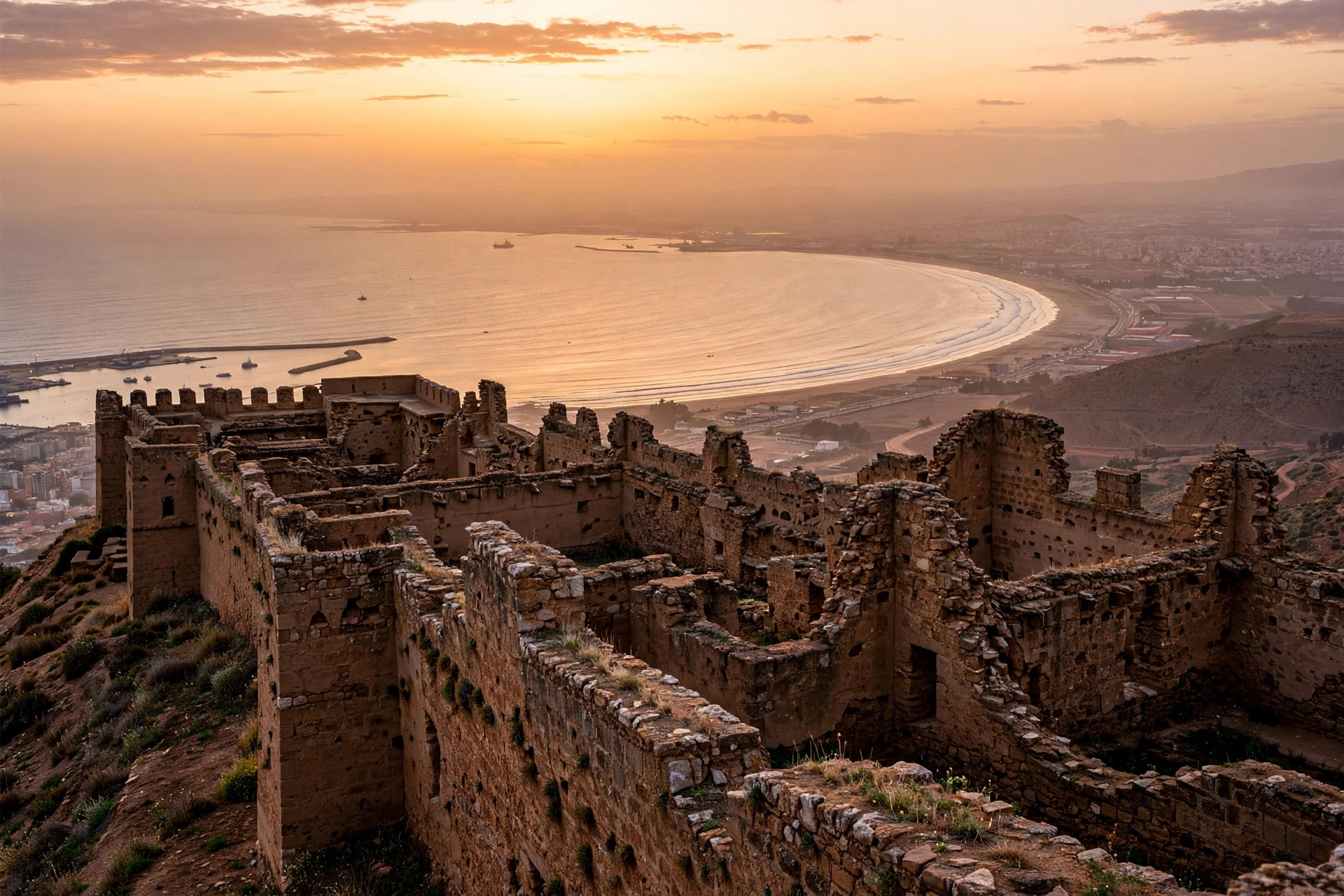
Ask any family in Agadir about the night their city vanished, and they will tell you about the Agadir earthquake 1960. On 29 February 1960, a leap-year night like any other, the ground under this Atlantic port city shook for less than fifteen seconds. When it stopped, a third of the city was dead, whole neighbourhoods were gone, and the Agadir that had stood for centuries no longer existed. It remains the deadliest earthquake in Moroccan history, and the reason the Agadir you visit today looks nothing like the city that came before it.
This guide tells the full story of the Agadir earthquake 1960 — the city as it was, the fifteen seconds that destroyed it, the rescue and the royal decision to rebuild, and the modern city that rose from the rubble. It sits in our History & Heritage section, and it is written by a Moroccan telling the story of his own country, honestly, including the numbers historians still argue about. If you are planning a trip, our Agadir travel guide covers the practical side; here is the history that explains everything you will see.
In this guide
- Agadir Before the Quake: A Port City on the Edge
- The Agadir Earthquake 1960: A Timeline of Fifteen Seconds
- Why a Moderate Quake Killed So Many
- The Agadir Earthquake 1960 at a Glance
- The Kasbah and Talborjt: What Was Lost
- Rescue, Relief and the World Responds
- King Mohammed V and the Decision to Rebuild
- The Agadir Earthquake 1960 and the New City
- What Visitors Can See Today
- Old Agadir vs New Agadir
- Lessons Morocco Learned
- Frequently Asked Questions
- Conclusion: The Night Agadir Remembers
Agadir Before the Quake: A Port City on the Edge
Before that night, Agadir was a busy Atlantic port with a long past. Portuguese traders built a fortified post here in the early 1500s, and the Saadian sultans drove them out in 1541 and raised the Kasbah above the bay. The town below grew around fishing and the port, and by 1960 it held somewhere between 35,000 and 45,000 people.
Life was spread across very different neighbourhoods. The old town crowded inside the Kasbah walls on Oufella hill, known to its Tashelhit-speaking Amazigh residents as Agadir Oufella. Below it sat Founti, the fishermen’s quarter, and Talborjt, the commercial district, with Yachech and the Ville Nouvelle further out, built after the Treaty of Fes of 1912.
On the evening of 29 February, Agadir felt ordinary: families at home, cafes full, the port quiet for the night. Nobody knew the ground beneath them had been shifting for centuries. Morocco’s nineteenth century, from the Battle of Tetouan in 1860 to the protectorate, had been shaped by wars and treaties. The force that would reshape Agadir was not an army. It was the earth itself.
The Agadir Earthquake 1960: A Timeline of Fifteen Seconds
At 23:40 on 29 February 1960, the Agadir earthquake 1960 began without warning. The shaking lasted less than fifteen seconds, but it threw people from their beds and collapsed whole streets at once. Lights went out, dust filled the air, and then came a silence broken only by cries for help.
In the minutes that followed, the city tried to save itself. Survivors dug with bare hands for family and neighbours, fires broke out among the ruins, and the port was damaged, roads twisted and blocked, and telephone lines down — so the first news travelled slowly to Rabat and Casablanca.
| Time | What happened |
|---|---|
| 23:40, 29 February 1960 | The main shock strikes Agadir; shaking lasts under fifteen seconds |
| Minutes later | Fires break out in the ruins; survivors dig for family with bare hands |
| Overnight | Rescue teams arrive from nearby towns; the port and roads are badly damaged |
| 1 March 1960 | King Mohammed V pledges that Agadir will be rebuilt; a reconstruction commission is formed |
| Days after | Aid arrives from across Morocco and abroad; survivors are housed in camps |
| Weeks after | The decision is taken: the old site is abandoned and a new city is planned to the south |
By dawn on 1 March, the scale was clear: where the Kasbah, Founti and Talborjt had stood, there was rubble. The second shock of the Agadir earthquake 1960 came not from the earth but from the counting — street after street had ceased to exist, and thousands were missing.
Why a Moderate Quake Killed So Many
The numbers confuse people first. The Agadir earthquake 1960 measured only about 5.7 to 5.9 in magnitude, which sounds moderate beside the great earthquakes of history. But magnitude alone does not decide how many people die — what matters is how shallow the quake is, how close it lies to a city, and how the buildings are made.
This one was shallow, about 15 kilometres deep, with its epicentre almost directly beneath the city, and the shaking reached intensity X, the highest level on the Mercalli scale. The old quarters were built of stone, mud brick and concrete never designed to resist shaking. More than 95 percent of the people in Founti, the Kasbah and Yachech were killed, according to the United States Geological Survey.
It also struck at the worst possible hour: at 23:40, almost everyone was at home and asleep, inside the very buildings that were about to fall. The 1960 disaster was not a giant earthquake — it was an ordinary earthquake in exactly the wrong place, at exactly the wrong depth, at exactly the wrong hour.
The Agadir Earthquake 1960 at a Glance
The figures below are the ones most sources agree on, but honesty requires a warning first: almost every number from that night is disputed. The magnitude is given as 5.7, 5.8 or 5.9. The death toll is given as 12,000 to 15,000, and some accounts go higher. Even the city’s population before the quake is reported as anything from 35,000 to 48,000. This guide uses the most commonly cited figures and says plainly where they disagree. For the full range of published figures, see the Wikipedia account of the 1960 Agadir earthquake.
| Fact | Most commonly cited figure |
|---|---|
| Date and time | 29 February 1960, 23:40 local time |
| Magnitude | 5.7–5.9 (sources differ: 5.7, 5.8 and 5.9 are all published) |
| Depth | About 15 km — shallow |
| Maximum intensity | X (Extreme) on the Mercalli scale |
| Duration | Under 15 seconds |
| Death toll | 12,000–15,000 (estimated, disputed — see below) |
| Injured | 12,000–25,000 (sources differ) |
| Left homeless | At least 35,000 people |
| Buildings destroyed | About 70% of the city |
The Agadir earthquake 1960 left roughly a third of the city’s people dead and another third injured or homeless. The city’s own history page records that the population fell from about 45,000 before the disaster to about 16,000 after it. Whatever exact figure you choose, the meaning is the same: in fifteen seconds, Agadir lost a generation.
The Kasbah and Talborjt: What Was Lost
The Kasbah of Agadir Oufella was the soul of the old city, and the Agadir earthquake 1960 took it almost entirely. This sixteenth-century fortress had watched over the bay for four hundred years, and its great gate carried the inscription "Fear God and Honour the King". In fifteen seconds its walls crumbled and the old town inside them was buried. The ruins were never rebuilt, and they still stand on the hill today as the city’s open-air memorial.
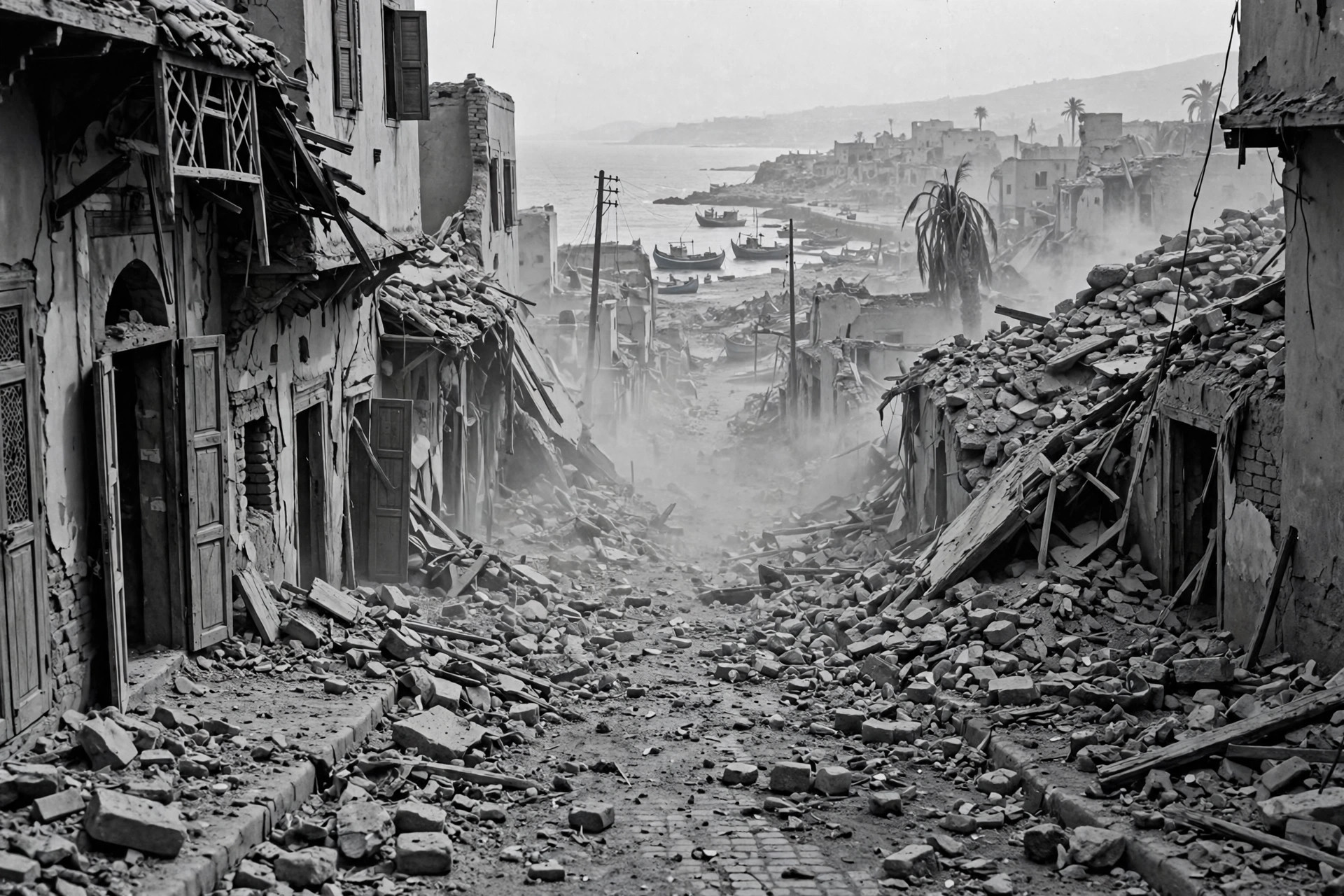
Founti, the fishermen’s quarter below the Kasbah, was destroyed just as completely, with about 95 percent of its buildings levelled. Talborjt, the commercial heart, suffered 60 to 90 percent damage, and Yachech was hit nearly as hard. The Ville Nouvelle was damaged less badly, and Anza and the industrial area escaped the worst. The destruction followed the ground.
What was lost was more than stone. The old city held the homes, mosques, shops and workshops of families who had lived there for generations. Its narrow streets were a whole way of life, Amazigh and Arab, fishing folk and merchants living close together above the bay. When the quake buried those streets, it buried the city’s memory of itself.
Rescue, Relief and the World Responds
The rescue began before any official help could arrive, carried out by the survivors themselves. People who had just lost their homes dug through the ruins with their hands, calling out names in the dark. Soldiers and sailors from the port joined them, and teams came in from nearby towns as soon as the roads allowed.
Help then came from further away: troops, doctors and supplies, and aid from France, the United States and other countries, with American help prominent in the relief and the reconstruction planning. Field hospitals and tent camps rose on the edge of the ruins, and the injured were carried to hospitals in Casablanca and Rabat.
The hardest work was also the saddest. Thousands of bodies could not be identified, and many were buried quickly as disease threatened the living. The Agadir earthquake 1960 left at least 35,000 people homeless, and the camps that sheltered them stayed up for months. For the survivors, the rescue was only the beginning.
King Mohammed V and the Decision to Rebuild
King Mohammed V came to Agadir in the days after the Agadir earthquake 1960, and his words there became part of the city’s identity. "If fate has willed the destruction of Agadir, its reconstruction depends on our faith and our will." The sentence is still quoted in the city today: Agadir would not be abandoned, and it would not be left as a ruin.
The day after the quake, the king formed a reconstruction commission headed by Crown Prince Moulay Hassan, the future King Hassan II. That put the rebuilding at the top of the young kingdom’s agenda, only four years after independence, and gave the project royal authority at every step. It is the same royal story our Kings of Morocco channel tells.
The commission faced a hard question before a single brick was laid: rebuild where the city had stood, or start again somewhere safer? The ground under the old quarters had proven itself deadly, so the decision was to move: the destroyed neighbourhoods north of the Tildi wadi were abandoned, and the new city would rise about two kilometres to the south, on steadier ground.
The Agadir Earthquake 1960 and the New City
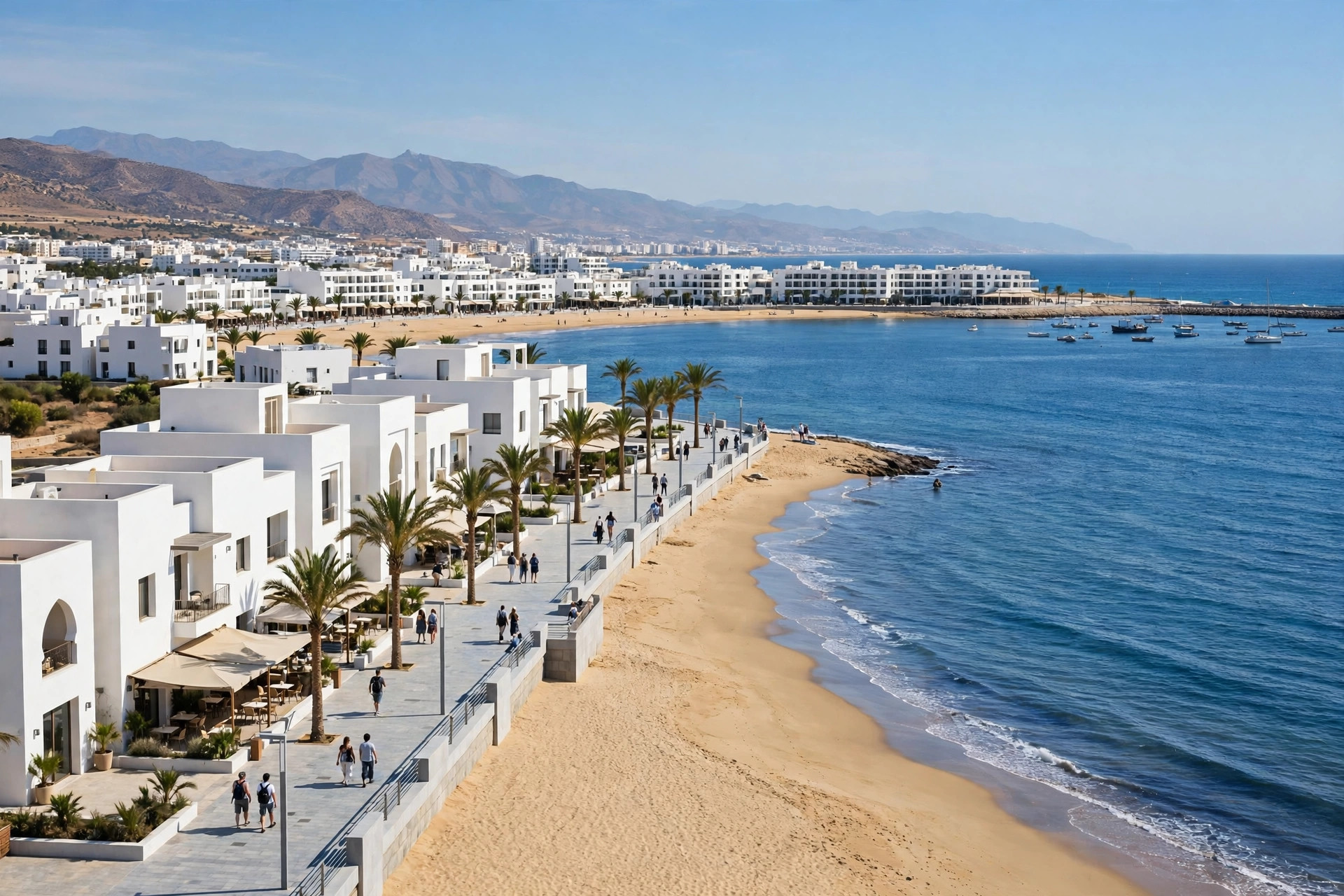
The new Agadir was planned from nothing after the Agadir earthquake 1960, and that is why it looks like no other old Moroccan city. Wide boulevards replaced narrow lanes, low-rise buildings replaced dense tall houses, and strict anti-seismic rules governed every new construction, so the city would never again fall so easily.
The port was rebuilt, fishing and trade came back to the bay, new districts grew along the wide avenues, and the great Souk El Had rose as one of the largest markets in the country. The Mohammed V Mosque gave the new city a spiritual centre, and today thousands of expats live in the city the quake created, as our guide to living in Agadir describes.
The Agadir earthquake 1960 is therefore not only a story of destruction. It is also the reason Agadir has its wide streets, white low-rise buildings and open feel — a city designed by people who had seen what the earth could do, and who refused to let it happen the same way twice.
What Visitors Can See Today
The best place to begin is the Kasbah hill, Agadir Oufella, where the ruins of the Agadir earthquake 1960 still stand above the bay. The old ramparts were partly destroyed in 1960 and later reinforced, and the great gate with its inscription can still be seen. From the hill, the bay opens below you, and the hillside carries the Arabic inscription "God, Country, King". A cable car now climbs the hill, but many visitors still walk up at sunset.
Down in the city, the memory of old Agadir lives on in new forms. The Medina of Agadir, built from 1992 by the artist and architect Coco Polizzi on five hectares, recreates a traditional medina with the hands of local artisans. The Amazigh Heritage Museum keeps the crafts and culture of the Souss alive, and the Mohammed V Mosque anchors the rebuilt city centre. The City of Agadir’s official history page traces the same rebuilding story.
Treat the Kasbah hill as a place of remembrance, not only a viewpoint. People died where you are standing, and families in Agadir still carry that night in their stories. Walk quietly, then go down to the corniche, where the new city is at its liveliest. Essaouira makes an easy day trip north, and the contrast between the two old port cities tells its own story.
Old Agadir vs New Agadir
Standing on the Kasbah hill, you can read the whole story of the city in one view: ruins above, modern city below. The table below sets the two Agadirs side by side, so you can see exactly what the quake changed and what the rebuilding chose to do differently.
| Feature | Old Agadir (before 1960) | New Agadir (today) |
|---|---|---|
| Site | Around the Kasbah hill and the old port | About 2 km south, on steadier ground |
| Streets | Narrow lanes and dense old quarters | Wide boulevards and open avenues |
| Buildings | Stone, mud brick and early concrete | Low-rise, white, built to anti-seismic rules |
| Kasbah | A living fortress town on the hill | Ruins preserved as a memorial and viewpoint |
| Heart of the city | Talborjt market district and Founti port quarter | The corniche, Souk El Had and the new city centre |
| Population | About 35,000–45,000 | A major city of nearly a million in the wider area |
The new city kept the old city’s name, its port and its place on the bay, but almost nothing else. That was the point: the people who rebuilt Agadir did not copy what the earth had taken. They built a city that could survive the next shaking, and gave Agadir a character unlike any other Moroccan city — modern, open and facing the sea.
Lessons Morocco Learned
The first lesson was about building. After 1960, Morocco understood that a moderate earthquake could destroy a city whose buildings were not made to resist shaking. Anti-seismic rules shaped the new Agadir. The lesson was tested again in September 2023, when the Al Haouz earthquake struck the High Atlas near Marrakech, and once more the quality of buildings decided who lived.
The second lesson was about memory. Agadir did not hide what happened: the Kasbah ruins were left standing, the story is told to every visitor, and the king’s words are still quoted. A disaster that is remembered is a disaster that teaches.
The third lesson belongs to all of Morocco. The quake showed a young independent country what its state could do in a crisis, and the world that Morocco would rebuild rather than retreat. For the kings who led that rebuilding, see our history of Morocco and the Kings of Morocco series. The Agadir earthquake 1960 taught Morocco to build better, to remember honestly, and to keep going.
Frequently Asked Questions
When did the Agadir earthquake happen?
It struck at 23:40 on 29 February 1960, and the shaking lasted less than fifteen seconds. Older accounts sometimes give 1 March, because of time-zone confusion in early reports, but the local date was 29 February 1960.
How many people died in the Agadir earthquake?
The commonly cited figure for the Agadir earthquake 1960 is 12,000 to 15,000 dead, about a third of the city’s population at the time, with roughly 12,000 to 25,000 injured and at least 35,000 left homeless. The toll is disputed, not settled: some sources give higher figures, and the exact population of Agadir before the quake is itself uncertain. No single number should be quoted as certain.
What caused so much destruction from a moderate quake?
Three things combined: the quake was shallow, at about 15 kilometres deep, its centre lay almost directly beneath the city, and the buildings of the old quarters were never designed to resist shaking. It struck at 23:40, when almost everyone was asleep at home.
Was the Kasbah of Agadir rebuilt after the earthquake?
No. The ruins of the Kasbah of Agadir Oufella were left standing as a memorial, and the hill was never rebuilt as a town. The ramparts were reinforced, the great gate can still be seen, and the hill is now a viewpoint reached by road or by cable car.
Where is the new Agadir?
The new city was built about two kilometres south of the destroyed quarters, on steadier ground beyond the Tildi wadi, with wide boulevards, low-rise buildings and strict anti-seismic rules. The old site was left as a place of memory.
What can I visit in Agadir related to the earthquake?
Start with the Kasbah hill at sunset for the ruins and the view over the bay. Then visit the Medina of Agadir, built from 1992 to recreate the lost medina, and the Amazigh Heritage Museum. Our Agadir travel guide covers opening times and transport.
Conclusion: The Night Agadir Remembers
Fifteen seconds. That is all it took to end the old Agadir, and sixty-six years later the city still measures its life from that night. Everything visitors love about modern Agadir exists because of a decision made in the rubble: not to give up, and not to rebuild the same danger twice.
The Agadir earthquake 1960 took a city in fifteen seconds, and the people of Agadir spent the next decades proving that a city is not its buildings. It is its people, their memory and their will to begin again. Stand on the Kasbah hill at sunset, look down at the lights coming on along the bay, and you will understand why this night, of all nights in Moroccan history, must never be forgotten.
Last checked: November 2026. Magnitude, death toll, injured and population figures differ between sources; the death toll is presented as disputed, not settled.