
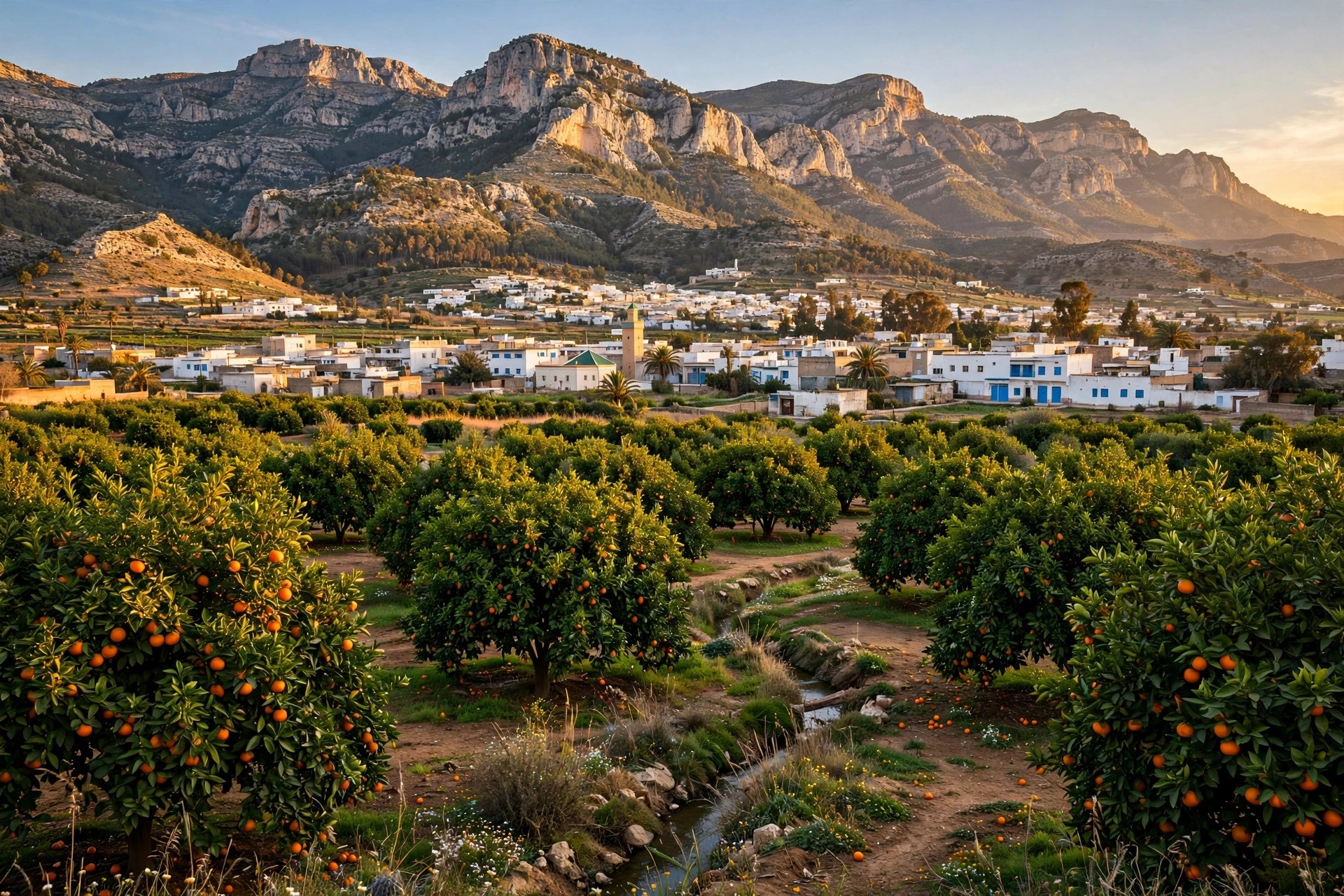
Living in Berkane is the Morocco most expats never consider — and that is exactly the point. This small agricultural city in the far northeast, about 60 kilometres west of Oujda and half an hour from the beach at Saïdia, is Morocco's citrus capital, where clementine groves ring the town and the Beni Snassen mountains rise to the south.
Berkane is the capital of its province in the Oriental region, with 99,069 people counted in the 2024 census (109,237 in 2014). It is a working city, not a tourist city. This guide to living in Berkane covers costs, neighbourhoods, housing, healthcare, internet and the honest downsides. All prices are in Moroccan dirhams (MAD), checked in November 2026, at roughly 10 MAD to $1 — planning ranges, so confirm them on arrival.
In this guide
- Berkane at a Glance
- Why Expats Choose Living in Berkane
- Where to Live in Berkane: Neighbourhoods
- Housing and Rents in Berkane
- Monthly Budget for Living in Berkane
- Food and Daily Life
- Getting Around Berkane
- Healthcare in Berkane
- Schools and Family Life
- Internet and Working Remotely from Berkane
- Climate and Seasons in Berkane
- Weekend Trips from Berkane
- Practical Tips: What to Know Before Moving to Berkane
- Frequently Asked Questions
- Conclusion
Berkane at a Glance
| Fact | Detail |
|---|---|
| Location | Triffa Plain, northeastern Morocco, at the foot of the Beni Snassen mountains, Oriental region |
| Population | 99,069 (2024 census); 109,237 in 2014 |
| Character | Citrus capital of eastern Morocco, famous for clementines |
| Elevation | About 185 metres |
| Nearest airport | Oujda Angads (OUD), 55–60 km east, about 1 hour |
| Nearest train station | Oujda, 60 km east, about 1 hour |
| Nearest beach | Saïdia, 28 km north, 30–40 minutes |
| Climate | Hot semi-arid with Mediterranean influences |
| Budget, single person | 5,600–10,000 MAD ($560–$1,000) a month |
| Budget, couple | 8,500–13,800 MAD ($850–$1,380) a month |
Berkane takes its name from Sidi Ahmed Aberkane, a local saint whose mausoleum stands in the city; in Tamazight, the Amazigh language of the region, "aberkan" means "black". The city grew around the irrigated farms of the Triffa Plain, and the clementine harvest still fills the winter months. A giant orange statue stands in the town centre, and Berkane is the birthplace of Hicham El Guerrouj, the Olympic champion who holds the 1,500-metre world record.
Why Expats Choose Living in Berkane
The first reason people choose living in Berkane is the price. Rents are among the lowest of any Moroccan city of this size: a one-bedroom flat in the centre typically runs 2,000–3,000 MAD ($200–$300) a month, and a three-bedroom family flat 3,500–5,000 MAD ($350–$500). A single person can live well on 5,600–10,000 MAD a month, and a couple on 8,500–13,800 MAD.
The second reason is the setting. Living in Berkane puts the Mediterranean within half an hour, the Beni Snassen mountains on the horizon, and the green Zegzel valley a short drive away. You can buy clementines from the farmer who grew them and be on a beach before lunch. But it is a deliberate trade, small-city calm over big-city choice, and the rest of this guide makes it with your eyes open. Read the city's background on Wikipedia.
Where to Live in Berkane: Neighbourhoods
Most of daily life for people living in Berkane happens within a few kilometres, and a petit taxi covers almost any trip inside town for a few dirhams.
The town centre, around Avenue Mohammed V, is where most newcomers start: banks, pharmacies, cafes, the market streets and the bus stops within a short walk. Flats here are simple, often above shops.
Hay Al Wifaq and the newer residential districts are the comfortable choice for a longer stay: wider streets, newer apartment buildings, more space and better odds of a balcony or a parking spot. They suit families and longer stays.
Sidi Slimane Echcharraa, across the bridge, is the neighbouring town that feels like a suburb of Berkane: cheaper rents, a local feel, and a short ride into the centre.
The orchard fringe, towards the groves and the hills, is the quietest option: scattered houses and small villas among the citrus trees, with the mountains in view. It suits people who want space and a garden.
Housing and Rents in Berkane
Renting while living in Berkane works the way it works in most small Moroccan cities: the best flats move by word of mouth, not listing sites. The local semsar, the neighbourhood broker, knows what is free; so do cafe owners and hotel receptionists. Arrive, stay a week in a small hotel, drink tea, and ask around.
Expect a simple contract in French or Arabic, a deposit of one to two months' rent (the legal maximum is two months under Law 67-12), and a flat that is usually unfurnished — often without appliances, sometimes without a cooker. Furnished flats cost roughly 300–700 MAD a month more. As a planning range for November 2026: one-bedroom in the centre 2,000–3,000 MAD ($200–$300), outside the centre 1,500–2,200 MAD ($150–$220); three-bedroom in the centre 3,500–5,000 MAD ($350–$500).
Never pay a full year upfront for a flat seen only in photos — rent month to month until you know the building and the summer heat. Check water pressure, hot water and air conditioning before you sign. Our renting an apartment in Morocco guide explains the contract and deposit rules.
Monthly Budget for Living in Berkane
A realistic monthly budget for living in Berkane in a modest flat, cooking mostly at home and eating out a few times a week. Planning ranges, checked in November 2026 — confirm on arrival.
| Expense | Single person (MAD/month) | Couple (MAD/month) |
|---|---|---|
| Rent, one-bedroom flat | 1,800–3,000 ($180–$300) | 2,500–4,500 ($250–$450) |
| Utilities, water and electricity | 300–600 ($30–$60) | 400–800 ($40–$80) |
| Food and market shopping | 1,800–2,800 ($180–$280) | 3,000–4,500 ($300–$450) |
| Eating out and cafes | 300–700 ($30–$70) | 500–1,000 ($50–$100) |
| Local transport | 200–400 ($20–$40) | 300–600 ($30–$60) |
| Internet and phone | 200–350 ($20–$35) | 250–400 ($25–$40) |
| Health insurance and care | 400–900 ($40–$90) | 600–1,200 ($60–$120) |
| Leisure and extras | 300–700 ($30–$70) | 500–1,000 ($50–$100) |
| Household and miscellaneous | 300–600 ($30–$60) | 400–800 ($40–$80) |
| Total | 5,600–10,000 ($560–$1,000) | 8,500–13,800 ($850–$1,380) |
Two costs surprise newcomers: summer cooling, which can push the electricity bill well above the winter level, and the Oujda run — you will travel to the regional capital more than you expect. Our cost of living in Morocco guide gives the wider picture with 2026 prices.
Food and Daily Life
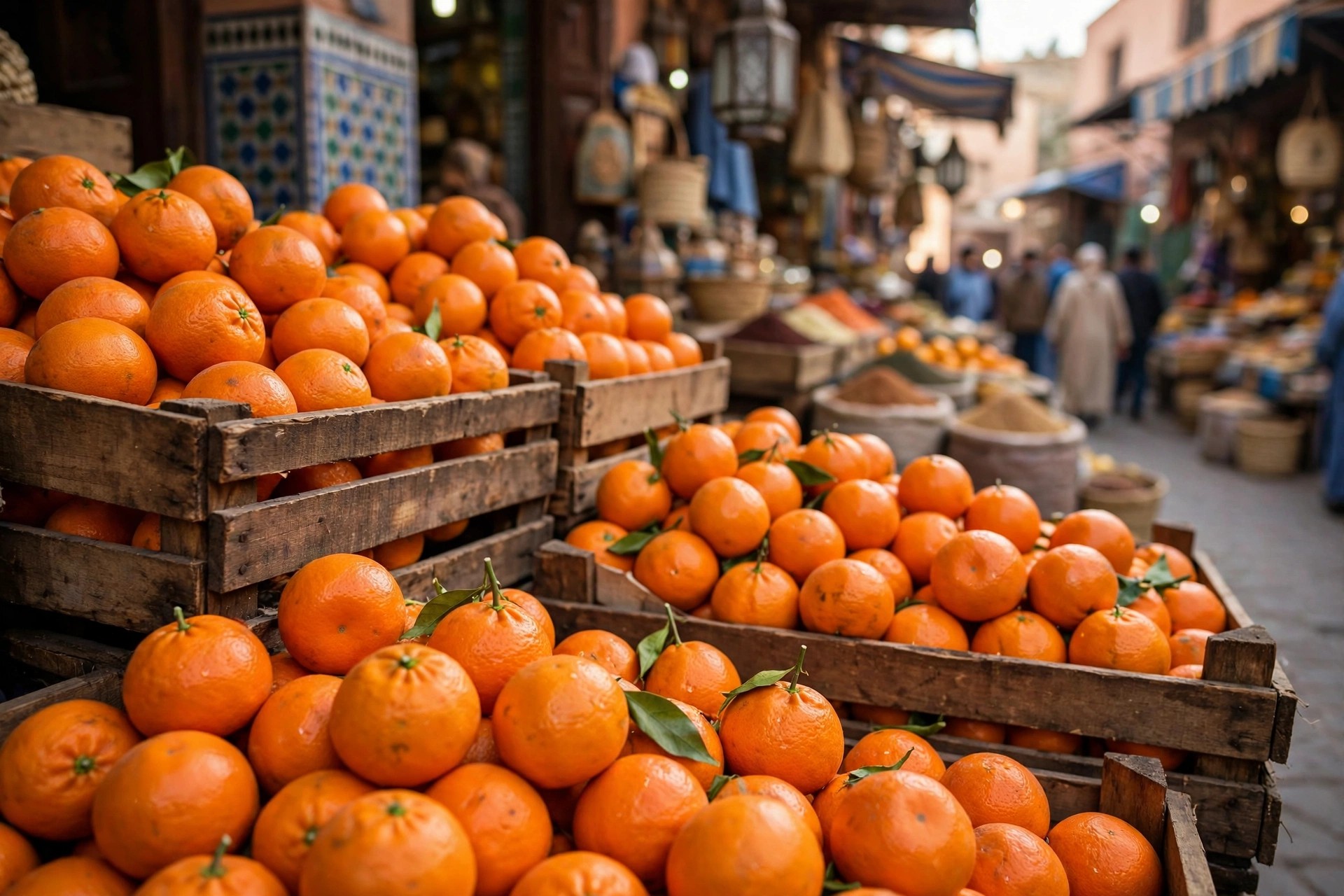
Daily life is the best part of living in Berkane. The day starts early in the market streets, where farmers from the Triffa Plain bring vegetables, olives, herbs, honey and, in season, crate after crate of clementines and oranges. Berkane's clementines are famous across Morocco, and in winter they sell by the kilo at roadside stalls for a few dirhams.
The weekly souk is the town's social event as much as its market — a working country souk, not a tourist bazaar. We could not verify the exact market day from published sources, so ask locally: arrangements change. Go early, bargain politely, bring cash — the market runs on dirhams, not cards.
Restaurants serve the Moroccan standards: tajine for 30–60 MAD ($3–$6), couscous on Fridays, harira and brochettes in the evenings, mint tea for 6–10 MAD ($0.60–$1). What Berkane lacks is variety — no supermarket with foreign foods, no delivery app. Our Moroccan food guide covers the dishes you will meet first.
Getting Around Berkane
Getting around while living in Berkane means buses, taxis and, for most residents, a car — the city has no passenger train station. Inside town, the centre, markets and cafes are all within half an hour on foot, and petit taxis cover the newer districts for about 7–10 MAD ($0.70–$1) a ride.
For longer trips, CTM and local buses reach Oujda in about an hour and Nador in about two. The nearest train station is in Oujda, 60 km east, with ONCF trains west to Fez, Rabat and Casablanca; the nearest airport is Oujda Angads (OUD), 55–60 km away and about an hour by road. Fares change, so check on the day — all figures below are approximate, checked in November 2026.
| From Berkane | How | Time | Cost |
|---|---|---|---|
| Oujda | Bus or grand taxi | About 1 hour | 30–60 MAD ($3–$6) |
| Saïdia beach | Bus, grand taxi or car | 30–40 minutes | 20–40 MAD ($2–$4) |
| Oujda Angads Airport (OUD) | Grand taxi or car via Oujda | About 1 hour | 60–120 MAD ($6–$12) |
| Nador | Bus or grand taxi | About 2 hours | 60–100 MAD ($6–$10) |
| Tafoughalt | Grand taxi or car | 45 minutes–1 hour | 30–60 MAD ($3–$6) |
| Fez | Bus to Oujda, then ONCF train | 4–5 hours | 120–200 MAD ($12–$20) |
A car changes everything here: the beach, the mountains and the weekly trips to Oujda become easy outings. Our getting around Morocco guide covers buses, trains and grand taxis.
Healthcare in Berkane
Healthcare is solid for everyday needs, and limited for anything serious. Berkane has a provincial hospital, local clinics and well-stocked pharmacies for minor injuries, infections and check-ups. For specialist care or surgery, the destination is Oujda, an hour east, with private clinics and a university hospital.
Keep a medicine cabinet, know your blood group, keep prescriptions in French, and have a taxi number ready for a trip to Oujda. Private insurance covering treatment there is the price of living in Berkane, and it belongs in your budget from day one. Our healthcare in Morocco for expats guide explains the public AMO system and private clinics.
Schools and Family Life
Families considering living in Berkane need the bluntest paragraph in this guide: there is no international school here, and no French or English-medium school either. Children attend Moroccan public schools, in Arabic with French — wonderful immersion for a young child, a hard transition for a teenager with no Arabic or French. The nearest international schooling is in Oujda, an hour away.
That decides it for most families: the ones who make it work have young kids, homeschool, or use distance learning. Living in Berkane gives families safety and freedom for children to roam, plus the beach and mountains for weekends — but not a place to move with a teenager in exam years.
Internet and Working Remotely from Berkane
Remote work is possible while living in Berkane, but it is not plug-and-play. Fibre is available in parts of town, so many flats still run on ADSL or 4G, and speeds vary by street — one published guide puts the average at around 25 Mbps, and a home connection at about 200 MAD ($20) a month. The answer is redundancy: a fixed line plus a 4G router from a second provider.
Video calls work most days, and the town's quiet suits focused work. But test the connection in the exact flat, at your working hours, before you sign — and keep a charged laptop and a phone with data for the brief power cuts. There is no coworking space in Berkane, so home is the office. Our digital nomad guide to Morocco covers visas, SIM cards and the best-connected cities.
Climate and Seasons in Berkane
Berkane has a hot semi-arid climate with Mediterranean influences: hot, dry summers, mild winters and most rain falling between November and March. Summer highs regularly pass 32°C, and July days can reach the high 30s. Winter days are mild, around 14–18°C, with cold nights around 7–10°C. Annual rainfall is modest, roughly 200–300 mm.
| Season | Weather | What to expect |
|---|---|---|
| Spring (March–May) | 14–24°C, sunny, cool nights | Orange blossom, best walking weather |
| Summer (June–August) | 23–35°C, dry, hot afternoons | Beach season in Saïdia, air conditioning essential |
| Autumn (September–November) | 15–29°C, warm days, cooling nights | Harvest season, comfortable sightseeing |
| Winter (December–February) | 7–18°C, mild days, rain | Clementine season, quiet town |
The best time to arrive is spring or autumn. If you can, visit in July before committing: the heat is the season that decides whether living in Berkane suits you. Visit Morocco lists the Oriental region among the country's quieter destinations.
Weekend Trips from Berkane
The reward for living in Berkane is the weekend. North, 28 km away, Saïdia is one of Morocco's finest Mediterranean beaches: a long stretch of golden sand, calm water and, in summer, a lively resort town. Go on a weekday outside July and August and you may have the beach almost to yourself.
East, 60 km away, Oujda is the regional capital: a medina, a university, big shops, private clinics and the train station — the place you go for the things Berkane does not have.
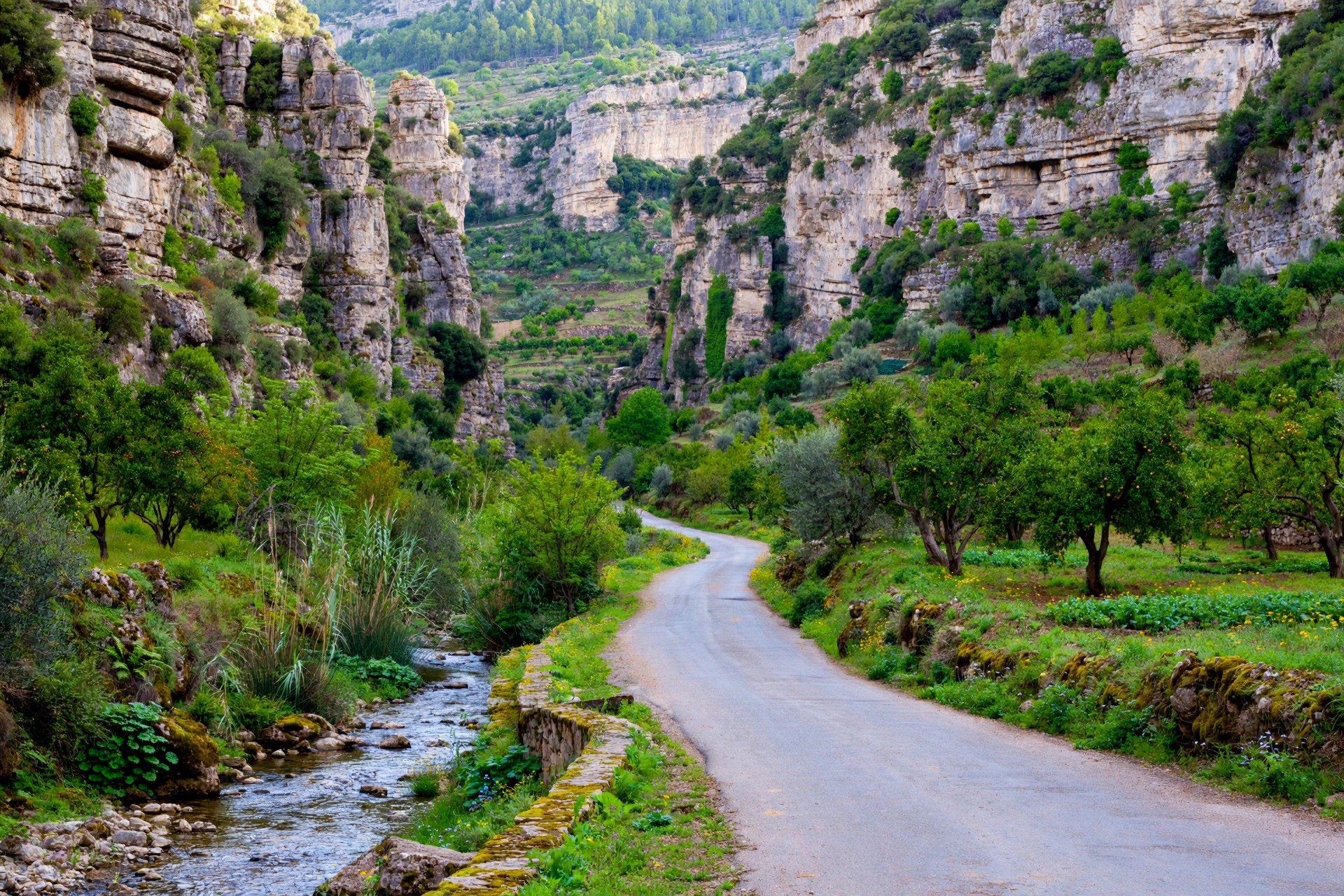
South and west, the Beni Snassen mountains rise behind the town. The Zegzel valley cuts a green gorge through the limestone, with the Camel Cave (Grotte du Chameau) a short walk from the road, and the village of Tafoughalt is known for its mountain air and herb markets. Its cave is one of the most important prehistoric sites in North Africa, with burials over 15,000 years old — but the site is restricted to researchers, so admire it from the village and the valley road.
Practical Tips: What to Know Before Moving to Berkane
Learn the languages that matter. Daily life runs in Moroccan Arabic (Darija) and Tamazight, the Amazigh language of the region; French opens every office door. English is rarely spoken, so twenty words of Darija and a little French will change your first month.
Bring cash and patience for paperwork. Residency, the carte de séjour, is applied for at the préfecture in Berkane before your 90 visa-free days end, and the file runs on paper, stamps and photocopies. Our moving to Morocco: visas and residency guide walks through it.
Expect a small foreign community. Very few non-Moroccans are living in Berkane, so most social life runs in Darija and Tamazight. You will be noticed, welcomed, and invited to tea — and you will need the language to make friends.
Rent before you buy. Spend a month in a rented flat, in the season you will actually live there, before any longer commitment. Check the water pressure, the cooling and the internet speed in the exact flat.
Keep a car in the plan. Berkane works without one, but it works much better with one — for the beach, the mountains, the hospital in Oujda and the airport. Compare the living in Oujda guide for the bigger-city alternative, and browse the full Living in Morocco section.
Frequently Asked Questions
Is Berkane a good place for expats to live?
Yes, for the right expat. Living in Berkane suits retirees, remote workers and slow travellers who want very low costs, a beach half an hour away and mountain air — and who accept a small town and limited English.
How much does it cost to live in Berkane?
A single person can live comfortably on about 5,600–10,000 MAD ($560–$1,000) a month, and a couple on about 8,500–13,800 MAD ($850–$1,380), including rent. A one-bedroom flat in the centre typically costs 2,000–3,000 MAD ($200–$300) a month.
Can I work remotely from Berkane?
Yes — remote work while living in Berkane is possible with redundancy: a fixed line where available plus a 4G backup, tested in the exact flat at your working hours. Video calls work most days, but speeds vary by street, so test first. There is no coworking space in town.
Is Berkane safe for expats?
Yes. Berkane is a small, quiet provincial city with a low-key feel, and residents generally feel comfortable walking the centre by day. Take the usual precautions at night, as anywhere in Morocco, and keep valuables out of sight at the market.
What is the nearest airport and train station to Berkane?
The nearest airport is Oujda Angads (OUD), about 55–60 km east and roughly an hour by road. The nearest train station is in Oujda, about 60 km east, with ONCF trains to Fez, Rabat and Casablanca.
What is Berkane famous for?
Berkane is Morocco's citrus capital, famous above all for its clementines, grown on the irrigated Triffa Plain and exported across Morocco and abroad. It is also the birthplace of Olympic champion Hicham El Guerrouj, and the gateway to Saïdia beach and the Beni Snassen mountains.
Conclusion
Living in Berkane is a choice, not a compromise — a choice of the citrus groves over the airport, of a slow, cheap, sunlit life near the sea over a convenient one. It asks you to accept the summer heat, the thin services and the drive to Oujda for a specialist, and it pays you back with some of the lowest living costs in Morocco. Compare the living in Midelt guide for the high-mountain alternative.
If that trade sounds like freedom, come and try it: rent for a month in spring, walk the market streets, drive to Saïdia for a swim, and see whether living in Berkane feels like home. It will not suit everyone — but for the people it suits, it suits them completely.