
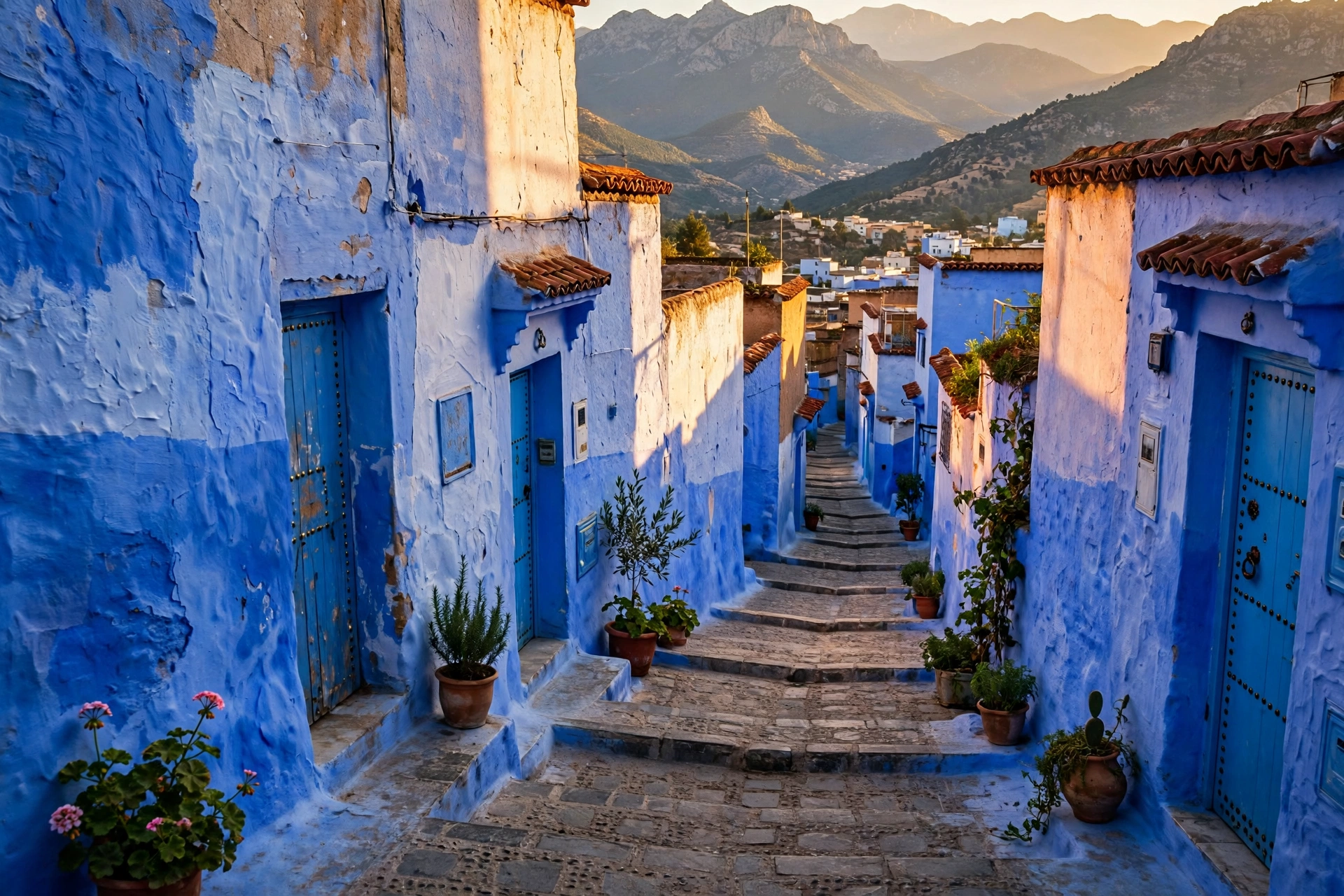
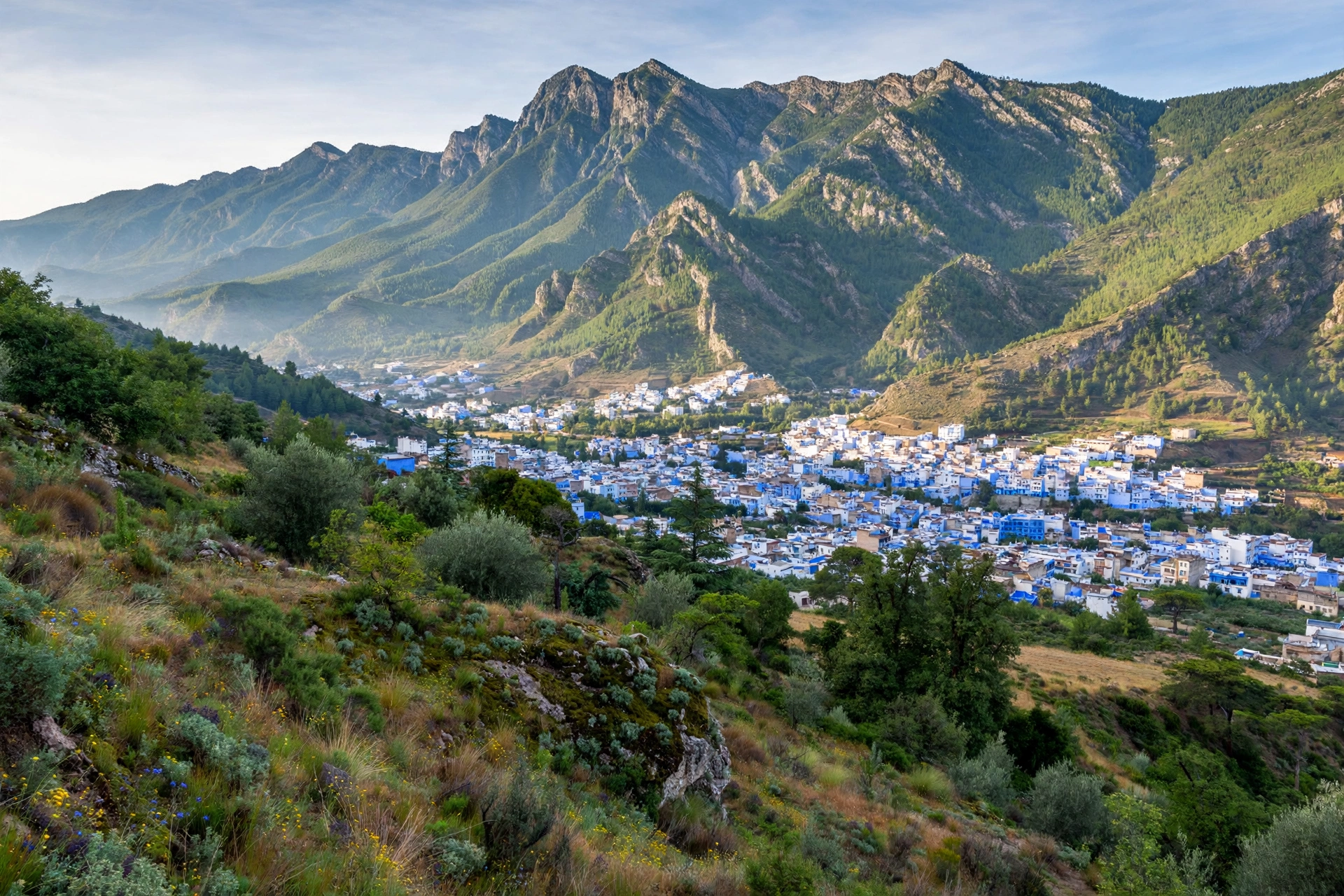
Living in Chefchaouen is Morocco at its slowest and most beautiful: a small mountain town of about 43,000 people where every street is painted blue, the Rif Mountains rise on every side, and the day is measured in mint tea, market visits and walks up to the Spanish Mosque at sunset. If you want Morocco without the rush of Casablanca or the crowds of Marrakech, living in Chefchaouen is the gentlest landing in the country.
Chefchaouen will not give you a big-city life — it has no train station, no shopping mall and no nightlife to speak of. What living in Chefchaouen offers instead is calm: clean mountain air, some of the cheapest rents in Morocco, a medina you can cross on foot in twenty minutes, and a community small enough that the baker learns your name in a week. It sits in our Living in Morocco section, alongside our wider Living in Morocco: The Complete Guide for Expats.
In this guide
- Why Expats Choose Living in Chefchaouen
- Chefchaouen at a Glance
- Best Neighbourhoods for Living in Chefchaouen
- Rents and Housing: What You Pay in 2026
- Monthly Cost of Living in Chefchaouen
- Weather: Mountain Air and Four Real Seasons
- Working Remotely While Living in Chefchaouen
- Daily Life: Food, Markets and Getting Around
- Healthcare and Schools
- The Downsides: Who Should Not Move Here
- Practical Steps to Move to Chefchaouen
- Frequently Asked Questions
- Conclusion: Is Living in Chefchaouen Right for You?
Why Expats Choose Living in Chefchaouen
Chefchaouen was founded in 1471 as a small fortress town in the Rif Mountains, and it stayed a quiet, hidden place for most of its history. The blue paint that made it famous is often said to have been brought by Jewish refugees in the 1930s, though the exact story is not settled — what matters is the result: a medina washed in dozens of shades of blue, now one of the most photographed towns in Morocco. Living in Chefchaouen today means waking up inside that postcard, long after the day-trippers have left.
The foreign community is small and unusual: artists and photographers who came for a week and stayed for years, retirees from France and Spain drawn by the climate and the prices, a few remote workers who traded city noise for mountain views, and Moroccans from bigger cities who moved here for the calm. Spanish is genuinely useful — the town was under Spanish rule from 1920 to 1956 and many older residents still speak it — and living in Chefchaouen is the only Moroccan life where the loudest sound at night is usually a donkey on a side street.
The trade is simple and honest: Chefchaouen gives you beauty, clean air, safety and some of the lowest living costs in the country, and asks you to accept a small-town pace, limited services and a two-hour drive to the nearest big city. For many, living in Chefchaouen is exactly the point — a place to slow down rather than to climb a ladder.
Chefchaouen at a Glance
Living in Chefchaouen rewards people who like their towns small, walkable and wrapped in mountains. The essentials below are what most newcomers ask about first, before they start comparing districts and rents.
| Fact | Detail |
|---|---|
| Population | About 43,000, one of the smallest towns on this site |
| Region | Tanger-Tétouan-Al Hoceïma, in the Rif Mountains |
| Altitude | About 600 metres above sea level |
| Founded | 1471, as a fortress against the Portuguese |
| Climate | Mountain Mediterranean; warm summers, cool and wet winters |
| Summer highs | 30–33°C by day, cooling fast after sunset |
| Winter lows | 3–5°C at night, 13–16°C by day; occasional snow on the peaks |
| Best months to arrive | April–June and September–October |
| Nearest airports | Tangier (about 2 hours by road), Fes (about 3.5 hours) |
| Trains | None — buses and grand taxis connect Chefchaouen to Tangier, Fes and Tetouan |
| Public transport | Petit taxis inside town; a ride costs about 5–7 MAD (about $0.50–$0.70) |
| Currency | Moroccan dirham (MAD); about 10 MAD to $1 in November 2026 |
Best Neighbourhoods for Living in Chefchaouen
Choosing a district matters when living in Chefchaouen, because the town is really two places: the blue medina on the hill and the newer town below it. Our full guide to the town, Chefchaouen: The Blue City Guide, covers the sights; the short version for residents is below.
The medina is where the magic lives. Its blue lanes, small squares and rooftop views over the Rif are the reason most people come — and living in Chefchaouen from the medina means stepping out of your door into the most beautiful streets in Morocco. The trade is real: steep lanes, no cars, stairs with your shopping, and damp in winter. It suits single expats and couples without a car who want the town at its most atmospheric.
The new town below the medina is the practical choice: flat streets, supermarkets, banks, pharmacies and the bus station, with apartments that have lifts, parking and proper heating. Families and long-term residents settle here, and the rents are the lowest in town. The trade is distance from the postcard — you will walk uphill ten minutes to reach the blue streets.
The hillside above the medina, towards the Spanish Mosque, offers houses with the best views in town and total quiet. A few expats rent small villas here, but you will need a car or strong legs, and winter nights are cold. Wherever you settle, living in Chefchaouen stays walkable — the whole town is barely two kilometres across.
Rents and Housing: What You Pay in 2026
Rents for living in Chefchaouen are among the lowest in Morocco — well below Tangier, Fes and Rabat — and a comfortable flat costs less than a studio in Casablanca. Expect to pay two months' deposit plus the first month up front, and always check the damp, the water pressure and the heating before signing — our guide to renting an apartment in Morocco explains the contract traps to avoid.
| Home type | Monthly rent (MAD) | Approx. USD |
|---|---|---|
| Studio, new town | 1,500–2,500 | $150–$250 |
| One-bedroom, new town | 2,000–3,500 | $200–$350 |
| Two-bedroom, new town | 3,000–5,000 | $300–$500 |
| One-bedroom, medina | 2,500–4,000 | $250–$400 |
| Two-bedroom, medina | 3,500–6,000 | $350–$600 |
| Small house with terrace | 4,000–7,000 | $400–$700 |
| Villa with mountain view | 6,000–10,000 | $600–$1,000 |
Medina flats cost more than their size suggests because tourists will pay nightly rates for the same rooms — ask whether the price is a resident's rent or a short-stay rate before you agree. Long stays of a year or more usually bring the price down by a third, and living in Chefchaouen costs less the longer you commit: landlords prefer a quiet year-long tenant to a summer of turnover.
Monthly Cost of Living in Chefchaouen
The monthly cost of living in Chefchaouen stays affordable even by Moroccan standards, because rents are low, the markets are cheap and there is almost nothing to spend money on after dark. A single person lives well on 7,000–9,000 MAD a month, and a couple on 11,000–14,000 MAD — our cost of living in Morocco guide puts these figures in national context.
| Expense | Single person (MAD/month) | Approx. USD |
|---|---|---|
| Rent, one-bedroom | 2,000–3,500 | $200–$350 |
| Groceries and markets | 1,500–2,200 | $150–$220 |
| Eating out (a few times a week) | 600–1,000 | $60–$100 |
| Utilities, water and electricity | 300–600 | $30–$60 |
| Internet and mobile | 250–400 | $25–$40 |
| Transport (taxis, occasional bus) | 200–400 | $20–$40 |
| Health insurance (private) | 400–800 | $40–$80 |
| Leisure and trips | 500–1,000 | $50–$100 |
| Total | 5,750–9,950 | $575–$995 |
Food is where living in Chefchaouen on a modest budget shines: the daily market sells vegetables, olives, bread and goat cheese for a fraction of supermarket prices, a filling lunch in a local restaurant costs 30–50 MAD (about $3–$5), and a mint tea on a terrace costs 6–10 MAD. The costs that surprise newcomers are heating in winter — old stone houses get cold — and the bus or taxi to Tangier whenever you need something the town does not sell.
Weather: Mountain Air and Four Real Seasons
The weather shapes living in Chefchaouen more than in any other town on this site, because 600 metres of altitude gives it four real seasons. Summers are warm and dry, with blue skies and evenings cool enough for a jacket, and the town fills with visitors escaping the coastal heat. Autumn is the sweet spot: clear light, empty lanes and harvest markets full of figs, walnuts and olives.
Winter is the test. Rain falls often from December to February, the medina lanes run with water, and nights drop to 3–5°C — while snow dusts the peaks above town. Houses built for summer can feel damp and cold, so heating matters more here than anywhere else in the north, and living in Chefchaouen in winter means blankets, a good heater and a tolerance for grey days. Spring makes up for it: wildflowers on the hills, the waterfalls at Akchour running full, and the best hiking weather of the year.
Working Remotely While Living in Chefchaouen
Working remotely while living in Chefchaouen is possible, but it is the weakest point of the town and you should plan for it honestly. Fibre reaches parts of the new town but not the medina, where many flats still rely on ADSL or 4G, and speeds vary street by street — test the connection in the exact flat before you sign, at the hour you work. Our Morocco internet guide explains the providers and the 4G backup options.
The upside is focus: few distractions, cheap cafes with terraces, and a rhythm that suits deep work. Several cafes in the new town have reliable wifi and do not mind a laptop for an afternoon, and living in Chefchaouen as a remote worker means your lunch break can be a walk to the Ras El Maa spring. Keep a 4G router as backup, keep your video calls in the morning when the network is quietest, and keep a Tangier or Tetouan coworking day in mind for deadline weeks — our digital nomad guide to Morocco covers the wider options.
Daily Life: Food, Markets and Getting Around
Daily life when living in Chefchaouen runs on a small-town rhythm: the morning market, the bakery run, a long lunch, and an evening walk. The medina market sells Rif produce — goat cheese, olives, honey, herbs and mountain bread — and the new town has supermarkets for everything else. Restaurants are simple and cheap: tagines, grilled fish from the coast, and the town's famous goat cheese salads, with a full dinner rarely passing 80–100 MAD (about $8–$10) a head.
Getting around is on foot or by petit taxi: the town is small, the medina is car-free, and a taxi across town costs 5–7 MAD. For longer trips, CTM and local buses run to Tangier (about 2 hours, 60–80 MAD), Tetouan (about 1.5 hours) and Fes (about 3.5 hours, 100–130 MAD), and grand taxis fill the gaps. Living in Chefchaouen means accepting that every big-city errand — a specialist doctor, a foreign embassy, a large hardware store — is a day trip, usually to Tangier. The waterfalls and natural pools of Akchour, 30 minutes away, are the weekend escape most residents use, and the Fes to Chefchaouen day trip shows how visitors first meet the town.
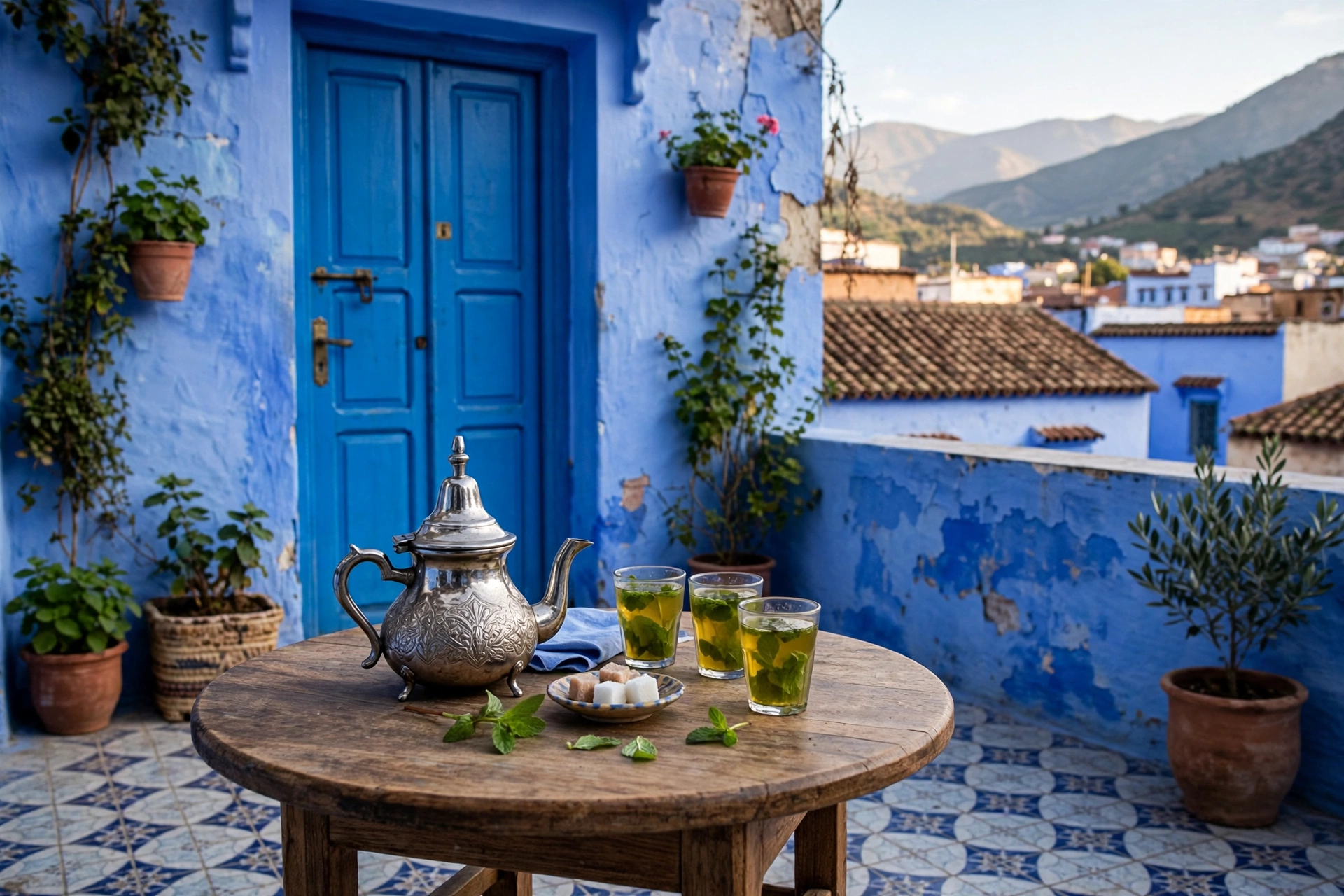
Evenings belong to the terraces. As the sun drops behind the mountains, the cafes on Place El Haouta and along the main medina lanes fill with residents drinking mint tea and watching the blue walls turn violet, and the town's unhurried pace becomes its main attraction. There are no cinemas and no late bars, so social life happens in these small, repeated rituals — the same cafe, the same neighbours, the same view — and newcomers who embrace that rhythm find friends faster than in any big city.
Healthcare and Schools
Healthcare is the other honest limit of living in Chefchaouen. The town has a public hospital and several clinics for everyday care, plus pharmacies that cover most needs, but anything serious means the road to Tangier or Tetouan — plan for a two-hour drive, keep private health insurance, and know the number of a Tangier clinic before you need it. Our healthcare guide for expats explains the public and private systems and what insurance to buy.
Schools are limited in the same way: good Moroccan public and private schools in town, but no international school — expat families usually choose Tangier or Rabat instead, or homeschool. If you are moving with children, read our schools guide for expat families before you commit. For retirees and singles, the limits matter less: the town is safe, quiet and walkable, and neighbours look out for each other in a way big cities rarely manage.
The Downsides: Who Should Not Move Here
Living in Chefchaouen is not for everyone, and it is better to know that before the move than after. The town is small, and small means few jobs, few services and few strangers: if you need a busy social scene, a large expat community or a career ladder, you will feel the limits within months. The foreign community is friendly but tiny, and winter can feel lonely when the tourists leave and the rain sets in.
The practical limits are concrete: no train, no airport, slow internet in the medina, damp houses, and a two-hour drive for anything the town lacks. Living in Chefchaouen long-term works best for people who bring their income with them — retirees, remote workers and artists — and who genuinely like quiet days. If you are restless, career-hungry or need city energy every day, choose Tangier instead and visit Chefchaouen on weekends.
Practical Steps to Move to Chefchaouen
Moving to Chefchaouen begins like any move to Morocco: enter on a tourist visa or visa-free stay, then apply for residency once you are settled. Our moving to Morocco guide walks through visas and the carte de séjour, and the renewal guide covers the yearly paperwork. Most newcomers rent first for three to six months, in the new town, before deciding between medina and new town for the long term. For official visitor information and regional transport, the Visit Morocco site is a useful starting point.
Open a bank account early — our guide to opening a bank account in Morocco explains the documents — and sort out tax residency if you stay past six months, with our Morocco tax guide for expats as a starting point. Learn some Darija from day one: our guide to learning Moroccan Arabic will help, and in a small town a few phrases open every door. If you later decide to buy, read our buying property in Morocco guide first — and for the retirement view, see retiring in Morocco.
Frequently Asked Questions
Is Chefchaouen a good place for expats to live?
Yes, for the right person: Chefchaouen suits retirees, remote workers and artists who want beauty, calm and low costs. It suits people who need a big city, a large expat scene or fast internet in every street far less — visit for a month in winter before you commit.
How much does it cost to live in Chefchaouen?
A single person lives comfortably on 7,000–9,000 MAD (about $700–$900) a month including rent, and a couple on 11,000–14,000 MAD (about $1,100–$1,400). Rents from 2,000 MAD and market food keep the total among the lowest in Morocco.
Can I work remotely from Chefchaouen?
Yes, with planning: fibre exists in parts of the new town, 4G covers the rest, and cafes welcome laptops. Test the connection in your exact flat before signing a lease, keep a 4G backup, and expect slower speeds than in Tangier or Casablanca.
What is the best area to live in Chefchaouen?
The medina for beauty and atmosphere, the new town for practical life, lifts and parking, and the hillside for views and quiet. Most newcomers start in the new town and move into the medina once they know the town.
How do I get to Chefchaouen?
By road only: buses and grand taxis from Tangier (about 2 hours) and Fes (about 3.5 hours). There is no train station and no airport in town — Tangier airport is the closest international gateway.
Is Chefchaouen safe for foreigners?
Yes — Chefchaouen is one of the safest towns in Morocco, with very low crime and a welcoming local community. Normal care with valuables in crowded market lanes is enough.
Conclusion: Is Living in Chefchaouen Right for You?
Living in Chefchaouen is a choice for slowness: blue lanes instead of boulevards, mountain air instead of traffic, a market instead of a mall, and a community small enough to know you. It asks you to give up big-city convenience and accept winter rain, slow internet and a two-hour road to the nearest airport — and it pays you back with beauty, calm and some of the lowest costs in Morocco.
If that trade sounds like freedom rather than sacrifice, come for a month first — ideally in January, when the town shows its honest face — and let the blue streets decide. For most people who stay, living in Chefchaouen becomes not a compromise but the reason they came to Morocco at all.