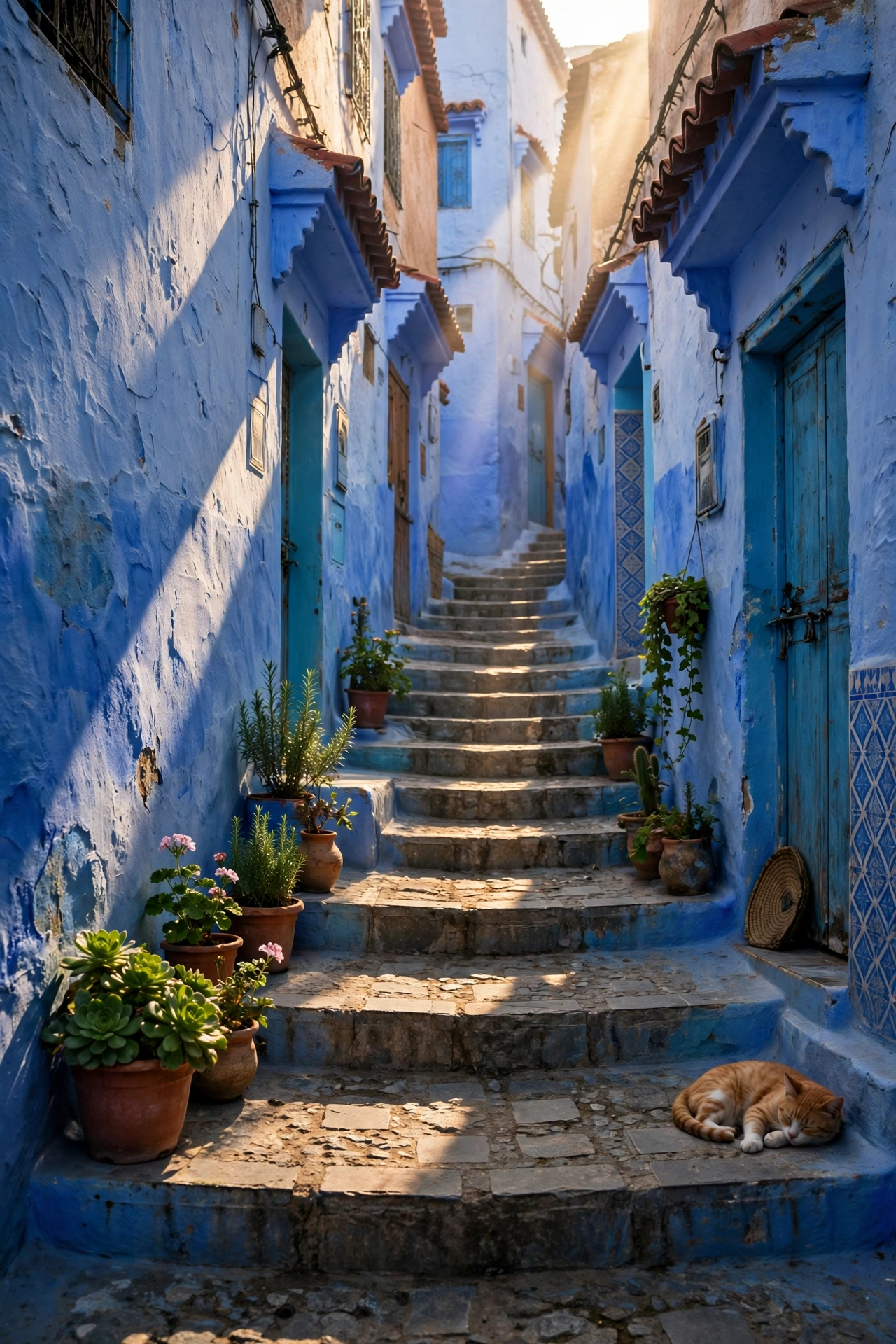
This chefchaouen travel guide is written by a Moroccan who has watched the Blue City change from a quiet mountain town into one of the most photographed places in the country. The photographs are real: the blue streets, the mountain air, the slow pace — all of it is there. But the town most visitors actually experience, arriving at midday in a crowd and leaving three hours later, is the worst version of it.
The good version takes a little patience: an early morning before the buses arrive, a night inside the medina, and a walk beyond the famous stairways. Everything in this chefchaouen travel guide was checked in November 2026, including bus fares, the Kasbah ticket and the prices below. Prices are in Moroccan dirhams (MAD), with dollar equivalents at about 10 MAD to the dollar.
New to the country? Start with our Morocco travel guide for first-time visitors for visas, money and safety basics. Most visitors arrive from the imperial city, so read our Fes travel guide too — and our Marrakech travel guide if you are crossing the country.
- Why This Chefchaouen Travel Guide Says: Stay the Night
- The Truth About the Blue
- Getting to Chefchaouen: Fes, Tangier and Casablanca
- Where to Stay: Inside the Medina or Outside It
- The Blue Streets: Best Photo Spots and the Best Light
- What to See in Chefchaouen
- Akchour Waterfalls: The Day Trip Worth Taking
- Where to Eat in Chefchaouen
- What Chefchaouen Costs (Checked November 2026)
- One Day vs Two Days: Two Plans That Actually Work
- Honest Drawbacks: What Nobody Tells You
- Chefchaouen FAQ
Why This Chefchaouen Travel Guide Says: Stay the Night
The first rule of this chefchaouen travel guide is simple: Chefchaouen deserves a night, not a rushed day trip. Most day-trippers arrive from Fes around midday, when the light is harsh, the lanes are packed shoulder to shoulder, and every blue doorway has a queue in front of it. They eat a hurried tagine, take the same three photographs as everyone else, and leave before sunset — then go home thinking the town was pretty but overrated.
Stay the night and the town changes completely. By six in the evening the buses are gone, the shopkeepers relax, and the medina belongs to its residents again. The next morning, between seven and nine, the blue streets are empty, the light is soft and golden, and you can hear the spring water at Ras El Maa. That quiet morning is the Chefchaouen in the photographs.
The Truth About the Blue
A good chefchaouen travel guide has to be honest about the blue, because the story most visitors hear is only half true. You will be told the town was painted blue centuries ago for religious reasons, or to keep mosquitoes away, or to mirror the sky. The real history is less tidy: Chefchaouen was founded in 1471, and the blue-washing habit is generally linked to Jewish refugees who arrived in the 1930s, though historians still argue about the exact origin. What is not argued is what keeps it blue today.
The blue is maintained by residents repainting their own walls and doors, usually in spring before the tourist season. Walk the medina in March and you will see fresh paint, ladders and buckets everywhere. Come in late winter and some walls look faded and patchy, because repainting has not happened yet. The colour is a living habit, not a monument.
Here is the second insider correction outsiders routinely get wrong: the blue stops at the medina walls. Step out of the old town and Chefchaouen looks like any other Moroccan mountain town — white and beige concrete, wide avenues, ordinary shops. The blue is the old medina only. A related mistake is picturing Chefchaouen as a coastal town. It is not: it sits inland in the Rif mountains, about 60 kilometres from the Mediterranean, and the air is mountain air — cool at night, cold and wet in winter.
Getting to Chefchaouen: Fes, Tangier and Casablanca
The first thing any chefchaouen travel guide must say plainly is that there is no train station in Chefchaouen. No railway reaches this mountain town, and anyone selling you a “train to Chefchaouen” is selling a bus from somewhere else. You arrive by road: bus or grand taxi, from Fes, Tangier or Casablanca.
From Fes, the most common route, CTM and Supratours buses take about four hours and cost roughly 75–90 MAD (about $7.50–$9). A grand taxi is faster, about three hours, at roughly 60–70 MAD (about $6–$7) per seat — but it only leaves when all six seats are full, so build in waiting time. The day-trip buses that flood the town at midday make this same journey — which is why the morning matters.
If you land in Tangier, this chefchaouen travel guide suggests the bus or a grand taxi rather than any complicated combination. Tangier is only about 110 kilometres away: the bus takes around two and a half hours and costs roughly 55–70 MAD (about $5.50–$7), and a grand taxi takes about two hours. Tangier has the nearest international airport and train station, so many travellers take the train there and continue by road. Check times and connections on the national railway site, ONCF, before you travel.
Travelling from Casablanca, this chefchaouen travel guide suggests the direct CTM bus if one is running on your date: roughly six to seven hours for about 140–170 MAD (about $14–$17). The alternative is the train to Tangier, then the bus or grand taxi down to Chefchaouen. Either way it is a long day, so an overnight stop in Tangier or Fes often makes more sense.
Where to Stay: Inside the Medina or Outside It
This chefchaouen travel guide recommends a riad inside the medina, and the reason is the morning. Staying inside the old town means you step out at seven straight into the empty blue streets, while guests in hotels outside are still walking to the gate. A small riad room typically costs 350–700 MAD (about $35–$70) a night, often including breakfast on a rooftop terrace above the blue rooftops.
Staying outside the medina is cheaper — simple hotels along Avenue Hassan II and in the new town run about 250–500 MAD (about $25–$50) — and the rooms are often bigger, with easier parking if you have a car. The trade-off is atmosphere: you sleep in an ordinary street and walk ten minutes to the blue. For one night, the medina is worth the premium; for a longer stay on a tight budget, outside is perfectly fine. Book ahead in spring and autumn, and ask the riad for directions — cars cannot enter the medina, so luggage goes uphill on foot, and the lanes all look alike.
The Blue Streets: Best Photo Spots and the Best Light
The golden rule of this chefchaouen travel guide is to shoot early. Between seven and nine in the morning, the lanes are empty and the low sun warms the blue walls without bleaching them. By eleven, the day-trip buses have arrived and the same lanes are crowded. The second-best light is the last hour before sunset, when the town turns a deeper blue and the rooftops glow.
The most photographed stairways are around Place El Haouta and the lanes of Derb El Assri, where blue steps, potted plants and painted doors line up perfectly. They are beautiful, and they are also where the queues form. Walk two minutes in any direction and you will find equally blue lanes with nobody in them — the lane behind the Kasbah and the streets climbing towards Bab El Ain are local favourites.
A word on respect: these are people’s front doors, not a film set. Do not block a doorway, photograph children without asking, or sit on someone’s steps for a posed shoot. A smile and a greeting — “salam” — opens more doors, literally, than any camera.
What to See in Chefchaouen
No chefchaouen travel guide is complete without the Kasbah, the small 15th-century fortress on Place Outa El Hammam, the medina’s main square. Inside are a garden of orange trees, a small ethnographic museum and a tower with a view over the rooftops. Entry is about 60 MAD (about $6), checked November 2026. Give it an hour, ideally late afternoon when the garden is shaded.
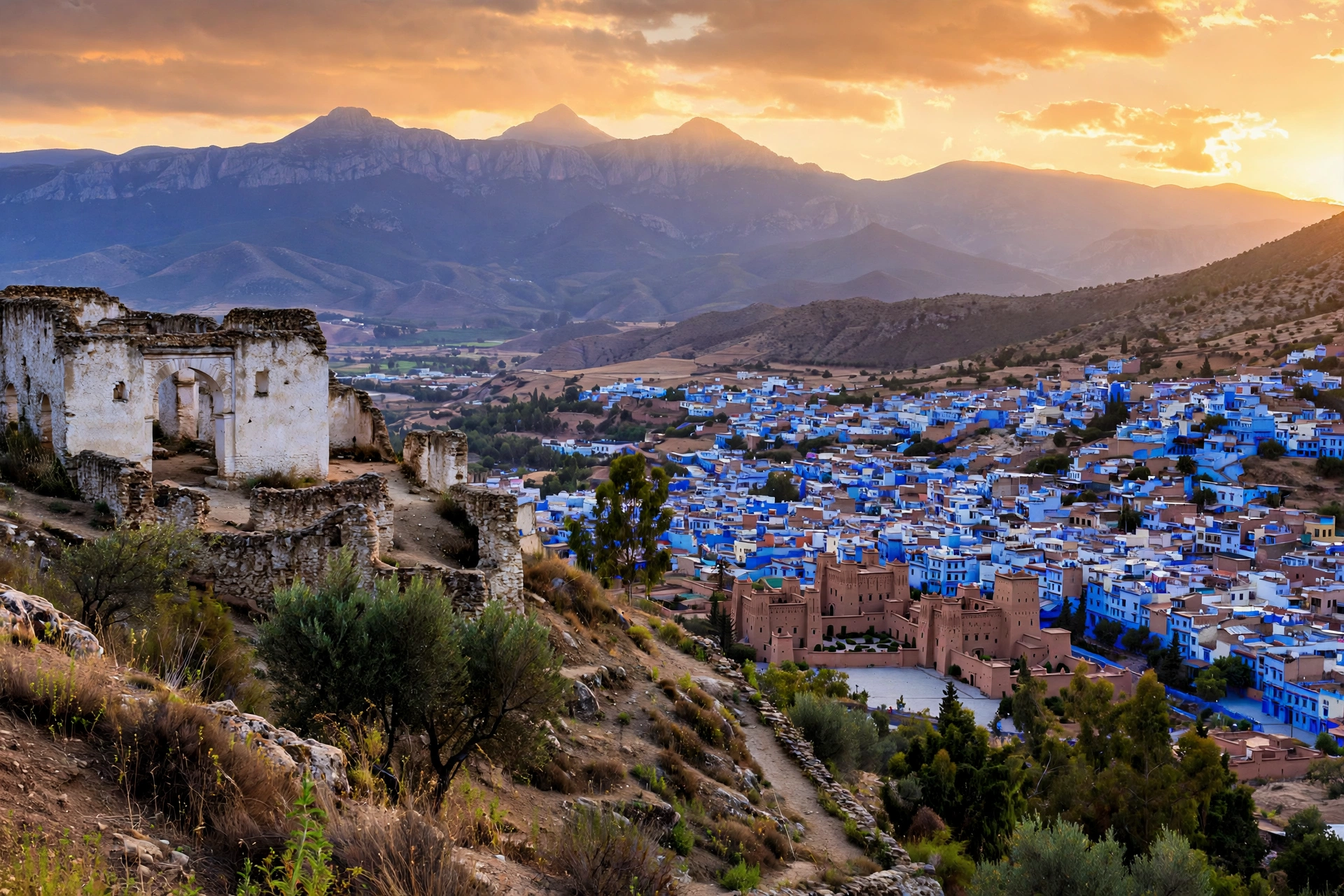
The Spanish Mosque is the sunset spot, and the chefchaouen travel guide tip is to climb in the late afternoon, not at midday. The white mosque on the hill east of town was built in the 1920s and was never really used as a working mosque — another thing outsiders get wrong — but the 20-minute uphill walk is rewarded with the best view in town: the whole blue medina spread below as the light turns gold. Bring water and decent shoes; the path is steep and dusty.
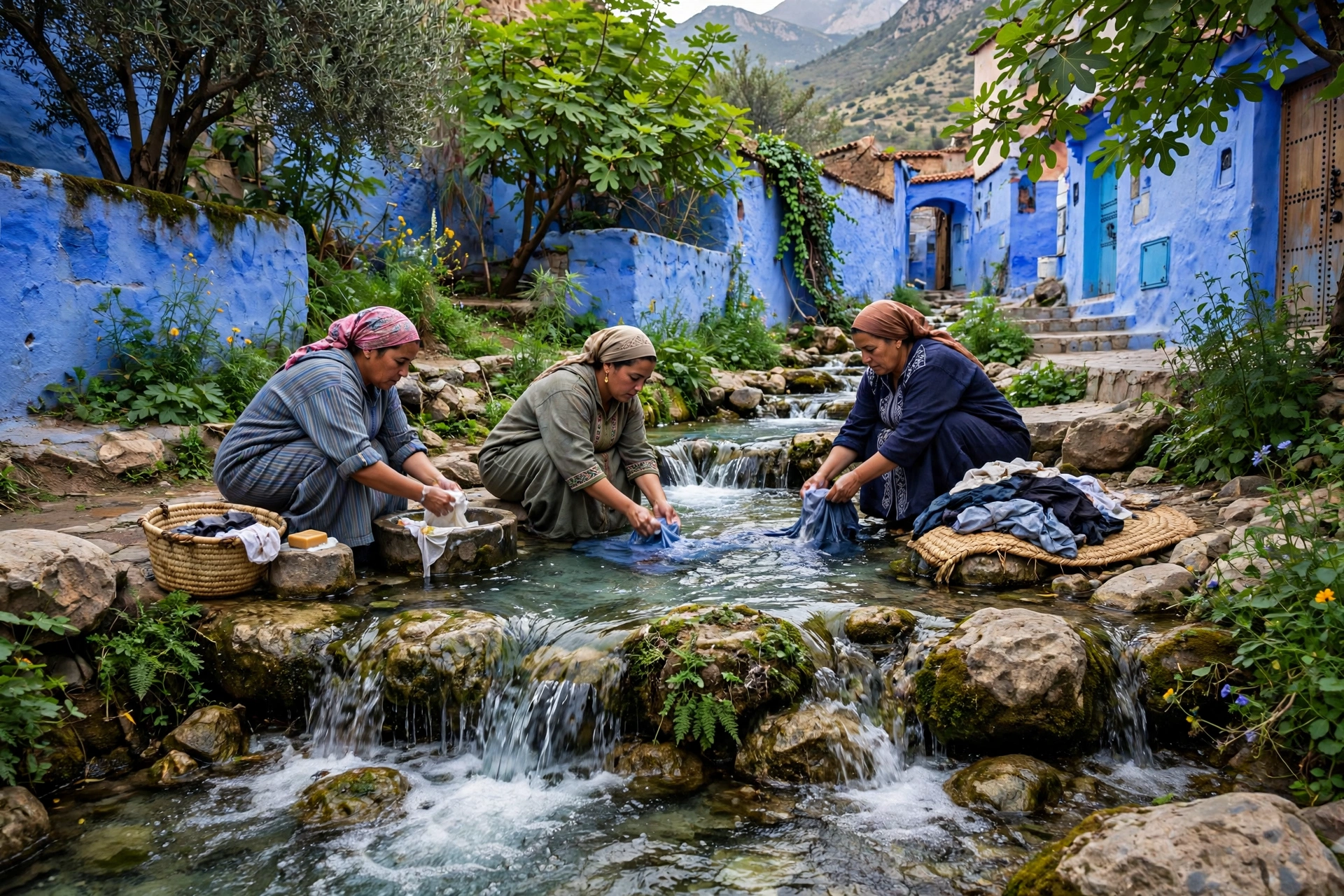
Ras El Maa is the spring at the eastern edge of the medina, where cold mountain water runs out of the hillside and local women still wash clothes in the stream, as they have for generations. Go in the morning, when the washing is happening and the light is good. It is free, it is real daily life rather than a performance, and it is the most honest corner of the town. Photograph with discretion, from a respectful distance.
Beyond those three, the pleasure of Chefchaouen is wandering: Place Outa El Hammam for mint tea and people-watching, the leather and weaving workshops, and Place El Haouta. For the deeper history of the town’s founding and its Jewish and Andalusi roots, the background on Chefchaouen on Wikipedia is a solid starting point before the Kasbah museum.
Akchour Waterfalls: The Day Trip Worth Taking
If you stayed the night, the chefchaouen travel guide verdict is to spend your second day at Akchour, about 30 kilometres away in the Talassemtane National Park. Shared grand taxis leave from near the bus station and take 30–45 minutes; expect roughly 25–35 MAD (about $2.50–$3.50) per seat each way, or hire a whole taxi for 250–350 MAD (about $25–$35) to set your own return time.
The walk follows a river through a green gorge to two waterfalls. The small waterfall is about an hour’s walk from the road, an easy path with places to sit and drink mint tea. The big waterfall is a further hour uphill, rougher underfoot, and worth it in spring when the water is strong. Wear proper shoes, not sandals: the rocks are slippery. In high summer the flow drops, so spring and autumn are the best seasons.
Bring cash, water and a swimsuit for the pools, and agree your return taxi time before you start walking — there is no bus back.
Where to Eat in Chefchaouen
This chefchaouen travel guide keeps the food advice simple, because Chefchaouen is not a fine-dining town and pretending otherwise would be dishonest. It is a tagine, harira and mint-tea town, and the best meals are the simplest ones. A chicken or vegetable tagine costs roughly 60–90 MAD (about $6–$9); a bowl of harira with bread is 15–25 MAD (about $1.50–$2.50); mint tea is 10–15 MAD (about $1–$1.50).
The local speciality is goat cheese, made in the Rif mountains around the town and served soft and fresh with bread and olives. You will see it on menus and in the small shops near Place Outa El Hammam. For breakfast, your riad’s rooftop spread — bread, olive oil, honey, eggs and orange juice, 40–60 MAD (about $4–$6) if not included — beats any café.
Eat where locals eat: the small restaurants on the lanes behind the main square, not the terraces with touts calling you in. Prices are usually on a menu board; if they are not, ask before ordering. For a fuller sense of daily spending across the country, see our cost of living in Morocco guide.
What Chefchaouen Costs (Checked November 2026)
The chefchaouen travel guide budget below uses prices checked in November 2026. Chefchaouen is one of the cheaper towns in Morocco: accommodation and food cost less than in Marrakech or Fes, and the main sights are free or nearly so. The exchange rate used is about 10 MAD to the dollar.
| Item | Price in MAD | Approx. USD |
|---|---|---|
| CTM bus, Fes–Chefchaouen | 75–90 | $7.50–$9 |
| Grand taxi seat, Fes–Chefchaouen | 60–70 | $6–$7 |
| CTM bus, Tangier–Chefchaouen | 55–70 | $5.50–$7 |
| Riad room in the medina (1 night) | 350–700 | $35–$70 |
| Hotel outside the medina (1 night) | 250–500 | $25–$50 |
| Kasbah entry | 60 | $6 |
| Tagine in a medina restaurant | 60–90 | $6–$9 |
| Mint tea | 10–15 | $1–$1.50 |
| Grand taxi to Akchour (per seat, each way) | 25–35 | $2.50–$3.50 |
Excluding transport to town, a comfortable daily budget is about 450–700 MAD (about $45–$70) per person for a riad, meals, tea and the Kasbah. A careful traveller staying outside the medina and eating simply can manage on 300–450 MAD (about $30–$45) a day. Those are the numbers this chefchaouen travel guide stands behind.
| Daily budget level | Per person, per day | What it covers |
|---|---|---|
| Budget | 300–450 MAD ($30–$45) | Hotel outside the medina, simple meals, tea, free sights |
| Comfortable | 450–700 MAD ($45–$70) | Medina riad with breakfast, restaurant meals, Kasbah |
| Easy | 700–1,000 MAD ($70–$100) | Best riad, rooftop dinners, private taxi to Akchour |
One Day vs Two Days: Two Plans That Actually Work
The chefchaouen travel guide answer is two days if you can spare them, but one well-planned day beats a rushed two. The difference is not how much you see; it is when you see it. A day trip from Fes gives you the crowded middle of the day; two days give you the empty morning and the sunset — the whole point of coming.
| Plan | How it runs |
|---|---|
| One day | Earliest bus from Fes; blue lanes before the crowds; Kasbah late morning; slow lunch off the main square; Ras El Maa in the afternoon; Spanish Mosque at sunset; last bus back. A long day, but it works. |
| Two days | Day one as above, but sleep in the medina. Day two starts at seven in the empty blue streets, continues with a long rooftop breakfast, and finishes with the Akchour waterfalls. Leave on the third morning or the evening bus — that second morning is the part nobody regrets paying for. |
Honest Drawbacks: What Nobody Tells You
An honest chefchaouen travel guide has to name the drawbacks, because the town is not for everyone. Midday in high season is genuinely crowded: the lanes fill with day-trippers, the famous stairways get queues, and the quiet the town sells disappears until evening. If crowds bother you, travel in late autumn or winter, and sightsee early.
The hills are the second drawback. The medina is built on a slope, and everything is steps: up to your riad, up to the Spanish Mosque, up to the viewpoints. Travellers with limited mobility will struggle, and wheeled luggage is a mistake — bring a backpack. In winter the town is cold and often rainy, and some guesthouses have thin heating, so pack warm layers.
Then there is money. A chefchaouen travel guide warning worth repeating: bring cash. ATMs in Chefchaouen are limited — a handful around Place Mohammed V and Avenue Hassan II — and they can run out or go offline, especially on weekends. Many small riads, restaurants and shops are cash-only, and cards are far less accepted here than in Marrakech or Casablanca. Withdraw dirhams in Fes or Tangier before you arrive, and keep small notes for taxis and tea.
Chefchaouen FAQ
How many days do you need in Chefchaouen?
Two days is ideal: one for the medina, Kasbah, Ras El Maa and the Spanish Mosque sunset, and one for Akchour and a slow morning in the blue streets. One full day is enough to see the highlights if you arrive early and stay for sunset. A three-hour stop on a day trip is not enough, and we do not recommend it.
How do I get to Chefchaouen from Fes?
By bus or grand taxi — there is no train station. CTM and Supratours buses take about four hours and cost 75–90 MAD (about $7.50–$9). A grand taxi takes about three hours at 60–70 MAD (about $6–$7) per seat, leaving when full. Book the bus a day ahead in high season.
Is Chefchaouen safe for solo travellers?
Yes. Chefchaouen is one of the safest towns in Morocco for solo travellers, including women travelling alone. The medina is small, well-lit and busy in the evenings, and hassle is far lighter than in Fes or Marrakech. The usual advice still applies: dress modestly, ignore persistent touts politely, and keep valuables out of sight.
When is the best time to visit Chefchaouen?
March to May and September to November, when the paint is fresh, the light is good and the crowds are manageable. Summer is hot and crowded; winter is quiet, cold and rainy, but the town is at its most local and hotel prices drop. The short answer is spring: the repainting is done, the mountains are green, and Akchour is at its best.
Why is Chefchaouen blue?
The exact origin is debated, but the blue-washing tradition is generally linked to Jewish refugees who arrived in the 1930s, and it may also have older roots. What is certain is that residents maintain it today by repainting their walls and doors, usually each spring before the tourist season. The blue is a living habit, not a single historical event.
Can you do Chefchaouen as a day trip from Fes?
You can, but this chefchaouen travel guide warns you will regret the timing: you arrive at midday with the crowds and leave before sunset. If a day trip is your only option, take the earliest bus, skip the long lunch, and stay for the Spanish Mosque sunset before the last bus back. If you can stay one night, do — it changes the whole trip.
Conclusion
This chefchaouen travel guide ends where it began: with the early morning. The blue town that fills the photographs is not the crowded midday version, and it is not a place you can rush. It is a small mountain town that rewards one night, one early walk, and one sunset from the hill above it. Come by bus from Fes or Tangier, sleep inside the medina, eat simply, carry cash, and give the town the time it deserves. That is the Chefchaouen this chefchaouen travel guide wants you to meet.