
Meknes is the imperial city most travellers skip, and that is exactly why it rewards the ones who stop. This meknes travel guide is for visitors who want Morocco’s grand history without the crowds of Marrakech or the intensity of Fes. Here Bab Mansour opens onto a wide, calm square, the medina moves at a local pace, and the sultan’s vast granaries stand mostly empty of tour groups.
Give Meknes a day or two and it opens up. You can walk from the monumental gate to a royal mausoleum, lose an afternoon in the souks, and still be back for dinner on Place el-Hedim. This meknes travel guide covers the sights, the practical costs, the trains and the honest trade-offs, so you can decide whether this quiet imperial city belongs on your route.
In this guide
- Why This Meknes Travel Guide Starts With Moulay Ismail
- Bab Mansour and Place el-Hedim: The Grand Entrance
- Heri es-Souani and the Mausoleum of Moulay Ismail
- The Medina, Souks and Dar Jamai Museum
- Volubilis and Moulay Idriss: The Essential Day Trip
- Getting There, Staying and Eating in Meknes
- When to Go, How Long to Stay and What to Know Before You Go
- Frequently Asked Questions
Why This Meknes Travel Guide Starts With Moulay Ismail
No city in Morocco is as much the work of one man as Meknes is the work of Sultan Moulay Ismail. When he took the throne in 1672, he chose this then-modest town as his capital and spent the next 55 years rebuilding it into a fortress-palace on an enormous scale, with walls, gates, granaries, stables and a royal kasbah covering a huge area. It was a Moroccan imperial project, built in rammed earth, green tile and carved cedar. The scale of that project is the first thing any meknes travel guide should help you grasp.
Understanding that ambition changes how you see the city. The buildings are not scattered monuments; they are fragments of a single royal machine. Bab Mansour was its ceremonial front door, Heri es-Souani its storehouse, the stables its cavalry reserve, and the mausoleum its spiritual heart. Damaged by the great Lisbon earthquake of 1755 and by later neglect, the city today feels like a grand plan half-revealed, with some parts still being restored. That is part of its charm, and any honest meknes travel guide should say so plainly rather than pretend every gate is freshly painted.
A few dates in this story are not settled, and it is worth knowing which ones. The exact completion date of Bab Mansour is usually given as 1732, five years after Moulay Ismail’s death, but sources differ on the precise year and on how much was finished under his successor. The famous claim that the sultan fathered hundreds of children is a legend repeated in travel writing, not a settled historical fact. If you want the wider story first, our guide to the imperial cities of Morocco puts the city in its full context.
The Least Rushed of the Imperial Cities
Fes overwhelms, Marrakech dazzles, and Rabat administers. Meknes, by contrast, lets you breathe, and that gentleness is the heart of this meknes travel guide. The medina is compact, the sights sit within walking distance, and the people you meet are mostly going about ordinary life. For first-time visitors, that is a gift: you can practise the rhythms of a Moroccan city — the call to prayer, the mint tea, the unhurried bargaining — before facing bigger crowds elsewhere. Our first-time visitor guide to Morocco covers the basics if this is your first trip to the country.
Bab Mansour and Place el-Hedim: The Grand Entrance
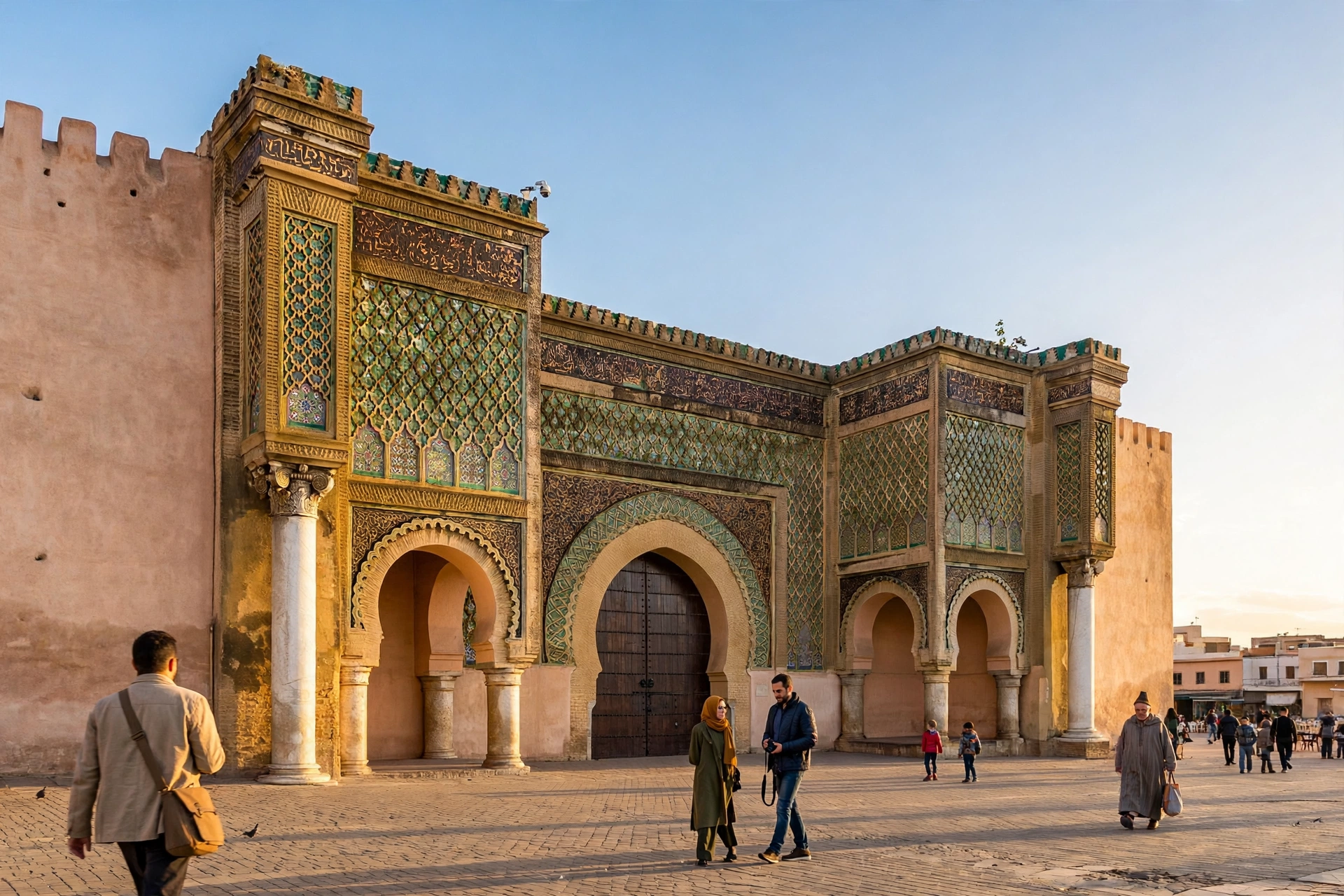
Bab Mansour is the sight that justifies the trip on its own, and any meknes travel guide has to start here. Completed after Moulay Ismail’s death, it is widely considered the finest gate in Morocco: a huge horseshoe arch framed by green tiles, marble columns taken from older sites, and carved plaster inscriptions that catch the late light. Stand in front of it at golden hour and the whole square seems to glow.
The gate opens onto Place el-Hedim, a vast open square that was once the parade ground of the royal city. Today families stroll in the evening, juice sellers work their carts, and the cafes fill with people watching the world go by. An evening here is the simplest pleasure in this meknes travel guide, and one of the best.
Look closely at the green tiles, the marble columns and the inscription band across the top. Photography is free and easy from the square, and the best light is the hour before sunset. Entry to the square costs nothing, and Bab Mansour itself is admired from outside; there is no ticket to enter the gate, so do not expect an interior tour. Behind the square, the medina begins through a maze of lanes that reward wandering without a plan.
Heri es-Souani and the Mausoleum of Moulay Ismail
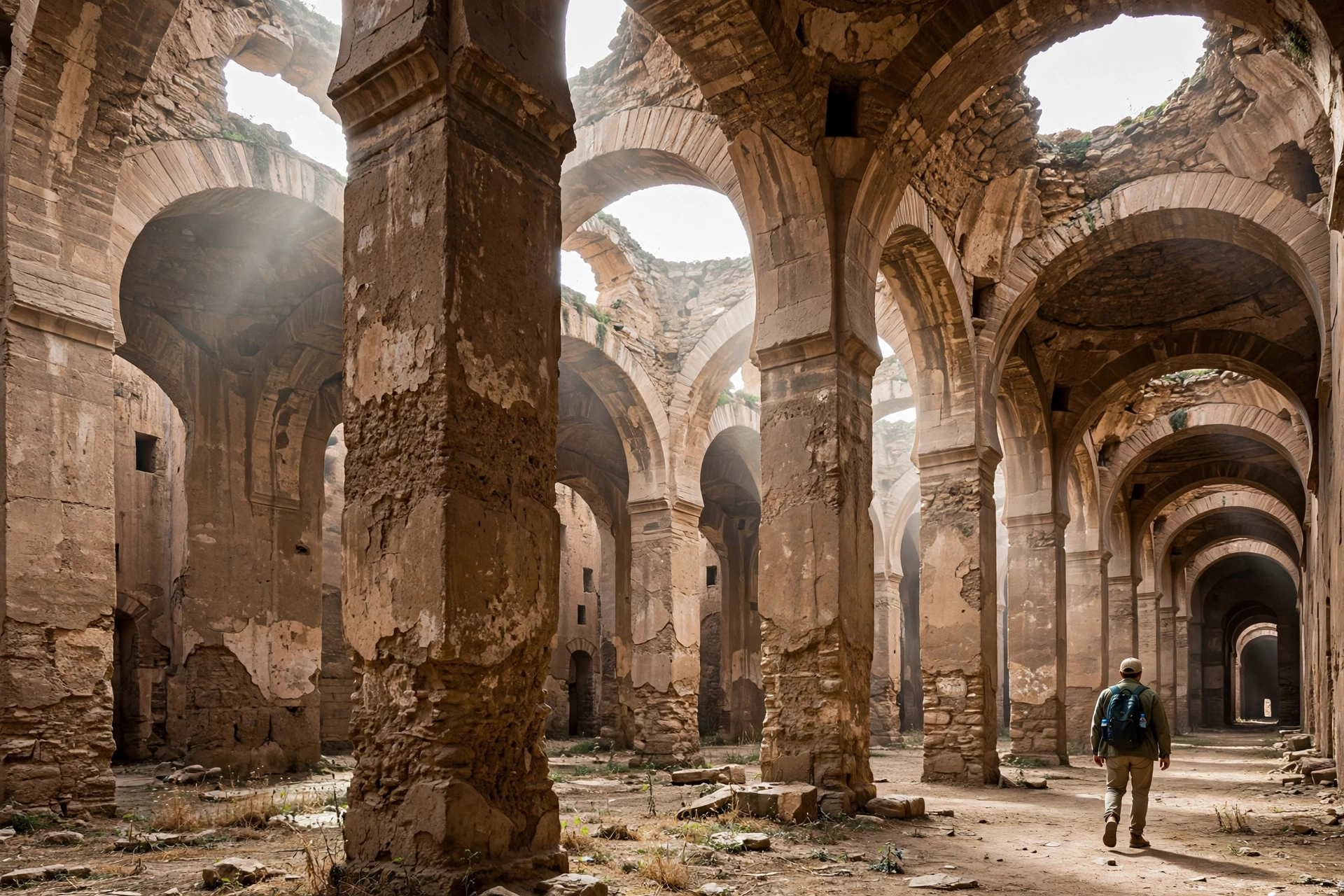
A short walk south of Place el-Hedim brings you to Heri es-Souani, the granaries and stables that show the true scale of Moulay Ismail’s project. The building is a forest of massive stone pillars and vaulted arches, built to store grain for the royal city and its armies through years of siege or drought. No meknes travel guide is complete without an hour under these arches.
Entry to Heri es-Souani costs around 60 dirhams (about $6) as of November 2026, though prices can change, so check at the gate.
The Mausoleum of Moulay Ismail
Close by stands the Mausoleum of Moulay Ismail, one of the few royal tombs in Morocco that non-Muslim visitors are allowed to enter. Inside is a quiet masterpiece of Moroccan craft: zellige tilework, carved plaster and painted cedar ceilings. Visitors are asked to dress modestly and to keep their voices low, and photography inside the tomb chamber is discouraged. The mausoleum is a highlight of any meknes travel guide, and if you read our history of the Alaouite dynasty before you go, it means much more, because Moulay Ismail was the sultan who made the dynasty a great power.
The Medina, Souks and Dar Jamai Museum
The medina of Meknes is a UNESCO World Heritage Site, listed in 1996, and it feels very different from the medinas of Fes and Marrakech. The lanes are wider, the crowds thinner, and the shopping is aimed as much at locals as at tourists. That makes it one of the best places in Morocco to buy everyday things at local prices: olives, spices, leather slippers, brassware and the embroidered textiles the region is known for. This meknes travel guide recommends starting at the main souk streets near Place el-Hedim and simply drifting.
The spice sellers, the tailors and the metalworkers each have their own quarter, and the smell of fresh bread from the communal ovens follows you from lane to lane. Allow two to three hours, including a stop for tea. For many visitors, this unhurried wandering is the most memorable part of a meknes travel guide to the city.
Dar Jamai Museum
For a deeper look at Moroccan craft, visit the Dar Jamai Museum, a 19th-century palace in the medina that now displays ceramics, jewellery, textiles and carved wood from the region. Entry costs around 20 to 30 dirhams (about $2 to $3) as of November 2026. It is calm and uncrowded, and this meknes travel guide suggests checking opening times at the door.
Volubilis and Moulay Idriss: The Essential Day Trip
No visit to Meknes is complete without Volubilis, the ruined Roman city on a hillside about 30 kilometres away. Founded in the third century BC and later the capital of the Roman province of Mauretania Tingitana, Volubilis was one of the most important Roman sites in North Africa. Its triumphal arch, basilica, forum and mosaic floors survive in remarkable condition, set among rolling green hills. Our full Volubilis guide covers the site in detail, and this meknes travel guide treats the trip as essential, not optional.
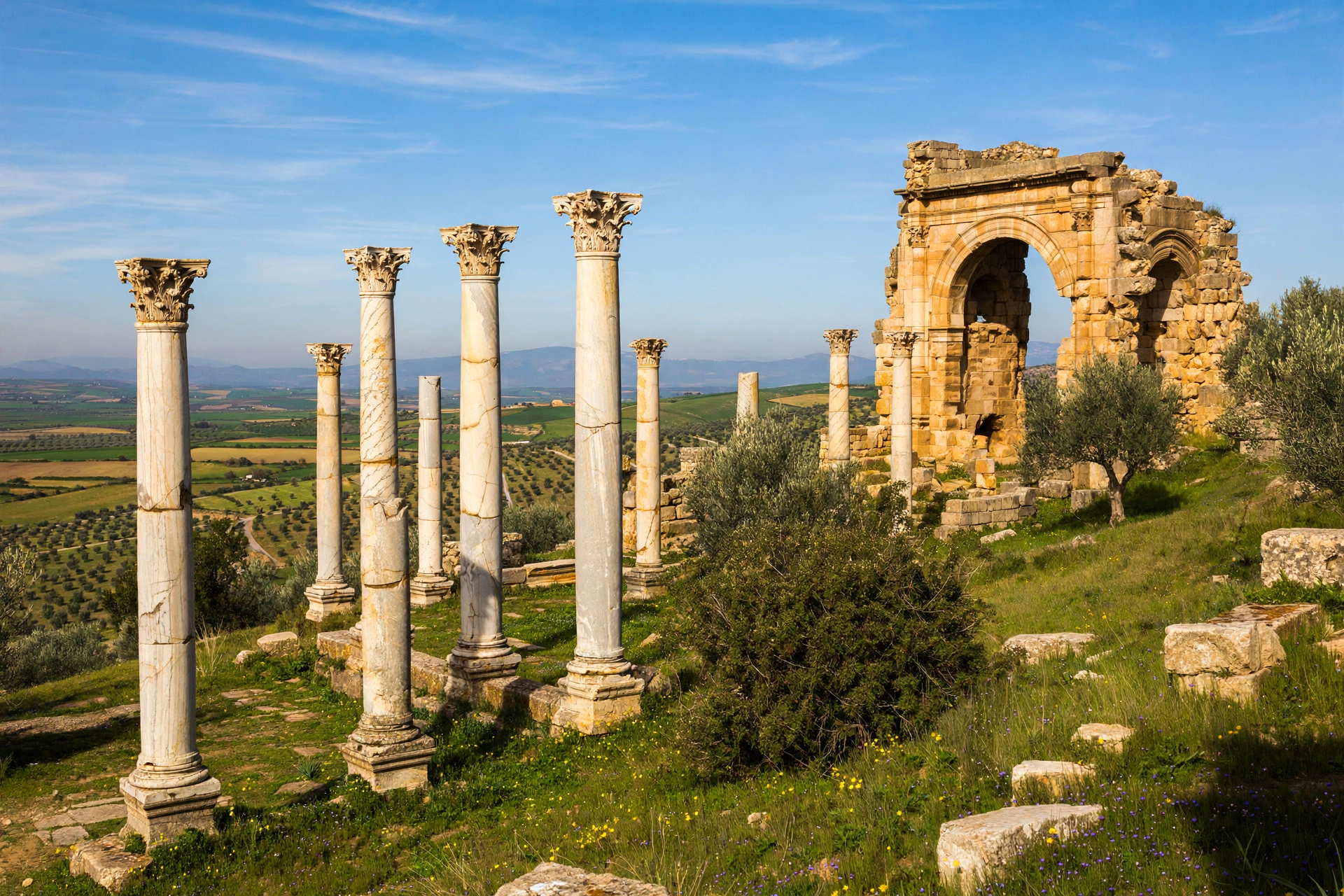
Entry to Volubilis costs around 70 dirhams (about $7) as of November 2026. Go in the morning for the best light and the fewest visitors, and allow two to three hours on site. Combine the trip with Moulay Idriss Zerhoun, the holy town on the hill above Volubilis, where the founder of Morocco’s first dynasty is buried. Non-Muslims cannot enter the sanctuary itself, but the town is lovely to walk through, and the views back over Volubilis are superb. A grand taxi from Meknes costs roughly 150 to 200 dirhams (about $15 to $20) for the car, and most drivers will wait while you visit.
Getting There, Staying and Eating in Meknes
The city sits on the main railway line between Fes and Casablanca, with frequent ONCF trains in both directions. The train from Fes takes about 40 minutes and costs roughly 30 to 50 dirhams (about $3 to $5) in second class as of November 2026; from Casablanca the journey takes around three hours. A petit taxi from the station to the medina should cost 10 to 15 dirhams (about $1 to $1.50) on the meter. Our guide to getting around Morocco by train, bus and taxi explains tickets and classes, and this meknes travel guide recommends the train for the Fes day trip.
Buses and grand taxis fill the gaps. CTM and local bus companies run to Fes, Rabat and Casablanca, and grand taxis leave when full from the stations on the edge of town. Driving is also straightforward, with the motorway from Rabat and Fes in good condition, and parking near Place el-Hedim is easy by Moroccan city standards.
Where to Stay
Meknes has a good range of places to stay for a small city, and where you sleep shapes the trip more than most visitors expect. Riads inside the medina offer the most atmosphere, with courtyards, rooftop terraces and breakfast included, while the hotels of the modern Ville Nouvelle suit travellers who want a pool and parking. Book ahead in spring and autumn, when the weather is best and the city fills with visitors heading for Volubilis. A medina riad is the pick of this meknes travel guide for a first stay.
| Stay | Typical price per night (MAD) | Approx. USD |
|---|---|---|
| Hostel dorm bed | 80–120 | $8–$12 |
| Budget guesthouse | 150–250 | $15–$25 |
| Mid-range riad in the medina | 350–600 | $35–$60 |
| Comfortable hotel, Ville Nouvelle | 500–800 | $50–$80 |
| Upscale riad with pool | 800–1,400 | $80–$140 |
Hotel prices verified November 2026; 1 USD ≈ 10 MAD. Rates rise in spring and autumn.
Where to Eat
Eating in Meknes is a pleasure and a bargain. The restaurants around Place el-Hedim serve tagines, pastilla, couscous and grilled meats for 60 to 120 dirhams (about $6 to $12) for a main course. In the medina, look for the small eateries where locals queue at lunchtime: a harira soup, a chicken tagine and bread rarely costs more than 40 to 60 dirhams (about $4 to $6).
For a fuller sense of what to order, our Moroccan food guide explains the dishes and the etiquette. Breakfast — fresh khobz, olive oil, honey and mint tea — is often included with a riad stay, and in the evening the square fills with food stalls where dinner costs less than a restaurant meal. Good food at local prices is one of the quiet pleasures of this meknes travel guide.
| Cost | Typical price (MAD) | Approx. USD |
|---|---|---|
| Train Fes–Meknes, second class | 30–50 | $3–$5 |
| Petit taxi, station to medina | 10–15 | $1–$1.50 |
| Grand taxi to Volubilis (car) | 150–200 | $15–$20 |
| Heri es-Souani entry | 60 | $6 |
| Volubilis entry | 70 | $7 |
| Dar Jamai Museum entry | 20–30 | $2–$3 |
| Tagine in a medina restaurant | 60–120 | $6–$12 |
| Mint tea in a cafe | 8–15 | $0.80–$1.50 |
Prices verified November 2026; 1 USD ≈ 10 MAD. Entry fees and fares can change; check on the day.
When to Go, How Long to Stay and What to Know Before You Go
The best time to visit Meknes is spring, from March to May, and autumn, from September to November. The weather is warm without being harsh, the hills around Volubilis are green, and the light is at its best for photography. Summer brings real heat, with temperatures regularly above 35°C, and winter can be cool and rainy, though the city is at its quietest then. Our guide to the best time to visit Morocco compares the seasons city by city, and spring is the season this meknes travel guide rates highest.
One full day covers the main sights, but two days is the better plan. A single day means Bab Mansour, the mausoleum, Heri es-Souani and the medina, with dinner on the square. A second day gives you Volubilis and Moulay Idriss without rushing, plus a slow morning in the souks and a proper look at the Dar Jamai Museum. If you only have a day, come early by train from Fes and take a late train back. That two-day rhythm is the pacing this meknes travel guide recommends most.
Honest Drawbacks
This guide would be incomplete without the trade-offs, and a meknes travel guide that hides them would mislead you. Meknes is quiet at night, and visitors looking for nightlife, live music or a wide choice of bars will be disappointed; the evening scene is cafes, the square and an early dinner. Some of the royal sites are still under restoration, and parts of the kasbah are closed or fenced off, so you may find a gate or a wall behind scaffolding. None of this should put you off, but it is worth knowing before you arrive: Meknes rewards patience and curiosity more than it rewards a checklist.
Conclusion
Meknes does not shout for attention, and that is its gift. In a single visit you can stand before the finest gate in Morocco, walk through granaries built for an empire, and end the day with mint tea on the square. If you want Morocco’s imperial past without the crowds, this meknes travel guide points to the city that gives it to you most generously: quiet, grand, and still wonderfully itself.
Frequently Asked Questions
Is Meknes worth visiting?
Yes, especially if you like history and quieter cities. Bab Mansour, Heri es-Souani and the mausoleum are among Morocco’s great sights, the medina is relaxed, and Volubilis is a short ride away.
How many days do you need in Meknes?
One full day covers the main sights, but two days is better: the second day is for Volubilis and Moulay Idriss, plus the souks and the Dar Jamai Museum.
How do I get from Fes to Meknes?
Take the ONCF train from Fes station, the route this meknes travel guide recommends. The journey takes about 40 minutes and costs roughly 30 to 50 dirhams (about $3 to $5) in second class.
What is the best time of year to visit Meknes?
Spring (March to May) and autumn (September to November) are best. Summer is hot, often above 35°C, and winter is cooler and quieter, with occasional rain.
Can you visit Volubilis from Meknes in half a day?
Yes. Volubilis is about 30 kilometres away, and a grand taxi costs roughly 150 to 200 dirhams for the car. Allow two to three hours at the site, and combine it with Moulay Idriss Zerhoun.
Is Meknes safe for tourists?
Meknes is generally considered safe, and its medina is calmer than those of Fes or Marrakech. Keep valuables out of sight and agree taxi fares before you ride.