
Walk through the blue lanes of the Fez mellah on a quiet afternoon and you will see balconies of carved cedar wood, Hebrew letters on a doorway, and a synagogue that has prayed in the same place for centuries. This is where morocco jewish heritage begins for most visitors, but the story is much older and wider than one quarter of one city.
Jews have lived in Morocco for around 2,000 years, as traders, scholars, goldsmiths and royal advisers. Their story runs through every dynasty in our history, and morocco jewish heritage is not a separate chapter kept apart from the rest. It is woven into the same cities, streets and kings you meet everywhere else in this country.
In this guide
- A History That Starts Before the Arab Conquest
- Morocco Jewish Heritage in Fez: The First Mellah
- Marrakech and the Mellah of the South
- Essaouira: The Port City Built by Jewish Merchants
- Synagogues Worth Visiting
- The Cemeteries: Reading Stones by the Sea
- 1948 to the 1960s: The Great Departure
- Mohammed V and the Second World War
- The Revival: Museums, Restoration and Mimouna
- Visiting Respectfully: A Practical Guide
- Why This History Still Matters
- FAQs
A History That Starts Before the Arab Conquest
Jewish communities were already living in North Africa before Islam arrived in the seventh century. Some families trace their roots to traders from the ancient Mediterranean world, and others arrived after the destruction of the Temple in Jerusalem. The exact dates of these first arrivals are unsettled, and honest historians say so, because the early evidence is thin and much of it comes from later traditions rather than records written at the time. That uncertainty is part of morocco jewish heritage, not a gap to hide.
When Muslim armies reached Morocco in the late seventh and early eighth centuries, Jewish communities were already part of the landscape. Under the Idrisids, who founded Fez, Jews lived as dhimmis, protected non-Muslim subjects who paid a tax and kept their own religion and communal life. It was not equality in the modern sense, but it was a working arrangement that lasted for centuries, and it is the first layer of morocco jewish heritage.
The great turning point came in 1492, when Spain expelled its Jews. Tens of thousands of Sephardic Jews crossed the Strait of Gibraltar, joining the older Toshavim communities who had been here for centuries. The newcomers brought Spanish language, new crafts, printing, medicine and music, and reshaped morocco jewish heritage completely. For the wider background, the history of the Jews in Morocco gives a useful overview of these early centuries.
Morocco Jewish Heritage in Fez: The First Mellah
Fez is where the mellah was born, and where morocco jewish heritage took its most famous form. In 1438, under the Marinids, the Jewish community of Fez was moved to a new quarter in Fes el-Jdid, the new city built beside the royal palace. The exact year is sometimes given differently in older sources, so treat 1438 as the commonly cited date rather than a settled fact, but the event itself is well documented.
Here is the insider correction most visitors need. Outsiders usually hear the word mellah and picture a ghetto, a place where Jews were locked away as punishment. That is not how it began. The word mellah comes from mallah, salt, because the site had been a salt market and storehouse. The quarter was built beside the palace precisely so the sultan could protect its residents, and its gates were closed at night for safety, not only for separation.
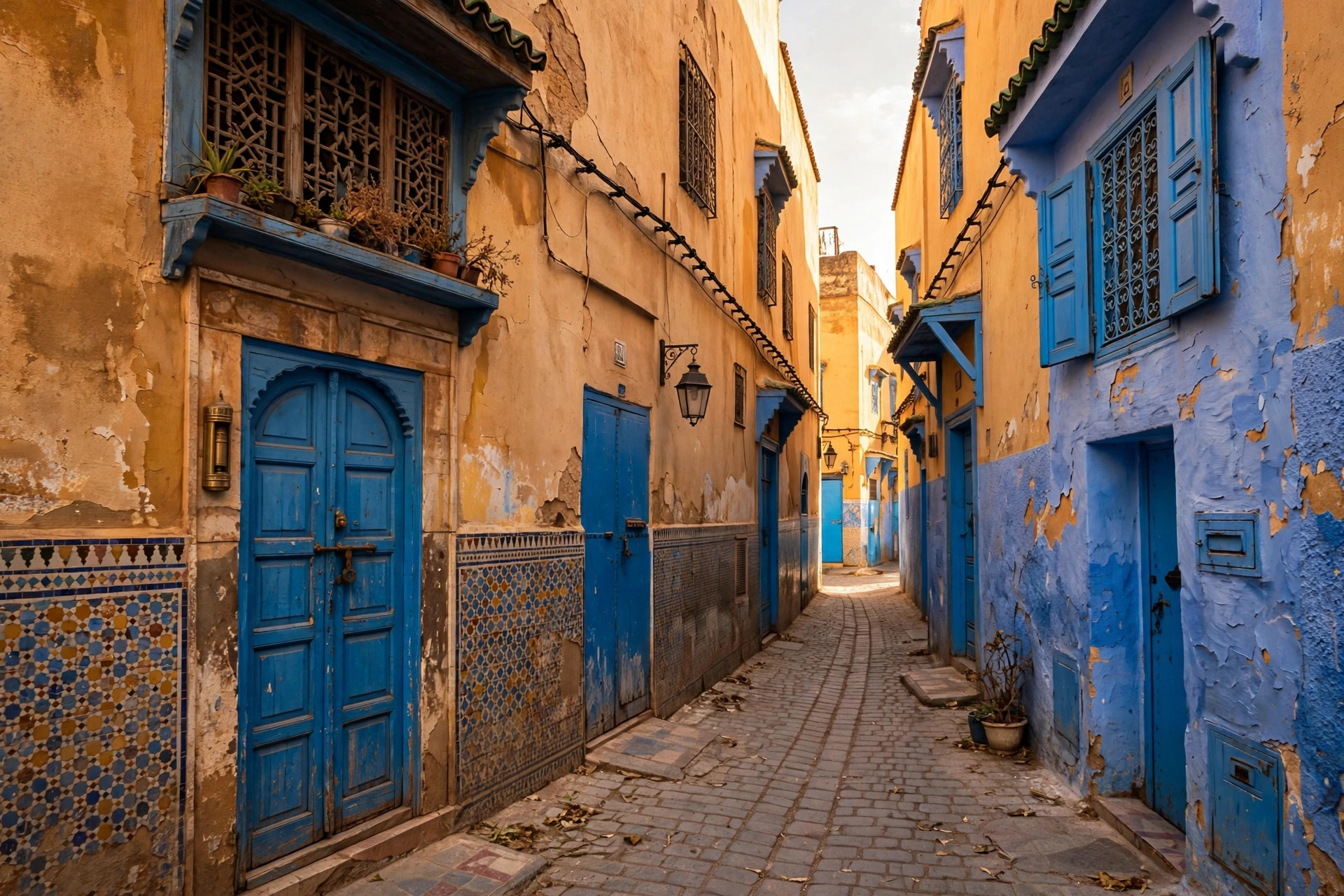
Walk the Fez mellah today and you will see morocco jewish heritage in its doorways and balconies. The houses look different from the rest of the medina: open decorated balconies, larger windows, doors painted blue. Jewish families built outward, towards the street, in a city where Muslim houses traditionally turn inward around a courtyard. A good Fez travel guide will point out the cemetery at the edge of the quarter, with whitewashed tombs stretching across the hillside. The old medina is listed by UNESCO, which helps explain why so much of this quarter survives.
Marrakech and the Mellah of the South
Marrakech built its mellah later, in 1557, under the Saadian dynasty. Sultan Abdallah al-Ghalib ordered the Jewish community to move to a walled quarter near the royal palace, the same logic as Fez: closeness to the sultan meant closeness to protection. The date is generally agreed, though some sources place the founding a few years either side of 1557, so it is best described as the mid-sixteenth century.
The Marrakech mellah, sometimes called the Mellah of the Kasbah, became one of the largest Jewish quarters in Morocco, with its own markets, synagogues, schools and ovens. Few places show morocco jewish heritage as a living neighbourhood rather than a monument, and this is one of them.
Marrakech also holds the Lazama synagogue, another thread of morocco jewish heritage, founded by Jews expelled from Spain, and the large Jewish cemetery known as Miâara, one of the oldest in Morocco. The cemetery is free to enter, though the caretaker appreciates a small tip of 10 to 20 MAD (about $1 to $2). For orientation, start with a Marrakech travel guide and give the mellah a full unhurried morning.
Essaouira: The Port City Built by Jewish Merchants
No city in Morocco owes more to its Jewish community than Essaouira, and none shows morocco jewish heritage more clearly. When Sultan Mohammed ben Abdallah founded the port in the 1760s, he invited Jewish merchants from across Morocco and Europe to settle there and run its trade. They became the tujjar as-sultan, the sultan’s merchants, handling the export of ostrich feathers, ivory, gold and grain, and the import of cloth, tea and sugar.
At one point in the nineteenth century, Jews made up a large share of Essaouira’s population, and some estimates put it close to half, though the exact figures are debated because no reliable census exists from that period. Jewish merchants lived alongside Muslim neighbours in the same streets behind the ramparts, not in a separate quarter at all, which makes Essaouira the great exception to the mellah story and a key chapter of morocco jewish heritage.
Synagogues Worth Visiting
Morocco has more than a hundred synagogues. The three below are the ones I would visit first, because each one shows a different face of the community that built it, and together they give a fair picture of morocco jewish heritage across the country.
Ibn Danan Synagogue, Fez
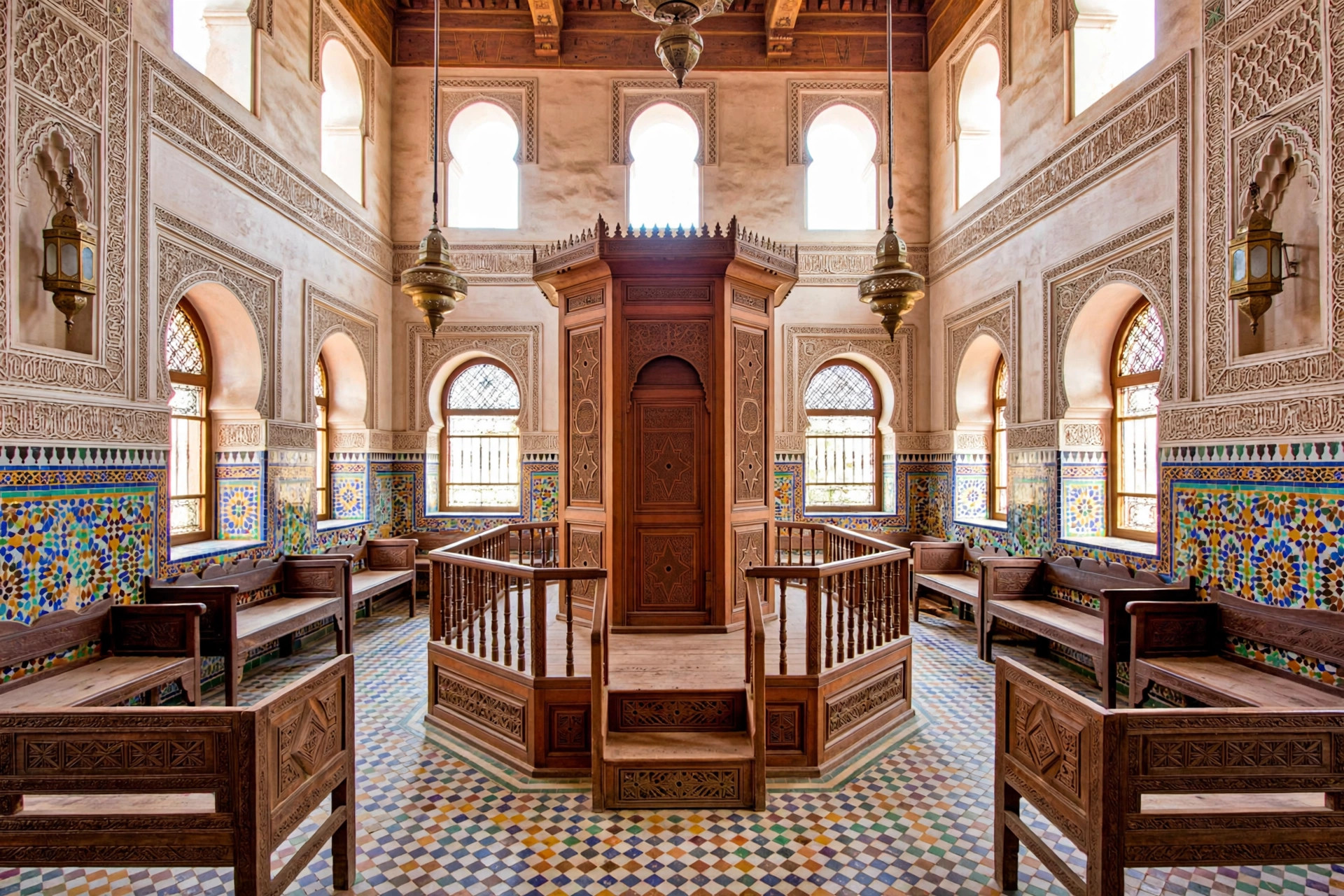
Built in the seventeenth century in the Fez mellah, Ibn Danan is the most beautiful synagogue in Morocco. Its wooden bimah sits in the centre of the prayer hall, its walls are covered in zellige tiles, and its courtyard holds a mikveh, a ritual bath, still visible today. The synagogue was restored with international support in the 1990s. Entry is around 20 MAD (about $2), and mornings are the best time to visit.
Slat al-Azama Synagogue, Marrakech
Slat al-Azama is the working heart of the Marrakech mellah. It is still used for prayer, which gives it an atmosphere no museum can copy. The building is modest from the outside and rich inside, with painted ceilings and a courtyard where the community gathers. Visit outside prayer times, leave a small donation, and remember that you are a guest in a place of worship, not a customer at an attraction.
Lazama Synagogue, Marrakech
The Lazama synagogue was built by Sephardic Jews who arrived after the expulsion from Spain, and its name remembers that origin. It is smaller and quieter than Slat al-Azama, and its courtyard is one of the most peaceful places in the medina. It holds a small collection of ritual objects and photographs, and morocco jewish heritage feels personal here, in a way a grand monument never quite manages.
The Cemeteries: Reading Stones by the Sea
Jewish cemeteries in Morocco are open-air archives of morocco jewish heritage. The tombs carry names, dates and places of origin, and a careful visitor can read the whole history of a community in a single afternoon. In Fez, the cemetery beside the mellah holds the tomb of Solica Hatchuel, known as Lalla Solika, a young Jewish woman executed in 1834 whose story is still told in both Jewish and Muslim families in the city.
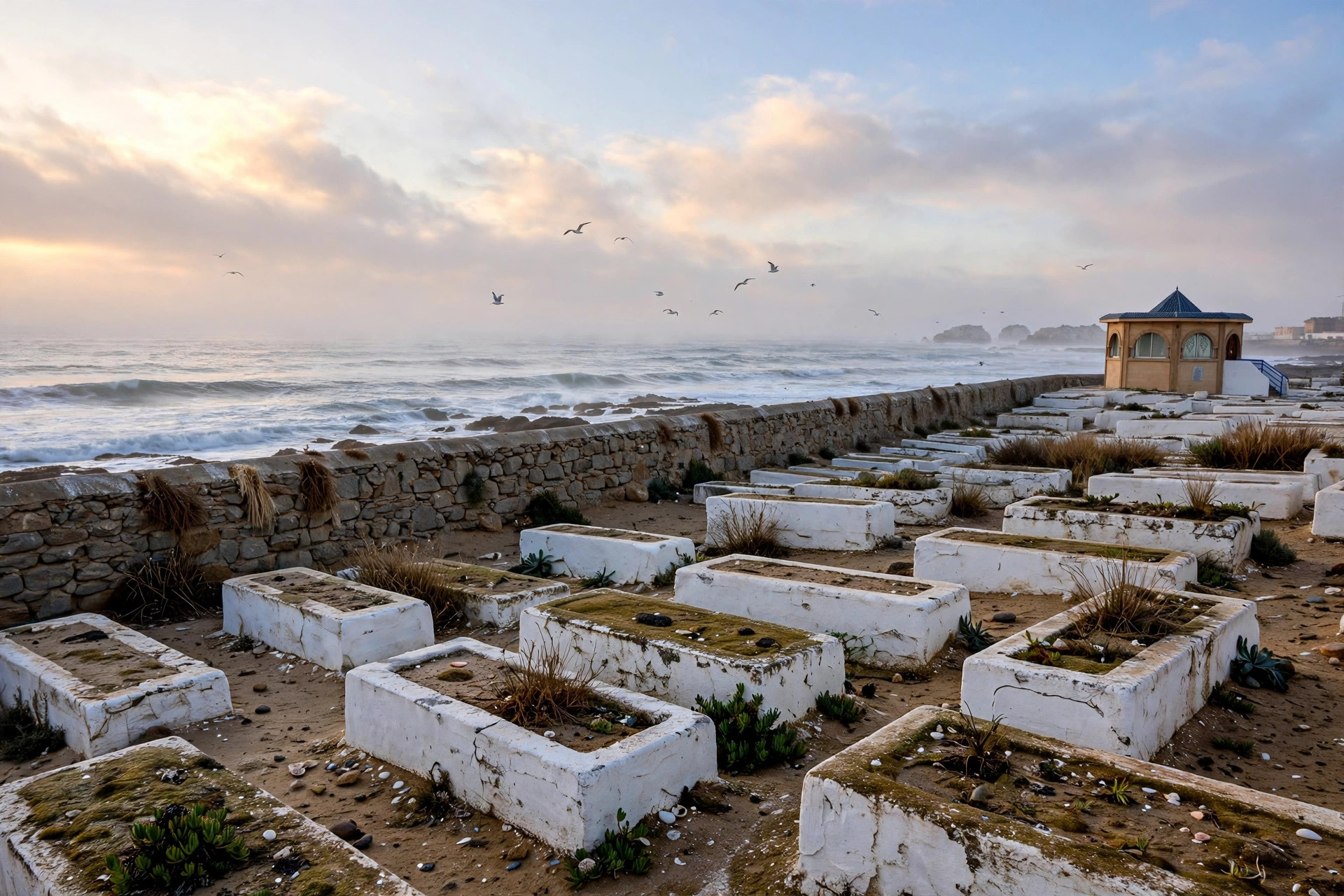
Essaouira’s cemetery, by contrast, is a story of merchants and sailors. Its tombs face the Atlantic because the community that built them looked out to sea for its living, and the inscriptions mix Hebrew with French and Spanish, a reminder that this was a cosmopolitan port where three languages were normal. The cemetery is free to enter and is best visited in the late afternoon, when the wind drops and the light is soft.
Two practical notes apply everywhere. First, do not walk on the tombs, and do not sit on them while taking photographs. Second, cover your head if you are a man entering a cemetery during a ceremony, and follow the caretaker’s lead. A tip of 10 to 20 MAD (about $1 to $2) is normal, and the caretaker is often the best guide you will find.
1948 to the 1960s: The Great Departure
In 1948, Morocco had one of the largest Jewish communities in the Arab world, with estimates usually given between 250,000 and 300,000 people. Those numbers are approximate, because counting was incomplete and different sources give different totals, but the scale is not in doubt. Within two decades, almost all of them had left, and that departure is the most painful chapter of morocco jewish heritage.
The departure happened in waves, not in a single moment. Some left after the creation of Israel in 1948, drawn by family ties and by the new state’s invitation. The largest wave came after Moroccan independence in 1956 and again in the early 1960s, when whole neighbourhoods emptied in a matter of months.
This is the hardest part of morocco jewish heritage to tell honestly, because the reasons people left were mixed. Some left because they felt unsafe after riots in Oujda and Jerada in 1948. No single explanation covers every family. What matters for a visitor today is to understand that the empty synagogues and quiet cemeteries are not ruins of an ancient past. They are the traces of a community that was here within living memory, and whose grandchildren now live in Israel, France, Canada and the United States.
Mohammed V and the Second World War
The most famous episode in morocco jewish heritage is also the most argued over. During the Second World War, Morocco was under the French protectorate, and the Vichy regime in France ordered anti-Jewish laws to be applied in Morocco. Sultan Mohammed V is widely credited with refusing to apply them fully, and with protecting Moroccan Jews from deportation.
What is documented is this. The sultan received Jewish delegations, he insisted publicly that Moroccan Jews were his subjects and under his protection, and no Moroccan Jew was deported to the camps in Europe.
What is debated is the detail. Historians disagree about how much the sultan could actually do under a French administration that held the real power, and about whether the famous refusal over the yellow star happened in the form the story gives it, because no written order of that kind has survived. Both views agree on the central fact: Morocco’s Jews survived the war in Morocco, and the sultan’s stance mattered.
I tell visitors both sides, because this history deserves honesty more than it deserves a hero story. The Almohad empire shows what persecution looked like in Moroccan history, and Mohammed V shows what protection looked like. Both are part of the same country, and both belong in any honest account of morocco jewish heritage.
The Revival: Museums, Restoration and Mimouna
Today only a few thousand Jews live in Morocco, most of them in Casablanca, but morocco jewish heritage is being restored with remarkable energy. The Jewish Museum in Casablanca, the only Jewish museum in the Arab world, holds ritual objects, photographs, costumes and documents from communities across the country. Entry costs 50 MAD (about $5), and it is open daily except Saturdays, roughly 10:00 to 18:00.
Synagogues across the country have been restored in the last twenty years, often with support from the Moroccan government, international Jewish organisations and the families who once prayed in them. The restoration is not nostalgia. It is a deliberate choice by Morocco to keep this part of its identity visible, and it is the most hopeful chapter of morocco jewish heritage today.
Visiting Respectfully: A Practical Guide
Most Jewish heritage sites in Morocco are free or cost very little. A few rules will make your visit better for everyone. Dress modestly when entering a synagogue or cemetery. Men should cover their heads inside a synagogue if a kippah is offered, and women should cover their shoulders. Ask before taking photographs, and never photograph people at prayer. Leave a small donation or tip, usually 10 to 20 MAD (about $1 to $2).
Hire a local guide in the mellah if one is offered. The quarters are dense, the signs are few, and the best stories are not written anywhere. Expect to pay 100 to 200 MAD (about $10 to $20) for a guided walk of one to two hours, and treat that as money well spent, because a good guide turns a walk through old streets into an understanding of morocco jewish heritage.
The table below brings together the main sites, their entry fees and their usual hours.
| Site | City | Entry fee | Usual hours |
|---|---|---|---|
| Ibn Danan Synagogue | Fez | 20 MAD (about $2) | Mornings, roughly 09:00 to 17:00 |
| Slat al-Azama Synagogue | Marrakech | Free, donation 10 to 20 MAD (about $1 to $2) | Outside prayer times |
| Lazama Synagogue | Marrakech | Free, donation 10 to 20 MAD (about $1 to $2) | Daytime, roughly 09:00 to 17:00 |
| Jewish Cemetery (Miâara) | Marrakech | Free, tip 10 to 20 MAD (about $1 to $2) | Daylight hours |
| Jewish Cemetery by the Sea | Essaouira | Free | Daylight hours |
| Slat Lkahal Synagogue | Essaouira | Free, donation welcome | Daytime, roughly 09:00 to 18:00 |
| Museum of Moroccan Judaism | Casablanca | 50 MAD (about $5) | Daily except Saturday, roughly 10:00 to 18:00 |
| Jewish Cemetery | Fez | Free, tip 10 to 20 MAD (about $1 to $2) | Daylight hours |
| Period | What happened |
|---|---|
| Before the 7th century | Jewish communities already living in North Africa; exact arrival dates unsettled |
| 7th to 8th century | Islam arrives; Jews live as protected dhimmis under the Idrisids |
| 1492 | Expulsion from Spain brings Sephardic Jews to Morocco |
| 1438 | First mellah created in Fez under the Marinids (commonly cited date, not fully settled) |
| 1557 | Mellah of Marrakech founded under the Saadians (mid-16th century) |
| 1760s | Essaouira founded; Jewish merchants run its trade |
| 1948 | Creation of Israel; first wave of departures begins |
| 1956 to 1960s | Independence and the largest waves of emigration |
| 1940s | Mohammed V protects Moroccan Jews during the Second World War (details debated) |
| 1997 | Jewish Museum opens in Casablanca |
| 2000s to today | Synagogue restorations and the public revival of Mimouna |
Why This History Still Matters
Morocco is often described as a meeting place of Arab, Berber, African and European cultures. It leaves out the community that lived here for two millennia. To walk the mellahs and the cemeteries is to complete the picture, and morocco jewish heritage is the thread that ties the medieval dynasties to the modern country.
FAQs
What is a mellah?
A mellah is a Jewish quarter in a Moroccan city, built beside the royal palace so the sultan could protect its residents. The first one was created in Fez in 1438
Can non-Jewish visitors enter synagogues in Morocco?
Yes, most historic synagogues welcome visitors outside prayer times. Dress modestly, and leave a small donation of 10 to 20 MAD (about $1 to $2).
How much does it cost to visit Jewish heritage sites in Morocco?
Most sites are free or cost very little. The Ibn Danan synagogue in Fez costs around 20 MAD (about $2), and the Jewish Museum in Casablanca costs 50 MAD (about $5). Cemeteries are free.
Is it safe to visit the mellahs?
Yes. The mellahs of Fez, Marrakech and Essaouira are ordinary residential quarters, and they are safe to walk in daylight.
Did Mohammed V really save Morocco’s Jews in the Second World War?
The sultan publicly protected Moroccan Jews, and refused to let Vichy anti-Jewish laws be fully applied, and no Moroccan Jew was deported to Europe. Some details of the famous stories, such as the yellow star episode, are debated by historians.
When is the best time to visit Jewish heritage sites in Morocco?
Spring and autumn are the most comfortable, and spring sometimes brings a public Mimouna celebration after Passover. Synagogues and museums keep their usual hours year round, though the Jewish Museum in Casablanca is closed on Saturdays. The story of morocco jewish heritage is best understood by visiting Fez, Marrakech and Essaouira in that order.
Last checked: November 2026