
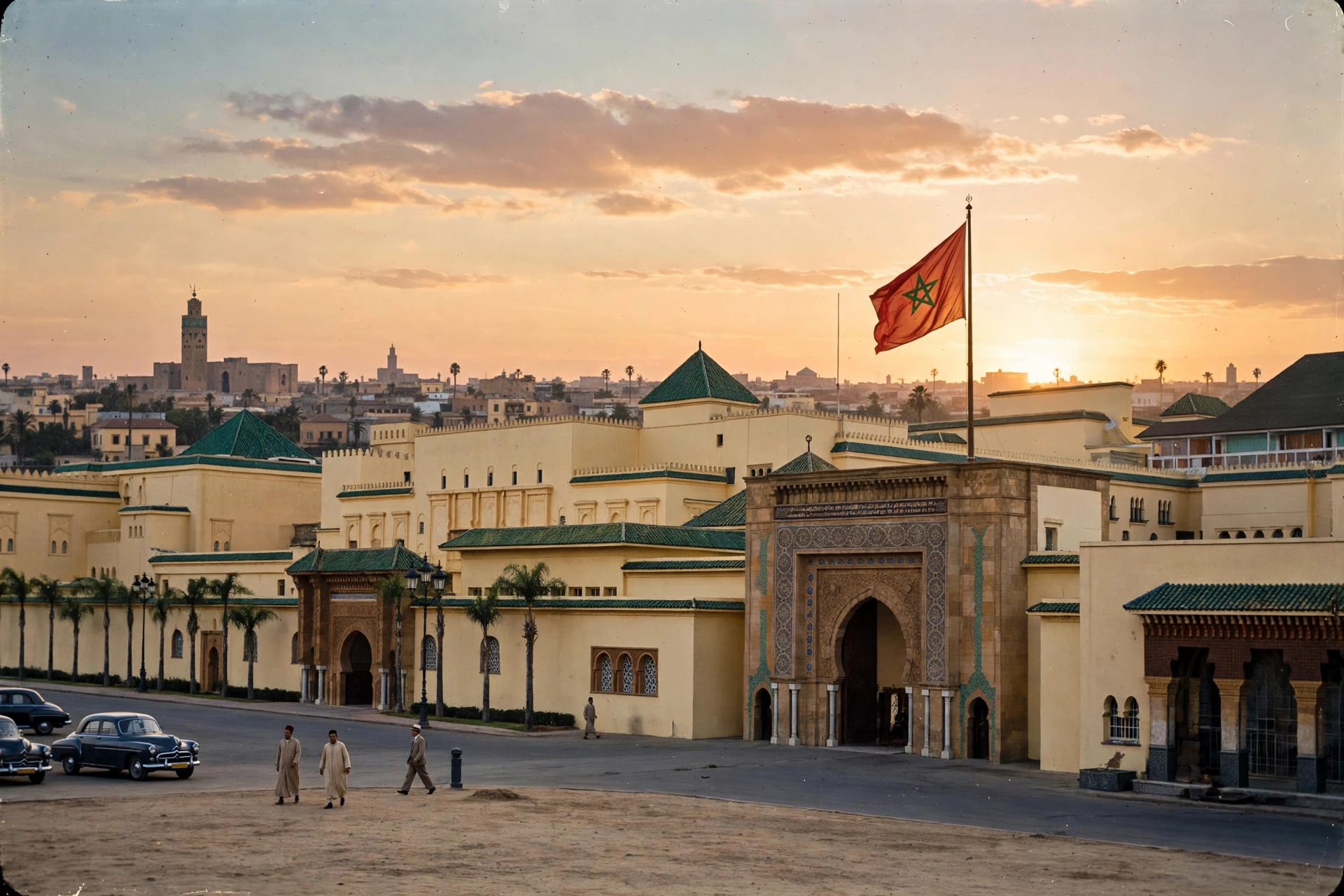
On 2 March 1956, France signed a declaration recognising Morocco as a sovereign state, ending forty-four years of protectorate rule. Yet the story of morocco independence 1956 begins long before that spring day, in the mountain valleys where resistance fighters refused to surrender, in the meeting rooms where nationalists drafted their demands, and in the palace where a young king chose his people over his throne.
This guide follows that road step by step, from the Treaty of Fez in 1912 to the reintegration of Tangier later in 1956 and the unfinished business that followed. Whether you are planning a history walk through Rabat or want to understand how the modern kingdom was born, this guide to morocco independence 1956 gives you the dates, the people and the places that matter, and flags the points where historians still disagree.
In this guide
- The Road to Freedom
- The Istiqlal Party and Allal al-Fassi
- The Exile of Mohammed V
- The Army of Liberation
- The Return of the King: 16 November 1955
- The Treaties That Made It Official
- Tangier Rejoins the Kingdom
- What Came After: Tarfaya, Ifni and the Green March
- The People Behind Independence
- Visiting Independence Sites in Rabat Today
- Frequently Asked Questions
- Conclusion: The Freedom Morocco Reclaimed
Morocco Independence 1956: The Road to Freedom
Morocco was never a blank page when the French arrived. By 1912 the Alaouite dynasty had ruled for more than two centuries, and the sultan's authority still reached from the Mediterranean to the Sahara. That is why the Treaty of Fez, signed on 30 March 1912, was so bitter: it placed Morocco under a French protectorate, leaving the sultan on his throne while real power passed to the resident-general.
The road to morocco independence 1956 was long because resistance never truly stopped. In the Rif, Abd el-Krim's fighters humiliated a Spanish army at Annual in 1921 and held out for five years against French and Spanish forces combined. In the Middle Atlas, Amazigh tribes fought on into the 1930s, keeping alive the idea that foreign rule could be resisted.
Life under the protectorate changed Morocco profoundly. The French built ports, railways and modern cities, but for the settler economy, and Moroccans were largely shut out of the best land, jobs and schools. A small educated elite began to ask why a country with its own king and history should be governed from Paris — the resentment that would one day fuel morocco independence 1956. Our brief history of Morocco covers the protectorate in full.
The 1930 Dahir and the Birth of Nationalism
The spark came in 1930, when the French issued a decree placing Amazigh customary law outside the jurisdiction of Islamic courts. The French intended it as administrative housekeeping; Moroccans read it as an attempt to divide the country, setting Amazigh communities apart from Arab ones. Protests erupted in Fez, Salé and Rabat, giving the opposition a national cause for the first time.
The Istiqlal Party and Allal al-Fassi
On 11 January 1944, the nationalists took their boldest step yet. The Istiqlal Party, founded the previous month, published its Manifesto of Independence, demanding full independence for Morocco under Sultan Mohammed V. It was handed to the sultan, the French resident-general and the consuls of Britain and the United States. It became the political engine of morocco independence 1956, and 11 January is still celebrated in Morocco as the anniversary of the manifesto.
The man behind the manifesto was Allal al-Fassi, a scholar from Fez whose learning at the Qarawiyyin had made him one of the most respected religious and intellectual figures in the country. Al-Fassi believed that independence needed schools, newspapers and a party that could speak for the whole nation, from the cities of the north to the southern oases.
The French response was arrest and repression. Al-Fassi himself was exiled to Gabon and then the Congo, spending nine years away from Morocco. But repression backfired: each arrest made the party more popular. By the early 1950s, Istiqlal was a mass movement with an ally in the palace. Al-Fassi's vision of a united, independent Morocco shaped morocco independence 1956 more than any single document of the era.
The Exile of Mohammed V and the Revolution of the King and the People
Mohammed V had been sultan since 1927, a young man of eighteen when he took the throne, and for years the French regarded him as a pliable figurehead. They misjudged him. In 1947 he travelled to Tangier and delivered a speech praising Moroccan unity, a public break with protectorate policy.
On 20 August 1953, the feast of Eid al-Adha, French troops surrounded the palace in Rabat, deposed Mohammed V and sent him into exile, first to Corsica and then to Madagascar. In his place they installed his elderly uncle, Mohammed Ben Arafa, a man with no popular support. Instead, the exile became the turning point of morocco independence 1956: a king who had been a symbol became a martyr, and a political dispute became a national cause.
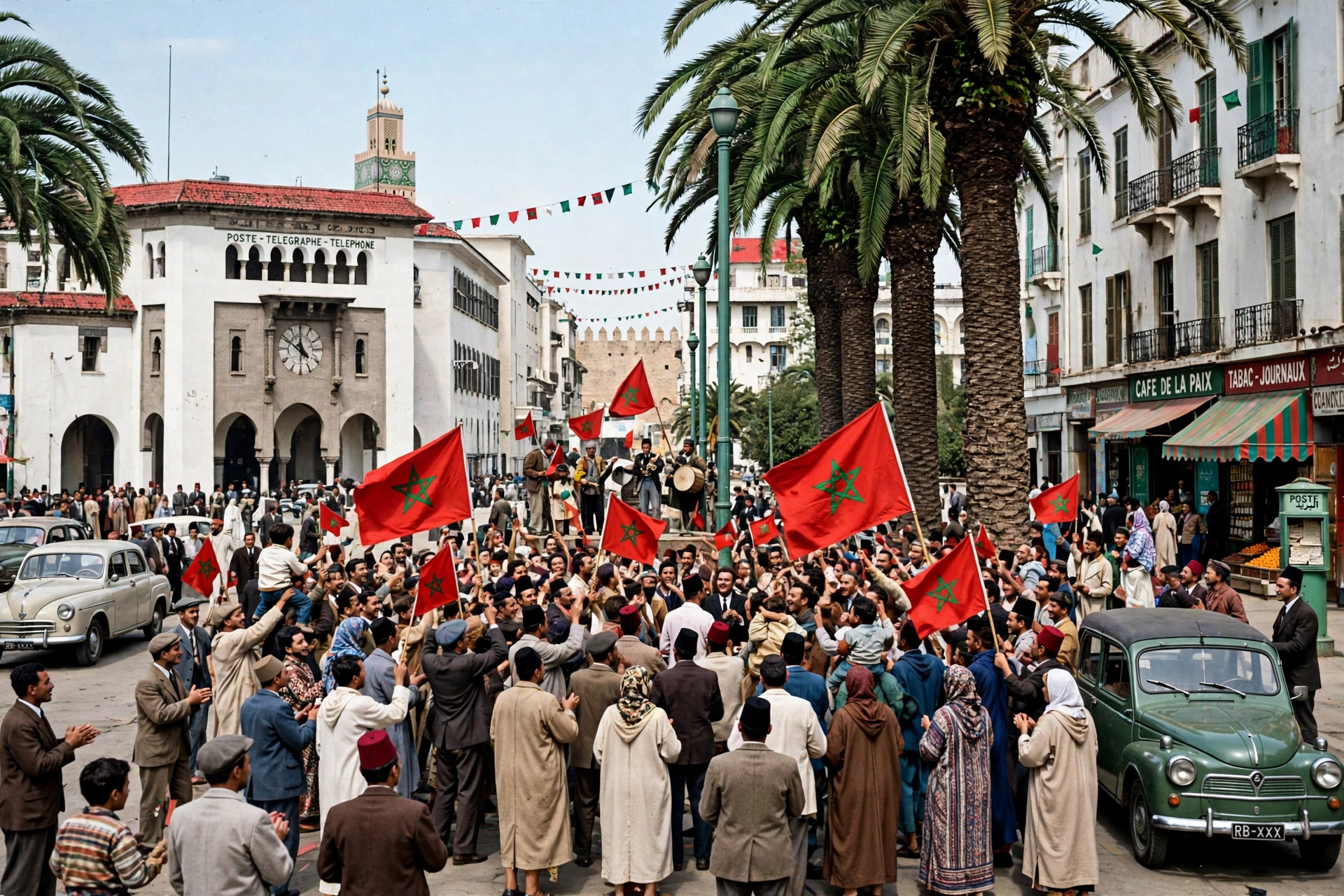
Moroccans call what followed the Revolution of the King and the People. Demonstrations broke out across the country, strikes paralysed the cities, and attacks on French settlers multiplied. Violence was never the whole story — most Moroccans resisted through boycotts and strikes — but the protectorate was becoming ungovernable. The Revolution of the King and the People carried morocco independence 1956 forward on a wave of popular feeling that no decree and no puppet sultan could stop.
The Army of Liberation
While the cities struck and demonstrated, a different resistance was taking shape in the countryside. In October 1955, the Army of Liberation launched coordinated attacks on French and Spanish posts in the Rif and the Middle Atlas. Its fighters were former resistance men, young nationalists and Amazigh tribesmen, and their operations coincided with the political crisis in Paris.
The Army of Liberation never fielded a large force, and its weapons were often old rifles captured or smuggled across borders. What it had was the terrain, the support of mountain villages, and a cause that needed no explanation. The army fought for morocco independence 1956 in the mountains while the diplomats argued in Paris, and its pressure helped force the pace of events.
The exact casualty figures of the liberation struggle are not settled. Moroccan sources, French military records and later historians give different numbers, and the fighting in remote mountain areas was never fully documented. This guide therefore presents no single total as fact.
The Return of the King: 16 November 1955
By the autumn of 1955, France had run out of options. The puppet sultan Ben Arafa had abdicated, the protectorate administration was losing control, and the new French government concluded that the exile had been a mistake. On 6 November 1955, at La Celle-Saint-Cloud near Paris, France agreed to restore Mohammed V and end the protectorate. Ten days later, on 16 November 1955, the king stepped off a plane at Rabat airport to a welcome no Moroccan had ever seen.
The return was the emotional climax of the whole struggle, and it fell on the eve of morocco independence 1956. Crowds lined the road from the airport to the palace, waving the red flag with its green pentagram and chanting the king's name. Mohammed V, who had left Morocco a sultan under a protectorate, came home as the father of independence, and 16 November is still a national holiday.
He returned not merely as a restored monarch but as a national leader who owed his throne to the people's loyalty, and he never forgot it. In the months that followed, he presided over the negotiations that ended the protectorate, in the tradition of the Alaouite dynasty that had ruled Morocco for three centuries. The crowds who cheered him home knew morocco independence 1956 was near, and they were right.
The Treaties That Made It Official
Independence was won in the streets and the mountains, but it was sealed on paper, in two stages that still cause confusion about the date. The La Celle-Saint-Cloud agreements of November 1955 promised negotiations, which produced the Franco-Moroccan Joint Declaration, signed in Paris on 2 March 1956, in which France recognised Morocco as an independent sovereign state. The declaration paved the way for morocco independence 1956.
A second treaty followed five weeks later. Spain, which had held its own zone in the north and the south, signed its own agreement with Morocco on 7 April 1956, ending the Spanish protectorate and returning its zone to Moroccan sovereignty. Morocco therefore regained its freedom in two steps.
| Date | Event | Significance |
|---|---|---|
| 30 March 1912 | Treaty of Fez | France establishes the protectorate over Morocco |
| 1921–1926 | Rif War under Abd el-Krim | Armed resistance humiliates Spain and inspires later nationalists |
| 16 May 1930 | Dahir of 1930 issued | Decree sparks nationwide protests and the birth of organised nationalism |
| 11 January 1944 | Istiqlal Manifesto of Independence | Nationalists demand full independence under Mohammed V |
| 10 April 1947 | Mohammed V's Tangier Speech | The sultan publicly aligns with the national cause |
| 20 August 1953 | Exile of Mohammed V | The sultan is deposed and exiled; the Revolution of the King and the People begins |
| 1 October 1955 | Army of Liberation attacks | Guerrilla offensive in the Rif and Middle Atlas |
| 6 November 1955 | La Celle-Saint-Cloud agreements | France agrees to restore Mohammed V and negotiate independence |
| 16 November 1955 | Return of Mohammed V | The king returns to Rabat to a hero's welcome |
| 2 March 1956 | Franco-Moroccan Joint Declaration | France recognises Moroccan independence |
| 7 April 1956 | Treaty with Spain | Spain ends its protectorate over northern Morocco |
| 29 October 1956 | Tangier reintegrated | The international zone returns to Moroccan sovereignty |
| 1958 | Tarfaya returned | Spain hands back the southern territory of Tarfaya |
| 1969 | Ifni returned | Spain returns the Ifni enclave to Morocco |
| 6 November 1975 | The Green March | 350,000 Moroccans march to reclaim the southern provinces |
Whether 2 March 1956 or 7 April 1956 is the "true" independence date is not settled, and this guide does not pretend otherwise. The 2 March declaration ended French rule over most of the country and is the date Morocco itself celebrates; the 7 April treaty ended Spanish rule in the north, so some argue Morocco was not fully independent until then. The honest answer is that independence came in stages, and the date most often cited for morocco independence 1956 is 2 March. For background on the French administration, the overview of the French protectorate in Morocco on Wikipedia is a useful starting point.
Tangier Rejoins the Kingdom
Tangier's story was different from the rest of the country. Since 1923 the city had been an international zone, governed by a committee of foreign powers, and it had grown into a famously cosmopolitan port — a city of spies, writers and exiles. Its status made its return a separate negotiation, and it took until the autumn of 1956 to complete.
In October 1956, an international conference agreed the protocol that returned Tangier to Moroccan sovereignty, and the city rejoined the kingdom after more than three decades apart. The reintegration was celebrated across the country, and Mohammed V visited the city to mark it. Yet the precise timing and terms of the Tangier reintegration protocol are not fully settled: accounts differ on the exact dates of the conference's sessions and on some transitional arrangements, so this guide dates the return to October 1956 without claiming more precision than the records support.
Tangier's return mattered far beyond the city itself. It closed the last chapter of the divided Morocco created by the protectorate treaties, and it gave the new kingdom its great northern port. Our guide to Tangier's international zone covers the city's strange decades in detail, and it helps explain why the reintegration felt like the completion of morocco independence 1956 in the north.
What Came After: Tarfaya, Ifni and the Green March
Independence in 1956 did not restore Morocco's historic borders in a single stroke. The treaties returned the protectorate zones, but Spain kept Tarfaya, the enclave of Ifni, and the Spanish Sahara. Mohammed V, and after his death in 1961 his son Hassan II, treated the recovery of these territories as unfinished business, and the story of morocco independence 1956 did not end in 1956 — it continued for another two decades.
Tarfaya was returned in 1958, and Ifni followed in 1969 after years of negotiation. The last chapter came in 1975, when Hassan II organised the Green March: some 350,000 unarmed Moroccans walked into the Spanish Sahara, and Spain agreed to withdraw. We tell that story in full in our guide to the Green March — but it belongs here too, as the final act of the independence story.
The People Behind Independence
Independence was not the work of one man, and the men and women behind morocco independence 1956 came from every part of Moroccan life: the palace, the party, the mountains and the mosques. The table below introduces the figures you will meet most often.
| Person | Role | Why they matter |
|---|---|---|
| Mohammed V | Sultan, later King (1927–1961) | Refused to serve as a figurehead, was exiled in 1953 and returned as the father of independence |
| Allal al-Fassi | Leader of the Istiqlal Party | Scholar and strategist behind the 1944 Manifesto of Independence |
| Crown Prince Hassan (Hassan II) | Heir to the throne | Acted as his father's adviser and negotiator, later king (1961–1999) |
| Mehdi Ben Barka | Istiqlal leader and organiser | Built the party's networks and led the resistance committees |
| Ahmed Balafrej | Nationalist diplomat | Negotiated with France and became independent Morocco's first foreign minister |
| Abbas Messaadi | Army of Liberation commander | Led guerrilla operations in the Rif in 1955 |
| Thami El Glaoui | Pasha of Marrakech | Powerful caïd who backed the French and the deposition of Mohammed V |
| Edgar Faure | French Prime Minister (1955) | Concluded the exile had failed and agreed to restore the king |
Mohammed V died suddenly in February 1961, less than five years after independence, and was succeeded by Hassan II. His tomb in Rabat, beside the Hassan Tower, is the most visited monument of the independence era.
Visiting Independence Sites in Rabat Today
Rabat is the best city in Morocco for walking the independence story, because the events of 1955 and 1956 happened here and the monuments are close together. A morning is enough to see the essentials, so you can walk the streets where morocco independence 1956 was celebrated.
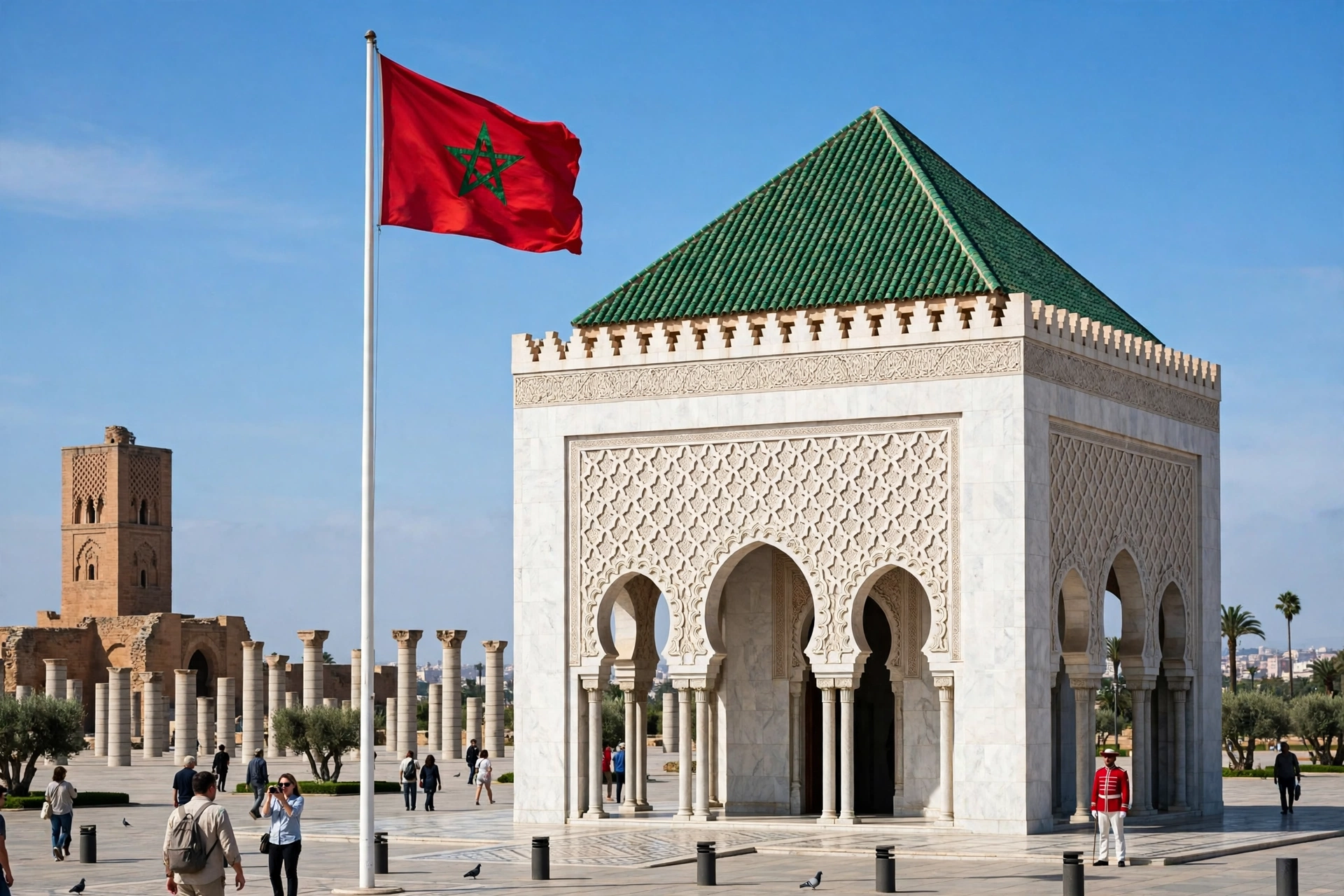
Start at the Mausoleum of Mohammed V, beside the Hassan Tower, where the king is buried alongside his sons Hassan II and Prince Abdallah. The white marble building, guarded by the Royal Guard in ceremonial dress, is open to visitors and free to enter.
| Site | What to see | Cost (November 2026) |
|---|---|---|
| Mausoleum of Mohammed V | Tomb of the king, Royal Guard ceremony, Hassan Tower | Free |
| Hassan Tower and the esplanade | The unfinished 12th-century minaret and the columns of the great mosque | Free |
| The Royal Palace (Dar al-Makhzen) | The palace gates and the mechouar square, viewed from outside | Free (exterior only; the palace is not open to visitors) |
| National Museum of History and Civilisations | Exhibits on Morocco's past, including the independence era | 60 MAD (about $6) |
| Chellah necropolis | Roman and medieval ruins in a walled garden | 70 MAD (about $7) |
| Rabat medina and the Kasbah of the Udayas | The old city streets and the Andalusian gardens | Free (gardens 10 MAD, about $1) |
Practical notes: Rabat is compact and walkable, and the tram connects the main sites for 6 MAD (about $0.60) a ride. A guided walking tour of the historic centre typically costs 200–300 MAD (about $20–$30) for a half day. For official visitor information, check Visit Morocco before you go; prices are checked as of November 2026 at roughly 10 MAD to the US dollar. A visit to these places brings morocco independence 1956 to life in a way no book can match, and it pairs well with our guide to the history of the Moroccan flag.
Frequently Asked Questions
When did Morocco become independent?
The most widely used date for morocco independence 1956 is 2 March 1956, when France signed the Franco-Moroccan Joint Declaration recognising Moroccan sovereignty. Spain followed with its own treaty on 7 April 1956, so some historians argue the country was not fully independent until then. Morocco celebrates Independence Day on 18 November, marking Mohammed V's 1955 speech on his return.
Who was Mohammed V?
Mohammed V was the sultan who became the face of morocco independence 1956. He took the throne in 1927, sided publicly with the nationalists in the 1940s, was deposed and exiled by France in 1953, and returned in triumph in November 1955. After independence he took the title of king.
What was the Istiqlal Party?
The Istiqlal Party was the nationalist party founded in 1943 that published the Manifesto of Independence in January 1944, demanding an end to the protectorate. Led by Allal al-Fassi, it organised the political campaign for independence through newspapers, schools and mass demonstrations.
What happened on 20 August 1953?
On 20 August 1953, France deposed Sultan Mohammed V and exiled him, first to Corsica and then to Madagascar, replacing him with his uncle Mohammed Ben Arafa. The date became a national holiday, the anniversary of the Revolution of the King and the People.
Can I visit the places linked to independence?
Yes. To understand morocco independence 1956, visit the Mausoleum of Mohammed V and the Hassan Tower in Rabat, both free to enter, and walk the medina where the crowds celebrated the king's return. The Royal Palace can only be viewed from outside, and the National Museum charges 60 MAD (about $6).
Why is the Green March connected to independence?
The Green March of November 1975 is often described as the final chapter of the independence story, because it recovered the Spanish Sahara, the last territory Spain held after 1956. Independence restored the protectorate zones, but Tarfaya, Ifni and the Sahara remained Spanish until 1958, 1969 and 1975.
Conclusion: The Freedom Morocco Reclaimed
The independence of Morocco was not a single day but a long road, and morocco independence 1956 was the moment that road reached its destination: a king restored, a protectorate dissolved, and a people who had refused foreign rule finally governing themselves. From the Rif mountains to the streets of Rabat, from the manifesto of 1944 to the treaties of 1956, the story belongs to a whole nation.
If you visit Rabat, stand on the esplanade of the Hassan Tower at sunset and look at the flag flying over the mausoleum of the king who came home. The freedom won by morocco independence 1956 still shapes the country around you — its monarchy, its cities and its sense of itself — and understanding that freedom is the best way to understand Morocco.
Last checked: November 2026. Prices are given in Moroccan dirhams with US dollar equivalents at about 10 MAD to 1 USD; confirm current entry fees before visiting. Historical dates follow the standard account, with the disputed points flagged in the text.
1 thought on “Morocco’s Independence in 1956: How the Kingdom Regained Its Freedom”