
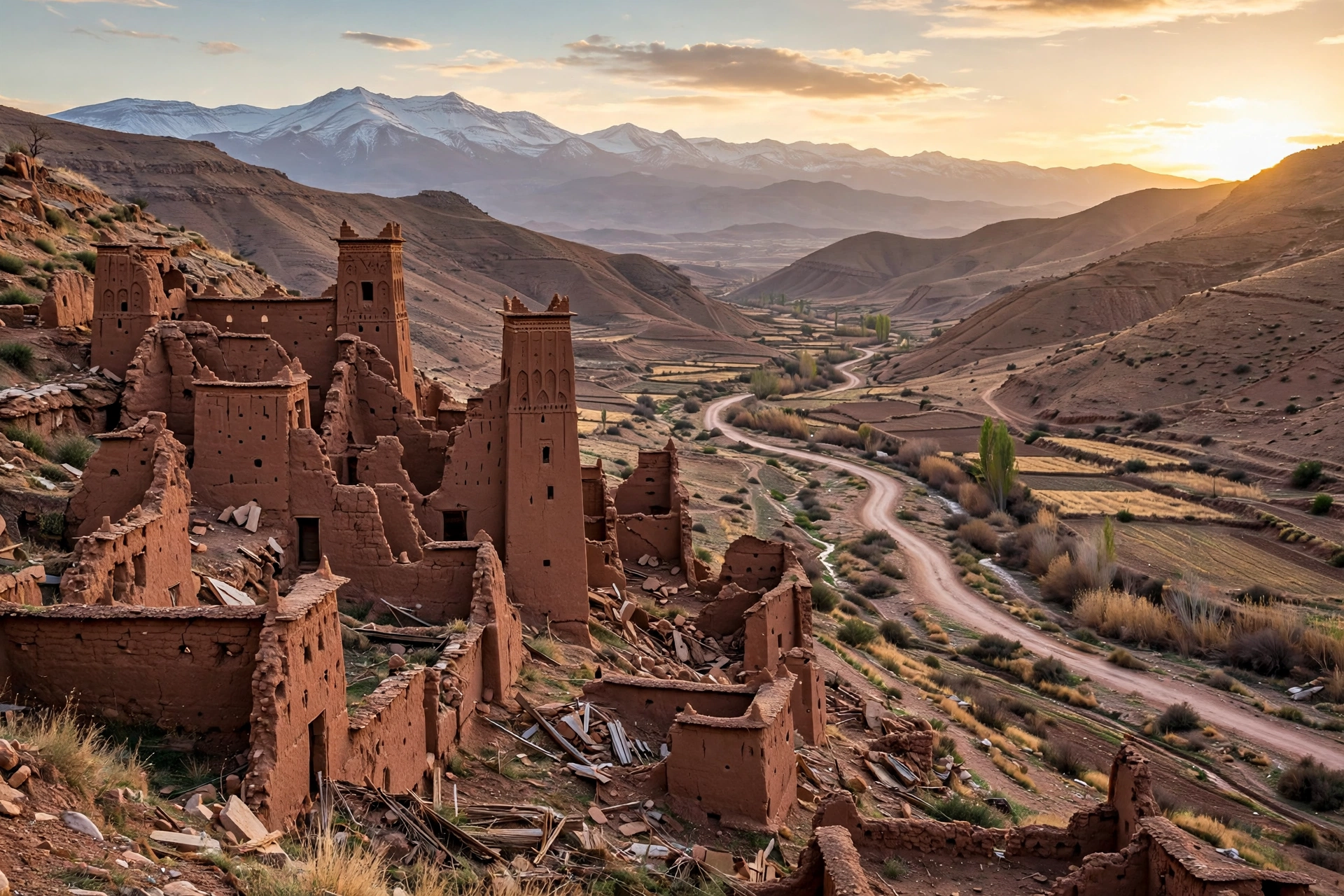
The Glaoui Pasha of Marrakech was the most powerful man in southern Morocco for almost half a century, a mountain chief who ruled like a king. His real name was Thami El Glaoui, and from his fortress at Telouet he controlled the passes of the High Atlas, taxed the caravans crossing them, and ruled Marrakech as its pasha from 1912 until 1955.
Few figures in Moroccan history divide opinion like the Glaoui Pasha of Marrakech. To the French colonial administration he was the loyal ally who kept the south quiet. To Moroccan nationalists he was the traitor who helped depose Sultan Mohammed V in 1953. To the Amazigh tribes of the Atlas he was both protector and tyrant. The truth, as this article shows, is more complicated than any single verdict.
In this guide
- Who Was the Glaoui Pasha of Marrakech?
- The Glaoui Family: From the High Atlas to Power
- Thami El Glaoui: The Making of a Strongman
- The Alliance with France: How the Glaoui Pasha of Marrakech Rose
- Telouet: The Kasbah at the Heart of the Empire
- Marrakech Under the Glaoui Pasha of Marrakech
- Wealth, Palaces and Taxes
- The Glaoui Pasha of Marrakech and Sultan Mohammed V
- The Fall: 1955–1956 and the Return of the King
- What Happened to the Family After 1956?
- Telouet Today: Visiting the Ruined Kasbah
- The Tizi n’Tichka: The Road the Glaoui Pasha Controlled
- The Glaoui Legacy: Hero, Villain or Both?
- Frequently Asked Questions
- Conclusion: Why the Glaoui Pasha of Marrakech Still Matters
Who Was the Glaoui Pasha of Marrakech?
The Glaoui Pasha of Marrakech was Thami El Glaoui (1879–1956), the head of the Glaoui family of the High Atlas and the pasha — the governor — of Marrakech under the French Protectorate. For more than forty years he was the uncrowned ruler of southern Morocco. At the height of his power, his word carried more weight in the south than the sultan's.
Thami El Glaoui was born in the mountains, probably in 1879, although his exact birth year is disputed and unsettled: some sources place it in the early 1870s, and no birth register exists for a mountain chief's son. He was the son of Mohammed El Glaoui, a local caïd, and he inherited his father's mountain stronghold at Telouet and his ambition. What set Thami apart was his grasp of a new reality: the chief who allied with the French early would keep his power.
By the time of his death in January 1956, the Glaoui Pasha of Marrakech had outlived the empire he built. He died in Marrakech just weeks before Morocco regained its independence, a broken and largely abandoned man. His palaces were seized, his fortune was confiscated, and his name became a byword for collaboration. Yet his kasbahs still stand, and his story remains essential to understanding modern Morocco. For the wider sweep of the country's past, see our history of Morocco.
The Glaoui Family: From the High Atlas to Power
The Glaoui family belonged to the Amazigh tribes of the High Atlas, the mountain people who had guarded the passes to the Sahara for centuries. Their base was Telouet, a village on the northern slope of the Atlas where the caravan route from the Draa climbed to Marrakech. Whoever held Telouet controlled the salt and the trade, and the Glaoui held it for generations.
In the 19th century, the Glaoui were one of several powerful mountain families, rivals of the Mtouggi and the Goundafi, who fought for control of the passes. The sultan claimed the mountains in theory, but in practice the Atlas was a land of local chiefs. Taxes were paid in men and in kind, and disputes were settled by force.
Thami El Glaoui: The Making of a Strongman
Thami El Glaoui took over the family leadership in 1900, after his father's death, and he moved quickly. He defeated his rivals, the Mtouggi, in a series of mountain battles, and by 1907 he dominated the southern Atlas. He was tall, imposing and intelligent, fluent in Arabic and Tamazight, and shrewd. He loved horses, falcons and lavish hospitality, and he understood that power was built as much on generosity as on force.
In 1907, the Glaoui Pasha of Marrakech — then still only the caïd of Telouet — made the decision that defined his life. When the French landed at Casablanca, Thami offered them his support. He lent them troops and guides, and in return the French recognised him as master of the south. It was a bargain that would make him fabulously rich and, in the end, destroy him.
The Alliance with France: How the Glaoui Pasha of Marrakech Rose
The alliance between the Glaoui Pasha of Marrakech and the French was simple and ruthless. The French, led by Resident-General Lyautey, needed the south pacified without a full military conquest. Thami needed French guns, French money and French recognition to crush his rivals. Each side got what it wanted, and the people of the Atlas paid the price.
With French backing, the Glaoui Pasha of Marrakech built a private army of several thousand men, equipped with modern rifles and artillery, and used it to subdue resisting tribes and collect taxes across the Haouz and the Souss. In return, the French left him alone: while the rest of Morocco was administered by French officials, the south remained his private domain.
| Year | Event in the rise of the Glaoui Pasha of Marrakech |
|---|---|
| 1879 | Thami El Glaoui born at Telouet (exact year disputed) |
| 1900 | Inherits leadership of the Glaoui family |
| 1907 | Allies with the French during the Casablanca landing |
| 1912 | Named Pasha of Marrakech as the Protectorate begins |
| 1920s | Crushes rival chiefs with French arms and builds his army |
| 1931 | Guest of honour at the Paris Colonial Exhibition |
| 1953 | Leads the deposition of Sultan Mohammed V |
| 1955 | Forced to submit to the returning sultan |
| 1956 | Dies in Marrakech, weeks before independence |
Telouet: The Kasbah at the Heart of the Empire
Telouet was the seat of the Glaoui Pasha of Marrakech and the symbol of his power. The great kasbah, built in the late 19th century and expanded by the Glaoui Pasha of Marrakech in the 1920s and 1930s, is a fortress-palace of red earth and stone, with towers, courtyards and reception halls decorated by the finest craftsmen of Fez and Marrakech — see our guide to the kasbahs of Morocco. At its height it housed hundreds of servants, guards and guests.
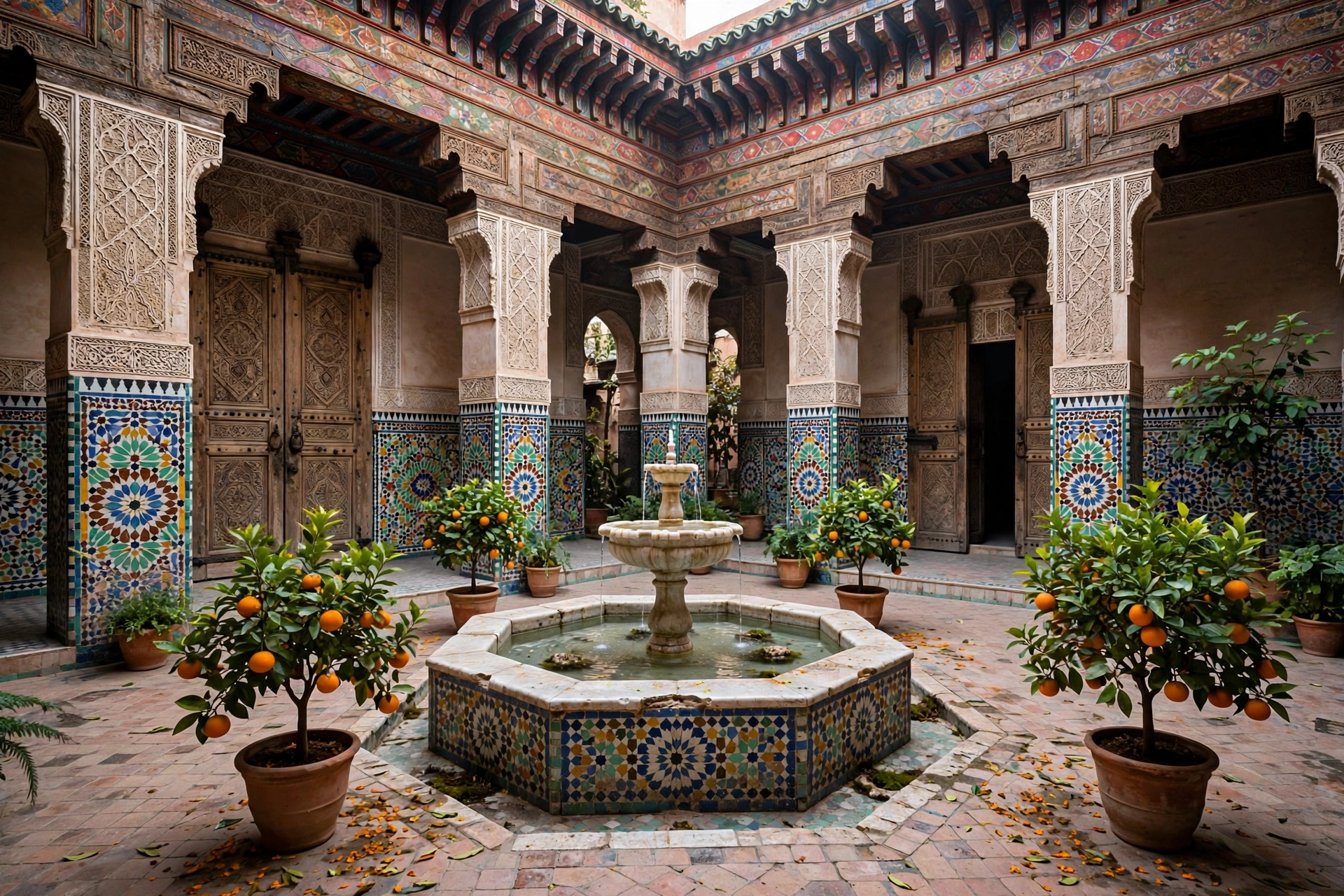
Inside, the contrast with the ruined exterior is startling. Some rooms still show painted cedar ceilings, carved plaster and zellige tilework, the work of artisans from the imperial cities. The great reception hall, with its tall windows looking toward the Atlas peaks, is where Thami received French generals, sultans' envoys and foreign travellers. Winston Churchill was among the famous visitors to the Glaoui court, and the hospitality of the Glaoui Pasha of Marrakech was legendary.
Marrakech Under the Glaoui Pasha of Marrakech
As pasha of Marrakech, Thami El Glaoui governed the city and its region from the Dar El Glaoui, his palace in the medina. He controlled the markets, the police and the courts, and his word was law. Merchants paid him for protection, officials paid him for their posts, and anyone who crossed him risked prison. The French resident was, in theory, his superior; in practice, the Glaoui Pasha of Marrakech usually got his way.
Marrakech flourished under his rule, in a narrow sense. The city became the showcase of the French Protectorate in the south: new roads, the Guéliz district, hotels like La Mamounia and a growing European community. Thami himself lived in extraordinary luxury. He owned palaces in Marrakech, Telouet and Casablanca, fleets of cars and a stable of Arabian horses. His parties were famous, and his generosity to French guests was matched only by his severity toward Moroccan opponents. For a modern guide to the city he ruled, see our Marrakech travel guide.
Wealth, Palaces and Taxes
The fortune of the Glaoui Pasha of Marrakech is one of the great mysteries of his story, and its size is disputed and unsettled. Some call it among the largest private fortunes in Africa; others say the legends far exceed the reality. What is certain is that his income came from many streams, and that all of them depended on his political position.
He collected taxes on the caravans crossing the Atlas, on the markets of Marrakech, on the salt of the Sahara trade and on the land of the tribes he controlled. He owned vast estates in the Haouz and the Souss, and property in Casablanca and Paris. He also received payments from the French administration, officially for keeping order in the south. The system made him rich, and it made the people who paid it poor.
| Source of wealth | How it worked | Who paid |
|---|---|---|
| Caravan and pass tolls | Fees on goods crossing the Tizi n'Tichka | Traders and travellers |
| Market taxes in Marrakech | Levies on the souks and the slaughterhouses | Merchants and butchers |
| Land rents | Rents from estates in the Haouz and Souss | Tenant farmers |
| French subsidies | Payments for policing the south | The Protectorate budget |
| Salt and Sahara trade | Shares in the desert caravan trade | Caravan merchants |
When the state seized his property in 1956, officials found palaces full of furniture, silver and carpets, and bank accounts in several countries. The exact total has never been published, and historians still argue over it. What matters is the mechanism: the Glaoui Pasha of Marrakech turned political power into private wealth on a scale Morocco had never seen.
The Glaoui Pasha of Marrakech and Sultan Mohammed V
The defining act of the Glaoui Pasha of Marrakech came in August 1953, when he led the deposition of Sultan Mohammed V. By then, the sultan had become the symbol of Moroccan nationalism, and the French administration decided to remove him. They needed a Moroccan face for the coup, and Thami provided it.
On 20 August 1953, Thami and allied caïds presented a petition demanding the sultan's abdication, and French troops exiled Mohammed V to Corsica and then Madagascar. A puppet sultan of the Alaouite dynasty, Mohammed Ben Arafa, was installed in his place. For the nationalists, this was the ultimate betrayal: the Glaoui Pasha of Marrakech had used his authority to destroy the monarchy itself.
The Fall: 1955–1956 and the Return of the King
The fall of the Glaoui Pasha of Marrakech was as swift as his rise had been slow. In the autumn of 1955, with France losing its grip, Mohammed V returned from exile. Thami, ill and isolated, was summoned to Rabat. On 12 November 1955, in a famous and humiliating scene, he knelt before the returning sultan and begged forgiveness. Mohammed V accepted, and the Glaoui Pasha of Marrakech returned to Marrakech a broken man. For the full story, see our account of Morocco's independence in 1956.
He died on 23 January 1956, less than three months after his submission and weeks before independence was proclaimed on 2 March 1956. He was buried quietly in Marrakech, and the new state moved quickly to erase his power: his palaces were seized and his lands confiscated. The man who had ruled the south for 43 years left almost nothing behind but ruins and a reputation.
What Happened to the Family After 1956?
After 1956, the Glaoui family faded from public life. Thami's sons kept some of their property, but they held no offices, and the family name became a liability. Some went into business, others into exile in France, and a few quietly returned to Telouet to farm. The great kasbah was left to decay, and the palaces of Marrakech were turned over to the state.
The ruins, meanwhile, became heritage. Telouet is now a stop on the road to Aït Ben Haddou, and the Moroccan state has begun restoring its decorated rooms. The story of the Glaoui Pasha of Marrakech is told to visitors as history: a warning about what happens when a leader ties his fate to a foreign power. Browse the full History & Heritage category for the rest of our series.
Telouet Today: Visiting the Ruined Kasbah
Visiting Telouet is one of the most atmospheric day trips in Morocco, easily combined with the drive over the Tizi n'Tichka to Aït Ben Haddou. The kasbah stands above the village, a 20-minute drive from the main road, and its decorated rooms are open to visitors. A local guide is worth hiring: the guardians know the history of every room. Many travellers pair it with our Ouarzazate travel guide.
Entry to the kasbah is free, and local guides usually ask 50–100 MAD (about $5–$10) for an hour-long tour. The site is open daily from around 9am to 6pm, but hours are informal, so arrive before mid-afternoon. The best light for photographs is late afternoon, when the sun turns the red earth to gold. Prices checked November 2026. Plan your visit on Visit Morocco, the official tourism site.
| Item | Cost in MAD | Cost in USD |
|---|---|---|
| Kasbah entry | Free | Free |
| Local guide (about 1 hour) | 50–100 MAD | $5–$10 |
| Grand taxi, Marrakech–Telouet return | 600–800 MAD | $60–$80 |
| Lunch in Telouet village | 40–70 MAD | $4–$7 |
| Combined trip to Aït Ben Haddou | 800–1,200 MAD by taxi | $80–$120 |
The Tizi n'Tichka: The Road the Glaoui Pasha Controlled
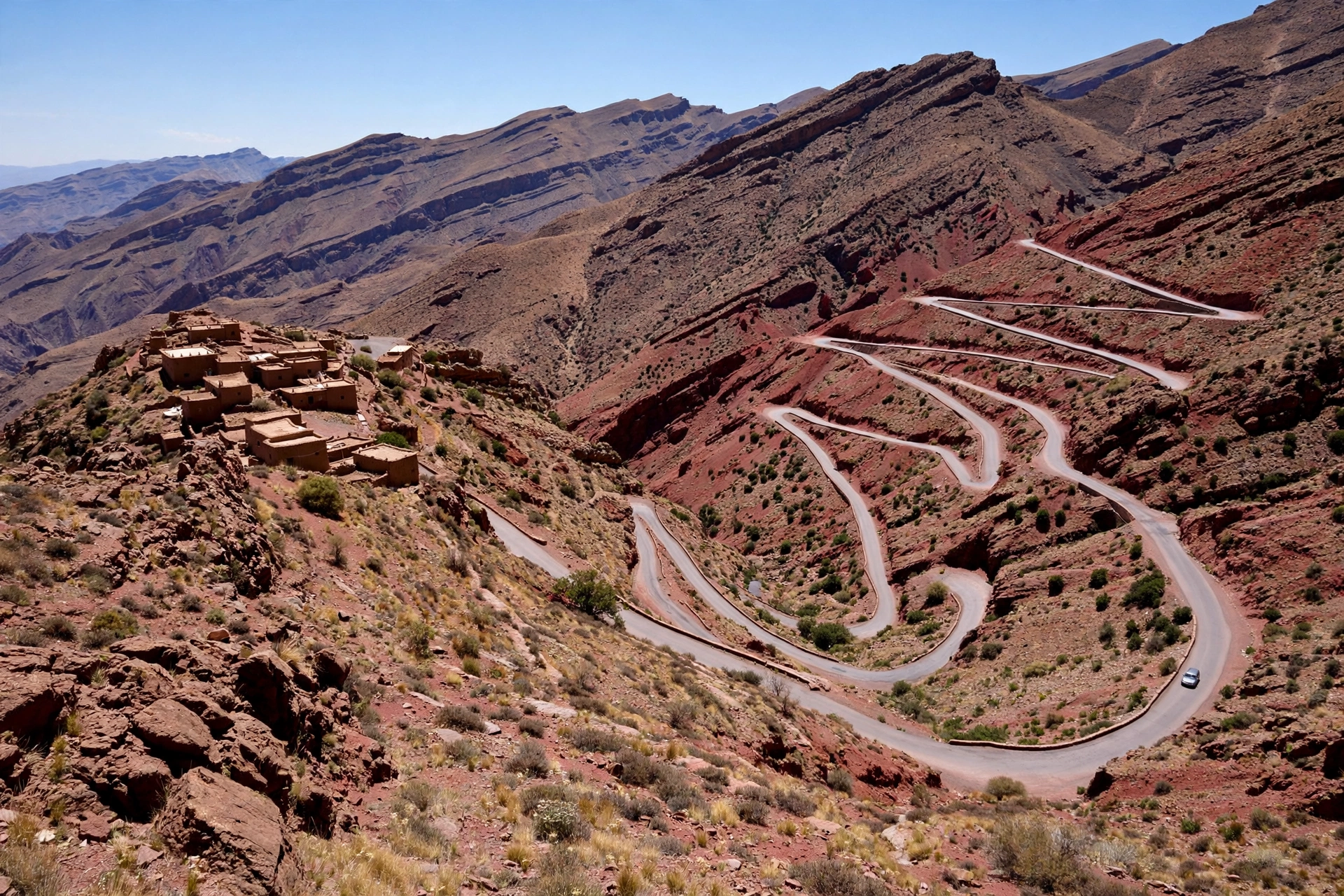
The Tizi n'Tichka, the mountain pass at 2,260 metres, was the key to the power of the Glaoui Pasha of Marrakech. Before the modern road, the pass was a mule track, and every caravan carrying salt, dates, grain and gold between Marrakech and the Sahara had to climb it. Thami's men collected tolls at the top, and no merchant passed without paying. The pass made the Glaoui rich, and it made them feared.
The French built the modern road in the 1920s and 1930s, to move troops and open the south to tourism. The road is now one of the great drives of Morocco: 140 kilometres of switchbacks from Marrakech to Ouarzazate, with views that stop traffic at every bend. The Glaoui tolls are long gone, but the road still follows the route his caravans used. For a very different story of Moroccan power, see the Republic of Sale.
| Fact | Detail |
|---|---|
| Pass height | 2,260 metres above sea level |
| Road distance Marrakech–Ouarzazate | About 200 km, 4–5 hours by car |
| Best time to drive | April to October; snow possible November–March |
| Tolls today | None; the road is free |
| Nearest Glaoui site | Telouet kasbah, 20 minutes from the pass road |
The Glaoui Legacy: Hero, Villain or Both?
Historians still argue about the Glaoui Pasha of Marrakech, and the argument says as much about modern Morocco as about the man. Was he a traitor who sold his country, or a pragmatist who kept the south stable when resistance would have meant ruin? The honest answer is that he was both: a brilliant administrator and a ruthless one, a protector of his people and their oppressor.
What is certain is that his story marks a turning point. Before Thami, Morocco was a land of local chiefs and mountain republics. After him, it was a modern state, with a single king, a single army and a single administration. He helped to destroy the old order, and then he was destroyed by the new one. That is the tragedy of the Glaoui Pasha of Marrakech, and it is why his name is still spoken in Morocco seventy years after his death. To follow the royal story he challenged, see our guide to the kings of Morocco, the imperial cities of Morocco and the Green March.
Frequently Asked Questions
Who was the Glaoui Pasha of Marrakech?
The Glaoui Pasha of Marrakech was Thami El Glaoui (1879–1956), the Amazigh chief of Telouet who served as pasha — governor — of Marrakech from 1912 to 1955. He ruled southern Morocco as a near-independent prince under the French Protectorate.
Where is the Glaoui kasbah?
The main Glaoui kasbah is at Telouet, a village in the High Atlas on the road between Marrakech and Ouarzazate, about 20 minutes from the pass. Thami also owned the Dar El Glaoui palace in the medina of Marrakech, which is closed to visitors.
Why is Thami El Glaoui controversial?
He is controversial because he allied with France, helped to depose Sultan Mohammed V in 1953, and ruled the south as a near-dictator. Nationalists see him as a collaborator; others argue he was a pragmatist who kept the south stable.
Can you visit Telouet kasbah today?
Yes. The kasbah is open daily, entry is free, and local guides charge 50–100 MAD (about $5–$10) for an hour-long tour. It is best visited as a stop on the drive from Marrakech to Aït Ben Haddou or Ouarzazate.
When did the Glaoui Pasha of Marrakech die?
He died on 23 January 1956 in Marrakech, about two months after submitting to the returning Sultan Mohammed V and a few weeks before Morocco's independence on 2 March 1956.
What happened to the Glaoui fortune?
His palaces and lands were seized by the Moroccan state after independence in 1956. The exact size of his fortune is disputed and unsettled, and no official total has ever been published.
Conclusion: Why the Glaoui Pasha of Marrakech Still Matters
The Glaoui Pasha of Marrakech matters because his life contains the whole story of Morocco in the first half of the 20th century: the mountain chiefs, the coming of France, the rise of nationalism, the exile of a king and the birth of an independent nation. For forty years, Thami El Glaoui was one of its authors, and his choices shaped the country we see today.
Visit Telouet, drive the Tizi n'Tichka and walk the medina of Marrakech, and you will see his world still standing in red earth and carved cedar. The Glaoui Pasha of Marrakech is gone, but the Atlas he ruled is still there, and the questions his life raises — about power, loyalty and the price of survival — are as alive now as they were in 1953.
Last checked: November 2026. Prices are approximate and may change; confirm locally before travelling.