
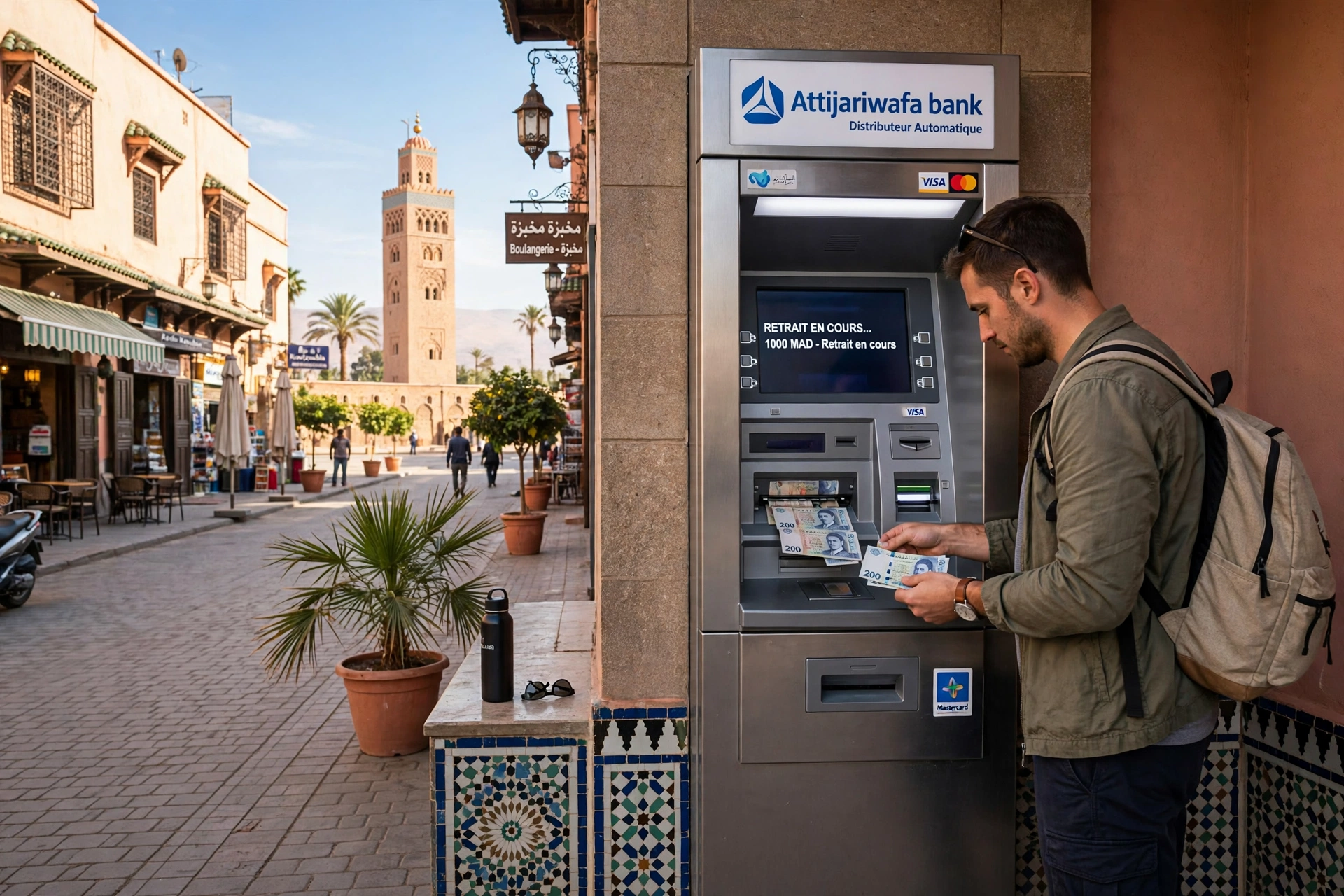
Morocco ATM fees are the first money question most travellers ask before landing, and the answer changed at the start of 2026: every bank ATM in the country now charges foreign cards a flat 35 MAD (about $3.50) per withdrawal. Get the rules right and cash in Morocco is cheap and easy.
The good news is that Morocco ATM fees are simple once you know them. There is one flat local charge, one clear trap to avoid at the machine, and a handful of banks whose higher withdrawal limits cut your cost in half. This guide gives you the exact 2026 numbers, bank by bank, plus the daily cash budget you actually need. It sits in our Costs & Practical Life section, alongside our wider Morocco Money Guide: The Dirham Explained.
In this guide
- Morocco ATM Fees at a Glance
- How Much Do Morocco ATM Fees Cost in 2026?
- Which Banks Charge the Lowest Morocco ATM Fees?
- The Second Charge: Your Home Bank’s Fees
- Morocco ATM Fees by Card: Visa, Mastercard and Amex
- Withdrawal Limits: How Much Cash Per Transaction?
- How to Withdraw Cash in Morocco, Step by Step
- The DCC Trap: Always Choose Dirhams
- Cash or Card? How Much Cash Do You Actually Need?
- ATM Safety in Morocco
- Common ATM Problems and What to Do
- How to Pay the Lowest Morocco ATM Fees: 7 Money-Saving Tips
- Frequently Asked Questions
- Conclusion: The Cheapest Way to Get Dirhams
Morocco ATM Fees at a Glance
Morocco ATM fees run at a flat 35 MAD (about $3.50) per foreign-card withdrawal at every bank machine in the country, and the standard cap is 2,000 MAD (about $200). Your home bank may add 1–3% on top, and accepting the machine’s conversion can add 4–12%. The cheapest way to handle Morocco ATM fees is one big withdrawal at a time, in dirhams, on a card with no foreign transaction fee.
| Fact | 2026 figure |
|---|---|
| Local Morocco ATM fees (foreign cards) | 35 MAD (~$3.50) flat per withdrawal |
| Standard per-transaction cap | 2,000 MAD (~$200) |
| Highest per-transaction cap (BMCI) | 4,000 MAD (~$400) |
| Home bank foreign transaction fee | 1–3% (often $0 with Wise, Revolut or Schwab) |
| Dynamic currency conversion markup | 4–12% — always decline it |
| Independent Euronet ATM fee | 25–60 MAD (~$2.50–$6) per withdrawal |
| Exchange rate used | ~10 MAD per USD, interbank rate when you decline conversion |
| Best strategy | Withdraw the maximum, in dirhams, as rarely as possible |
Last checked: November 2026. Fees are shown on the ATM screen before you confirm, so you always see the charge before it happens.
How Much Do Morocco ATM Fees Cost in 2026?
Since January 2026, Morocco ATM fees have been a flat 35 MAD per withdrawal for foreign cards at every Moroccan bank. The charge is per withdrawal, not per amount: 500 MAD costs the same 35 MAD as 2,000 MAD. Three small withdrawals cost 105 MAD in fees, while one maximum withdrawal costs just 35 MAD.
This is a change from a few years ago, when some banks charged nothing. Al Barid Bank, the postal bank that used to be the free option, introduced the same 35 MAD fee at the start of 2026. Older guides that say Moroccan ATMs are free are out of date — Morocco ATM fees are now the same everywhere.
The fee appears on the machine’s screen before the cash is dispensed, and you can cancel at that point. The charge is small, but it adds up fast if you withdraw little and often. Ten small withdrawals on a two-week trip pay 350 MAD (about $35) in Morocco ATM fees alone, while four maximum withdrawals pay just 140 MAD (about $14).
Which Banks Charge the Lowest Morocco ATM Fees?
Here is the pleasant surprise: Morocco ATM fees do not vary between the main banks any more, so pick the bank with the highest limit and the most reliable machines. Attijariwafa Bank runs the widest network, with machines in airports, medinas and small towns; BMCE Bank of Africa and Banque Populaire are close behind, and CIH Bank is solid in cities. All of them charge the same flat 35 MAD to foreign cards.
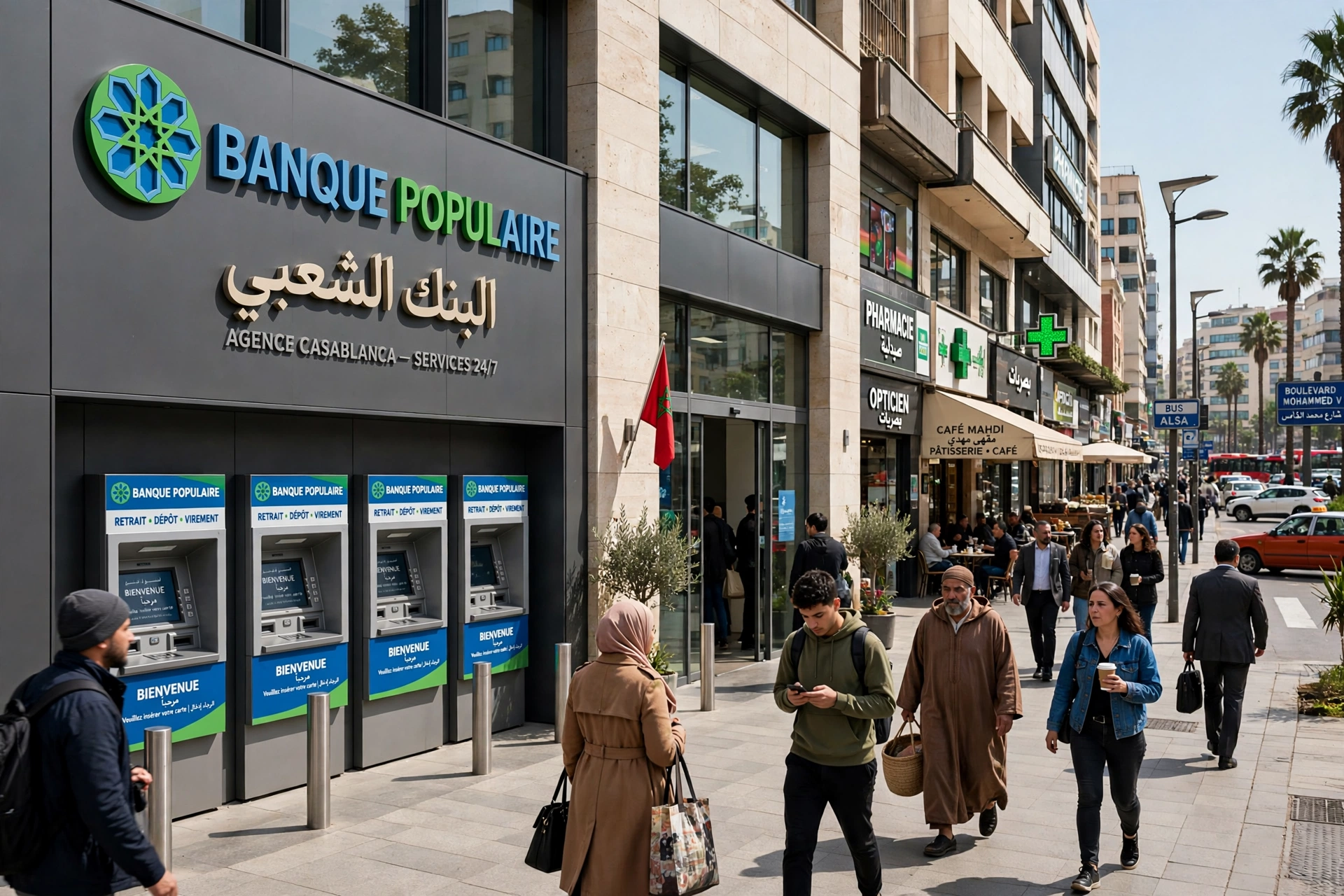
The one exception worth knowing is BMCI, whose machines allow up to 4,000 MAD (about $400) per withdrawal for the same 35 MAD fee — double the usual cap. That halves your Morocco ATM fees on a long trip. Société Générale and Crédit du Maroc work the same way at the standard cap.
| Bank | Local fee (foreign cards) | Per-transaction cap | Coverage | Verdict |
|---|---|---|---|---|
| Attijariwafa Bank | 35 MAD (~$3.50) | 2,000 MAD (~$200) | Nationwide, including airports | Recommended |
| BMCE Bank of Africa | 35 MAD (~$3.50) | 2,000 MAD (~$200) | Nationwide, city centres | Recommended |
| Banque Populaire | 35 MAD (~$3.50) | 2,000 MAD (~$200) | Very wide, including small towns | Recommended |
| CIH Bank | 35 MAD (~$3.50) | 2,000 MAD (~$200) | Urban areas | Good option |
| BMCI | 35 MAD (~$3.50) | 4,000 MAD (~$400) | Cities and larger towns | Best for big withdrawals |
| Al Barid Bank | 35 MAD (~$3.50) | 2,000 MAD (~$200) | Widespread, including rural areas | Decent fallback |
| Société Générale | 35 MAD (~$3.50) | 2,000 MAD (~$200) | Cities | Fine when nearest |
| Euronet / independent | 25–60 MAD (~$2.50–$6) | Varies, often lower | Airports, tourist zones | Last resort only |
To keep Morocco ATM fees at 35 MAD, avoid the independent machines in souvenir-shop doorways and tourist squares whenever a bank machine is nearby. Euronet and similar operators charge 25–60 MAD of their own, push the conversion trap harder, and sometimes cap withdrawals lower. Use them only as a last resort.
The Second Charge: Your Home Bank's Fees
On top of Morocco ATM fees, most traditional banks add two things: a flat foreign ATM fee of roughly $2–5 per withdrawal, and a foreign transaction fee of 1–3% of the converted amount. On a 2,000 MAD (about $200) withdrawal, that is another $5–11 on top of the 35 MAD local fee — and it does not appear on the ATM screen.
The fix is to travel with the right card. Wise and Revolut charge no foreign transaction fee and convert near the interbank rate. Charles Schwab refunds the local ATM fee itself for US travellers. Bank of America customers should note no Moroccan bank is a Global ATM Alliance partner, so its card pays a $5 out-of-network fee plus 3% on top of the Moroccan charge.
Before you fly, check your card's exact terms in your banking app and tell your bank you are travelling to Morocco, so a withdrawal in Marrakech does not trigger a fraud block. That avoids the most common ATM headache: a good card refused because the bank suspected fraud.
Morocco ATM Fees by Card: Visa, Mastercard and Amex
Visa works at virtually every bank ATM in Morocco, and Mastercard is nearly as reliable, with the same Morocco ATM fees. Bring one of each, on two accounts, so a lost card never leaves you without cash. Debit cards are the right tool for withdrawals; credit cards work at ATMs too, but most issuers treat the withdrawal as a cash advance, charging interest from day one plus a cash-advance fee.
American Express is the exception: Amex cards are rarely accepted at Moroccan ATMs, and the fees are higher where they work. Do not rely on Amex for cash in Morocco. Discover and Diners Club have almost no ATM presence either. If you hold only Amex, arrange a Visa or Mastercard debit card before you travel.
One practical detail catches people out: Moroccan ATMs expect a four-digit PIN. If yours is longer, ask your bank to shorten it — some machines will not accept five- or six-digit PINs. Cash withdrawals still need the PIN, so make sure you know it rather than relying on your phone.
Withdrawal Limits: How Much Cash Per Transaction?
Most Moroccan ATMs cap each withdrawal at 2,000 MAD, about $200 — the real reason Morocco ATM fees feel expensive. BMCI is the exception at 4,000 MAD (about $400) per transaction, so plan around 2,000 MAD. Back-to-back withdrawals are possible, but each costs another 35 MAD.
| Limit | Typical figure |
|---|---|
| Per-transaction cap, most banks | 2,000 MAD (~$200) |
| Per-transaction cap, BMCI | 4,000 MAD (~$400) |
| Daily cap at the Moroccan ATM | 10,000–20,000 MAD (~$1,000–$2,000) |
| Your home bank's daily withdrawal limit | Often $300–$1,000 — check before travel |
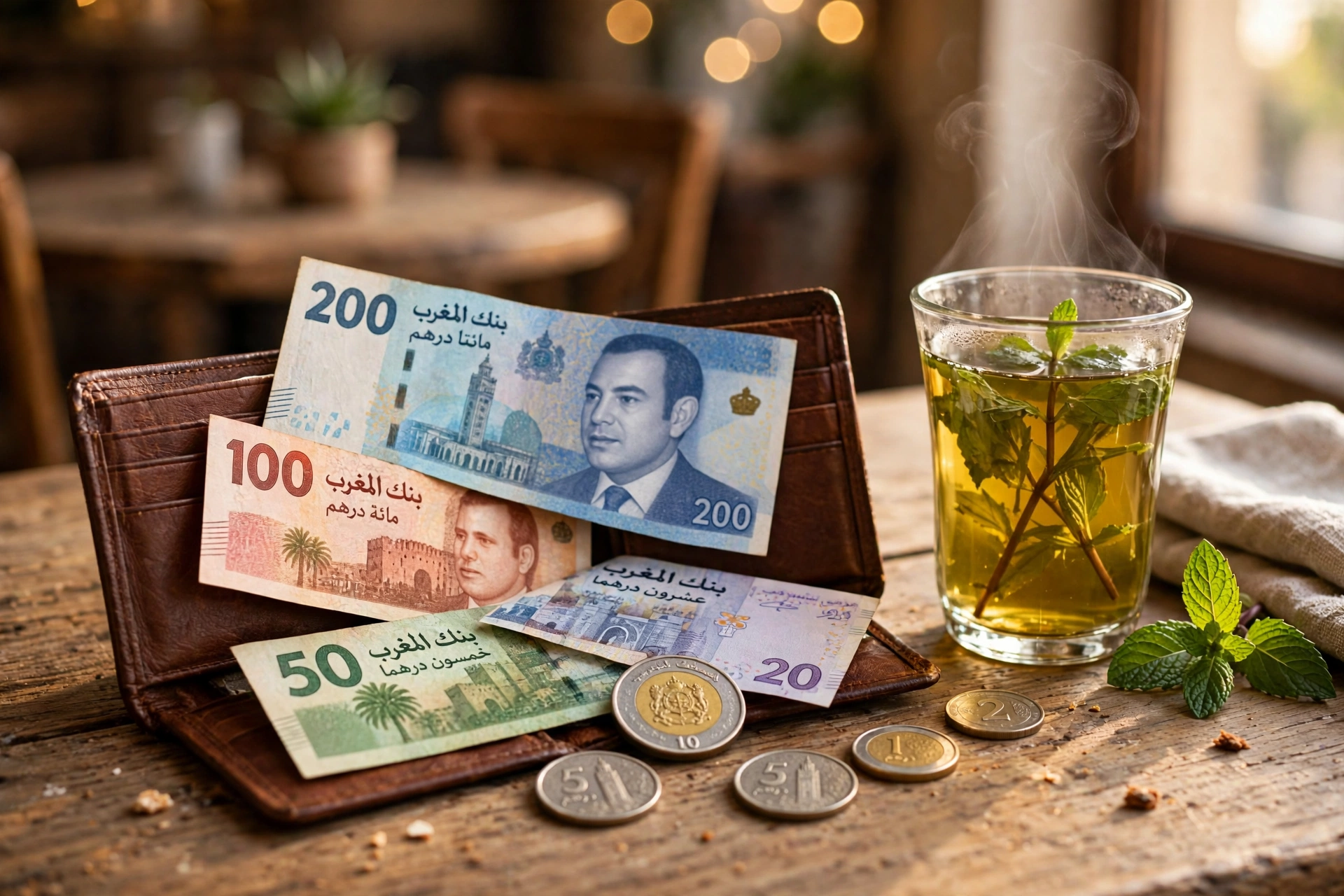
| Smallest note dispensed | 20 MAD (~$2) |
| Largest note dispensed | 200 MAD (~$20) |
Your home bank's daily limit is the part of Morocco ATM fees that surprises people most. A $300 daily limit means only about 3,000 MAD a day, whatever the machine allows — and it is set in your home currency. Raise it in your banking app before the trip if you plan to pay for a tour or a riad in cash. Ask for 1,900 MAD rather than 2,000 MAD — it gives you more small notes for taxis and market stalls.
How to Withdraw Cash in Morocco, Step by Step
Withdrawing cash works like at home, with one extra screen to watch for. Use a machine attached to a bank branch or inside a mall, in daylight when you can. Machines offer English, French and Arabic — choose English at the first screen.
- Insert your card and select English as the language.
- Enter your four-digit PIN, shielding the keypad with your other hand.
- Choose "Withdrawal" and the account type if asked.
- Type the amount in dirhams, ideally the maximum the machine allows.
- Read the fee screen: it shows the 35 MAD local charge before you confirm.
- When asked about conversion, choose "Without conversion" or "Charge in Moroccan dirhams" — never your home currency.
- Take your cash, your card and the receipt, then count the notes before you walk away.
- Store the cash out of sight and keep the receipt.
If the machine offers to convert the amount for you, that is the trap below, not a service — and it costs far more than Morocco ATM fees. If anything looks wrong — a loose card slot, a device over the keypad, someone hovering too close — cancel and use another machine. A little caution costs nothing; a skimmed card costs a holiday.
The DCC Trap: Always Choose Dirhams
Dynamic currency conversion, or DCC, is the most expensive mistake you can make at a Moroccan ATM, and it is also the most common. When it detects a foreign card, it may offer to charge you in your home currency instead of dirhams. It is not a convenience: the bank sets the rate and builds in a 4–12% markup. On a 2,000 MAD withdrawal, that is an extra $8–24 on top of the Morocco ATM fees.
The fix is simple and absolute: always decline conversion and always choose dirhams. Tap "Decline conversion", "Without conversion" or "Charge in MAD" — sometimes shown smaller than "Continue with conversion". Your own bank then converts at close to the interbank rate, which is almost always far better. If you accept by mistake, the transaction cannot be undone — slow down on this one screen.
The same trap appears when paying by card in shops and restaurants: if the terminal offers to charge you in your home currency, decline it there too. Pay in dirhams everywhere, and never let a machine choose the rate for you. After the first withdrawal, spotting it becomes automatic.
Cash or Card? How Much Cash Do You Actually Need?
Morocco is a cash-heavy country, but less so than it used to be. Cards work in hotels, larger restaurants, supermarkets and malls. Cash is still essential in medinas, for taxis, cafes, stalls and tips — and in rural areas it is often the only option. See our Morocco Taxi Prices and Tipping in Morocco guides for where cash matters most.
A realistic daily cash budget is 300–500 MAD (about $30–50) per person for a budget traveller, and 600–900 MAD (about $60–90) for a mid-range traveller. Hotels and big purchases go on the card. One maximum withdrawal of 2,000 MAD covers roughly three to five days for most travellers, so a two-week trip needs only three or four withdrawals — just 105–140 MAD (about $10.50–14) in Morocco ATM fees.
Keep a spread of small notes. A 200 MAD note is awkward for a 12 MAD taxi ride, and drivers often cannot change it early in the morning. Break big notes at supermarkets, and keep coins for tips and toilets. At the end of the trip, spend your remaining dirhams or change them back before you leave: the dirham is a closed currency, so leftover notes become souvenirs unless you reconvert them at the airport.
ATM Safety in Morocco
Moroccan ATMs are generally safe; the main risk is confusion, not crime. Use machines inside branches, malls and hotels, in daylight on busy streets. Cover the keypad when you enter your PIN, and be firm with anyone offering unsolicited help: a stranger watching your PIN is the oldest ATM scam.
Check the card slot and keypad before you insert your card. A loose or bulky attachment is a reason to walk to the next machine. Never show your PIN or hand your card to a stranger. If someone stands too close, cancel and come back later — another ATM is usually minutes away. Keep your receipt, and photograph the machine if anything goes wrong.
Common ATM Problems and What to Do
A declined withdrawal is usually your home bank's doing, not the Moroccan machine's. An unnotified trip, a reached daily limit, or three wrong PIN attempts all produce a refusal with no useful explanation. Check your banking app for a fraud alert, and try a different bank's machine — one network can be down while the next works. Morocco ATM fees are only charged on successful withdrawals, so a declined attempt costs you nothing.
If the machine swallows your card, note the bank, branch and time, then go inside if it is open — staff can often retrieve the card the same day. If it is closed, call the number on the machine, then your home bank to block the card. If the machine debits your account but gives you no cash, keep the receipt, photograph the machine, and dispute the charge with your home bank: these "phantom debits" are almost always refunded, but the dispute needs the receipt. If you run out of cash in a small town, licensed bureaux de change will change clean dollars or euros at the official rate.
How to Pay the Lowest Morocco ATM Fees: 7 Money-Saving Tips
Paying the lowest Morocco ATM fees means avoiding the small costs that stack up. Together these seven habits can save a typical two-week traveller $30–50.
- Withdraw the maximum every time. The 35 MAD fee is flat, so one 2,000 MAD withdrawal beats four 500 MAD ones.
- Use BMCI when you see one. Its 4,000 MAD cap halves the number of withdrawals — and the fees — on a long trip.
- Travel with a no-foreign-fee card. Wise, Revolut or a similar card removes the 1–3% home-bank charge entirely.
- Always decline conversion. Choosing dirhams instead of your home currency saves 4–12% on every withdrawal.
- Withdraw rarely, not often. Three or four planned withdrawals cover a two-week trip for most travellers.
- Bring backup cash in euros or dollars. Clean notes give you a bureau de change as a fallback.
- Reconvert before you fly home. The dirham is a closed currency — change leftovers at the airport.
One more habit helps: check your statement the day after each withdrawal. The Morocco ATM fees and your bank's fee appear as separate lines, so query anything unexpected while you remember the machine. See our How Much Does a Trip to Morocco Cost? guide for a full trip budget, and Cost of Living in Morocco for daily life costs.
Frequently Asked Questions
How much are Morocco ATM fees in 2026?
A flat 35 MAD (about $3.50) per withdrawal for foreign cards at every bank ATM, a standard since January 2026. Your home bank may add its own fee of 1–3% on top. Independent Euronet machines charge 25–60 MAD extra.
Can I use my debit card at ATMs in Morocco?
Yes — Visa and Mastercard debit cards work at virtually every bank ATM in Morocco. American Express is rarely accepted at ATMs, so bring a Visa or Mastercard debit card, and tell your bank you are travelling first.
What is the maximum I can withdraw from an ATM in Morocco?
Most Moroccan ATMs cap each withdrawal at 2,000 MAD (about $200), while BMCI machines allow up to 4,000 MAD (about $400) for the same 35 MAD in Morocco ATM fees. Daily caps at the machine run to 10,000–20,000 MAD, but your home bank's limit is often lower.
Are there any free ATMs in Morocco for foreign cards?
No. Since January 2026 every Moroccan bank charges the flat 35 MAD fee to foreign cards, including Al Barid Bank, which used to be free. Older guides saying otherwise are out of date. The cheapest option now is a BMCI machine with a no-foreign-fee card, which keeps the total cost to the flat 35 MAD alone.
Should I accept the ATM's currency conversion in Morocco?
No — always decline it. The machine's conversion, called dynamic currency conversion, adds a markup of 4–12% on top of the Morocco ATM fees. Choose "Without conversion" or "Charge in Moroccan dirhams" and let your bank convert instead.
Can I buy Moroccan dirhams before I travel?
No. The Moroccan dirham is a closed currency, so no bank outside Morocco sells it and you cannot order it in advance. Your first dirhams come from an ATM or a licensed bureau de change after you land, and you must spend or reconvert any leftovers before you leave. For official visitor information, see Visit Morocco.
Conclusion: The Cheapest Way to Get Dirhams
Morocco ATM fees in 2026 are simple: 35 MAD flat, a 2,000 MAD cap, 4,000 MAD at BMCI. Withdraw the maximum at a bank ATM, decline conversion, and use a card with no foreign transaction fee — that is the whole secret to low Morocco ATM fees. Do that three or four times on a two-week trip and your total cash cost is barely more than $15.
Last checked: November 2026