
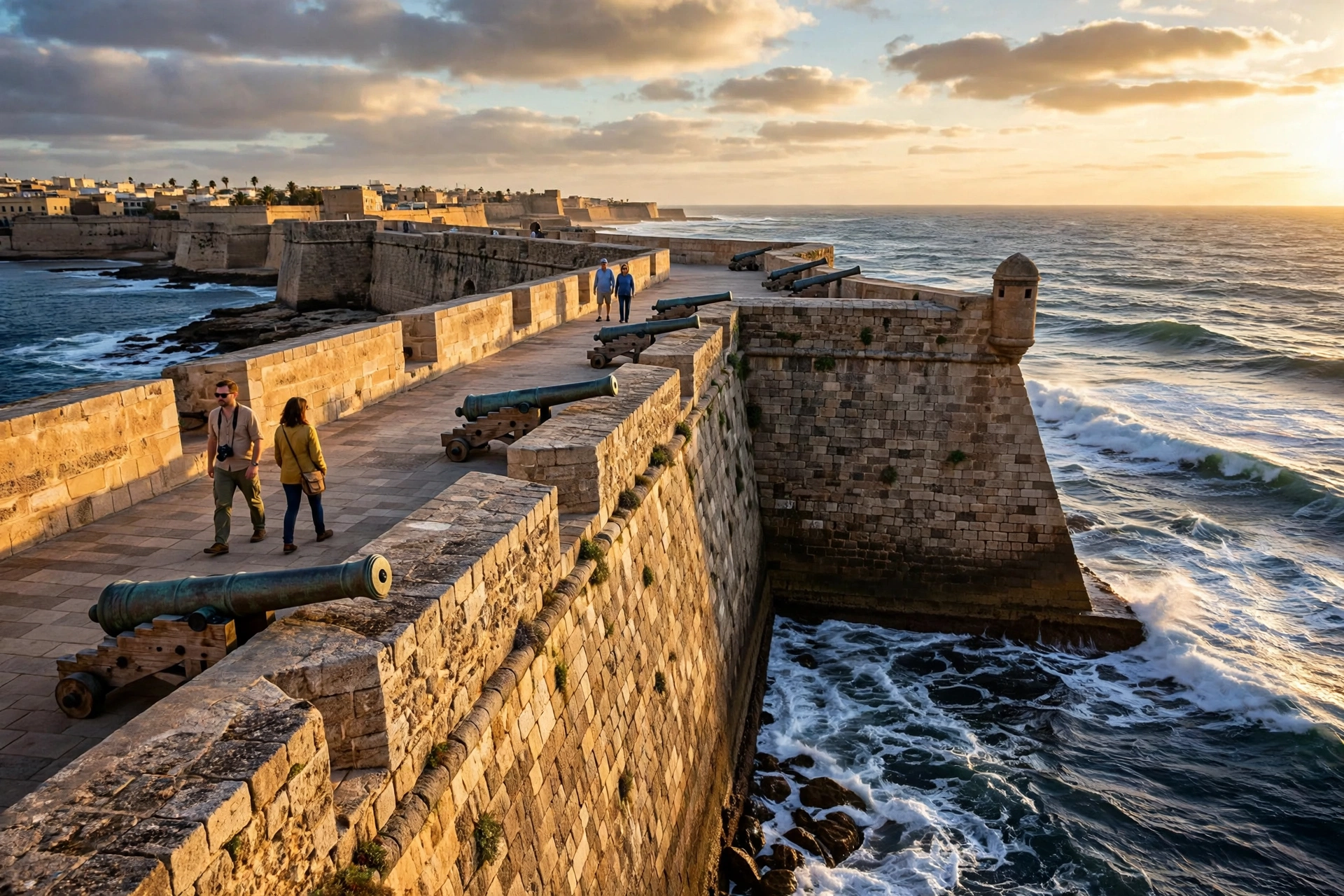
The Portuguese fortress of El Jadida is one of the most complete Renaissance fortresses anywhere in Africa. It stands above the Atlantic, about 100 kilometres south of Casablanca, its thick stone ramparts still forming the star shape that Italian engineers drew in the 1540s. Inside the walls, a small Portuguese town survives almost intact.
UNESCO listed the fortress as a World Heritage Site in 2004, calling it an outstanding witness to the meeting of European and Moroccan cultures. This guide to the Portuguese fortress of El Jadida explains how it was built, what to see inside the walls, and how to visit it in 2026, including the cistern's closure. It sits in our History & Heritage section, alongside our History of Morocco.
In this guide
- Why the Portuguese Fortress of El Jadida Matters
- The Portuguese Fortress of El Jadida at a Glance
- From Phoenician Anchorage to Portuguese Mazagan
- 1514: The First Citadel on the Atlantic
- 1541–1548: The Star Fortress Takes Shape
- The Portuguese Cistern: The Fortress’s Underground Hall
- The Church of the Assumption: Manueline Stone in Africa
- The Ramparts and Bastions: A Walk Above the Atlantic
- 1769: The End of Portuguese Mazagan
- From Ruin to El Jadida: The 19th-Century Revival
- UNESCO World Heritage: Why Mazagan Was Listed in 2004
- Visiting the Portuguese Fortress of El Jadida in 2026
- Practical Information and Costs
- Where to Stay and Eat Near the Fortress
- Common Mistakes Visitors Make
- Frequently Asked Questions
- Conclusion: Why the Fortress Still Matters
Why the Portuguese Fortress of El Jadida Matters
Most visitors to Morocco never reach El Jadida, and that is exactly why the fortress matters. While the great imperial cities were rebuilt again and again by successive dynasties, Mazagan was abandoned by its builders in 1769 and left largely untouched for decades. The result is a rare thing: a 16th-century fortified town preserved whole.
The fortress also tells a bigger story. For more than 250 years Mazagan was a Portuguese town on African soil, trading, fighting and worshipping behind its walls. When the Portuguese left, Moroccans moved in and made the place their own, adding a mosque and a mellah. The Portuguese fortress of El Jadida is therefore not a foreign relic. It is a Moroccan town with a Portuguese first chapter.
The Portuguese Fortress of El Jadida at a Glance
| Fact | Detail |
|---|---|
| Location | El Jadida, Atlantic coast, about 100 km south of Casablanca |
| Built | First citadel 1514; star fortress 1541–1548 |
| Builders | Portuguese, to plans by Benedetto da Ravenna |
| Size | About 250 m by 300 m, star-shaped |
| UNESCO listing | 2004, criteria (ii) and (iv) |
| Famous for | The Portuguese Cistern and the Church of the Assumption |
| Time needed | 2 to 3 hours for the fortress and old town |
| Ramparts | Free to walk |
| Cistern ticket | Reported 10 to 60 MAD in recent guides; confirm on arrival |
| Best months | October to April, for mild Atlantic weather |
From Phoenician Anchorage to Portuguese Mazagan
The site of El Jadida was used long before the Portuguese arrived. Ancient sources place a Phoenician anchorage here in the 5th century BC, and later writers knew the place under names such as Rusibis. The exact early history is not settled, and the details are still debated. What is certain is that the bay was attractive: a natural harbour on a coast with few good ones, close to the rich Doukkala plain.
By the late 15th century, the coast belonged to a different contest. Portugal had taken Ceuta in 1415 and was building a chain of fortified posts down the Moroccan Atlantic coast to protect the sea route to India. Azemmour, a few kilometres north, fell to the Portuguese in 1513. The Portuguese looked south to a small settlement the local Amazigh population called Mazighen, and decided to build there instead. The name they gave it was Mazagan, or Mazagão in Portuguese.
1514: The First Citadel on the Atlantic
In the summer of 1514, the Portuguese built a citadel at Mazagan. It was a rectangular fort, about 47 by 56 metres, with four towers, designed by the brothers Diogo and Francisco de Arruda. One tower, El-Brija, already stood on the site, and the builders kept it.
The citadel was the first permanent Portuguese construction on this spot, and it still stands at the heart of the Portuguese fortress of El Jadida today. Under it lies the chamber that would become the famous cistern, and around it grew the small walled town. At this stage Mazagan was a garrison post rather than a city: hold the bay, protect Portuguese shipping, and give the crown a foothold on the coast. The Saadian-ruled countryside watched it with suspicion, and the little fort was attacked more than once.
1541–1548: The Star Fortress Takes Shape
The citadel alone was not enough. Gunpowder artillery had changed warfare, and a rectangular fort with tall thin walls was no longer safe. In 1541 the Portuguese began a much larger project: they rebuilt Mazagan as a star-shaped fortress, following the new Renaissance military science known as the trace italienne. Benedetto da Ravenna drew the plans, and João Ribeiro and Juan Castillo built them.
The result is the fortress you walk today. Low, thick ramparts slope outward to deflect cannonballs. Four pointed bastions — the Angel, the Holy Spirit, St Sebastian and St Anthony — jut out at the corners, so defenders on one could fire along the face of the next. The whole enclosure measures roughly 250 by 300 metres, small enough to cross on foot, yet built to withstand a siege. It worked: the Portuguese fortress of El Jadida was besieged but never taken by storm.
The Portuguese Cistern: The Fortress's Underground Hall
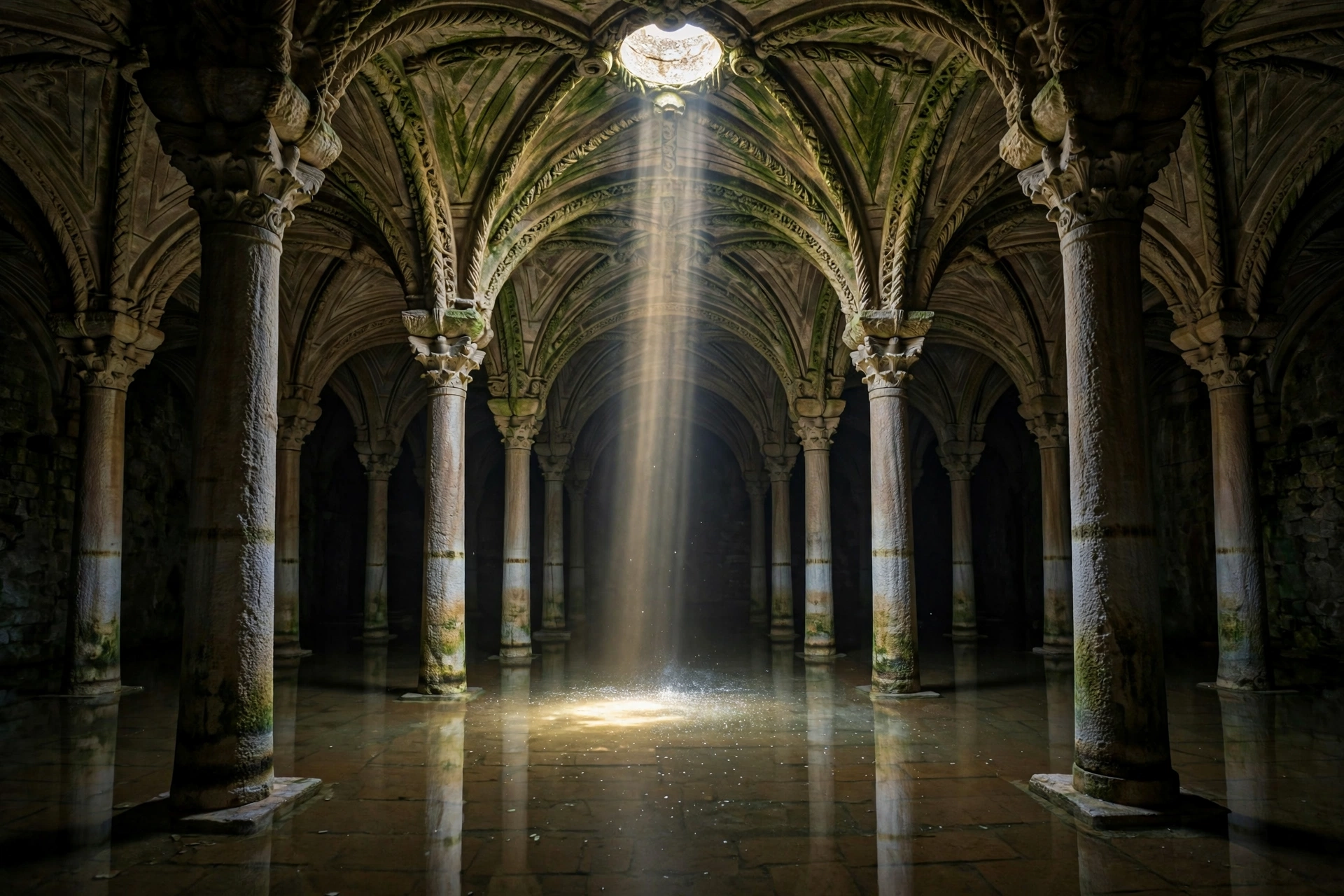
Beneath the citadel of the Portuguese fortress of El Jadida lies its most famous room: the Portuguese Cistern. It is a near-square hall about 33 by 34 metres, its ceiling carried on five rows of five slender stone columns, twenty-five in all, under Manueline vaults. A single round opening in the roof lets a shaft of light fall onto the thin layer of water that still covers the floor.
The cistern's own history is less certain than its beauty. It was built in 1514, at the same time as the citadel, but its original purpose is debated: some say an armoury, others a barracks or a granary. What is recorded is that it was converted into a water cistern in 1541, when the fortress needed a secure supply to survive a siege. The design is attributed to Miguel de Arruda, and the construction to João de Castilho.
An important warning for 2026: several recent reports say the cistern has been closed to visitors since winter storms in 2021 damaged its vaults, and that restoration work restarted in 2026 with about eighteen months of works planned. No reopening date has been announced. Other guides still list it as open. Do not build your trip around going inside; ask at the gate when you arrive.
The Church of the Assumption: Manueline Stone in Africa
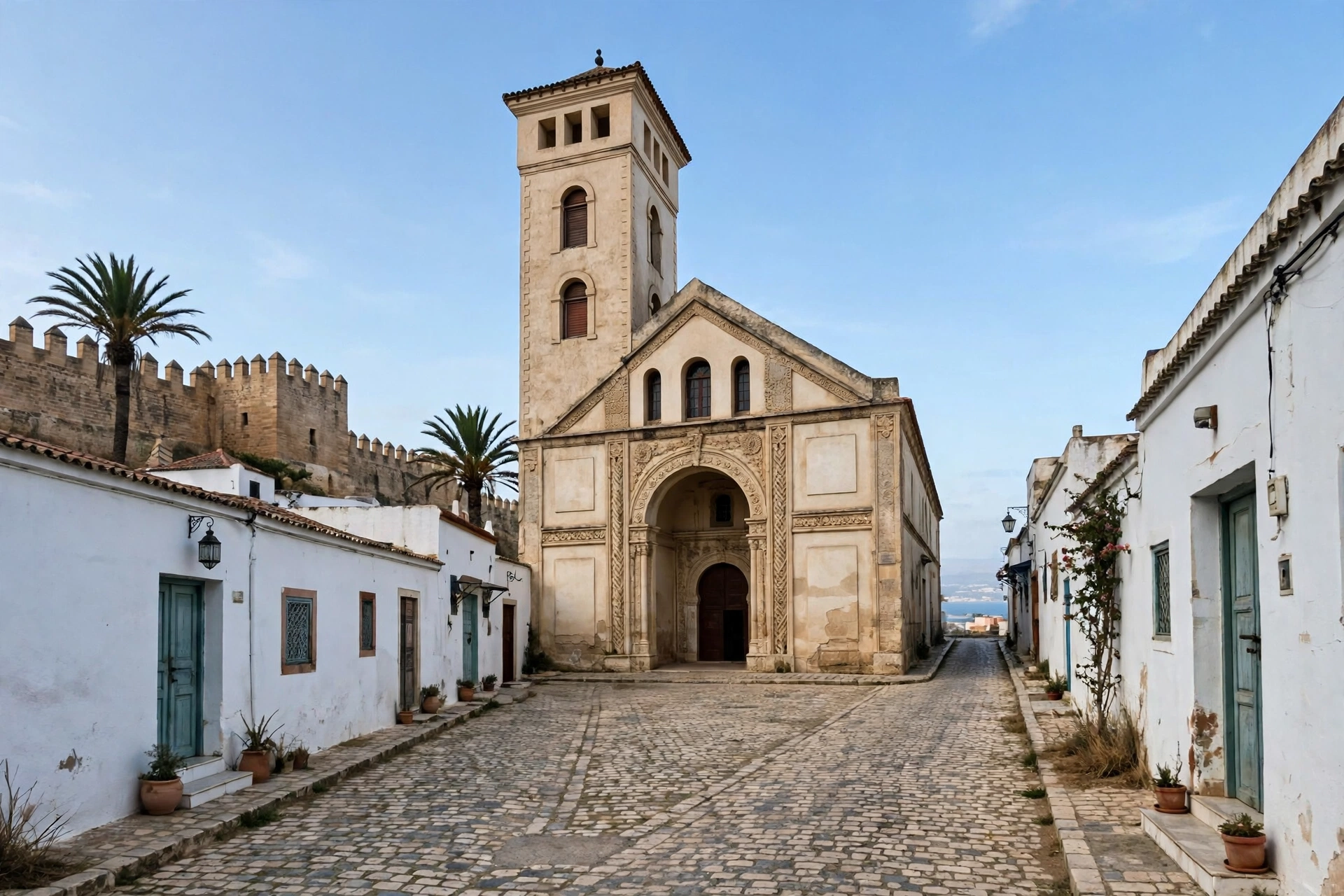
A short walk from the cistern stands the Church of the Assumption, the finest Manueline church in Morocco and one of the two great Portuguese monuments of the fortress, together with the cistern. It was built in the 16th century in the late Gothic style that Portugal made its own, with a single nave, a choir, a sacristy and a square bell tower.
The church was the parish church of Portuguese Mazagan, and it stood at the centre of the town's religious life for two and a half centuries. After the Portuguese departure it fell out of use, and today it is a monument rather than a working church. It is usually closed inside, but its exterior, its tower and its position on the main street make it one of the most photographed buildings in the fortress. It is the oldest surviving Manueline church on the African continent.
The fortress also holds three faiths in one small square: the mosque of Sidi Mohammed ben Abdallah stands in front of the church, its minaret adapted from the old Portuguese Torre de Rebate, and a mellah grew beside the walls. See our guide to Morocco's Jewish Heritage and Mellahs.
The Ramparts and Bastions: A Walk Above the Atlantic
The best way to understand the fortress is to walk its ramparts. A walkway about two metres wide runs along the top of the seaward walls, and the full circuit takes about an hour at a gentle pace. From the Bastion of the Angel you look west across the Atlantic. From the Bastion of St Sebastian you look back over the old town rooftops. The walls are free to walk, and they are the one part of the Portuguese fortress of El Jadida that is almost always open.
Notice how the walls slope, how the bastions angle outward, and how each stretch of wall is covered by the guns of its neighbour. This was not decoration. The designers were solving a new problem, the cannon, and the star shape was their answer. Cannons still stand on the bastions today, pointing out to sea. The walk is at its best in the late afternoon, when the light turns the stone gold.
1769: The End of Portuguese Mazagan
The Portuguese held Mazagan for 255 years, longer than any of their other Moroccan posts, but the end came quickly. By the 1760s, Portugal's empire was shrinking and Sultan Mohammed ben Abdallah was pressing hard on its remaining positions. In 1769 the Portuguese decided to leave, and they did so in an orderly evacuation, taking their people and goods with them.
The departure was not a defeat in battle: Mazagan had survived sieges, including a major one in 1562, and its walls had never been breached. It was abandoned for politics and money, not because its defences failed. The Moroccans who entered found streets, houses, a church and a cistern waiting for them, intact. See The Battle of the Three Kings 1578 for how differently Portugal's Moroccan adventure ended elsewhere.
From Ruin to El Jadida: The 19th-Century Revival
After 1769, Mazagan lay largely empty for decades. Then, in the 19th century, Sultan Moulay Abd al-Rahman ordered the town rebuilt and repopulated, and it was renamed El Jadida, "the New". The exact date of the renaming is reported differently — some sources give 1820, others the middle of the 19th century — but the meaning is clear: this was a new Moroccan town rising on Portuguese foundations.
The revival worked. El Jadida became a commercial port and a multicultural town, exporting grain and importing goods from Europe, with Muslim, Jewish and Christian merchants working side by side. New buildings rose outside the old walls, while the street plan of the Portuguese fortress of El Jadida survived untouched inside. That is why the fortress looks the way it does today: a living old town that never had its first chapter erased.
UNESCO World Heritage: Why Mazagan Was Listed in 2004
In 2004, UNESCO added the Portuguese City of Mazagan to the World Heritage List, under criteria (ii) and (iv). Criterion (ii) recognises the fortress as an outstanding example of the exchange of influences between European and Moroccan cultures. Criterion (iv) recognises it as an outstanding example of the new Renaissance fortress design.
The listing noted three things in particular: the ramparts and their bastions, the cistern as an outstanding example of its type, and the Church of the Assumption as a fine Manueline building. It also noted the site's integrity: the shape and layout of the Portuguese fortress of El Jadida have been well preserved. The official UNESCO page is the best place to read the full citation: Portuguese City of Mazagan (El Jadida). Our guides to Volubilis and Lixus cover Morocco's deeper urban history.
Visiting the Portuguese Fortress of El Jadida in 2026
Getting There from Casablanca
ONCF trains run from Casablanca to El Jadida about ten times a day, taking roughly 1 hour 5 to 1 hour 30 minutes, with second class from about 40 MAD (around $4). From the station, the Portuguese fortress of El Jadida is a short taxi ride or a 20-minute walk. Buses take a similar time and cost about 50 MAD; see our Casablanca Travel Guide.
Tickets, Hours and the Cistern Question
The ramparts and the old town are free to walk. The only ticketed interior is the cistern, and this is where the confusion lies: recent guides report fees of 10 to 60 MAD (about $1 to $6), and several recent reports say it is closed for restoration with no reopening date. Carry cash and ask at the gate on arrival.
A Half-Day Walking Route
Give the fortress two to three hours. Start at the Sea Gate, walk the Rua da Carreira to the Church of the Assumption and the cistern, then climb to the ramparts and walk the full circuit above the Atlantic. Come down at the land gate, cross to the Moroccan medina for lunch, and finish with a walk along the corniche to Deauville beach. If you have a full day, add Azemmour, 15 kilometres north.
Practical Information and Costs
| Item | Cost in MAD | Cost in USD | Notes |
|---|---|---|---|
| Train Casablanca to El Jadida, 2nd class | 40 | $4 | About 10 trains a day |
| Bus Casablanca to El Jadida | 50 | $5 | About 1 hour 30 minutes |
| Taxi from El Jadida station to the fortress | 10–15 | $1–$1.50 | Agree the fare first |
| Ramparts and old town | Free | Free | Almost always open |
| Portuguese Cistern ticket | 10–60 | $1–$6 | Reported range; closure possible |
| Lunch in the medina | 40–80 | $4–$8 | Fish restaurants near the port |
| Mint tea in a cafe | 8–12 | $0.80–$1.20 | Standard Moroccan price |
| Half-day guided tour | 150–300 | $15–$30 | Book through your hotel |
Where to Stay and Eat Near the Fortress
Most visitors come for the day from Casablanca, but El Jadida rewards an overnight stay. Small hotels and riads cluster around the corniche near the Portuguese fortress of El Jadida, with doubles from about 300 to 800 MAD. For food, head to the port: fish restaurants serve the morning's catch, grilled simply with bread and salad, for 40 to 80 MAD.
Common Mistakes Visitors Make
The first mistake is building the whole trip around the cistern. It is a wonderful room, but it may be closed, and the fortress has far more to offer than one underground hall. Come for the ramparts, the church, the streets and the sea.
The second mistake is rushing. Many visitors allow an hour, photograph the church, and leave. The fortress needs two to three hours, and the walk along the ramparts is the heart of the visit. Give it time, and bring water and sun protection.
The third mistake is skipping the town outside the walls. The medina, the port and the corniche are part of the same story: the Moroccan town that grew up around the Portuguese fortress of El Jadida. Eat lunch there and walk the beach at Deauville, and you will see El Jadida as a living place, not a museum. See also our guide to The Kasbah of the Udayas in Rabat.
Frequently Asked Questions
Is the Portuguese Cistern open in 2026?
The situation is uncertain. Several reports published in November 2026 say the cistern has been closed since winter storms in 2021 and that restoration restarted in 2026 with about eighteen months of works planned. Other guides still list it as open. Ask at the gate when you arrive.
How long do I need at the Portuguese fortress of El Jadida?
Two to three hours is enough for the fortress and the old town, including the ramparts walk. Add another hour for lunch in the medina and a walk along the corniche, and you have a full and relaxed half day.
Is El Jadida worth a day trip from Casablanca?
Yes. It is one of the easiest and most rewarding day trips from Casablanca: about an hour by train, a UNESCO-listed fortress, a real working port, and a beach town atmosphere that feels very different from the big city.
What is the Portuguese fortress of El Jadida also called?
It is also called Mazagan, or Mazagão in Portuguese, the name the Portuguese gave it in the 16th century. The Moroccan name El Jadida means "the New" and dates from the town's 19th-century revival.
Can I walk the ramparts of the fortress?
Yes. The ramparts walk is free and is the best part of the visit. The walkway runs along the top of the seaward walls, past the bastions, and the full circuit takes about an hour.
Is the fortress suitable for children?
Yes, with care. Children enjoy the ramparts, the cannons and the sea views, but the walls are high, the walkway is narrow in places, and there are few railings. Hold small children by the hand on the ramparts.
Conclusion: Why the Fortress Still Matters
The Portuguese fortress of El Jadida survives because it was forgotten at the right moment. Abandoned by its builders in 1769, it escaped the rebuilding that changed Morocco's great cities, and it reached the 21st century with its walls, church and cistern still standing.
UNESCO recognised that luck in 2004, but the fortress does not need a plaque to justify a visit. Walk the ramparts at sunset and you are standing where Portuguese soldiers stood nearly five centuries ago, in a town that Moroccans then made their own. That meeting of two histories is what makes this fortress worth the journey from Casablanca. Our guide to the Kings of Morocco: The Dynasties continues the tale, and our Ait Ben Haddou guide shows the other great fortress tradition of the south.