
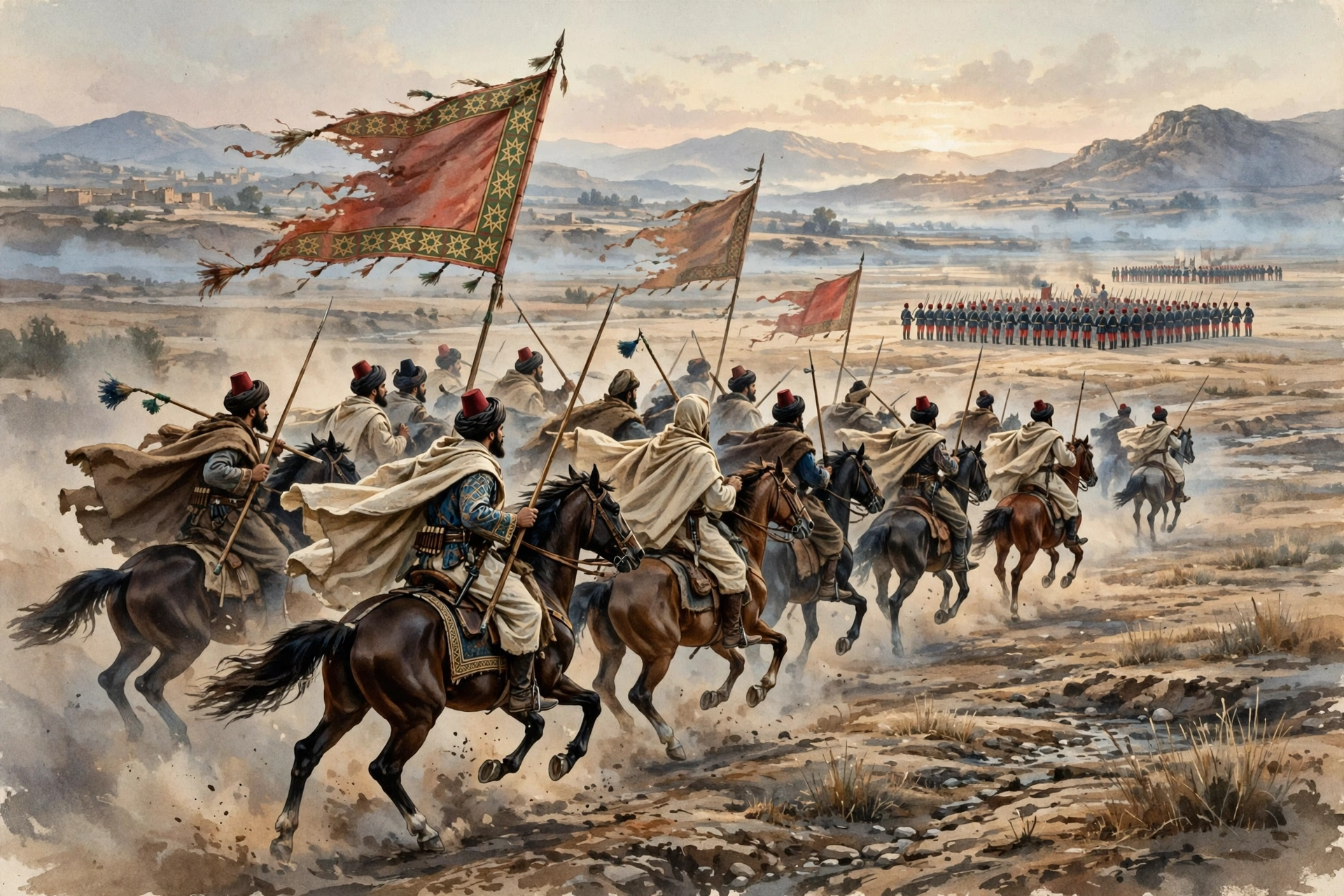
The Battle of Isly 1844 was the morning Morocco's old army met modern European firepower — and lost. On 14 August 1844, on a dry river plain near Oujda, a French column of roughly 8,000 men broke a Moroccan host many times its size, captured the camp of the Sultan's son, and changed the country's history in a single day. This guide tells the story of that battle, the short war around it, and why it matters.
The battle did not come from nowhere. France had conquered neighbouring Algeria in the 1830s, and the Algerian resistance leader Emir Abd al-Qadir had taken refuge across the Moroccan border. Paris demanded that Sultan Moulay Abd al-Rahman hand him over or expel him, while the two sides also quarrelled over where the frontier ran. When diplomacy failed, France struck first at sea — and the Battle of Isly 1844 followed eight days later.
This guide covers the causes, the bombardment of Tangier, the battle itself, the two armies, the Treaty of Tangier, and what the defeat meant for Morocco. It sits in our History & Heritage section, alongside our wider history of Morocco and our guide to the Alaouite dynasty. For the wider war, see the Franco-Moroccan War on Wikipedia.
In this guide
- Why the Battle of Isly 1844 Still Matters
- The Road to War: Abd al-Qadir and the Border
- The Franco-Moroccan War at a Glance
- Tangier Bombarded: 6 August 1844
- The Battle of Isly 1844: 14 August on the River
- The Two Armies Compared
- Mogador and the Treaty of Tangier
- What the Battle of Isly 1844 Changed for Morocco
- Visiting Oujda and the Isly Country Today
- Frequently Asked Questions
- Conclusion: A Morning That Changed Morocco
Why the Battle of Isly 1844 Still Matters
Most visitors to Morocco know the country's great victories better than its defeats. The Battle of the Three Kings in 1578, when a Moroccan army destroyed a Portuguese invasion, is still celebrated today. The Battle of Isly 1844 is the mirror image: a defeat so complete that it exposed how far behind Europe Morocco's army had fallen, and set the country on the road to the protectorate of 1912.
The battle also began the modern story of Morocco's eastern border. The frontier with Algeria, disputed in 1844 and settled only roughly by the Treaty of Lalla Maghnia in 1845, remains one of North Africa's most sensitive lines. Our guide to the Green March and our story of Morocco's independence in 1956 both pick up threads from this summer. Understanding the Battle of Isly 1844 helps explain why Morocco spent the next seventy years trying to reform its army before it was too late.
The Road to War: Abd al-Qadir and the Border
The war began in Algeria, not Morocco. France invaded Algiers in 1830 and spent the next decade fighting to hold the country. The most effective resistance came from Emir Abd al-Qadir, a scholar and warrior who built a state in western Algeria and fought the French to a standstill for years. By 1843, French columns under General Bugeaud had broken his power, and the Emir crossed into Morocco with his remaining fighters, where he found shelter and recruits among the tribes of the north-east.
Paris demanded that Sultan Moulay Abd al-Rahman expel the Emir and hand over his followers. The Sultan, an Alaouite ruler who had reigned since 1822, was caught between two dangers: defying France meant war with a European power, but betraying a fellow Muslim leader who had sought sanctuary would destroy his standing at home. He stalled, promised much and delivered little, while Moroccan troops gathered on the frontier. The Battle of Isly 1844 grew directly out of this stalemate, as France decided that only a blow on land would force Morocco to choose.
The border itself was part of the quarrel. France, ruling Algeria, wanted the frontier fixed at the Kiss River, close to the Moroccan city of Oujda. Morocco claimed a line much further east, at the Tafna or even the Moulouya River. No agreed border existed — only a shifting zone of tribes, markets and garrisons. That uncertainty made a clash almost inevitable, and Moroccan forces answered by massing in the plain of the Isly.
The Franco-Moroccan War at a Glance
The whole war lasted barely five weeks, from the first French shells over Tangier to the Treaty of Tangier. The Battle of Isly 1844 sits at its centre, and the table below sets out the key dates; the sections that follow tell the story behind each of them.
| Date (1844) | Event |
|---|---|
| 6 August | French fleet bombards Tangier |
| 14 August | Battle of Isly near Oujda |
| 15 August | French bombard Mogador (Essaouira) and occupy it |
| 10 September | Treaty of Tangier signed |
| 18 March 1845 | Treaty of Lalla Maghnia settles the border |
Tangier Bombarded: 6 August 1844
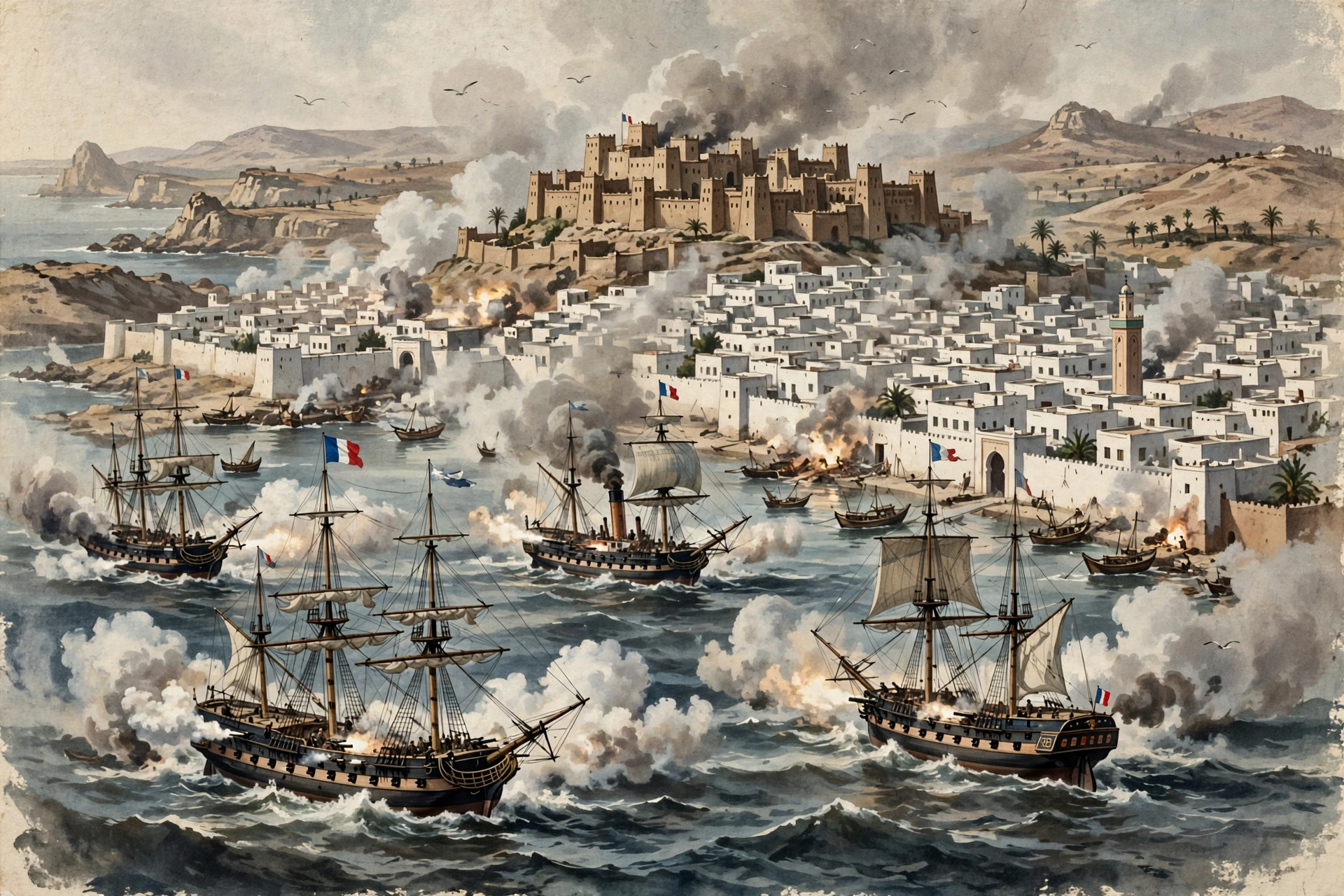
France opened the war at sea. On 6 August 1844, a French squadron under Prince de Joinville — François d'Orléans, the son of King Louis-Philippe — appeared off Tangier and bombarded the port and its defences. Tangier was Morocco's main window on Europe, a city with a long international history, which we trace in our guide to Tangier and its international zone. Its old guns could not answer modern naval artillery, and the bombardment did its work in a day.
The bombardment was a message as much as an attack: France could strike Morocco's coast at will, and the Sultan had no navy to answer with. Moroccan forces in the north were thin, and the blow at Tangier forced the Sultan to look east, where his son's army was gathering on the Isly. The Battle of Isly 1844 would be fought eight days after the shells fell on Tangier, and the speed of the French campaign left Morocco no time to prepare a second line of defence.
Tangier recovered quickly as a port, but the shock of August 1844 stayed. For the first time, a European power had attacked Morocco's cities directly to settle a dispute over Algeria. The Battle of Isly 1844, fought a week later, would confirm the lesson.
The Battle of Isly 1844: 14 August on the River
The armies of the Battle of Isly 1844 met on the Isly, a river near Oujda in the far north-east, close to the Algerian frontier. The Moroccan force was led by Sidi Mohammed, the Sultan's son, and it was large — contemporary European accounts put it at tens of thousands, and the 1911 Encyclopaedia Britannica gives a figure of 45,000. That number is disputed: Moroccan armies of the period counted tribal levies and camp followers alongside regular troops, so no exact figure can be trusted.
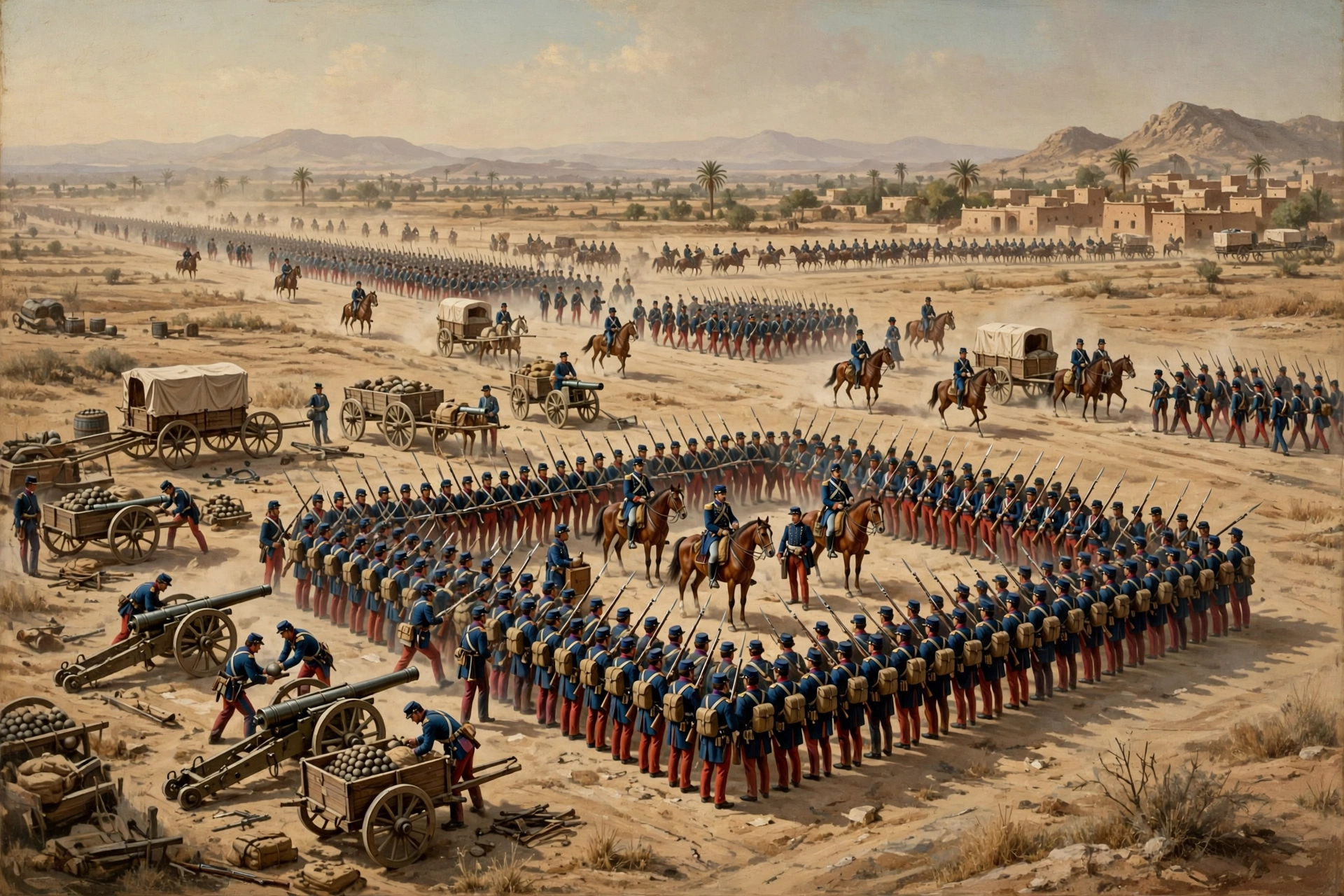
Facing them was Marshal Thomas Robert Bugeaud, Governor-General of Algeria and France's most experienced colonial soldier. His force was small — about 8,000 men, roughly 6,500 infantry and 1,500 cavalry with a few guns — though even this figure is an estimate, not a settled count. Bugeaud arranged his men in a formation the French called the "boar's head": a dense column with infantry squares and cavalry on the flanks, designed to punch through a larger, looser enemy and keep moving.
The battle began on the morning of 14 August 1844. Moroccan cavalry charged the French column again and again, but the French infantry held its squares and fired in disciplined volleys. The Battle of Isly 1844 was decided by firepower and discipline, not numbers: the French column kept advancing through the charges, broke the Moroccan centre, and drove the whole host back across the river in disorder. By midday, the Moroccan army was in full retreat.
The French captured the Moroccan camp, including that of Sidi Mohammed himself, and with it his great ceremonial umbrella — the parasol that marked the Sultan's son on the field. In Moroccan tradition the umbrella was a symbol of sovereignty, and its capture was both a military trophy and a humiliation. Bugeaud was rewarded by being made Duke of Isly, a title that tied his name to the river for ever. For France, the Battle of Isly 1844 was proof that Algeria could be held and that Morocco could be beaten.
The Two Armies Compared
The contrast between the two forces explains the result of the Battle of Isly 1844 better than any single moment of the battle. One side was a modern colonial army built around firepower and drill; the other was a traditional host built around cavalry, numbers and courage. The table below sets out the comparison, with disputed numbers flagged as estimates.
| French force | Moroccan force | |
|---|---|---|
| Commander | Marshal Thomas Robert Bugeaud | Sidi Mohammed, son of the Sultan |
| Size | ~8,000 men (estimate) | Tens of thousands; 45,000 per Britannica 1911 (disputed) |
| Infantry | ~6,500, in squares with modern muskets | Large infantry and tribal levies, mixed firearms |
| Cavalry | ~1,500 | Large cavalry, the army's striking arm |
| Artillery | A few modern guns | Older guns, limited effect |
| Formation | "Boar's head" column | Massed cavalry charges |
The lesson is plain. Moroccan cavalry was brave and superbly horsed, and in earlier centuries it had broken European armies — most famously the Portuguese at the Battle of the Three Kings in 1578. But by 1844, disciplined infantry in square, firing volleys and protected by a few guns, could break charge after charge. The Battle of Isly 1844 showed that courage without modern drill and firepower was no longer enough.
The Moroccan army's weakness was not its soldiers but its organisation. It was raised for a campaign, not kept as a standing professional force; its guns were old, its supply was improvised, and its tribal contingents fought under their own chiefs. France, by contrast, brought a professional army that had spent fourteen years learning war in Algeria. That experience gap mattered more than the numbers, as later generations would remember through the Rif War and Abd el-Krim.
Mogador and the Treaty of Tangier
France did not stop with the Battle of Isly 1844. The day after the battle, 15 August 1844, the French fleet bombarded Mogador — the Atlantic port now called Essaouira — and occupied it. The blow was deliberate: with Tangier hit in the north and Mogador held in the south, Morocco's coast was at France's mercy, and the Sultan had no fleet to answer with. The occupation lasted only a short time, but it showed the war could reach any Moroccan port.
With his army broken and his ports defenceless, the Sultan sued for peace. The Treaty of Tangier was signed on 10 September 1844, less than a month after the battle. Morocco recognised Algeria as a French possession, agreed to treat Abd al-Qadir as an outlaw and give him no help or shelter, reduced the garrison at Oujda, and accepted a commission to settle the border. The terms were harsh, but the alternative — a longer war Morocco could not win — was worse.
The border question was settled the following spring by the Treaty of Lalla Maghnia, signed on 18 March 1845. It fixed the frontier roughly along the Kiss River, much as France had wanted — the line that, with changes and disputes, would become the modern Morocco–Algeria border. Abd al-Qadir himself fought on for three more years before surrendering to the French in 1847. The Battle of Isly 1844 had decided his fate as surely as it had decided Morocco's: without a Moroccan refuge, his resistance could not survive.
What the Battle of Isly 1844 Changed for Morocco
The defeat broke something in Morocco's confidence. For centuries, Moroccan armies had beaten European invaders on their own ground — the Portuguese in 1578, the Spanish at times — and the Sultan's government had dealt with Europe as an equal. The Battle of Isly 1844 ended that belief in a morning. Morocco's rulers now knew their army could not face a modern European force, and every reform of the next seventy years was an attempt to close the gap.
The second blow came fifteen years later, when Spain went to war in 1859–60 and took Tetouan. Together, the Battle of Isly 1844 and Tetouan are remembered as the two hammer blows that broke Morocco's military independence and opened the road to the French protectorate of 1912. Our guide to the Portuguese fortress of El Jadida and our history of the imperial cities show the older Morocco these defeats ended: a country that had held its own against Europe for centuries.
The defeat also shaped the Alaouite dynasty itself. Sidi Mohammed, the commander who lost the battle, became Sultan Mohammed ben Abd al-Rahman in 1859 and ruled until 1873, carrying the memory of Isly through his whole reign. Our guides to the Alaouite dynasty and the kings of Morocco and their dynasties follow his successors as they tried, and largely failed, to modernise in time. The story of Isly is therefore not only a battle story but a chapter in the history of Morocco's kings — the same story our «Kings of Morocco» channel tells.
Visiting Oujda and the Isly Country Today
The battlefield of the Battle of Isly 1844 lies near Oujda, in Morocco's far north-east, close to the Algerian border. Oujda itself is a quiet, workaday city with a medina, old gates and a university, far from the tourist crowds of Fes or Marrakech. There is no major battlefield museum, but the plain, the riverbed and the hills that framed the battle are still there, and the city's own history makes the trip worthwhile.
Getting there is straightforward. ONCF trains run to Oujda from Casablanca via Fes, a journey of roughly ten hours, and buses and grand taxis connect the city with the surrounding towns. Fares vary by class and season, so check current prices with ONCF before you travel — for official visitor information, see Visit Morocco. The best base is Oujda itself, and a morning walk through the medina gives a good sense of the city.
Pair the visit with the wider history. The story of the Battle of Isly 1844 belongs with the history of Morocco as a whole, and with the border story that runs from Lalla Maghnia to the present day. Come for the battle, and stay for a corner of Morocco that most travellers never see.
Frequently Asked Questions
When was the Battle of Isly fought?
The Battle of Isly 1844 was fought on 14 August 1844, on the Isly river near Oujda in north-east Morocco. It came eight days after the bombardment of Tangier on 6 August, and one day before the bombardment of Mogador on 15 August.
Who won the Battle of Isly?
France won the Battle of Isly 1844 decisively. Marshal Bugeaud's force of about 8,000 men broke the much larger Moroccan army under Sidi Mohammed, captured its camp and the prince's ceremonial umbrella, and forced Morocco to sue for peace within weeks.
How big were the two armies?
The French force was about 8,000 men, though even that figure is an estimate. Moroccan numbers are disputed: the 1911 Encyclopaedia Britannica says 45,000, but modern historians treat all figures for the Moroccan host as uncertain.
What did the Treaty of Tangier decide?
Signed on 10 September 1844, it made Morocco recognise Algeria as French, treat Abd al-Qadir as an outlaw with no help or shelter, reduce the Oujda garrison, and accept a border commission. The border was fixed the next year by the Treaty of Lalla Maghnia.
Can I visit the battlefield today?
Yes, the field lies near Oujda, reached by ONCF train from Casablanca via Fes in about ten hours. There is no major battlefield museum, so come for the landscape and the city rather than expecting a visitor centre.
Why does the battle still matter?
The Battle of Isly 1844 was the first of two hammer blows — Isly in 1844 and Tetouan in 1859–60 — that broke Morocco's military independence and opened the road to the 1912 protectorate. It also began the modern story of the Morocco–Algeria border.
Conclusion: A Morning That Changed Morocco
The Battle of Isly 1844 lasted a morning, but its consequences lasted seventy years. It showed Morocco that courage and numbers could no longer hold back a modern European army, and it forced the country's rulers into a long effort to reform before it was too late. The hammer blow at Tetouan, the long road to 1912, and the border story that still shapes North Africa all run back to that August day on the Isly. The Battle of Isly 1844 deserves to be remembered — not as a footnote to French history, but as a turning point in Morocco's own story.
Last checked: November 2026
1 thought on “The Battle of Isly 1844: Morocco and France”