
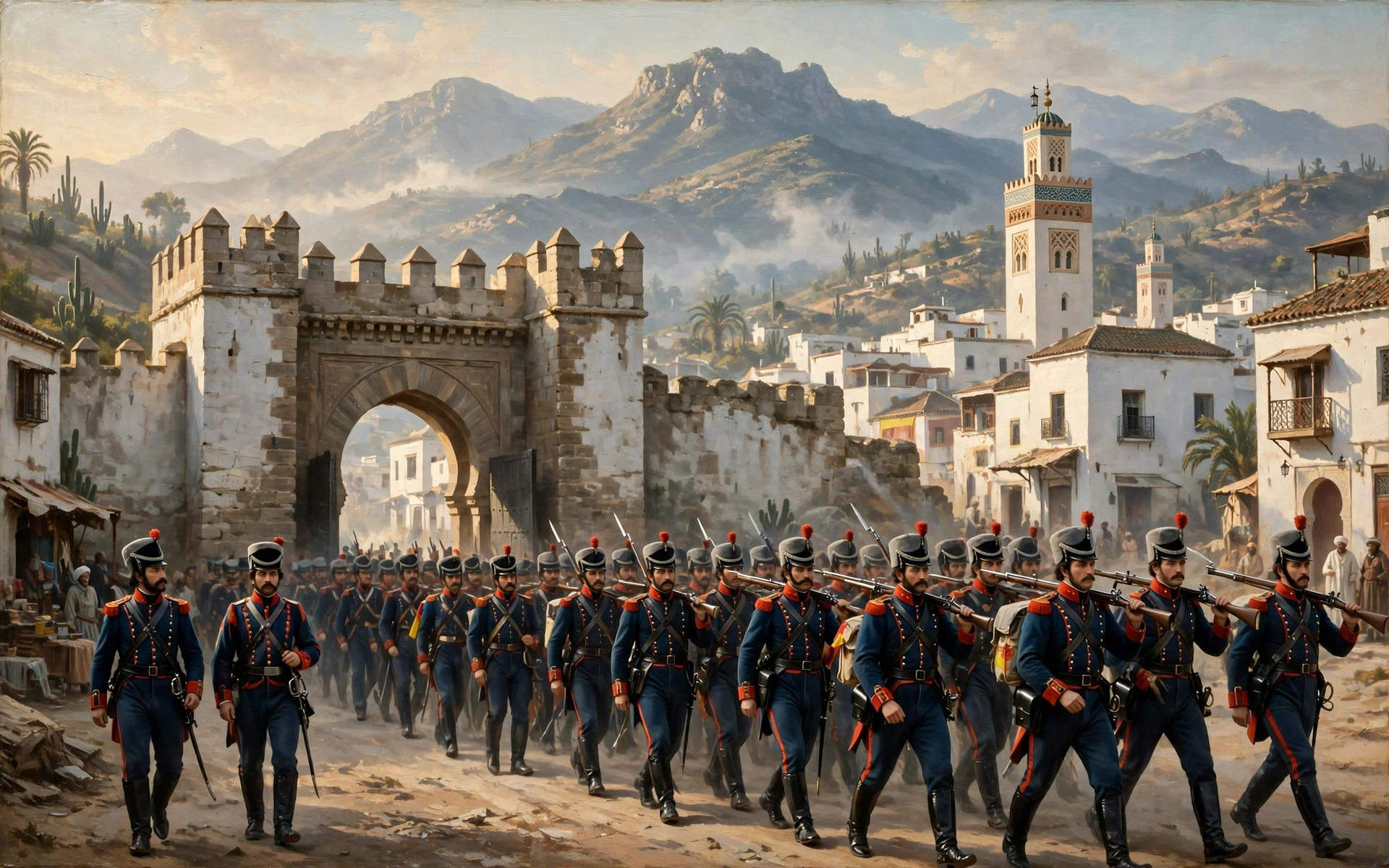
The Battle of Tetouan 1860 was the day Spain took one of Morocco's great northern cities — and kept it. On 6 February 1860, Spanish troops under General Leopoldo O'Donnell marched into Tetouan after two days of fighting outside its walls, and the Spanish flag flew over the city for over two years. This guide tells the story of that battle, the short war around it, and why it still matters.
The battle did not come from nowhere. Fifteen years earlier, France had crushed Morocco at the Battle of Isly in 1844, and Europe had learned Morocco's army could be beaten. Spain, which held Ceuta and Melilla on Morocco's northern coast, saw its chance in 1859, when Anjra tribesmen attacked Spanish positions near Ceuta. The Battle of Tetouan 1860 was the climax of the war that followed.
This guide covers the causes, the fighting at Castillejos, the battle itself, the two armies, the Treaty of Wad-Ras, and what the defeat meant for Morocco. It sits in our History & Heritage section, alongside our wider history of Morocco and Alaouite dynasty guide. For the wider war, see the Hispano-Moroccan War of 1859–1860 on Wikipedia.
In this guide
- Why the Battle of Tetouan 1860 Still Matters
- The Road to War: Ceuta and the Anjra Attack
- The Hispano-Moroccan War at a Glance
- Castillejos: 1 January 1860
- The Battle of Tetouan 1860: 4–6 February
- The Two Armies Compared
- Wad-Ras and the Treaty of Wad-Ras
- What the Battle of Tetouan 1860 Changed for Morocco
- Visiting Tetouan Today
- Frequently Asked Questions
- Conclusion: A City Held Hostage
Why the Battle of Tetouan 1860 Still Matters
Most visitors know Tetouan as a quiet, whitewashed city near the Mediterranean, famous for its Andalusian medina. Few know that in 1860 a foreign army occupied it for more than two years — the first Moroccan city held hostage for a war debt. In Spain the Battle of Tetouan 1860 is remembered as the War of Africa, a glorious campaign celebrated in paintings and street names. In Morocco it is remembered very differently: as the second hammer blow, after Isly in 1844, that broke the country's military independence.
The battle opened the long Spanish story in Morocco. The Treaty of Wad-Ras gave Spain an enlarged Ceuta, a claim on the Atlantic coast that would become Sidi Ifni, and a debt that mortgaged Morocco's customs revenues to European controllers. That story runs from Tetouan through the Rif War and Abd el-Krim to the Spanish protectorate in the north and, much later, the Green March of 1975. It helps explain why northern Morocco's history took a different path.
The Road to War: Ceuta and the Anjra Attack
The war began on the border of Ceuta, the Spanish enclave on Morocco's north coast. Spain had held Ceuta for centuries, and its frontier was a line of forts and watchtowers that tribesmen raided at will. In August 1859, Anjra tribesmen attacked a barracks the Spanish were building outside Ceuta and tore down the Spanish coat of arms. Madrid treated the insult as a cause for war, and General Leopoldo O'Donnell — Spain's prime minister as well as its leading soldier — demanded that the Sultan punish those responsible.
Sultan Moulay Abd al-Rahman, who had already lost at Isly in 1844, could not control the tribes of the Rif, and stalled while the negotiations dragged on. He died in the middle of the talks, in August 1859, and was succeeded by his son Muhammad IV — the Sidi Mohammed who had commanded the Moroccan army at Isly. Spain's Congress voted unanimously for war on 22 October 1859, and the expeditionary army sailed from Algeciras. The Battle of Tetouan 1860 was still months away, but the war was now certain.
Before declaring war O'Donnell had secured the consent of Britain and France, promising no permanent territorial conquests. That promise mattered: Britain, which watched the Strait jealously, would not have tolerated a Spanish Tangier. The war's stated aims were therefore limited — taking Tetouan and occupying Tangier — but its real aims were prestige at home, a popular war to unite a divided Spain behind Queen Isabella II, and proof that Spain was still a colonial power.
The Hispano-Moroccan War at a Glance
The whole war lasted barely six months, from declaration to treaty. The Battle of Tetouan 1860 sits at its centre, and the table below sets out the key dates.
| Date | Event |
|---|---|
| August 1859 | Anjra tribesmen attack Spanish positions near Ceuta |
| 28 August 1859 | Sultan Abd al-Rahman dies; Muhammad IV succeeds him |
| 22 October 1859 | Spain declares war on Morocco |
| 1 January 1860 | Battle of Castillejos — General Prim's famous charge |
| 4–5 February 1860 | Battle of Tetouan fought outside the city walls |
| 6 February 1860 | Spanish troops enter Tetouan |
| 23 March 1860 | Battle of Wad-Ras, the last major battle |
| 26 April 1860 | Treaty of Wad-Ras signed |
| 1862 | Spain evacuates Tetouan after the indemnity is paid |
Castillejos: 1 January 1860
The Spanish army that landed at Ceuta in December 1859 was large — about 35,000 to 45,000 men with 78 guns, though the exact figure is disputed. It was also slow: bad roads, winter rain and cholera held it around Ceuta for weeks. O'Donnell's plan was to advance along the coast towards Tetouan, and the first step was the Battle of Castillejos, fought on 1 January 1860 at the mouth of the Uad el-Jelú.
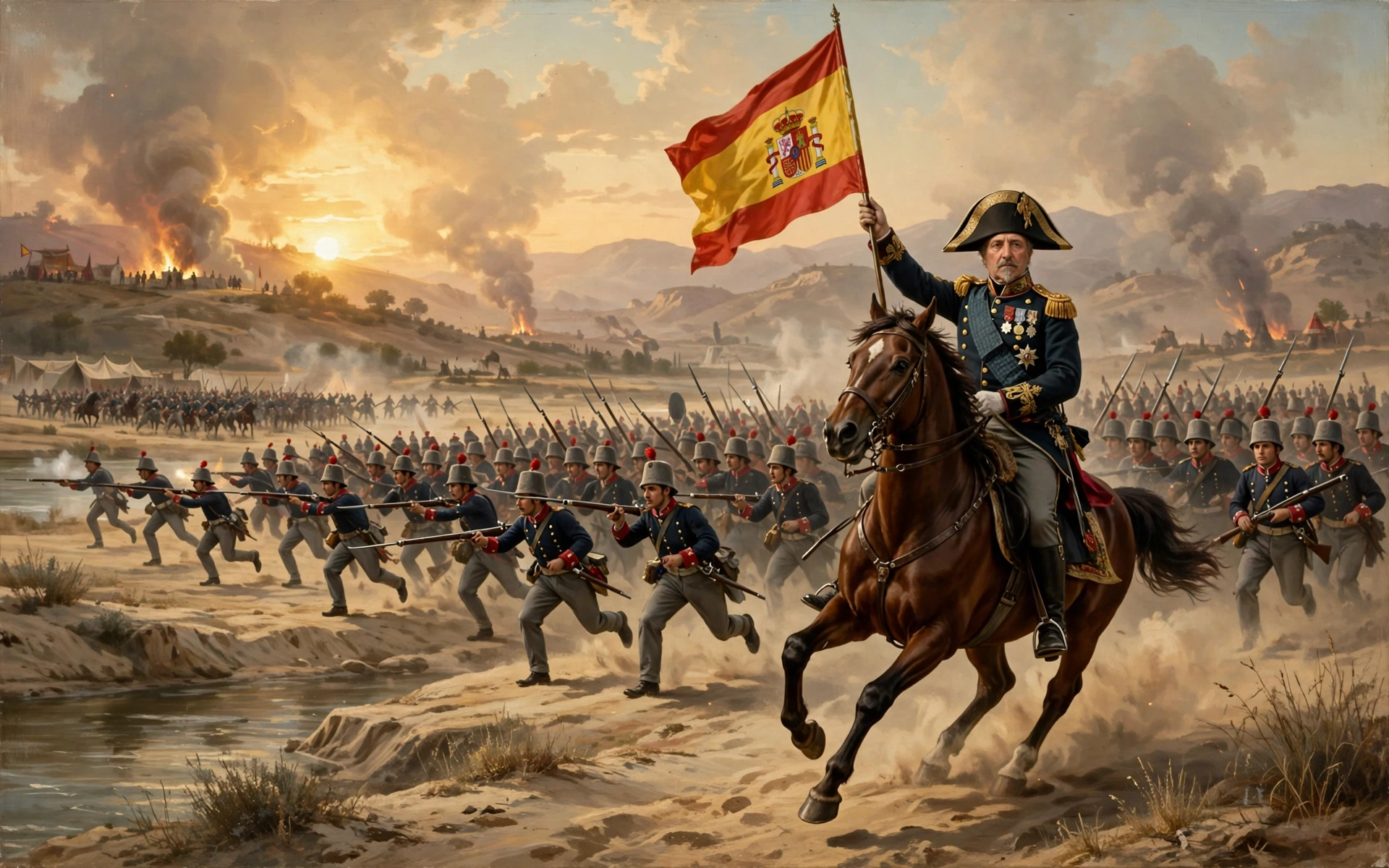
The battle made the reputation of General Juan Prim. His division was hard pressed by Moroccan attacks, and Prim — so the famous story goes — seized a Spanish flag, rallied his men and led the charge that broke the line. The story may have been polished afterwards, but the victory was real: the Spanish lost more than 600 men, yet cleared the road to Tetouan. Prim's fame from Castillejos later carried him to the top of Spanish politics.
Castillejos also showed the pattern of the war. Moroccan troops fought bravely and charged hard, but Spanish rifles, artillery and discipline decided every open battle. Through January the Spanish advanced slowly, containing a Moroccan offensive on 31 January before O'Donnell began the final march. The Battle of Tetouan 1860 would be fought on ground the Spanish had chosen, against an army already worn down by a month of skirmishing.
The Battle of Tetouan 1860: 4–6 February
The Moroccan army waiting outside Tetouan was commanded by Moulay Abbas, the Sultan's brother, and held strong positions on the hills above the city, its flanks on the Martil river. Its size is disputed: Spanish accounts speak of tens of thousands, while modern historians treat all figures for the Moroccan host as uncertain. What is certain is that it was large, well placed, and determined to defend one of the country's most important northern cities.
The Battle of Tetouan 1860 was fought over two days, 4 and 5 February. O'Donnell advanced with his three army corps, the flanks covered by Ros de Olano and Prim, and the fleet offshore keeping Moroccan forces away from the coast. Spanish artillery pounded the Moroccan positions until the ranks broke, and the survivors fell back into Tetouan. The fighting was bloody — Spanish sources record heavy Moroccan losses — but the exact casualty figures are disputed, and no reliable Moroccan count survives.
On 6 February 1860, Spanish troops entered Tetouan. The city that greeted them was in chaos: shops had been looted, and the Jewish quarter — Tetouan had a large, old Jewish community — had suffered badly in the disorder after the Moroccan retreat. Spanish guns bombarded the city for two more days while order was restored. The Battle of Tetouan 1860 was over, and the white dove of the north, as Tetouan is known, flew the Spanish flag.
The victory was celebrated wildly in Madrid. O'Donnell was made Duke of Tetouan, a title that tied his name to the city for ever, and the painter Mariano Fortuny — who had travelled with the army as a war artist — produced the great canvas of the battle now in Barcelona. For Spain, the Battle of Tetouan 1860 was proof the country could still win a colonial war. For Morocco, it was the loss of a city.
The Two Armies Compared
The contrast between the two forces explains the result of the Battle of Tetouan 1860 better than any single moment of the battle. One side was a modern European army built on firepower, drill and a fleet offshore; the other was a traditional host built on cavalry, numbers and courage. The table below sets out the comparison, with disputed numbers flagged.
| Spanish force | Moroccan force | |
|---|---|---|
| Commander | General Leopoldo O'Donnell | Moulay Abbas, brother of the Sultan |
| Size | ~35,000–45,000 men (disputed) | Tens of thousands (disputed) |
| Infantry | Modern rifles, in disciplined lines | Large infantry and tribal levies, mixed firearms |
| Cavalry | Small cavalry arm, including Catalan volunteers | Large cavalry, the army's striking arm |
| Artillery | 78 guns, with naval support offshore | Older guns, limited effect |
| Losses | ~4,040 dead, mostly from cholera (disputed) | ~6,000 killed, per Spanish sources (disputed) |
The lesson is the same one Isly had taught sixteen years earlier. Moroccan cavalry was brave and superbly horsed, and in earlier centuries it had broken European armies — most famously the Portuguese at the Battle of the Three Kings in 1578. But by 1860, disciplined infantry with modern rifles, backed by artillery and a fleet, could break charge after charge. The Battle of Tetouan 1860 showed again that courage without modern drill and firepower was no longer enough.
Disease, not battle, was the Spanish army's worst enemy. Of the roughly 4,040 Spanish dead in the whole war, only about 1,152 fell in battle; the rest — nearly 2,888 — died of cholera and other diseases. The Moroccan army suffered the same fevers, without field hospitals. The Battle of Tetouan 1860 was therefore won as much by logistics and medicine as by tactics, and the Spanish advance on Tangier was slowed more by sickness than by Moroccan resistance.
Wad-Ras and the Treaty of Wad-Ras
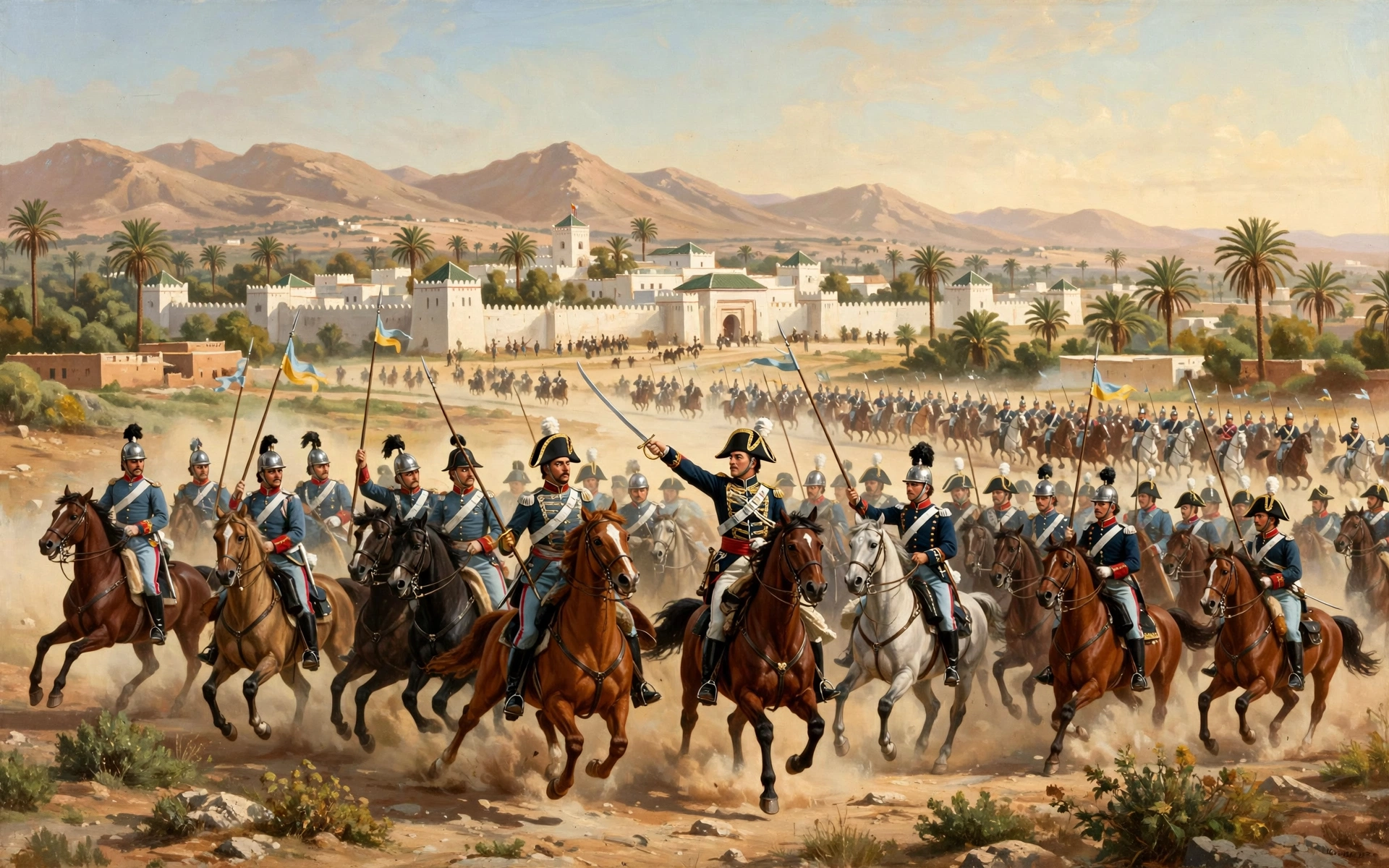
Spain did not stop with Tetouan. After a pause to rest the army, O'Donnell marched towards Tangier, and on 23 March 1860 the two armies met again at Wad-Ras. The battle was sharp and costly, but the Spanish won it, and the next day Moulay Abbas offered peace. An armistice of 32 days followed, and the Treaty of Wad-Ras — also called the Peace of Tetouan — was signed on 26 April 1860.
The terms were harsh. Morocco accepted full responsibility for the war and agreed to pay Spain an indemnity of 20 million duros — 400 million reales, or 100 million pesetas in the currency that came later — an astronomical sum for a nearly empty treasury. Ceuta and Melilla were enlarged, Morocco recognised Spanish sovereignty over the Chafarinas Islands, and Spain received Santa Cruz de la Mar Pequeña, a territory on the Atlantic coast whose exact location was uncertain even then. That vague claim would later become the enclave of Sidi Ifni. Spain also won the right for missionaries to build a Christian church in Tetouan.
The indemnity was the cruellest clause, because Morocco could not pay. The treasury borrowed in London in 1861, pledging customs revenues as security, and European agents were installed in Morocco's ports to count the receipts — half of which went to repay Spain. Spain kept Tetouan until the money was paid, evacuating it only in 1862, after Britain advanced the funds. The debt of Tetouan thus invented a new kind of foreign control: not occupation by soldiers, but control of the customs house — the forerunner of the financial tutelage that would end in the protectorate of 1912.
What the Battle of Tetouan 1860 Changed for Morocco
The defeat broke something in Morocco's confidence. Isly in 1844 had shown the army could not face a modern European force; the Battle of Tetouan 1860 showed the lesson had not been learned, and that a European army could now take and hold a Moroccan city for years. Every reform of the next fifty years was an attempt to close the gap before it was too late.
The defeat also shaped the Alaouite dynasty itself. Muhammad IV, who inherited the war from his father, ruled until 1873 carrying the memory of both Isly — where he had commanded and lost — and Tetouan. Our guides to the Alaouite dynasty and the kings of Morocco and their dynasties follow his successors as they tried, and largely failed, to modernise in time. The story of Tetouan is therefore not only a battle story but a chapter in the history of Morocco's kings — the same story our «Kings of Morocco» channel tells.
The third legacy was the Spanish north. The Treaty of Wad-Ras gave Spain a permanent foothold that grew, over the following decades, into the Spanish protectorate in northern Morocco, with Tetouan as its capital. The Rif War of the 1920s, Abd el-Krim's republic, and the long Spanish presence in the north all run back to the Battle of Tetouan 1860. Our guide to Tangier and its international zone and our story of the Rif War pick up those threads; the independence of 1956 finally closed them.
Visiting Tetouan Today
The Tetouan of the Battle of Tetouan 1860 is still there to walk. The medina — a UNESCO World Heritage site since 1997, and one of the smallest and most complete in Morocco — is the Andalusian old town the Spanish entered in 1860, with whitewashed houses, covered lanes and artisan quarters. The Spanish ensanche, the grid of boulevards built during the protectorate, still frames the medina, and the old kasbah looks over the city from the hills where Moulay Abbas placed his guns.
Getting there is easy. Tetouan lies about 60 kilometres south-east of Tangier, and buses and grand taxis run between the two cities in about an hour; our Tangier travel guide covers the gateway. It is also a good base for the Rif mountains and the Mediterranean beaches of Martil and Cabo Negro, a short drive away. For official visitor information, see Visit Morocco.
Come for the history, and stay for the city. Tetouan's medina rewards a slow morning, its museums tell the deeper story, and the hills above give the view the Spanish guns had in February 1860. The Battle of Tetouan 1860 is remembered in stone and street names here, but the city itself has long since returned to being what it was: the white dove of the north.
Frequently Asked Questions
When was the Battle of Tetouan fought?
The Battle of Tetouan 1860 was fought on 4 and 5 February 1860, outside the walls of Tetouan in northern Morocco. Spanish troops entered the city on 6 February 1860, and Spain occupied Tetouan until 1862.
Who won the Battle of Tetouan?
Spain won the Battle of Tetouan 1860 decisively. General O'Donnell's army broke the Moroccan force under Moulay Abbas, entered the city on 6 February, and forced Morocco to sue for peace after the further victory at Wad-Ras on 23 March.
How big were the two armies?
The Spanish force at the Battle of Tetouan 1860 is usually given as about 35,000 to 45,000 men with 78 guns, though even that figure is disputed. Moroccan numbers are uncertain: Spanish accounts speak of tens of thousands, but no reliable count survives.
What did the Treaty of Wad-Ras decide?
Signed on 26 April 1860, after the Battle of Tetouan 1860, it made Morocco pay Spain an indemnity of 20 million duros, accept enlarged Ceuta and Melilla, recognise Spanish sovereignty over the Chafarinas Islands, and cede Santa Cruz de la Mar Pequeña on the Atlantic coast — the claim that later became Sidi Ifni.
How long did Spain occupy Tetouan?
After the Battle of Tetouan 1860, Spain occupied Tetouan from 6 February 1860 until 1862, holding the city as security until the war indemnity was paid. Britain advanced the money, taking Moroccan customs revenues as collateral, and the Spanish evacuated the city in 1862.
Can I visit Tetouan today?
Yes — about an hour by bus or grand taxi from Tangier, and its Andalusian medina is a UNESCO World Heritage site. Come for the medina, the museums and the hills where the Moroccan guns stood during the Battle of Tetouan 1860.
Conclusion: A City Held Hostage
The Battle of Tetouan 1860 lasted two days, but its consequences lasted a century. It showed Morocco that the defeat at Isly had not been an accident, and it forced the country's rulers into a long effort to reform before it was too late. The indemnity mortgaged the customs houses, the treaty planted Spain permanently in the north, and the occupation taught Morocco a new kind of defeat — a city held hostage for a debt. The Battle of Tetouan 1860 deserves to be remembered — not as a footnote to Spanish history, but as a turning point in Morocco's own story.
Last checked: November 2026