
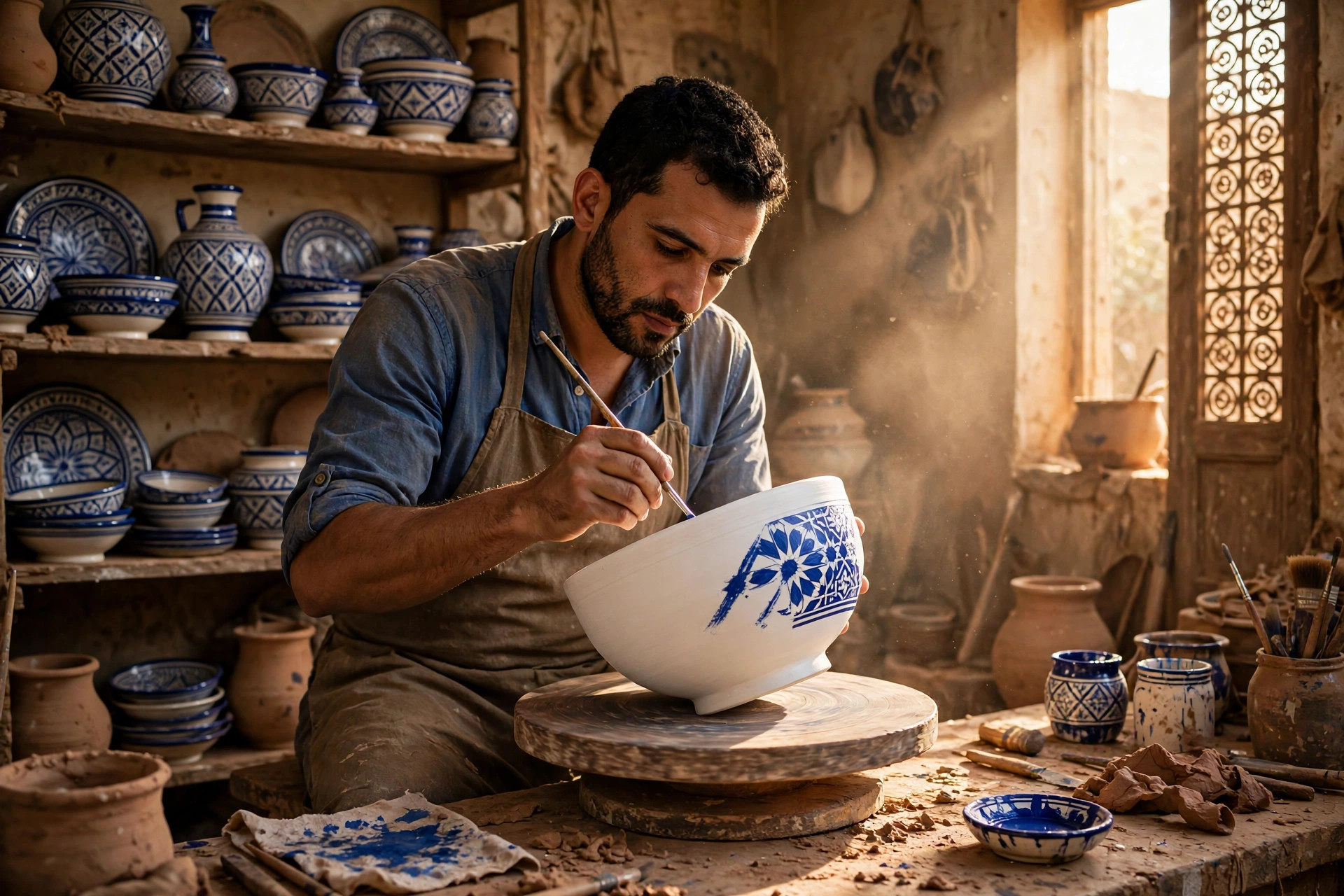
The history of Moroccan pottery begins with a lump of clay and a pair of patient hands. In Fez, a painter draws cobalt flowers on a white bowl; in Safi, kilns glow on the Potters' Hill; in the desert village of Tamegroute, vases emerge the colour of deep water. Clay has been shaped in Morocco for thousands of years, and each centre still works in its own colours.
This guide follows the history of Moroccan pottery from Neolithic pots to the workshops of today: the Amazigh coil builders, the tin glaze that came with Islam, the Cordoban potters of 814, the blue of Fez, the kilns of Safi and the green of Tamegroute.
In this guide
- The Short Answer: The History of Moroccan Pottery in One Page
- The History of Moroccan Pottery at a Glance
- Ancient Roots: Clay Before Written History
- Amazigh Coil Pottery: Pots Built by Hand
- Islamic Influence and the Tin Glaze
- 814: Cordoban Artisans Come to Fez
- Almoravid and Almohad Zenith: The 11th to 13th Centuries
- Marinid Golden Age: The 13th to 15th Centuries
- Fes Blue: The Heart of the History of Moroccan Pottery
- Zellige: The History of Moroccan Pottery on the Wall
- Safi: The History of Moroccan Pottery by the Sea
- Tamegroute and Its Deep Green Glaze
- Meknes: The Imperial City’s Kilns
- How Moroccan Pottery Is Made
- Buying Moroccan Pottery: Prices in 2026
- Where to See and Buy Moroccan Pottery
- Caring for Moroccan Pottery
- Frequently Asked Questions
- Conclusion: Why the History of Moroccan Pottery Still Matters
The Short Answer: The History of Moroccan Pottery in One Page
The history of Moroccan pottery is the story of clay shaped by many hands over thousands of years, from Neolithic pots to the cobalt bowls of Fez. Amazigh women built jars by coiling clay, Muslim potters brought the tin glaze.
Two cities dominate the story. Fez is famous for its blue-and-white ware, painted with cobalt on a tin glaze, while Safi is known for red clay, green and turquoise glazes, and kilns that have burned on the Potters' Hill for centuries.
The History of Moroccan Pottery at a Glance
| Era | What happened |
|---|---|
| Neolithic period | First clay vessels made by farming communities in Morocco |
| Around 1000 BCE | Phoenician, then Carthaginian, traders active on the Moroccan coast |
| 5th century BCE | The potter's wheel arrives in Morocco |
| 7th century | Islam brings tin glazing and geometric and floral decoration |
| 814 | Idriss II welcomes artisan families fleeing Cordoba to Fez |
| 11th–13th centuries | Almoravid and Almohad zenith; Safi pottery evidence from the 11th century |
| 13th–15th centuries | Marinid golden age of pottery and zellige |
| 1488–1541 | Portuguese hold Safi |
| 1609–1614 | Morisco potters expelled from Spain arrive in Morocco |
| 18th century | Artisans from Meknes help develop Safi pottery |
| 1850s | Purer European cobalt reaches Fez potters |
| Late 19th century | Fes blue-and-white ware becomes widely popular |
| 1919 or 1920 | Boujemaa Lamali founds his pottery school in Safi (date disputed) |
| 1990 / 2018 | National Ceramic Museum founded in Safi; moved and reopened in 2018 |
| Today | Family workshops and cooperatives in Fez, Safi, Tamegroute and Meknes |
Ancient Roots: Clay Before Written History
Morocco's oldest pots date from the Neolithic period, when farming communities first settled the land and needed vessels to store grain, water and oil. These early pots were simple, hand-built and fired in open fires.
By around 1000 BCE, Phoenician and later Carthaginian traders were active along the Moroccan coast, bringing new shapes and new tastes in pottery. The potter's wheel arrived around the 5th century BCE, and with it came thinner walls, smoother surfaces and forms that could be repeated again and again.
For the wider story of the country behind the craft, see our brief history of Morocco.
Amazigh Coil Pottery: Pots Built by Hand
Long before the wheel reached every village, Amazigh women built pots by the coil method, rolling clay into long ropes and stacking them ring upon ring, then smoothing the walls with a wet hand or a piece of leather.
The decoration was geometric: diamonds, zigzags, triangles and combed lines, painted or scratched into the surface. These motifs were more than decoration; they were read as signs of protection and fertility, and they still appear on Moroccan ceramics today — a thread running through the history of Moroccan pottery from its earliest chapters to the present.
Coil-built pots were made for daily life: water jars, grain stores, cooking pots and butter churns. Their shapes follow their uses — a narrow neck keeps water cool, a wide mouth suits grain — and their rough, warm surfaces are the opposite of the glossy glazed ware of the cities.
Islamic Influence and the Tin Glaze
Islam reached Morocco in the 7th century, and with it came a new way of glazing pottery. Tin glazing coats the clay with an opaque white surface, giving the painter a clean ground on which to draw.
The new decoration was geometric and floral: stars, rosettes, interlacing bands and stylised leaves, drawn in cobalt blue, green, ochre and black. Figural painting faded from view, and the geometry that replaced it gave the history of Moroccan pottery its most recognisable language — the same patterns that still cover the walls of Fez and Meknes.
814: Cordoban Artisans Come to Fez
In 814, Idriss II welcomed families of artisans fleeing Cordoba, in al-Andalus, and settled them in Fez. They brought the skills of Andalusi workshops with them: finer clays, better glazes, new shapes and the habit of painting freehand with a brush.
The arrival of the Cordoban potters is one of the turning points in the history of Moroccan pottery. Fez gained a court and a market for fine ceramics, and the city's potters began the long experiment with blue and white that would, a thousand years later, make Fes blue famous around the world. The city's Marinid tombs overlook the medina where the workshops still stand.
Almoravid and Almohad Zenith: The 11th to 13th Centuries
Under the Almoravids and the Almohads, in the 11th to 13th centuries, Moroccan pottery reached a new height. Great building projects needed tiles, fountains and fine tableware. Safi, too, has pottery evidence reaching back to the Almoravid period, in the 11th century.
The Almohad capital at Tinmel, hidden in the High Atlas, shows the same taste for geometry in stone that the potters expressed in clay.
Dates from this period are not settled, and the same is true of the history of Moroccan pottery as a whole: archaeologists date layers, not legends, and early kiln sites are rare. What is certain is that by the 13th century Morocco had a mature ceramic tradition, with distinct centres, trained potters and a market that reached across the Strait of Gibraltar.
Marinid Golden Age: The 13th to 15th Centuries
The Marinid dynasty, which ruled from the 13th to the 15th centuries, is often called the golden age of Moroccan pottery. The Marinids built madrasas, mosques and palaces across Fez.
The Marinid court demanded the finest tableware, and the potters of Fez answered with thin, well-fired bowls painted in blue, green and black on white. The architecture of the period shows the same love of pattern in stone and plaster.
Marinid pottery also travelled. Pieces made in Fez have been found far from Morocco, carried by merchants along the caravan routes and across the Mediterranean. The golden age ended with the dynasty, but the workshops, the glazes and the patterns survived — and the history of Moroccan pottery carried on, handed down from master to apprentice.
Fes Blue: The Heart of the History of Moroccan Pottery
Fes blue is Morocco's most famous ceramic: a white bowl or vase painted in deep cobalt blue. The ware is made by painting cobalt oxide onto a tin-glazed surface, then firing it a second time so the blue sinks into the glaze and turns a rich, glassy dark blue.
The blue-and-white style owes a debt to Chinese porcelain, which reached Morocco through trade and was admired for its crisp white ground and blue painting. From the 1850s, potters could also buy purer European cobalt. The Victoria and Albert Museum holds a fine Fes bowl of this kind: see the V&A's Fes bowl.
Here the dates are not settled, and buyers should know it. Some sources claim that Fassi blue dates from the 12th century, but the blue-and-white ware only became widely popular in the late 19th century, when the new cobalt and a growing market for Moroccan crafts met. The older claim is repeated often; the later popularity is the better-documented fact.
The most loved Fes shape is the zlafa, a wide shallow bowl used to serve harira, the soup that breaks the fast in Ramadan. A good zlafa is light for its size, evenly glazed and painted with a steady hand — and in Fez it is still a wedding gift, bought in pairs. The music of Morocco plays at those same weddings, and the bowls are part of the celebration.
Zellige: The History of Moroccan Pottery on the Wall
Zellige is pottery turned into architecture: small pieces of glazed terracotta, cut by hand into geometric shapes and fitted together into patterns that cover walls, fountains and floors. The craft needs a potter, a cutter and a setter.
Each tile is glazed in a single colour — blue, green, white, ochre or black — then chipped to shape with a small hammer. The patterns are built from stars, crosses and eight-pointed shapes, and a single wall can hold thousands of pieces. For the full story of the tile tradition, see Wikipedia's article on zellige.
Zellige shows the same geometry as the history of Moroccan pottery in its tableware, but on a grander scale: a courtyard wall is a carpet of clay, meant to cool a room and dazzle the eye at once.
Safi: The History of Moroccan Pottery by the Sea
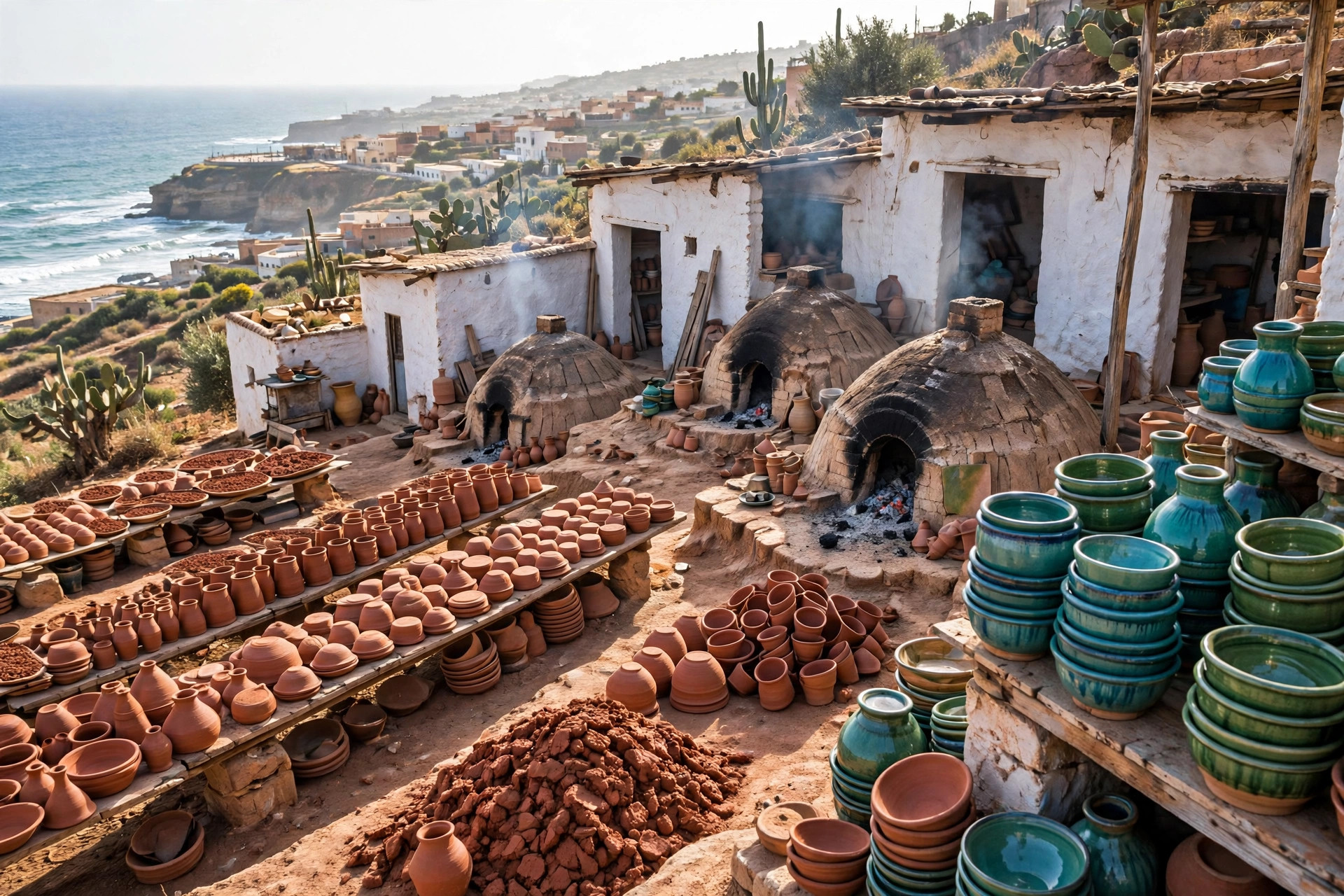
Safi is Morocco's other great pottery city, and its story is older than its fame. Pottery evidence in Safi reaches back to the Almoravid period, in the 11th century, and the city has made ceramics ever since. The clay here is red, the glazes are green, turquoise and black, and the shapes are bold and generous.
The heart of the craft is the Potters' Hill, at Bab Chaaba on Jbel Lahdid, where more than 200 potters work in a warren of workshops and kilns. The kilns burn at 900 to 1,050 degrees Celsius, and the smoke and heat have blackened the hill for generations.
Safi's history is written in its occupiers and arrivals. The Portuguese held the city from 1488 to 1541. Then, between 1609 and 1614, Morisco potters expelled from Spain arrived, bringing new techniques and new shapes. In the 18th century, artisans from Meknes helped develop Safi pottery further, carrying the styles of the imperial city to the coast.
The most famous name in Safi pottery is Boujemaa Lamali (1890–1971), who founded a school and a style that made Safi ware known across Morocco. The school's founding date is not settled: some sources give 1919 and others 1920, and both dates are still cited today. The National Ceramic Museum, established in 1990 in the Kechla fortress, moved to the Cité des Arts and reopened in 2018, and it is the best place to study the city's long ceramic story. For a stay in the city, see our guide to living in Safi.
Tamegroute and Its Deep Green Glaze
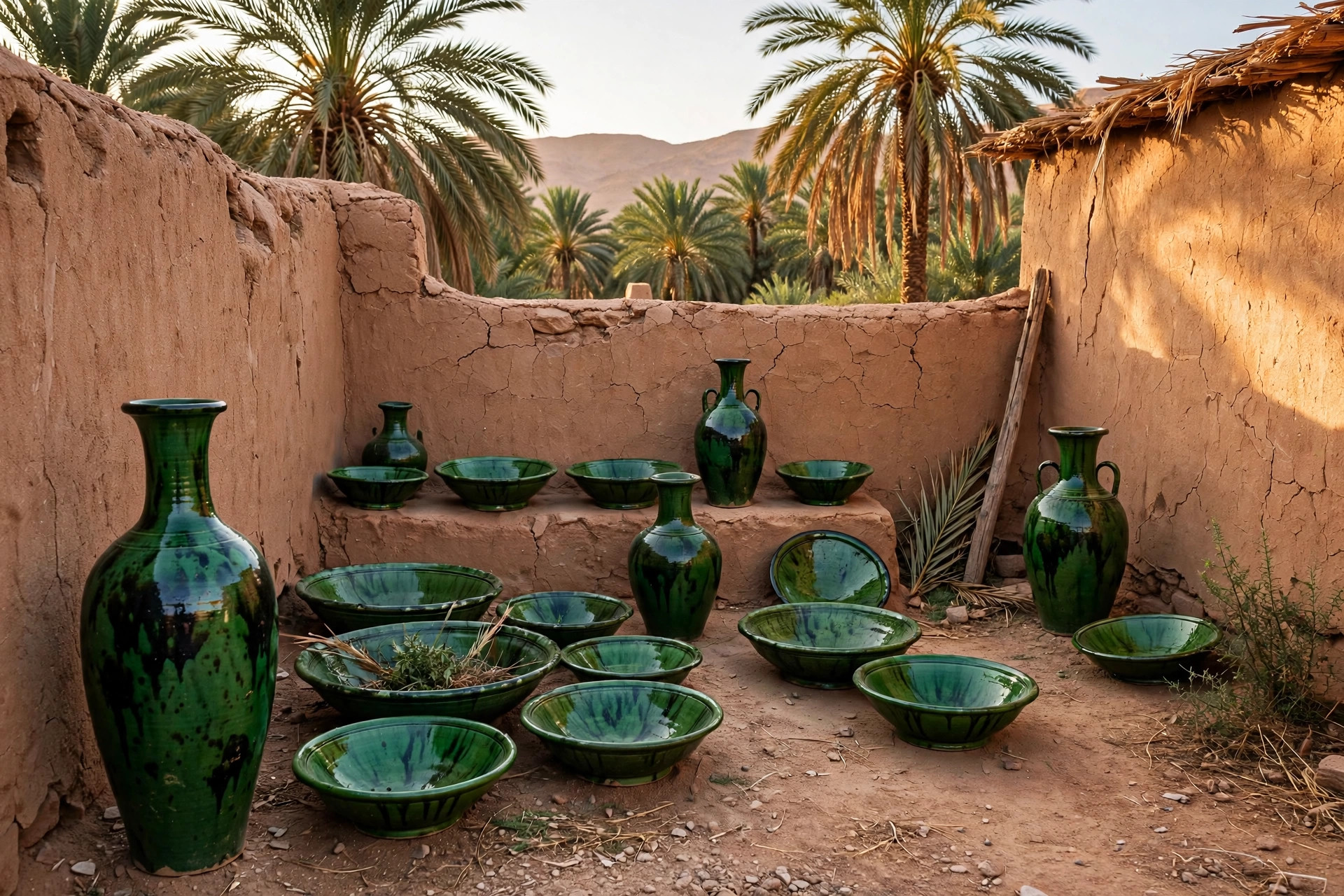
South of Zagora, on the road to the desert, the village of Tamegroute makes pottery of a single unforgettable colour: a deep, dark green, almost black in shadow and jewel-bright in the sun. The glaze gets its colour from local minerals.
Tamegroute pottery is thrown on the wheel and fired in kilns built of clay and straw, and the shapes are tall and practical: water jars, vases, lamps and bowls with narrow necks that keep water cool.
The desert glaze is the most distinctive chapter in the history of Moroccan pottery south of the Atlas, and it has changed little in centuries. Tamegroute potters still dig their clay nearby, still glaze with the same minerals, and still sell from the workshop door — a craft that tourism has reached but not yet remade.
Meknes: The Imperial City's Kilns
Meknes, the imperial city of Moulay Ismail, has its own pottery tradition, in blue-green and ochre glazes painted with bold floral patterns.
Meknes also shaped the craft beyond its own walls. In the 18th century, artisans from Meknes helped develop Safi pottery, carrying new glazes and shapes to the Atlantic coast — a reminder that Moroccan ceramics has always travelled, from city to city, along with its makers. The caftan followed a similar road from court to city.
| Centre | Clay | Colours | Famous for |
|---|---|---|---|
| Fez | White, tin-glazed | Cobalt blue on white | Blue-and-white bowls, zlafa, zellige |
| Safi | Red clay | Green, turquoise, black | Large platters, metal inlays, kilns |
| Tamegroute | Desert clay | Deep green | Tall vases, lamps, water jars |
| Meknes | Fine pale clay | Blue-green, ochre | Floral bowls, palace ware |
| Rural villages | Coarse local clay | Ochre, black, natural | Coil-built jars, cooking pots |
How Moroccan Pottery Is Made
A Moroccan pot begins as raw clay, dug from a pit, dried, crushed and sieved, then mixed with water and kneaded until it is smooth and free of air. The potter throws it on the wheel or builds it by hand, trims the foot, and leaves it to dry until it is firm enough to handle — the stage potters call leather-hard.
The dry pot is fired once to harden it, then painted and glazed before a second, hotter firing fixes the colours. In Fez the painting is freehand; in Safi the glazes are poured and dipped. Each centre fires differently, but the sequence is the same, and it has changed little in a thousand years — the craft at the core of the history of Moroccan pottery.
- Dig and prepare the clay: dry, crush, sieve and knead it.
- Throw the pot on the wheel, or build it by coiling.
- Trim the foot and leave the pot to dry until leather-hard.
- Fire once in the kiln to harden the clay.
- Paint with oxides or dip in glaze.
- Fire a second time at full heat to fix the colours.
- Cool slowly, inspect, and sort the pieces for sale.
Buying Moroccan Pottery: Prices in 2026
Prices for Moroccan pottery are modest, and the table below gives fair prices for good handmade pieces in 2026, checked in November 2026. A small bowl costs less than a restaurant lunch; a large hand-painted platter is the price of a good dinner.
Bargaining is expected in the souks, and a first price can be double the fair one. Check the glaze for cracks, the foot for chips, and the painting for a steady hand — and remember that a handmade piece is never perfectly identical to its neighbour. That small unevenness is the mark of the hand, and it is what the history of Moroccan pottery has always valued most.
| Piece | Fair price in Morocco (MAD) | Approx. USD |
|---|---|---|
| Small Safi bowl | 40–80 | $4–$8 |
| Fes zlafa bowl | 60–150 | $6–$15 |
| Set of 6 small cups | 120–300 | $12–$30 |
| Glazed tagine pot | 80–200 | $8–$20 |
| Tamegroute vase | 150–500 | $15–$50 |
| Fes blue vase, medium | 200–600 | $20–$60 |
| Large Fes platter | 400–1,200 | $40–$120 |
| Zellige tile panel | 1,500–5,000 | $150–$500 |
Where to See and Buy Moroccan Pottery
Fez is the best place to start: the pottery quarter near Bab Ftouh holds workshops where you can watch painters at work, and the shops of the medina sell everything from zlafa bowls to large vases. In Safi, go to the Potters' Hill and buy from the workshops themselves.
Museums are the best classrooms. The National Ceramic Museum in Safi, reopened in 2018 at the Cité des Arts, shows the city's ware from the Almoravid period to today, and the museums of Fez and Rabat hold fine blue-and-white pieces.
For a wider view of the country's craft traditions, browse our History & Heritage category — including the history of Moroccan carpets — and plan the trip around the workshops rather than the souvenir shops. Tamegroute's green vases are best bought at the workshop door, where the potter will show you the kiln. The kilns of Fez and Safi are still burning, and the history of Moroccan pottery is still being written in clay.
Caring for Moroccan Pottery
Glazed Moroccan pottery is tougher than it looks, but it is still clay. Wash it by hand with warm water and mild soap, never in a dishwasher, and avoid sudden changes of temperature, which can crack the glaze.
Unglazed and coil-built pots need more care: they are porous, so they stain, and they should be dried fully before storage. A soft cloth and a dry shelf are all the care a glazed piece needs between uses. Treated gently, a handmade piece will outlast the trip that brought it home.
Frequently Asked Questions
What is Moroccan pottery famous for?
The history of Moroccan pottery is famous above all for the blue-and-white ware of Fez, the green and turquoise glazes of Safi, and the deep green vases of Tamegroute.
How old is Moroccan pottery?
Moroccan pottery dates from the Neolithic period, with the potter's wheel arriving around the 5th century BCE and tin glazing in the 7th century. The earliest dates are not settled.
When did Fes blue become popular?
Some sources claim Fassi blue dates from the 12th century, but the blue-and-white ware only became widely popular in the late 19th century, helped by purer European cobalt from the 1850s and by Chinese porcelain as a model. That is why dates in the history of Moroccan pottery are still debated.
What is the difference between Fez and Safi pottery?
Fez pottery is white, tin-glazed and painted in cobalt blue, while Safi pottery uses red clay with green, turquoise and black glazes, often with metal inlays.
How much does Moroccan pottery cost?
A small handmade bowl costs roughly 40–150 MAD ($4–$15) in Morocco in 2026, a medium vase 150–600 MAD ($15–$60), and a large platter 400–1,200 MAD ($40–$120).
Where is the best place to buy Moroccan pottery?
Buy in Fez near Bab Ftouh and in Safi on the Potters' Hill, directly from the workshops, where prices are lower and you can watch the potters at work.
Conclusion: Why the History of Moroccan Pottery Still Matters
The history of Moroccan pottery is not a museum story. It is a living craft, still practised at the wheel in Fez, on the Potters' Hill in Safi and in the desert kilns of Tamegroute. Each piece carries the clay of its place and the hand of its maker.
If you travel to Morocco, watch a potter at work before you buy. The piece you bring home will be more than a souvenir: a fragment of the history of Moroccan pottery, begun thousands of years ago and still being shaped today.
Last checked: November 2026
1 thought on “The History of Moroccan Pottery: Fes Blue, Safi and the Art of Clay”