
This Azemmour travel guide is for travellers who like their Morocco quiet. Azemmour is a small walled town on the Oum Er-Rbia river, about 75 kilometres southwest of Casablanca and 17 kilometres north of El Jadida. There are no ticket queues, no tour buses and no touts — just a river, old Portuguese walls, a medina painted with murals, and a long Atlantic beach a short walk away. Half a day is enough to see it properly; a full day, paired with El Jadida, is one of the easiest trips on the Moroccan coast.
The name comes from the Amazigh word azemmur, the wild olive, and the town has been a river-mouth settlement since antiquity. Portugal seized it in 1513 and left in 1541, leaving the walls and towers you still walk today. This Azemmour travel guide follows that story through the old town, the river and the beach.
All prices are in Moroccan dirhams (MAD), checked in November 2026, with dollar equivalents at roughly 10 MAD to $1. They are planning ranges, not promises.
In this guide
- Azemmour at a Glance
- A Short History of Azemmour
- The Old Town in Three Parts: Kasbah, Medina and Mellah
- The Ramparts, Gates and Dar el Baroud
- The Painted Walls: Street Art in the Medina
- The Oum Er-Rbia: River, Estuary and Beaches
- Azemmour Travel Guide: A Half-Day Walking Route
- Where to Eat in Azemmour
- Where to Stay in Azemmour
- Getting to Azemmour
- Azemmour and El Jadida in One Day
- When to Visit Azemmour
- Practical Tips for Visiting Azemmour
- Frequently Asked Questions
- Conclusion
Azemmour at a Glance
Azemmour is one of the smallest historic towns on the Moroccan Atlantic coast, and that is exactly its charm. About 42,000 people lived here at the 2024 census, and the old town would fit inside one corner of the Marrakech medina. You walk everywhere and eat well for very little. This Azemmour travel guide keeps the plan simple: walk the walls, look at the paint, eat the fish, watch the river.
| Fact | Detail |
|---|---|
| Location | Left bank of the Oum Er-Rbia, 75 km southwest of Casablanca, 17 km north of El Jadida |
| Population | About 42,000 (2024 census) |
| Best for | Half-day walk, street art, river views, a quiet escape from the city |
| Time needed | 3–4 hours for the old town; a full day with El Jadida |
| Getting there | Train from Casablanca, 1–1.5 hours; car about 1 hour |
| Budget | 150–300 MAD ($15–30) per person for a day trip without a hotel |
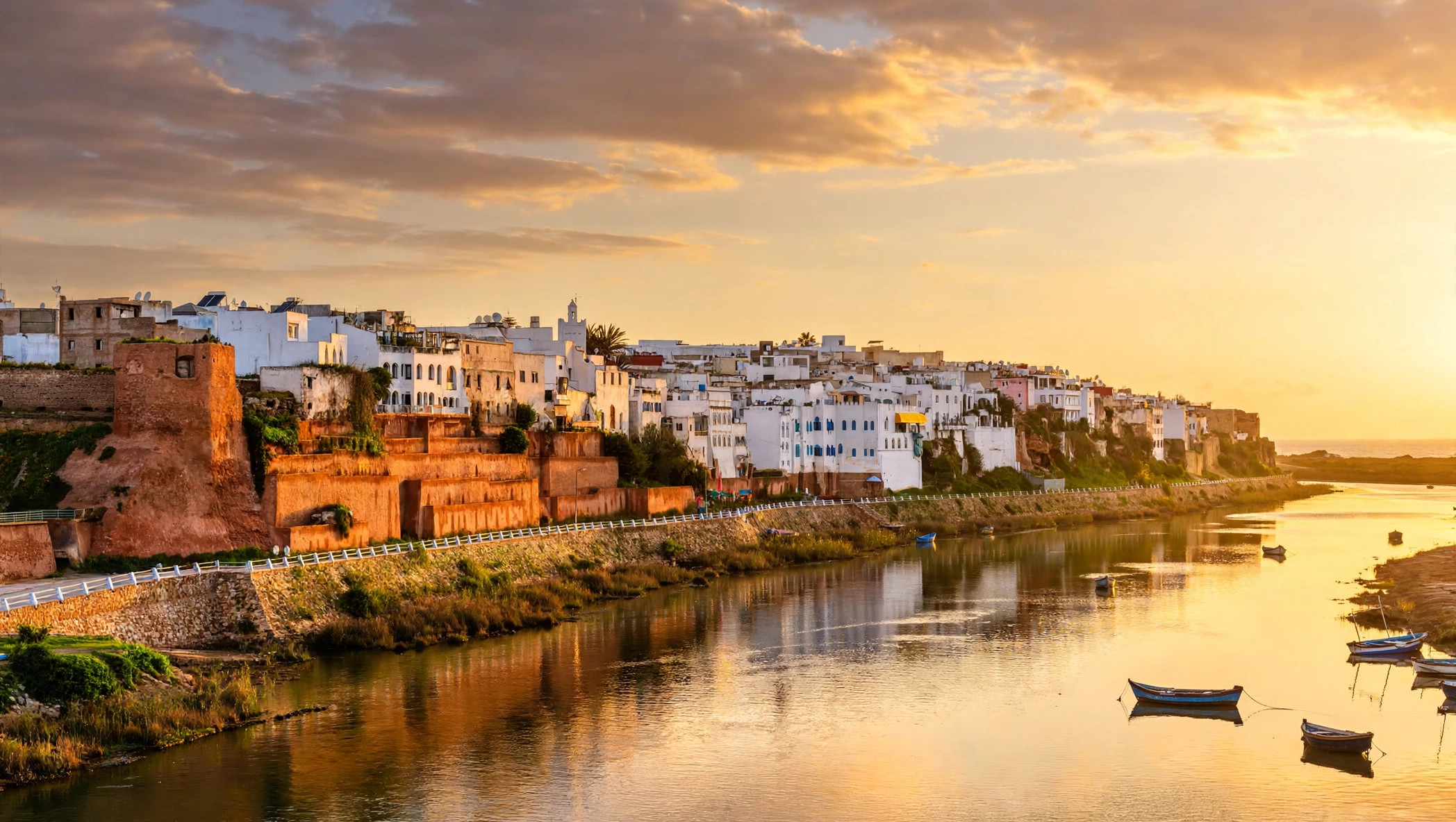
The town sits on a low bluff above the river, and the Oum Er-Rbia reaches the Atlantic only about 3 kilometres below the medina — river on one side, ocean on the other — which shaped everything from the Portuguese fortifications to the fishing boats still on the water.
A Short History of Azemmour
The site is old. An ancient settlement called Azama stood at this river mouth when Phoenician and Carthaginian traders worked the coast, and under the Almohads and Marinids it grew as a river port. Its name — from the Amazigh azemmur, the wild olive — survived every dynasty. The Portuguese chapter is the heart of this Azemmour travel guide.
The chapter that shaped the town began in 1513. Portugal seized Azemmour after the Battle of Azemmour, when the local governor, Moulay Zayam, refused to go on paying tribute. According to Portuguese accounts, a young Ferdinand Magellan fought in the campaign, years before he sailed west around the world. The occupation lasted only until 1541, when the cost of holding the place outweighed the profit and the Portuguese withdrew, leaving the walls, the gates and a ruined powder store.
Two other stories from those years still follow the town. Jewish families, many of them exiles from Portugal, had settled in the mellah and lived here for centuries as fishermen, craftsmen and merchants. During the occupation, a man from Azemmour named Estevanico — Esteban the Moor, also called Mustafa Zemmouri — was enslaved and taken to the Americas, where he became one of the first African explorers of North America, on the Narváez expedition of 1527. Our history of Moroccan ports puts Azemmour's river trade inside the wider story of Morocco's Atlantic coast.
The Old Town in Three Parts: Kasbah, Medina and Mellah
The old town still divides neatly into three quarters, and this Azemmour travel guide walks them in order — you can cross all three in under half an hour. The kasbah is the fortified quarter on the bluff, the oldest and highest part of town, with Portuguese walls and towers and a view straight down the Oum Er-Rbia towards the Atlantic. The medina proper is the maze of whitewashed lanes below the kasbah, where most people live today — about 90 percent of the old town is still residential, which is why it feels like a neighbourhood rather than a museum. The mellah, in the north of the medina, was the Jewish quarter, and its synagogue and the shrine of Rabbi Abraham Moul Niss still stand. Our guide to Morocco's Jewish heritage tells the wider story of the mellahs across the country.
Take your time in the mellah: its balconies and tall doorways look different from the rest of the medina, the doors are painted deep blue and green, and the shrine of Rabbi Abraham Moul Niss still draws visitors on his annual hiloula. The town's Muslim patron saint, Abu Shuayb — Sidi Bouchaib — has his own mausoleum and an annual moussem, so two pilgrimage traditions live a few streets apart.
The Ramparts, Gates and Dar el Baroud
This Azemmour travel guide begins with a warning: Azemmour is not a town of ticketed monuments. Its monuments are the walls themselves, and the best way to see them is to walk them slowly. The medina is still ringed by its old stone-and-earth wall, and the gates are the best introduction to it. Bab el Jiafs, on the landward side, is the kind of low, thick-set arch that makes you understand what a fortified town actually felt like.
Climb to the kasbah ramparts for the view that explains the town's history: the Atlantic to the west, the Oum Er-Rbia bending to its mouth below, the flat Doukkala plain to the east. This is why Portugal wanted the place — whoever held this bluff controlled the river mouth and the rich shad fishery. The kasbah also holds a mosque that predates the castle, the castle's prison, and two towers with their original cannons.
The most tangible Portuguese relic is Dar el Baroud, the "powder house": only a tall, roofless tower survives, standing over the river with grass growing from its stonework. It is the town in miniature, and the most photographed building in this Azemmour travel guide.
The Painted Walls: Street Art in the Medina
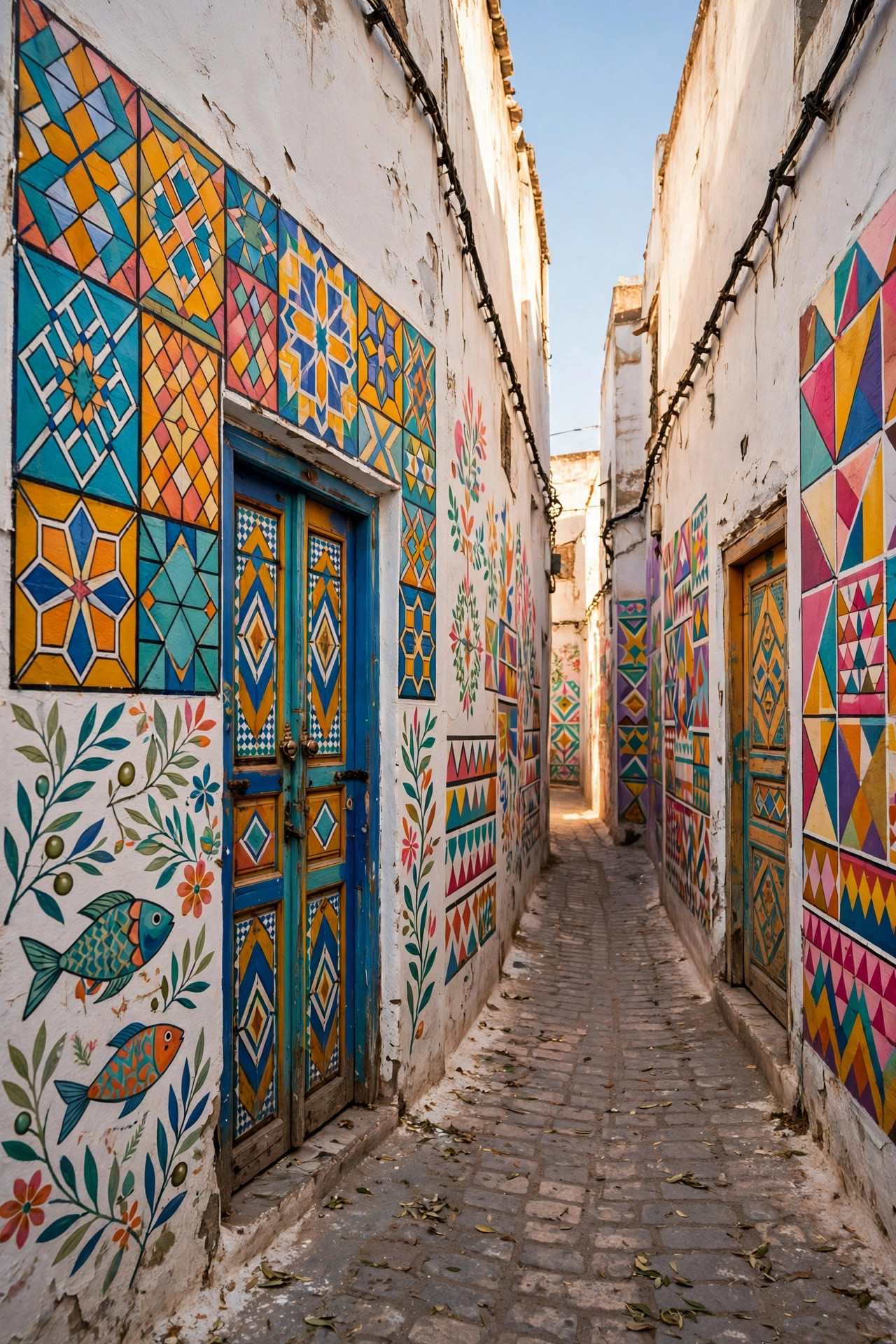
Over the past two decades, artists have turned Azemmour's blank walls into an open-air gallery: murals, painted doors, calligraphy and bright geometric panels down the whitewashed lanes. The work changes yearly, so the medina never looks the same twice — some pieces cover whole house fronts, others are small panels above doorways, in river blue, rampart ochre and olive green. No Azemmour travel guide is complete without them.
Walk without a map and let the paint lead you: the lanes are short, you cannot get lost for long, and every wrong turn finds another painted wall. Photography is easy here — but ask before photographing a doorway up close, and greet residents in French or Darija before pointing a camera. The murals are the reason many travellers now add Azemmour to an El Jadida day, and they cost nothing.
The Oum Er-Rbia: River, Estuary and Beaches
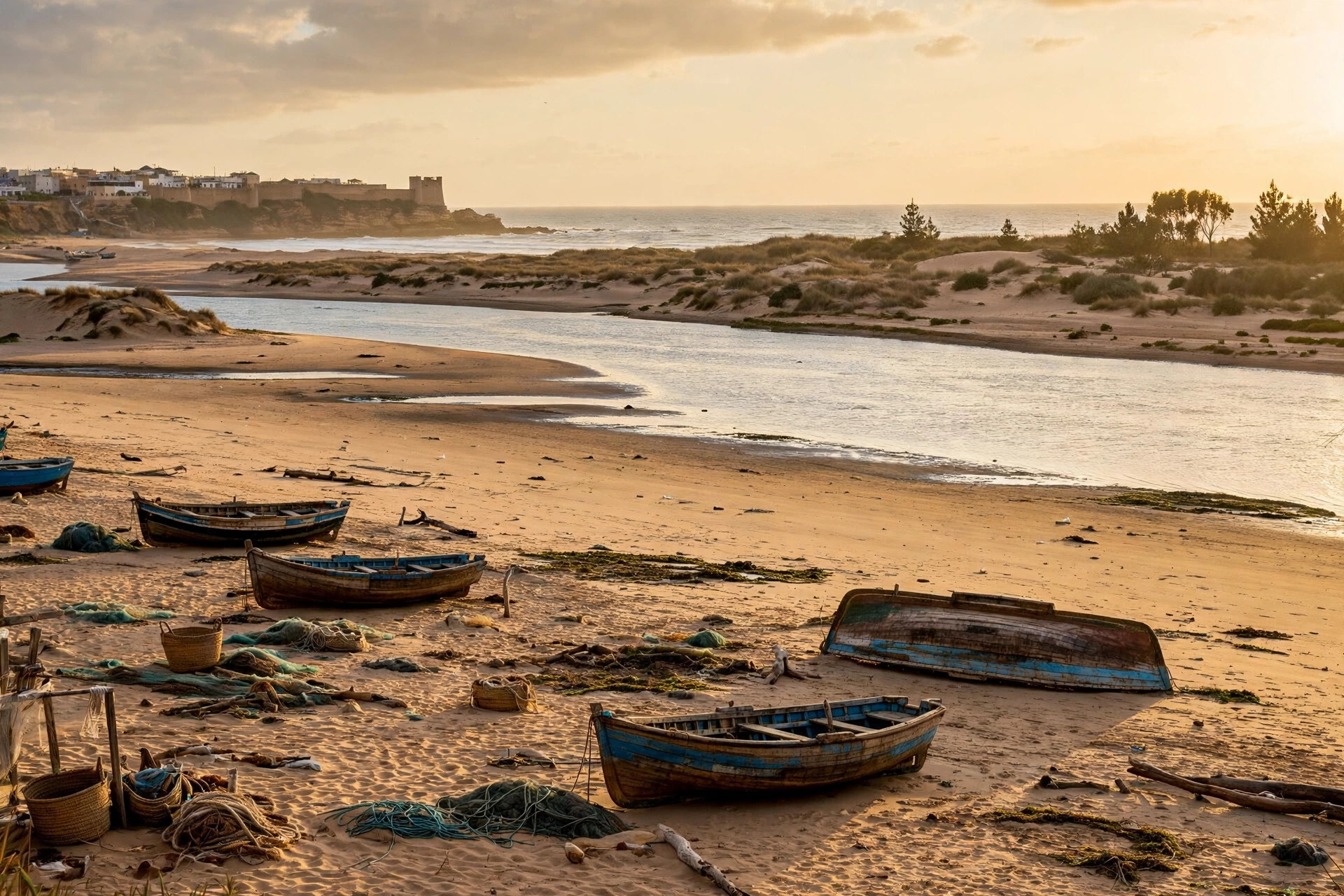
The Oum Er-Rbia is Morocco's second-longest river, and Azemmour sits where it finishes its journey, reaching the Atlantic only about 3 kilometres below the medina. The estuary is the second half of this Azemmour travel guide: walk down from the ramparts and the town noise falls away — herons on the mudflats, fishing boats on the sand, the long beach curving south.
Do not swim in the river — the current at the mouth is strong — but the ocean beach below the town is wide, sandy and almost empty outside summer weekends. Haouzia Beach, a few kilometres south, is the better swimming beach. The river is also the town's working water: fishermen still work the estuary for shad, the fish that drew the Portuguese here five centuries ago, and the small harbour below the ramparts is worth a look at dawn, when the boats come in. If you eat fish in Azemmour, it was probably caught within sight of your table — a detail every Azemmour travel guide should mention.
Azemmour Travel Guide: A Half-Day Walking Route
You do not need a guide here, but you do need a plan — the lanes all look alike at first. This route takes about three hours at a slow pace, and it is the route this Azemmour travel guide recommends.
- Walk from the train station to the medina (15 minutes), across the modern town and up towards the walls.
- Enter through Bab el Jiafs and climb to the kasbah ramparts (30 minutes) — the town's best view.
- Walk the kasbah lanes down to Dar el Baroud and photograph the powder-house tower against the river.
- Cross into the medina and follow the painted walls for an hour; the murals reward slow looking.
- Visit the mellah in the north of the medina — the synagogue and the shrine of Rabbi Abraham Moul Niss.
- Walk down to the river and along the estuary towards the beach for the late-afternoon light.
- Finish with a fish lunch near the river gate, then catch the train or drive on to El Jadida.
If you arrive by car, park outside the walls — the lanes are too narrow for cars. Wear good shoes: the lanes are cobbled and the climb to the kasbah is steep.
Where to Eat in Azemmour
Every Azemmour travel guide should start with the fish. A grilled lunch with bread, salad and mint tea costs 60–100 MAD ($6–10) at the small restaurants near the river gate, and the catch of the day is usually shad, sardines or sea bass, grilled over charcoal and served whole.
In the modern town below the medina, restaurants serve the usual standards — tajines at 50–80 MAD ($5–8), pastilla at 60–90 MAD ($6–9), harira with bread for under 20 MAD ($2). Breakfast is bread, olive oil and amlou or eggs for 15–25 MAD ($1.50–2.50); coffee is 8–12 MAD and mint tea 6–10 MAD. The Azemmour travel guide rule is simple: eat what the fishermen eat, pay what the fishermen pay.
Where to Stay in Azemmour
Most visitors sleep in El Jadida, but a night here is the best tip in this Azemmour travel guide for travellers with time. The old town has a handful of small guesthouses and riads inside the walls; the modern town has simple hotels along the main road.
A guesthouse room in or near the medina costs 250–450 MAD ($25–45) a night, usually with breakfast; simple hotels in the modern town run 200–350 MAD ($20–35). El Jadida, 20 minutes away, has the wider choice. Our El Jadida guide covers the fortress and where to stay there. Book ahead in summer, and ask for a river-facing room: the sunset over the Oum Er-Rbia is the town's free show.
Getting to Azemmour
Getting here is the easiest part of this Azemmour travel guide: Azemmour is one of the easiest historic towns in Morocco to reach without a car, which is rare on this coast. The train is the simplest option from Casablanca, and the drive is short and flat.
| From | How | Time | Cost |
|---|---|---|---|
| Casablanca | Train from Casa Voyageurs or Casa Port | 1–1.5 hours | 40–60 MAD ($4–6) |
| Casablanca | Car via the A5 motorway | About 1 hour | 50–70 MAD fuel and tolls ($5–7) |
| Casablanca | Bus from the main station | 1.5–2 hours | 40–50 MAD ($4–5) |
| El Jadida | Train or grand taxi | 20–30 minutes | 10–20 MAD ($1–2) |
| El Jadida | Car | About 20 minutes | 15–25 MAD fuel ($1.50–2.50) |
From the station, walk to the medina in 15 minutes or take a petit taxi for 10–15 MAD ($1–1.50). Grand taxis run to El Jadida all day and leave when full; drivers should take the A5 from Casablanca and follow the signs. Our Casablanca travel guide covers where to start if you are basing yourself in the city.
Azemmour and El Jadida in One Day
Azemmour and El Jadida belong together — the pairing this Azemmour travel guide recommends above all — and it is the best use of a day on this coast. El Jadida is 17 kilometres south, twenty minutes by road or a short train hop, and its Cité Portugaise is a UNESCO World Heritage site. Its star is the underground Portuguese Cistern, a vaulted stone chamber where a thin sheet of water mirrors the columns.
Do Azemmour in the morning, as this Azemmour travel guide recommends, when the light is best on the ramparts and the murals, and El Jadida in the afternoon, when the Cistern's light is at its most dramatic. Lunch in Azemmour, where the fish is cheaper; coffee in the Cité Portugaise before the train home. The two towns were both Portuguese, both abandoned and retaken — the same history twice, once as a quiet river town, once as a fortified port city. For the wider coast, browse our Morocco Travel guides.
When to Visit Azemmour
Azemmour is a year-round town. Spring and autumn are the sweet spot in this Azemmour travel guide: warm days, cool evenings, the river light at its best. Summer weekends bring Casablanca families to Haouzia Beach, but the old town stays calm. Winter rain makes the cobbles slippery and the Atlantic wind is cold — bring a jacket.
| Season | Weather | What to expect |
|---|---|---|
| Spring (March–May) | 20–26°C, sunny | Best walking weather, green countryside, few crowds |
| Summer (June–August) | 26–32°C, humid | Hot but breezy; beaches busy on weekends |
| Autumn (September–November) | 22–28°C, sunny | Warm sea, quiet lanes, the best light for photos |
| Winter (December–February) | 15–20°C, some rain | Mild and very quiet; the estuary at its wildest |
The moussem of Sidi Bouchaib is the one time the town fills up; check the date locally, as it follows the Islamic calendar.
Practical Tips for Visiting Azemmour
The practical advice in this Azemmour travel guide comes down to five points:
- Cash is king. Bring dirhams: the medina's small shops and fish restaurants rarely take cards, and the ATMs are in the modern town, not inside the walls.
- French and Darija open doors. English is understood in El Jadida's hotels but less so in the medina — a few words of French go a long way.
- Respect the shrines. The mausoleums of Sidi Bouchaib and Rabbi Abraham Moul Niss are places of pilgrimage — enter quietly, ask before photographing inside, and dress modestly.
- Do not swim in the river. The current at the Oum Er-Rbia mouth is strong. Swim at Haouzia Beach instead, and stay out of the water on rough days.
- Stay for sunset if you can: the light over the estuary in the last hour is the best thing in town, and it costs nothing.
Frequently Asked Questions
Is Azemmour worth visiting?
Yes, if you like quiet historic towns — the verdict of this Azemmour travel guide: Portuguese ramparts, painted medina walls, a Jewish mellah and a beautiful estuary, all walkable in half a day. Pair it with El Jadida, 20 minutes away.
How do I get to Azemmour from Casablanca?
The Azemmour travel guide answer is the train: from Casa Voyageurs or Casa Port, the journey takes 1–1.5 hours and costs 40–60 MAD ($4–6). By car, the A5 motorway takes about an hour; buses take 1.5–2 hours.
How much time do I need in Azemmour?
Three to four hours is enough for the old town: the kasbah ramparts, Dar el Baroud, the painted medina walls, the mellah and a walk down to the river. A full day lets you add Haouzia Beach and El Jadida, as this Azemmour travel guide suggests.
What is Azemmour famous for?
The short answer of this Azemmour travel guide: its Portuguese history (seized 1513, abandoned 1541), the street art on its medina walls, the mellah and its Jewish heritage, and as the birthplace of Estevanico, who travelled to North America in 1527. Its name comes from the Amazigh word for the wild olive.
Can I visit Azemmour and El Jadida in one day?
Yes, easily: 17 kilometres apart, about 20 minutes by car or train. Do Azemmour in the morning and El Jadida — the UNESCO-listed Cité Portugaise and its underground cistern — in the afternoon.
Is Azemmour safe for tourists?
It is one of the quietest and safest towns on the Moroccan coast: the old town is residential and calm and crime is rare. The main risks are the strong river current at the estuary mouth and slippery cobbles in the rain.
Conclusion
This Azemmour travel guide ends where the town begins: on the ramparts above the river, looking west. Azemmour will not overwhelm you — no grand palace, no famous square, no crowds — and that is precisely why it stays with you. In half a day you walk through five centuries, at the pace of a town that has never hurried.
Come for the walls and the murals, stay for the fish lunch and the sunset over the estuary, and pair it with El Jadida to see the same Portuguese history at a grander scale. Now you know the way — and, as this Azemmour travel guide showed, the train from Casablanca takes barely an hour.
1 thought on “Azemmour Travel Guide: Morocco’s Quiet River Town on the Atlantic”