
The history of Moroccan gardens begins with a simple problem: how do you grow paradise in a dry country? For nine centuries, Moroccan sultans, scholars and gardeners answered it the same way — with water. They dug channels under the desert, built basins the size of lakes, and planted walls of olive, orange and palm. It is the story of dynasties, engineers and a paradise idea that travelled from Persia to Andalusia and took root in Moroccan soil.
In this guide
- The Short Answer: The History of Moroccan Gardens in One Page
- The History of Moroccan Gardens at a Glance
- The Idea of the Garden: A Paradise in Four Parts
- The First Agdals: The Almoravids and the Water of Marrakech
- The Almohads: Menara and the Great Basins
- The Marinids: Fes and the Gardens of the Madrasas
- The Saadians: Sugar, Water and the Gardens of Marrakech
- The Alaouites: Moulay Ismail's Meknes and the Royal Agdal
- The Riad Garden: The Courtyard as a Private Paradise
- The Majorelle Garden: A French Painter's Blue Paradise
- The Oasis Gardens of the South: Palmeraies and Khettaras
- What the Gardens Grow: Orange, Olive, Palm and Rose
- Where to See the History of Moroccan Gardens Today
- Visiting the Gardens: Tickets, Hours and Practical Tips
- Frequently Asked Questions
The Short Answer: The History of Moroccan Gardens in One Page
The history of Moroccan gardens starts in the 12th century, when the Almoravids founded Marrakech and built the first agdals — vast walled orchards watered by underground channels. The Almohads dug the great basins of Menara and the Agdal, turning water storage into royal display. Later dynasties shrank and refined the idea: the Marinids planted courtyard gardens inside the madrasas of Fes, the Saadians rebuilt the Agdal, and the Alaouites raised a royal agdal at Meknes. Alongside them, ordinary Moroccans perfected the riad courtyard and the oasis palmeraie, and Jacques Majorelle added a cobalt-blue garden. The thread running through all of them is water.
The History of Moroccan Gardens at a Glance
| Period | Dynasty or era | Garden landmark | What changed |
|---|---|---|---|
| c. 1070–1147 | Almoravids | First agdals of Marrakech | Walled orchards fed by khettara channels |
| c. 1147–1269 | Almohads | Menara basin, Agdal basin | Water storage becomes royal spectacle |
| 1244–1465 | Marinids | Madrasa courtyards of Fes | The garden shrinks into the courtyard |
| 1554–1659 | Saadians | El Badi gardens, Agdal restored | Sugar wealth funds water and planting |
| 1666–present | Alaouites | Agdal of Meknes, royal gardens | The agdal becomes a working royal estate |
| 19th century | Late Alaouite era | Jnan Sbil in Fes, Bahia gardens | City gardens open to the public |
| 1923–1962 | Protectorate era | Majorelle Garden | A painter's blue garden, later world famous |
| 1980–today | Modern Morocco | Restored agdals and public parks | Gardens as heritage and public space |
The Idea of the Garden: A Paradise in Four Parts
Every garden in the history of Moroccan gardens descends from one idea: the walled garden as an image of paradise. Paradise comes from the old Persian pairidaeza, a walled enclosure, and the Islamic garden took its shape — a square divided into four parts by crossing water channels, with a basin where they meet, recalling the four rivers of paradise. In a hot, dry land, moving water was a ruler's most expensive display.
The idea reached Morocco through Andalusia. When Muslim rulers fled Granada for Fes, Tetouan and Rabat, they brought the courtyard garden of Cordoba and Seville: orange trees in a square, a central fountain, cool tile underfoot. Morocco added its own materials — zellige tilework among them — and its own scale: not only a courtyard, but an orchard you could ride through for an hour.
The First Agdals: The Almoravids and the Water of Marrakech
Marrakech was founded around 1070 by the Almoravids, desert warriors from the Sahara who chose a flat, stony plain at the foot of the Atlas with no river of its own. That choice made water engineering the city's first duty: they dug khettaras — gently sloping underground channels carrying groundwater from the foothills without losing it to evaporation — and around them they planted the first agdals, the opening chapter in the history of Moroccan gardens.
An agdal is an Amazigh word for a protected pasture, land closed off for part of the year so the grass could recover. The sultans made it royal: a vast walled estate of olives, oranges and palms, part orchard, part hunting ground, part pleasure garden. The exact founding date of the Agdal of Marrakech is not settled — most histories place its creation around 1156–1157, under the Almohad sultan Abd al-Mu'min, though some traditions credit earlier Almoravid works. By the 12th century the Agdal was already the model every later royal garden would copy: water first, walls second, trees third.
The Almohads: Menara and the Great Basins
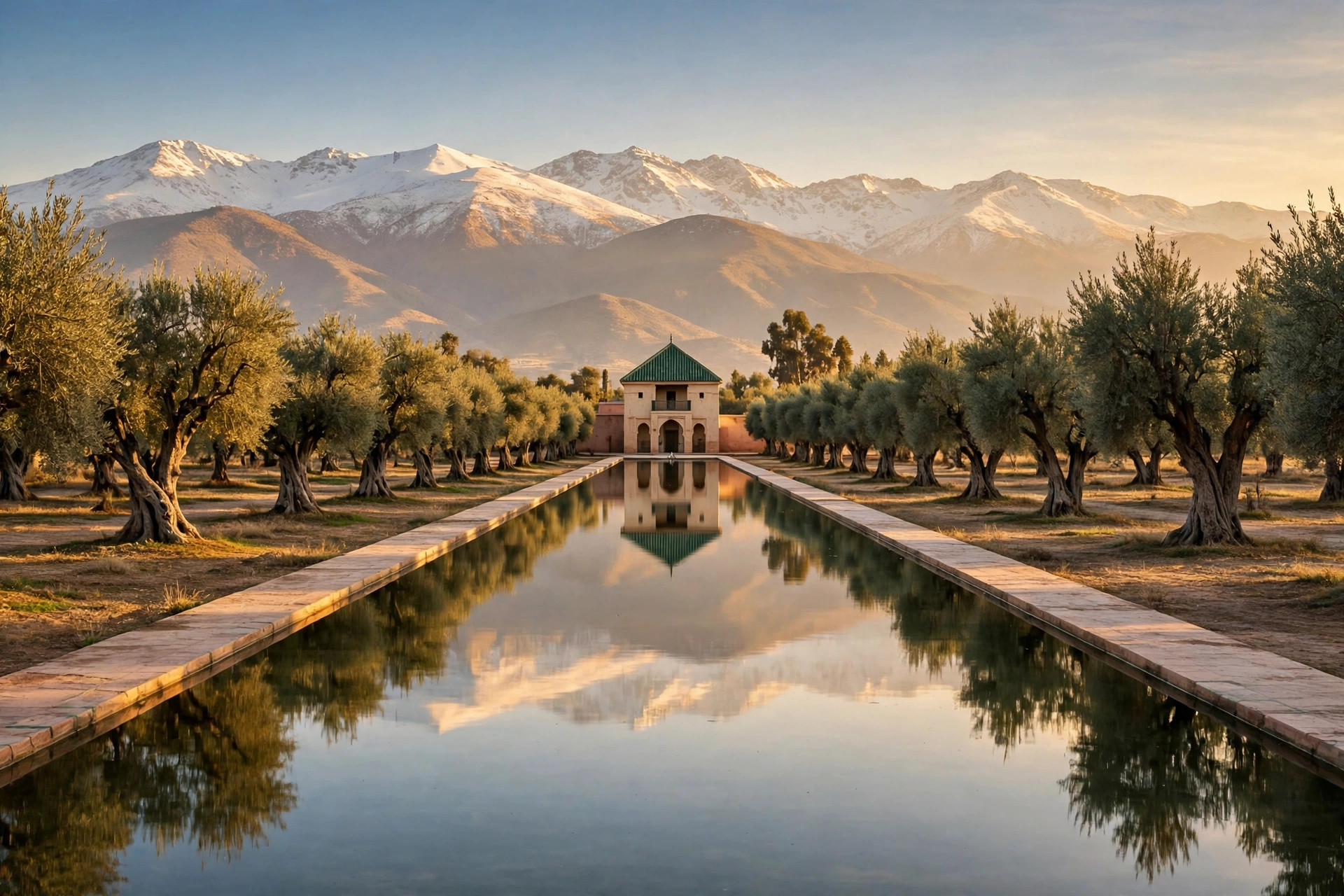
If the Almoravids dug the channels, the Almohads dug the lakes. The Menara, Morocco's most famous garden, is an Almohad creation of the 12th century: a great rectangular basin, around 200 metres long, ringed by olive groves and backed by the Atlas. The basin stored water for the orchards — and it also turned a reservoir into a mirror, doubling sky and mountains in still water.
The small pavilion at the water's edge came much later, in 1870, under Muhammad IV, and its green pyramid roof has become the postcard image of Marrakech. But the basin itself is the Almohad work, and it shows what the history of Moroccan gardens is really about: a basin this size was not built for beauty alone, but to state that the sultan could command water in a dry land, and therefore command the land itself. The great basins became the signature of their empire, and the medina they built is today a UNESCO World Heritage site.
The Marinids: Fes and the Gardens of the Madrasas
The Marinids, who ruled from Fes in the 13th and 14th centuries, moved the garden indoors. Their great works were madrasas — schools built around open courtyards — each holding a small garden: a fountain, orange trees, carved cedar above and zellige below. The Bou Inania Madrasa in Fes, built between 1350 and 1355, is the finest example: a small courtyard where every surface is worked and the fountain sounds through the whole building.
This was a different idea of paradise from the Agdal: the royal garden impressed by size, the Marinid garden by craft. The same courtyard plan, with its fountain and orange tree, would later be copied in thousands of ordinary houses across Morocco. The history of Moroccan gardens splits here into two lines — the royal agdal outside the walls and the courtyard garden inside them.
The Saadians: Sugar, Water and the Gardens of Marrakech
The Saadians, who ruled from Marrakech in the 16th century, were rich on sugar: their plantations in the Souss supplied Europe, and they spent the profits on building. Their palace, El Badi — "the Incomparable" — rose beside the Agdal, its courtyards planted in the Andalusian manner, with orange trees, myrtle and running water. They also restored the Agdal itself, replanting its orchards and repairing its basins.
The Saadian gardens are mostly gone — El Badi was stripped of its marble by Moulay Ismail a century later — but their taste survives in the Saadian Tombs, where a small walled garden of palms and orange trees still stands behind cedar doors. The tombs remind us that in the history of Moroccan gardens, a garden was also a place for the dead: a quiet, watered enclosure where a dynasty could rest.
The Alaouites: Moulay Ismail's Meknes and the Royal Agdal
Moulay Ismail, who ruled from 1672 to 1727, built the largest royal city Morocco has ever seen at Meknes, and he built it around water. His Agdal held a basin so large it was called the Sahrij Swani, and beside it stood the vast granaries of Heri es-Souani, where the sultan stored the grain that fed the capital. Garden, granary and stable were one machine: the basin watered the orchards, the orchards fed the court, and the estate displayed the sultan's control of food and water.
His successors kept the agdal as a working royal estate rather than a ruin to admire, and that working character is a late chapter in the history of Moroccan gardens. The Agdal of Marrakech still grows olives today, and the royal agdals of Rabat still supply the palace. That is the quiet difference from a European garden: it was never only ornamental — an agdal was a farm, a hunting ground, a water reserve and a pleasure garden at once, and it had to earn its keep.
The Riad Garden: The Courtyard as a Private Paradise
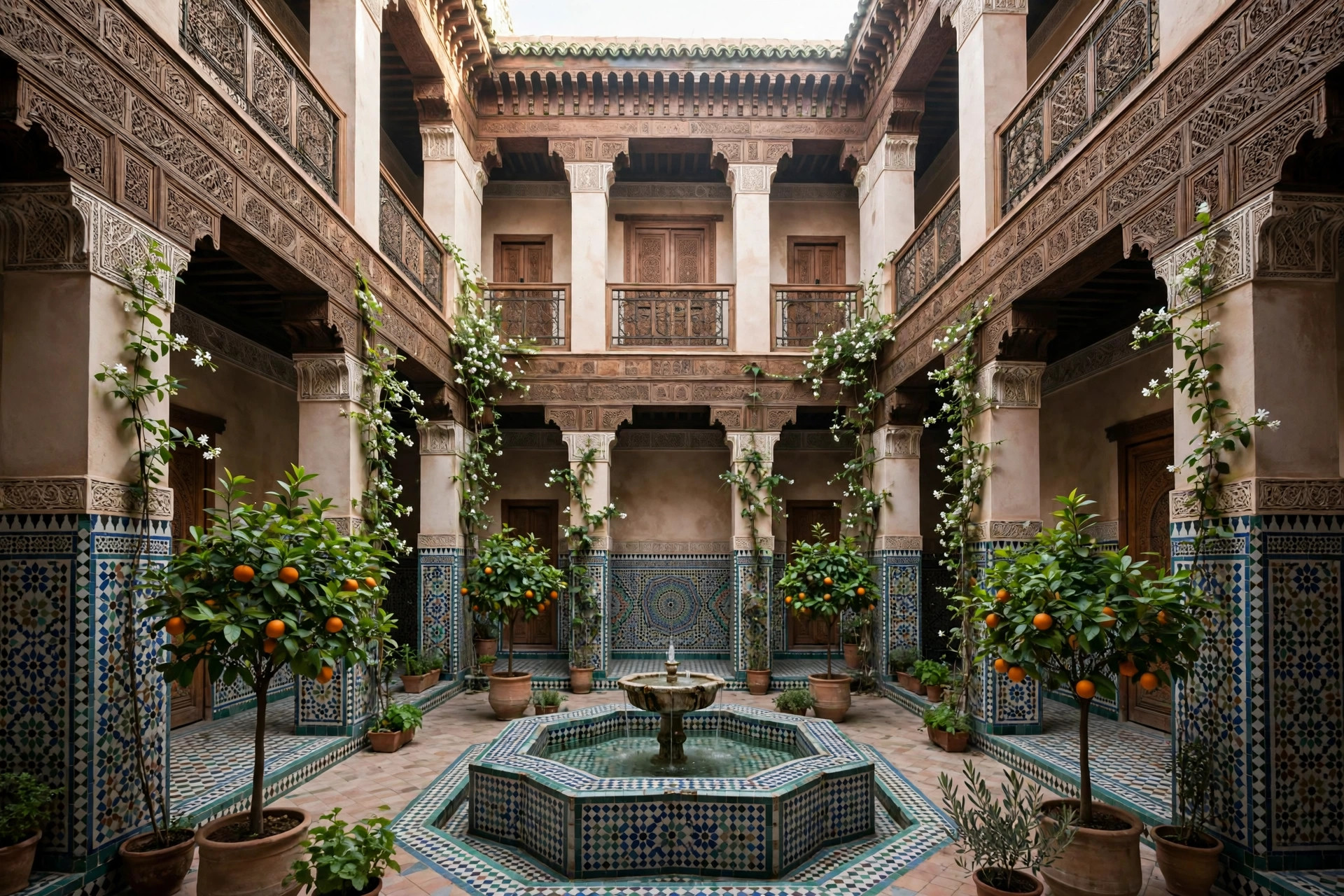
The most loved garden in the history of Moroccan gardens is also the smallest: the riad. A riad is a house built around a courtyard, and the courtyard is a garden — orange trees, a central fountain, jasmine climbing the walls. From the street it shows nothing but a blank wall and a heavy wooden door. Inside, it opens to the sky.
The riad garden works by subtraction: it shuts out the dust and noise of the medina and keeps only three things — shade, water and scent. The fountain cools the air, the orange trees shade the rooms, and the jasmine perfumes the evening. Today thousands of riads have become guesthouses, and a night in a riad courtyard is the closest most visitors come to sleeping inside the history of Moroccan gardens.
The Majorelle Garden: A French Painter's Blue Paradise
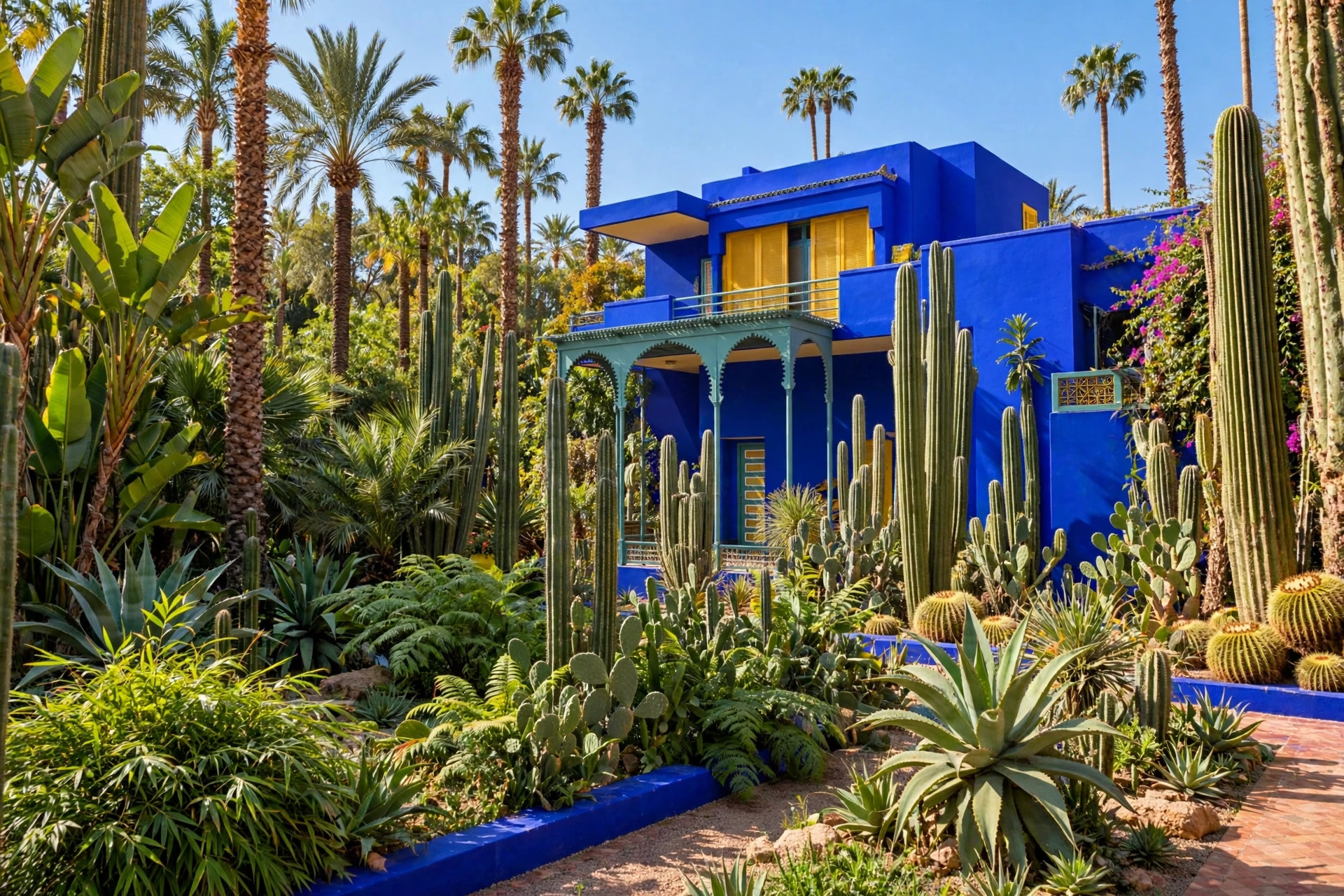
The most visited garden in Morocco was planted by a Frenchman. Jacques Majorelle, a painter from Nancy, arrived in Marrakech in 1919 and in 1923 bought a palm grove outside the medina, where he built a studio and planted cacti, palms, bamboo and bougainvillea. He painted his villa and its walls a fierce cobalt blue — Majorelle blue — that made the green burn brighter.
Majorelle died in 1962, and the garden might have vanished with him. Instead, in 1980, Yves Saint Laurent and Pierre Bergé bought it, restored it and opened it to the public. Today it draws hundreds of thousands of visitors a year, and the villa holds a museum of Amazigh art and culture. The Majorelle Garden belongs to the history of Moroccan gardens as its strangest chapter: a garden not Moroccan in origin at all, yet one that could only have been made in Marrakech, where the light sets blue and green arguing in the open air.
The Oasis Gardens of the South: Palmeraies and Khettaras
South of the Atlas, the garden changes its shape entirely. In the Draa Valley, the Tafilalt and the oases around Zagora and Merzouga, the garden is not a walled square but a palmeraie — date palms planted in layers. The palms shade the fruit trees, the fruit trees shade the vegetables, and the vegetables shade the soil, so three crops grow where one would burn. The palmeraie is a garden built by farmers, not sultans — the oldest garden form in Morocco.
Its water comes from the khettara, the same underground channels the Almoravids used in Marrakech, and from the seasonal floods of the Draa. In the Tafilalt, the oasis around Rissani once held one of the largest palm groves in the world, its dates traded across the Sahara for salt and gold. The palmeraie reminds us that the history of Moroccan gardens did not start with kings, but with people who kept water underground and grew shade above it.
What the Gardens Grow: Orange, Olive, Palm and Rose
Four plants define the history of Moroccan gardens, and each arrived with a story. The bitter orange came from Asia through Andalusia; too sour to eat, but perfect for scenting a courtyard, and its blossom, azahar, still perfumes the spring evenings of Fes. The olive was already old when Rome came, and the great groves of the Agdal and the Menara are living archaeology.
The date palm is the tree of the south: food, shade and building material in one trunk. And the Damask rose of Kelaat M'Gouna arrives each May in a harvest festival, when the whole valley smells of roses. Around these four, the gardens gather jasmine, oleander, bougainvillea, myrtle, cypress and pomegranate: never a collection of rarities, but a small set of plants, grown well, arranged so shade, scent and water reach the visitor.
Where to See the History of Moroccan Gardens Today
These nine gardens cover every chapter in the history of Moroccan gardens, from Marrakech's 12th-century basins to the southern palmeraies.
| Garden | City | What to see | Best time |
|---|---|---|---|
| Menara Gardens | Marrakech | 12th-century basin, olive grove, 1870 pavilion | Sunset, any season |
| Agdal Gardens | Marrakech | Royal orchards, Dar el Hana pavilion | Spring, when the orchards flower |
| Majorelle Garden | Marrakech | Cobalt villa, cacti, museum of Amazigh art | Early morning, before the crowds |
| Jnan Sbil | Fes | 19th-century public garden, lake, palms | Late afternoon in summer |
| Andalusian Garden | Rabat | Formal Andalusian plan inside the Kasbah | Morning, with the river light |
| Bahia Palace gardens | Marrakech | Late 19th-century courtyards and orange trees | Mid-morning |
| Saadian Tombs garden | Marrakech | Walled garden of palms and orange trees | Any time, quietest at opening |
| Agdal of Meknes | Meknes | Sahrij Swani basin, granaries, orchards | Spring |
| Palmeraie of Skoura | Ouarzazate | Oasis garden, kasbahs among the palms | October to April |
Visiting the Gardens: Tickets, Hours and Practical Tips
Most gardens in the history of Moroccan gardens cost little or nothing. The Menara, the Agdal and the Jnan Sbil in Fes are free public parks, open from sunrise to sunset. The Majorelle Garden is the exception: entry costs around 165 MAD (about $17) for the garden alone, with a separate ticket for the museum, and it is the busiest garden in the country — book a timed ticket online and arrive at opening. The Bahia Palace and the Saadian Tombs cost around 70 MAD (about $7) each. All prices are approximate, checked in November 2026 — confirm them on arrival. Our guide to Morocco attraction ticket prices lists entry fees for museums, palaces and gardens in one place.
Go early or late: a Moroccan garden is at its best in the first hour after opening, when the water is still and the light is low, and in the last hour before closing. Bring water, wear a hat, and allow an hour for the Menara or the Majorelle. The Agdal needs half a day on foot, and the palmeraies of the south are best seen with a local guide who can explain which channels still run.
Frequently Asked Questions
What is the oldest garden in Morocco?
The oldest surviving royal gardens are the Agdal and Menara of Marrakech, whose basins and orchards date to the 12th century, under the Almoravids and Almohads — the oldest chapter in the history of Moroccan gardens. The Agdal's exact founding date is not settled; most histories give 1156–1157, under Abd al-Mu'min.
What does agdal mean?
Agdal is an Amazigh word for a protected pasture, land closed off so its grass could recover. Moroccan sultans took the word for their great walled orchards.
Is the Majorelle Garden Moroccan?
The Majorelle Garden was created by the French painter Jacques Majorelle in 1923 and restored by Yves Saint Laurent from 1980. It is not a traditional Moroccan garden, but it is planted in Marrakech, and it is now the most visited chapter in the history of Moroccan gardens.
Can you visit the Agdal Gardens in Marrakech?
Yes. The Agdal is a public park, free to enter, and its orchards and the Dar el Hana pavilion are open to walkers. It is much quieter than the Menara, and its scale — hundreds of hectares of olive and orange — is best on foot in spring.
Why are Moroccan gardens always walled?
The wall keeps out dust, heat and noise, keeps in cool air and moisture, and marks the garden as a separate world. The idea comes from the Persian paradise garden: a walled enclosure sheltering water, shade and scent from the desert outside.
What is a khettara?
A khettara is an underground channel, dug with a gentle slope so groundwater flows by gravity from the foothills to a garden or a city. It loses almost no water to evaporation, and it watered Marrakech, the southern oases and many royal gardens for centuries.
The history of Moroccan gardens is, in the end, a history of water made visible. From the Almoravid channels under Marrakech to the blue walls of Majorelle, every garden in the story argued that a dry land could still hold a paradise — if someone would dig for the water, wall it in, and plant trees that would outlive them. Walk the Menara at sunset, when the basin doubles the Atlas, and the argument is hard to resist. The sultans are gone, but the gardens still keep a little green alive against the dust.
Explore more stories in our History & Heritage archive.