
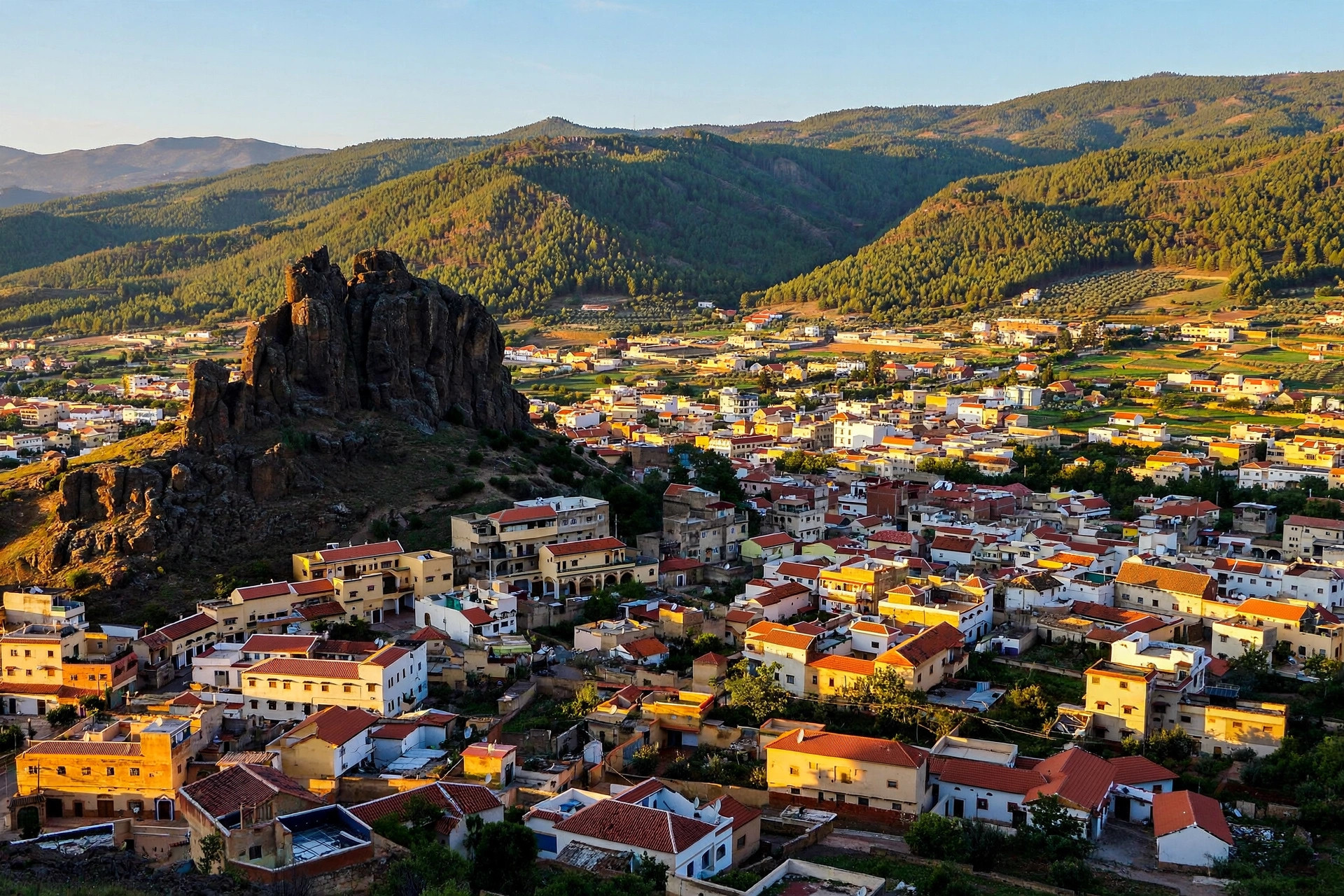
Living in Azrou is the Middle Atlas at its most liveable: a market town of about 58,000 people at roughly 1,250 metres, where the cedar forest starts at the edge of town and the weekly souk still sets the rhythm of the week. Azrou is the largest town in Ifrane Province, a working crossroads on the N13 between Meknes and Midelt — and the forest, the macaques and the mountain air are part of everyday life, not a weekend excursion.
Azrou takes its name from the Tamazight word for "rock", after the dark basalt outcrop above the old town. It is a town of cedar-wood carvers and wool weavers, of cherry and apple orchards, and of the Tuesday souk that pulls farmers and shepherds in from the surrounding valleys. This guide to living in Azrou covers costs, housing, healthcare, internet and the honest downsides. All prices are in Moroccan dirhams (MAD), checked in November 2026, at roughly 10 MAD to $1.
In this guide
- Azrou at a Glance
- Why Expats Choose Living in Azrou
- Where to Live in Azrou: Neighbourhoods
- Housing and Rents in Azrou
- Monthly Budget for Living in Azrou
- Food and Daily Life
- Getting Around Azrou
- Healthcare in Azrou
- Schools and Family Life
- Internet and Working Remotely from Azrou
- Climate and Seasons in Azrou
- Weekend Trips from Azrou
- Practical Tips: What to Know Before Moving to Azrou
- Frequently Asked Questions
- Conclusion
Azrou at a Glance
| Fact | Detail |
|---|---|
| Location | Middle Atlas, Ifrane Province, Fez-Meknes region |
| Population | 57,657 (2024 census) |
| Character | Market town and cedar-wood centre, largest town in Ifrane Province |
| Elevation | About 1,250 metres |
| Nearest airport | Fez-Saïss (FEZ), about 90 km, roughly 1.5 hours by road |
| Budget, single person | 6,000–10,000 MAD ($600–$1,000) a month |
| Budget, couple | 9,000–14,000 MAD ($900–$1,400) a month |
Azrou sits at the crossroads of the N13 and the N8, about 89 km south of Fez, 70 km from Meknes and 19 km from Ifrane. It was long overshadowed by its planned neighbour Ifrane, built as a French hill station in 1929, while Azrou stayed the working town — the true market capital of the Middle Atlas. Read more on Wikipedia.
Why Expats Choose Living in Azrou
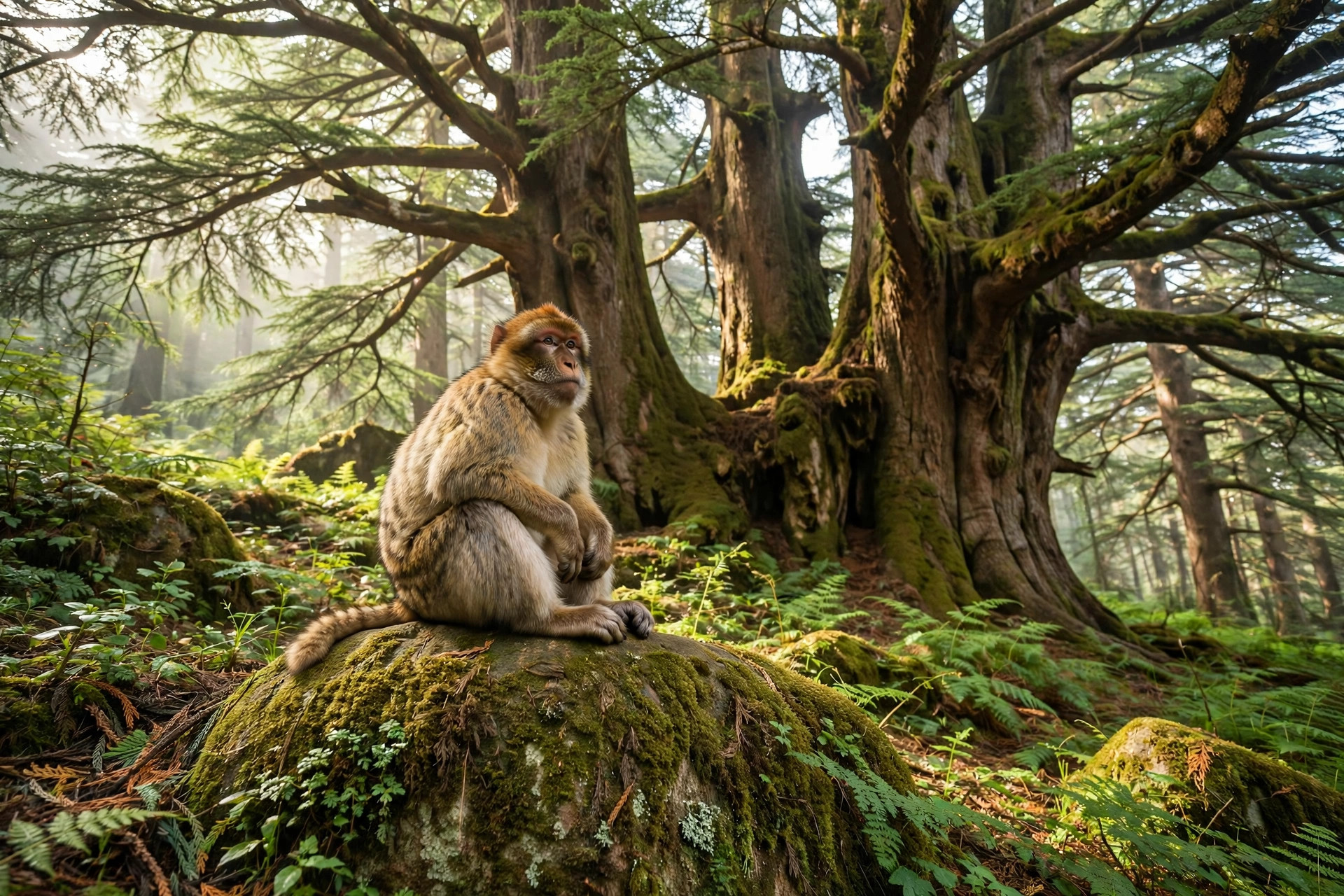
The first reason people choose living in Azrou is the setting: the cedar forest is not a place you drive to, it is where you live. The Cèdre Gouraud forest begins a few minutes from the centre, with Atlas cedars 30 to 40 metres tall — some reckoned 800 years old or more — and troops of Barbary macaques, the only monkey native to North Africa.
The second reason is the balance. Living in Azrou gives you a proper town — banks, pharmacies, cafes, a covered market, workshops — at rents far below Fez or Ifrane, with clean mountain air. It is a deliberate trade, mountain calm over big-city choice, and the rest of this guide makes it with your eyes open.
Where to Live in Azrou: Neighbourhoods
Most of daily life for people living in Azrou happens within a couple of kilometres, and a petit taxi covers almost any trip in town for a few dirhams.
The town centre, around the main avenues and the old town, is where most newcomers start: banks, pharmacies, cafes and the market streets within a short walk. Flats here are simple, often above shops.
The newer residential districts at the edges of town are the comfortable choice for a longer stay: wider streets, newer buildings, more space and better odds of a balcony or a parking spot.
The districts towards the forest, on the road to Ifrane, are quieter and greener, with the cedar-covered hills at the end of the street — the best choice if you came for the trees.
Housing and Rents in Azrou
Renting while living in Azrou works the way it works in most small Moroccan cities: the best flats move by word of mouth, not listing sites. The local semsar, the neighbourhood broker, knows what is free; so do cafe owners and hotel receptionists.
Expect a simple contract in French or Arabic, a deposit of one to two months' rent (the legal maximum is two months under Law 67-12), and a flat that is usually unfurnished. As a planning range for November 2026: one-bedroom in the centre 1,800–3,000 MAD ($180–$300), outside the centre 1,500–2,500 MAD ($150–$250); three-bedroom in the centre 3,000–5,000 MAD ($300–$500). Our renting an apartment in Morocco guide explains the contract rules.
Never pay a full year upfront for a flat seen only in photos — rent month to month until you know the building. Check water pressure, hot water and heating before you sign: winter nights drop near freezing and many flats have no central heating.
Monthly Budget for Living in Azrou
A realistic monthly budget for living in Azrou in a modest flat, cooking mostly at home and eating out a few times a week — planning ranges, checked in November 2026.
| Expense | Single person (MAD) | Couple (MAD) |
|---|---|---|
| Rent, one-bedroom centre | 1,800–3,000 | — |
| Rent, two-bedroom centre | — | 2,500–4,000 |
| Utilities (electricity, water) | 300–600 | 500–900 |
| Internet and mobile | 200–350 | 300–500 |
| Groceries and market | 1,800–3,000 | 3,000–5,000 |
| Eating out and cafes | 400–800 | 600–1,200 |
| Local transport | 200–400 | 300–600 |
| Healthcare and pharmacy | 200–500 | 300–700 |
| Leisure and trips | 400–800 | 600–1,200 |
| Total | 6,000–10,000 | 9,000–14,000 |
The biggest saving against the big cities is rent, and the second is food: the Tuesday souk and the daily market sell what the surrounding farms grow — apples, cherries, walnuts, honey and mountain vegetables. Heating is the cost newcomers forget: winter gas bottles and electric heaters can add 300–600 MAD a month from December to February.
Food and Daily Life
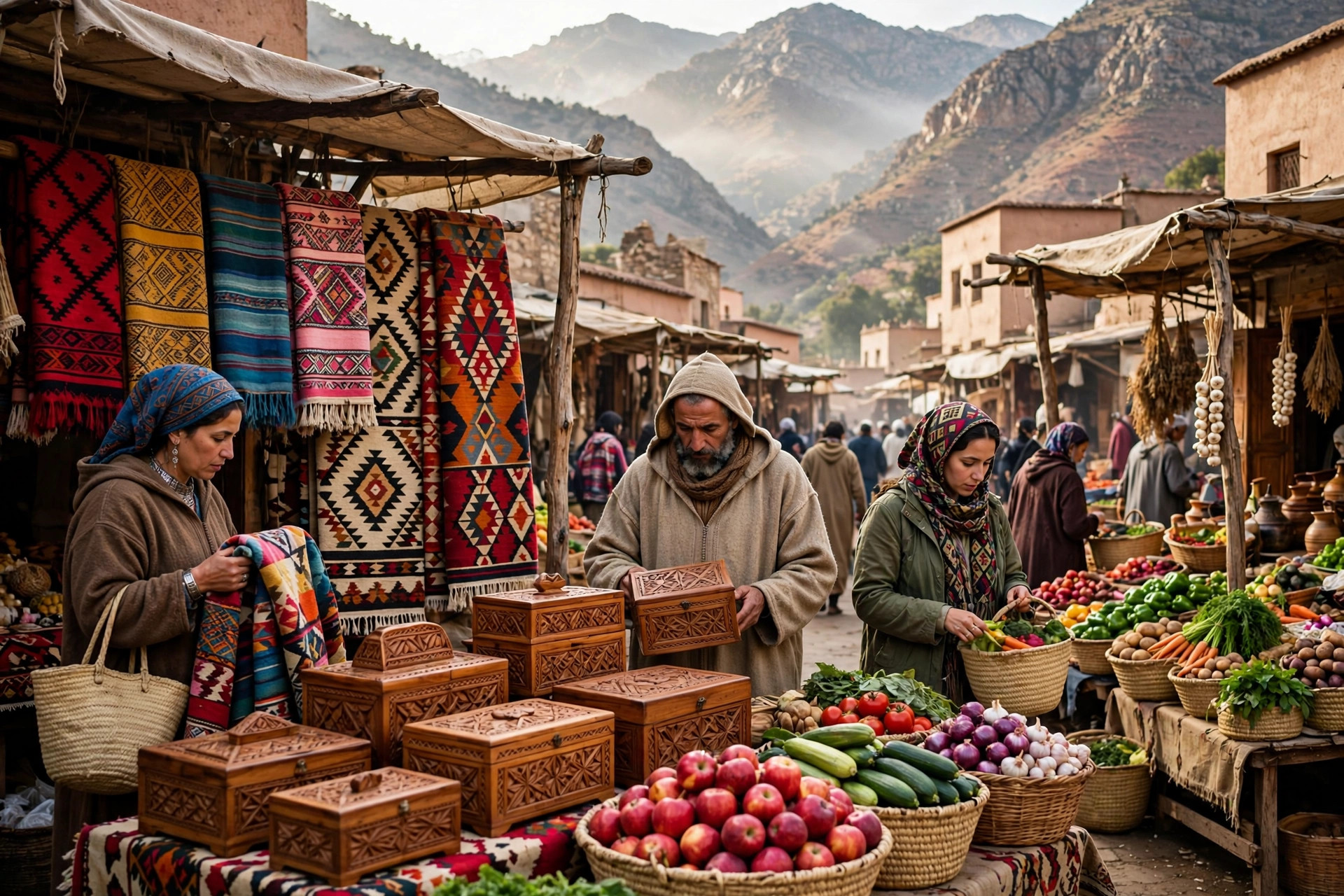
Daily life for people living in Azrou runs on the market: the covered market and the street stalls sell lamb, chicken and the produce of the Middle Atlas, and bread comes from the neighbourhood bakery, still warm, for a dirham or two. The Tuesday souk is the event of the week — farmers and shepherds from the surrounding valleys spread wool, vegetables, olives, livestock and honey across the ground outside town.
Eating out while living in Azrou is simple and cheap: a tagine or grilled meat lunch runs 30–60 MAD ($3–$6), a harira and bread breakfast less than 15 MAD, and mint tea in a cafe 5–10 MAD. Azrou is also known for its crafts: thick, warm, geometric wool carpets woven for cold mountain winters, and cedar-wood carving from the workshops around town.
Getting Around Azrou
Getting around while living in Azrou is easy: the town is compact enough to walk across in half an hour. Petit taxis run everywhere for a few dirhams a ride, and grand taxis connect the town to Ifrane, Meknes, Fez, Midelt and Khenifra. There is no train station and no tram — this is a bus and taxi town.
For longer trips, CTM and local buses run daily to Meknes (about 1.5 hours), Fez (about 1.5–2 hours) and Casablanca (about 5 hours). Driving is the real freedom for people living in Azrou: the N13 runs through town from Meknes to Midelt and on to the desert, and the N8 runs to Khenifra and Marrakech. Our Morocco driving costs guide covers petrol and tolls.
Budget for winter driving: the passes can close briefly in heavy snow.
Healthcare in Azrou
People living in Azrou have a local hospital for general care and emergencies, plus private clinics and pharmacies in the centre. For routine care — a doctor's visit, a prescription, a minor injury — the town is well served, and a private GP consultation typically costs 150–250 MAD ($15–$25).
For anything serious, the plan is Fez or Meknes: the nearest large hospitals with specialists are in Fez, about 1.5–2 hours by road, and Meknes, about 1.5 hours. That is the honest trade of mountain living, and it matters most for families with young children and for anyone who needs regular specialist care. Our healthcare in Morocco guide explains public and private cover for expats.
Schools and Family Life
There is no international school in Azrou, and no French mission school — the plain fact families need first. Children go to Moroccan public or local private schools, where teaching is in Arabic and French, and a child who arrives speaking neither will need a year of patience and language support. The nearest international schools are in Fez, about 1.5–2 hours away, so most expat families who choose Azrou either home-school or accept the local system.
What living in Azrou gives families in return is space and safety: children play in the streets, the air is clean, and the cedar forest is a classroom. The forest, the macaques and the souk give children a Moroccan childhood rather than an international-school bubble.
Internet and Working Remotely from Azrou
Internet for people living in Azrou is good enough for remote work, with fibre in the centre and 4G across town from Maroc Telecom, Orange and inwi. A home fibre subscription typically costs 200–350 MAD ($20–$35) a month, and speeds in the centre are fine for video calls. Ask whether the building already has fibre before you sign — a new installation can take a week or two.
There are no coworking spaces — people work from home, or from a cafe table with a coffee. Power cuts are rare but do happen in winter storms, so keep a mobile data backup. If your work is a laptop and a video call, living in Azrou works; if you need a coworking community, it does not — yet. Our living in Ifrane guide covers the nearest alternative.
Climate and Seasons in Azrou
Living in Azrou means four real seasons. Winters are cold: daytime highs around 10–15°C, night lows near or below freezing from December to February, and snow on the surrounding peaks, sometimes in town. Summers are warm and dry, with highs around 30–34°C, but the evenings cool down with the altitude.
Spring, from March to May, is the best season: green hills, apple and cherry blossom, and the forest at its freshest. Autumn is almost as good, with clear skies and the cedar forests turning gold.
Weekend Trips from Azrou
The best reason for living in Azrou is how much of Morocco sits within two hours.
The Cèdre Gouraud forest, a few minutes away, is the nearest wonder: the famous old cedar, troops of Barbary macaques and walking trails under trees centuries old — the easiest wildlife encounter in Morocco.
Ifrane, about 19 km away, is the classic day trip: the alpine-style hill station with its stone lion, red roofs and the Michlifen ski slopes in winter. Our Ifrane travel guide covers it.
Dayet Aoua, about 30 km away, is the nearest lake: a shallow bowl ringed by forest, good for a picnic and a slow afternoon.
Fez, about 89 km to the north, is the nearest great imperial city, and Meknes, about 70 km, is the nearest for a big hospital, a train, or a proper shopping trip. Khenifra, about 85 km south, is the next Middle Atlas town — see our living in Khenifra guide.
Practical Tips: What to Know Before Moving to Azrou
Learn a little Darija and a little Tamazight. French gets you through the paperwork, but living in Azrou runs on Darija and Central Atlas Tamazight in the market, and even twenty words of greeting will change how the town treats you.
Sort out your heating before your first winter: ask the landlord how the flat is heated, buy a gas heater or an electric radiator in October, and keep a spare gas bottle.
Bring what you cannot buy: Azrou has everything for daily life, but not the imported foods or electronics of a big city. Stock up in Fez or Meknes.
Frequently Asked Questions
Is Azrou a good place for expats to live?
Yes — for remote workers, retirees and families who want low costs, mountain air and a Moroccan market town. It does not suit anyone who needs an international school, a coworking scene or a nightlife — those are 1.5–2 hours away in Fez or Meknes.
How much does it cost to live in Azrou?
The cost of living in Azrou is roughly 6,000–10,000 MAD ($600–$1,000) a month for a single person, 9,000–14,000 MAD ($900–$1,400) for a couple, including rent. Rents start around 1,800 MAD for a one-bedroom flat in the centre — planning ranges checked in November 2026.
Does it snow in Azrou?
Yes. Winters are cold, with nights near or below freezing from December to February and snow on the peaks, sometimes in town.
Is there an international school in Azrou?
No — there is no international school and no French mission school in Azrou. Children attend Moroccan public or local private schools in Arabic and French; the nearest are in Fez, about 1.5–2 hours away.
How do I get to Azrou?
By road — there is no train station and no airport in Azrou. CTM buses and grand taxis run daily to Meknes (about 1.5 hours), Fez (about 1.5–2 hours) and Ifrane (about 30 minutes). The nearest airport is Fez-Saïss, about 90 km away.
What is Azrou famous for?
Azrou is famous for the Cèdre Gouraud forest and its Barbary macaques, for cedar-wood carving and Middle Atlas wool carpets, and for its Tuesday souk — the market capital of the Middle Atlas.
Conclusion
Living in Azrou is a choice for people who want Morocco at mountain pace: low rents, clean air, a cedar forest at the edge of town and a souk that runs the week. The trade is real — cold winters, no international school, and a 1.5-hour drive to the nearest big hospital or train — but so is the reward. Come in spring, stay a week, and see whether the Middle Atlas feels like home.