
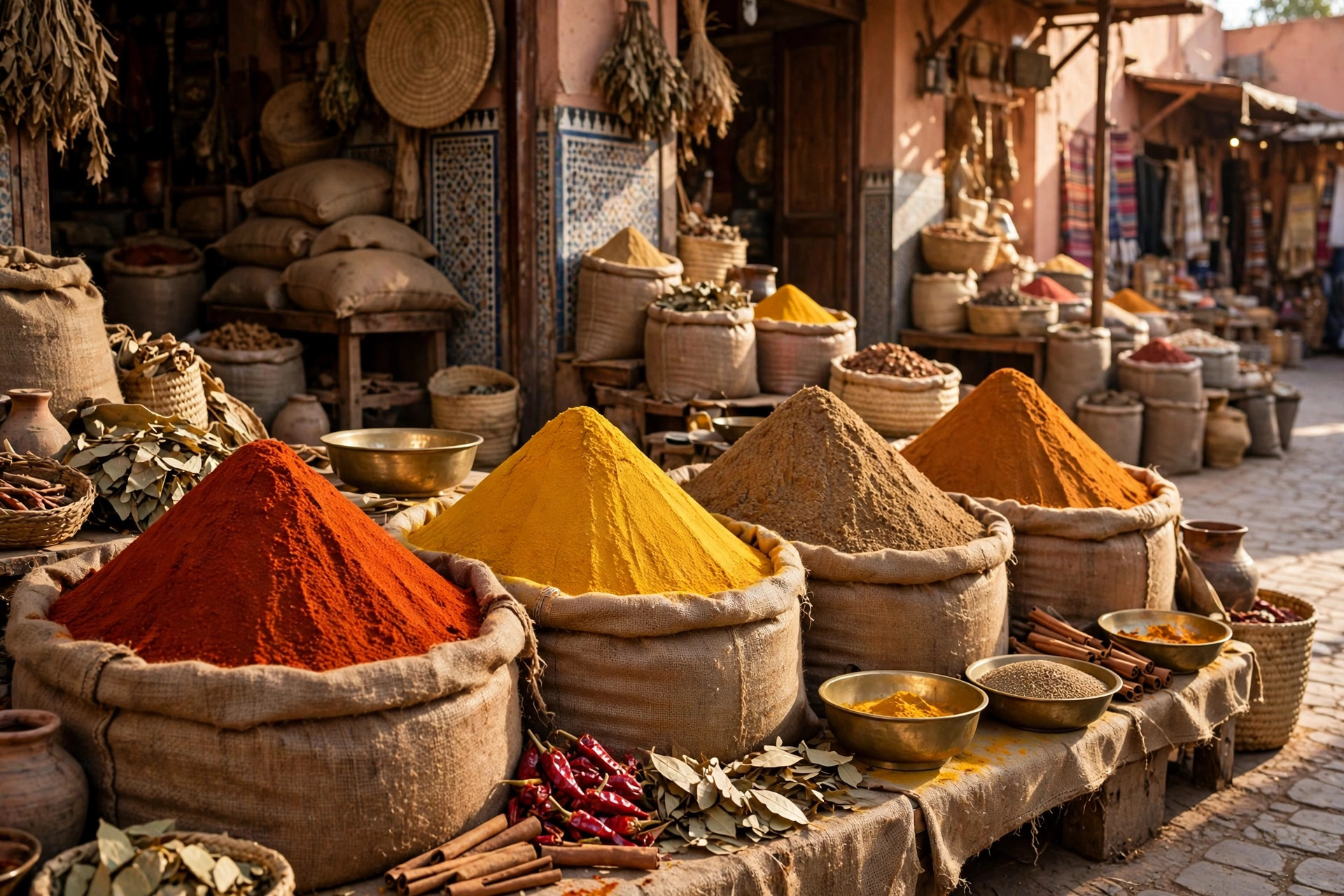
Walk into a spice square in Marrakech at nine in the morning and the whole of Moroccan cooking opens up before you: pyramids of brick-red paprika, golden turmeric, earthy brown cumin, and, in a small brass bowl at the centre, a pinch of crimson saffron worth more than its weight in silver. The history of Moroccan spices begins in scenes like this one, where trade, farming, medicine and cooking have met for centuries.
This guide follows that long road, from the dawn harvests of Taliouine to the camel caravans of the Sahara and the secret blends of the Fez spice merchants, flagging the dates historians still argue about, because the history of Moroccan spices has its share of open questions, and honest history says so.
In this guide
- Where the History of Moroccan Spices Began
- The Caravan Roads in the History of Moroccan Spices
- Saffron and Taliouine in the History of Moroccan Spices
- Ras el Hanout: The Blend at the Heart of the History of Moroccan Spices
- The Everyday Spices in the History of Moroccan Spices
- Spice, Medicine and the Apothecary Tradition
- The Spice Souks: Rahba Kedima, Fez and the Attarine
- The History of Moroccan Spices Today: Cooperatives, Protection and Change
- Where to Buy Moroccan Spices and What to Pay
- Frequently Asked Questions
- Conclusion
Where the History of Moroccan Spices Began
The history of Moroccan spices begins not with a single spice but with a place that needed them. Morocco sits at the north-western corner of Africa, where the Mediterranean meets the Atlantic and the Sahara meets the sea, and for more than a thousand years traders, migrants and armies have passed through it carrying flavour in their packs. The Amazigh peoples who have lived in these mountains and valleys for millennia cooked with local herbs, olives, figs and dates long before the first caravan arrived, and their kitchens gave Moroccan food its base of barley, wheat and slow-cooked stews.
When Arab traders and settlers arrived in the 7th and 8th centuries, they brought new tastes with them: cinnamon, cumin, ginger and saffron, along with the sweet-and-savoury pairings they had learned from Persian cooking. The history of Morocco is the story of those meetings, and the spice trade is one of its clearest threads. Later arrivals added more layers, as Andalusi refugees crossing from Spain in the 15th century brought citrus, olives and refined court cooking. Each layer added to the history of Moroccan spices, and Moroccan cooks kept what worked.
| Period | What happened | Why it matters |
|---|---|---|
| 7th–8th centuries | Arab traders and settlers bring cinnamon, cumin, ginger and saffron from the east | The sweet-and-savoury palette of Moroccan cooking takes shape |
| 8th–9th centuries (date disputed) | Saffron probably reaches Morocco from the eastern Mediterranean | The crop that will define Taliouine begins its Moroccan story; the route is not proven |
| 11th century | Almoravid era; Marrakech founded around 1070; caravan trade grows | Spices flow through the new caravan cities of the south |
| 12th–13th centuries | Almohad and Marinid expansion; couscous and court cuisine develop | Spice use spreads from courts and cities into everyday cooking |
| 15th century | Andalusi refugees arrive from Spain | Citrus, olives and refined dishes enrich the spice palette |
| 1591 | Saadian victory at Tondibi opens the gold road to the Niger | Caravan wealth funds courts that prize rare spices |
| 1776 | First known written mention of saffron at Taliouine | The Taliouine crop enters the written record |
| 1985 | Medina of Marrakech inscribed as a UNESCO World Heritage Site | The spice souks gain world protection as part of the medina |
| 2010 | "Safran de Taliouine" recognised as a protected geographical indication | Taliouine saffron gains official origin protection |
The Caravan Roads in the History of Moroccan Spices
No spice reached a Moroccan kitchen by accident. For centuries the great carrier was the camel caravan, crossing the Sahara on routes that linked the Mediterranean ports with the gold kingdoms of the Niger. The history of Moroccan spices is inseparable from those roads, because the same caravans that carried gold north and salt south also carried the small, light, precious cargoes that flavour food: pepper, ginger, cinnamon, cloves and nutmeg from the Indian Ocean world, passed from port to port until they reached the markets of Fez and Marrakech.
The greatest of the northern caravan cities was Sijilmasa, founded in the 8th century near present-day Rissani in the Tafilalt, at the edge of the Sahara. From there caravans crossed to the salt mines of Taghaza, then on to Walata and Timbuktu, a journey of weeks across open desert, guided by wells, stars and the knowledge of Amazigh and Arab caravan leaders. Salt went south, gold came north, and spices travelled in both directions, tucked among bales of cloth and sacks of dates.
The trade reached its height between the 13th and 16th centuries, when the empires of Mali and Songhai were at their richest and the Moroccan dynasties taxed and protected the routes. A caravan might number hundreds of camels, and the arrival of one in Marrakech or Fez was a festival as well as a market day. The history of Moroccan spices was written on those arrival days, in the bargaining between a caravan merchant and a city spice seller, and in the new flavour that appeared in a court kitchen the following week.

Saffron and Taliouine in the History of Moroccan Spices
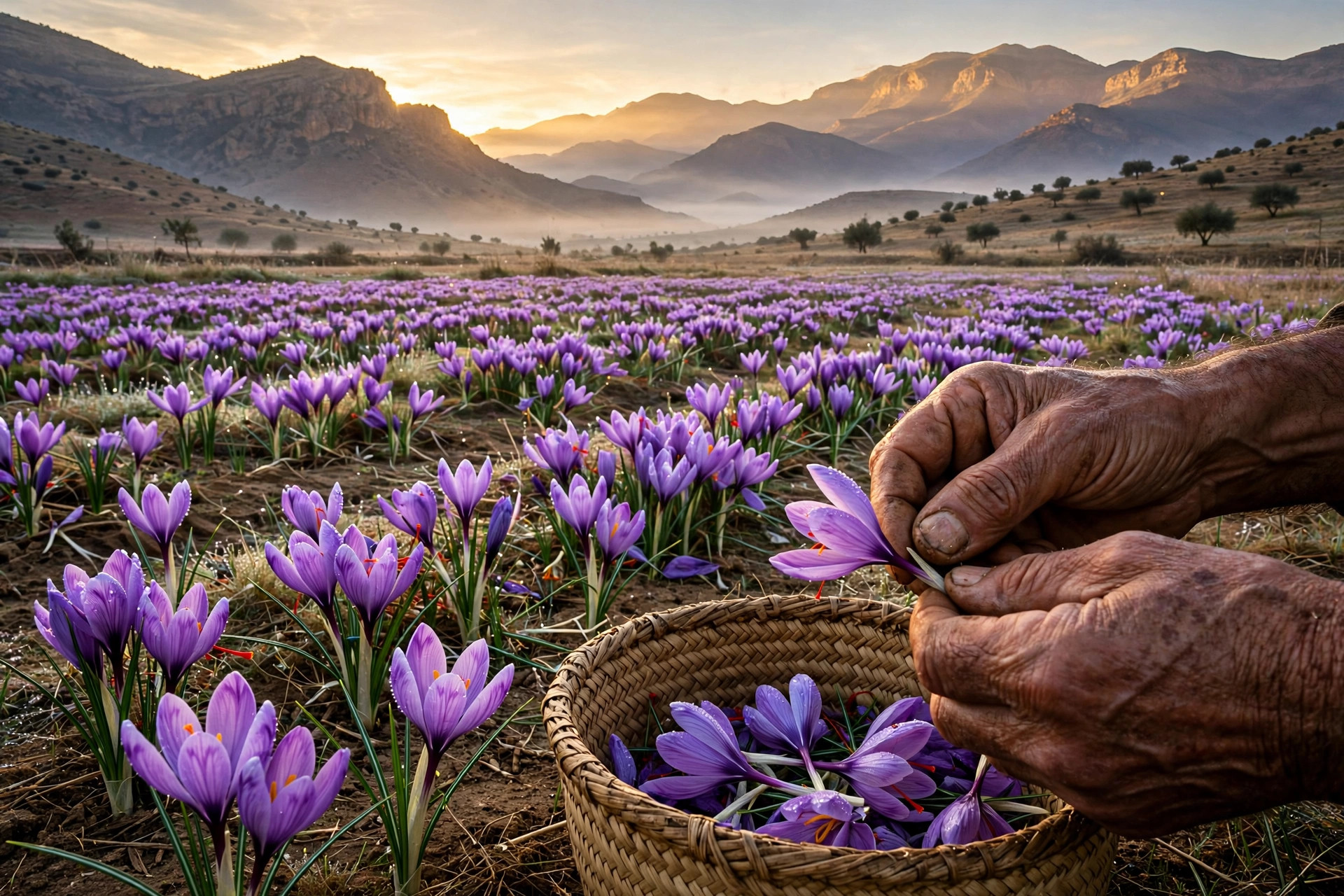
If one spice deserves to stand for the whole story, it is saffron, the red gold of Taliouine. The village sits on the dry Souktana plateau of the Anti-Atlas, about an hour and a half east of Taroudant, at roughly 1,200 metres above sea level. Its fields of purple crocus flowers bloom for only a few weeks each autumn, and the harvest is one of the most urgent jobs in Moroccan farming. The history of Moroccan spices reaches its most vivid chapter here, at dawn, in a field of lilac flowers.
The plant is Crocus sativus, a sterile flower that cannot set seed and is spread only by splitting its underground corms. Each flower carries three crimson stigmas, and those three threads are the spice. Around 150,000 flowers are needed to make a single kilogram of dried saffron, and a kilogram of fresh flowers yields only about twelve grams.
The harvest begins at the end of October in the higher fields to the east and works its way downhill over about a month until it reaches Taliouine itself, which flowers last. Each field blooms for only ten days to two weeks. Women do most of the picking, moving down the rows with baskets in the first hours of the day, snapping off each flower before the sun opens it. Indoors, the three stigmas are pulled from each bloom by hand and dried in the sun or in a shaded room.
How saffron first reached Taliouine is one of the open questions in the history of Moroccan spices. Local tradition among the Amazigh farming families of the Souss places the arrival of the bulb 800 to 1,000 years ago, possibly carried by Arab traders or Andalusi refugees, and the crop most likely reached Morocco by the 9th century from the eastern Mediterranean. But the first written reference to saffron at Taliouine goes back only about 240 years, to a contract of 1776 that names zaafrane three times. Treat the 9th-century arrival as the most commonly suggested estimate, not a proven fact, and the 1776 contract as the first solid date.
What is certain is the modern story. The Cooperative Souktana du Safran, founded in 1979, is the oldest of nearly three dozen cooperatives in the area, and Taliouine grows around 90 per cent of Morocco's saffron. In 2010 Morocco secured a geographical indication for Taliouine saffron, protecting the name "Safran de Taliouine", and the town marks each harvest with an international saffron festival in late October or November. For a fuller picture of the food this spice seasons, see our Moroccan food guide.
Ras el Hanout: The Blend at the Heart of the History of Moroccan Spices
Ras el hanout means "head of the shop" in Arabic, and the name is the recipe. It is the finest blend a spice merchant has to offer, the best of the shop gathered into one mixture, and no two merchants make it the same way. The history of Moroccan spices has no more famous creation, and no more misunderstood one, because the blend was never a fixed formula.
A traditional ras el hanout may contain twenty, thirty or even more ingredients, each toasted and ground by hand: cumin, coriander and black pepper for warmth and earth; cinnamon, cardamom and nutmeg for sweet depth; ginger and turmeric for colour and bite; cloves and mace for perfume; and, in the finest versions, dried rose petals, lavender, cubeb berries and a pinch of saffron. The variation is the point: a blend made for lamb in the High Atlas is not the blend made for pigeon in a Fez tagine.
When did it begin? Here the history of Moroccan spices is honest about its limits. Popular stories claim a 12th-century Andalusi origin or a single apothecary inventor in Fez, but no document proves either claim, and the earliest unambiguous written reference appears only in a 19th-century Tunisian manuscript. The blend itself seems to have coalesced gradually over centuries. Treat any single founding date for ras el hanout as legend, not history. It seasons lamb tagines, pastilla, couscous and harira, and the Wikipedia overview of Moroccan cuisine lists as many as twenty-seven spices combined in the mixture.
The Everyday Spices in the History of Moroccan Spices
Beyond saffron and ras el hanout sits the working palette of the Moroccan kitchen, the spices that appear in almost every meal. Cumin is the most common of them all, so fundamental that many families keep a small jar of ground cumin on the table beside the salt. Its warm, earthy flavour seasons harira, bean stews, grilled meats and boiled vegetables, and it is valued as an aid to digestion as well as for taste. Ginger brings sharp warmth, cinnamon brings sweet fragrance, and coriander, fresh or ground, brings a citrus lift.
These spices did not all arrive together, and their histories differ. Cumin and coriander are old Mediterranean plants, known in North Africa since antiquity. Cinnamon, ginger and black pepper travelled much further, from South and Southeast Asia through the Indian Ocean and the Red Sea, reaching Morocco by caravan and by ship. Paprika and chilli are the newcomers: they came from the Americas after 1492, and their exact arrival in Moroccan cooking is not precisely dated, so the story should not pretend otherwise.
| Spice | Origin and route | Classic Moroccan use |
|---|---|---|
| Saffron | Eastern Mediterranean; grown in Taliouine | Chicken with preserved lemon, pastilla, couscous |
| Cumin | Mediterranean; ancient trade | Harira, bean stews, grilled meats, table spice |
| Paprika | The Americas, after 1492; arrival date not precisely known | Vegetable tagines, tomato dishes, colour |
| Turmeric | South Asia, via Indian Ocean trade | Couscous, chicken tagines, golden colour |
| Ginger | Asia, via caravan and sea routes | Lamb with prunes, tagines, sweet-and-savoury dishes |
| Cinnamon | Asia, via Arab and Indian Ocean trade | Lamb tagines, pastries, fruit dishes, tea |
| Coriander | Mediterranean; ancient trade | Tagines, salads, fresh herb and ground seed |
| Black pepper | India, via Indian Ocean and caravan routes | Everyday seasoning, ras el hanout, grilled meats |
| Nutmeg and mace | Southeast Asia, via long-distance trade | Ras el hanout, pastilla, festive dishes |
| Dried rose petals | Local and imported; floral tradition | Ras el hanout, festive tagines, sweets |
Spice, Medicine and the Apothecary Tradition
In Morocco, the spice seller and the herbalist were long the same person. The attarine, the spice and perfume merchants of the medina, sold flavour and medicine from the same stall, and the line between the kitchen and the pharmacy was deliberately thin. This is a thread that runs through the history of Moroccan spices, and it explains why the souk spice stall still sells roots, barks and dried flowers alongside cumin and paprika.
The Spice Souks: Rahba Kedima, Fez and the Attarine
The spice trade has a geography, and it can still be walked today. In Marrakech, the centre is Rahba Kedima, the Old Square, also called Place des Epices, a short walk north of Jemaa el-Fnaa through the covered lanes of Souk Semmarine. The square has served as a trading space for centuries, first as a grain market and auction place, and today as the city's spice market. The same organisation survives in Fez, where the attarine quarter near the Qarawiyyin mosque has sold spices and perfumes for centuries. Our guide to the history of Moroccan leather walks the neighbouring craft quarters of that same medina.
Buying in these souks is a social act as much as a commercial one. A vendor who pushes pre-ground saffron at a suspiciously low price is selling something else, and the oldest warning in the trade still applies. The history of Moroccan spices carries a warning first written two thousand years ago: Pliny the Elder wrote that nothing is so much adulterated as saffron, and the warning is as true in Rahba Kedima today as it was in Rome. The Saudi Aramco World account of Taliouine saffron records that warning and the harvest it describes.
The History of Moroccan Spices Today: Cooperatives, Protection and Change
The history of Moroccan spices is still being written, and the current chapter is about protection. For centuries the trade ran on reputation and family knowledge; today it runs increasingly on cooperatives, labels and geographical indications. The history of Moroccan spices today is the negotiation between standardisation for export and the variation that made the blends Moroccan, and it is far from settled.
The geographical indication for Taliouine saffron, recognised in 2010, is the clearest example. It ties the name to a place, a plant and a method, and it gives buyers a way to tell real Taliouine threads from the counterfeits sold in wholesale quarters. The cooperatives also matter socially: saffron supports around 1,500 families in the Taliouine area, and the harvest income arrives in a season when little else grows.
Where to Buy Moroccan Spices and What to Pay
The best way to understand this story is to buy a little of it, carefully, and cook with it at home. Start in Marrakech at Rahba Kedima or in Fez in the attarine quarter, go in the morning when the stalls are fresh, and buy whole spices where you can: whole cumin seed, cinnamon sticks and saffron threads rather than anonymous powders. Ask the vendor to grind to order, smell before you pay, and buy saffron only as whole red threads, never as powder from an open sack. For the wider trip, and for the dishes these spices season, see our guide to the history of Moroccan mint tea.
| Item | Typical price (November 2026) | What to check |
|---|---|---|
| Taliouine saffron, 1 gram | 30–60 MAD (about $3–$6) | Whole red threads only; buy from a cooperative or trusted vendor |
| Ras el hanout, 100 grams | 20–50 MAD (about $2–$5) | Ground to order; smell for rose, cinnamon and cumin |
| Cumin, 100 grams | 10–20 MAD (about $1–$2) | Whole seed if possible; strong earthy smell |
| Paprika, 100 grams | 10–25 MAD (about $1–$2.50) | Deep red colour; ask whether it is sweet or hot |
| Turmeric, 100 grams | 10–20 MAD (about $1–$2) | Bright golden colour; no musty smell |
| Cinnamon sticks, 100 grams | 15–30 MAD (about $1.50–$3) | Whole sticks, not powder; sweet fragrance |
| Ginger, dried, 100 grams | 15–30 MAD (about $1.50–$3) | Sharp, warming smell; pale and dry |
| Spice-souk guided walk, half day | 200–400 MAD (about $20–$40) | Licensed guide; includes tasting, not just shopping |
Prices are typical ranges as of November 2026, gathered from souk stalls and local guides; always check on arrival, and expect to haggle.
Frequently Asked Questions
What is the history of Moroccan spices in one sentence?
It is the story of Amazigh kitchens, Arab and Andalusi arrivals, and Saharan caravan trade blending imported flavour with local harvests over more than a thousand years, with saffron from Taliouine and ras el hanout as its two most famous creations.
When did saffron first reach Morocco?
The crop most likely reached Morocco by the 9th century from the eastern Mediterranean, according to the most commonly suggested estimate, but the route is not proven and the first written mention at Taliouine dates only to a contract of 1776.
What is ras el hanout, and how many spices does it contain?
Ras el hanout means "head of the shop": the finest blend a spice merchant offers. There is no fixed recipe. Traditional versions contain twenty to thirty or more ingredients, including cumin, coriander, cinnamon, ginger, turmeric, cardamom, cloves and, in the best blends, rose petals and saffron, and every merchant's version differs.
How can I tell real Taliouine saffron from fake?
Buy whole red threads, never powder from an open sack, and buy from a cooperative shop or a trusted vendor. Real saffron smells honeyed and slightly bitter, colours water slowly golden, and cannot be cheap: about 150,000 flowers make a kilogram.
Where is the best place to buy spices in Morocco?
Rahba Kedima in Marrakech and the attarine quarter in Fez are the classic choices, and the cooperative shops of Taliouine are the best place for saffron itself.
Is Moroccan food very hot and spicy?
No. Moroccan cooking is warm and fragrant rather than hot. Cinnamon, cumin, saffron and ginger give depth and sweetness, paprika gives colour, and chilli is used sparingly.
Conclusion
From the dawn fields of Taliouine to the caravan roads of the Sahara and the spice pyramids of Rahba Kedima, the history of Moroccan spices is the story of a country that learned to cook with the world. It arrived on camelback and by ship, it was ground by hand in the souk, and it was passed from parent to child in kitchens that never wrote the recipes down.
That is why the history of Moroccan spices is not finished: the flowers still open at night, and the next blend is still being mixed in a shop that has sold the best of everything for centuries.